
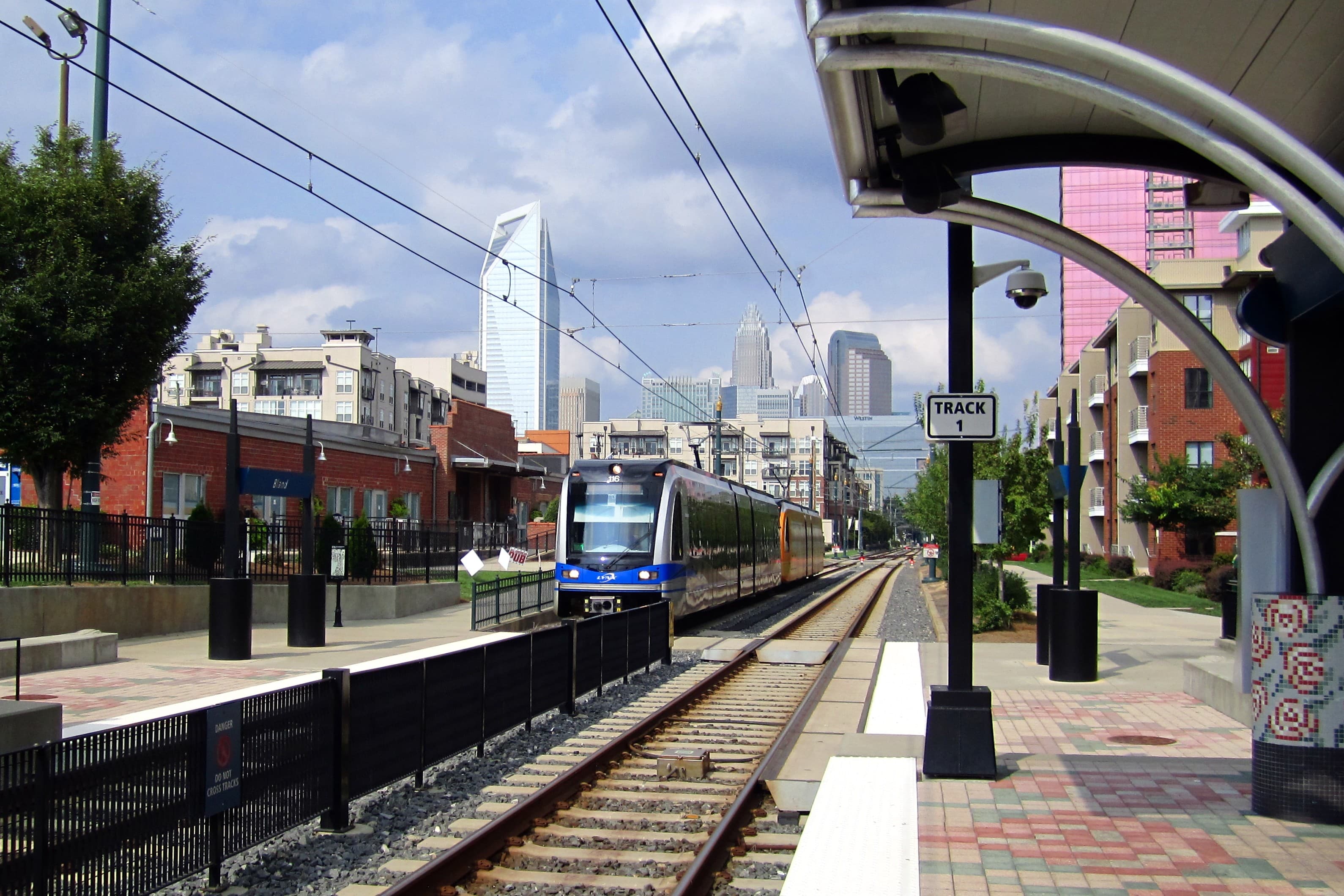
You've heard the words "Silver Line" for years now. Charlotte's been talking about expanding the train system for so long that it's easy to tune out. Another meeting, another plan, another promise that doesn't go anywhere.
But something real just changed. Charlotte created a brand-new transit authority, and it starts collecting money on July 1. About $210 million a year in dedicated sales tax will fund new rail lines. The biggest piece is the Silver Line, a 29-mile east-west train route with 30 stations cutting through the heart of the metro, from Belmont to Indian Trail.
That matters because we already know what happens when Charlotte builds a rail line. The last time, home values near stations surged. This round brings three times as many stops, and if your home's near one of them, you'll want to know.
TL;DR: Charlotte's Blue Line boosted home values 40%+ near stations. The planned Silver Line adds 30 stops from Belmont to Indian Trail. Check the CATS route map to see if your home's in the path.
How Much Did the Blue Line Change Home Values?
Home values within a half-mile of Blue Line stations jumped roughly 40%, and South End's total assessed value multiplied many times over as warehouses gave way to apartment towers. It wasn't just one neighborhood. The entire corridor shifted.
When Charlotte opened the Blue Line in 2007, it ran about 10 miles from Uptown south to Pineville along South Boulevard. Homes near stations, particularly between Scaleybark and New Bern, started climbing almost right away. A peer-reviewed study from the Journal of Transport and Land Use confirmed the pattern: homes closer to Blue Line stations showed measurably higher values compared to homes farther away, even after adjusting for other factors. Real estate analysts tracking the corridor peg the increase at roughly 40% or more for properties within a half-mile. On a $250,000 home, that works out to $100,000 in added value, and nobody renovated their way into it. The train did it.
South End tells the fullest version of that story. Before the train showed up, it was mostly old warehouses and empty parking lots along South Boulevard between Uptown and Woodlawn Road. The neighborhood's total assessed property value climbed dramatically in the years after the line opened, as UNC Charlotte's Urban Institute documented the surge in construction and development along the corridor. Breweries moved in, apartment towers went up, and restaurants packed every block. The original Blue Line cost less than $470 million to build. It pulled in over $1.8 billion in private development, nearly $4 of private money for every $1 the city spent. That ratio is why Charlotte's going all in on more rail.
South End was warehouses and parking lots before the Blue Line. Now it's one of the most expensive neighborhoods in Charlotte. That's what a rail line does to a corridor.
For example, say you owned a three-bedroom ranch near the Scaleybark station on South Boulevard in 2005. Your place might've been worth around $180,000 at the time. By 2015, similar homes nearby were selling above $320,000, and that's before the second wave of apartment towers went up. You didn't paint a single wall, yet the station rewired the entire neighborhood: who wanted to live there, what got built around it, and what buyers were willing to pay.
Where Are the 30 New Silver Line Stops Going?
The Silver Line's 30 stations span 29 miles east to west, from Belmont (28012) through Uptown to Matthews (28105) and Indian Trail (28079). It's the biggest rail project Charlotte's ever planned, and the route map is already public.
Unlike the north-south Blue Line, this one cuts across the metro. It'll connect suburbs on both sides of Charlotte to Uptown and to Charlotte Douglas International Airport. The CATS Silver Line project page shows the full corridor.
Charlotte's rail timeline already has a long track record, and what's coming next isn't just talk anymore.
On the eastern side, the line follows the Independence Boulevard corridor through some of Charlotte's fastest-changing areas. If you live in a neighborhood off Independence near the Bojangles Coliseum, or farther east toward the intersection of Independence and Idlewild Road, you're in the Silver Line's path. Keep going east and you'll hit Matthews, Stallings, and Indian Trail, all planned stops. On the western side, the route heads past Charlotte Douglas Airport and into Gaston County, ending at the small town of Belmont. There's also the Red Line, a commuter rail running north from Uptown through Huntersville (28078) to Mooresville (28117) along the Lake Norman corridor. That line could open in roughly 10 years, according to WFAE.
This breakdown shows which neighborhoods fall under each corridor and where things stand right now:
| Rail Line | Direction | Neighborhoods | Status |
|---|---|---|---|
| Blue Line | North-South | South End, NoDa, University City (28213) | Running now |
| Silver Line | East-West | Belmont (28012), Matthews (28105), Indian Trail (28079) | Design phase |
| Red Line | North | Huntersville (28078), Mooresville (28117) | Planning phase |
Wondering what your home is worth right now?
Get a free, no-obligation estimate, whether you're thinking about selling or just want to know.
Get My EstimateCould Your Neighborhood See the Same Value Jump?
It's possible. The Blue Line's biggest gains hit neighborhoods that had open land near stations, places like South End and NoDa where vacant lots turned into apartments and shops. The Silver Line's eastern corridor has that same setup today.
Whether your street benefits depends on three things: where exactly you are, what the land around you looks like, and how long you can wait. The Blue Line's biggest value gains happened near stations that had open land ripe for new construction. South End had empty lots and old warehouses that turned into apartment towers and breweries. NoDa (28205) had former mills and vacant parcels near 36th Street that filled in with shops, restaurants, and dense housing. If your home sat nearby, you didn't need to do anything; the rising tide of development lifted your value along with everything else on the block.
The Silver Line's eastern corridor along Independence Boulevard has that same raw potential. There are large commercial parcels near the Bojangles Coliseum and along the Monroe Road corridor that could get redeveloped once a station is confirmed. East Charlotte is already shifting. The Eastland Yards project broke ground on a $67 million sports campus, and that's pulling private investment into the surrounding blocks. A Silver Line station in that corridor wouldn't just add transit access. It'd signal to developers that the area is worth betting on, the same way Scaleybark signaled South End's transformation two decades ago.
The data on distance from a station and home value tells a clear story: closer is better. But the size of the gap might surprise you.
On the western end, Belmont's in an interesting position. It's a small Gaston County town with a walkable downtown, and median home prices sit well below Charlotte's. A direct rail connection to Uptown and the airport could make Belmont far more attractive to buyers who work in the city but want more land, lower taxes, and a quieter pace. That's the kind of mismatch (low prices today plus high future demand) that created the biggest gains along the Blue Line. The Red Line corridor through Huntersville and up to Mooresville is a different situation. Those areas are already well-established and pricier. A commuter train would help people ditch the I-77 traffic crawl, but it's less likely to trigger the kind of ground-up transformation that reshaped South End from warehouses into one of the hottest zip codes in the Southeast.
The biggest value jumps don't come from the train itself. They come from the apartments, restaurants, and shops that follow the train. That's what happened in South End, and it could happen in East Charlotte next.
When Will the Silver Line Actually Get Built?
Full construction is still roughly 10 years away. But the new transit authority starts collecting $210 million per year on July 1, 2026, and that's the funding trigger that'll turn this plan from talk into concrete and steel.
The Silver Line's still in the design phase, and actual construction won't start for years. What changed is that the money is finally real. Charlotte's new Metropolitan Public Transportation Authority starts operating on July 1, 2026, backed by a dedicated transit sales tax that will generate roughly $210 million per year. About two-thirds of that annual haul (around $140 million) goes directly to rail projects. For a transit system that's been stuck for years without funding, that's the difference between PowerPoint slides and actual construction.
The Red Line to Lake Norman could arrive first, possibly within about 10 years. The Silver Line will likely follow a similar timeline. Meanwhile, there's a piece of the puzzle already taking shape: the Charlotte Gateway Station at Trade and Graham Streets in Uptown. Phase 1 cost $80 million in track and signal work and it's done. Phase 2, the permanent passenger building, has been stalled by funding disputes between the city and NCDOT. But the new transit authority could break the impasse with $16 million for a temporary station, potentially by summer 2026. That station matters because it's where all these rail lines eventually connect. Your ticket to Uptown from Matthews, Indian Trail, or Mooresville would run through Gateway.
For years, Charlotte's rail plan was a promise with no checkbook behind it. That era ended. The funding is locked in, it's arriving annually, and two-thirds of it is earmarked for trains.
If you're a homeowner, you don't need to wait for the train to be running before your home's value starts moving. Values near planned stations tend to climb years before construction even begins. That's what the Blue Line data showed us. Once the route was locked in and stations were confirmed, buyers started paying a premium for homes in the corridor. They weren't buying a train ride; they were buying the future of that neighborhood. The moment to watch for the Silver Line is the formal route confirmation for the eastern and western segments. That's when the pricing shift begins.
Picture this: you're a homeowner in Matthews, near the intersection of Independence Boulevard and Stallings Road. Based on Redfin's Matthews data, your place might be worth roughly $350,000 today. If the Silver Line route gets confirmed with a station nearby, and the same pattern from the Blue Line corridor plays out, your home could climb to somewhere between $430,000 and $490,000 within a few years, depending on how much private development follows. That kind of gain wouldn't require a single renovation, because it's the announcement, the confirmation, and the developer interest that drive the change. By the time the actual train is running, it's almost a formality.
3 Steps to Check Your Home's Position This Week
You don't need to wait for construction to start. With 30 planned stations across two new rail lines and the transit authority's July 1 launch date approaching fast, there are three concrete things you can do this week to figure out where you stand and what your options look like.
- Look up the Silver Line route map. Go to catssilverline.com and find the planned station locations. Check how close your home is to a proposed stop. If you're within a half mile, the Blue Line data says your property sits in the highest-impact zone. Within a mile, you're still in range for meaningful value gains.
- Get a current snapshot of what your home is worth. Before transit plans move your home's value, know where you're starting from. You can request a free estimate from RobinOffer, or check Redfin's Charlotte data for recent sales of similar homes in your neighborhood. This gives you a baseline to measure against as the route gets finalized.
- Watch for the route confirmation announcement. The new transit authority begins work on July 1, 2026. Once it starts making formal decisions about station locations, that's when the real pricing shift begins. Follow CATS Silver Line updates directly so you're not relying on secondhand news. Sign up for their email alerts if they offer one.
In Charlotte's market, the pattern along the existing Blue Line corridor is clear: the window between "route announced" and "stations confirmed" is when existing homeowners have the most options. You can hold and ride the climb upward, or you can sell into rising demand before construction headaches start (the noise, the detours, the years of orange barrels that make a neighborhood feel like a work zone). Either path has trade-offs, but the one thing you don't want is to be caught flat-footed. Know where your home sits relative to the planned route, and you'll be in a much stronger position than most of your neighbors.
Should You Sell Now or Wait for the Train?
It depends on your life, not the train's schedule. Blue Line corridor homes within a half mile saw gains of 25% to 40% that played out over a full decade, not overnight. That timeline is your framework.
There's no one-size answer. It comes down to your finances, your timeline, and whether you've got the runway to wait.
If you're in no rush and can afford to keep paying your mortgage, holding a home near a future Silver Line station is a reasonable bet. The Blue Line Extension opened in 2018, running to UNC Charlotte, and NoDa's transformation is still playing out today, eight years later, and that kind of long runway rewards patience.
If you need to sell soon because of a job change, a shift in your financial situation, or a life event that won't wait for a train, that's fine too. The Silver Line is years away from breaking ground. You shouldn't put your life on hold for a transit project. Selling now, at today's prices, and moving forward is a perfectly valid choice.
| Option | Upside | Risk | Best For |
|---|---|---|---|
| Hold and wait | You could see 25–40% value gains near confirmed stations | Timeline delays; you're still paying monthly costs | Homeowners who aren't in a rush to move |
| Sell now | You lock in today's value and move on | You'd miss out if values climb after route confirmation | Homeowners facing a life change or tight finances |
| Sell later (after route's confirmed) | You'd capture the early-stage premium before construction | Market could shift; you'll face more competition | Patient homeowners who can time it |
Don't put your life on hold for a train that's a decade away. If you need to move, move. But if you can wait, the history says patience near a transit stop tends to pay off.
One more thing to keep in mind: if you're thinking about what it costs to sell, the math changes when your home is worth more. The same 2% to 4% in fees on a $350,000 sale is $7,000 to $14,000. On a $450,000 sale, it's $9,000 to $18,000. The fees go up, but the cash you walk away with goes up by a lot more.
How We Checked These Numbers
Home value impact data comes from the Journal of Transport and Land Use study on Charlotte's Blue Line (covering 1997–2008 data) and real estate analyses by RM82 Real Estate. South End assessed value data from the Charlotte Urban Institute. Private development investment figures from Bisnow. Transit authority funding details from WFAE reporting (February 2026). Silver Line route and station count from CATS Silver Line. All neighborhood medians verified against Redfin data. Last updated April 2026.
Check the Silver Line Route Map
See the full planned route, station locations, and project timeline. Find out if your Charlotte home is near a future stop.
View the Silver Line MapWant to know what your home is worth today? Get a free home value estimate.
Curious what yours would bring? get your Charlotte home value.
Timing your move? Read about the best time to sell a house in the Carolinas.
Related reading:
Thinking about selling? RobinOffer buys houses across the Carolinas. Our Carolinas cash offer guide explains how a no-obligation offer works, or see how to sell your Charlotte house fast.