

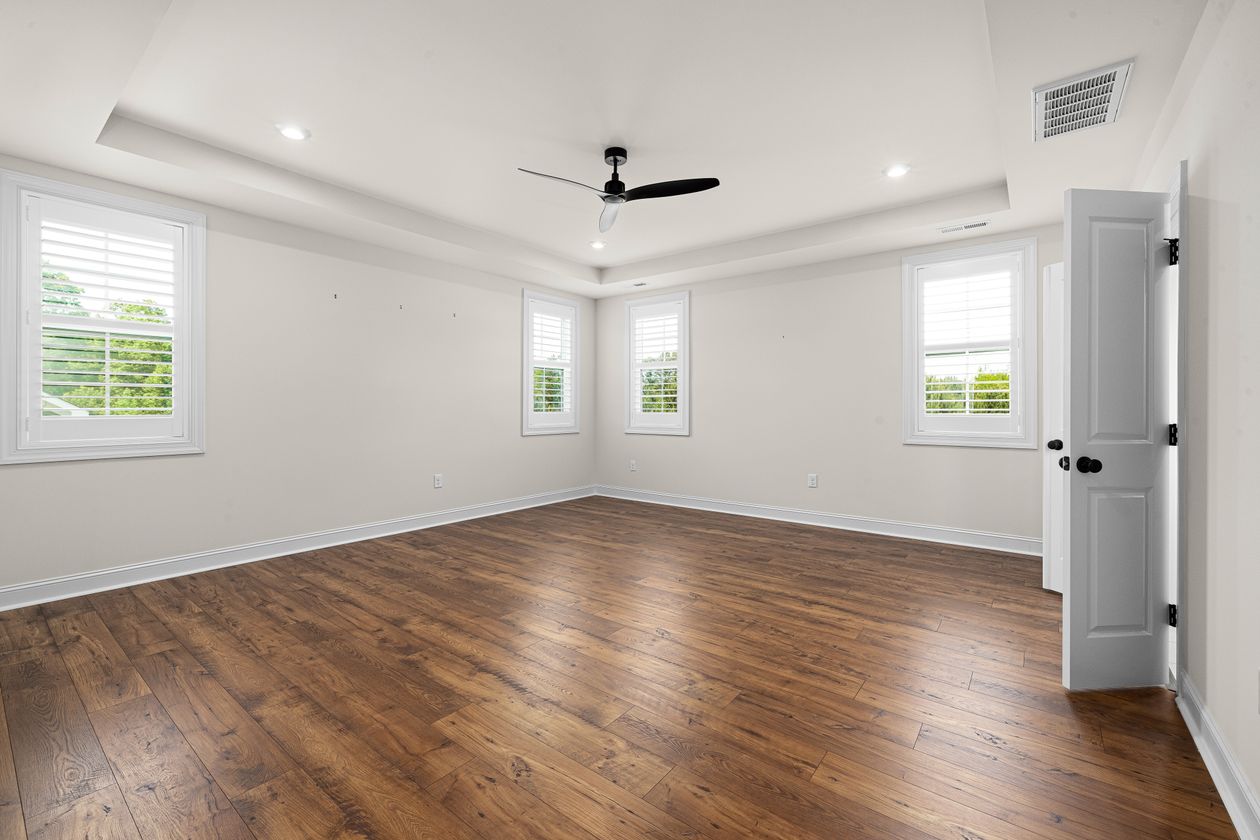
The property tax bill arrived in March. Four bedrooms, 2,400 square feet, SouthPark zip code 28211. The number at the bottom: $4,800 for the year. You set it on the kitchen counter and looked around. Two of those bedrooms hadn't been slept in since last August, when your youngest drove off to NC State with a carload of stuff.
The house is quiet now. You still love it, don't you? The neighbors know your name. The Harris Teeter on Rea Road is ten minutes away. But something feels off about paying full price for a house you're only half using.
You're not alone. Thousands of Charlotte homeowners hit this moment every year. The kids are gone and the rooms sit empty. And a mortgage, taxes, insurance, and utility bills are adding up to more than $3,400 every month. That's money going toward walls your family has outgrown.
This is the part where most people freeze. They don't know if they should sell, wait, rent out a room, or just stay put. This article breaks down your 3 real options, the math behind each one, and what Charlotte homeowners are actually doing in 2026.
TL;DR: Charlotte empty nesters in a typical $435K home spend about $3,400 a month to keep it. Downsizing can save $800 to $1,200 per month and free up over $100K in equity. Most sellers owe zero capital gains tax (IRS Section 121).
The Real Cost of Staying in Your Big House
Most empty nesters don't realize what their home actually costs each month. The mortgage payment is visible — it's right there on your statement. But the full picture is bigger than that. According to Redfin's May 2026 Charlotte market data, the median sale price in Charlotte sits at $435,000. On a home like that, your monthly costs stack up fast.
Say you're a homeowner in SouthPark, off Providence Road, with a 4-bedroom home you bought twelve years ago. The kids are in college. Here's what your typical monthly number looks like:
| Cost Category | Monthly Estimate | Annual Estimate | Notes |
|---|---|---|---|
| Mortgage payment (P&I) | $1,850 | $22,200 | 30-yr fixed, assumes 2014 purchase |
| Property taxes | $265 | $3,175 | Mecklenburg rate ~$0.73 per $100 assessed value |
| Homeowners insurance | $195 | $2,340 | Up 9% per NC Rate Bureau 2025-2026 filings |
| Maintenance & repairs | $545 | $6,525 | 1.5% of home value annually on aging home |
| Utilities (electric, water, gas) | $320 | $3,840 | Duke Energy + CMUD averages for 2,400 sq ft |
| Total | ~$3,175–$3,400 | ~$38,080+ | Does not include HOA fees |
That maintenance number catches people off guard. The 1-2% rule says older homes cost 1% to 2% of their value per year to maintain. On a $435,000 home, that's $4,350 to $8,700 every year in HVAC filters, roof repairs, water heaters, and weekend trips to Home Depot. The house doesn't get cheaper just because the kids left — and it's not going to.
Insurance is rising fast too. The NC Rate Bureau approved a 9% average rate increase for homeowners insurance in 2025-2026. That's on top of several years of increases. A home that was insured for $1,800 a year in 2022 might be running $2,300 or more today.
Staying in a house you've outgrown isn't "doing nothing." It's a choice to spend $3,400 a month on space that mostly sits empty.
And then there's the part that doesn't show up on any bill. The part of your home you actually own — your equity — is sitting in the walls instead of working for you. Most Charlotte homeowners in this situation have $200,000 or more locked up in their property. That money could be in investments, paying down other debt, or funding the retirement lifestyle you've been planning. Right now, it's just there, waiting.
The Downsizing Math for Charlotte
When you sell a $435,000 Charlotte home and buy a $275,000 townhome or condo, the math can put $100,000 to $130,000 back in your pocket after closing costs — the fees you pay when the sale goes through — and you could cut your monthly housing costs by $800 to $1,200 or more. That's the headline, and here's how the math works.
On the sell side, you're looking at roughly 6% to 8% in total transaction costs (agent commissions, title fees, transfer taxes). On a $435,000 sale, call it $28,000 to $35,000 going out. On the buy side, closing costs on a $275,000 purchase run another $5,000 to $8,000. So the cash you actually keep after all costs sits somewhere between $92,000 and $127,000, depending on your remaining mortgage balance.
That money can go into a brokerage account, pay down any remaining debt, or fund your next chapter. To understand the full picture, read which selling fees you can actually negotiate before you sign anything.
Where do you look in Charlotte when you're ready to downsize? Three neighborhoods stand out for empty nesters. Dilworth condos run roughly $250,000 to $350,000 and sit close to South End's restaurants and light rail. Belmont, just east of Uptown, has smaller homes and townhomes in the $250,000 to $300,000 range. NoDa townhomes fall between $275,000 and $375,000 and put you near the Lynx Blue Line stop at 36th Street. You're not giving up Charlotte. You're trading square footage for cash.
Check the best time to sell in the Carolinas before you list — timing your sale right can mean thousands more in your pocket.
Before you make any of the 3 moves below, you need a real number. Get a free home value estimate for your Charlotte property and see how much equity you've built.
See What Your Home Is WorthMove 1: Sell and Downsize in Charlotte
Selling your family home and buying something smaller in Charlotte is the most common path empty nesters take, and the data backs it up. According to the National Association of Realtors 2025 Generational Trends Report, buyers aged 58 and older are the most likely to downsize within the same metro area, staying close to friends, doctors, and routines they've built over decades.
This makes the most sense if you love Charlotte but want to stop overpaying for square footage you don't use. You keep your city, your doctors, and your routine. You keep the neighborhood Kroger you've been going to for 15 years. You just stop paying for three empty bedrooms.
Who Move 1 Is Best For
- You love Charlotte and don't want to leave the metro
- You have friends, family, or doctors in the area
- Your social life is rooted here
- You want to stay close to grandkids when they arrive
Here's what the math looks like in practice. Say you're a couple in SouthPark. Your 4-bedroom home sells for $435,000. You buy a 2-bedroom condo in Dilworth for $295,000. After all the fees, you pocket roughly $100,000 to $115,000 in cash. Your mortgage on the new place is smaller. Your insurance drops because the replacement cost is lower. Your utility bill shrinks and maintenance gets simpler.
Your monthly housing cost drops from that monthly number to somewhere between $2,000 and $2,300. That's $1,100 to $1,400 back in your budget every month. Over five years, that's $66,000 to $84,000 in freed-up cash, not counting what your invested equity earns.
Downsizing in Charlotte isn't about giving something up. It's about trading rooms you never enter for money you can actually use.
The catch: Charlotte's condo market moves fast. Good properties in Dilworth, NoDa, and Belmont don't sit long. You'll want to be ready to move when you find the right place. That means knowing your home's value before you start shopping. Read the full NC downsizing guide to understand the full process from listing to closing.
One more thing worth noting. Your property tax bill could drop significantly when you move. Mecklenburg County's rate runs about $0.73 per $100 of assessed value. On a $295,000 condo, that's roughly $2,153 per year versus $3,175 on the $435,000 home. That's another $85 a month in savings. You can also apply for relief programs if you're 65 or older. See how to file for the NC property tax break for homeowners over 65 before your next bill arrives.
Move 2: Sell and Rent for a Year
This option sounds simple, and it is. Sell your house, put the proceeds somewhere safe, and rent for 12 months. According to Apartment List's 2026 rent report, a 2-bedroom apartment in Charlotte runs approximately $1,700 to $1,900 per month depending on the neighborhood. That's a meaningful step down from what you're paying now, and you're not locked into anything.
The real value of Move 2 isn't the rent savings. It's the breathing room. You just went through a major life transition. You don't have to make two big decisions at the same time. You sell when the market is right, you bank the equity, and you take a year to figure out what you actually want your next chapter to look like. Do you want to be near the grandkids in Raleigh? Near the mountains, on a lake, or in a quieter suburb? Renting for a year lets you test that without commitment.
Who Move 2 Is Best For
- You're not sure yet where you want to land
- You want to sell in a good market without rushing into a purchase
- You're considering a major lifestyle change (travel, relocating near kids)
- You want to separate the "sell" decision from the "buy" decision
The concern most people raise about Move 2 is: "What if home prices keep going up while I'm renting?" That's a real risk. But the equity you've unlocked is yours. If you invest the proceeds, even conservatively, the return can offset some of the price appreciation you might miss. And you save yourself the stress of buying in a hurry.
If your home is in good shape and your neighborhood is in demand, Move 2 is also the lowest-pressure path. You list the house, let the market do its job, and close on your timeline. When you're ready to buy again, you're a cash buyer or a very well-positioned buyer with a large down payment. That's real leverage in a competitive market. For a step-by-step breakdown, check out the cash offer guide for the Carolinas to understand what your options look like on the buy side when you're ready.
Move 3: Sell and Relocate
Charlotte's home values are high. That's good for sellers. But it also means the places near Charlotte can offer you significantly more for your money. Homeowners who sell a $435,000 Charlotte house and buy in the right neighboring market can pocket even more cash and cut their ongoing costs even further. According to Zillow's 2026 Charlotte metro report, nearby markets like Rock Hill, SC and Belmont, NC still offer median home prices 20% to 35% below Charlotte's city center.
The tax angle makes this especially compelling for retirees. South Carolina's homestead exemption removes the first $50,000 of assessed value from property taxes for residents over 65. If you're selling in Charlotte and buying in Fort Mill or Lake Wylie, the combination of lower purchase price plus lower taxes can add up to thousands of dollars per year in savings. Read more about what the move looks like financially in the guide to retiring near Charlotte with 3 real price tags.
Who Move 3 Is Best For
- You want to stretch your equity further
- You're open to a slower-paced life — lake, mountains, small town
- You want lower property taxes in retirement
- Your kids have already left Charlotte or are scattered geographically
Three relocation markets worth looking at closely:
- Belmont, NC — Twenty minutes from Uptown Charlotte, near the Daniel Stowe Botanical Garden off Wilkinson Boulevard, median home prices run $250,000 to $300,000. Still in North Carolina, still close to Charlotte's hospitals and airports.
- Lake Norman area — Cornelius and Mooresville offer lakefront lifestyle with townhomes and smaller single-family homes in the $280,000 to $380,000 range. Good schools if grandkids are coming.
- Fort Mill or Lake Wylie, SC — Just across the state line, lower taxes, and home prices that can run $50,000 to $100,000 below comparable Charlotte properties. The SC homestead exemption is a real annual benefit for homeowners over 65.
Selling a $435K Charlotte home and buying a $275K house in Belmont or Fort Mill isn't downsizing in spirit. It's upsizing your financial life.
Move 3 requires the most planning but often delivers the biggest financial outcome. Your equity goes further. Your ongoing costs drop more. And in many cases, you end up with a home you love just as much, in a place that fits the life you're actually living now.
The Tax Angle You Need to Know
Here's the part that surprises most Charlotte homeowners: the profit you make when you sell your home is often completely tax-free. The IRS Section 121 exclusion lets single homeowners exclude up to $250,000 in profit from capital gains tax. Married couples can exclude up to $500,000. According to IRS Topic 701, you qualify as long as you've lived in the home as your primary residence for at least 2 of the last 5 years.
What does that mean for a SouthPark homeowner who bought at $220,000 fifteen years ago and sells today at $435,000? The profit is $215,000. Under the Section 121 exclusion, a single owner owes $0 in federal capital gains tax on that entire amount. A married couple selling the same home doesn't owe a dime on gains up to $500,000.
Capital gains tax is the tax on the profit you make when you sell something that went up in value. For most Charlotte empty nesters, this tax simply doesn't apply to your home sale. But the rules get more complicated if you've made major improvements, rented the property, or your gain exceeds the exclusion limits. Read the details on capital gains tax when selling in NC before you assume you're in the clear.
3 Moves at a Glance
Here's how the three options compare across the dimensions that matter most to empty nesters making this decision. Every situation is different, but these ranges reflect what Charlotte-area homeowners are seeing in 2026. If you're still unsure which path fits, the numbers here usually make it clearer.
The empty-nester situation in Charlotte isn't a housing problem. It's a math problem that most homeowners don't sit down and actually run. When you do the math, staying in a 4-bedroom home in SouthPark or off Providence Road often costs $1,000 to $1,400 more per month than it needs to. That's $12,000 to $17,000 per year. Over a decade, you're talking about real money.
What makes Charlotte's market unusual right now is that the gap between large-family homes and smaller condos and townhomes has widened. Demand for 4-bedroom homes in desirable zip codes remains strong, which means sellers are getting top dollar. At the same time, the number of condos and townhomes for sale in Dilworth, NoDa, and Belmont has grown. Buyers have more options in the downsized category than they did two years ago. That spread — high prices for what you're selling, more options in what you're buying — is genuinely favorable for empty nesters right now.
The homeowners who wait tend to cite the same reasons: they're not ready emotionally, they're hoping values go higher, or they're unsure of their next step. All three are valid. But the data suggests that the financial cost of waiting is real. Every month you stay is a month you pay the cost we flagged above instead of $2,200. The emotional timing has to be right. But it's worth knowing what that emotional comfort is actually costing you.
The 3 Numbers That Matter for Your Sale
- The full cost of your Charlotte home adds up fast. Mortgage, taxes, insurance, maintenance, and utilities on a median $435K home can run $3,175 to $3,400 per month — and that's before HOA fees.
- Downsizing frees up $800 to $1,200 per month. Selling your 4-bedroom home and buying a 2-bedroom condo or townhome in Charlotte can drop your monthly costs significantly and put $100,000 to $130,000 in cash back in your hands.
- Your 3 real options: Sell and downsize in Charlotte (keep the city, cut the costs), sell and rent for a year (buy yourself time), or sell and relocate (stretch your equity further in markets like Belmont, Lake Norman, or Fort Mill, SC).
- Most homeowners pay $0 in federal capital gains tax on their home sale, thanks to the IRS Section 121 exclusion ($250K single, $500K married). Confirm with a CPA if your situation is complex.
- Insurance is going up. NC Rate Bureau approved a 9% average rate increase for homeowners insurance in 2025-2026. Staying in your big house means paying more for coverage you may not need.
- Start by knowing your home's value. You can't make a smart financial decision without a real number.
Methodology and Sources
The $435,000 median home price figure comes from Redfin's May 2026 Charlotte market data. Monthly cost estimates for housing in Charlotte are calculated using the Mecklenburg County property tax rate of approximately $0.73 per $100 of assessed value (as published by Mecklenburg County Tax), the 1-2% annual maintenance rule widely cited in financial planning literature, and average utility costs for a 2,400-square-foot home based on published Duke Energy and CMUD averages. Insurance cost estimates reflect the NC Rate Bureau 2025-2026 filing showing a 9% average homeowners insurance rate increase. Neighborhood price ranges for Dilworth, NoDa, and Belmont are based on Redfin and Zillow listing data as of mid-2026 and reflect approximate ranges, not guarantees. Rent estimates for Charlotte 2-bedroom apartments reference Apartment List's 2026 national rent report. The IRS Section 121 capital gains exclusion is sourced from IRS Topic 701. NAR generational data comes from the National Association of Realtors 2025 Generational Trends Report. South Carolina homestead exemption details are sourced from SC state statutes. All cost estimates are approximations intended to illustrate general financial ranges, not individual financial advice. Readers should consult a CPA and licensed real estate professional for guidance specific to their situation.
Ready to See What Your Charlotte Home Is Worth?
The first step in any of these 3 moves is knowing your real number. You can't make a smart decision without it.
Get a free home value estimate for your Charlotte property. No commitment and no pressure — just a clear picture of where you stand.
See What Your Home Is WorthThinking about what comes next after you sell? Read retiring near Charlotte: 3 spots with 3 real price tags.
Thinking about selling? RobinOffer buys houses across the Carolinas. Our Carolinas cash offer guide explains how a no-obligation offer works, or see how to sell your Charlotte house fast.