
Behind on Property Taxes in the Carolinas?
A practical 1-year, 2-year, and 3+ year action guide for NC and SC homeowners who need a deadline-first plan.
1. The counter-narrative: being behind on property taxes is a solvable logistics problem until you treat it like a shame problem
Most homeowners assume there are only two versions of this story: you catch up quietly, or the county takes your house. Real life in the Carolinas has more stages than that. If you are one year behind, your highest-value move is usually administrative: confirm exact payoff, control penalty growth, and choose a cure path before legal costs stack. If you are two years behind, this becomes a deadline-management case with stricter triage. If you are three years or more behind, you are no longer solving a tax bill; you are solving an equity-preservation problem with multiple legal clocks and public-process risk.
This guide is intentionally practical and statewide. It combines North Carolina and South Carolina rules, then filters them through the decision that actually matters: what gives your household the highest probability of preserving options and equity right now. You will see side-by-side tables, severity tiers, call scripts, payoff math, and “if this, then that” frameworks you can use tonight without waiting for perfect certainty.
And here is the counter-narrative you may not hear from people around you: falling behind on taxes does not mean you failed at homeownership. It means your cash-flow model and your bill timing collided. Job loss, medical leave, divorce, caretaker expenses, and insurance shocks all create the same operational outcome: taxes moved from annual expense to emergency debt. Treat it as operations, not identity. Operations can be rebuilt.
If your case also includes mortgage delinquency, pair this with the North Carolina foreclosure guide or South Carolina foreclosure guide. Mortgage and tax timelines can run in parallel, and the tax side can move faster than families expect. South Carolina households tracking a mortgage case alongside taxes should also keep the SC foreclosure timeline handy for the court-side deadlines.
2. Stage map first, details second: where Carolina tax distress actually goes
The process is different in each state. North Carolina is primarily a county-led foreclosure model (civil tax foreclosure under G.S. 105-374 or in-rem under G.S. 105-375). South Carolina is a delinquent-tax sale model with a 12-month redemption period after auction. That structural difference changes strategy. In NC, legal-track identification matters early. In SC, sale-date and redemption economics dominate.
| Decision Lens | North Carolina | South Carolina |
|---|---|---|
| Core collection model | County/municipal foreclosure pathways | Annual delinquent tax sale auction |
| Early delinquency pressure | Interest starts after Jan 5 under statute; enforced collection can begin once delinquent | Penalty schedule escalates quickly after Jan 15, then execution and sale prep |
| Critical homeowner question | Which legal track is active on my parcel? | What is my exact sale date and redemption deadline? |
| Post-auction reality | Upset-bid and confirmation mechanics by county process | 12-month redemption period with quarterly interest tiers |
| Best strategic frame | Case-status discipline + deadline control | Redemption affordability + equity-preserving exit planning |
This is why one-size advice fails. A homeowner in Raleigh and a homeowner in Rock Hill can both say “I’m two years behind,” but the next best step differs based on state procedure, county cadence, and whether other liens are in play. You do not need perfect legal fluency to act effectively; you need the right state-specific questions and an honest budget boundary.
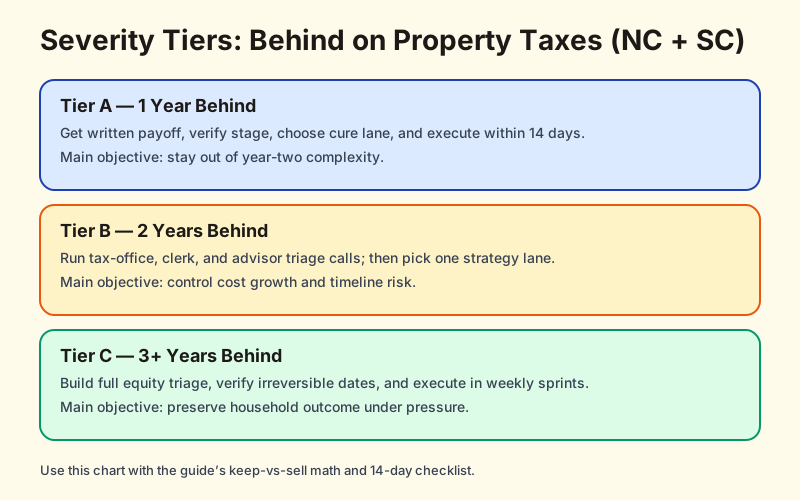
3. Severity tier A, one year behind: the last low-friction window
One year behind is usually the most fixable tier because your debt stack is still mostly taxes plus predictable penalties and interest, not fully layered legal costs. In North Carolina, taxes are due September 1 and payable at face value before January 6; then statutory interest applies. In South Carolina, January deadlines and step-up penalties make the first quarter expensive quickly. In both states, the first-year owner who acts decisively can often avoid much larger second-year complexity.
At this stage, your priorities are plain: get exact payoff by tax year, confirm whether account is still at tax office or already assigned/advanced, and choose one of three pathways within 14 days: full cure, formal payment arrangement where available, or controlled sale prep if cure is unrealistic. Delay is the only universally bad option.
| One-Year-Behind Task | Why It Matters | Target Deadline |
|---|---|---|
| Request written payoff by parcel ID | Verbal estimates are often stale and incomplete | Within 48 hours |
| Confirm procedural stage | Tax-office stage is easier than attorney/court stage | Same week |
| Run 30-day household cash plan | Determines if cure is realistic without collapse elsewhere | Within 7 days |
| Open backup sale track | Preserves optionality if cure fails | Within 10 days |
If you are still pre-attorney or pre-sale-list in your county, this is often your cheapest correction point. Use it.
4. Severity tier B, two years behind: this is where “I’ll catch up soon” starts costing real equity
Two years behind is the tier where many families are still emotionally in year-one mode while the system has already moved to year-two consequences. Balances are higher, tolerance windows are narrower, and staff handling often shifts from customer-service cadence to enforcement cadence. If you had one temporary setback in year one, year two usually means structural mismatch between income and obligations unless something changed materially.
Your strategy in this tier is not “work harder and hope.” It is controlled prioritization. First, protect irreversible deadlines. Second, choose one primary outcome for the next 30 days (retain with cure vs preserve equity via sale). Third, stop partial random payments that do not change status if your county rules require full cure to halt process. Ask directly how payments are applied and whether partials stop legal progression in your file.
Two-year cases often benefit from advisor stacking: housing counselor + legal triage consult + sale-readiness consult. Not because you need three opinions forever, but because the cost of one wrong assumption now can be five figures in lost flexibility later.
5. Severity tier C, three years or more: equity triage, not optimism, should drive every move
Once you are three years behind, you should assume that procedural momentum is real even if you have not personally seen every notice. File posture can outpace your awareness. Public advertisement systems, attorney assignments, and county docket workflows are designed to continue unless cured. Your objective becomes preserving net outcome under time pressure.
In this tier, many households benefit from flipping one mental model: from “How do I make this feel normal again?” to “How do I prevent irreversible loss and maximize family runway?” Sometimes the answer is still retention through cure. Often, the answer is a controlled sale while you still control timing, marketing narrative, and closing conditions.
| Three-Plus-Year Reality | Common Mistake | Better Move |
|---|---|---|
| Costs are now layered, not linear | Budgeting for principal only | Demand complete all-in payoff stack |
| Procedural clocks may be advanced | Assuming no immediate risk without new mail | Check clerk/tax records directly weekly |
| Dual-default risk is higher | Solving tax debt while ignoring mortgage/default notices | Run unified debt timeline and single action calendar |
| Decision fatigue is severe | Researching endlessly without choosing a lane | Choose primary strategy and execute in 7-day sprints |
6. North Carolina mechanics you must know before calling anyone back
North Carolina statutes set a clear delinquency framework. Under G.S. 105-360, unpaid property taxes accrue 2% interest from January 6 to February 1, then 0.75% per month or fraction thereafter until paid. Counties can begin enforcement once delinquent status is reached, and local practice can include collection remedies and foreclosure progression depending on file status.
Tax-lien foreclosure in NC can proceed through civil action (G.S. 105-374) or in-rem method (G.S. 105-375). Operationally, that means homeowners should ask one direct question early: “Is my parcel moving under 105-374 or 105-375, and what is my next hard deadline?” Knowing this changes what paperwork you need, who you call, and how urgently you must act.
County implementation is not identical. Larger counties may run more predictable high-volume workflows; smaller counties may run fewer events with less visible web tooling. The law is statewide, but pace is local.
7. South Carolina mechanics you must know before you assume you still have plenty of time
South Carolina’s system is different: delinquency escalates toward tax sale, and after sale the homeowner has a statutory redemption period. SC Code §12-51-40 outlines execution, notice, seizure/posting mechanics, and three-week advertisement requirement before real-property sale. County process details vary, but the sale pipeline is real and scheduled.
After sale, redemption cost rises by quarter under the familiar 3%, 6%, 9%, 12% structure in county guidance, with statutory caps tied to minimum-bid logic. Homeowners often misunderstand this stage as “nothing happens for a year.” In reality, you have a year to perform a full redemption payment while other financial stressors continue.
If your budget cannot realistically produce that redemption payment in a short horizon, your better outcome is often a controlled pre-sale strategy before the tax sale or early in the redemption window, while you still have decision control.
8. One-year-behind action plan (NC + SC): what to do in your next 14 days
Here is the practical two-week sprint for tier-A homeowners:
- Day 1–2: Pull parcel ID, tax years owed, and written payoff.
- Day 3: Confirm process stage with county office and, if applicable, clerk records.
- Day 4–5: Build a realistic 30-day cash map (income, fixed bills, emergency floor).
- Day 6: Decide retention path vs backup sale path.
- Day 7–10: If retention, execute payment arrangement/cure plan; if sale backup, gather documents and launch valuation.
- Day 11–14: Reconcile updated payoff and verify status moved as expected.
Speed matters because the system does not wait for emotional recovery. But this is still a stage where fast, unglamorous administrative work can save thousands.
9. Two-year-behind action plan: three conversations that create clarity fast
At tier B, schedule three calls in the same week and use specific scripts:
| Call | Exact Questions | Deliverable |
|---|---|---|
| Tax office / collector | What is all-in payoff by tax year? Is account assigned? What event changes rights? | Written payoff + status email |
| Clerk or case desk | What is current case stage, sale setting, upset/redemption status? | Date-stamped status notes |
| Counselor/attorney triage | Given stage and budget, what is highest-probability path in 30 days? | One-page action memo |
Then pick one outcome for the month. “Maybe keep, maybe sell, maybe wait” is not a plan.
10. Three-plus-year action plan: equity triage worksheet for hard choices
Use this worksheet with real numbers, not estimates:
| Input | Your Number | Note |
|---|---|---|
| Current market value range | $___ to $___ | Use two independent comps or valuations |
| Mortgage payoff | $___ | Request formal payoff quote |
| Tax payoff stack | $___ | Include penalties/fees/legal costs |
| Other liens/judgments | $___ | HOA, code liens, judgments |
| Estimated sale costs | $___ | Commissions/closing/repairs as applicable |
| Estimated net to household | $___ | What remains after all payoffs |
If net is meaningful and cure is not realistic, controlled sale is often the highest-protection move. If cure is realistic within a defined window and supported by a real budget, retention may still win. The key is to decide with math, not guilt.
11. Payment plans in the real world: what they solve, what they do not, and how to ask correctly
Payment plans can help, but homeowners overestimate their flexibility. Counties differ. Some allow short-term arrangements pre-assignment; others require tighter terms or full cure to stop progression. Ask five things in writing: eligibility, required down payment, missed-payment consequences, whether plan pauses legal actions, and exact completion deadline.
In South Carolina, installment options under state law may help prevent future delinquency but may not rescue an already advanced file. In North Carolina, some counties publish short-term plan options early in delinquency. Neither state guarantees a universally available “easy monthly plan” for deeply advanced files.
Treat plans as tactical tools, not permanent relief. If cash-flow fundamentals are still broken, a plan can postpone failure rather than solve it.
12. Selling with tax liens on title: yes, you can do it, but timing and payoff accuracy determine outcome
A common myth is “I can’t sell because there’s a tax lien.” In most normal transactions, liens are handled at closing from proceeds. The real issue is whether you can close before irreversible events and whether your net remains acceptable after payoff stack growth.
For homeowners under timeline stress, a faster certainty path may outperform an idealized listing plan that misses deadlines. For homeowners with more runway, traditional listing may produce higher gross. Either way, tax lien status itself usually does not block a sale; it changes urgency and net math. If condition uncertainty is part of the delay, review the as-is selling framework and adapt the same pricing-discipline logic to your local market.
| Sale Path | Potential Upside | Main Risk in Tax Distress |
|---|---|---|
| Traditional listing | Higher potential price | Timeline miss from inspections/financing delays |
| As-is listing with realistic pricing | Broader buyer pool than investor-only | May still require more runway than you have |
| Cash buyer process | Speed and certainty | Discounted price if not competitively shopped |
Read our Carolinas cash-offer guide before signing any rapid contract.
13. Keep-versus-sell decision math: one framework for NC and SC households
Run three scenarios side by side: retain and cure, sell now, or wait and attempt later cure. Include carrying costs, legal progression risk, and probability of execution success. Most bad outcomes come from comparing best-case keep with worst-case sell instead of comparing realistic versions of both.
| Scenario | Cash Needed Now | 12-Month Risk | Expected Household Position |
|---|---|---|---|
| Retain and cure | High upfront | Medium if budget fragile | Home retained if execution succeeds |
| Sell now under control | Low upfront cash required | Lower if timeline managed | Equity converted to cash runway |
| Wait and hope | Low today | High | Often reduced options and lower net later |
Behind on property taxes and want a clean way out?
We buy homes in any condition and can send a real cash offer so you can close on your timeline, before options narrow further.
14. Dual-default households (behind on taxes and mortgage): one calendar or you will get blindsided
When mortgage and tax default overlap, families often spend all energy on whichever creditor calls the loudest. That can be fatal to outcomes. Tax liens have priority dynamics that materially affect mortgage behavior. Servicers may advance taxes; counties continue process; legal tracks can collide.
Build one shared calendar with all deadlines: tax, mortgage, court, sale, redemption, insurance renewal, and any benefit review dates. If you cannot maintain this yourself, assign one household “case manager” and require every call to end with written next steps.
This is not bureaucratic overkill. It is how families stop losing days to repeated confusion.
15. County-cadence differences across the Carolinas: why your cousin’s story is not your timeline
Large counties with dedicated tax collections teams may move quickly and publicly. Smaller counties may move in more episodic bursts but still complete sales with little drama. Your strategy should be based on your parcel’s file status, not anecdotes from another county or another year.
Use county websites for delinquent tax information, public notices, and contact channels, but always confirm by parcel ID. Published general timelines are useful context, not guarantees.
16. What to collect before you make a single major decision
Create a case folder with these documents:
- Latest county payoff letter by tax year.
- Any execution/foreclosure notices and advertisement references.
- Mortgage statement and reinstatement/payoff figures if applicable.
- Title report or preliminary lien summary when available.
- Homeowner insurance status and renewal dates.
- Two market value references (agent CMA, buyer offer, or appraisal equivalent).
- Household 90-day cash-flow worksheet.
Without this file, most households make decisions from fragments. With it, decision quality improves dramatically in days, not months.
17. Attorney and counselor lanes: who does what, and when each lane is worth the money
Housing counselors are excellent for budgeting, workout options, and stabilization planning. Attorneys are essential when legal status, service issues, redemption disputes, or procedural risk requires precise rights analysis. Referral services from NC and SC bars can quickly locate paid consults; legal-aid channels may support qualifying households.
You do not need to retain everyone long-term. A focused 30-minute consult at the right moment can prevent expensive mistakes, especially near sale or redemption deadlines.
18. Scam resistance for stressed homeowners: protect yourself when urgency is high
Distressed-owner scams spike when public notices are published. Common patterns include fake “government rescue” letters, assignment traps, deed transfer pressure, and offers that rush signature before independent review. Red flags: no proof of funds, no clear timeline, unexplained fees, and resistance to attorney/title review.
Basic defense rules:
- Never sign under same-day pressure without outside review.
- Get at least two written offers on any rapid-sale path.
- Require transparent net sheet before accepting.
- Verify buyer entity and closing attorney/title firm independently.
19. 30-day sprint if you are one year behind
Week 1: payoff, status, budget, path selection. Week 2: execute cure/plan or launch sale prep. Week 3: verify status movement and remove blockers. Week 4: finalize and set prevention controls for next tax cycle.
This sprint is about avoiding progression into tier-B complexity.
20. 30-day sprint if you are two years behind
Week 1: three-call clarity sequence (tax office, clerk, legal/counselor triage). Week 2: choose one primary lane and publish household execution checklist. Week 3: hard verification of milestone completion and payoff updates. Week 4: if retention is slipping, switch to controlled sale without delay.
Tier B requires active management, not occasional calls.
21. 30-day sprint if you are three years or more behind
Week 1: full equity triage worksheet + deadline map. Week 2: launch highest-probability outcome lane (retain with funded cure or sale with defined close). Week 3: remove legal/title blockers and lock execution partner(s). Week 4: confirm completion or activate fallback lane before deadlines.
At this tier, speed with documentation beats perfection without movement.
22. Prevention after recovery: how to avoid repeating this cycle next tax year
After you stabilize, install guardrails immediately:
| Guardrail | Why It Works | Setup Time |
|---|---|---|
| Dedicated tax sinking fund | Turns annual shock into monthly habit | 1 day |
| Quarterly account review reminder | Catches drift early | 30 minutes |
| Auto-transfer on payday | Removes willpower dependence | 1 hour |
| Emergency trigger rules | Predefined plan for income shocks | 1 evening |
The best prevention system is boring, automatic, and visible to every adult in the household.
23. FAQ for homeowners behind on property taxes in NC and SC
Can I sell my house if I owe back property taxes?
Usually yes. The delinquent taxes are typically paid from closing proceeds. The main issue is timeline and net amount, not basic sale eligibility.
Is one year behind an emergency?
It is a high-priority warning state. You often still have practical options at lower cost than later tiers, but delay can push you into legal-cost growth.
If my property is in South Carolina and already sold at tax sale, do I have options?
You may still have options during the redemption period, but they require full redemption payment and strict deadline tracking. Evaluate whether redemption is realistically fundable and compare against controlled-sale math.
In North Carolina, what single question should I ask first?
Ask which statutory track your parcel is in and what your next irreversible deadline is. That answer defines your next move.
24. Your next move this week: pick one lane and execute it with evidence, not hope
If you are one year behind, use this week to stay out of year-two complexity. If you are two years behind, use this week to choose one outcome lane and stop indecision bleed. If you are three years or more behind, use this week to run equity triage and protect what can still be protected.
For state-specific timelines, keep these open while you work: NC property-tax timeline guide and SC property-tax timeline guide. For fast-sale due diligence, use the cash-offer comparison checklist. You do not need to solve your entire case tonight. You do need to stop drifting by tomorrow.
25. County call scripts you can read word-for-word when you are overwhelmed
Many homeowners call offices while stressed and then forget what they asked. The solution is scripted calls with checkboxes. Below are starter scripts. Keep your parcel number, property address, and last bill nearby. Ask for answers in writing whenever possible.
Script A: tax office or delinquent tax collector
“Hi, I’m calling about parcel [ID]. I need an itemized written payoff by tax year, including all penalties, interest, legal fees, publication costs, and any other costs due as of today. I also need to know whether this account is still handled by your office or assigned to counsel/another department. Please confirm the next date on which my legal options materially change.”
Script B: clerk or case-status desk
“I’m checking case status for parcel [ID] / case [number]. Has any sale date been set? If this is North Carolina, has an upset-bid period started or reset? If this is South Carolina, please confirm whether the sale has occurred and, if so, the redemption end date in county records. What is the next irreversible milestone listed in the docket or file?”
Script C: assigned attorney or collections counsel
“I want to resolve this file. Please provide the all-in payoff with expiration timestamp, exact payment instructions, and confirmation of what event ends cure or redemption rights in this case. If funds are delivered before that event, how and when is removal from sale/public process confirmed?”
These scripts are not legal advice. They are anti-confusion tools. The goal is not sounding smart. The goal is getting precise answers you can execute against.
| Call Outcome | If You Hear This | Your Immediate Response |
|---|---|---|
| “Just pay as soon as possible” | No numbers provided | Request itemized written payoff before ending call |
| “It’s with another office now” | Responsibility shifted | Get direct name, phone, and email; call same day |
| “There may be a sale later” | Vague timeline language | Ask for next date when rights/status change |
| “We can’t advise you” | No strategy guidance | Use data for counselor/attorney decision consult |
26. How to read payoff letters without missing the expensive details
Payoff letters are where homeowners accidentally lose money. They often focus on the final total and skip the line items that determine whether payment today, next week, or next month changes outcome. Read every line with three questions: what grows over time, what is fixed, and what event creates new charges.
Look for tax year breakdowns, daily accrual language, legal fee references, publication charges, and sale costs. If a line item is unclear, ask: “What statute, policy, or event generated this charge?” You are not being difficult. You are auditing your own survival math.
Also verify expiration timestamps. Many payoff statements are valid only through a specific date. If you miss that date, you may owe more and need a revised figure. In fast-moving files, even small time slips can matter.
| Line Item Type | Static or Dynamic? | What To Confirm |
|---|---|---|
| Base unpaid taxes | Static principal by year | All delinquent years included? |
| Interest/penalty | Dynamic | Exact accrual method and cut-off date |
| Attorney/legal costs | Can increase by stage | What additional steps trigger new charges? |
| Publication/notice/admin | Often stage-based | Already incurred or projected? |
| Sale-related costs | Stage-triggered | Can these be avoided with pre-event payment? |
If you are coordinating with a lender, relative, or buyer, circulate the payoff document to everyone the same day. Hidden version drift is common; one person may work from an old number while another works from a new one.
27. Fast net-sheet method: the 20-minute calculation that prevents emotional decisions
When households are stressed, they often decide based on monthly-payment pain, not total-outcome math. A fast net sheet corrects this. You can build one in 20 minutes. Use conservative inputs and run three paths: retain/cure, traditional sale, faster certainty sale.
Start with realistic market range, not aspirational listing price. Subtract mortgage payoff, tax payoff stack, other liens, and estimated transaction costs. Then compare with cash required to cure and keep. If keeping requires money you do not have and cannot reliably access, that scenario is not a real option today, even if it is emotionally preferred.
| Net-Sheet Block | Conservative Input | Aggressive Input |
|---|---|---|
| Market value estimate | $___ | $___ |
| Mortgage payoff | $___ | $___ |
| Tax payoff stack | $___ | $___ |
| Other liens | $___ | $___ |
| Sale costs | $___ | $___ |
| Estimated net to household | $___ | $___ |
Once you have this range, attach probabilities. Example: 70% chance fast-close path succeeds on time, 35% chance higher-price path closes before deadline. Probability-weighted math can reveal that lower gross with higher certainty is better than higher gross with deadline-miss risk.
28. Redemptions, upset bids, and “finality confusion”: terms that trip up homeowners
Homeowners often hear one word and assume the case is over. “Sold” can mean different things by state and stage. In North Carolina, a reported sale may still be in upset-bid sequence before confirmation. In South Carolina, post-auction ownership has redemption mechanics and notice requirements before deed transfer finality. Missing these nuances causes either panic or dangerous complacency.
The fix is simple: stop using general labels and ask status in event terms. “Has confirmation entered?” “Has redemption deadline passed?” “Has deed been issued and recorded?” Event language creates actionable clarity where emotional language creates fog.
| Common Phrase | What It Might Mean | What To Verify |
|---|---|---|
| “It sold already” | Initial auction event occurred | Is there still an upset/redemption window? |
| “You can still redeem” | Some rights remain | Exact payoff amount + hard deadline timestamp |
| “Case is closed” | Office-level processing done | Has title transfer finalization occurred in records? |
| “Nothing else can be done” | Practical options are narrow | Confirm with qualified legal review before assuming zero options |
Do not argue with staff. Just ask event-specific questions and document answers. Precision beats frustration.
29. Family coordination when multiple owners or heirs are involved
Co-owned homes and inherited properties fail under deadline pressure for one repeat reason: everyone assumes someone else is handling it. To avoid this, assign role ownership immediately. One person handles county/legal communication, one handles financial assembly, and one handles document management. If there are only two people, combine roles but still assign explicitly.
Create a shared timeline document with visible owner initials for each task. This is not corporate theater. It prevents the common collapse where two heirs each think the other sent funds, signed documents, or confirmed payoff. In deadline cases, role ambiguity is expensive.
If family conflict is high, use neutral professionals for constrained decisions. A short mediated meeting around net-sheet scenarios can save relationships and money compared with months of unstructured arguments while costs rise.
| Role | Primary Duties | Backup If Unavailable |
|---|---|---|
| Case Coordinator | Calls offices, logs status, tracks deadlines | Co-owner B |
| Finance Lead | Collects payoff funds, updates budget, verifies transfers | Trusted relative |
| Document Lead | Maintains shared folder, signatures, notices, receipts | Closing attorney paralegal liaison |
30. What to do if your mail is unreliable, your address changed, or notices were missed
Notice systems rely heavily on addresses and publication channels. If you moved, have shared mailboxes, or have postal irregularities, you can miss practical warning time even when legal notice standards were met. Do not build strategy around whether notice “should have reached you.” Build strategy around current file status and next irreversible date.
Immediately update mailing address where allowed, confirm contact email, and request future communication preferences in writing. Then audit all historical notices in county or court records. This is especially important for owners living out of county or managing inherited homes from another city/state.
For high-risk files, set a recurring weekly status check regardless of whether new mail arrives. Administrative vigilance is cheap compared with procedural surprises.
Get Your Free, No-Obligation Cash Offer
Tell us about your NC or SC home and we’ll send a real cash offer, any condition, and close on the timeline that works for you.
31. If you are considering a quick sale: how to compare offers without getting trapped
Speed offers can be legitimate and useful when deadlines are near. They can also be exploitative. Use a structured comparison sheet across at least two or three offers whenever time allows. Compare not just headline price, but proof of funds, close date certainty, inspection/contingency terms, assignment rights, and who pays which closing costs.
| Offer Comparison Field | Offer A | Offer B | Offer C |
|---|---|---|---|
| Price | $___ | $___ | $___ |
| Proof of funds provided | Yes/No | Yes/No | Yes/No |
| Close by required deadline | Yes/No | Yes/No | Yes/No |
| Inspection contingency | None/limited/full | None/limited/full | None/limited/full |
| Assignment allowed | Yes/No | Yes/No | Yes/No |
| Estimated net proceeds | $___ | $___ | $___ |
Do not sign agreements with vague amendment rights that let buyers retrade price late in the process. In deadline cases, late repricing is one of the most common homeowner harms.
32. Resource directory for Carolina homeowners in tax distress
Use official and vetted pathways first. The list below is a starting framework; always confirm current details directly.
| Resource Type | North Carolina | South Carolina |
|---|---|---|
| Housing counseling | NCHFA + HUD-approved counselor network | HUD-approved counselor network + SC Housing resources |
| Court help content | NC Judicial Branch foreclosure help topic | County + state judiciary information pages |
| Attorney referral | NC Bar Lawyer Referral Service | SC Bar Lawyer Referral Service |
| Legal aid | Legal Aid of North Carolina | South Carolina Legal Services |
| County tax contact | County tax administration/collector offices | County treasurer/delinquent tax collector offices |
When calling any resource, start with: parcel ID, tax years behind, current stage, and your one-sentence goal (“retain with cure” or “sell to preserve equity”). Clear framing gets better help faster.
33. Case studies (composite): what different tier decisions look like in practice
Case A (one year behind, retained home): Household in NC was one cycle behind after medical leave. They requested full payoff within 48 hours, used short-term family loan, and cured before file moved to higher-cost stage. They then set automatic monthly tax reserve transfers. Outcome: retained home, lower total cost, reduced stress.
Case B (two years behind, controlled sale): SC owner-occupant had unstable variable income and could not sustain cure schedule. After running net sheet and deadline risk, they listed as-is with aggressive pricing and closed before auction cycle. Taxes and mortgage paid at closing; household exited with meaningful net cash and relocation runway.
Case C (three-plus years behind, dual-default triage): NC inherited property with co-owner conflict and missed mail. File status was farther advanced than family realized. They assigned roles, obtained unified payoff stack, and chose quick-close path after determining cure was not fundable. Outcome: not ideal emotionally, but far better than last-minute loss with no planning cash.
The point of these composites is not to prescribe one choice. It is to show that decisive, evidence-based execution beats prolonged uncertainty across tiers.
34. Final execution checklist: print this and mark it done
- □ Written payoff requested and received (date/time logged).
- □ Procedural stage confirmed with county/clerk records.
- □ Next irreversible deadline identified and shared with all stakeholders.
- □ 90-day budget map completed with realistic cash limits.
- □ Primary strategy selected (retain/cure or sell/preserve equity).
- □ Backup strategy defined if primary path misses milestone.
- □ All documents centralized in one shared folder.
- □ Professional support contacted (counselor, attorney, or both as needed).
- □ Offer comparison or cure funding plan documented in writing.
- □ Status re-check scheduled weekly until case resolves.
If you finish this checklist, you have converted a chaotic tax-distress situation into a managed project with measurable progress. That does not remove difficulty, but it restores agency. And agency is what protects households when timelines are tight.
35. Budget surgery for distressed homeowners: where the cure money usually comes from
When homeowners hear “find $6,000 to $15,000,” they often freeze because they interpret the number as a single impossible bill. Operationally, cure funding is usually assembled from several smaller channels: temporary spending cuts, paused discretionary transfers, tax refunds, family bridge loans, retirement-loan decisions, side-income bursts, negotiated creditor deferments, and in some cases secured short-term financing. None of these options are painless, but most are easier when mapped as a package instead of a single-source miracle.
Start by separating expenses into four buckets: mission-critical (housing, food, transportation to work), legal/financial risk expenses (taxes, mortgage, insurance), negotiable commitments (subscriptions, optional memberships, non-essential debt acceleration), and temporary pauses (discretionary spending that can stop for 60 days). Then identify what can be redirected immediately.
Next, run a “one-time liquidity inventory.” This includes savings beyond your minimum emergency floor, receivables (money owed to you), seasonal income, and assets that can be sold quickly without harming employment stability. The goal is not financial perfection. The goal is to find enough controlled liquidity to hit the next hard deadline.
| Funding Channel | Speed | Risk Level | Best Use |
|---|---|---|---|
| Expense freeze (30–60 days) | Immediate | Low | Create first $500–$2,000 quickly |
| Tax refund / expected inflow | Near-term | Low-Medium | Partial payoff or legal-cost containment |
| Family bridge loan (written terms) | Fast if available | Relationship risk | Deadline-specific cure gap |
| Retirement loan/distribution analysis | Medium | Tax/retirement risk | Use only after comparing long-term impact |
| Short-term secured financing | Medium | Medium-High | Narrow deadline rescue if repayment path is clear |
| Controlled sale proceeds | Medium | Market/timeline risk | Comprehensive debt and equity reset |
If your assembled liquidity still cannot meet required cure amounts with margin, treat that as decision clarity, not defeat. You likely need to prioritize equity preservation through sale strategy rather than continuing a retention plan that is underfunded from day one.
36. Employer, lender, and creditor communication templates that buy you time without making false promises
Time can be as valuable as money in tax-distress cases. Many households lose time because they avoid communication or overpromise payment dates they cannot meet. Better approach: send concise, factual updates that request specific accommodations while you execute your plan.
Employer/HR template: “I am addressing an urgent housing-related legal deadline and may need one documented schedule adjustment in the next 30 days for court/county meetings. My goal is to maintain full performance and minimize disruption. I can provide requested documentation.”
Mortgage servicer template: “I am resolving a delinquent property-tax matter and need written confirmation of current reinstatement/payoff figures and any options to prevent progression while this is being resolved. Please provide exact dates and required documents.”
Unsecured creditor template: “I am in temporary hardship related to housing stabilization. I am requesting short-term reduced payment for [30/60] days while I complete a defined cure plan. Please provide confirmation in writing.”
These messages do not guarantee accommodation, but they create a record of active management and often reduce avoidable friction while you focus on the highest-risk deadlines.
| Communication Target | What To Ask For | What To Avoid |
|---|---|---|
| Employer/HR | Specific time flexibility for defined dates | Vague “ongoing emergency” requests |
| Mortgage servicer | Written figures + timeline options | Verbal-only summaries with no follow-up |
| Credit card/personal loan | Temporary hardship terms | Promises to pay full by unrealistic date |
| Family lender | Simple written repayment terms | Handshake agreements under stress |
37. Advanced timeline coordination: how to run weekly case reviews like a project manager
Complex housing distress is project management. Weekly reviews keep cases from drifting. Choose one day and one hour each week. Review status across five categories: money, legal stage, sale pipeline, documentation, and next-week commitments. Keep it short and factual.
A useful meeting format is “past due / due this week / due next week.” Past-due items get immediate owner reassignment if blocked. Due-this-week items get exact date and proof requirement. Due-next-week items get pre-work assignments now, not later.
If professionals are involved, send a one-page summary after each review. Professionals respond faster to concise status snapshots than to scattered emotional updates. Your summary should include updated payoff amount, current stage, major risk, and requested action.
| Weekly Review Block | Questions | Output |
|---|---|---|
| Money | What funds are confirmed vs estimated? | Updated cash-on-hand and gap number |
| Legal/County | Any stage change since last week? | Confirmed next irreversible date |
| Sale Path (if active) | Showings/offers/title blockers? | Probability of closing before deadline |
| Documents | Any missing payoffs, signatures, IDs? | Task list with owners |
| Decisions | What must be decided this week? | Go/no-go choices and fallback triggers |
Households that run this cadence usually make fewer panic moves and recover more control, even when outcomes are difficult.
38. Special situations: disability income, military households, probate properties, and landlord-owned rentals
Tax-distress strategy changes when property ownership context changes. For disability-income households, predictability of monthly inflow can support structured cure plans but may not support large lump sums. For military families, PCS timing and deployment realities can compress decision windows and require delegated authority documents. For inherited/probate homes, title authority and co-heir coordination can be the bottleneck, not funding. For landlord-owned rentals, tenant occupancy and lease obligations create additional execution complexity.
In each special context, the rule remains: identify the true bottleneck and solve it first. Do not spend weeks optimizing financing if title authority is unresolved. Do not negotiate offers if tenancy/access constraints will kill closing certainty. Do not chase perfect legal theories if deadline math already points to a practical execution path.
| Situation | Typical Bottleneck | First Priority |
|---|---|---|
| Fixed disability income | Lump-sum scarcity | Assess staged funding vs equity-preserving sale |
| Military/PCS | Time and document authority | Set delegated sign authority and accelerated timeline |
| Probate/inherited | Title and decision rights | Confirm representative authority immediately |
| Rental property | Tenant logistics and access | Plan compliant showing/closing operations |
If your case fits one of these categories, communicate that fact in your first call to county/counsel/professionals. It helps them give you advice that reflects reality instead of generic scripts.
39. Decision triggers: objective rules that tell you when to pivot from retain to sell
Most costly mistakes happen because households pivot too late. Define pivot triggers in advance. Example triggers: (1) cure funds not 100% committed by a specific date, (2) payoff increases beyond budget tolerance, (3) legal stage advances to high-risk milestone, (4) lender workout denied, (5) verified sale-close probability on current path drops below threshold. If any trigger hits, move to pre-defined sale execution lane within 24–72 hours.
Triggers remove emotion from high-stakes transitions. They also improve family alignment because the decision was made in advance under calmer conditions, not during a panic call.
| Trigger | Threshold Example | Required Pivot Action |
|---|---|---|
| Funding trigger | Less than 100% cure funds by date X | Activate controlled sale lane same week |
| Cost-growth trigger | Payoff rises >10% over modeled range | Re-run net sheet and adjust strategy |
| Stage trigger | Sale/confirmation/redemption milestone reached | Escalate to attorney + execution sprint |
| Certainty trigger | Current path close probability <60% | Switch to higher-certainty closing path |
Write your triggers down and share them with everyone making decisions. Clarity under pressure is a competitive advantage.
40. Closing perspective: the goal is not to win every argument, it is to preserve the best possible household outcome
When property taxes are overdue, people often spend energy proving that the system is unfair, notices were confusing, or timing was impossible. Those feelings can be true. But in live cases, outcome quality comes from execution quality. The household that preserves equity, stabilizes housing, and avoids irreversible surprises is the household that wins, even if no step felt ideal.
You can still create strong outcomes in all three tiers. One-year-behind households can often retain with disciplined admin work. Two-year-behind households can still choose between retention and controlled sale with real agency if they move quickly. Three-plus-year households can still protect significant value by running equity triage and acting before final events.
If you remember only one line from this guide, make it this: confirm stage, confirm payoff, choose one lane, and execute on a weekly cadence until resolved. That pattern works better than any single tactic because it prevents drift, and drift is what converts manageable debt into permanent loss.
41. Expanded NC and SC milestone matrix: what changes at each step and what homeowners can still control
Most guides show one timeline. Real households need a control map. The matrix below is designed for that purpose. Read it horizontally: milestone, what legally/operationally changes, what you can still control, and the most expensive mistake at that stage.
| Milestone Stage | What Changes | What You Still Control | Most Expensive Mistake |
|---|---|---|---|
| First missed payment window | Account enters delinquency logic | Speed of response, communication quality, budget triage | Ignoring until formal/legal wording appears |
| Penalty/interest escalation | Balance growth accelerates and compounds urgency | Full payoff requests, funding assembly, short-term plan options | Making partial payments without status impact |
| Assignment/advanced handling | Customer-service flexibility often decreases | Case documentation, legal/counselor input, strategy selection | Assuming old office can still resolve everything |
| Public-process stage | Publication/sale mechanics become visible | Emergency execution, controlled sale lane, legal clarity | Treating public notice as negotiation tactic instead of deadline |
| Post-auction procedural stage | Rights are narrower and highly time-bound | Precise redemption/cure action where available | Confusing “not final yet” with “plenty of time” |
This matrix is especially useful for households where one person is “calendar-oriented” and another is “numbers-oriented.” Put both people in the room, assign owners to each control lever, and review weekly. Distress cases improve when roles are explicit and evidence is shared.
For North Carolina households, keep watching for stage language around statutory paths and sale confirmation mechanics. For South Carolina households, keep strict focus on sale dates and redemption deadlines. In both states, ask for event dates rather than general estimates. “Around fall” and “sometime next month” are not decision-grade answers.
Also use this matrix for professional conversations. When you call a counselor, attorney, agent, or buyer, state your current milestone and ask for the highest-probability move before the next one. Professionals can only be as precise as your stage description.
Finally, remember that milestone awareness is a compounding advantage. The earlier you map your real stage, the more low-cost options remain available. The later you map it, the more solutions require speed, cash, or legal precision that may be harder to mobilize under stress.
42. Long-form due-diligence checklist for any sale under tax-pressure timelines
Sales under deadline pressure can still be clean and fair. They fail when homeowners skip due diligence because “we don’t have time.” You usually have enough time to run a disciplined checklist, even if you do not have time for endless negotiation. The goal is to avoid avoidable surprises that kill closings or destroy net proceeds at the last moment.
Start with counterpart quality. Is the buyer real, funded, and operationally capable of closing in your window? Proof of funds should be current, credible, and sized for your transaction plus reserves. Ask who signs, who funds, who closes, and whether assignment is permitted. If answers are vague, risk is high.
Next, inspect contract mechanics. Review inspection periods, financing contingencies, extension rights, cure periods, earnest money structure, and default remedies. Under time pressure, broad unilateral extension clauses and low earnest money are common traps. They give buyers leverage to renegotiate price late when you have fewer alternatives.
Then test closing path realism. Confirm title/attorney intake now, not later. Pull payoff statements early and reconcile differences before contract execution if possible. Identify occupancy logistics, utility transfer, and any personal-property removal requirements. Operational details are where “great offers” often stall.
| Due-Diligence Category | Minimum Standard | Red Flag |
|---|---|---|
| Buyer credibility | Named entity + current proof of funds + closing references | Refuses to identify funding source |
| Earnest money | Meaningful deposit with clear non-refundable triggers | Tiny deposit or delayed deposit terms |
| Inspection rights | Narrow, time-limited scope | Open-ended “sole discretion” cancellation language |
| Extensions | Mutual consent or tightly defined conditions | Buyer-only extension rights with minimal cost |
| Assignment | Restricted or disclosed with protections | Unlimited assignment without seller consent |
| Closing certainty | Named closing agent + timeline + required docs list | No identified closer within first few days |
In high-pressure scenarios, build a “failure tree” before signing: if buyer delays, what is plan B by date; if title issue appears, who resolves and by when; if payoff increases, who recalculates net and approves go/no-go. This pre-work prevents paralysis when surprises appear.
Use transparent net sheets for every offer revision. Ask for updated expected net after taxes, mortgage, liens, credits, and fees. If a party resists clear net presentation, treat that as a warning sign. You are not selling headline price; you are selling for actual household outcome.
When in doubt, spend money on targeted review. A focused contract/legal review can cost far less than one bad clause under deadline pressure. Precision is cheaper than cleanup.
43. After-resolution playbook: rebuilding financial resilience after tax distress
Resolution is not the finish line; it is a reset point. Whether you retained the home or sold to preserve equity, the next 12 months determine whether the same stress cycle returns. Households that treat resolution as closure often drift back into reactive patterns. Households that treat resolution as system design usually stabilize.
Begin with a 90-day stabilization phase. If you kept the home, confirm all delinquency indicators have cleared and future bills are mapped to automatic reserve funding. If you sold, define your cash runway rules before discretionary spending resumes: emergency floor, housing transition budget, debt clean-up order, and one medium-term target (for example, improved credit profile or savings benchmark).
Then run a post-mortem with compassion and honesty. Ask what failed first: income volatility, absent reserves, medical shock, household coordination, or information delays. You are not assigning blame. You are identifying system weaknesses that can be fixed.
Households that recover fastest usually implement four habits:
- Visibility habit: one shared monthly dashboard for bills, reserves, and risk dates.
- Buffer habit: automatic transfer into tax/insurance reserve each payday.
- Trigger habit: pre-agreed action plan when income drops or large expenses hit.
- Review habit: brief monthly check-in that includes all adult decision-makers.
| Recovery Horizon | Primary Objective | Practical Metric |
|---|---|---|
| 0–90 days | Stabilize cash flow and eliminate surprise bills | No missed critical payments |
| 3–6 months | Rebuild reserve behavior | Consistent reserve contributions |
| 6–12 months | Improve flexibility and optionality | Emergency buffer + improved debt profile |
| 12+ months | Sustain resilience under ordinary shocks | Documented trigger plan tested in practice |
If family trust was strained, include relationship repair in the plan. Financial crises often leave emotional residue that harms future decision-making. Simple structures help: shared dashboards, written agreements for major commitments, and regular low-drama money reviews.
The deeper win after tax distress is not “we survived.” It is “we built a system that makes the next shock less dangerous.” That is how households convert a hard chapter into long-term strength.
44. One-page worksheet you can copy into notes and use tonight
To make this guide executable, here is a compact worksheet format. Copy it into your notes app and fill in every blank before bed. In distressed cases, clarity by tomorrow morning often matters more than perfect plans next week.
Case identity: Parcel ID: ____ | State: ____ | County: ____ | Tax years delinquent: ____
Current stage (verified): ____ | Verified with: ____ | Date/time verified: ____
All-in payoff today: $____ | Payoff valid through: ____
Next irreversible event: ____ | Event date/time: ____
Primary strategy for next 30 days: Retain/Cure ____ or Sell/Preserve Equity ____
Funding available now: $____ | Additional confirmed by date: $____ | Remaining gap: $____
Top three risks: 1) ____ 2) ____ 3) ____
Top three actions due this week: 1) ____ (owner/date) 2) ____ (owner/date) 3) ____ (owner/date)
Fallback trigger: If ____ is not complete by ____, then switch to ____ immediately.
Support contacts: Tax office ____ | Clerk/case desk ____ | Counselor/attorney ____ | Closing partner ____
Print this if you can. Put it where everyone in the decision circle can see it. Update it every week until resolution. The worksheet turns abstract fear into visible progress and visible constraints.
Last reminder: you are not trying to become a tax-law expert in one night. You are trying to make one high-quality move at a time with current facts. When you feel overwhelmed, return to the four-step loop: verify stage, verify payoff, choose lane, execute weekly. That loop works in both Carolinas, across one-year and three-year cases, and across retain-versus-sell decisions. It also gives professionals a clear framework to help you faster. If your situation changes tomorrow, update the worksheet and run the loop again. Consistency under pressure is how homeowners stop losing leverage and start rebuilding options. Keep copies of every email, receipt, and status note in one folder, and never assume that an oral update changed your legal status until you see written confirmation from the responsible office. Small documentation habits create major protection when deadlines tighten unexpectedly.