
NC Property Tax Lien Timeline
From first delinquency through foreclosure and upset-bid windows: what changes each stage and what to do before options narrow.
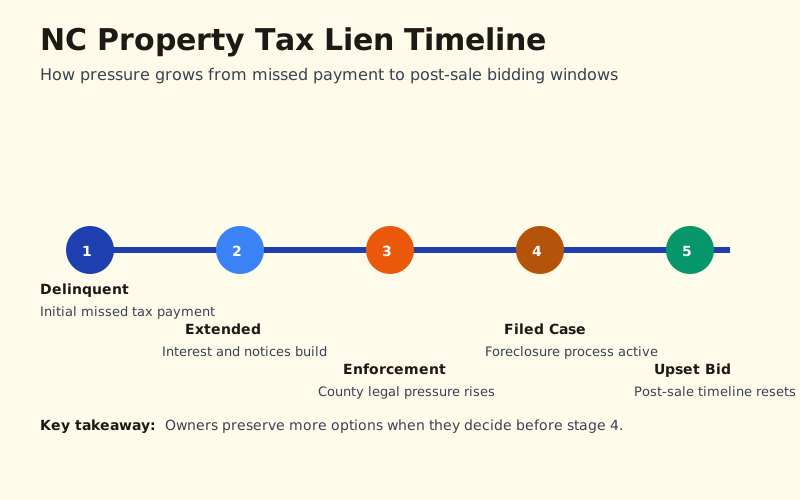
1. North Carolina property tax delinquency is a legal timeline, not a billing inconvenience
NC property tax lien timeline pressure starts earlier than most owners expect: once taxes stay delinquent, counties can escalate from notices to legal foreclosure steps, and every month of delay usually raises costs while shrinking your options.
This guide is built for homeowners, heirs, and family members who need a plain-language map of what actually happens after property taxes go unpaid in NC. We are not going to blur mortgage foreclosure with tax foreclosure. They intersect in real life, but they are different systems with different triggers and different deadlines. Here, the focus is county tax delinquency under North Carolina law and the county-level mechanics that drive the pace.
The through-line is timeline pressure. NC counties can begin public delinquency enforcement after one year of non-payment under statutes that govern local tax collection. Some counties move with more urgency than others, but the baseline authority is statewide. If your plan is to "wait and see," that is still a plan, just usually an expensive one because interest, attorney fees, publication costs, and carrying costs continue to accumulate while your options narrow.
What you will get below: a stage-by-stage timeline from first delinquency to foreclosure sale and upset-bid cycles; the difference between statutory rules and county implementation choices; action checklists by stage; net-proceeds math for deciding whether to keep, refinance, list, or sell quickly; and a resource map for legal aid and housing counselors. If you are already seeing sale notices or upset-bid language, skip to sections 8 through 12 first and then come back.
| Timeline Stage | What Changes Legally | What Changes Financially | Your Best Move |
|---|---|---|---|
| Current year bill unpaid | Tax obligation becomes delinquent after due dates | Interest and penalties start building | Contact county tax office immediately |
| One-year delinquency window | County enforcement posture can escalate under statute | Balance grows and cure amount becomes harder | Build a written cure or sale plan |
| Foreclosure filing phase | In rem or mortgage-style foreclosure mechanisms activate | Attorney and publication costs enter the file | Choose keep/sell path with deadlines |
| Sale and upset-bid phase | Auction process starts and upset bids can reset timeline | Uncertainty and additional costs can persist | Track Clerk deadlines daily |
2. The legal backbone: what North Carolina statutes actually allow counties to do
North Carolina does not operate like tax-lien-certificate states where investors routinely buy county tax liens at public auctions and then collect from homeowners directly. In NC, the local government unit generally enforces tax liens through statutory foreclosure mechanisms. The two statutes homeowners hear most often are G.S. 105-374 (foreclosure in the nature of mortgage foreclosure) and G.S. 105-375 (in rem foreclosure process). Counties and their counsel select the legal route based on case posture, title profile, and local practice.
This distinction matters because homeowners often search for out-of-state content and assume the same rules apply in North Carolina. They do not. In practical NC files, the county objective is collection of delinquent taxes, accrued interest, and associated costs, with foreclosure sale as the enforcement lever when voluntary payment does not occur. The homeowner objective is either curing delinquency, negotiating a feasible resolution, or preserving remaining equity through a timely sale before deeper enforcement costs compress net proceeds. If you remember one phrase, remember this: the NC property tax lien timeline is a countdown, not a waiting room.
Statutes provide authority and procedural boundaries, but county pages tell you how quickly that authority is exercised in your jurisdiction. Wake County's delinquent-tax language, Mecklenburg's foreclosure operations pages, and Orange/Gaston upset-bid details all show the same pattern: once files move from passive delinquency into active legal enforcement, deadlines become operationally short and document precision matters. Verbal promises and partial plans typically fail when formal notices are already in motion.
For homeowners, the key legal takeaway is not memorizing every subsection. It is understanding that county enforcement authority is real, routinized, and documented. If your taxes have been delinquent long enough to appear in county delinquency processes, your best leverage comes from acting before publication and sale mechanics are fully underway. If you are already inside those mechanics, focus on executable options with date-certain milestones.
- Statutory authority exists statewide even though county pace differs.
- NC tax foreclosure process is separate from mortgage lender foreclosure process.
- "I can pay eventually" is not the same as a county-acceptable resolution plan.
- Written records, payoff quotes, and date tracking are mandatory, not optional.
3. The real timeline from missed tax payment to high-pressure enforcement
On paper, a delinquent tax timeline can sound linear. In real files, stages overlap. You may receive delinquency notices while dealing with insurance escrows, inherited title issues, or mortgage arrears. That overlap makes owners feel like everything is happening at once. To reduce the chaos, separate the timeline into operational stages: initial delinquency, prolonged non-payment, pre-foreclosure escalation, filed foreclosure process, and post-sale upset-bid window.
During early delinquency, your best move is straightforward: verify balance, confirm interest accrual mechanics with the county, and ask what payment-plan options are available. Some counties offer structured payment arrangements; others may require larger cure amounts or have stricter eligibility conditions. Do not assume your county works like your neighbor's county. Use official county tax administration contacts and ask for terms in writing.
As delinquency persists toward and beyond one year, counties can increase pressure through statutory pathways and public-listing mechanics. This is where many owners lose time to false optimism. They believe that because no one has posted sale notices on the property yet, there is still "plenty of time." Often there is some time, but not enough for indecision. If you need to sell, this is the stage where listing strategy should already be active rather than conceptual.
Once foreclosure legal mechanics are underway, each step introduces additional costs and procedural constraints. Attorney handling, publication requirements, courthouse scheduling, and upset-bid rules all come with detail-sensitive execution. Owners who continue making decisions week-to-week instead of following a dated project plan usually get forced into lower-certainty outcomes with thinner net proceeds.
| Stage | Typical Trigger | Primary County Tool | Homeowner Decision Point |
|---|---|---|---|
| Stage A: Delinquent | Tax due date passes unpaid | Billing, notices, interest accrual | Can you cure without selling? |
| Stage B: Extended delinquency | Months of non-payment | Collections and pre-enforcement pressure | Do you need payment plan or refinance? |
| Stage C: Enforcement ramp | Approaching or past one-year mark | Advertisement/listing and legal prep | Keep vs sell decision deadline |
| Stage D: Foreclosure process | Case filed and scheduled | Court procedures, sale setup | Exit strategy must be executable now |
| Stage E: Post-sale bid cycle | Auction conducted | Upset-bid process and confirmation | Monitor finality and redemption realities |
4. County-by-county reality: same statutes, different speed and friction
A major source of homeowner confusion is seeing statewide legal language and assuming every county applies the same tempo. They do not. Wake, Mecklenburg, Orange, Gaston, Chatham, Haywood, and others publish slightly different process language, contact structures, and bid mechanics. Those differences do not erase statewide authority, but they do change how quickly pressure becomes practical pain.
Wake County publicly notes delinquency enforcement actions that may include newspaper advertisement after accounts become delinquent, signaling that public escalation is not hypothetical. Mecklenburg publishes tax foreclosure information emphasizing that ownership transfers by court judgment when sales are confirmed. Orange and Gaston provide explicit upset-bid instructions that highlight how post-sale timelines can reset repeatedly when qualifying bids are filed.
What this means for owners: your strategy should anchor in your county's current process pages and the Clerk/tax-office instructions for your specific file. Generic online advice is often too broad to be useful and sometimes dangerously wrong. Even small procedural assumptions (where deposits must be delivered, whether certified funds are required, how day-counting works when a deadline falls on weekends) can change outcomes.
If you are helping a parent or inherited-property estate, county variation gets even more important because authority-to-sign questions overlap with tax deadlines. A plan that might work in one county with flexible communications can fail in another county where formal filing steps proceed quickly. Reduce risk by treating county process as a compliance checklist, not a suggestion.
| County Signal | What It Shows Homeowners | Strategic Consequence |
|---|---|---|
| Wake delinquency advertising references | Public escalation can occur relatively early in enforcement cycle | Do not wait for a final sale date before acting |
| Mecklenburg foreclosure transfer language | Confirmed sale changes ownership by court process | Treat hearing and sale notices as hard deadlines |
| Orange upset-bid instructions | 10-day upset periods and filing requirements are active mechanics | Track post-sale windows closely; timeline can reset |
| Gaston upset-bid restart guidance | Each qualifying upset bid can restart the 10-day clock | Do not assume auction day equals immediate finality |
5. Interest, fees, and equity burn: why waiting quietly is an expensive decision
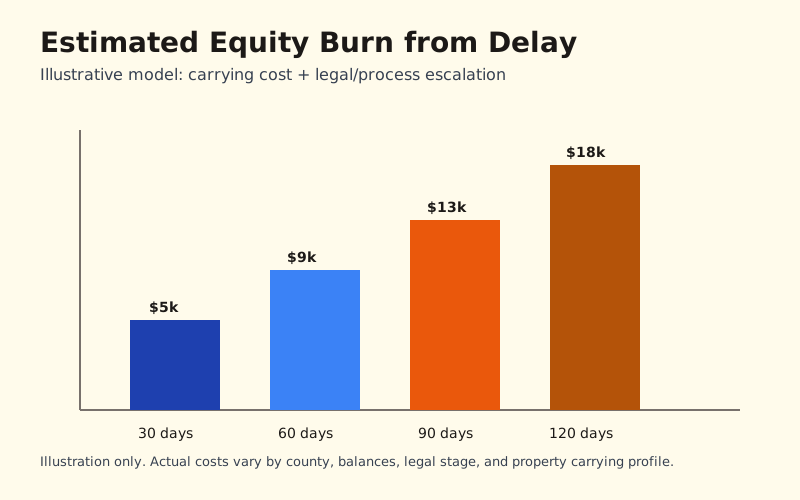
In tax-delinquency situations, owners often track only the original tax amount. That is a mistake. The economically relevant number is the all-in cure burden: principal delinquent taxes, interest accrual, penalties where applicable, attorney fees once legal action begins, publication expenses, and carrying costs while the property remains unresolved. Even if each component looks manageable in isolation, combined growth can significantly reduce exit equity.
Think of this as equity burn rate. If your total monthly drag is $1,800 between accrued obligations and ordinary carrying costs, a six-month delay consumes roughly $10,800 before negotiation discounts or repair concessions are considered. In high-stress files, additional delay also weakens negotiating position with buyers because certainty drops and counterparties price risk into offers.
This is why owners nearing enforcement should run a three-scenario model: cure now, sell within 30-60 days, or defer decision for 90+ days. The model does not need to be perfect. It needs to be honest enough to show direction. If delayed action consistently shows lower expected net, you have your answer even if it is not emotionally comfortable.
Families managing inherited properties should include estate administration costs, vacancy risk, insurance adjustments, and deferred maintenance in the same model. A house that "feels like it should be worth more if we wait" can still produce less net if unresolved taxes and carrying drag consume the upside. The goal is not to win a pricing argument; it is to preserve usable proceeds.
| Cost Category | How It Enters the File | Common Underestimate | Control Lever |
|---|---|---|---|
| Delinquent tax principal | Original unpaid obligation | Owners track this but ignore additions | Immediate balance verification |
| Interest and statutory add-ons | Accrues over delinquency period | "It won't be much" assumption | Request detailed payoff breakdown |
| Attorney/legal process costs | Added during formal enforcement | Not modeled until too late | Resolve before deeper filing stages |
| Publication/sale administration | Triggered by sale process | Treated as minor but can stack | Avoid reaching sale mechanics if possible |
| Carrying costs | Utilities, insurance, maintenance, mortgage, HOA | Excluded from decision math | Run monthly net-burn model |
6. The decision fork: keep the property, sell conventionally, or sell quickly
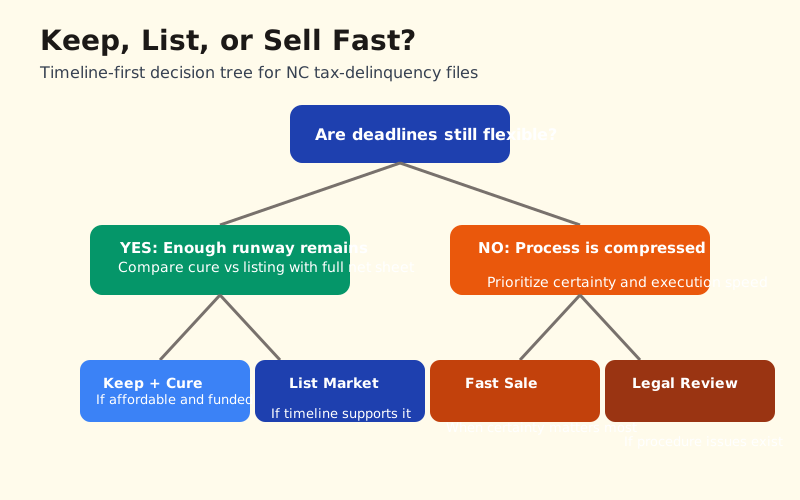
Once a property tax file enters serious delinquency, every family hits the same fork. Option one: keep the property and cure delinquency through available resources, payment arrangements, or financing. Option two: market the property conventionally to maximize gross price, accepting timeline and execution risk. Option three: pursue a faster sale path that prioritizes certainty and speed, usually at some pricing discount. None of these is morally superior. They are tradeoffs.
To choose correctly, match strategy to constraints. If income is stable, title is clean, and cure funds are realistic, keeping the home may still be practical. If the property is market-ready and you have enough runway before legal milestones, conventional listing may preserve more gross value. If deadlines are compressed, repairs are heavy, or title complexity is high, a fast as-is sale can outperform in net certainty even with a lower headline offer.
The wrong move is hybrid indecision: spending weeks preparing for a traditional listing while also hoping for a payment-plan rescue, then pivoting to a rushed investor sale after publication deadlines escalate pressure. That sequence often yields the lowest net because each pivot burns time and bargaining leverage. Decide early, execute hard, and reassess only at pre-set dates rather than daily anxiety swings.
If you are comparing quick offers, use net-sheet discipline. Require proof of funds, ask for clear closing timeline commitments, and stress-test contract escape clauses. A high nominal offer with broad assignment or inspection-outs may be less reliable than a lower offer from a buyer with stronger execution history. In timeline-driven tax cases, certainty itself has financial value.
| Path | Best-Fit Conditions | Main Risk | Time Sensitivity |
|---|---|---|---|
| Keep and cure | Stable income + realistic cure capacity | Underestimating total cure amount | High |
| Conventional listing | Property shows well + adequate runway | Buyer financing/appraisal delays | Moderate to high |
| Fast as-is sale | Compressed deadlines + condition/title friction | Over-discounting due to panic | Very high |
For buyer-vetting frameworks in distressed timing situations, see our cash offer guide for the Carolinas. For broader sell-timing context outside distress constraints, compare with best time to sell in the Carolinas.
Facing NC tax foreclosure and want a clean exit?
We buy homes in any condition and can send a real cash offer so you can close on your timeline, before legal costs climb.
7. Pre-foreclosure action checklist: what to do in the next 7 days
If your taxes are delinquent and enforcement pressure is rising, momentum matters more than perfection. The next week should produce a complete information set and one chosen strategy. Do not spend this window consuming more generic articles. Spend it gathering file-level facts and assigning deadlines.
Start by requesting a payoff or current balance breakdown from the county tax office, including interest and any additional charges currently posted. Ask whether there is a payment arrangement process and what documentation is required. If you are represented by family, confirm authorization pathways so staff can discuss account details with the helper actually doing the work.
Next, run your property-side file: estimated as-is value, realistic list-ready value, known repair liabilities, occupancy status, utility status, HOA status, and title flags (probate, divorce orders, liens, judgments). These are not side details. They determine which exit route is truly executable before deadlines tighten further.
Finally, create a dated action board with owner tasks, helper tasks, and outside-party tasks. Every task gets an owner and due date. The moment your file gets emotional, the board keeps execution grounded. Without it, families repeat the same conversations while deadlines keep moving.
- Call county tax office; request written balance and process notes.
- Collect all notices in one digital folder plus printed backup.
- Confirm title authority and signer requirements for any sale path.
- Obtain at least two pricing opinions (agent + investor or broker + direct buyer).
- Contact legal aid/housing counselor if affordability or legal process questions exist.
- Choose one primary path and one fallback by end of week.
8. When foreclosure is filed: what changes immediately for homeowners
Once a tax foreclosure action is filed or clearly underway, planning must shift from flexible strategy to deadline execution. The question is no longer "what could we do this season?" It is "what can we complete before the next procedural trigger?" This shift catches people off guard because they still feel like owners with broad discretion while the file is now inside a legal process with structured steps.
At this phase, communication discipline is critical. Keep copies of every notice, envelope, posting, and correspondence. Log every call with date, time, name, and what was said. If you receive instructions verbally, request written confirmation. In legal timelines, undocumented assumptions are where costly misunderstandings begin.
If you are pursuing a sale, align closing timeline with legal milestones and confirm payoff timing windows in writing. If you are pursuing cure or legal challenge, coordinate counsel/counselor support quickly. Delays of even one to two weeks can materially reduce feasible options, especially where hearings and sale calendars are already set.
Do not rely on internet myths such as "if I file X random letter everything pauses" or "counties always postpone." Some matters can be continued or resolved; some cannot. Your file outcome depends on facts, compliance, and timing, not folklore. Treat every statutory and court deadline as real unless a competent authority confirms otherwise in writing.
| File Status | Common Homeowner Belief | Reality | Better Response |
|---|---|---|---|
| Foreclosure initiated | "I still have plenty of time" | Timeline is now procedural and compressing | Build 30-day execution calendar |
| Sale date discussion begins | "I can decide after auction notice" | Decision quality worsens late | Commit to a path before formal sale pressure |
| Multiple notices received | "They're all duplicates" | Each notice can carry separate legal significance | Catalog and review each item carefully |
9. Sale mechanics and upset bids: why "auction day" is often not final
In North Carolina foreclosure contexts, the first auction event is often misunderstood as final disposition. In many counties, upset-bid procedures can extend the process after sale by allowing qualifying higher bids during designated windows. As county guidance from places like Orange and Gaston emphasizes, each qualifying upset bid may restart the clock. Homeowners, heirs, and even casual observers are surprised by how much "post-sale" uncertainty can remain.
This matters for two reasons. First, families making moving, storage, or handoff plans should not assume immediate finality on initial sale day. Second, stakeholders tracking potential equity outcomes need to monitor whether additional bidding changes expected distribution dynamics. Even if owners cannot redeem, timeline resets can affect practical planning and communication with all involved parties.
Operationally, this is a Clerk-and-county-detail phase. Where to file bids, what funds qualify, how deadline counting works, and how notices are posted can be specific and unforgiving. Missing a procedural requirement by a small margin can invalidate a planned action. If your file is in this stage, daily monitoring is better than occasional checking.
For homeowners still trying to preserve options, the lesson is earlier action. Upset-bid complexity is not where you want to begin strategic decision-making. It is where late decisions go to run out of room. Use this section as awareness, not as your first intervention point.
| Upset-Bid Concept | Practical Meaning | Risk If Ignored |
|---|---|---|
| 10-day bid windows | Post-sale timeline may remain open for qualifying bids | False assumption of immediate finality |
| Minimum increase and deposit rules | Only properly filed bids count | Invalid submissions waste time and money |
| Clock reset with new qualifying bids | Process can extend beyond first expected close | Planning errors for occupancy and logistics |
10. Inherited properties with delinquent taxes: probate and tax clocks collide
Inherited homes are overrepresented in serious property-tax delinquency files because authority, communication, and maintenance get fragmented after a death. One sibling believes taxes are current. Another assumes the mortgage escrow handles everything. A third is not sure who can legally sign sale paperwork. Meanwhile, county delinquency timelines continue regardless of family alignment.
The first challenge is legal authority. Depending on estate status, only an executor/administrator (or otherwise authorized party) may have power to enter contracts and close transfers. If authority is unclear, buyers hesitate, title companies slow down, and timeline pressure increases. This is why probate status is not a side issue in tax delinquency cases; it is central to whether any resolution path can actually close.
The second challenge is condition and occupancy drift. Vacant inherited homes can deteriorate quickly, and deferred repairs reduce conventional buyer appetite just when time flexibility is shrinking. Families often hold out for peak market pricing while the house quietly becomes less marketable and more expensive to carry. The result is delayed sale at a lower net than an earlier realistic approach would have delivered.
If your file involves inheritance, create a dual-track plan immediately: estate compliance track and sale/cure track. Calendar both. Delay in either track can stall everything. For detailed probate-first workflow, see our NC inherited property guide.
| Inherited-Home Issue | How It Affects Tax Timeline | Fix |
|---|---|---|
| Unclear signer authority | Sale cannot close when needed | Confirm estate appointment status early |
| Family disagreement on strategy | Decision delays increase costs | Set voting/deadline protocol in writing |
| Vacancy and deferred maintenance | Buyer pool shrinks under pressure | Choose as-is strategy sooner if needed |
| Missing records/notices | Harder to evaluate true urgency | Centralize all county and court communications |
11. Mortgage foreclosure vs tax foreclosure: how mixed-distress cases go wrong
Some owners face both mortgage arrears and delinquent property taxes. In those mixed-distress files, people often focus on whichever notice feels scariest that week, rather than managing both timelines in parallel. That reactive approach fails because tax enforcement and mortgage enforcement can proceed on different clocks and with different cure mechanics.
Mortgage delinquency may involve servicer loss mitigation, federal servicing rules, and deed-of-trust procedures. Property tax delinquency involves county collection authority and tax-foreclosure mechanisms. One process does not automatically pause the other. Assuming "if I solve the mortgage, the tax file goes away" is risky without explicit confirmation and documented payoff resolution.
The safer method is dual-calendar management. Build one timeline for mortgage events and one for county tax events, then identify cross-over decision points where one action supports both outcomes (for example, a sale that clears both obligations). In mixed-distress cases, sale coordination and payoff verification are often the decisive operational tasks.
If mortgage foreclosure pressure is your primary immediate threat, use our NC foreclosure help guide and NC foreclosure timeline breakdown alongside this tax-focused guide. The key is integrated planning, not choosing one risk stream and hoping the other waits.
12. Legal aid, housing counselors, and county contacts: who to call and when
Homeowners in distress often delay outreach because they think professional help is only for "final emergency" moments. In reality, counselor and legal-aid support is most useful when there is still enough runway to execute recommendations. North Carolina owners can use HUD-approved counseling pathways and state-connected resources such as the NC Housing Finance Agency's foreclosure-prevention ecosystem for mortgage-related hardship guidance.
For legal process questions, the NC Judicial Branch help topics and Legal Aid channels provide orientation and intake pathways. Not every household will qualify for full representation, and not every issue requires litigation. But early contact helps separate solvable administrative problems from cases that truly need legal intervention. That triage alone can save critical weeks.
County tax offices remain central in tax-delinquency files. They control balance information, payment channels, and process communication for local enforcement tracks. Treat county staff as process authorities and keep communications respectful, concise, and documented. Ask for written confirmation of key figures and deadlines whenever possible.
Below is a practical outreach sequence that works for most households: county tax office first for numbers and status, housing counselor for affordability and planning support, legal aid/counsel for process disputes or rights analysis, then property-disposition team if sale becomes the chosen route. Sequence prevents duplicated effort and reduces panic-driven mistakes.
| Resource Type | Best Use Case | When to Contact |
|---|---|---|
| County Tax Office | Balance, payment options, process status | Immediately |
| HUD/State Counseling | Budgeting, affordability, housing guidance | Early delinquency through active distress |
| Legal Aid / Attorney | Notice, procedure, rights and defense questions | As soon as legal process concerns arise |
| Listing/Cash Buyer Team | Disposition execution and timeline matching | When keep-and-cure is not viable |
Get Your Free, No-Obligation Cash Offer
Tell us about your home and we’ll send a real cash offer, any condition, and close on the timeline that works for you.
13. 30-60-90 day planning model for owners deciding whether to sell
A practical way to cut through uncertainty is to model your likely net outcome at 30, 60, and 90 days under one chosen path. Most owners compare today's offer to an aspirational future sale price and stop there. That comparison is incomplete because it ignores carry, risk of delay, and changing buyer leverage as deadlines tighten.
Start with a conservative estimate of what you can net today after all known obligations. Then project what changes by day 60 and day 90 assuming no best-case miracles: additional carrying costs, likely additional legal/process costs, and realistic concession pressure if buyers know your timeline is constrained. If the model shows declining net with delay, your priority should shift from maximizing list price to maximizing closed certainty.
Do not treat this as defeatist math. It is decision clarity. Some files genuinely improve with short delay if repairs materially expand buyer demand and timeline room still exists. Others deteriorate quickly and should move now. The model tells you which reality you are in, rather than letting anxiety pick the story of the day.
Households with shared decision makers should review this model in one meeting and decide with explicit criteria. If you set a trigger such as "if projected 60-day net is lower than current executable net by more than $8,000, we list/sell now," then everyone has a rule to follow when stress spikes.
| Model Variable | 30-Day View | 60-Day View | 90-Day View |
|---|---|---|---|
| Expected gross sale price | Baseline based on current condition | May improve slightly with prep or decline with stigma | Uncertain; often pressured by timeline |
| Total obligations payoff | Current known figures | Higher due to accrual and added costs | Higher still, plus execution risk premium |
| Carrying and operational drag | One month cost | Two months cost | Three months cost |
| Probability-adjusted net | Highest certainty if plan is executable now | Moderate certainty if no delays occur | Lowest certainty in constrained files |
14. Common myths that cost NC homeowners money in tax-delinquency cases
Myth 1: "The county won't really foreclose over taxes." Counties generally prefer voluntary payment, but statutory enforcement authority exists for a reason and is used. Betting your equity on disbelief is a poor strategy.
Myth 2: "If I wait for a better market, I'll come out ahead." Sometimes waiting helps, but in distressed timelines the added costs and reduced leverage often erase pricing gains. Run the model; do not trust vibes.
Myth 3: "Auction day means it's over no matter what." Upset-bid procedures can extend finality in many NC contexts. Planning around the first sale date alone causes logistical and emotional whiplash.
Myth 4: "A verbal promise means my deadline is safe." In legal processes, written confirmation and filed status are what protect you. Friendly phone calls are useful, but not enough.
Myth 5: "I have to solve this alone before calling anyone." Early support from tax office staff, counselors, and legal resources often expands options. Silence usually shrinks them.
Myth 6: "I can figure it out later because my family is on the same page." Families are often not on the same page once money, grief, and urgency collide. Write decisions down, assign deadlines, and keep one source of truth.
15. Practical scripts for calls and emails you will actually make
People in distress freeze when they have to make difficult calls. Scripts reduce friction. Use this county-tax-office script: "I'm calling about parcel [ID/address]. I need the current total amount due, itemized by principal, interest, and any added costs, and I need to understand available payment options and current enforcement status. Please send this information in writing to [email]." Keep it short and specific.
Use this counselor outreach script: "I own (or help manage) a property in North Carolina with delinquent taxes and possible foreclosure pressure. I need help evaluating keep-vs-sell options and building a timeline plan. What documents should I prepare before our appointment?" The goal is not to tell your entire story on the first call. The goal is to book the right next step quickly.
Use this buyer/listing comparison script: "I am evaluating options under a compressed timeline. Please provide expected list-to-close timeline, fees, likely contingencies, and probability-of-closing estimate for my property condition and title status." Ask every party the same questions so you can compare apples to apples.
When emailing family decision makers, include only facts, deadlines, and required decisions. Example: "Current county balance as of [date] is [amount]. Next known process milestone is [date/event]. We must choose Path A or Path B by [decision date]. If no vote by then, default to Path B." Clarity beats emotional essays when time is short.
16. If you are within 30 days of a sale event: emergency stabilization plan
At 30 days or less from a major sale milestone, treat your case like a project sprint. Build a single dashboard with these fields: current balance/payoff, next legal date, chosen path, responsible parties, required documents, outside contacts, and daily status. The purpose is to stop context switching and eliminate "I thought someone else handled that" failures.
Lock in communication routines: one daily check-in at a fixed time, one document repository, one point person for each outside contact. Fragmented communication is the top avoidable failure in high-pressure property cases. If three siblings are emailing different people with conflicting instructions, delay and mistrust multiply immediately.
If selling, prioritize certainty execution: verify buyer funds, title readiness, and realistic close date tied to legal timeline. If curing, prioritize funds movement logistics and written confirmations. If pursuing legal process challenges, prioritize attorney coordination and document organization. In every path, remove non-essential tasks. This is not the week for optional upgrades or speculative strategy pivots.
Document every completed step and keep copies offline if possible. When systems fail or messages get lost, your audit trail becomes operational insurance. It also helps any attorney or counselor who joins late understand the file quickly.
17. Frequently asked questions about NC property tax lien timelines
Can a county in NC really start enforcement after only one year of non-payment?
Counties have statutory authority under North Carolina tax-collection law to escalate enforcement, and many county process pages signal active use of delinquency and foreclosure pathways. Exact pacing and steps depend on county practice and case details, which is why local process verification is essential.
Is this the same thing as a mortgage foreclosure timeline?
No. Mortgage foreclosure and tax foreclosure are different legal systems, even when they affect the same property at the same time. You may need a coordinated strategy that addresses both clocks simultaneously.
Do I lose the home immediately on sale day?
Not necessarily. Upset-bid procedures can extend finality after initial sale events depending on jurisdictional mechanics and filings. Treat post-sale periods as active timeline windows until confirmation processes conclude.
Should I wait to call for help until I get a final notice?
Usually no. Earlier outreach to county offices, counselors, and legal resources improves decision quality and preserves options. Late outreach can still help, but choices are often narrower and more expensive.
Can I still sell if enforcement has already started?
Often yes, but execution becomes harder and speed-sensitive. You must align sale timeline, title readiness, and payoff logistics with legal milestones. A delayed or uncertain buyer can cause failure under deadline pressure.
How many offers should I compare if I need a fast sale?
At minimum, gather more than one executable option and compare net certainty, not just price. A lower but highly reliable close can outperform a higher but fragile contract in distressed timelines.
What if this is an inherited house and family members disagree?
Set a documented decision protocol immediately and confirm legal signer authority. Without a clear governance structure, disagreement alone can burn the timeline and reduce net outcomes.
Do I need an attorney for every tax-delinquency case?
Not always. Some files resolve through payment or sale workflows without contested legal issues. However, if notice compliance, authority disputes, or procedural concerns are present, legal guidance can be essential.
What documents should I keep from day one?
All notices, envelopes, payoff statements, tax-office communications, title documents, and call logs. Build one folder and maintain it. In compressed timelines, retrieval speed is a competitive advantage.
Where should I begin tonight if I'm overwhelmed?
Do three things: get your current county balance in writing, set one family decision meeting with a firm date, and choose one outreach contact for counselor/legal guidance. Momentum beats rumination.
18. Your next 14 days: a concrete execution calendar
Day 1-2: Request account balance and enforcement status from county tax office, gather all notices, confirm title/authority status, and start a shared document folder. Day 3-4: Obtain property value perspectives and net estimates under at least two disposition paths. Day 5: Hold a decision meeting and choose primary strategy plus fallback trigger.
Day 6-8: Execute chosen strategy tasks only. If curing, gather and move required funds with written confirmation. If selling conventionally, finalize listing readiness checklist and timeline realism. If selling quickly, vet counterparties, verify funds, and negotiate for certainty terms. Day 9-10: Reconcile all timelines with legal milestones and adjust task owners where slippage appears.
Day 11-12: Reconfirm payoff numbers and required closing mechanics. Ensure everyone working your file has current information, not old screenshots. Day 13-14: Run a hard status review: what is done, what is late, and what must happen in the next seven days to protect your chosen outcome. If the primary path is slipping, trigger your fallback without debate.
This cadence may feel rigid, but rigidity is what protects equity in deadline-driven cases. Flexibility sounds good in normal real estate cycles. In delinquency enforcement timelines, disciplined execution is the safer form of compassion for your future self. The households that treat the NC property tax lien timeline like a project plan usually keep more options than households that treat it like background noise.
If you need a broader framework for Carolina homeowners weighing timing and sale-channel decisions, use this guide alongside cash offer comparison guidance, NC foreclosure support resources, and NC inherited-home process planning. The goal is not a perfect script. The goal is the best executable outcome before the timeline gets narrower.
19. Detailed scenario walkthroughs: four NC households and how timing changed the outcome
Scenario A: Retired owner in Wake County with fixed income shock. A retired homeowner misses property-tax payments after a medical event increases monthly expenses. For six months, they assume they can "catch up later" because the home is mortgage-free and long owned. When delinquency notices become more serious, they still delay because friends repeat that counties rarely enforce quickly on seniors. By the time family steps in, accrued obligations are materially higher and stress is severe.
What changed the outcome in this scenario was not a legal loophole. It was operational structure. The family requested a complete balance breakdown from the county, built a budget-based affordability snapshot, and then compared two executable paths: staged cure with support from relatives versus sale of a secondary parcel that had been left idle. Because they moved from stories to numbers, they stopped making week-to-week emotional decisions. The homeowner avoided deeper enforcement and preserved housing stability.
Scenario B: Inherited house in Mecklenburg with sibling disagreement. Three siblings inherit a home with delinquent taxes and deferred maintenance. One sibling wants full retail listing after renovations. One wants immediate as-is sale. One avoids all decisions due to grief and distrust. Two months pass with no action while carrying and delinquency pressure rise. Buyer interest drops as condition worsens and neighbors start discussing public notices.
The turning point came when the siblings adopted a written governance protocol: one document repository, one weekly decision call, majority vote by set date, and an agreed fallback if no consensus. They also confirmed estate authority and title steps early. The selected path was a faster as-is sale with a backup listing trigger if contract failed. Because they reduced internal friction, they closed before the file became even more expensive. Net proceeds were lower than peak-market fantasies but significantly higher than the late-stage alternatives they would have faced if disagreement continued.
Scenario C: Mixed-distress owner with both mortgage and tax arrears. This owner focused exclusively on mortgage calls while assuming county tax problems would resolve once mortgage status improved. Instead, county enforcement timeline continued in parallel. By the time they recognized dual exposure, they had to solve two escalating files at once. That pressure reduced negotiation leverage with everyone involved.
Recovery required dual-calendar planning and strict triage. The household built separate workstreams for mortgage mitigation and tax delinquency, then linked them through one disposition decision: sell before either process moved to a less controllable phase. They evaluated two conventional-listing options and two faster buyers, selecting the route with highest probability-adjusted net based on verified timeline fit. The key lesson was not speed alone; it was alignment. Fast but misaligned actions can fail. Properly aligned actions close.
Scenario D: Rural owner with vacant home and optimism bias. The owner believed waiting for spring demand would improve price enough to offset current distress. But the property remained vacant with limited maintenance and occasional vandalism risk. Insurance, utility minimums, and delinquency obligations kept accumulating. In practice, each month of waiting reduced net certainty more than expected future price upside could recover.
Once the owner modeled 30-60-90 day net outcomes with realistic carrying and risk assumptions, the decision became clear. They moved to an as-is strategy with transparent disclosures and a short execution window. The final number was not emotionally satisfying, but it was financially superior to continued delay. The owner's quote after closing is the most honest summary of distressed timeline decisions: "I didn't get the price I wanted. I got the outcome I could actually complete."
These scenarios are intentionally ordinary. Most NC tax-delinquency files are not legal dramas with dramatic courtroom reversals. They are execution challenges where clarity, documentation, and timing discipline decide outcomes. If you see your household in one of these stories, treat that recognition as a practical asset. Familiar pattern means you can borrow proven structure instead of improvising under pressure.
| Scenario | Main Failure Pattern | Correction That Worked | Primary Lesson |
|---|---|---|---|
| Retired owner | Assumed timeline flexibility without data | Balance verification + affordability-based plan | Numbers beat assumptions |
| Inherited sibling case | Family gridlock and no authority workflow | Written governance + early title authority check | Decision process is part of strategy |
| Mixed mortgage/tax distress | Managed one clock, ignored the other | Dual calendars + aligned sale execution | Parallel timelines require integrated planning |
| Vacant rural property | Optimism bias on future pricing | Probability-adjusted 30-60-90 modeling | Certainty can outperform speculation |
20. A document pack that survives stress: exactly what to collect before deadlines tighten
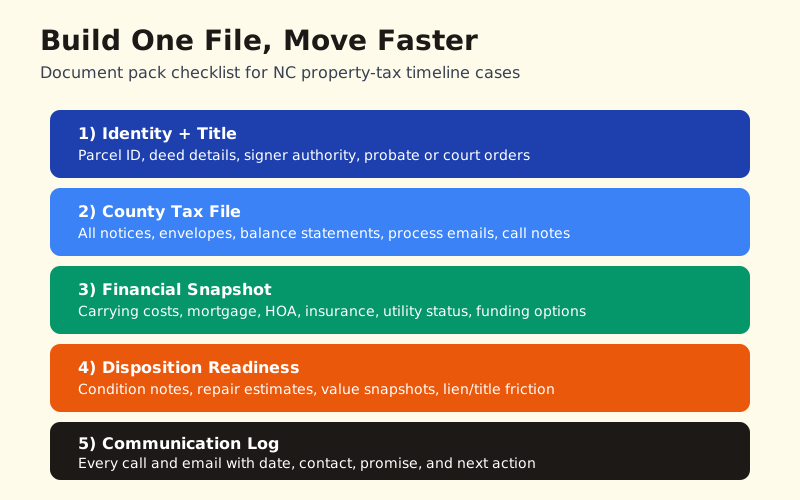
When homeowners say they "have the paperwork somewhere," they usually do not have a usable file. Under timeline pressure, the difference between scattered records and a structured document pack is the difference between making decisions and making guesses. A good pack does not need legal perfection. It needs fast retrieval, clear naming, and enough evidence to support whatever path you choose next.
Start with property identity documents: parcel number, legal address, owner name exactly as recorded, and any recent deed instrument references you can locate. Then collect every county notice and envelope in chronological order. Envelopes matter because postmarks and delivery details can become relevant in process discussions. Scan everything into one folder with date-first naming conventions (for example, "2026-02-14_county_notice_balance_update.pdf").
Next, assemble financial decision documents: current county balance breakdown, recent tax statements, mortgage statement if applicable, HOA account status, utility obligations, insurance declarations, and a simple carrying-cost worksheet. Your worksheet should include monthly outflow and any one-time expected expenses needed to close a sale or cure delinquency. If your household has multiple contributors, include who can actually fund each item and by when.
Then add transaction readiness documents: known liens or judgments, probate letters (if inherited), divorce orders (if relevant), repair estimates, occupancy status notes, and at least two marketability snapshots (list-ready estimate and as-is estimate). You are not trying to produce a marketing brochure. You are building a decision tool that helps advisors, buyers, and family members evaluate executable paths quickly.
Finally, maintain a communication log. Every call gets date, time, party, summary, and promised follow-up. Every email gets saved in one thread folder. This log becomes critical when memories diverge under stress. It also protects you from repeated tasks because you can confirm what was already requested, delivered, and acknowledged.
A well-structured document pack helps in three ways: it accelerates professional support, improves negotiation quality, and reduces emotional conflict inside families. People argue less when facts are visible. Advisors can act faster when they do not spend the first week reconstructing the file. Buyers and counterparties are less likely to exploit uncertainty when your household is organized and deadline-aware.
| Document Group | Must-Have Items | Why It Matters | Owner |
|---|---|---|---|
| Identity and title | Parcel info, deed references, signer authority records | Prevents contract/closing authority failures | Primary decision maker + title contact |
| County tax file | Notices, envelopes, balance breakdowns, process correspondence | Defines urgency and payable amounts | Tax-office point person |
| Financial profile | Carrying-cost worksheet, mortgage/HOA/utility/insurance status | Supports keep-vs-sell modeling | Finance coordinator in household |
| Disposition readiness | Condition notes, repair estimates, pricing snapshots, lien notes | Improves execution reliability | Agent/buyer comparison lead |
| Communication log | Call and email records with dates | Stops confusion and duplicate effort | Single file administrator |
If this feels like a lot, break it into two 90-minute sessions. Session one builds the skeleton folders and captures whatever is already on hand. Session two fills identified gaps and assigns who will obtain missing items. The act of structuring the file is often the moment homeowners move from reactive fear to active control.
Want a fast, certain sale before the upset-bid window closes?
A cash sale skips repairs, showings, and financing delays. We can send an offer and close when you need to.
21. Negotiation under timeline pressure: how to protect net outcomes when you cannot protect perfect price
Tax-delinquency cases push owners into negotiation environments where counterparties can sense urgency. Some buyers and service providers respond professionally. Others lean into pressure tactics, vague commitments, or contract language that preserves their flexibility while consuming your remaining time. To protect your net, negotiate around certainty variables as much as headline numbers.
For conventional listing paths, insist on an execution conversation before signing anything: likely days-on-market for your condition bracket, expected financing profile of buyers, fallback strategy if appraisal is weak, and how your timeline constraints will be disclosed and managed. A listing plan that sounds impressive but ignores deadline friction is not a strategy; it is marketing theater.
For fast-sale paths, require verifiable proof of funds and ask direct questions about assignment rights, inspection contingencies, re-trade behavior, and earnest money structure. A high offer with broad unilateral exit rights can be functionally weaker than a modest offer from a buyer with tighter terms and demonstrated close performance. In compressed files, the expected value of certainty can exceed nominal price gaps.
Use a normalized comparison sheet for all options. Include offered price, estimated closing date, required seller concessions, contingency risk, and probability-adjusted net. Scoring options on the same criteria prevents charismatic presentations from distorting decisions. It also helps families align because disagreements become about assumptions in a shared model rather than unstructured opinions.
Do not negotiate from apology language. You are not asking for favors. You are offering a real asset under known constraints. Clear disclosures and disciplined process are strengths, not weaknesses. Counterparties who punish transparency are usually high-risk partners anyway. Better to discover that early and move on.
If you receive multiple offers, test each one with one simple stress question: "If we hit a title or scheduling issue, what exactly is your process and timeline to resolve, and can you commit in writing?" Serious operators answer concretely. Weak operators pivot to vague reassurance. In deadline files, vague reassurance is a red flag.
| Negotiation Variable | What to Ask | Strong Answer Looks Like | Weak Answer Looks Like |
|---|---|---|---|
| Funds certainty | Can you provide current proof of funds and close history? | Immediate documentation and specifics | "Trust us, we'll handle it" |
| Contingency discipline | What conditions allow repricing or cancellation? | Narrow, clear, written conditions | Broad discretionary exits |
| Timeline realism | What date can you actually close given this file? | Date tied to concrete process steps | Aggressive date with no method |
| Issue resolution | How do you handle title/scheduling surprises? | Defined escalation and communication plan | General promises without detail |
Remember the target metric: reliable net proceeds before the timeline worsens. Perfect pricing is rarely available in distress contexts. Reliable execution is.
22. Closing the loop after resolution: how to avoid repeating the same tax timeline crisis
Once a delinquency file is resolved (through cure, plan, or sale), most households understandably want to forget the experience. But the highest-value move is a short postmortem while details are fresh. The goal is prevention. Property tax distress usually repeats through the same channels: poor notice tracking, unclear responsibility, no reserve planning, and delayed decision habits.
Begin with responsibility mapping. Who is accountable for checking annual tax status? Who confirms whether escrow is actually paying as expected? Who opens and logs county notices if the owner travels, is ill, or is otherwise unavailable? If the answer to each is "we all kind of do it," then no one really does it. Assign names.
Next, build a lightweight annual tax-control routine: calendar reminders before and after due dates, one shared file location for tax statements and proof of payment, and a quarterly five-minute check on any open county correspondence. This is not bureaucratic overkill. It is cheap insurance against reliving a much more expensive timeline later.
For inherited or jointly owned properties, formalize a governance note even if relations are currently calm. Include voting rules, spending thresholds, emergency decision authority, and what triggers a sale discussion. Families rarely fail because they lack love. They fail because they lack operating rules when stress arrives.
Financially, create a property-resilience reserve target. Even modest reserves reduce panic and improve bargaining position when surprises happen. If reserve-building is difficult, at least define early-warning thresholds that trigger immediate action, such as missing one payment or receiving a first delinquency notice. Early response is the cheapest response.
Finally, retain your document pack template. The structured folders and logs you built during crisis should become your standard property-management system. Future-you will thank present-you for making complexity boring and repeatable.
| Post-Resolution Habit | Frequency | Owner | Benefit |
|---|---|---|---|
| Tax status verification | At least quarterly and around due dates | Named property manager/family lead | Catches issues before enforcement stage |
| Notice log maintenance | Every new communication | Document administrator | Prevents lost deadlines and confusion |
| Reserve and affordability review | Monthly | Finance lead | Improves shock resilience |
| Co-owner governance check-in | Semiannual | All decision makers | Reduces conflict during future stress |
| Disposition contingency plan | Annual refresh | Owner + trusted advisors | Speeds response if distress returns |
North Carolina's tax enforcement framework is not designed to surprise people; it is designed to function consistently. Households that build equally consistent management habits rarely reach late-stage distress. Households that rely on memory and optimism eventually collide with a system that tracks dates better than humans do. The good news is you can choose which household you become starting now.
23. Final pre-deadline sanity review: 12 questions to answer before you sleep tonight
When households are exhausted, they default to "we're working on it" language that hides unresolved risk. A sanity review converts vague progress into binary clarity. Run these questions in order and write yes/no next to each one: (1) Do we have the latest county balance in writing? (2) Do we know the next legal or procedural date? (3) Do we have one chosen primary strategy? (4) Do we have one fallback trigger with a date? (5) Is signer authority confirmed for contracts and closing? (6) Have we assigned one owner per task?
Continue: (7) Are all notices and communications in one folder? (8) Have we compared options using net certainty, not just price? (9) Have we spoken with the right support resource for our bottleneck (county staff, counselor, or legal help)? (10) Do all family decision makers see the same timeline board? (11) Are we still executing tasks that match our chosen strategy? (12) If the primary plan fails tomorrow, do we know exactly what happens next?
If you answer "no" to more than three questions, you are not behind because you are incapable; you are behind because the process is not yet tight enough for the timeline you face. Tighten it tonight. Move one unresolved item to done status before bed. Momentum compounds in your favor the same way delays compound against you.
NC property-tax delinquency files reward disciplined follow-through. The system is date-driven, and dates do not negotiate with anxiety. Your advantage is execution: clear records, clear responsibilities, clear deadlines. That is how ordinary homeowners work through difficult files and still protect meaningful equity when circumstances are far from ideal.
This guide is for educational purposes and does not constitute legal or financial advice. North Carolina property-tax foreclosure is governed by NCGS Chapter 105 (notably §§ 105-374 and 105-375); county process and timing vary, so verify your specific file against your county's current tax-office and Clerk of Court instructions. Consult a real estate attorney or licensed tax professional for advice specific to your situation. Content written by CC Evans, RobinOffer, with research current as of July 2026.
See What We’d Pay for Your Home
No pressure and no obligation—just a real cash offer, any condition, with a closing date you choose.
Free Action Plan
Get the free Property Tax Action Plan
The tax-sale deadlines and your options, in plain English — payment plans, relief programs, and how to protect your equity. Email only. Unsubscribe anytime.