
Selling a House As-Is in North Carolina
A practical guide to disclosure rules, buyer-pool constraints, pricing strategy, and real net-proceeds tradeoffs for NC homeowners.
Also relevant: if your mortgage payoff is higher than expected net sale value, read Underwater Mortgage Options in North Carolina for retention-vs-sale decision math.
For a city-level execution plan built around ECU and Pitt County demand patterns, see our Greenville homeowner selling options guide.
1. What "As-Is" Actually Means in North Carolina (and What It Doesn't)
Selling a house as-is in North Carolina means you're telling buyers: this is the house, this is its condition, and we're not fixing anything before closing. That's it. It's a negotiating position, not a legal shield.
Most homeowners who Google "sell my house as-is" think it means they can skip disclosures, dodge inspections, and close in a week. Wrong on all three counts. Here's what as-is actually means in NC, and the three things it absolutely does not mean:
What As-Is Does
- Sets buyer expectations. You're signaling up front that the price reflects the home's current condition. Buyers who make offers know they're buying the problems along with the property.
- Eliminates repair negotiation obligation. When a buyer's inspector finds a bad roof or failing HVAC, you can say "no" to repair requests without breaching the contract. You're not required to fix anything.
- Attracts the right buyer pool. Investors, flippers, and renovation-loan buyers self-select into as-is listings. You waste less time with buyers who want a turnkey home.
What As-Is Does NOT Do
- It does not exempt you from disclosures. North Carolina law (Chapter 47E) requires you to provide the Residential Property and Owners' Association Disclosure Statement regardless of how you sell. As-is, through an agent, FSBO, the form is mandatory. More on this in Section 2.
- It does not prevent inspections. Buyers can still hire inspectors during the due diligence period. They can still walk away based on what they find. As-is just means you won't fix what they find, it doesn't mean they can't look.
- It does not guarantee a fast sale. If you price an as-is home at full market value, it will sit. If the condition issues are severe enough to disqualify FHA and VA financing, you've cut your buyer pool by more than half. Speed depends on pricing, not labeling.
2. The NC Disclosure Trap: You Still Have to Fill Out the Form
This is where most sellers get tripped up. You've decided to sell as-is because you don't want to deal with the condition issues. Makes sense. But North Carolina doesn't care about your preference, you still owe the buyer a completed disclosure form.
The RPOADS Form
Every residential property sale in North Carolina (1-4 units) requires the seller to complete and deliver the Residential Property and Owners' Association Disclosure Statement. You must provide this form to the buyer no later than the time they make an offer. Not at closing. Not after inspection. Before or at the time of the offer.
The form has dozens of questions covering:
| Category | What They Ask | Examples |
|---|---|---|
| Structural | Foundation, walls, floors, roof condition | Cracks, settling, water intrusion, sagging |
| Systems | HVAC, plumbing, electrical, water heater | Age, functionality, known issues |
| Water | Flooding, drainage, moisture, well/septic | Standing water, wet crawlspace, failed perc test |
| Environmental | Asbestos, radon, lead paint, underground tanks | Pre-1978 homes, tested levels, removal status |
| Legal | Liens, encroachments, zoning violations, HOA | Tax liens, boundary disputes, code violations |
| Additions | Unpermitted work, renovations without inspection | Converted garages, added bathrooms, deck permits |
The "No Representation" Loophole (Sort Of)
Here's the part that confuses everyone. For each question on the RPOADS form, you have three choices:
- Yes, you know about a condition and you're disclosing it
- No, you're stating you have no knowledge of that condition
- No Representation, you're not making any claim either way
Many as-is sellers check "No Representation" across the board, thinking this protects them. It does reduce your exposure, if you mark "No Representation," you're not making a warranty about that condition. But here's the catch: if you have actual knowledge of a defect and choose "No Representation" to hide it, that's fraud.
The NC Real Estate Commission has been clear on this. A seller who knows the basement floods every spring and marks "No Representation" on the water intrusion question isn't being clever, they're creating legal liability. The disclosure form isn't asking what you want to share. It's asking what you know.
Additional Required Disclosures
Beyond the RPOADS, North Carolina and federal law require these additional disclosures regardless of as-is status:
- Lead-Based Paint Disclosure, required for all homes built before 1978. Federal law, no exceptions.
- Radon Gas Warning, NC statute requires a written warning about radon risk and recommending the buyer test the property.
- Property Tax Reassessment Notice, warning the buyer not to rely on your current tax bill since a sale triggers reassessment.
- HOA Disclosure Summary, if the property is in a mandatory HOA, you must provide this before contract execution.
- Synthetic Stucco (EIFS), if the home has synthetic stucco, separate disclosure requirements apply.
One thing you don't have to disclose: North Carolina law explicitly states that sellers are not required to reveal if the home was the site of a death, homicide, suicide, or if a previous occupant had HIV/AIDS.
What Happens If You Don't Disclose
If you skip the disclosure form entirely, the buyer can cancel the contract, full stop. If you fill it out but lie about known conditions, you're exposed to a fraud claim. NC courts have consistently held that as-is language in a contract does not protect sellers who knowingly misrepresent property conditions.
The statute of limitations for a disclosure-related claim in North Carolina is three years from the date of closing. That means a buyer who discovers a concealed problem 18 months after purchase can still come after you. The typical damages include the cost of repairs, plus attorney fees if the court finds willful misrepresentation. We've seen cases in Mecklenburg County where a $3,000 undisclosed plumbing issue turned into a $35,000 judgment after legal fees. Honesty is not just the ethical choice, it's the financially rational one.
3. Seven Situations Where Selling As-Is Is the Smart Move
As-is isn't always the right call. Sometimes spending $15,000 on repairs nets you $40,000 more at closing. But there are situations where as-is is clearly the better path, where the math, the timeline, or the emotional reality makes repairs impractical or financially worse.
1. You Inherited a House You've Never Lived In
Probate in North Carolina takes 6-12 months. By the time you have clear title, the house may have been sitting vacant, deferred maintenance compounding, insurance costs adding up, property taxes coming due. You don't know what's behind the walls because it was never your house. If the inherited home has significant clutter or hoarding conditions, the cleanout cost alone can reach $8,000–$40,000+ before repairs — see our guide to selling a hoarder house in the Carolinas for the full cost breakdown and decision math.
Here's what the carrying costs look like on a typical inherited property in the Charlotte metro while you wait for probate and then try to renovate:
| Monthly Carrying Cost | Typical Amount | 12-Month Total |
|---|---|---|
| Property taxes | $250-$400 | $3,000-$4,800 |
| Insurance (vacant home policy) | $150-$300 | $1,800-$3,600 |
| Utilities (minimum to prevent pipe freeze) | $100-$200 | $1,200-$2,400 |
| Lawn care / basic maintenance | $100-$150 | $1,200-$1,800 |
| Total | $600-$1,050 | $7,200-$12,600 |
That's $7,200 to $12,600 in carrying costs before you spend a dime on renovations. Pouring another $25,000-$40,000 into renovating a property you've never occupied, in a market you may not understand, rarely pencils out, especially when you factor in the capital gains tax implications of improving a property and then selling it. Sell it as-is and put the proceeds toward your own life. If you're in this situation, our inherited property guide for NC walks through the probate timeline and tax implications step by step.
2. You're Facing Foreclosure
North Carolina's foreclosure process moves fast, roughly 120 days from the first notice to the courthouse steps. You don't have time to paint the kitchen and stage the living room. A cash buyer can close in 7-14 days. An as-is MLS listing with aggressive pricing might sell in 30-45 days. Either route beats a foreclosure on your credit report, which tanks your score by 100-160 points and stays there for seven years.
The math is stark: even selling at 60% of fair market value to a cash buyer is better than a foreclosure if you have any equity at all. A foreclosure wipes out your equity entirely, destroys your credit, and, in North Carolina, the lender may pursue a deficiency judgment for any amount the auction sale doesn't cover. An as-is sale, even at a steep discount, lets you control the outcome. For a deeper look at the NC foreclosure process and all your options, see our foreclosure help guide, the step-by-step avoid foreclosure in North Carolina action plan, and our underwater mortgage options in NC guide if your loan payoff is above likely sale value.
3. You're Going Through a Divorce
The house is usually the biggest shared asset, and neither party wants to spend $30,000 of joint money renovating a home they're both trying to leave behind. As-is removes the "who pays for what repairs" argument and speeds up the division of assets. Courts generally accept a lower sale price when both parties agree the as-is route is faster and less contentious. Our divorce selling guide covers the buyout math and legal timeline.
4. The Repair Bill Exceeds Your Available Cash
A $25,000 foundation repair doesn't help you if you don't have $25,000. You can't get a HELOC on a house with known structural issues. Personal loans at 12-18% interest to fix a house you're about to sell make zero financial sense. When the repair cost exceeds your liquid reserves, as-is is the pragmatic choice, take the price hit rather than going into debt to renovate a home you're leaving.
5. You've Already Relocated
Paying two mortgages while managing a renovation from 500 miles away is a special kind of misery. Every month you carry the old house costs you, mortgage, insurance, utilities, lawn care, and the constant stress of coordinating contractors you can't supervise. At $2,500/month in carrying costs, a three-month renovation that runs two months late costs you $12,500 in carrying costs alone, before a single repair dollar is spent.
Charlotte is one of the biggest relocation markets in the country, companies like Bank of America, Lowe's, Honeywell, and the growing fintech corridor bring in thousands of new employees every year. The Research Triangle is NC's other relocation engine, with employers like Cisco, Epic Games, and the sprawling Research Triangle Park pulling families into towns like Apex, if you're relocating out of the Triangle, our Apex homeowner selling guide breaks down every selling path with local numbers. But relocation goes both ways. When you get transferred to Denver or Dallas, your old North Carolina house becomes a liability on your balance sheet. The longer it sits empty, the worse it gets, vacant homes deteriorate faster, attract vandalism, and cost more to insure. As-is selling eliminates the remote-management nightmare and stops the financial bleeding.
6. The House Has a Major System Failure
When the problem is one big-ticket item, the roof needs full replacement ($8,000-$15,000), the septic has failed ($15,000-$35,000), or the HVAC died ($5,000-$10,000), the question isn't whether to sell as-is. It's whether the repair cost plus your time and stress is less than the price discount you'll take on an as-is sale. Sometimes it is. Often it isn't. Run the math in Section 4.
7. You're a Landlord Exiting a Rental
Rental properties accumulate tenant wear that goes beyond normal cosmetic damage. Between turnovers, a full renovation can cost $15,000-$40,000 and take 2-3 months of lost rent. If you're exiting the rental game entirely, selling as-is to another investor, potentially with tenants in place, skips the renovation entirely and puts cash in your hand faster.
4. The Math: As-Is Cash vs. As-Is MLS vs. Repaired MLS
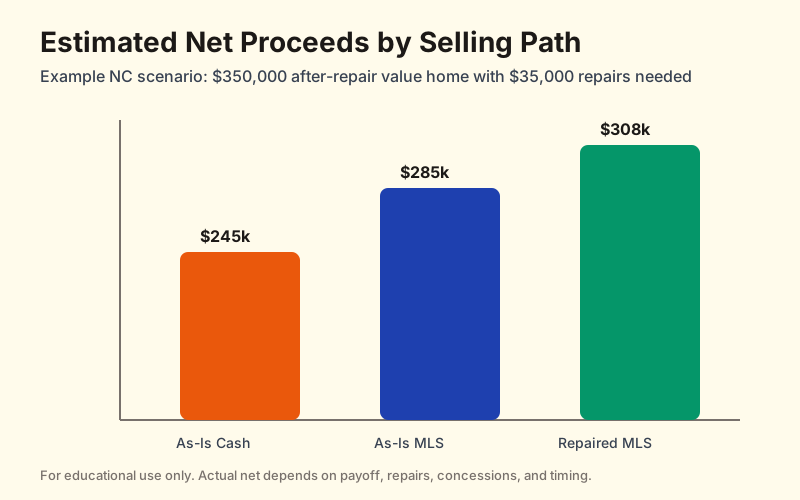
Every other guide on the internet tells you "expect 20-30% less when selling as-is." That's lazy advice. The actual number depends on what's wrong, who's buying, and how you sell. Here are three real scenarios using Charlotte metro numbers.
Scenario: A $350,000 Home Needing $35,000 in Repairs
This is a typical as-is situation, a 3BR/2BA ranch in the Charlotte suburbs with a 22-year-old roof, original HVAC, and some water damage in the crawlspace. Good bones, bad systems.
| Selling Method | Sale Price | Costs | Net Proceeds |
|---|---|---|---|
| Cash Buyer (investor) | $227,500 (65% FMV) | Attorney: $900, Transfer tax: $455 | $226,145 |
| As-Is on MLS | $297,500 (85% FMV) | Agent: $17,850, Attorney: $900, Transfer tax: $595 | $278,155 |
| Repaired + MLS | $350,000 (100% FMV) | Repairs: $35,000, Agent: $21,000, Attorney: $900, Transfer tax: $700 | $292,400 |
Look at those numbers. The gap between selling to a cash investor and listing as-is on the MLS is $52,010. The gap between listing as-is and listing after repairs is $14,245. That second gap is much smaller than most people expect, because the repair cost eats into your additional proceeds.
When Cash Makes Sense Despite the Price Hit
The net proceeds table doesn't account for time and carrying costs. If your mortgage, insurance, taxes, and utilities run $2,800/month:
| Method | Timeline | Carrying Cost | Adjusted Net |
|---|---|---|---|
| Cash Buyer | 14 days | $1,307 | $224,838 |
| As-Is MLS | 60-90 days | $7,000 | $271,155 |
| Repaired MLS | 90-150 days (repairs + listing) | $14,000 | $278,400 |
When you factor in carrying costs, the repaired MLS advantage over as-is MLS shrinks to about $7,245. For some homeowners, especially those paying two mortgages or facing foreclosure, that $8,245 isn't worth three extra months of stress and contractor management.
Scenario 2: A $275,000 Home with Cosmetic Issues Only
Different situation, a 3BR/2BA in Concord or Kannapolis that's structurally sound but looks dated. Popcorn ceilings, wood paneling in the den, avocado green bathroom fixtures, and carpet that's seen better decades. No roof issues, HVAC works fine, foundation is solid. The home qualifies for FHA/VA financing as-is.
| Selling Method | Sale Price | Costs | Net Proceeds |
|---|---|---|---|
| Cash Buyer (investor) | $192,500 (70% FMV) | Attorney: $900, Transfer tax: $385 | $191,215 |
| As-Is on MLS | $255,000 (93% FMV) | Agent: $15,300, Attorney: $900, Transfer tax: $510 | $238,290 |
| Cosmetic repairs + MLS | $275,000 (100% FMV) | Repairs: $8,000, Agent: $16,500, Attorney: $900, Transfer tax: $550 | $249,050 |
Notice the difference. With cosmetic-only issues, the as-is MLS price is much closer to full market value (93% vs. 85% in the structural-damage scenario). The gap between as-is MLS and repaired MLS is only $10,760, and $8,000 of that gap is the repair cost itself. You're netting just $2,760 more by investing $8,000 and 4-6 weeks of time.
This is the scenario where as-is on the MLS shines. The home qualifies for all financing types, so your buyer pool stays broad. The cosmetic issues don't scare serious buyers, they just affect what people are willing to pay. Price it right and you'll attract multiple offers from buyers who see the potential.
Want a cash offer on your house as-is before you decide?
Get a free, no-obligation cash offer — any condition, no repairs, no inspection drama, and close on your timeline.
5. How NC's Due Diligence Period Changes Everything
North Carolina has a contract structure that's different from most states, and it fundamentally changes how as-is sales work here. If you've read advice written for Texas or California sellers, throw it out. NC plays by its own rules.
What Due Diligence Means
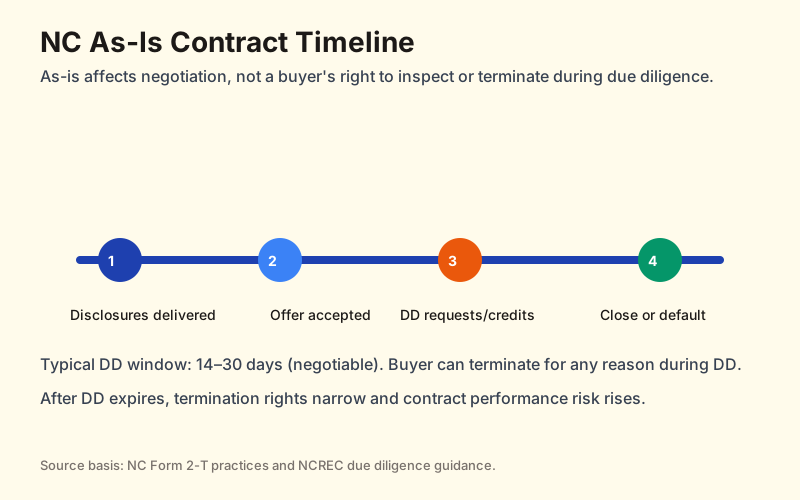
When a buyer makes an offer on your home in North Carolina, the contract includes a due diligence period, a window of time (typically 14-30 days, negotiable) during which the buyer can:
- Inspect the property at their expense
- Get an appraisal
- Secure financing
- Run a title search
- Test for radon, mold, or pests
- Do anything else they need to evaluate the purchase
During this period, the buyer can terminate the contract for any reason or no reason at all. It's a unilateral right. They don't need your consent. They don't need to explain why. They simply notify you in writing, and the deal is dead.
The Money at Stake
NC contracts typically involve two separate payments from the buyer:
| Payment | Typical Amount | When Buyer Terminates During DD | When Buyer Terminates After DD |
|---|---|---|---|
| Due Diligence Fee | $500-$5,000+ (negotiable) | Seller keeps it | Seller keeps it |
| Earnest Money | 1-2% of purchase price | Returned to buyer | Seller keeps it (typically) |
The due diligence fee is the buyer's "skin in the game." It's non-refundable from day one, the seller keeps it even if the buyer walks on day two. The earnest money, however, is only at risk after the due diligence period expires.
What This Means for As-Is Sellers
Here's the critical implication: selling as-is doesn't stop inspections. It doesn't stop buyers from walking. It just changes the negotiation dynamic.
In a traditional sale, the buyer inspects, finds issues, and asks for repairs. The seller either makes the repairs or offers a price credit. In an as-is sale, the buyer inspects, finds issues, and has two choices:
- Accept the property with all its problems (because that's what as-is means)
- Terminate during the due diligence period and walk away
What they can't do, at least not with any contractual leverage, is demand you fix things. You've established that you won't. But they can absolutely use inspection findings to renegotiate the price. And in practice, that's exactly what happens. A buyer whose inspector finds $40,000 in issues will often come back and say: "We'll still buy it, but at $25,000 less than our original offer."
You can say no. But then they walk, you keep the due diligence fee (maybe $2,000), and you start over. The practical reality of as-is selling in NC is that it shifts the repair conversation into a price conversation, but the conversation still happens. If you want to understand the full mechanics, DD fee refund rules, the 21-day action timeline, and how 2026 market conditions affect DD fee levels, our NC due diligence period guide covers every scenario.
When payoff pressure is part of your as-is decision (especially if you owe more than likely sale proceeds), review our underwater mortgage options in NC guide so you can compare cash-to-close, short-sale, and retention paths with the same numbers.
A Real-World Example
Let's walk through how this typically plays out. Say you list your 1980s ranch in Gastonia as-is at $265,000. A buyer offers $260,000 with a $2,500 due diligence fee and a 21-day due diligence period.
On day 5, their inspector finds: roof has 2-3 years left ($12,000 replacement), HVAC is original and on borrowed time ($7,500 replacement), and there's moisture in the crawlspace ($3,500 to encapsulate). Total: $23,000 in documented issues.
On day 14, the buyer's agent calls your agent: "We'd like to proceed, but we're asking for a $20,000 price reduction to $240,000, given the inspection findings."
Your options:
- Accept the reduction. You sell at $240,000, about 90% of your list price. Still no repairs on your end.
- Counter at $250,000. Split the difference. The buyer's already invested $2,500 in DD fees plus inspection costs. Many will accept rather than start over.
- Hold firm at $260,000. The buyer either accepts or walks. If they walk, you keep the $2,500 DD fee and relist. You now know exactly what inspectors will find, so you can adjust your pricing or disclosure strategy.
- Offer a small credit ($5,000-$8,000) instead of a price reduction. This addresses the buyer's concern without reducing the recorded sale price, which matters for your comps and the buyer's appraisal.
This dance happens on virtually every as-is sale in North Carolina. Understanding it in advance, and having a strategy, is the difference between leaving money on the table and making an informed decision.
6. Why FHA and VA Buyers Can't Touch Your House
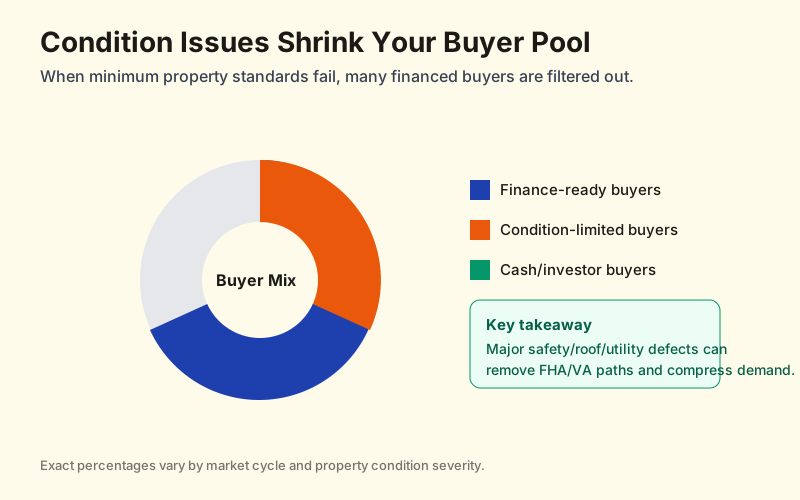
If your home has condition issues, you need to understand who can buy it, because a significant chunk of buyers may not be able to, no matter how much they want to.
The Financing Wall
FHA and VA loans, the two most common government-backed mortgage programs, have Minimum Property Requirements (MPRs). The appraiser doesn't just assess value. They assess whether the home meets basic safety, structural, and livability standards. If it doesn't, the loan isn't approved. Period.
Here's what triggers an MPR failure:
| Issue | FHA/VA Standard | Common As-Is Problem |
|---|---|---|
| Roof | Must have 3+ years remaining useful life | 20+ year old shingles, visible wear, leaks |
| Foundation | No cracks, settling, or structural damage | Foundation cracks, bowing walls |
| Electrical | No exposed wiring, functional panel | Knob-and-tube, DIY wiring, outdated panel |
| Lead Paint | No chipping or peeling paint (pre-1978) | Old paint on windows, trim, siding |
| Water/Sewage | Safe potable water, functional sewage | Failed septic, contaminated well |
| Heating | Adequate permanent heating system | Dead HVAC, space heaters only |
| Access | All-weather road access | Unpaved private roads, shared driveways |
| Safety | No broken windows, handrails on stairs | Deferred maintenance, missing features |
The Buyer Pool Impact
In North Carolina, roughly 30% of home purchases use FHA loans and another 10-12% use VA loans. That's 40% or more of your potential buyer pool that can't buy a home failing minimum property requirements. Add in conventional buyers who don't want renovation hassle, and an as-is home with serious condition issues may be marketable only to:
- Cash investors (who will offer 50-70% of FMV)
- Renovation loan buyers (FHA 203k or Fannie HomeStyle, rare, complex, slower)
- Conventional buyers with high risk tolerance and cash reserves
This is why pricing strategy matters so much for as-is homes. You're not competing in the full market. You're competing in a subset of it.
The Renovation Loan Exception
There is one financing option that can bridge the gap: renovation loans. The FHA 203(k) program and Fannie Mae's HomeStyle Renovation loan let buyers finance both the purchase and the repairs in a single mortgage. The appraiser evaluates the property at its after-repair value, not its current condition.
For sellers, this means a renovation-loan buyer can pay more than a cash investor because they're financing the purchase at a higher appraised value. For buyers, it means they can purchase a home that wouldn't qualify for standard FHA/VA financing.
The downside: renovation loans are complicated. They require a HUD-approved consultant (for FHA 203k Standard), contractor bids before closing, and a longer closing timeline of 45-60 days. Only about 3-5% of buyers pursue them. But if your as-is listing agent understands how to market to renovation-loan buyers, and your price leaves room for them to work, you can access a buyer pool that most as-is listings miss entirely.
Quick Self-Assessment: Cosmetic vs. Structural
Use this table to figure out whether your issues are cosmetic (FHA/VA still possible) or structural (cash/renovation-loan only):
| Cosmetic (Won't Fail FHA/VA) | Structural (Will Fail FHA/VA) |
|---|---|
| Outdated kitchen or bathrooms | Roof with less than 3 years remaining life |
| Old carpet, worn flooring | Foundation cracks or settling |
| Dated fixtures and finishes | Active water intrusion or mold |
| Peeling paint (post-1978 homes) | Peeling paint (pre-1978 = lead risk) |
| Minor cosmetic wall damage | Exposed or faulty wiring |
| Overgrown landscaping | Non-functional HVAC or plumbing |
| Stained ceilings (if source is fixed) | Failed septic system |
| Missing cabinet doors or hardware | Missing handrails, broken windows |
7. Pricing an As-Is Home: The Strategy Nobody Talks About
Most advice about pricing an as-is home comes down to "discount it 20-30% and hope for the best." That's not a strategy. That's a guess. Here's how to actually price an as-is home to maximize your net proceeds.
Step 1: Get Real Comps
Pull 3-5 comparable homes that sold recently in similar condition in your area. Not the turnkey renovated flip down the street, homes that actually looked like yours when they sold. Your agent (or a good appraiser) can find these. In the Charlotte metro, MLS data is detailed enough to filter for "as-is" in agent remarks.
Step 2: Get a Pre-Listing Inspection
This is the single most underused tool in as-is selling. For $350-$500, a licensed home inspector will document every issue with your property. You'll know exactly what buyers will find, no surprises, no ambush negotiations. More importantly, you'll have a real repair cost estimate, not a guess.
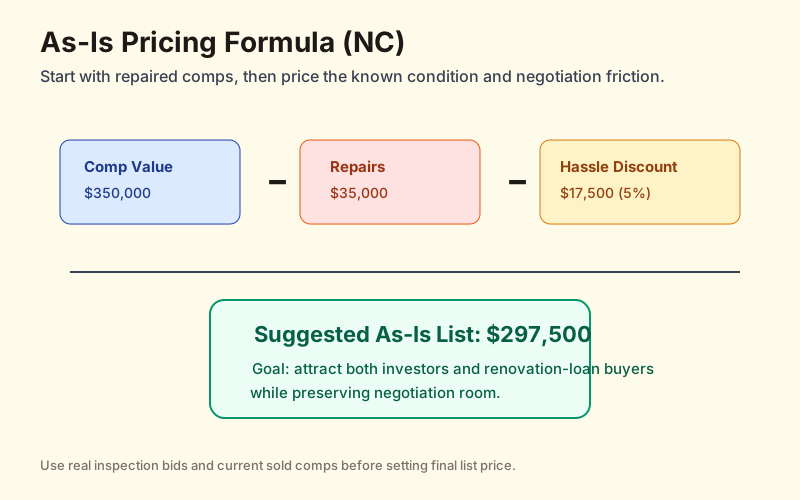
Step 3: The Pricing Formula
| Component | Example ($350K Good-Condition Comps) |
|---|---|
| Comparable sales average (good condition) | $350,000 |
| Minus: Documented repair costs | -$35,000 |
| Minus: Buyer risk premium (5-10%) | -$17,500 |
| Strategic list price | $297,500 |
The "buyer risk premium" is the part most sellers miss. Buyers know that inspection reports rarely catch everything. They assume there are hidden problems beyond what's documented. So they mentally discount another 5-10% as a hedge. If you price this in up front, you eliminate the negotiation friction and attract more offers.
Step 4: The Sweet Spot Strategy
Here's the counterintuitive move: price your as-is home slightly below the formula. Why? Because the ideal price attracts both cash investors AND renovation-loan buyers. When both groups compete, the final sale price gets pushed up. An investor who thinks they're getting a deal at $290,000 will bid $300,000 if a renovation-loan buyer is also offering $295,000. You'll often sell above your list price when you price to generate competition.
Common Pricing Mistakes on As-Is Listings
These are the traps we see NC sellers fall into repeatedly:
| Mistake | What Happens | Better Approach |
|---|---|---|
| Pricing based on Zestimate or tax value | Overpriced by 15-25%, home sits for months, then sells at a steep discount | Use actual comparable sales adjusted for condition |
| Pricing based on what you owe | Your mortgage balance has nothing to do with market value. Buyers don't care about your balance. | Price based on what the market will pay, then figure out the net |
| Refusing to lower price after 30 days | Days on market become a stigma. Buyers assume something is deeply wrong. | If no offers in 21 days, reduce by 3-5%. Stale listings repel buyers. |
| Not disclosing known issues in the listing | Buyers discover problems during inspection and renegotiate from a position of distrust | Disclose major issues in the listing description. Informed buyers make cleaner offers. |
| Pricing the same as nearby turnkey homes | Buyers compare your as-is listing to the renovated flip and your home looks like a bad deal | Price below the renovation cost threshold so buyers see the value gap |
The Agent Question
Should you use an agent to sell as-is? It depends on the price point and your buyer target. If you're selling a $150,000 property to cash investors, an agent's 5-6% commission ($7,500-$9,000) may not be justified, investors find properties through direct mail, driving for dollars, and wholesaler networks more than MLS. But if you're selling a $350,000+ home as-is on the MLS to attract the broadest buyer pool, an agent who understands as-is pricing, renovation-loan buyers, and investor negotiations is worth the commission. The wrong agent will price it like a turnkey listing and let it sit. The right agent will price it to generate competition and handle the due diligence negotiations that determine your actual net.
8. Who's Actually Buying As-Is Homes in North Carolina
Not all buyers are created equal, and the type of buyer you attract determines your timeline, your sale price, and your closing experience. Here's who's out there in the NC market right now.
Cash Investors and Flippers
These are the "We Buy Houses" companies. In North Carolina, 25% of all home sales in 2025 were cash transactions, the highest share in more than a decade. The Charlotte metro runs even higher. These buyers range from solo local investors to national franchises like HomeVestors ("We Buy Ugly Houses").
| Company/Type | Typical Offer | Timeline | Best For |
|---|---|---|---|
| Local flippers | 50-70% of ARV | 7-14 days | Severely distressed, need speed |
| Buy-and-hold investors | 60-75% of FMV | 14-30 days | Rental-ready properties |
| HomeVestors franchise | 50-65% of FMV | 14-21 days | Any condition, established process |
| iBuyers (Opendoor, Offerpad) | 85-95% FMV minus 5-13% fee | 14-45 days | Good condition only |
A few NC-specific companies worth knowing:
- Travis Buys Homes, operating since 1999, has purchased over 1,000 NC homes. One of the more established local operations.
- Green Street Home Buyers, statewide coverage, buys from homeowners and landlords.
- ASAP Cash Home Buyers, Charlotte metro focused.
Renovation Loan Buyers
FHA 203(k) and Fannie Mae HomeStyle loans let buyers finance both the purchase price and renovation costs in a single mortgage. These buyers can purchase as-is homes that wouldn't qualify for standard FHA/VA financing because the loan includes funds to bring the property up to code.
The catch: renovation loans are complex, take longer to close (45-60 days typical), and require a licensed contractor with approved bids. Not many buyers pursue them. But the ones who do are often willing to pay more than cash investors because they're buying a home to live in, not flip for profit.
Conventional Cash Buyers (Non-Investors)
Not every cash buyer is an investor. Retirees downsizing from the Northeast, relocators from high-cost markets like DC, New York, or San Francisco, and buyers tired of losing bidding wars sometimes buy homes with cash simply to be competitive. These buyers may see your as-is listing as an opportunity to get a home below market value and renovate to their taste. They're the best-case scenario: they pay more than investors and close fast.
In the Charlotte metro, this buyer type has become increasingly common as equity-rich homeowners from more expensive markets discover that their $600,000 sale in New Jersey buys a $350,000 fixer-upper in North Carolina with cash left over for renovations. They're not trying to flip your house, they want to live in it. That motivation translates to higher offers.
How to Vet a Cash Buyer
Not all cash offers are equal. Before you sign anything, verify these five things:
| Verification Step | What to Ask For | Red Flag |
|---|---|---|
| Proof of funds | Bank statement or letter from financial institution | They won't provide it, or the letter is vague |
| Company history | NC Secretary of State registration, BBB rating, Google reviews | LLC formed last month, no reviews, no physical office |
| Contract review | Have YOUR attorney review before signing | They pressure you to sign immediately or without attorney review |
| Closing timeline | Written commitment to specific close date | "We'll close when we can" or repeated extensions |
| Net to seller | Written net sheet showing all fees and deductions | Hidden "assignment fees," "admin fees," or "processing charges" |
The biggest warning sign in NC's cash buyer market is the wholesaler posing as a buyer. A wholesaler puts your house under contract, then sells that contract to an actual investor for a markup, typically $5,000-$15,000. You end up selling to someone you never vetted, and the price you received is $5,000-$15,000 below what the actual buyer was willing to pay. Ask directly: "Are you the end buyer, or will you be assigning this contract?" If they hedge, walk.
Not sure whether to take a cash offer or list as-is with an agent? We ran the full net proceeds math, commissions, carrying costs, fall-through risk, in our cash offer vs. realtor comparison for the Carolinas. It's the decision framework for exactly this crossroads.
Get Your Free, No-Obligation Cash Offer
Tell us about your property and we'll send a real cash offer — any condition, no repairs, no fees, and you close on your timeline in North Carolina.
9. The Pre-Listing Inspection Play
If you take one tactical recommendation from this entire guide, let it be this: get a pre-listing inspection before you sell as-is.
A standard home inspection in North Carolina costs $300-$600 depending on home size. In the Charlotte metro, expect $400-$500 for a typical 3BR/2BA. That's less than one month of utilities on an empty house. Here's what it buys you:
Why Pre-Listing Inspections Work
| Benefit | How It Helps |
|---|---|
| Accurate pricing | You know actual repair costs instead of guessing |
| Fewer surprises | Buyer's inspector won't find anything you don't already know about |
| Faster negotiations | Everything's on the table from day one, no ambush repair requests |
| Stronger offers | Buyers who see the full picture upfront make higher initial offers |
| Reduced fallthrough | Buyers who offer on a pre-inspected as-is home rarely back out |
What to Include
The standard inspection covers structural, roof, electrical, plumbing, HVAC, and visible moisture. For an as-is home, consider adding:
- Termite/pest inspection ($75-$150), NC is a heavy termite state. Buyers will ask.
- Radon test ($150-$200), required disclosure in NC anyway. Better to know your number.
- Septic inspection (if applicable, $300-$500), 40% of NC homes use septic systems. A failed septic is a $15,000-$35,000 problem that kills deals.
- Sewer scope (if on municipal, $200-$400), catches root intrusion and pipe collapse before the buyer does.
Total investment: $600-$1,200 for a comprehensive inspection package. On a $350,000 home, that's 0.2-0.3% of the sale price.
Finding a Good Inspector in NC
North Carolina licenses home inspectors through the NC Home Inspector Licensure Board. Every inspector must carry a license number, errors and omissions insurance, and complete continuing education. When hiring a pre-listing inspector, look for these qualifications:
- NC license in good standing, verify at the NCHILB website
- 5+ years of experience, new inspectors miss things. You want someone who has inspected hundreds of homes.
- No affiliation with a buyer's agent or cash buyer company. Some inspection firms get referral fees from investors. Your inspector should be working for you, not feeding leads to a "We Buy Houses" operation.
- Written report with photos, not a verbal summary. You want a document you can attach to your listing and provide to every potential buyer's agent.
- Willingness to explain findings to you in person. A good inspector will walk through the report with you, explain which issues are safety concerns versus cosmetic, and give you a rough sense of repair priorities. That conversation is worth more than the written report.
10. Closing Costs When You Sell As-Is in NC
One advantage of selling as-is, especially to a cash buyer, is that closing costs are typically lower. Here's what you'll actually pay at the closing table in North Carolina.
Seller Closing Costs Breakdown
| Cost | As-Is (Cash Buyer) | As-Is (MLS with Agent) | Traditional Sale |
|---|---|---|---|
| Real estate agent commission | $0 | 5-6% of sale price | 5-6% of sale price |
| NC excise/transfer tax | $1 per $500 (0.2%) | $1 per $500 (0.2%) | $1 per $500 (0.2%) |
| Attorney fees | $750-$1,250 | $750-$1,250 | $750-$1,250 |
| Title search/insurance | $400-$800 | $400-$800 | $400-$800 |
| Recording fees | $50-$100 | $50-$100 | $50-$100 |
| Prorated property taxes | Varies | Varies | Varies |
| HOA transfer fees | $0-$500 | $0-$500 | $0-$500 |
| Repairs/credits | $0 | $0 (as-is) | $5,000-$20,000+ |
| Total (on $300K sale) | $1,800-$2,850 | $16,800-$20,850 | $21,800-$40,850+ |
The closing cost difference between a cash buyer sale and a traditional agent-assisted sale is roughly $15,000-$18,000. That's a significant offset against the lower sale price you'll get from a cash buyer. When cash buyer advocates say "but you save on commissions and repairs," this is the math they're referencing. It's real, but it rarely closes the gap entirely.
The Attorney Requirement
North Carolina is an attorney-closing state. Unlike many states where escrow companies handle closings, NC law requires a licensed attorney to supervise the real estate closing. This costs $750-$1,250 for a straightforward transaction. In an as-is sale, the closing attorney also reviews the contract language to ensure the as-is provisions properly protect you.
Seven-County Transfer Tax Surcharge
Seven North Carolina counties charge an additional land transfer tax of $1 per $100 of the sale price (1%) on top of the state's standard $1 per $500 (0.2%). These counties are: Dare, Pasquotank, Perquimans, Chowan, Camden, Currituck, and Washington. If your property is in one of these coastal counties, your transfer tax jumps significantly, from 0.2% to 1.2% of the sale price.
Sample Net Sheet: Cash Buyer vs. MLS
Here's what a real seller net sheet looks like for a $300,000 as-is sale in Mecklenburg County:
| Line Item | Cash Buyer Sale at $210,000 | As-Is MLS Sale at $270,000 |
|---|---|---|
| Sale price | $210,000 | $270,000 |
| Mortgage payoff | -$165,000 | -$165,000 |
| Agent commission (0% / 5.5%) | $0 | -$14,850 |
| NC excise tax (0.2%) | -$420 | -$540 |
| Attorney fees | -$950 | -$950 |
| Title search & insurance | -$600 | -$600 |
| Recording fees | -$75 | -$75 |
| Prorated property taxes | -$800 | -$800 |
| HOA transfer fee | -$250 | -$250 |
| Net to seller | $41,905 | $86,935 |
The MLS sale nets $45,030 more, even after paying a full agent commission. This is the math cash buyer companies don't want you to see. Their pitch, "no commissions, no repairs, no hassle", is true. But "no commissions" on a $210,000 sale still leaves you with less cash than "yes commissions" on a $270,000 sale. Always compare net, not gross.
11. What to Do Before You List (Even If You're Not Fixing Anything)
"As-is" doesn't mean "do nothing." There are zero-cost and low-cost steps that dramatically affect how your home is perceived, and how much buyers offer.
The Free Stuff
- Declutter ruthlessly. Remove personal items, excess furniture, and anything that makes rooms feel smaller. A cluttered home looks worse in photos and suggests the owner gave up on maintenance long ago.
- Clean everything. Deep clean the kitchen and bathrooms. Mop floors. Wipe baseboards. A clean as-is home signals "the owner cares but can't afford repairs." A dirty as-is home signals "abandon all hope."
- Mow the lawn and trim bushes. First impressions are made from the curb. Basic yard maintenance costs nothing but time and completely changes how buyers feel walking through the front door.
- Open all blinds and turn on all lights. Dark homes feel depressing. Bright homes feel optimistic, even when the carpet is stained and the kitchen is from 1987.
- Remove hazards. Trip hazards, hanging wires, standing water. Anything that makes an inspector's pen move faster should be addressed if you can do it safely.
The Cheap Stuff ($200-$500 Total)
- Fresh door hardware and outlet covers. Brass door handles from 1994 and yellowed outlet covers make a house feel older than it is. $150 in new hardware changes the subconscious read of the entire home.
- Light bulbs. Replace every burnt-out bulb with the same color temperature (3000K warm white). A fully lit home photographs better and feels more inviting. $30-$50.
- Air fresheners or an ozone treatment. Pet odor and smoke are the two fastest ways to cut your buyer pool. An ozone treatment ($100-$200) or even strategic air fresheners can make a meaningful difference.
- Caulk around tubs and sinks. Old, peeling caulk screams "water damage" even when there isn't any. A $7 tube of caulk and 30 minutes can eliminate an inspector's easy checkmark item.
The Documentation Prep
Before any buyer walks through the door, gather these documents:
- Your completed RPOADS disclosure form. Fill it out honestly and have it ready. Don't wait for an offer.
- Any existing inspection reports. If you had a home inspection when you bought the house, or any subsequent inspections, have them available. Transparency builds trust.
- Repair estimates you've already received. If a contractor quoted you $12,000 for a roof and that's why you're selling as-is, showing that quote helps justify your price.
- Utility bills for the last 12 months. Buyers, especially investors running rental numbers, want to know operating costs.
- Survey, if available. NC doesn't always require a new survey, but having one saves the buyer $400-$600 and speeds up closing.
- HOA documents (if applicable). Covenants, recent meeting minutes, financial statements. In NC, HOA disclosure is mandatory and delays kill deals.
- Permit history. If you or previous owners did any renovation work, having the permit records shows it was done properly. Not sure whether that deck or shed even needed a permit? Our free do-I-need-a-permit quiz gives you the answer for Charlotte and York County with the code section cited. If there's unpermitted work, acknowledge it in your disclosures, hiding it creates legal risk that far outweighs any price impact.
The Photography Strategy
This sounds minor, but it determines whether buyers even request a showing. As-is homes need better photos than turnkey homes, not worse. Here's why: an investor scrolling Zillow at 10 PM is looking at 50 properties. If your photos are dark, blurry, or missing, they skip to the next listing. They never see your price. They never run the numbers.
Professional real estate photography costs $150-$300 in the Charlotte metro. For an as-is home, tell the photographer to:
- Shoot in daylight with all lights on and all blinds open
- Focus on the best features, lot size, room size, natural light, layout flow
- Include wide-angle shots that show the full room, not just the parts that look good
- Don't try to hide problems, investors and renovation buyers want to see the real condition. A listing that looks too polished for an "as-is" property makes experienced buyers suspicious.
12. Your Three Paths Forward
You've read the legal requirements, the math, the strategy, and the buyer landscape. Now it's decision time. Here are your three paths, and honest advice about when each one makes sense.
Path 1: Sell to a Cash Buyer
Best when: You need to close in under 30 days, the home has severe structural or system failures, you're in foreclosure, or the carrying costs of holding the property exceed the price premium you'd get on the open market.
Expect: 50-75% of fair market value. Closing in 7-21 days. Minimal paperwork. No agent commissions. You still need an attorney.
Protect yourself: Get at least three cash offers. Verify proof of funds. Have your closing attorney review the contract, some cash buyer contracts include fee structures and clauses that further reduce your net. Never sign on the first visit. For a deep dive into evaluating cash offers, see our complete cash offer guide for the Carolinas.
Path 2: List As-Is on the MLS
Best when: The home's issues are moderate (single-system failures, cosmetic damage, deferred maintenance), you have 45-90 days, and you want exposure to the full buyer market, including renovation loan buyers and bargain-hunting owner-occupants who'll pay more than investors.
Expect: 75-90% of fair market value. 30-90 days on market. Agent commission of 5-6%. Full exposure means competitive offers. Pre-listing inspection recommended.
Protect yourself: Price using the formula in Section 7. Get the pre-listing inspection. Negotiate for higher due diligence fees. Make sure your listing agent has experience with as-is properties, not every agent knows how to market condition issues as opportunities.
Path 3: Make Strategic Repairs and List Traditionally
Best when: The repair costs are under $15,000, the repairs are cosmetic rather than structural, you're not paying carrying costs on the property, and you have 3-5 months for repairs plus sale.
Expect: 95-100% of fair market value. Higher agent commission base (because the sale price is higher). Full buyer pool access including FHA and VA buyers. Standard timeline of 30-60 days after listing. For insights on timing your sale, check our best time to sell guide.
Protect yourself: Only do repairs with a positive ROI. A $15,000 kitchen remodel doesn't return $15,000 on a $300,000 house. Focus on safety items (roof, HVAC, electrical) that unlock FHA/VA buyers, and cosmetic items (paint, carpet, landscaping) that photograph well.
Side-by-Side Decision Matrix
| Factor | Cash Buyer | As-Is MLS | Repair + List |
|---|---|---|---|
| Timeline | 7-21 days | 45-90 days | 90-150 days |
| Net proceeds (% of FMV) | 50-75% | 70-85% | 85-95% |
| Out-of-pocket costs | ~$1,800-$2,850 | ~$16,800-$20,850 | $21,800-$55,000+ |
| Hassle level | Low | Medium | High |
| Risk of deal falling through | Very low | Medium | Medium-high |
| Buyer pool size | Small (investors only) | Medium | Full market |
| Best for | Speed, severe condition | Moderate condition, some time | Cosmetic issues, no time pressure |
How to Decide: The Three-Question Filter
If you're still unsure which path fits, answer these three questions:
- "Do I have more than 90 days before I need this resolved?" If yes, Path 3 (repair + list) is worth exploring. If no, you're choosing between Path 1 and Path 2.
- "Can my home qualify for FHA/VA financing in its current condition?" If yes, Path 2 (as-is MLS) keeps your full buyer pool. If no, your realistic buyers are cash investors and renovation-loan applicants.
- "Is the total repair cost more than 10% of the home's value?" If yes, Path 1 (cash buyer) or Path 2 (as-is MLS) makes more sense than sinking money into a property that still won't be turnkey after repairs.
Whatever path you choose, the most important step is the same: know what your home is actually worth, know what the problems actually cost to fix, and don't let urgency override arithmetic. The homeowners who get burned selling as-is aren't the ones who made a conscious decision after running the numbers. They're the ones who panicked, took the first offer, and found out later they left $40,000 on the table.
If you want to see the numbers for your specific situation, what your home would sell for as-is versus repaired, what a cash offer should look like, and what you'd actually net at closing, we'll run that analysis for free. No obligation, no pressure. Just the math.
This guide provides general information about selling a home as-is in North Carolina and is not legal advice. Every home sale involves unique circumstances. Consult with a licensed North Carolina real estate attorney for advice specific to your situation. Market data referenced in this guide reflects conditions as of early 2026 and is subject to change.