
Cash Offer for Your House in the Carolinas
The honest guide to cash offers in NC & SC — who's buying, what they actually pay, your legal protections, and how to avoid getting ripped off.

1. What Nobody Tells You About Cash Offers
You've seen the signs. Bandit signs zip-tied to telephone poles at every major intersection from Charlotte to Greenville: "We Buy Houses, Cash, Any Condition, Close in 7 Days." Yellow postcards in your mailbox. Facebook ads with stock photos of smiling families holding oversized checks. Text messages from numbers you don't recognize.
If you own a home in North Carolina or South Carolina, you're a target, and that word is chosen deliberately. The cash home buying industry in the Carolinas is a $4.8 billion annual market. Nearly 40% of all home sales in North Carolina are now cash transactions, and institutional investors purchased 9.5% of homes sold in the Charlotte metro in the first quarter of 2025. These aren't mom-and-pop operations. This is an industry, and like any industry, it has good actors, bad actors, and a whole lot of fine print designed to move money from your pocket to someone else's.
This guide exists because most "cash offer" content on the internet is written by the same people trying to buy your house. The comparison sites ranking on Google? They sell your information to investors the moment you fill out a form. The franchise operations with national TV ads? ProPublica published a 2023 investigation documenting how their franchisees systematically underpaid elderly and financially distressed homeowners. The iBuyers promising "market value"? Opendoor faced disciplinary action from the North Carolina Real Estate Commission for disclosure violations.
We're coming at this from a different direction. RobinOffer is a Carolina cash home buyer, not a licensed brokerage, and we work with a licensed real estate agent partner, Chamiese Evans of NorthGroup Real Estate. We make cash offers, and because our agent partner also lists homes, we can tell you what your home would likely sell for on the open market too. That dual perspective is what makes this guide possible. Whether you want to sell your house for cash in NC or SC, or list with a traditional agent, we can tell you honestly when each path makes sense, how much you'd leave on the table, and how to protect yourself regardless of which path you choose.
This isn't a sales pitch. It's thousands of words of data, math, legal context, and hard-earned advice for homeowners in both Carolinas. Read the whole thing, or jump to whatever section fits your situation. Either way, you'll know how to evaluate a cash offer instead of just hoping it's fair.
If your cash-offer decision is happening in the middle of a separation, keep this companion resource open too: selling during divorce in NC & SC. It walks through buyout vs sale decision structure, interim payment tracking, and timeline triggers.
And if your property is in Cleveland County, these city-specific companions are useful: Kings Mountain homeowner selling options and Shelby homeowner selling options, both with sparse-comparable pricing tactics and certainty-adjusted decision frameworks.
Still deciding whether a cash offer or listing with an agent makes more sense for your situation? Our cash offer vs. realtor comparison runs the net proceeds math side-by-side at four Carolinas price points, including the carrying costs and fall-through risk that most comparisons leave out.
And if you're specifically comparing Opendoor or Offerpad to a local cash buyer, our iBuyer vs. local cash buyer teardown breaks down service fees, repair deductions, and the timeline differences between national platforms and local operators.
Military family on PCS orders? Use this companion playbook alongside the offer math in this guide: military PCS relocation in the Carolinas. It adds timeline controls, VA assumption considerations, and remote-closing safeguards specific to service-member moves.
Is a cash sale right for your Carolina home?
A cash offer for your house trades a slice of your sale price for speed and certainty. There is no repair list, no staging, and no financing contingency, and you pick the closing date. In exchange, a cash number usually lands below what a fully marketed listing would bring. The real question is not whether a cash offer is "good" or "bad," but whether that trade fits your situation.
Rough ranges to set expectations, drawn from industry payout data and a UC San Diego Rady School of Management study on cash-vs-financed pricing. Every home is different, so treat these as starting points, not quotes:
- A solid, livable home: reputable cash buyers and iBuyers in NC and SC typically pay in the range of 80% to 90% of market value.
- A home needing significant work: often 70% of market value or below, because the buyer prices in repairs and their own margin.
- Timeline: a written offer in roughly 24 to 48 hours and closing in about 7 to 14 days, versus 45 to 90 days for a typical financed sale.
A cash sale tends to make sense when speed and certainty matter more than squeezing out the last few percent of price: foreclosure, an inherited or as-is property, a divorce or relocation deadline, or a home that will not pass a lender's appraisal. It tends to make less sense when your home is move-in ready in a strong market and you have time to wait for retail buyers. We break both cases down in when a cash offer makes sense and when you should list instead.
Selling in a specific Carolina city? These local pages cover timelines, pricing, and how a cash offer for your house works where you live: Charlotte, NC, Rock Hill, SC, Fort Mill, SC, Tega Cay, SC, Clover, SC, and York, SC. Working through an inheritance or a missed payment? See selling an inherited property in NC, selling inherited property in SC, foreclosure help in NC, and the SC foreclosure timeline.
What does a cash offer for a house actually look like in NC and SC?
A real cash offer is a written, no-obligation number from a buyer who can show proof of funds, walks the property in person or by video, and lets you choose the closing date. You should never pay a fee up front, and standard closing costs come out of the proceeds at closing.
Is a cash offer for a house a good idea?
It can be, when the certainty is worth more to you than the price gap. Compare the cash number against what you would net on the open market after commissions, repairs, and carrying costs, then decide with both figures in front of you.
2. Cash Offers in the Carolinas: The Numbers Behind the Signs
These aren't national averages. This is your backyard.
Cash Sale Market Share
| Market | Cash Sale Percentage | National Average |
|---|---|---|
| North Carolina (statewide) | 39.5% | 33% |
| Charlotte Metro (MSA) | 37.4% | 33% |
| South Carolina (statewide) | 35–38% | 33% |
| Mecklenburg County | ~40% | 33% |
Sources: ATTOM Data Solutions Q1 2025, Redfin, NC REALTORS January 2026 Housing Report.
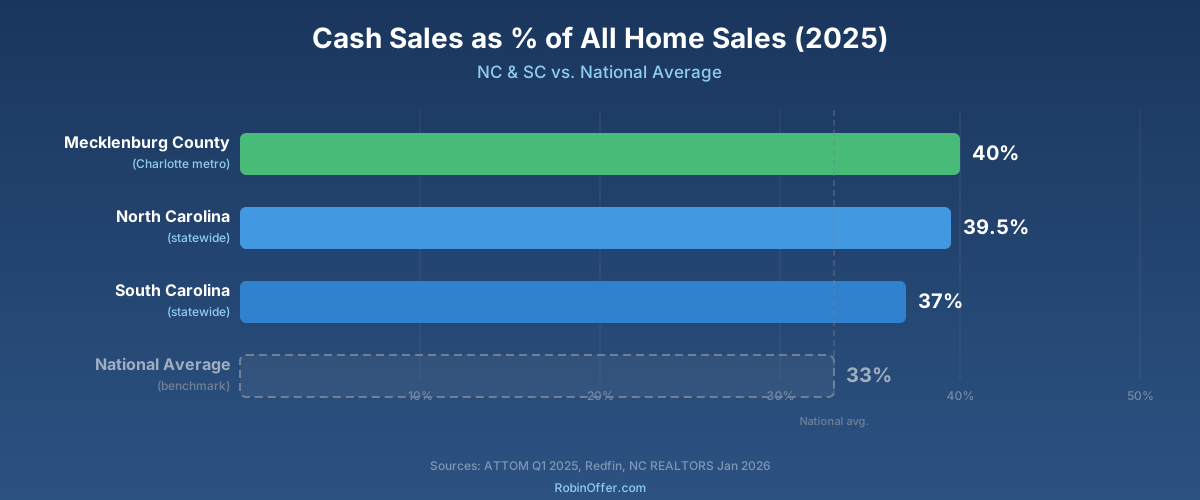
Four out of ten homes sold in North Carolina involve no mortgage at all. In Mecklenburg County (Charlotte's core), the number is even higher. This isn't a niche market. It's close to becoming the default.
Who Is Actually Buying?
The phrase "cash buyer" covers an enormous range of people with very different motivations, and very different offers:
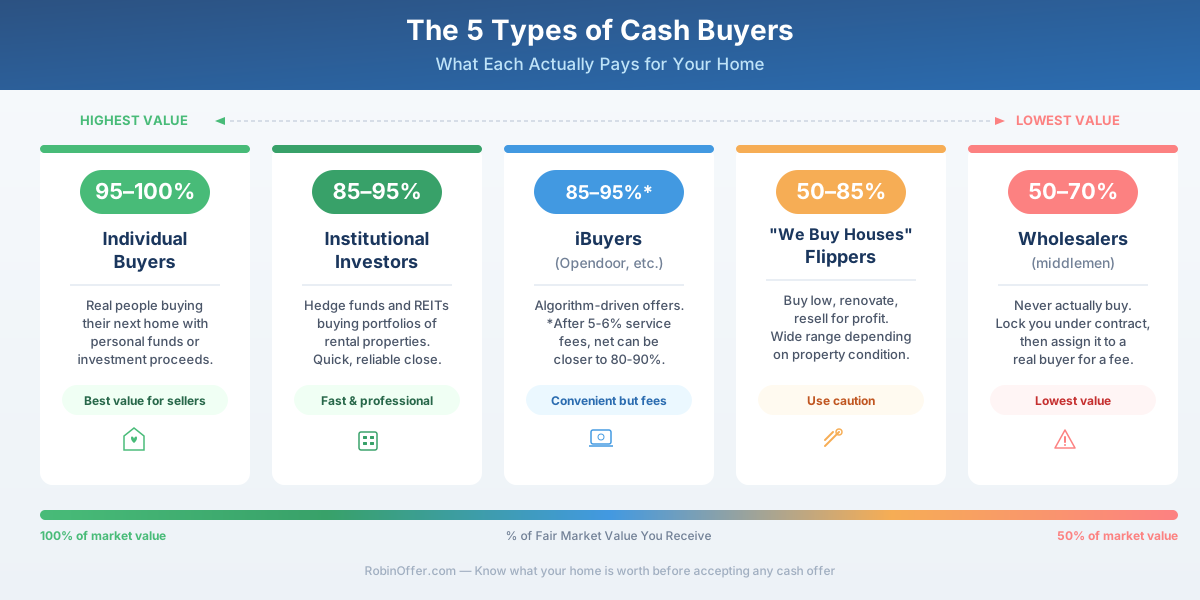
| Buyer Type | Share of Market | What They Typically Pay |
|---|---|---|
| Individual cash buyers (retirees, relocators, downsizers) | ~55–60% of cash sales | 95–100% of market value |
| Institutional investors (corporate landlords, REITs) | ~9.5% of all sales | 85–95% of market value |
| "We Buy Houses" companies and local flippers | ~15–20% of cash sales | 50–85% of market value |
| iBuyers (Opendoor, Offerpad) | ~3–5% of cash sales | 85–95% of market value minus fees |
| Wholesalers | ~5–8% of cash sales | 50–70% of market value |
Charlotte Metro Market Context (February 2026)
| Metric | Current | Year Ago |
|---|---|---|
| Charlotte Median Home Price | $400,000–$435,000 | $390,000–$420,000 |
| NC Statewide Median | $375,700 | $365,000 |
| Charlotte Average Days on Market | 64 days (2025 avg) | 29–40 days (2024) |
| Active Listings (Charlotte) | ~4,800 | ~3,900 |
| Sale-to-List Price Ratio (NC) | 97.2% | 98.5% |
| Months of Inventory (NC) | 5.0 | 3.8 |
Sources: NC REALTORS January 2026 Report, Redfin, Canopy Realtors October 2025 Report.
The Carolinas market is shifting. Inventory is up 24% year-over-year in Charlotte. Homes are sitting longer: the average jumped from 29 days in mid-2024 to 64 days through 2025, and some months hit 98 days. Sale-to-list ratios have dipped below 98%. Prices are still rising modestly at 2.4% to 3.5% annually, but it's no longer the frenzied seller's market of 2021–2022.
What does this mean for cash offers? Two things pulling in opposite directions. Rising inventory gives you more room to reject a lowball cash offer, because your home is more likely to eventually sell on the open market. But longer days on market give cash buyers more negotiating power, especially on properties sitting past 60 days. If your listing goes stale, a cash offer starts looking more attractive, and experienced investors know this.
The Institutional Investor Footprint
Charlotte is one of the most heavily targeted markets in the country for institutional real estate investment:
- Wall Street-backed landlords own approximately 11,500 single-family houses in Mecklenburg County, more than 4% of all single-family homes.
- In some Charlotte neighborhoods, corporate landlords own one out of every five single-family homes.
- Institutional investors own 25% of rental single-family homes in the county.
- The institutional investor share of purchases rose from 8.2% in Q1 2024 to 9.5% in Q1 2025.
In 2021 and 2022, institutional investors bought half the homes sold in certain Charlotte-area neighborhoods. That pace has moderated, but the structural appetite (fueled by rent growth and appreciation in the Charlotte metro) remains strong. If you sell your home to a cash buyer in the Charlotte region, there's a meaningful chance it will become a rental property managed by a company headquartered in New York, San Francisco, or Dallas.
Honestly, institutional buyers aren't the worst people to sell to: they close fast, they don't fall through, and they usually skip the inspection contingency. But you should know who's actually on the other side of that "fair cash offer."
3. The Five Types of Cash Buyers (And What Each Actually Pays)
The retiree from Connecticut paying cash for a Hilton Head condo and the LLC sending you yellow postcards are both "cash buyers." They couldn't be more different. Here's who's actually out there and what each type pays. For a Charlotte-specific breakdown, see who buys houses for cash in Charlotte and what each type pays.
Type 1: Individual Cash Buyers
What they pay: 95–100% of market value
How they find you: Through the MLS, Zillow, Redfin, the same channels as mortgage buyers
How fast they close: 14–21 days
These are regular people buying a home to live in. Retirees who sold a more expensive home in the Northeast and are paying cash with their equity. Relocators whose employers are covering the move. Downsizers who sold their family home and are buying something smaller outright. They represent the majority of cash transactions (roughly 55–60%) and they typically pay at or near market value because they're not looking for an investment return. They're looking for a home.
If you've got a move-in ready home in a desirable neighborhood, individual cash buyers are your best-case scenario. They offer the speed of cash with minimal discount. The challenge? You usually find them through the open market, which means listing your home, paying agent commissions, and waiting for the right buyer to appear.
Type 2: iBuyers (Opendoor, Offerpad)
What they pay: 85–95% of market value (after all fees and deductions)
How they find you: Online platforms (you request an offer on their website)
How fast they close: 14–60 days (you often pick the date)
iBuyers use algorithms to generate offers on homes that meet specific criteria, typically newer construction, standard layouts, and median price ranges. Their pitch is convenience: skip the showings, skip the staging, pick your closing date.
The fine print tells a different story. Opendoor charges a 5% service fee plus 1–3% in closing costs plus repair deductions that can run $5,000 to $30,000 after their inspection. Offerpad averages an 8% service fee. By the time all deductions are applied, the "competitive offer" they initially quote shrinks significantly.
Important for Carolinas homeowners: iBuyers have limited geographic coverage. Opendoor operates in the Raleigh-Durham and Charlotte metros but doesn't cover most smaller NC cities (Gastonia, Shelby, Hickory) or much of South Carolina. If your home is outside a major metro, iBuyers likely aren't an option. And even where they do operate, Opendoor faced NC Real Estate Commission disciplinary action in 2022 for disclosure violations, worth knowing. For Charlotte-metro homeowners in Cabarrus County, our Concord selling guide compares cash buyer offers against agent listings in a market where iBuyers are active.
Type 3: Local Flippers and "We Buy Houses" Companies
What they pay: 50–85% of market value
How they find you: Bandit signs, postcards, cold calls, door knocking, Facebook ads, driving for dollars
How fast they close: 7–21 days
This is the category most people think of when they hear "cash buyer." These are small to mid-sized companies (sometimes a single operator with a pickup truck and a contractor, sometimes a team with a professional office) who buy homes at a discount, renovate them, and resell at market value. Their profit comes from the spread between what they pay you and what they sell for after rehab.
The standard formula in this industry is the 70% rule: offer no more than 70% of the home's after-repair value (ARV), minus estimated repair costs. On a home worth $300,000 in good condition needing $30,000 in updates, that formula produces an offer of $180,000, or 60% of what you could sell for on the open market.
The range is wide, though. A professional local buyer with low overhead buying a home that truly needs $50,000+ in repairs might offer 70–85% of as-is value and still make a fair margin. A predatory operator targeting a distressed homeowner might offer 50% and pressure you to sign before you can think it through. Because the range is so wide, knowing how to separate legitimate operators from predatory ones is critical, our guide to vetting "We Buy Houses" companies covers the five business models, contract red flags, and wholesaling laws that apply in both Carolinas.
Type 4: Institutional Investors and Corporate Landlords
What they pay: 85–95% of market value
How they find you: Through the MLS, off-market deals, portfolio acquisitions
How fast they close: 14–30 days
Companies like Invitation Homes, American Homes 4 Rent, and Progress Residential buy single-family homes at scale to rent them out. In the Charlotte metro, these companies own over 11,500 homes. They typically buy homes in good condition in suburban neighborhoods with strong rental demand, and they pay closer to market value because their return comes from long-term rent, not a quick flip margin.
You'll rarely interact with these companies directly. They usually work through acquisition agents or buy homes listed on the MLS. If you list your home with an agent and receive a cash offer from an LLC you've never heard of, there's a reasonable chance it's backed by institutional money.
Type 5: Wholesalers
What they pay: 50–70% of market value
How they find you: Cold calls, texts, postcards, door knocking (the most aggressive outreach)
How fast they close: They don't. They assign the contract to another buyer.
Wholesalers are the most misunderstood, and most controversial, category of cash buyer. A wholesaler puts your home under contract at a low price, then sells (assigns) that contract to an actual cash buyer at a higher price, keeping the difference. They never buy your home and never intended to. They're middlemen who profit from the spread between what you agreed to sell for and what an investor is willing to pay.
A typical wholesale deal: a wholesaler offers you $160,000 for a home worth $250,000. They assign the contract to a flipper for $190,000, walking away with $30,000 without ever touching the property. You net $160,000 instead of the $220,000+ you might have gotten on the open market.
South Carolina sellers: SC doesn't have a similar wholesaling protection law as of February 2026. You don't have a statutory right to cancel a real estate contract after signing. That makes it even more critical to have an attorney review any purchase agreement before you sign, especially one from a buyer you've never met who found you through a cold call.
Cash Buyers Active in the Carolinas (2026)
If you're selling a home in the Charlotte metro, the NC Piedmont, or upstate South Carolina, these are the types of operations you'll encounter. This isn't an endorsement of any company. It's a market overview so you know who you're dealing with.
| Company/Type | Coverage Area | Typical Offer Range | Notes |
|---|---|---|---|
| Opendoor | Charlotte, Raleigh-Durham | 85–95% minus 5% fee + repairs | iBuyer. Faced NC Real Estate Commission action (2022). Not available in smaller NC/SC cities. |
| Offerpad | Charlotte, Raleigh | 80–90% minus 8% avg fee | iBuyer. 1% cancellation fee if you back out. Limited geographic coverage. |
| HomeVestors / We Buy Ugly Houses | Statewide NC & SC (franchise) | 50–75% | National franchise. ProPublica investigation documented systemic underpayment practices. |
| Local flippers and investors | Varies by operator | 50–85% | Wide range. Quality varies enormously. Always verify proof of funds and references. |
| Invitation Homes / American Homes 4 Rent | Charlotte metro suburban | 85–95% | Institutional buy-to-rent. Usually purchase through MLS, not direct to homeowner. |
Because both NC and SC are attorney-close states, every cash transaction goes through a licensed attorney. That's a built-in consumer protection that doesn't exist in many other states where title companies alone handle closings. Your closing attorney works for you. Use them. Ask them to review the purchase agreement, explain every line item on the settlement statement, and verify that the buyer's funds are real.
Curious what a cash offer looks like for your home?
Tell us about your property and we'll send you a real, no-obligation cash offer — any condition, close on your timeline.
4. How a Cash Sale Actually Works: Day by Day
Speed is the whole point of a cash sale. It's also the biggest risk: moving so fast you agree to terms you don't fully understand.
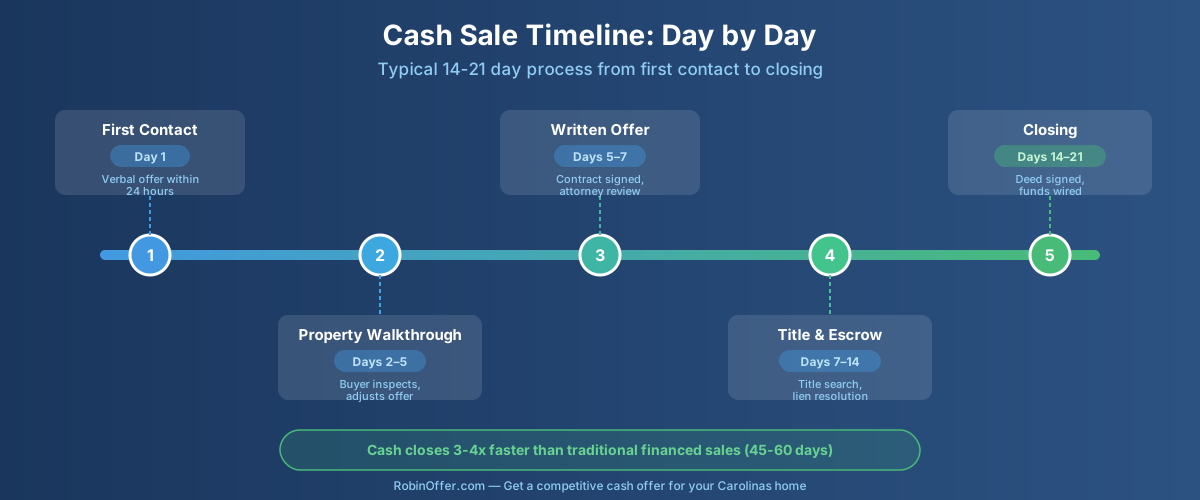
Day 1: First Contact
You call a cash buyer (or they call you). They ask basic questions: address, number of bedrooms and bathrooms, approximate square footage, condition, and whether you have a mortgage. Most companies will give you a preliminary verbal offer within 24 hours, sometimes on the first phone call. This offer isn't binding on either side. It's a starting point based on comparable sales and the information you provided.
Days 2–5: Property Walkthrough
A legitimate cash buyer will want to see the property in person. This is where the preliminary offer gets adjusted. Expect the buyer or their representative to spend 30–60 minutes walking through the home, checking the roof, HVAC, foundation, plumbing, and electrical. They're not doing a formal home inspection. They're estimating repair costs to plug into their offer formula.
Watch for this: If the offer drops significantly after the walkthrough, ask for an itemized list of the repair estimates they're using. A $5,000–$10,000 adjustment is normal. A $40,000 reduction on a home that looks fine from the inside should prompt serious questions.
Days 3–7: Written Offer and Contract
The buyer presents a written purchase agreement. This is the most important document in the entire transaction, and it's where most problems hide. Key terms to examine:
- Purchase price: Is it what they quoted verbally, or has it changed?
- Earnest money deposit: How much are they putting down? Low earnest money ($100–$500) on a $300,000 home signals a buyer with minimal skin in the game, often a wholesaler.
- Assignment clause: Does the contract allow the buyer to assign it to someone else? If yes, you may be dealing with a wholesaler.
- Inspection contingency: Cash buyers often waive formal inspections, but some include language allowing them to renegotiate based on "satisfactory inspection," a backdoor to reduce the price after you're committed.
- Closing timeline: Is a specific date named, or just "within 30 days"?
- Who pays closing costs: Many cash buyers advertise that they cover closing costs, but verify this is in the contract, not just the marketing.
Days 7–14: Title Search and Escrow
Once you sign the purchase agreement, the closing attorney orders a title search to confirm you have clear ownership and identify any liens, judgments, or encumbrances against the property. This takes 5–10 business days in most NC and SC counties. If title issues are found (unpaid property taxes, contractor liens, HOA delinquencies), they'll need to be resolved before closing, which can extend the timeline.
Days 10–21: Closing
At closing, you sign the deed transferring ownership, the buyer wires the purchase price to the closing attorney's escrow account, and any outstanding mortgage balance, liens, and closing costs are paid from the proceeds. The remaining balance (your net proceeds) is wired to your bank account or issued as a check, typically within 24–48 hours.
How the mortgage payoff works: You don't need to pay off your mortgage before closing. The closing attorney handles it. Before the closing date, the attorney requests a payoff statement from your lender (this shows the exact amount owed including per-diem interest through the expected closing date). At closing, the attorney pays your lender directly from the sale proceeds, then sends you the remainder. One thing to check: some mortgages have prepayment penalties, especially loans originated before 2014 or certain adjustable-rate products. Ask your lender or check your loan documents.
Move-out and possession: Unless the contract specifies otherwise, you're expected to vacate by the closing date. This catches people off guard: if you close in 14 days, you need to be packed and out in 14 days. If that's too tight, negotiate a post-closing possession agreement (sometimes called a rent-back or leaseback) before you sign the contract. Many cash buyers, especially investors who plan to renovate, will agree to let you stay 7–30 days after closing, sometimes rent-free, sometimes at a nominal daily rate. But this must be in the contract. A verbal promise to "work something out" isn't enforceable.
The Full Timeline
| Step | Typical Timeline | What Can Delay It |
|---|---|---|
| Initial contact to preliminary offer | 1–2 days | Nothing, this is always fast |
| Property walkthrough | Days 2–5 | Scheduling, access issues |
| Written offer and contract | Days 3–7 | Negotiation, attorney review |
| Title search | Days 7–14 | Title issues, liens, probate |
| Closing | Days 10–21 | SC in-person attorney requirement, lien resolution |
Best case: 7–10 days from first contact to closing, if title is clear and both parties move quickly. Realistic case: 14–21 days. With complications: 30–45 days, still faster than the 64-day average for a traditional Charlotte-area sale, before you add 30–45 days of mortgage closing on the buyer's end.
5. The Real Math: Cash Offer vs. Listing on the Open Market
This is the section no cash buyer wants you to read. Here's what a $350,000 Carolinas home actually nets you, cash sale vs. open market, line by line.
Scenario: $350,000 Home in the Charlotte Metro
Take a realistic scenario: a three-bedroom, two-bathroom home in a Charlotte-area suburb (Gastonia, Belmont, Rock Hill, Indian Land, Indian Trail, the type of home RobinOffer works with daily). Market value: $350,000. Remaining mortgage: $180,000. Condition: livable but needs cosmetic updates (original kitchen, dated bathrooms, older carpet).
Path A: List With an Agent on the Open Market
| Line Item | Amount | Notes |
|---|---|---|
| Expected sale price | $340,000–$350,000 | 97–100% of market value (NC avg sale-to-list: 97.2%) |
| Agent commissions (5%) | −$17,000 to −$17,500 | Negotiable; 5% is current average |
| Pre-listing repairs and staging | −$5,000 to −$12,000 | Paint, carpet, landscaping, staging |
| Seller closing costs (1.5–2%) | −$5,100 to −$7,000 | Attorney, title insurance, excise tax, recording |
| Carrying costs during listing (3 months) | −$4,500 to −$6,000 | Mortgage, taxes, insurance, utilities at ~$1,500–$2,000/mo |
| Mortgage payoff | −$180,000 | |
| Estimated net proceeds | $118,000–$138,000 |
Timeline: 90–150 days from listing to money in your bank account (64 days average on market + 30–45 days buyer mortgage closing + 7–14 days to prepare and list).
Path B: Sell to a Cash Buyer
| Line Item | Amount | Notes |
|---|---|---|
| Cash offer (75–85% of market value) | $262,500–$297,500 | Range depends on buyer type and home condition |
| Agent commissions | $0 | No agents involved in most direct cash sales |
| Repairs and staging | $0 | Cash buyers purchase as-is |
| Seller closing costs | $0 to −$3,500 | Many cash buyers cover closing costs; some don't |
| Carrying costs (2–3 weeks) | −$750 to −$1,500 | Minimal holding period |
| Mortgage payoff | −$180,000 | |
| Estimated net proceeds | $78,000–$116,000 |
Timeline: 14–30 days from first contact to money in your bank account.
The Gap
| List With Agent | Cash Sale (Mid-Range) | Difference | |
|---|---|---|---|
| Net proceeds | ~$128,000 | ~$97,000 | ~$31,000 |
| Timeline | 90–150 days | 14–30 days | 60–120 days faster |
| Certainty of closing | ~87–90% | ~95%+ | Higher with cash |
| Effort required | High (repairs, showings, staging, negotiation) | Low (sign and close) | Significant |
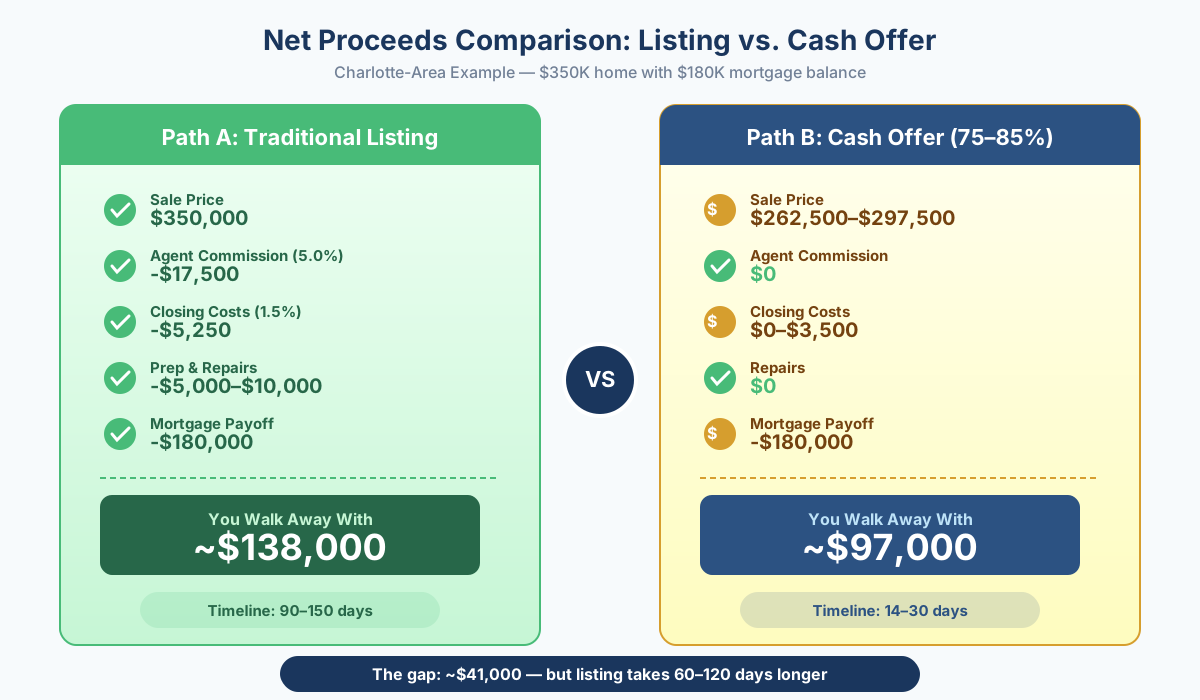
$31,000. That's the gap on a $350,000 home with $180,000 in mortgage debt. Real money. But the gap narrows dramatically if your home needs significant repairs (which reduce the listing price while the cash offer stays the same), if your carrying costs are high (a $3,000/month mortgage erodes $9,000 in three months of market time), or if time has a dollar value to you (avoiding foreclosure, closing before a divorce deadline, stopping a lien from growing). The right answer depends on your math, not anyone else's.
When the Gap Disappears Almost Entirely
There are situations where listing gains you almost nothing over a cash offer:
- Major repairs needed ($25,000+): A home needing a new roof, HVAC, and foundation work will sell at a steep discount on the open market too, and you still pay commissions and closing costs on the reduced price.
- High carrying costs: If your monthly mortgage, taxes, and insurance total $3,000+, every month on market costs you real money that erodes the listing premium.
- Property condition issues that limit buyer financing: FHA and VA loans require minimum property standards. If your home doesn't meet them, you've eliminated roughly 40% of the buyer pool, and the remaining buyers know it.
- Title complications: Liens, probate issues, and disputed ownership make traditional sales take 6–12 months. Cash buyers specialize in handling these situations.
- A financed deal already collapsed: If a buyer's financing just fell apart on you, the calculus changes. We wrote up the options in what to do when your home sale falls through in Charlotte.
Scenario B: $225,000 Home Needing Major Work
Now let's run the same comparison for a very different situation. A three-bedroom ranch in Gastonia, Shelby, or Rock Hill. Market value in good condition: $225,000. But this home needs a new roof ($18,000), HVAC replacement ($12,000), and kitchen/bath updates ($15,000). Current as-is value: approximately $180,000. Remaining mortgage: $95,000.
Path A: List With an Agent (As-Is or After Repairs)
| Line Item | List As-Is | Repair and List |
|---|---|---|
| Sale price | $175,000–$185,000 | $215,000–$225,000 |
| Repair costs | $0 | −$45,000 |
| Agent commissions (5%) | −$8,750 to −$9,250 | −$10,750 to −$11,250 |
| Closing costs (1.5%) | −$2,625 to −$2,775 | −$3,225 to −$3,375 |
| Carrying costs (3–5 months) | −$3,600 to −$6,000 | −$6,000 to −$10,000 |
| Mortgage payoff | −$95,000 | −$95,000 |
| Net proceeds | $63,000–$74,000 | $51,000–$64,000 |
Notice something counterintuitive: listing as-is actually nets more than spending $45,000 on repairs before listing. This is common for older homes in the $150,000–$250,000 range, because the market won't fully reward $45,000 in improvements when the total value only rises $40,000–$45,000. You recover the repair costs at best, and often less, while adding months of timeline and carrying costs.
Path B: Sell to a Cash Buyer (As-Is)
| Line Item | Amount |
|---|---|
| Cash offer (70–80% of as-is value) | $126,000–$144,000 |
| Closing costs | $0 (buyer covers) |
| Carrying costs (2–3 weeks) | −$500 |
| Mortgage payoff | −$95,000 |
| Net proceeds | $30,500–$48,500 |
The Gap for a Fixer-Upper
| List As-Is | Cash Sale | Difference | |
|---|---|---|---|
| Net proceeds (midpoint) | ~$68,500 | ~$39,500 | ~$29,000 |
| Timeline | 90–150 days | 14–21 days | 70–130 days faster |
| Out-of-pocket costs | $0 (but carrying costs add up) | $0 | |
| Risk of deal falling through | Higher (FHA/VA issues with condition) | Very low |
The ~$29,000 gap is still real money. But factor in the stress of managing a 4-month listing process for a property that may struggle to attract financed buyers, and the certainty of a 2-week cash close starts carrying legitimate weight. If you need the money now (for a down payment on your next home, to settle a divorce, to catch up on other bills), $39,500 in 14 days might genuinely serve you better than $68,500 in 5 months.
Understanding the 70% Rule
You'll hear investors reference the "70% rule," and understanding it removes the mystery from how cash offers are calculated. The formula:
Maximum Offer = (After-Repair Value × 70%) − Estimated Repair Costs
On a home with an ARV of $300,000 needing $30,000 in repairs:
($300,000 × 0.70) − $30,000 = $180,000 maximum offer
The 30% margin covers the investor's holding costs during renovation (mortgage payments, insurance, taxes, utilities), selling costs when they flip (agent commissions, closing costs, staging), and their profit margin. Most flippers target a 10–15% net profit on ARV, which means the remaining 15–20% goes to hard costs of carrying and reselling the property.
This is why investors consistently offer less than you expect. It's not (necessarily) greed. It's the math of their business model. They need the margin to make the deal work. Your job is to make sure the ARV they're using is accurate and the repair estimates are honest, because inflating either number in their favor is the easiest way to push your offer lower.
How to Get and Compare Multiple Cash Offers
The single most effective thing you can do to protect yourself is get more than one offer. Three is a good number, enough to see a range without turning it into a full-time job:
- Get one offer from a local "We Buy Houses" operator. Search "[your city] we buy houses" or respond to one of the postcards you've been getting. This gives you a baseline from the type of buyer most actively marketing to homeowners.
- Get one offer from an iBuyer (if available in your area). Request an offer from Opendoor or Offerpad through their website. Takes 5 minutes and gives you a technology-driven comparison point. If you're outside their service area, skip this step.
- Get one offer from a Realtor who also makes cash offers. This is the most important comparison because a Realtor can also show you what your home would sell for on the open market, giving you the listing option as a benchmark.
When comparing offers with different terms, don't just look at the headline number. Two offers for the same price can net you very different amounts depending on who pays closing costs, whether there are service fees or repair deductions, and when the money actually hits your bank account:
| Compare This | Why It Matters |
|---|---|
| Net proceeds after all fees and costs | The number that actually goes into your bank account, not the offer price |
| Closing timeline | A faster close means less carrying cost. A $5,000 lower offer that closes 60 days sooner might net the same once you subtract two months of mortgage payments. |
| Who pays closing costs | This swings the net by $3,000–$7,000 on a typical sale |
| Inspection or renegotiation risk | Some buyers lock in a price and hold it. Others quote high, then reduce after "inspection." Ask directly: is this price firm after your walkthrough? |
| Possession date | When do you need to be out? Can you negotiate a rent-back period if you need extra time? |
| Proof of funds | An offer from someone who can't prove they have the cash isn't an offer. It's a conversation |
You can run that same test on your own figures before you call anyone. Our cash offer vs listing calculator puts the two columns side by side with the real North Carolina & South Carolina rates, including the repairs, concessions and carrying cost a listing adds, and it says so plainly when the listing is the one that nets more.
If you already have two cash offers in hand, the harder problem is putting them on the same footing: one buyer pays your closing costs, one is charging an assignment fee, one wants a 45 day inspection window. Our compare two cash offers calculator lines up who pays closing costs, inspection or renegotiation risk, possession date and every other term from the table above, side by side, so you can see the true net and the real close date on each one before you sign anything.
Negotiating a Cash Offer
Most homeowners assume cash offers are take-it-or-leave-it. They're not. Cash buyers expect to negotiate, and their first offer is almost never their best. What's actually on the table:
- Price: The most obvious lever. If you have competing offers, say so. "I have another offer at $X" is the single most powerful negotiating tool available to you. Even a 5% bump on a $200,000 offer puts $10,000 more in your pocket.
- Closing costs: If the buyer isn't covering closing costs, ask. This is $3,000–$7,000 that costs the buyer relatively little (they're already spending six figures) but meaningfully changes your net.
- Closing date: Need to close fast? That's your bargaining chip, because investors love certainty and speed. Need more time? A longer close costs the buyer carrying expenses, so expect to negotiate this against price.
- Possession / rent-back: If you need to stay in the home for 2–4 weeks after closing while you move, many cash buyers will agree to a short-term leaseback at little or no cost. This is easier to negotiate with investors than with traditional buyers who need to move in.
- Personal property: Leaving behind furniture, appliances, or stuff you don't want to move? For flippers, this is often a non-issue since they're gutting the house anyway. Clarify in the contract what stays and what goes to avoid disputes.
The one thing you shouldn't negotiate away: your right to have an attorney review the contract. Any buyer who objects to attorney review is telling you something important about the deal they're offering.
Get Your Free, No-Obligation Cash Offer
Tell us about your property and we'll send you a real cash offer — any condition, no repairs, and you pick the closing date. Free and confidential.
6. NC vs. SC: What Every Seller Needs to Know
Plenty of Charlotte-area homeowners hold property on both sides of the state line. If that's you, or if you're just trying to understand which state's rules apply, here's what actually differs and why it matters for a cash sale.
Side-by-Side Comparison
| Factor | North Carolina | South Carolina |
|---|---|---|
| Attorney at closing | Required, but can be conducted remotely (mail, email, electronic) | Required, attorney must be physically present at closing |
| Seller disclosure | Mandatory RPOADS form (37 questions) + Mineral/Oil/Gas disclosure. Sellers can answer "no representation" to any question. | Mandatory disclosure form. Seller and buyer may agree in writing to waive disclosure entirely. |
| Wholesaling protection | HB 797 (Oct 2025): wholesalers must be licensed brokers; 30-day mandatory cancellation right; 14-point font disclosure | No specific wholesaling regulation as of Feb 2026 |
| Cooling-off period | No statutory cooling-off for standard sales; 30 days for wholesale contracts (HB 797) | No statutory cooling-off period for any real estate transaction |
| Due diligence period | Negotiable, buyer can terminate for any reason during DD period (loses DD fee, gets earnest money back) | Must be negotiated into contract; not a standard statutory provision |
| State income tax on gains | Flat 3.99% on all capital gains | Up to 6.2%, but 44% deduction on long-term gains (effective ~3.5%) |
| Transfer tax (excise tax) | $1 per $500 of sale price (seller pays) | $1.85 per $500 (split varies by county custom) |
| Foreclosure type | Non-judicial (power of sale), faster | Judicial (court-supervised), slower |
| Foreclosure timeline | 60–120 days typical | 6–12 months typical |
| Foreclosure rate (2025) | 1 in 4,454 housing units (ranked 22nd nationally) | 1 in 2,311 housing units (ranked #1 nationally) |
NC's Wholesaling Protection, A Big Deal
North Carolina's HB 797 deserves its own spotlight because it fundamentally changes the power dynamic between homeowners and cash buyers who are actually wholesalers.
Before October 2025, anyone, licensed or not, could put your home under contract, assign that contract to a third party, and pocket the difference. No licensing requirement, no cancellation right, no disclosure obligation. If a wholesaler locked you into a contract at $160,000 for a home worth $250,000, you had no way out unless the contract itself included an escape clause (which it never did).
Now:
- Wholesalers must hold a valid NC real estate broker license
- You have 30 days to cancel, no reason required, cannot be waived
- The cancellation right must be disclosed in 14-point font directly above your signature
- If you cancel, the wholesaler must refund all payments within 10 business days
- Operating without a license subjects the wholesaler to consumer protection fines and NCREC disciplinary action
If someone puts your NC home under contract and you later realize the deal isn't right (maybe you got a better offer, maybe you consulted a Realtor who told you the price is far below market), you have 30 days to walk away. Full stop.
SC sellers don't have this protection. Once you sign a purchase agreement in South Carolina, your ability to cancel depends entirely on the terms of the contract. That makes pre-signature due diligence (getting competing offers, having an attorney review the contract, verifying proof of funds) absolutely critical.
7. Your Legal Protections: A Contract Clause Checklist
A cash offer is only as good as the contract behind it. This section is your checklist for evaluating any purchase agreement a cash buyer puts in front of you, whether you're in North Carolina or South Carolina.
Before You Sign: 8 Things to Verify
| # | Verify This | Why It Matters | Red Flag If... |
|---|---|---|---|
| 1 | Proof of funds | Confirms the buyer actually has the cash to close | They refuse or provide a "pre-qualification" letter instead of a bank statement |
| 2 | Business registration | Verifies the company is a legal entity | Not registered with NC Secretary of State or SC Secretary of State |
| 3 | Real estate license (NC) | Required for wholesalers under HB 797 | Operating in NC without a license post-October 2025 |
| 4 | Earnest money amount | Shows buyer commitment | Less than 1% of purchase price ($100–$500 on a $300K home) |
| 5 | Assignment clause | Reveals if buyer intends to wholesale | Contract allows assignment to third party without your consent |
| 6 | Inspection contingency language | Protects against post-contract price reductions | "Subject to satisfactory inspection" with no limits on deductions |
| 7 | Closing cost responsibility | Affects your net proceeds | Verbal promise to cover closing costs, but not in the written contract |
| 8 | Specific closing date | Ensures a commitment, not an open-ended timeline | "Within a reasonable time" or "on or about" with no firm date |
NC-Specific Contract Requirements
- Residential Property and Owners' Association Disclosure Statement (RPOADS): You're required to complete this 37-question disclosure form and provide it to the buyer before or when they make an offer. Even if selling to an investor. Even if selling as-is. The only exemptions are court-ordered transfers, estate administration transfers, and transfers to family members.
- Mineral and Oil and Gas Rights Disclosure (MOGS): A second mandatory disclosure covering mineral rights. Both forms are legally required, and not providing them can create liability after closing.
- Due diligence period: NC uses a unique due diligence framework. The buyer pays a negotiable due diligence fee (non-refundable) and has until the due diligence deadline to conduct inspections and terminate for any reason. If they terminate during DD, they lose the fee but get their earnest money back. This protects you because the DD fee is your compensation for taking the home off the market.
SC-Specific Contract Requirements
- Disclosure statement: SC requires a Residential Property Condition Disclosure Statement, but unusually, the buyer and seller can agree in writing to waive it entirely. If a cash buyer asks you to waive disclosure, understand what you're giving up: the legal protection of having documented the home's condition at the time of sale.
- No statutory due diligence framework: Unlike NC, South Carolina doesn't have a standardized due diligence period. Inspection contingencies and cancellation terms must be negotiated into the contract. If the contract doesn't include these terms, they don't exist.
- In-person closing: The closing attorney must be physically present. Plan accordingly.
8. The Anti-Scam Checklist: 10 Red Flags That Should Stop You Cold
The NC Attorney General's office has specifically warned homeowners about "We Buy Houses" scams, and the NC Real Estate Commission has issued multiple bulletins about rising seller impersonation fraud and fraudulent buyer schemes in the Carolinas. These are the 10 red flags that should stop any transaction immediately.
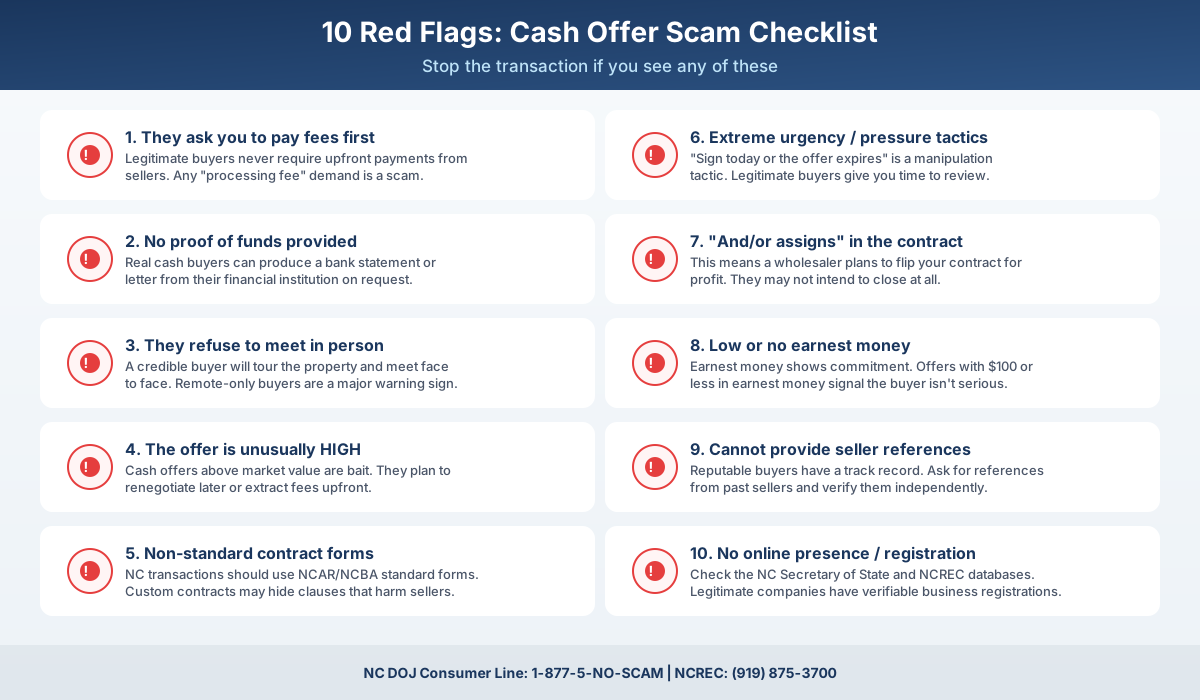
Red Flag #1: They Ask You to Pay Something First
Legitimate cash buyers never charge application fees, processing fees, or upfront deposits from the seller. Ever. If anyone asks you to pay money to receive a cash offer, walk away.
Red Flag #2: No Proof of Funds
A cash buyer who can't produce a recent bank statement or a letter from their financial institution isn't a cash buyer. They may be a wholesaler planning to assign your contract, a scammer, or someone hoping to secure financing after getting you locked in. Legitimate buyers provide proof of funds willingly and without hesitation.
Red Flag #3: They Refuse to Meet in Person
The NC Real Estate Commission has flagged this as a hallmark of impersonation fraud: "buyers" who claim to be traveling, on vacation abroad, or otherwise unable to meet in person. A legitimate investor spending $200,000+ on a property will look at it with their own eyes or send a trusted representative.
Red Flag #4: The Offer Is Unusually High
This one surprises people. If a cash offer sounds too good to be true, especially significantly above what other cash buyers have offered, it often is. Scammers sometimes offer above-market prices to get you under contract, then reduce the price dramatically after "inspection," or worse, they're running an impersonation fraud where the closing is fake and your title gets transferred without legitimate payment. An offer that's suspiciously generous deserves more scrutiny, not less.
Red Flag #5: Non-Standard Contract Forms
NC transactions typically use standardized forms approved by the NC Bar Association and NC Association of Realtors (Form 2-T for Offer to Purchase). SC uses forms from the SC Association of Realtors. If the contract looks like it was printed from a random template, or worse, handwritten on a blank piece of paper, that's a serious red flag.
Red Flag #6: Extreme Urgency and Pressure
"This offer is only good for 24 hours." "We have other properties we're looking at, so we need an answer today." "If you don't sign now, we'll move on."
These are high-pressure tactics designed to prevent you from consulting a Realtor, getting competing offers, or having an attorney review the contract. A legitimate cash buyer will give you reasonable time to make an informed decision.
Red Flag #7: Assignment Language Buried in the Contract
If the purchase agreement includes language like "Buyer and/or assigns" or "Buyer reserves the right to assign this contract," you're likely dealing with a wholesaler who has no intention of buying your home. In NC, this now triggers HB 797 requirements (licensing, 30-day cancellation right). In SC, you have no such protection, which means you need to catch this yourself.
Red Flag #8: Low or No Earnest Money
Earnest money is the buyer's skin in the game. On a $300,000 purchase, a serious cash buyer typically puts down $3,000–$10,000. A wholesaler or non-serious buyer might offer $100–$500. Low earnest money means they can walk away with minimal consequence, leaving you back at square one after weeks off the market.
Red Flag #9: They Can't Provide References
Ask for the names and phone numbers of three sellers they've purchased from in the past 12 months. A legitimate cash buyer closing 5, 10, or 20 deals a year will have references ready. Refusal, or references that don't check out, is a disqualifier.
Red Flag #10: No Online Presence Whatsoever
Look up the company name, the individual's name, and the phone number. Check Google reviews, the Better Business Bureau, and the NC Secretary of State (sosnc.gov) or SC Secretary of State (sos.sc.gov) business entity search. A company with no website, no Google listing, no BBB profile, and no business registration isn't a company you should be selling your home to.
If something feels wrong, it probably is. The NC DOJ maintains a consumer complaint line at 1-877-5-NO-SCAM (1-877-566-7226). The NC Real Estate Commission can be reached at (919) 875-3700. In South Carolina, contact the SC Department of Consumer Affairs at (803) 734-4200. File a complaint before the transaction closes, not after.
Have an offer you want us to beat?
If you've received a cash offer, tell us about your home and we'll send you our own no-obligation cash offer to compare — no strings attached.
9. When a Cash Offer Makes Sense
For all the warnings in this guide, there are real situations where a cash offer isn't just acceptable but the best option available.
One thing before the specifics. Some of these situations (foreclosure, divorce, a parent's death) aren't just financial problems. They're life problems. If getting a fast, clean sale at a fair price gives you the breathing room to deal with everything else, that matters. Don't let anyone (including us) tell you the spreadsheet is the only thing that counts.
Pre-Foreclosure or Active Foreclosure
If you've gotten a Notice of Default, you already know the clock is running. What you might not know is how much time you actually have, and it's different depending on which Carolina you're in.
In North Carolina, the non-judicial foreclosure process can move from filing to auction in as little as 60 days. A cash sale closing in 14–21 days can stop the foreclosure, protect your credit from a completed foreclosure record (which stays on your credit report for 7 years), and preserve whatever equity you have left.
South Carolina's judicial foreclosure process is slower (6–12 months), giving you more time, but SC also has the highest foreclosure rate in the country (1 in 2,311 housing units in April 2025). Speed matters regardless of which state you're in. If you need a stage-by-stage legal sequence, read our South Carolina foreclosure timeline guide.
We wrote an entire guide on this topic for NC homeowners: Facing Foreclosure in NC? Your Complete Guide.
Inherited Property and Probate
Inheriting a house often means inheriting problems: deferred maintenance, property taxes accumulating, insurance requirements, and the emotional weight of deciding what to do with a home that holds a lifetime of memories. There's no right way to feel about it, and there's no timeline for grieving. But there's a financial reality: every month the house sits empty, it costs money in taxes, insurance, and upkeep. If the property needs significant work, is in a different city from where you live, or has multiple heirs who need to agree on a sale, a cash offer eliminates the months-long listing process and the risk of a traditional sale falling through.
In NC, estates must go through probate in the county where the deceased resided, which means dealing with the county Clerk of Court, filing the will, and potentially waiting months for Letters Testamentary before you can sell. Cash buyers who specialize in probate properties understand this process and can often close faster than traditional buyers who get spooked by probate paperwork. For the full walkthrough, see our inherited property guides for North Carolina and South Carolina.
Divorce
If you and your spouse have agreed to sell, you probably both want it done yesterday. Nobody wants to coordinate showings and maintain a house with someone they're splitting from.
A cash sale gives you a clean break with a hard closing date, something both attorneys can build settlement terms around. No extended listing period, no showings that require coordination between two people who may not be communicating.
The math: on a $350,000 home with $180,000 in mortgage debt, a cash offer at 80% ($280,000) nets approximately $96,500 after mortgage payoff and minimal closing costs. Split two ways, that's roughly $48,000 each, in less than a month. The traditional route might net $63,000 each, but it takes 4–6 months and requires ongoing cooperation.
Significant Repair Needs ($25,000+)
If your home needs a new roof ($15,000–$25,000), HVAC replacement ($8,000–$15,000), foundation repair ($10,000–$30,000), or extensive water damage remediation, listing on the open market gets complicated. FHA and VA loans, which represent roughly 40% of the buyer pool, have minimum property condition requirements. A home that fails these standards can only be purchased with conventional or cash financing, dramatically reducing your buyer pool.
In this scenario, the "discount" from a cash buyer is less of a discount and more of a reflection of reality: your home is worth less in its current condition, and the buyers who can purchase it are limited.
Tenant-Occupied Properties
Selling a home with a tenant in place creates complications that most traditional buyers want no part of. Showing the property requires tenant cooperation (NC requires 24 hours' notice to enter a rental property). Lease terms may extend beyond the closing date. In North Carolina, even month-to-month tenants require 7 days' written notice to vacate, and tenants with an active lease have the right to remain through the lease term regardless of a property sale.
Cash investors who buy rental properties are set up to handle these situations, and they may even want to keep the tenant in place. If your tenant is paying $1,800/month reliably, that's actually an asset to an investor buyer, not a liability. For a full comparison of all five selling paths, including investor sale, cash-for-keys, and MLS with tenants, see our guide to selling a rental property with tenants in NC.
Relocation With a Hard Deadline
A job transfer with a start date six weeks away. A military PCS order (common around Fort Liberty, formerly Fort Bragg, and the numerous military installations in both Carolinas). A family emergency requiring an immediate move. When you must be somewhere else by a specific date, a cash sale gets it done.
The carrying cost math hits hard here: if you're paying $2,500/month for your current home while also paying rent or a mortgage at your new location, every month of a traditional listing costs you $2,500 in duplicate housing costs. Three months of that is $7,500 in pure carrying cost, which narrows the gap between a cash offer and a traditional listing significantly.
Tax Liens, Code Violations, or Title Issues
Properties with unpaid property taxes, city or county code violations, mechanic's liens, or disputed ownership are difficult to sell through traditional channels. Most buyers (and their mortgage lenders) won't touch a property with unresolved title issues. Cash buyers who specialize in these situations have attorneys and title companies experienced in resolving liens and encumbrances, often as part of the closing process itself.
In North Carolina, the county can initiate tax foreclosure proceedings after property taxes are delinquent for just one year. In South Carolina, the county holds an annual tax sale for properties delinquent as of March 16 of the current year. If you're behind on property taxes and getting notices from the county, a cash sale that resolves the delinquency at closing may be your fastest path to a clean resolution.
Homes That Can't Qualify for Financing
This one gets overlooked. FHA and VA loans have minimum property standards. If your home has any of the following, it may fail an FHA/VA appraisal:
- Roof with less than 2 years of remaining life
- Peeling or chipping paint (on homes built before 1978, lead paint concern)
- Missing or non-functional handrails on stairs
- Active water damage or evidence of mold
- Non-functional heating system
- Structural defects or foundation issues
- Missing flooring
- Electrical hazards
A home that fails FHA/VA requirements can only be purchased with conventional financing (slightly more lenient standards) or cash. Eliminating that much of your buyer pool fundamentally changes the listing math: your expected days on market go up, your expected sale price goes down, and the premium from listing over a cash offer shrinks.
When You Owe More Than the Offer
Nobody wants to talk about this one. If your remaining mortgage balance exceeds what a cash buyer, or even the open market, will pay for your home, you're "underwater," and a standard sale won't work. The closing attorney can't distribute money that doesn't exist.
You have three options:
- Bring cash to closing: If the shortfall is modest ($5,000–$15,000), you may be able to bring a check to closing to cover the difference. This is more common than people realize, especially for homeowners who bought at 2021–2022 peak prices with low down payments.
- Short sale: Your lender agrees to accept less than the full mortgage balance. This requires lender approval, which can take 60–120 days and involves financial hardship documentation. A short sale damages your credit (typically 100–150 points), but significantly less than a foreclosure (200+ points). Some cash buyers specialize in short sales and will handle the lender negotiation for you.
- Deed in lieu of foreclosure: You voluntarily transfer the property to the lender to avoid a foreclosure proceeding. Last resort. The credit impact is similar to a short sale, but you walk away with nothing.
If you think you might be underwater, the first step is simple: call your mortgage servicer and request a payoff statement. Compare that number to what the market says your home is worth (check Zillow's Zestimate, Redfin's estimate, or request a free CMA from a local Realtor). If there's a gap, you need to know before you sign anything.
10. When You Should List Instead
A cash offer solves specific problems. It doesn't solve all of them. This section covers the situations where listing your home on the open market will almost certainly put more money in your pocket, and the convenience of a cash sale isn't worth the trade-off.
Your Home Is Move-In Ready in a Desirable Area
If your home has been updated in the last 5–10 years, is in a neighborhood with strong demand (South Charlotte, Ballantyne, Lake Wylie, Belmont, downtown areas of Raleigh, Charleston, Greenville), and shows well, you're giving away money by selling to a cash buyer. These homes attract the full buyer pool, including individual cash buyers who'll pay market value, and the competition from multiple offers typically drives the price up, not down.
You Have No Urgency
If there's no deadline (no foreclosure, no divorce, no relocation) and you can comfortably wait 3–5 months for the listing and closing process, the premium from a traditional sale is almost always worth the wait. The 64-day average time on market in Charlotte, plus 30–45 days for buyer closing, means you're looking at roughly 100–110 days. If you can afford that timeline, the additional $20,000–$40,000 in net proceeds is significant.
Your Equity Position Is Strong
The higher your equity, the more painful the cash-offer discount becomes in absolute dollars. A 15% discount on a $200,000 home with $150,000 in mortgage debt means $30,000 off a $50,000 equity position, so you keep $20,000 instead of $50,000. That same percentage discount on a home you own free and clear is $30,000 off $200,000, painful but not devastating. Know your equity number before evaluating any offer.
The Market Is Hot in Your Area
If homes in your neighborhood are selling in under 30 days with multiple offers, you don't need a cash buyer. The open market is already delivering speed and premium pricing. Check the days-on-market for recent sales in your zip code on Redfin or Zillow. If homes like yours are consistently selling within 30 days at or above list price, listing is the clear winner.
Strong Sellers' Market Indicators
These are all signals that listing will outperform a cash offer:
- Your area has less than 3 months of housing inventory
- Sale-to-list price ratios above 99%
- Homes receiving multiple offers within the first week
- Buyer agents calling your neighbors to ask if anyone is thinking of selling
- New construction selling out before completion
If most of these describe your market, a cash buyer's discount is a poor trade for the premium the open market will deliver.
See What We'd Pay for Your Home
Tell us about your property and we'll send you a real cash offer — any condition, close on your timeline. Free and confidential.
11. Tax Implications: What You'll Owe
Selling your home for cash doesn't create different tax obligations than selling with traditional mortgage financing. The IRS doesn't care how the buyer pays. Cash and financed sales are taxed identically. But the tax rules themselves matter, and they differ between NC and SC in ways that can affect thousands of dollars.
The Primary Residence Exclusion
If you owned and lived in your home as your primary residence for at least 2 of the last 5 years, you can exclude up to $250,000 in capital gains (single filers) or $500,000 (married filing jointly) from federal taxes. For the vast majority of Carolinas homeowners, this exclusion eliminates the tax bill entirely.
Example: You bought your Charlotte home for $200,000 in 2016 and sell it for $380,000 in 2026. Your capital gain is $180,000. If you're married filing jointly, the entire gain falls within the $500,000 exclusion, so you owe $0 in federal capital gains tax.
When You WILL Owe Taxes
- Investment or rental property: No exclusion. The full gain is taxable.
- Owned less than 2 years: You don't qualify for the primary residence exclusion. The gain is taxed as ordinary income (short-term if owned less than 1 year) or long-term capital gains (if owned 1–2 years).
- Gains exceeding the exclusion: If your gain exceeds $250,000/$500,000, the excess is taxable.
- Depreciation recapture: If you previously rented the home and claimed depreciation, that amount is recaptured at a 25% federal rate regardless of your income bracket.
NC vs. SC: State Tax on Capital Gains
| North Carolina | South Carolina | |
|---|---|---|
| State income tax rate | Flat 3.99% | Up to 6.2% |
| Capital gains treatment | Taxed as regular income at the flat rate | 44% deduction on long-term gains |
| Effective rate on long-term gains | 3.99% | ~3.5% (6.2% × 56%) |
| Primary residence exclusion | Follows federal rules | Follows federal rules |
For short-term capital gains (property held less than one year), NC's flat 3.99% is better than SC's potential 6.2%. For long-term gains, SC's 44% deduction produces an effective rate of approximately 3.5%, actually lower than NC's flat rate. The difference on a $100,000 gain is roughly $490 ($3,990 NC vs. $3,500 SC). Not life-changing, but worth knowing.
Transfer Taxes at Closing
Both states impose a transfer tax (called "excise tax" in NC) when property changes hands:
- NC: $1 per $500 of sale price, paid by the seller. On a $350,000 sale: $700.
- SC: $1.85 per $500 of sale price, typically split between buyer and seller by county custom (though this is negotiable). On a $350,000 sale: $1,295 total.
1031 Exchanges: Investor Properties Only
Selling a rental property or a home you never lived in? A Section 1031 like-kind exchange lets you roll the proceeds into another investment property and defer the capital gains bill indefinitely. That comes up a lot in the Charlotte metro, where investor-to-investor transactions are common. But the rules are strict and the deadlines are unforgiving.
From the day your sale closes, you have exactly 45 calendar days to formally identify your replacement property, in writing, delivered to a Qualified Intermediary (QI) who holds your sale proceeds in escrow (you never touch the money yourself). Then you have 180 calendar days total from your original closing to complete the purchase. Miss either deadline by a single day and the entire exchange fails, and the full capital gain becomes taxable that year.
The replacement property must be of equal or greater value. If you trade down (a $400,000 sale into a $300,000 purchase), the $100,000 difference (called "boot") is taxable. Your primary residence never qualifies for a 1031 exchange; this is strictly for investment and business-use property.
The deferred gain carries forward through every subsequent exchange. But if you hold the final property until death, your heirs receive a stepped-up cost basis, and the accumulated deferred gain effectively disappears. This is how generational real estate wealth is built.
12. Your Next Step
You now know more about cash offers in the Carolinas than most real estate agents, and certainly more than the people sending you postcards.
If you want to understand your options: Start with a free home evaluation. We'll show you what your home is worth on the open market AND what a cash offer would look like, side by side, with real numbers. No obligation, no pressure, and no one will show up at your door uninvited.
If you're in a time-sensitive situation (foreclosure, divorce, relocation, inherited property) we can typically provide a cash offer within 48 hours and close in as little as 14 days. We start by talking, not sending you paperwork.
If you're not ready to do anything yet: Bookmark this guide. Share it with someone who needs it. And when the next yellow postcard arrives, you'll know exactly what questions to ask.
Get your free home evaluation →
13. Common Questions About Cash Offers in the Carolinas
How much will I actually get from a cash offer on my Carolinas home?
It's a range, not a single number. For a solid, livable home, reputable cash buyers and iBuyers in NC and SC typically pay roughly 80% to 90% of market value. For a home needing significant repairs, expect less, often 70% of market value or below, because the buyer is pricing in renovation costs and their margin. Nationally, all-cash buyers tend to pay about 10% less than financed buyers. You're trading that gap for speed and certainty, so always compare the cash number against what you'd net after commissions, repairs, and carrying costs on the open market.
How fast can I close a cash sale in North or South Carolina?
Most legitimate cash buyers make a written offer within 24 to 48 hours and can close in about 7 to 14 days, versus roughly 45 to 90 days for a financed sale. Fast is a feature, not a deadline, a trustworthy buyer lets you pick the closing date, including a later one if you need time. Anyone pushing you to sign "today" is using pressure, not offering a service.
How do I avoid a "we buy houses" scam or a lowball offer?
Vet the buyer before you sign. Ask for proof of funds and verify it independently; check their reviews, BBB profile, references, and the homes they've actually closed (county records show real purchases). Real buyers walk the property in person and put down earnest money. Walk away from any up-front fee, no proof of funds, refusal to meet, "sign now" pressure, a suspiciously high offer, or a contract form you've never seen. A quick attorney review is cheap insurance.
Is a cash offer actually worth it, or should I list with an agent?
It depends on your situation, not a slogan. Cash usually nets less than a well-run listing, so it's worth it when speed and certainty matter more than the last few percent of price, foreclosure, an inherited or as-is home, a divorce or relocation deadline, a home that won't pass financing. It's usually not the right call when your home is move-in ready in a desirable area, you have no time pressure, and your equity is strong. Run both sets of numbers before you decide.
Do I have to make repairs or pay anything to sell for cash?
No. A legitimate cash buyer buys as-is, no repairs, no staging, no deep clean, and never asks you to pay a fee or deposit up front. Standard closing costs come out of the proceeds at closing. If anyone asks for money before closing, that's a scam.
What protections do North Carolina and South Carolina give cash sellers?
North Carolina's House Bill 797 (effective October 1, 2025) treats residential wholesaling as licensed brokerage and gives homeowners a non-waivable 30-day right to cancel a wholesale contract, with a refund due within 10 business days; violations are unfair trade practices the Attorney General can enforce. NC also requires the Chapter 47E property disclosure in most sales. South Carolina requires an attorney to close, giving you an independent professional reviewing the paperwork. In both states, read the contract for assignment language.
Can I sell for cash if I'm behind on payments, in foreclosure, or have liens?
Often yes, if you have enough equity to cover what's owed. A cash sale can close before a foreclosure sale and pay off your mortgage, delinquent taxes, and most liens directly from the proceeds at closing. The thing to confirm first is the math: if the offer is less than your total payoff, you'd need to look at a short sale or other options. See avoiding foreclosure in NC and the SC foreclosure timeline.
Sources
- HomeLight — How Much Do House-Buying Companies Pay?
- UC San Diego Rady School of Management — All-Cash Buyers Pay 10% Less Than Mortgage Buyers
- North Carolina General Assembly — House Bill 797 (2025)
RobinOffer provides cash offers and traditional listing services for homeowners across North Carolina and South Carolina through NorthGroup Real Estate. This guide is for educational purposes only and does not constitute legal, tax, or financial advice. Market data is current as of July 2026 and subject to change. Always consult a licensed attorney, CPA, or financial advisor for advice specific to your situation.
If your sale is tied to military orders, also read our Military PCS relocation guide for NC & SC for timeline-first decision frameworks and closing-risk controls.