
SC Property Tax Lien Timeline: How Long Before the County Sells Your Home?
From January delinquency to tax sale and redemption: what changes each stage and what to do before options narrow.
1. How long can you go without paying property taxes in SC before losing your house?
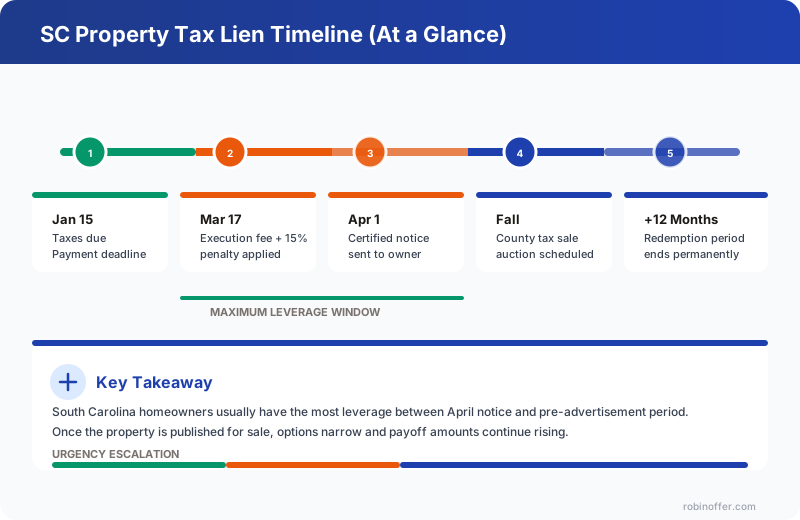
Here is the short answer: in South Carolina you can fall behind on property taxes for roughly a year before the county sells your home at its annual delinquent tax sale, and even then you get a full 12 months after the sale to redeem the property and keep it. Nobody changes the locks the day you miss a payment. But the clock is real, the cost to catch up climbs every quarter, and once it runs out your ownership is gone for good.
It helps to think of two clocks. Roughly the first year is the run-up to the auction: your bill is due January 15, penalties stack through the spring, and the county holds its delinquent tax sale in the fall. The second year is the redemption window after the sale. Miss that window and the winning bidder gets a quitclaim deed, and after 24 total months that deed is legally incontestable and your ownership is gone.
This guide walks through every stage of South Carolina's property tax lien timeline, from the day your bill arrives in October through the auction and redemption period. We will cover what the penalties actually cost, how the tax sale works in practice, what investors are thinking when they bid on your property, and, most importantly, when selling your home before the sale makes more financial sense than trying to catch up. If you are also dealing with mortgage trouble, pair this with our SC Foreclosure Help guide, which covers the judicial process running on a separate track.
The South Carolina tax-sale timeline at a glance
| Stage | When | What it means for you |
|---|---|---|
| Tax bill mailed | October | Due January 15 with no penalty |
| Penalties begin | Jan 16 → Mar 16 | 3% → 10% → 15% added, plus execution cost |
| Execution & certified notice | On/after April 1 | Formal seizure process starts (SC Code 12-51-40) |
| Newspaper advertisement | 3 weeks before sale | Your name and property are published |
| Delinquent tax sale (auction) | Usually Oct–Dec | Highest bidder wins; you still own and live in the home |
| 12-month redemption window | "One year and a day" from sale | Pay taxes + tiered interest to keep the home (SC Code 12-51-90) |
| Certified "time is running out" notice | 20–45 days before deadline | Last warning by certified mail (SC Code 12-51-120) |
| Tax deed issued | ~12 months + 1 day | Ownership lost if not redeemed; deed is incontestable after 24 months |
How long do you have to redeem after a tax sale in South Carolina? Twelve months from the date of the sale, many counties call it "one year and a day." That window is fixed by SC Code 12-51-90, it does not pause for hardship, and the cost to redeem climbs every quarter you wait.
2. SC property tax basics: assessment ratios, millage, and the October bill
Before we get into what happens when things go sideways, you need to understand how South Carolina calculates what you owe. It works differently than most states, and the math trips people up.
South Carolina uses a two-step system. First, the county assessor determines your property's fair market value. Then they multiply it by an assessment ratio to get your "assessed value." For owner-occupied homes, that ratio is 4%. For non-owner-occupied residential property (rental homes, second homes), it is 6%. For commercial property, it jumps to 6% as well. This is important because the tax you owe is based on assessed value, not market value.
How the math works on a $300,000 home
| Calculation Step | Owner-Occupied (4%) | Non-Owner-Occupied (6%) |
|---|---|---|
| Fair market value | $300,000 | $300,000 |
| Assessment ratio | 4% | 6% |
| Assessed value | $12,000 | $18,000 |
| Millage rate (example: 300 mills) | $3,600/year | $5,400/year |
Tax bills go out in October. You will see the county, school district, and any special district levies combined into one number. The total millage rate varies by county and municipality. York County runs differently than Richland County, and a property inside the City of Rock Hill pays a different rate than one in unincorporated York County.
The key date is January 15. That is when your taxes are due without penalty. If January 15 falls on a weekend or holiday, you get until 5:00 PM the next business day. After that, the penalty clock starts, and once it starts, it does not stop until you pay in full or your property goes to auction.
3. After January 15: the penalty ratchet that turns a tax bill into a crisis
Miss January 15, and the penalties start stacking immediately. South Carolina does not send a single late fee and wait patiently. The state authorizes a progressive penalty schedule that escalates every few weeks, and individual counties implement it on slightly different calendars.
Here is a representative penalty schedule based on published county data from Greenville, Sumter, and Aiken counties:
Typical SC property tax penalty escalation
| Deadline Passed | Cumulative Penalty Added | On a $3,600 Tax Bill | New Total Owed |
|---|---|---|---|
| January 16 | 3% | $108 | $3,708 |
| February 1–2 | 10% (additional 7%) | $360 | $3,960 |
| March 16–17 | 15% (additional 5%) + $15 execution fee | $555 | $4,155 |
That is a 15.4% increase in just two months. And notice the language shift at the March deadline: "execution fee." That word matters. It means the county treasurer has issued a formal execution, a legal instrument directing the delinquent tax collector to begin seizing your property for sale. This is not a late notice anymore. It is the start of a legal process.
We see homeowners treat January and February penalties like convenience fees, the cost of paying late at the electric company. They are not. Each penalty tier is a procedural step toward auction. By the time you hit March, the county has already assigned your account to the delinquent tax collector's office, and your name is on a list that leads to one place: the tax sale.
4. April through fall: execution, seizure notice, and the walk toward auction day
On April 1 (or as soon after as practicable) the delinquent tax collector mails you a formal notice under SC Code 12-51-40. This certified letter tells you that your property taxes are delinquent and that the county has the authority to seize and sell your property to satisfy the debt.
If you do not pay within 30 days of that notice, the collector can take "exclusive possession" of your property. For real estate, that means posting a notice in one or more conspicuous places on the premises. For personal property (mobile homes that are not permanently affixed, for example), it means the collector can physically take possession.
The timeline from bill to auction
| Month | What Happens | Your Remaining Options |
|---|---|---|
| October (prior year) | Tax bill mailed | Pay in full, set up installment plan by Jan 15 |
| January 15 | Payment deadline, no penalty | Pay in full to avoid any penalties |
| January 16 – March 17 | Escalating penalties: 3% → 10% → 15% + execution fee | Pay delinquent amount plus accumulated penalties |
| April 1 | Execution issued; certified delinquent notice mailed | Pay full amount within 30 days to stop process |
| May (approx.) | 30-day notice period expires; seizure authorized | Pay in full or negotiate; list property for sale |
| Late summer | County prepares delinquent tax sale list | Pay before advertisement deadline; sell to cash buyer |
| 3 weeks before sale | Property advertised in local newspaper (3 consecutive weeks) | Pay full amount before sale day to remove from list |
| October – December | Delinquent tax sale auction | Your last chance was before the gavel dropped |
The exact sale date varies by county, and that variation matters more than most homeowners realize. Lancaster County held its 2025 sale on November 3. Florence County went on October 6. Saluda County scheduled theirs for November 4. York County typically holds its sale in October or November, and Williamsburg County ran its deadline out to December 2, 2025. The point is: by fall, your property is on the auction block unless you have paid every dollar of delinquent taxes, penalties, and costs. And "fall" means different weeks depending on which county you live in.
One detail that surprises homeowners: the county does not mail you a separate notice of the actual sale. The law requires newspaper advertisement (three consecutive weekly publications) but there is no requirement for a personal letter saying "your house will be sold next Tuesday." If you have been ignoring the certified notices since April, you may not realize the sale is happening until it has already happened.
5. Inside the SC tax sale: who bids, what they pay, and what happens to your equity
South Carolina's delinquent tax sale is a public auction, open to anyone who registers as a bidder. The mechanics work like this:
The opening bid equals the total delinquent taxes, assessments, penalties, and costs owed on the property. Bidders compete by offering amounts above that floor, and the highest bidder wins. If nobody bids, the Forfeited Land Commission (FLC), a county body, becomes the default purchaser at the minimum bid amount.
Here is what catches homeowners off guard: the successful bidder does not get immediate ownership. They get a tax lien certificate, essentially a claim against your property. You still own the home and still live in it, but now there is someone with a financial interest in your property who is counting the days until the redemption period expires.
What the winning bidder actually gets
| After the Auction | Bidder's Rights | Homeowner's Rights |
|---|---|---|
| Day of sale | Holds tax lien certificate; earns interest on investment | Full ownership and possession; can redeem by paying bidder's amount + interest |
| During 12-month redemption | Cannot enter, maintain, or interfere with property | Lives in and uses property normally; must pay to redeem before deadline |
| 20–45 days before redemption expires | Waits for county to send homeowner final notice | Receives certified mail warning that redemption window is closing |
| 12 months + 1 day after sale | Receives quitclaim deed to property | Ownership lost unless redeemed; may have surplus claim |
| 24 months after sale | Deed becomes incontestable | No further legal challenge possible on procedural grounds |
The quitclaim deed is significant. It is not a warranty deed, so the buyer receives no title guarantees. Most tax sale investors will need to file a quiet title action (a court proceeding to establish clean ownership) before they can resell or refinance the property. That process costs them $1,500 to $3,000 in legal fees and takes 60 to 90 days. They factor that cost into their bidding strategy.
6. The 12-month redemption clock: what it costs to buy back your own home
South Carolina gives you exactly 12 months from the date of the tax sale to redeem your property. This is your last clear window to keep your home. But redemption is not free, and the cost escalates the longer you wait.
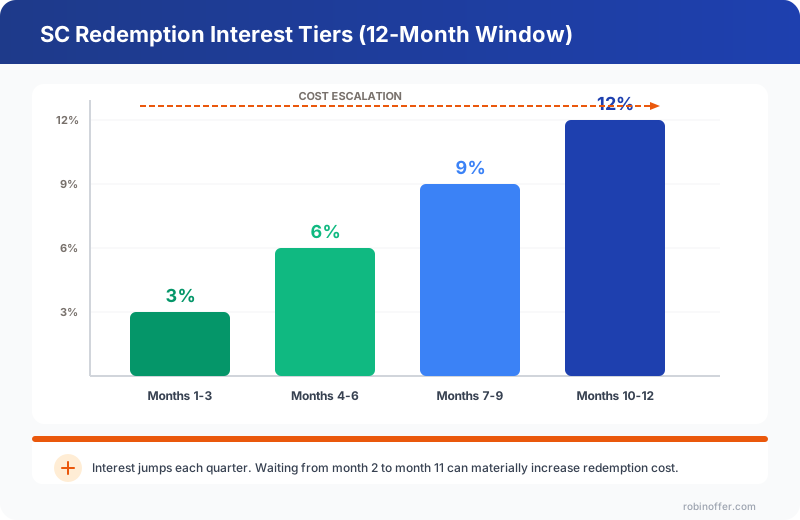
To redeem, you must pay the county's delinquent tax collector the full amount of delinquent taxes, penalties, assessments, and costs, plus interest owed to the winning bidder. That interest follows a statutory schedule set by SC Code 12-51-90:
Redemption interest schedule (on the bid amount)
| Redemption Window | Interest Rate Owed to Bidder | Example: $5,000 Bid | Example: $12,000 Bid |
|---|---|---|---|
| Months 1–3 after sale | 3% | $150 | $360 |
| Months 4–6 after sale | 6% | $300 | $720 |
| Months 7–9 after sale | 9% | $450 | $1,080 |
| Months 10–12 after sale | 12% | $600 | $1,440 |
Notice the structure: the interest is not compounding monthly. It is a flat percentage of the bid amount that jumps every quarter. If someone bid $5,000 on your lien and you redeem in month two, you owe $5,150. Wait until month eleven, and you owe $5,600. On a $12,000 bid, the difference between redeeming early and late is $1,080.
There is one protection built into the law: the interest cannot exceed the amount the Forfeited Land Commission would have bid. This caps the interest at the minimum bid amount (the total taxes, penalties, and costs owed). So if an investor bid $50,000 on a property where the minimum bid was $8,000, your interest is calculated on $8,000, not $50,000.
Between 20 and 45 days before your redemption period expires, the delinquent tax collector must mail you a certified notice warning that your time is running out. If you miss that 12-month deadline, the property is deeded to the purchaser, typically within 30 days.
Want to know what we would pay before the tax sale?
Get a free, no-obligation cash offer on your home — any condition, close on your timeline, no repairs or fees.
7. The Forfeited Land Commission: what happens when nobody bids on your property
If no private investor bids on your property at the tax sale, the Forfeited Land Commission (FLC) becomes the default purchaser. Every SC county has an FLC, and its job is to serve as the buyer of last resort so that no delinquent property goes unsold.
The FLC bids the minimum amount, just enough to cover the delinquent taxes, penalties, assessments, and costs. After the 12-month redemption period, if you have not redeemed, the FLC takes ownership and can dispose of the property according to its own policies.
In practice, FLC-held properties are often sold at a subsequent auction or through a sealed-bid process. The commission's goal is to return the property to the tax rolls (a performing, tax-paying parcel), not to hold real estate long-term.
FLC vs. private investor: how outcomes differ for the homeowner
| Scenario | Private Investor Wins Bid | Forfeited Land Commission Wins |
|---|---|---|
| Bid amount | Often above minimum (especially on desirable properties) | Always the minimum (taxes + penalties + costs) |
| Redemption interest cap | Capped at FLC's hypothetical bid amount | Same, interest based on minimum bid |
| Investor contact during redemption | May receive letters from investor or their attorney | No investor pressure; county manages |
| After redemption expires | Investor gets quitclaim deed; files quiet title action | FLC takes title; disposes through county procedures |
| Surplus from sale | If bid exceeds taxes owed, surplus belongs to former owner | No surplus, FLC bid equals minimum |
The surplus rule matters. After the 2023 U.S. Supreme Court decision in Tyler v. Hennepin County, taxing authorities across the country (including South Carolina) cannot keep sale proceeds that exceed the taxes owed. If an investor bids $45,000 on a property with $6,000 in delinquent taxes, the remaining $39,000 belongs to you. But you have to claim it. Counties are not required to track you down and hand you a check.
If you suspect your property will attract private bidders (because it has good equity, is in a desirable location, or is a buildable lot), the surplus recovery right is real, but it is cold comfort compared to selling the property yourself and controlling the price, the timeline, and the closing costs. A homeowner-directed sale at market value will almost always net more than a surplus claim after an auction. For a walkthrough of how cash sales work and what buyers typically offer, see our Cash Offer Guide for the Carolinas.
8. What investors see when they look at your delinquent property
Understanding the investor side of the table helps you make better decisions. Tax sale investors are not charities; they are running a return-on-capital calculation, and your property is just a line item in their spreadsheet.
Here is how a typical SC tax lien investor evaluates a property before bidding:
Investor decision framework at SC tax sales
| What Investors Evaluate | What They Want to See | What Makes Them Walk Away |
|---|---|---|
| Property value vs. lien amount | High equity cushion ($200K+ home with $5K lien) | Lien amount close to property value; negative equity |
| Redemption likelihood | Low, owner unlikely to redeem (vacant, abandoned, distressed) | High, active owner-occupant will probably pay to redeem |
| Title complexity | Clean title; single owner | Multiple heirs, probate, divorce liens, HOA liens, IRS liens |
| Property condition | Habitable or buildable lot | Environmental contamination, structural collapse, flood zone |
| Quiet title cost | Standard $1,500–$3,000 | Complex heir situations requiring $5,000+ in legal fees |
| Market demand | Growing area with buyer interest | Rural, declining population, no rental demand |
The best return for an investor is a high-equity property where the owner does not redeem. They pay $8,000 at auction, wait 12 months, get a quitclaim deed to a $250,000 property, spend $2,500 on a quiet title action, and either flip it or rent it out. Their total investment: $10,500. Their return: the difference between $10,500 and market value.
That is the scenario you want to avoid. Every day you wait to act is a day closer to handing an investor that kind of return, funded entirely by your equity.
Some investors will also contact you directly during the redemption period, offering to "help" with the situation. Most of these offers involve buying your property at a steep discount. Some are legitimate. Some are predatory. If someone contacts you after a tax sale offering to buy your property, get at least two other offers before signing anything, and never sign a document you have not shown to an attorney. For a full checklist of red flags and scam protections, see our Cash Offer Guide's anti-scam section.
9. How SC differs from NC
If you own property in both Carolinas, the key distinction is the collection method. South Carolina sells tax lien certificates to private investors, who earn interest on your delinquency and are financially motivated to see you fail to redeem. North Carolina uses a county-driven foreclosure process through the courts, where the county just wants the taxes paid. SC gives you a 12-month post-sale redemption window; NC's timeline is generally shorter and court-supervised. SC's final deed is a quitclaim (no title warranty), while NC issues a court-ordered deed with stronger title. These differences mean the strategy that works in one state can fail in the other.
10. When property tax trouble and mortgage default happen at the same time
If you are behind on both property taxes and your mortgage, you are managing two separate legal tracks, and they do not coordinate with each other.
Your mortgage lender has a strong incentive to pay your delinquent property taxes. Why? Because property tax liens have priority over mortgage liens. If your property goes to tax sale and you do not redeem, the tax sale purchaser can potentially wipe out the mortgage lien. Your lender does not want that.
In practice, many mortgage servicers will advance the delinquent tax payment on your behalf and add it to your mortgage balance. You will see this as a line item on your mortgage statement, and now you owe the mortgage company for both your regular payments and the tax advance. This can accelerate your mortgage into default if it was not already there.
How dual delinquency creates compound pressure
| Pressure Source | Property Tax Track | Mortgage Track | Combined Impact |
|---|---|---|---|
| Monthly cost growth | Penalties: 3% → 15% over 2 months | Late fees: typically 4-5% of monthly payment | Two compounding debt streams |
| Legal process start | April 1 execution | After 120 days of non-payment (federal law) | Both tracks can run simultaneously |
| Public record | Delinquent list published in newspaper | Lis Pendens filed with county (SC judicial foreclosure) | Both appear on title search; complicates sale |
| Sale timeline | October – December tax sale | 6-12 months after Lis Pendens (SC judicial process) | Tax sale may happen first |
| Redemption/cure option | 12 months post-sale | Right to cure before court order of sale | Different deadlines, different payoff amounts |
If you are in this dual-track situation, the most important thing to understand is that the tax lien has priority. Even if your mortgage lender starts foreclosure proceedings, the tax sale can still happen. And if a tax sale investor gets the property and you do not redeem, the mortgage lender's lien may be eliminated entirely. To keep both clocks straight, see how a South Carolina foreclosure moves stage by stage while the tax timeline runs in parallel.
This is actually leverage for a homeowner who wants to sell. Both the tax collector and the mortgage servicer have reasons to cooperate with a sale that pays off all liens. A cash buyer sale can close in 14 to 21 days, pay off delinquent taxes at closing, satisfy the mortgage, and put remaining equity in your pocket, all before either legal process reaches its endpoint. For homeowners facing SC's judicial foreclosure process specifically, our SC Foreclosure Help guide explains the Lis Pendens timeline and your options at each stage.
One scenario we see in the Charlotte metro's SC counties, particularly in York and Lancaster, is homeowners who stopped paying both their mortgage and their property taxes after a job loss or medical event. By the time they stabilize financially, they are facing a tax sale in October and a Lis Pendens filing from their mortgage lender. The instinct is to try to save the house by catching up on both. But the math often points in a different direction: selling while you still have equity, paying off both debts at closing, and using the remaining funds to rent or relocate. We do not push homeowners toward selling, but we do insist on running the numbers so the decision is based on math, not emotion. If keeping the house requires $15,000 in back taxes and mortgage reinstatement, but selling nets you $60,000 in equity, you need to see both numbers side by side before committing to a plan.
11. The installment plan most SC homeowners do not know exists
South Carolina law (SC Code 12-45-75) allows counties to offer installment payment plans for property taxes. Not every county participates, and the enrollment window is narrow, but if you qualify, it can prevent delinquency entirely.
Here is how it works: you notify the county treasurer in writing between December 1 and January 15 that you want to pay in installments. The county then divides your estimated tax obligation into five payments:
SC installment payment schedule
| Installment | Due Date | Percentage of Estimated Tax | On a $3,600 Bill |
|---|---|---|---|
| First | February 15 | 16.67% | $600 |
| Second | April 15 | 16.67% | $600 |
| Third | June 15 | 16.67% | $600 |
| Fourth | August 15 | 16.67% | $600 |
| Fifth | October 15 | 16.67% | $600 |
| Balance | By January 15 (next year) | Remaining amount after reassessment | Varies |
Two important restrictions: you cannot use the installment plan if your taxes are paid through a mortgage escrow account (your lender handles that). And you must opt in each year; it does not renew automatically.
If you are reading this guide because you are already behind, the installment plan will not help you for this tax year. But once you resolve your current delinquency, enrolling in the installment plan for next year can prevent the same situation from recurring. Six payments of $600 are easier to manage than one payment of $3,600 in January, especially if January is already tight because of holiday spending.
12. Selling before the tax sale: when getting out ahead of the auction makes financial sense
For many SC homeowners behind on property taxes, selling the property before the tax sale is the smartest financial move, but it only works if you act early enough to close before the auction date.
Here is the math that makes the decision clear. Suppose you own a home worth $275,000 with a mortgage balance of $180,000 and $6,500 in delinquent taxes plus penalties. Your equity is roughly $275,000 minus $180,000 minus $6,500 = $88,500.
Sell now vs. wait and redeem vs. lose at auction
| Path | Estimated Proceeds | Key Assumption | Risk Level |
|---|---|---|---|
| Sell now (agent, market price) | $68,000–$73,000 net after commissions, closing costs, and payoff of mortgage + taxes | 30-45 day closing; market-rate sale | Low, you control the process |
| Sell now (cash buyer, quick close) | $55,000–$63,000 net | 14-21 day closing; 85-92% of market value | Low, fast, certain close |
| Redeem after tax sale (month 3) | Keep the house; pay $6,695 (taxes + 3% interest) | You have $6,695 available in cash within 3 months | Medium, requires lump-sum payment |
| Redeem after tax sale (month 11) | Keep the house; pay $7,280 (taxes + 12% interest) | You have $7,280 available in 11 months | High, cutting it close to deadline |
| Fail to redeem | $0 (lose property; may have surplus claim) | No redemption payment made within 12 months | Maximum, you lose the house |
Look at the spread. If you sell to a cash buyer at a discount, you walk away with $55,000 to $63,000. If you fail to redeem, you walk away with nothing, or at best, a surplus claim that requires you to petition the county and wait months for processing. The difference between the worst sale and the worst non-sale is the entire value of your equity.
The timing calculus is straightforward: if you cannot realistically pay the full redemption amount within three months of the tax sale, you should start a sale process before the tax sale happens. That gives you maximum control over the price, the timeline, and the closing terms. It also keeps the tax sale off your property's title history, which matters for your next home purchase.
One practical note: delinquent property taxes are paid at closing. Your closing attorney or title company will pull the payoff amount from the county, add it to the settlement statement, and pay it directly. You do not need to come up with the tax money separately before listing. The sale itself clears the lien.
Get Your Free, No-Obligation Cash Offer
Tell us about your property and we'll send a real cash offer — any condition, no repairs, and you close on your timeline. Free and confidential.
13. Three SC county snapshots: how local practice shapes your actual timeline
South Carolina's tax collection statutes are statewide, but counties implement them with different schedules, systems, and levels of staffing. Here is what the process actually looks like in three of the state's most active counties.
York County
York County (home to Fort Mill, Rock Hill, and Tega Cay) typically holds its delinquent tax sale in October or November. The county publishes the sale list in The Herald newspaper for three consecutive weeks before the sale date. Bidder registration is available online and in person. York County's tax collector office can be reached at (803) 684-8527. Given the strong Charlotte-metro housing market in York County, properties here tend to attract competitive investor bidding, which means higher auction prices and larger potential surplus claims, but also more investor contact during the redemption period.
Lancaster County
Lancaster County, which includes Indian Land (one of the fastest-growing areas in the Charlotte metro), held its 2025 sale on November 3 at 9:00 AM. The payment deadline to remove your property from the sale list was 5:00 PM on October 31, 2025. Lancaster's delinquent tax collector handles certified mail, property posting, mortgage verification, and title searches as part of the pre-sale process. The county has a dedicated Indian Land selling guide community that is particularly active in real estate investment, meaning tax sale properties in this area draw serious bidder interest.
Richland County (Columbia)
Richland County, centered on the state capital, processes one of the largest delinquent tax sale lists in SC. The county offers an online portal for bidder registration and publishes its sale list on the county website in addition to newspaper advertisement. Richland's Forfeited Land Commission is active in disposing of properties that do not attract private bidders, often holding separate FLC sales throughout the year.
What these county differences mean for you
The practical takeaway is that your county's specific calendar, staff capacity, and investor competition level all affect your strategy. A property in rural Oconee County may sit on the FLC's books for years because investor interest is low. The same property in York County or Charleston County would attract multiple bidders within minutes of the auction opening. Higher investor interest means a higher chance of a competitive bid, which could mean a larger surplus claim if you do not redeem, but it also means a more motivated purchaser who will be counting down the 12-month redemption clock with serious financial interest in seeing you fail. Call your county's delinquent tax collector, get the specific dates that apply to your parcel, and build your plan around those dates, not around general guidelines.
For homestead exemption details, see our SC Homestead Exemption Guide.
For inherited property with tax issues, see our SC Probate Guide.
14. Your defense file: what to gather, who to call, and what to do this week
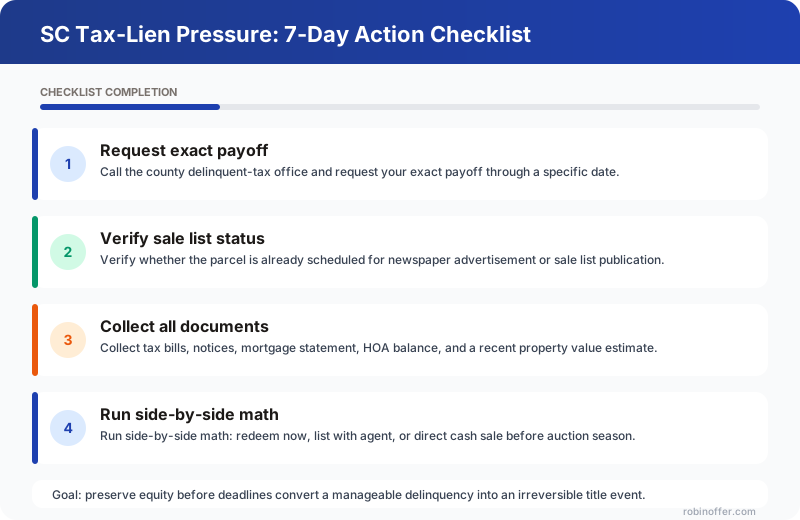
If you are behind on SC property taxes and want to protect your position, the single best thing you can do is build a clean file. Not next month. This week. Here is what goes in it:
Documents to collect immediately
- Current tax bill: pull it from your county treasurer's website or call their office. Confirm the exact amount owed including all penalties and costs.
- Delinquent notice: the certified letter from the delinquent tax collector (sent around April 1). If you did not save it, request a copy.
- Payment history: any partial payments or prior-year payments. Counties sometimes misapply payments to the wrong tax year.
- Property tax assessment: your current assessed value. If your home's value has dropped since the last reassessment, you may be paying more than you should.
- Mortgage statement: confirm whether your lender is escrowing for taxes. If they stopped escrowing (common after a loan modification), you are responsible for direct payment.
- Title report: if you plan to sell, order a preliminary title report to identify any other liens.
People to call this week
- County delinquent tax collector: ask for a written payoff amount and confirm the sale date for your county. Get the name of the person you speak with and the date of the call.
- SC Legal Aid: if your income qualifies, Legal Aid can provide free help with tax delinquency issues. South Carolina Legal Services: (803) 799-9668 or (888) 346-5592.
- HUD-approved housing counselor: free counseling available through HUD's network. They can help you evaluate whether to pay, sell, or explore other options. Find one at (800) 569-4287.
- A real estate attorney: if your situation involves inheritance, divorce, or multiple liens, spend $200-$400 on a consultation. The cost of not understanding your legal position is measured in thousands, not hundreds.
Facing a deadline and want a fast way out?
We buy homes in any condition for cash. Get a free, no-obligation cash offer and close on the timeline that works for you.
15. SC property tax lien timeline FAQ: the questions homeowners actually search for
Can I still live in my house after the tax sale?
Yes. During the 12-month redemption period, you retain full ownership and possession of your property. The tax sale purchaser has no right to enter, maintain, or interfere with your property until the redemption period expires and they receive a deed. This is one of the strongest homeowner protections in SC's tax sale system.
What happens to my mortgage if the property goes to tax sale?
Your mortgage still exists during the redemption period. However, if you fail to redeem and the tax sale purchaser gets a deed, the tax lien's priority can potentially eliminate the mortgage lien. In practice, most mortgage servicers will pay the delinquent taxes on your behalf to protect their interest, and then add that amount to your mortgage balance.
Can I make partial payments on delinquent taxes to stop the sale?
Generally, no. South Carolina requires full payment of all delinquent taxes, penalties, and costs to remove your property from the sale list. Some counties may accept partial payments toward the balance, but partial payment does not stop the tax sale process. The only way to remove your property from the sale is to pay the full amount before the county's cutoff deadline, typically a few days before the auction.
How do I find out if my property is on the tax sale list?
Check your county's delinquent tax collector website. Most SC counties publish the sale list online three to four weeks before the auction. The list is also published in a local newspaper for three consecutive weeks. You can also call the delinquent tax collector's office directly and ask.
What if I think my property was assessed too high?
You have the right to appeal your property tax assessment through the county assessor's office. However, an appeal does not stop the collection process on taxes already billed. You must still pay the current bill by January 15 to avoid penalties. If your appeal is successful, you will receive a credit or refund for the overpayment, but only after the appeal is resolved, which can take months.
Can I sell my house if it has a tax lien on it?
Yes, you can sell at any time, before or after the tax sale. Delinquent property taxes are paid at closing from the sale proceeds, just like a mortgage payoff. Your closing attorney or title company handles the payoff directly with the county. You do not need to pay the taxes out of pocket before listing. The lien simply gets satisfied as part of the closing transaction. For homeowners in the Charlotte metro area facing this situation, our Cash Offer Guide explains how to compare multiple offers quickly.
What is a quitclaim deed and why does it matter for tax sales?
A quitclaim deed transfers whatever interest the grantor has in a property, without any warranty or guarantee that the title is clean. When a tax sale purchaser receives a quitclaim deed after the 12-month redemption expires, they own the property but do not have the title guarantees that come with a standard warranty deed. This is why most tax sale investors must file a separate court action called a "quiet title" action (which costs $1,500 to $3,000 in legal fees and takes 60 to 90 days) before they can resell or refinance the property with clean title. After 24 total months from the sale date, the quitclaim deed becomes incontestable on procedural grounds, which strengthens the purchaser's position significantly.
What happens to my surplus if the property sells for more than the taxes owed?
Under the 2023 U.S. Supreme Court ruling in Tyler v. Hennepin County, taxing authorities cannot keep sale proceeds that exceed the amount of delinquent taxes, penalties, and costs owed. If an investor bids $40,000 on a property with $6,000 in delinquent taxes, the remaining $34,000 belongs to you, the former owner. However, you must actively claim the surplus from the county. Counties are not required to search for you or automatically issue a refund. Contact the delinquent tax collector's office after the sale to inquire about surplus funds. Some counties have forms and procedures for filing a surplus claim; others require a written request.
How long does the tax sale affect my credit score?
A property tax lien itself does not directly appear on your credit report the way a mortgage default does. However, if a tax lien leads to a judgment or if your mortgage servicer reports the account as delinquent because they advanced your tax payment, the downstream credit effects can be significant. The credit impact depends more on what happens alongside the tax delinquency (missed mortgage payments, collection accounts, or a foreclosure) than on the tax lien itself.
Can I challenge the tax sale if the county made a procedural error?
Yes, but the window is narrow. During the first 12 months after the sale (the redemption period), you can challenge procedural errors, such as improper notice, incorrect tax amounts, or failure to advertise. After 24 total months from the sale date, the quitclaim deed becomes incontestable on procedural or other grounds, with very limited exceptions. If you believe the sale was conducted improperly, consult a real estate attorney immediately. Do not wait for the redemption period to expire while you consider your options.
See What We'd Pay for Your Home
Send us your property details and we'll follow up with a real cash offer — any condition, no obligation, close on your timeline.
16. Your decision checkpoint: a framework for what to do next
You have read the timeline, the math, and the legal framework. Now you need to decide. Here is a framework that cuts through the noise:
Decision tree based on your current position
| Your Current Situation | Best First Move | Why This Path | Timeline to Act |
|---|---|---|---|
| Taxes due January 15, can pay in full | Pay before deadline | Zero penalty, zero risk | Before January 15 |
| Taxes due January 15, cannot pay lump sum | Enroll in installment plan | Six smaller payments; no penalties if current | Notify county by January 15 |
| Penalties accruing (Jan–March), can pay soon | Pay ASAP to minimize penalties | Penalties escalate every few weeks; cheaper to pay now | Within 30 days |
| Execution issued (April+), can pay | Get written payoff from county; pay immediately | Once seized, the march to auction accelerates | Before advertisement begins |
| Property on sale list, can pay | Pay full amount before county's cutoff deadline | Only full payment removes you from the list | Days before auction, check exact deadline |
| Property on sale list, cannot pay | List property for sale or accept cash offer | Sale proceeds pay taxes at closing; preserve equity | Immediately, need to close before auction |
| Property already sold at auction, can redeem | Redeem within first 3 months (3% interest) | Cheapest redemption; interest quadruples by month 10 | Within 90 days of sale |
| Property sold at auction, cannot redeem | Sell property during redemption (you still own it) | Sale closes the tax lien; you walk away with equity | Before 12-month redemption expires |
| Inherited property with delinquent taxes | Start probate if not done; consult attorney | Cannot sell without legal authority; clock is ticking | Immediately |
The through-line in every scenario is the same: act now, not later. The penalty structure, the interest schedule, and the auction calendar are all designed to reward early action and punish delay. There is no scenario where waiting makes the math better.
One thing we see repeatedly in the Charlotte metro counties on the SC side (York, Lancaster, and beyond) is homeowners who assumed they had until spring to figure things out, only to discover that their county's tax sale is in October and the advertisement cutoff was in September. The calendar does not care about your plans; it cares about deadlines, so get your county's specific dates nailed down this week.
If you are dealing with multiple pressures simultaneously (delinquent taxes plus a mortgage you are behind on, delinquent taxes on an inherited property that has not been through probate, or an HOA assessment case that is moving into court) the complexity multiplies but the solution usually simplifies: sell the property, clear all the liens at closing, and walk away with whatever equity remains. That is not giving up. That is financial triage. You preserve the most value by acting when you still have options, not when you are down to one. If HOA litigation is part of your file, use our SC HOA foreclosure guide for the association-lien process map.
If you are a South Carolina homeowner with delinquent property taxes and you want to understand what your home is worth, what a cash offer would look like, or how to compare your options side by side, we do that analysis for free. No obligation, no pressure. Just real numbers so you can make a real decision. Reach out through our SC resources page or request a free home evaluation.
This guide is for educational purposes and does not constitute legal or financial advice. South Carolina property tax laws are governed by SC Code Title 12, Chapter 51. County implementation varies. Consult with a real estate attorney or licensed tax professional for advice specific to your situation. Content written by CC Evans, Founder of RobinOffer, with research current as of July 2026.
If you also own property in North Carolina, compare this with our NC Property Tax Lien Timeline guide to see how 105-374/105-375 foreclosure mechanics differ from South Carolina redemption structure.
Related: For stage-based 1-year, 2-year, and 3+ year action planning across both states, read Behind on Property Taxes in NC & SC.
Dealing with HOA assessment pressure too? Read our South Carolina HOA foreclosure guide for lien-specific timelines and negotiation strategy.