
iBuyers vs. a Local Cash Buyer: The Carolinas Fee Teardown
Opendoor and Offerpad charge 7–18% in fees and repair deductions. Local buyers charge $0 in fees but offer less upfront. Here's the real math on which path nets you more.
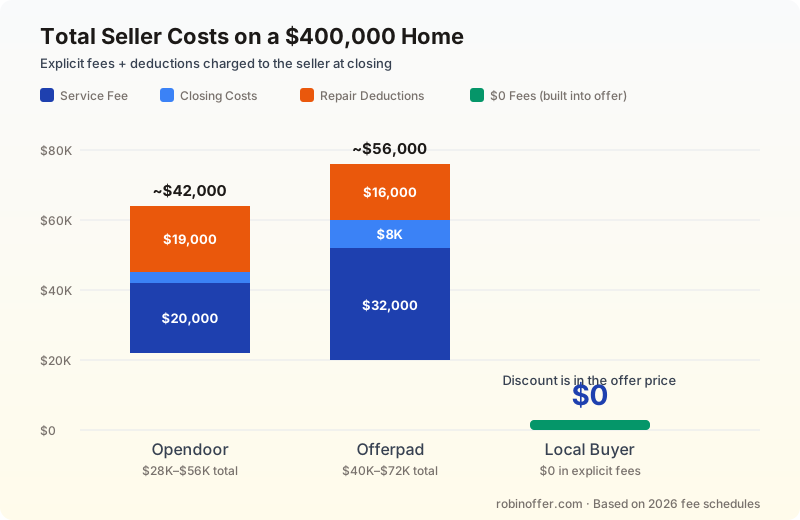
An iBuyer like Opendoor or Offerpad uses algorithms to buy homes at scale, charging 7–18% in fees and repair deductions after the offer. A local cash buyer walks through your home first, makes a firm offer that won't change, and charges $0 in separate fees. Choosing between an iBuyer vs. a local cash buyer comes down to your home's condition, your timeline, and how much fee uncertainty you can absorb.
1. The $62 Million Question Nobody Asked Until It Was Too Late
In 2022, the Federal Trade Commission ordered Opendoor to pay $62 million in refunds to 54,689 homeowners. The charge: misleading sellers about how much they'd actually net compared to a traditional sale. Opendoor told sellers they'd get more money. They got less. Not sometimes, systematically, across nearly 55,000 transactions.
That settlement was the biggest wake-up call the iBuyer industry has received, and it didn't make a single headline in the Charlotte Observer. The checks went out in April 2024. Some of those homeowners were in the Charlotte metro area, Opendoor launched here in late 2019. If you sold to Opendoor between 2017 and 2019 in any of their markets, you may have gotten one.
This guide exists because the iBuyer vs. cash buyer decision is one of the most consequential a Carolinas homeowner can make. Both paths put cash in your hand. Both close faster than the MLS. But the fee structures, offer tactics, and risk profiles are completely different, and the marketing materials from both sides are designed to obscure those differences, not illuminate them.
RobinOffer is a local cash buyer in the Charlotte metro. We operate through NorthGroup Real Estate and make offers in York County, Gaston County, Mecklenburg, and surrounding areas. We also list homes on the MLS through our brokerage, so we see both sides of this transaction every week.
Below: the actual fee breakdown for each path (not the headline number, the real one), how repair deductions work and why they're the single biggest source of seller regret, what the regulatory record says about each model, and a decision framework for your specific situation.
If you're still deciding between a cash sale and listing with an agent, start with our cash offer vs. realtor comparison, it runs that math. This guide assumes you've already decided on a cash path and need to choose between the national platform and the local buyer.
2. iBuyer vs. Cash Buyer: Two Models, Defined
The term "iBuyer" (instant buyer) describes a specific business model: a technology company that uses algorithms to generate automated home valuations, makes sight-unseen offers based on those valuations, and purchases homes at scale to resell on the open market. The business model depends on volume, speed, and the spread between purchase price and resale price.
As of mid-2026, two iBuyers operate in the Charlotte metro area:
| Company | Market Share (of iBuyer sector) | Markets | 2025 Purchases | Carolinas Coverage |
|---|---|---|---|---|
| Opendoor | 79% | 50+ | ~18,000 homes nationally | Charlotte metro, including Rock Hill and Fort Mill (York County SC) |
| Offerpad | 20% | 25+ | 1,210 homes nationally | Charlotte metro, including Fort Mill SC |
A local cash buyer is different. It's an individual, a small company, or a mid-size investment group that purchases homes directly, typically one at a time, in a specific geography. They see the home in person before making a final offer, they use local market knowledge instead of algorithms, and their business model is renovation-and-resell or buy-and-hold rental. The transaction is personal, not automated.
The Market Context: Charlotte Metro, Mid-2026
Opendoor Property Trust I was the single most active buyer in the Charlotte metro in April 2026, acquiring 35 properties in one month. The Charlotte metro median home price sits at approximately $412,500 as of Q2 2026, with a median of 27–46 days on market depending on the source and submarket. Inventory is 2.4 months of supply, still a seller's market, but one with meaningfully more choice than 2021–2023.
Both Opendoor and Offerpad actively transact in York County, South Carolina (Rock Hill, Fort Mill, Tega Cay), and across the Charlotte metro. If you own a home in these areas, both options are available to you. The question isn't availability, it's which one serves your actual situation better.
3. The Fee Teardown: What Each Path Actually Costs You
This is where marketing and reality diverge most sharply. Both iBuyers and local cash buyers advertise "no commission" or "no agent fees." That's technically true and practically misleading. The money comes out of your proceeds regardless, it's just labeled differently.
iBuyer Fee Structure (2026)
| Fee Category | Opendoor | Offerpad | What It Actually Means |
|---|---|---|---|
| Service fee | 5% | Up to 8% | Their profit margin, disguised as a "fee" |
| Closing costs | 0.5–1% | 1–3% | Title, escrow, transfer taxes, prorations |
| Repair deductions | 1–3% typical; up to 10%+ | Variable; reports of 5–15% | Deducted AFTER you accept the offer (see Section 4) |
| Total cost to seller | 7–14% | 10–18% | Range depends heavily on repair deductions |
On a $400,000 Charlotte-area home, Opendoor's total cost ranges from $28,000 to $56,000. Offerpad's ranges from $40,000 to $72,000 or more. The variability comes almost entirely from repair deductions, which you don't know until after the home assessment.
Local Cash Buyer Fee Structure
| Fee Category | Typical Local Buyer | What It Actually Means |
|---|---|---|
| Service fee | $0 | No separate fee, profit is built into the offer price |
| Closing costs | $0 (buyer covers) | Most local buyers pay all closing costs |
| Repair deductions | $0 post-offer | The offer IS the repair-adjusted number. It doesn't change. |
| Total explicit fees | $0 | The discount is in the offer, not added on top |
The Math on a $350,000 Charlotte Metro Home
| Line Item | Opendoor (typical) | Offerpad (typical) | Local Cash Buyer |
|---|---|---|---|
| Offer price | $336,000 (96% of market) | $329,000 (94% of market) | $280,000–$315,000 (80–90%) |
| Service fee | −$16,800 (5%) | −$26,320 (8%) | $0 |
| Closing costs | −$2,520 (0.75%) | −$6,580 (2%) | $0 (buyer pays) |
| Repair deductions | −$8,400 (2.5%) | −$13,160 (4%) | $0 (already in offer) |
| Net to seller | $308,280 | $282,940 | $280,000–$315,000 |
| Days to close | 14–45 | 7–60 | 7–21 |
The local cash buyer's range is wide because the market includes both sophisticated operators who offer 85–90% of market value and predatory wholesalers who offer 50–65%. The operator you choose matters enormously, which is why Section 11 of this guide walks you through vetting.
4. The Repair Deduction Trap: Where iBuyer Offers Go to Die
The offer an iBuyer shows you on their website is not the offer you will receive. The iBuyer vs. cash buyer difference comes down to when the inspection happens, and that timing changes everything about the seller's experience.
How It Works
The iBuyer process has two stages that most sellers don't understand until they're already emotionally committed:
Stage 1: The Preliminary Offer. You enter your address online. An algorithm generates an offer based on comparable sales, market conditions, and property characteristics pulled from public data. This number is designed to get you to say yes. It's the number they show in their advertising. It's often within 2–5% of market value.
Stage 2: The Home Assessment. After you accept the preliminary offer and sign a purchase agreement, the iBuyer sends their own inspector, not an independent one, their employee, to evaluate the property. Based on this inspection, they generate a "condition adjustment" (Opendoor's term) or "repair credit" (Offerpad's). This deduction is subtracted from your offer price.
What Sellers Actually Report
| Source | Preliminary Offer | Final Offer (after assessment) | Reduction |
|---|---|---|---|
| Trustpilot reviewer (Opendoor) | $315,000 | $224,000 | −$91,000 (−29%) |
| BBB complaint (Offerpad) | $266,000 | $193,000 | −$73,000 (−27%) |
| Real Estate Witch analysis (median) | Varies | 20–30% reduction from estimate | |
| Industry average (after fees + repairs) | Total 7–14% below market net |
These aren't outliers. They're documented in review patterns across Trustpilot, BBB, and Google Reviews. The pattern is consistent: a competitive preliminary offer gets the seller emotionally committed, then the condition adjustment brings the actual proceeds into a range the seller wouldn't have accepted on day one.
Why You Can't Negotiate
Opendoor's own documentation states that condition adjustments are generally non-negotiable. The iBuyer uses its own inspectors and its own repair cost database. You can dispute a factual error (they say your roof is 25 years old when it was replaced 5 years ago), but you cannot dispute their cost estimates, their repair scope decisions, or their methodology.
Your only leverage is the ability to cancel. Opendoor does allow you to cancel at any point before closing day with no penalty. But by this point you may be 2–3 weeks into the process, you may have made plans around the original timeline, and the psychological cost of starting over is real. The companies know this.
How Local Cash Buyers Handle Repairs Differently
A local cash buyer walks through your house before making an offer. They see the 20-year-old HVAC, the water stain on the ceiling, the cracked foundation wall. Their offer already reflects all of that. When a legitimate local buyer says "$295,000, as-is, close in 14 days," that number includes their repair estimates. It doesn't change after an inspection because there is no second inspection.
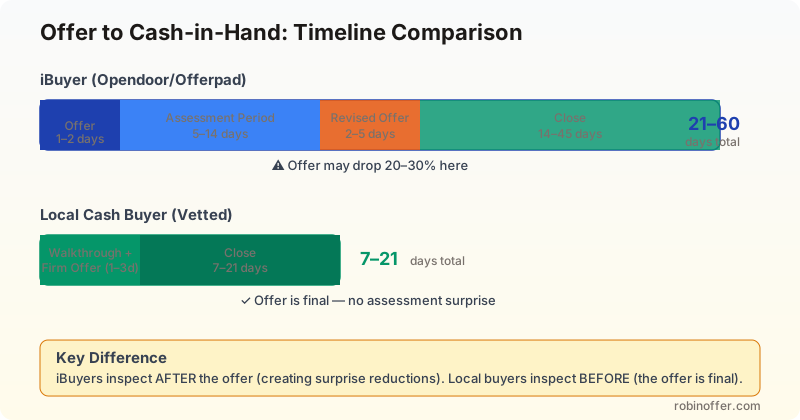
This is the fundamental structural difference: iBuyers inspect after the offer, and local buyers inspect before. The information is the same. The psychology, and the power dynamic, is completely different.
Want to know what your home is actually worth?
Before you compare offers from an iBuyer or a local buyer, start with your real market value. Get a free estimate — no strings, no pressure.
5. Speed and Certainty: Who Actually Closes Faster?
Speed is the primary selling point of both iBuyers and local cash buyers. But the actual timelines diverge more than the marketing suggests.
| Stage | Opendoor | Offerpad | Local Cash Buyer |
|---|---|---|---|
| Initial offer | 24–48 hours (automated) | 24 hours (automated) | 24–72 hours (after walkthrough) |
| Home assessment/walkthrough | 5–14 days after acceptance | 7–14 days after acceptance | Before the offer |
| Revised offer received | 2–5 days after assessment | 2–5 days after assessment | N/A, offer is final |
| Close (from acceptance) | 14–45 days | 7–60 days | 7–21 days |
| Total: offer to cash in hand | 21–60 days | 14–75 days | 7–21 days |
The iBuyer's initial speed advantage (an offer in hours instead of a day or two) disappears once you account for the assessment period. The assessment adds 1–3 weeks to the timeline that wouldn't exist with a local buyer, because a local buyer does their evaluation upfront.
Certainty of Close
This is where iBuyers have a genuine advantage over financed buyers but are actually comparable to local cash buyers:
| Buyer Type | Close Rate | Primary Risk |
|---|---|---|
| Financed (mortgage) buyer | ~73% | Financing denial, appraisal gap, cold feet |
| Opendoor | ~90–95% | Condition adjustment too large, market shift, internal policy change |
| Offerpad | Not disclosed; lower than Opendoor based on review patterns | Last-minute cancellations, inspection disputes |
| Local cash buyer (vetted) | ~95–98% | Title issues, seller changes mind |
Both iBuyers and local cash buyers virtually eliminate the financing contingency risk that kills ~27% of traditional deals. But local cash buyers who've already walked through the property have essentially no inspection contingency either, they've already seen everything. iBuyers retain the right to renegotiate or cancel after their assessment, which introduces uncertainty that a local buyer's firm offer doesn't have.
6. What They'll Buy vs. Won't Buy
iBuyers and local cash buyers serve fundamentally different segments of the housing market. If your home doesn't meet iBuyer criteria, the comparison is moot, and a surprising number of Charlotte-area homes don't qualify.
iBuyer Property Requirements
| Requirement | Opendoor | Offerpad | Why It Matters |
|---|---|---|---|
| Home value range | $100K–$600K (varies by market) | $100K–$500K | Homes above or below are auto-rejected |
| Year built | After 1930 (soft; case-by-case) | After 1950 (firmer) | Older homes = unpredictable repair costs |
| Lot size | Under 1 acre typically | Under 1 acre | Rural or large-lot properties excluded |
| Property type | Single-family, townhome, some condos | Single-family, townhome | Multi-family, mobile homes excluded |
| Condition | Must be livable; no major structural damage | Must be "in good shape" | Foundation issues, fire damage, mold = rejected |
| Location | Within metro service area | Within metro service area | Rural York County may not qualify |
What Local Cash Buyers Will Purchase
The short answer: virtually anything with a clear title. Local cash buyers, particularly those who are themselves renovators, purchase homes in any condition because their business model assumes they'll do the work. Foundation cracks, roof failure, fire damage, mold, code violations, hoarder conditions, water damage, termite damage, unpermitted additions, all buyable.
This isn't altruism. It's a business model: the worse the condition, the deeper the discount they require, but the transaction still happens. For an iBuyer, a home with a failing foundation isn't worth less, it's worth nothing, because their algorithm can't reliably price the repair and their business model can't absorb the risk.
| Situation | iBuyer Response | Local Cash Buyer Response |
|---|---|---|
| Foundation issues | Declined or massive deduction | Purchased; discount reflects repair cost |
| Active mold | Declined | Purchased as-is |
| Fire damage | Declined | Purchased as-is |
| Code violations | Declined | Purchased; buyer assumes violations |
| Unpermitted work | May decline or heavy deduction | Purchased; buyer assumes permit risk |
| Tenant-occupied | Declined | Purchased with tenants in place |
| Estate/probate (no clean title yet) | Declined until title clears | Can work with estate attorney to close |
| Hoarder conditions | Declined | Purchased; buyer handles cleanout |
7. The Offer Price Gap: What Each Actually Pays
Headlines quote a single percentage, "iBuyers pay 95% of market value" or "cash buyers pay 70 cents on the dollar." Both are misleading oversimplifications. The real answer depends on three variables: the home's condition, the local market, and which specific buyer you're talking to.
What iBuyers Actually Pay (Data-Backed)
An analysis of 409 Opendoor transactions found that Opendoor paid a median of 7.8% below the price they eventually resold the home for. A separate analysis of 410 transactions found the discount was approximately 9%. The middle 50% of sellers received between 4% and 13% less than Opendoor's resale price.
But that's the discount on the offer alone, before fees. Here's the total discount to seller:
| Component | Opendoor | Offerpad |
|---|---|---|
| Initial price discount vs. market | 4–13% (median ~8%) | 6–15% |
| Service fee | 5% | 6–8% |
| Closing costs + repair deductions | 1.5–4% | 2–6% |
| Total seller discount vs. open market sale | 10.5–22% | 14–29% |
On a $400,000 home, that's $42,000 to $88,000 less than you'd net selling on the open market with an agent (after agent commissions). The wide range reflects condition: a 5-year-old home in Ballantyne with no deferred maintenance will land at the low end. A 30-year-old ranch in Rock Hill with an aging roof and original HVAC will land at the high end.
What Local Cash Buyers Pay
Local cash buyers typically offer 70–90% of market value, with the range reflecting three factors:
| Buyer Type | Typical Offer Range | Why |
|---|---|---|
| Fix-and-flip investor (small) | 65–80% of ARV | Needs repair margin + profit |
| Buy-and-hold landlord | 75–85% of market | Less repair needed; values rental yield |
| Professional local buyer (like us) | 80–92% of market | Multiple exit strategies; lower margin, higher volume |
| Wholesaler (avoid) | 50–65% of market | Needs room to mark up to actual buyer |
The critical distinction: local buyers' offers don't get reduced after the fact. What they quote is what you get. There are no "condition adjustments," no "repair credits," no post-inspection surprises. The assessment already happened, it was the walkthrough before the offer was made.
See what a local cash offer looks like for your home
Get a firm cash offer from RobinOffer with no assessment surprises and no condition adjustments. We'll also tell you what we think the open market would pay.
8. The Regulatory Record: What the Government Found
Before you trust either model with the largest financial transaction of your life, you should know what regulators have documented. This isn't opinion, it's public record.
Opendoor: FTC Settlement ($62 Million)
In August 2022, the FTC charged Opendoor with systematically misleading sellers. The specific allegations:
- False claim #1: Opendoor told sellers they'd receive "market value" offers based on comparable sales. In reality, offers included undisclosed downward adjustments that weren't communicated to sellers.
- False claim #2: Opendoor told sellers they'd "make more money" selling to Opendoor than selling traditionally. The FTC found the opposite was true in most cases, sellers typically netted thousands less.
- False claim #3: Opendoor told sellers its profit came only from its disclosed service fee. In reality, it also profited from the buy-low/sell-high spread that wasn't disclosed.
Result: $62 million in refunds distributed to 54,689 homeowners in April 2024. Opendoor was required to stop making these specific claims and modify its marketing practices.
Opendoor: North Carolina Real Estate Commission Discipline
In 2022, the NC Real Estate Commission disciplined Opendoor and two of its brokers for violations in three Charlotte-area transactions:
- Advertised a property as having an outdoor pool when it didn't (an Opendoor vendor had buried it in the backyard instead of removing it)
- Advertised a 5-bedroom home when the septic permit only allowed 3-bedroom occupancy
- Failed to disclose and correct property defects
Result: 18-month license suspension, stayed, meaning Opendoor continued operating under 18 months of probation. Both brokers received 12-month probation.
Offerpad: No Major Regulatory Actions (but Review Patterns)
Offerpad has not faced the same level of regulatory scrutiny, but its BBB profile and review platforms document recurring complaints about last-minute offer reductions and inspection-driven cancellations. The company closed on only 1,210 homes in 2025, down from 9,034 at its 2022 peak, which suggests a business model under significant stress.
Local Cash Buyers: The Spectrum
Local cash buyers are not regulated as a category. Individual operators range from licensed Realtors with decades of experience to unlicensed wholesalers operating from a kitchen table. This is both the strength and the risk of the local path, which is why vetting (Section 11) is non-negotiable. For a deeper look at the five types of "We Buy Houses" operations, the contract red flags to watch for, and how NC's wholesaling law changes the landscape, see our complete guide to vetting "We Buy Houses" companies in the Carolinas.
The relevant regulation in both Carolinas: NC Chapter 47E requires the Residential Property and Owners' Association Disclosure Statement regardless of sale method. SC's Residential Property Condition Disclosure Act (§ 27-50-10) has comparable requirements. These apply to all sales, including cash.
9. NC vs. SC: What Changes at the State Line
The Charlotte metro spans two states, and the legal frameworks create different dynamics for cash transactions on each side of the border.
| Factor | North Carolina | South Carolina |
|---|---|---|
| Closing requirement | Attorney not required by law (but standard in practice, even for cash) | Closing attorney required by law |
| Due diligence period | Yes (NC-specific; buyer can walk for any reason) | No formal due diligence period |
| Transfer tax | $1 per $500 of value (excise tax) | Deed recording fee only (~$1.85 per page) |
| Seller disclosure | Required (Chapter 47E) | Required (§ 27-50-10) |
| Foreclosure type | Non-judicial (power of sale), fast | Judicial, slower, court-ordered |
| Property tax rates | Varies by county; Mecklenburg ~0.87% effective (post-2023 revaluation) | Lower effective rates; York County ~0.55% (4% owner-occupied assessment) |
What This Means for Your Cash Sale
NC's due diligence period creates a unique wrinkle. Even in a cash transaction, if the contract includes a due diligence period (standard in NC), the buyer can walk for any reason during that window. A local cash buyer will typically negotiate a short or no due diligence period. An iBuyer's contract uses their own terms, read them carefully to understand when and how they can exit.
SC's mandatory closing attorney means every transaction goes through a licensed attorney. This adds a layer of consumer protection that NC doesn't guarantee. The attorney reviews the contract, conducts the title search, and handles the closing. This isn't optional, it's law. If a cash buyer tells you they'll handle closing without an attorney in South Carolina, walk away.
For York County sellers specifically: both Opendoor and Offerpad operate here, and local buyers like RobinOffer actively purchase in Rock Hill, Fort Mill, and Tega Cay. The SC mandatory attorney requirement gives you built-in protection regardless of which path you choose. See our Rock Hill selling guide or Fort Mill selling guide for market-specific context.
10. The Situation Playbook: When Each Makes Sense
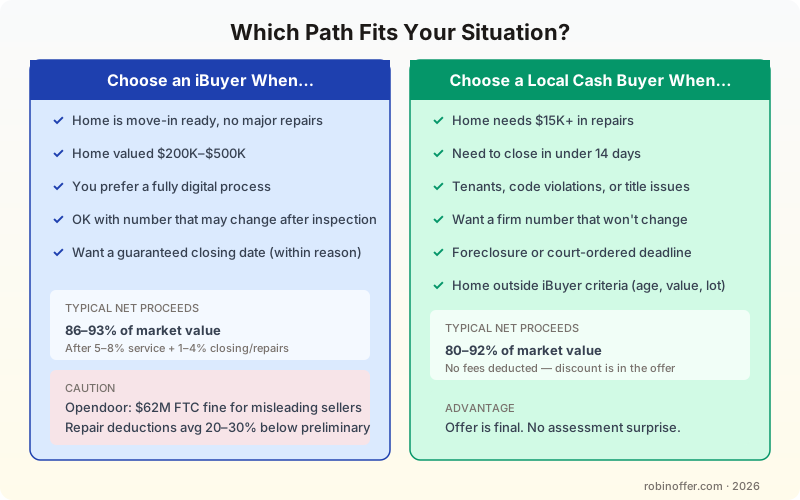
The right choice depends on your situation, not on which company has better marketing. Here's the honest framework:
Choose an iBuyer When:
| Your Situation | Why iBuyer Works | Watch Out For |
|---|---|---|
| Move-in-ready home, good condition | Minimal repair deductions; offer stays close to preliminary | Still compare net to a local buyer's firm offer |
| You value a digital-first process | Minimal in-person interaction; everything is online | Less flexibility when issues arise |
| Your home is $150K–$500K in a major metro | Sweet spot for iBuyer algorithms (stated min is $100K, but algorithms perform best above $150K) | Outside this range, they rarely make competitive offers |
| You want a guaranteed exit date (within reason) | iBuyers close on your selected date | Assessment can delay or derail the timeline |
Choose a Local Cash Buyer When:
| Your Situation | Why Local Buyer Works | Watch Out For |
|---|---|---|
| Home needs significant repairs | They buy as-is; no condition adjustments | Offer will be lower than iBuyer's preliminary (but higher than iBuyer's net) |
| Active code violations or permit issues | They assume the risk | Verify they're the end buyer, not a wholesaler |
| Tenant-occupied property | They buy with tenants in place | Verify their experience with tenanted properties |
| Foreclosure timeline (< 30 days) | Can close in 7–14 days; no assessment delay | Time pressure makes you vulnerable to lowball offers, get 3 quotes |
| Probate or estate sale | They work with estate attorneys; flexible on timeline | Ensure they understand SC/NC probate requirements |
| Home is outside iBuyer criteria | They buy what iBuyers won't | The deeper the distress, the deeper the discount |
| You want a firm number with no surprises | The offer is the offer, period | Still get 3 offers minimum |
When Neither Is Right
If your home is in good condition, you have 3+ months, and you want to maximize sale price, list with an agent. Cash paths (both iBuyer and local) trade some proceeds for speed and certainty. If you don't need speed or certainty, you're paying for a service you don't need. Our cash offer vs. realtor comparison runs that math in detail.
11. How to Vet Either Option: The Protective Checklist
Regardless of which path you choose, due diligence protects you. Here's what to verify before signing anything.
Vetting an iBuyer
| Check | What to Look For | Red Flag |
|---|---|---|
| Understand the full fee structure | Service fee + closing costs + estimated repair range | They won't give you a repair estimate range before you sign |
| Read the contract cancellation terms | When can they exit? When can you exit? | You can't cancel after assessment without penalty |
| Ask what triggers a condition adjustment | Their criteria for repair deductions | "We can't tell you until after the assessment" |
| Compare preliminary to final offer stats | Ask what % of offers close within $5K of preliminary | They won't share this data |
| Check regulatory history | FTC actions, state real estate commission records | Multiple state-level violations |
Vetting a Local Cash Buyer
| Check | What to Look For | Red Flag |
|---|---|---|
| Proof of funds | Bank statement or lender letter showing available cash | Won't provide it, or it's vague |
| Are they the end buyer? | "Will you be closing on this purchase, or assigning the contract?" | They hedge, say "it depends," or mention partners |
| NC/SC business registration | Active LLC or corporation in state records | Entity formed less than 6 months ago; no track record |
| Local transaction history | Recent purchases in the county (deed records are public) | No verifiable local transactions |
| Contract review | Have YOUR attorney review before signing | They pressure you to sign today, no attorney review |
| Assignment clause | Check if the contract allows assignment to another party | "And/or assigns" language = probable wholesaler |
| Earnest money deposit | $1,000–$5,000+ deposited into escrow | $0 or $10 earnest money = no skin in the game |
12. iBuyer vs. Cash Buyer: The Decision in One Page
Strip everything else away. Here's the framework:
| Question | If Yes → iBuyer | If Yes → Local Cash Buyer |
|---|---|---|
| Is your home move-in ready with no major repairs? | ✓ | |
| Is your home valued between $150K–$500K? | ✓ | |
| Do you prefer a fully digital process? | ✓ | |
| Are you OK with a number that may change after inspection? | ✓ | |
| Does your home need $15K+ in repairs? | ✓ | |
| Do you need to close in under 14 days? | ✓ | |
| Does your home have tenants, code violations, or title issues? | ✓ | |
| Do you want a firm number that won't change? | ✓ | |
| Is your home outside the $150K–$500K range? | ✓ | |
| Are you in foreclosure or on a court-ordered deadline? | ✓ |
The Three-Offer Rule
Regardless of which path you lean toward, get at least three offers before committing to any of them:
- One iBuyer offer (Opendoor, if your home qualifies), it's free, it's fast, and it sets a data point.
- Two local cash buyer offers from different companies, the spread between them tells you what the market actually values your home at in its current condition.
- Bonus: one CMA from a listing agent, this tells you what the open market would likely pay, which puts all cash offers in context.
The homeowner who gets three offers and a CMA makes a rational, informed decision. The homeowner who takes the first offer that arrives makes an emotional decision that statistically costs $15,000–$30,000. Don't be the second homeowner.
For a more detailed breakdown of how cash offers compare to the traditional listing path, read our comprehensive cash offer guide for NC and SC. It covers the vetting process, scam detection, and offer evaluation in depth.
If you're a York County homeowner weighing your options, you can see what a local offer looks like, often within a day. Request a no-obligation cash offer from RobinOffer. We'll send you a number, and we'll also tell you what we think you'd get on the open market. Because we do both, and the right answer isn't always us.
Ready to get your three offers?
Start with a free home value estimate from ListRobin. Then request a cash offer from RobinOffer. Compare both to any iBuyer number — and pick the path that nets you the most.
13. Frequently Asked Questions: iBuyer vs. Local Cash Buyer
What is the difference between an iBuyer and a local cash buyer?
An iBuyer (like Opendoor or Offerpad) is a tech company that uses algorithms to generate automated offers and buys homes at scale. A local cash buyer is an individual or small company that purchases homes directly in a specific area after a personal walkthrough. iBuyers charge 5-8% service fees plus repair deductions after inspection. Local buyers charge $0 in fees, their profit is built into the offer price, which doesn't change after acceptance.
How much does Opendoor charge in fees in 2026?
Opendoor charges a 5% service fee, plus 0.5-1% in closing costs, plus repair deductions that typically range from 1-3% but can exceed 10% of the home's value. Total cost to the seller ranges from 7-14% depending on the condition of the home.
Do iBuyers operate in Rock Hill and Fort Mill SC?
Yes. Both Opendoor and Offerpad actively purchase homes in York County, South Carolina, including Rock Hill, Fort Mill, and Tega Cay. They operate as part of their Charlotte metro coverage area.
Why do iBuyer offers drop after the home inspection?
iBuyers make preliminary offers based on algorithms before seeing the home. After acceptance, they send their own inspector who identifies repairs needed. These "condition adjustments" are deducted from your offer. Documented cases show reductions of 20-30% between preliminary and final offers, though the industry-average total cost (fees plus repair deductions) runs 7-14% of home value. The adjustment is generally non-negotiable, your only option is to cancel.
Is selling to a local cash buyer safe?
Selling to a vetted local cash buyer is safe. Verify they are the end buyer (not a wholesaler), check for proof of funds, confirm NC or SC business registration, and have your own attorney review the contract. In South Carolina, a closing attorney is required by law for all transactions, providing built-in consumer protection.
This guide was written by CC Evans, licensed NC/SC Realtor and principal of RobinOffer/NorthGroup Real Estate. RobinOffer is a local cash buyer operating in York, Gaston, Mecklenburg, and surrounding counties. We have a financial interest in sellers choosing local cash buyers, and we still wrote this guide to include scenarios where an iBuyer is the better choice, because your best outcome matters more than our next deal.