
Cash Offer vs. Realtor in NC & SC: The Net Proceeds Math
Side-by-side comparison at four Charlotte-metro price points — with carrying costs, commissions, fall-through risk, and the costs nobody puts on the whiteboard.
1. The $31,500 Question Every Carolinas Seller Faces
Cash offer vs. realtor in the Carolinas comes down to net proceeds, what you actually keep after every fee, carrying cost, and closing expense. On a $350,000 Charlotte-area home, the gap between a cash offer and a traditional listing ranges from $31,500 to less than $3,000, depending on your timeline and home condition.
Most guides online are written by one side. Cash buyers tell you speed matters more than price. Realtors tell you the open market always wins. Neither is lying, exactly, they're just showing you the math that makes their service look best.
This guide shows you both sets of math. We run net proceeds calculations at four Carolinas price points, $250K, $350K, $450K, and $600K, and we account for costs that most comparison articles leave out: the carrying costs you burn while your listing sits on market, the repair concessions buyers negotiate after inspection, and the 1-in-4 chance your financed deal falls through entirely.
RobinOffer makes cash offers and lists homes through NorthGroup Real Estate. We see both sides of this decision every week in Mecklenburg, Gaston, York, Cabarrus, and Union counties. That dual perspective is what makes this guide different from the SEO-optimized content that cash buyer companies and brokerage blogs push out.
A few things you should know upfront. Nationally, 27% of home transactions in the first half of 2026 were all-cash, according to NAR's existing home sales reports. In North Carolina, cash transactions run even higher, close to 39% of all sales. The 30-year fixed mortgage rate sits at 6.43% as of early July 2026 (Freddie Mac PMMS), and Charlotte-metro homes are spending a median of 48 days on market, up from 43 days a year ago. Inventory is climbing. The market isn't crashing, but it's no longer a frenzy, and that shift changes the calculus between these two paths more than most people realize.
If you already know you want a cash offer and need to evaluate specific companies, start with our deep-dive cash offer guide for NC and SC. If you're specifically weighing Opendoor or Offerpad against a local buyer, our iBuyer vs. local cash buyer comparison tears down the fee structures side by side. This page is for the homeowner who hasn't decided between cash and agent yet.
2. Two Paths Through the Same Front Door
Before we run the numbers, let's make sure we're comparing the same thing. "Cash offer" and "listing with a realtor" each describe a selling process with different timelines, costs, and risks.
Path A: List With a Real Estate Agent
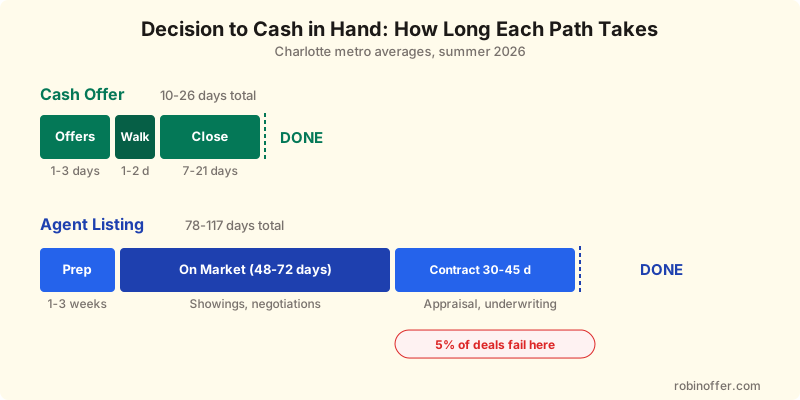
You hire a listing agent, prep and possibly stage the home, set a list price based on comparable sales, and put it on the MLS. Buyers, most of whom need a mortgage, tour the property, make offers, negotiate, and go through inspection, appraisal, and underwriting. The typical timeline from listing to close in the Charlotte metro right now is 48 to 72 days on market plus 30 to 45 days to close, so roughly 78 to 117 days from sign-in-yard to money-in-account.
The agent path gives you access to the broadest pool of buyers. The MLS feeds into Zillow, Redfin, Realtor.com, and every brokerage website in the Carolinas. More eyeballs mean more competition, and competition generally pushes prices up. In a seller's market with under 3 months of inventory, the MLS can produce multiple offers within days, sometimes above asking price. That's the best-case scenario.
The worst-case scenario is equally real. Your home sits on market for 90 days, you do two price reductions totaling 6%, a buyer goes under contract and then their financing falls through 28 days later, and you relist at a lower price. Now you're five months in, you've paid $11,000 in carrying costs, and you're accepting an offer $20,000 below your original ask. It happens. Not always, not usually, but often enough that the "agent always gets more" assumption deserves scrutiny.
| Step | Typical Timeline | What Can Go Wrong |
|---|---|---|
| Prep and staging | 1–3 weeks | Costs $1,800–$5,000 you may not recoup |
| On market | 48–72 days (Charlotte metro avg) | Price reductions if no offers in 21 days |
| Under contract | 30–45 days to close | Buyer financing denied (27.8% of cancellations) |
| Total | 78–117 days | Mortgage, taxes, insurance due every month |
Path B: Accept a Cash Offer
A cash buyer, individual, investor, iBuyer, or "We Buy Houses" company, makes an offer, usually after a brief walkthrough. No MLS listing, no staging, no open houses, no appraisal contingency. The timeline from signed contract to close is typically 7 to 21 days.
The cash path trades price competition for certainty. You won't get multiple offers bidding each other up. But you also won't spend $3,000 staging a house, take a Tuesday off work for a midday showing, or lie awake at 11 PM wondering if the buyer's underwriter will approve their mortgage. The offer is the offer. If you accept it, you close. Almost always.
What people get wrong about cash offers is treating them as one category. An individual cash buyer, a retiree relocating from New Jersey, a tech worker paying from stock proceeds, might offer 95% of market value. Investor and "We Buy Houses" companies typically offer 50–85% of market value, depending on the home's condition and their business model. Those are completely different propositions, and lumping them together is like comparing a Honda Accord and a go-kart because they both have four wheels. The type of cash buyer matters enormously, and we break that down in our detailed cash offer guide.
| Step | Typical Timeline | What Can Go Wrong |
|---|---|---|
| Request offers | 1–3 days | Lowball offer from a wholesaler, not a real buyer |
| Walkthrough | 1–2 days | Post-walkthrough price reduction |
| Contract to close | 7–21 days | Last-minute repair deductions ($7K–$40K possible) |
| Total | 10–26 days | No competitive bidding = potentially lower price |
3. Cash Offer vs. Realtor Net Proceeds: Four Price Points, Two Paths
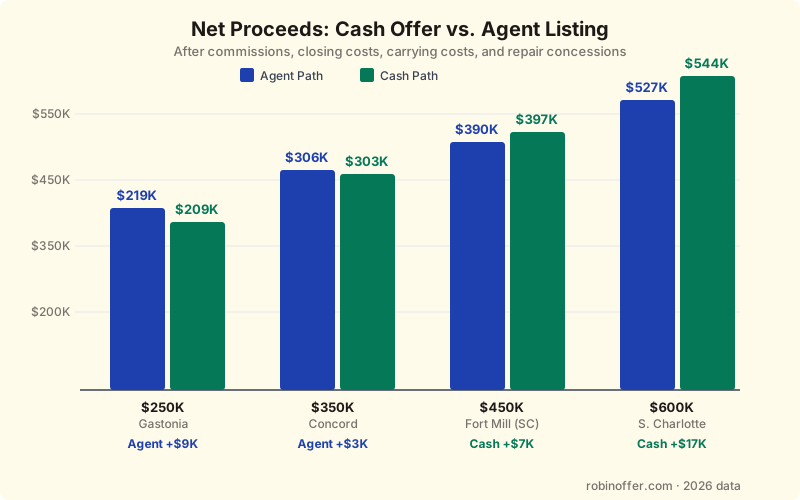
This is the section most guides don't write, because the math doesn't always make their preferred option look good. We're running both paths at four Charlotte-metro price points that represent real homes: a Gastonia starter, a Concord mid-range, a Fort Mill family home, and a South Charlotte executive property.
Assumptions (same for all scenarios)
| Variable | Agent Path Value | Cash Path Value | Source |
|---|---|---|---|
| Listing agent commission | 2.8% | $0 | NC avg (Clever 2026 survey) |
| Buyer agent commission | 2.7% | $0 | NC avg (Clever 2026 survey) |
| Seller closing costs (NC) | 2.6% | 1.5% | Clever, Bankrate |
| Seller closing costs (SC) | 3.5% | 2.0% | Clever, Bankrate |
| Staging and prep | $2,500 | $0 | HomeAdvisor 2025 |
| Repair concessions after inspection | 1.5% of sale price | $0 (priced in) | NAR 2025 data |
| Cash offer discount | N/A | 10–20% below market | ATTOM, Cotality 2025 |
| Carrying costs per month | Included (see Section 5) | Minimal (closes fast) | Calculated |
| Time on market (Charlotte avg) | 60 days | 0 days | Redfin May 2026 |
| Closing period | 38 days | 14 days | ICE Mortgage Tech, industry avg |
Scenario 1: $250,000 Gastonia Starter Home
| Line Item | Agent Path | Cash Offer (15% discount) |
|---|---|---|
| Sale price | $250,000 | $212,500 |
| Agent commissions (5.5%) | −$13,750 | $0 |
| Closing costs (NC 2.6%) | −$6,500 | −$3,188 |
| Staging and prep | −$2,500 | $0 |
| Repair concessions (1.5%) | −$3,750 | $0 |
| Carrying costs (3 months × $1,650) | −$4,950 | $0 |
| Net proceeds | $218,550 | $209,312 |
| Gap | $9,238 more with agent | |
Scenario 2: $350,000 Concord Family Home
| Line Item | Agent Path | Cash Offer (12% discount) |
|---|---|---|
| Sale price | $350,000 | $308,000 |
| Agent commissions (5.5%) | −$19,250 | $0 |
| Closing costs (NC 2.6%) | −$9,100 | −$4,620 |
| Staging and prep | −$2,500 | $0 |
| Repair concessions (1.5%) | −$5,250 | $0 |
| Carrying costs (3.5 months × $2,200) | −$7,700 | $0 |
| Net proceeds | $306,200 | $303,380 |
| Gap | $2,820 more with agent | |
Scenario 3: $450,000 Fort Mill Family Home (SC)
| Line Item | Agent Path | Cash Offer (10% discount) |
|---|---|---|
| Sale price | $450,000 | $405,000 |
| Agent commissions (5.9%) | −$26,550 | $0 |
| Closing costs (SC 3.5%) | −$15,750 | −$8,100 |
| Staging and prep | −$3,000 | $0 |
| Repair concessions (1.5%) | −$6,750 | $0 |
| Carrying costs (3 months × $2,800) | −$8,400 | $0 |
| Net proceeds | $389,550 | $396,900 |
| Gap | $7,350 more with CASH | |
This one surprises people. At $450K in South Carolina, where commission rates and closing costs run higher than NC, a 10% cash discount actually nets you more than listing, once you account for the full cost stack. The agent path only wins here if your home sells in under 30 days at full ask with no repair concessions. That happens, but it's the exception, not the rule, in the current Fort Mill market where days on market averaged 57 in spring 2026.
Notice something else about the SC scenario: the 5.9% commission is almost double what you'd pay in total closing costs on the cash path. Commission is the single largest line item on the agent side, and it's the one that doesn't exist at all on the cash side. That's why South Carolina sellers, paying both higher commissions and higher transfer taxes than their NC neighbors, find the cash path comparatively more attractive. If you're selling in York County, the numbers in our Rock Hill guide show how this plays out at the county level.
Scenario 4: $600,000 South Charlotte Executive Home
| Line Item | Agent Path | Cash Offer (8% discount) |
|---|---|---|
| Sale price | $600,000 | $552,000 |
| Agent commissions (5.5%) | −$33,000 | $0 |
| Closing costs (NC 2.6%) | −$15,600 | −$8,280 |
| Staging and prep | −$4,000 | $0 |
| Repair concessions (1.0%) | −$6,000 | $0 |
| Carrying costs (4 months × $3,600) | −$14,400 | $0 |
| Net proceeds | $527,000 | $543,720 |
| Gap | $16,720 more with CASH | |
At higher price points, the fixed costs of listing (staging, prep) become a smaller percentage, but the commission and carrying cost percentages stay the same. A $600K home paying 5.5% commission loses $33,000 before any other costs. If the cash discount is moderate, 8% from an individual cash buyer or well-funded investor, the listing path needs a fast sale at full price to compete. In Mecklenburg County's current market with 4+ months of inventory, that fast sale is no longer guaranteed.
The Break-Even Line
| Home Price | Max Cash Discount Where Cash Still Wins | Months on Market Needed for Agent to Win |
|---|---|---|
| $250,000 | 6–8% | Fewer than 2 months |
| $350,000 | 9–11% | Fewer than 2.5 months |
| $450,000 (SC) | 12–14% | Fewer than 2 months |
| $600,000 | 11–13% | Fewer than 3 months |
The break-even line moves based on three variables: how much below market the cash offer is, how long your home sits on market with an agent, and how much your monthly carrying costs burn. This table uses average carrying costs for each price tier. Your actual break-even will depend on your mortgage balance, tax rate, and insurance.
Why the Cash Discount Isn't What You Think
The 9% average cash discount statistic (from Cotality's 2025 national data) includes every type of cash transaction, including individual buyers paying near-market. When you're evaluating a cash offer from an investor or "We Buy Houses" company, the discount is typically steeper: 10–25% below market. But "market value" itself is an estimate. A $350,000 Zestimate might sell for $340,000 on the MLS after 60 days and a price reduction. The "discount" from that adjusted reality is smaller than it looks on paper.
Those four price points are illustrations, not your house. If you want the same arithmetic on your own numbers, our cash offer vs listing calculator runs both columns side by side with the real North Carolina & South Carolina rates, and tells you plainly when the listing is the one that nets more.
The net proceeds tables above use realistic cash discounts for each price tier, 15% for the $250K starter (likely an investor), 12% for the $350K mid-range, 10% for the $450K SC home, and 8% for the $600K executive home (likely an individual cash buyer). If you're getting offers from multiple cash buyers, the discount you actually receive could be better or worse than these assumptions. That's why the worksheet in Section 10 uses YOUR actual offers, not averages.
Want to see the math for your home?
Start with your number. Get a free home value estimate so you can run the cash-vs-agent comparison with real data instead of averages.
4. The Costs Nobody Puts on the Whiteboard
Every real estate professional, agent and cash buyer alike, presents the costs that make their path look better and minimizes the ones that don't. Here's the full inventory of costs on both sides.
Hidden Costs of Listing With an Agent
| Cost | Typical Range | Who Mentions It |
|---|---|---|
| Pre-listing repairs | $2,000–$10,000 | Agent (sometimes) |
| Professional staging | $1,800–$5,000 | Agent (sometimes) |
| Professional photography | $200–$600 | Often included by agent |
| Carrying costs during listing | $1,600–$3,600/month | Almost never |
| Price reduction(s) | 3–5% after 21+ days | Only when necessary |
| Buyer repair concessions | 1–3% of sale price | Only after inspection |
| Closing date delays (buyer financing) | Adds weeks of carrying costs | Never upfront |
| Deal falling through entirely | Restarts the clock + stigma | Never |
Hidden Costs of a Cash Offer
| Cost | Typical Range | Who Mentions It |
|---|---|---|
| Below-market offer price | 8–25% below market value | Always framed as "fair market" |
| Post-walkthrough price reduction | $5,000–$40,000 | Only after initial offer |
| Service fees (iBuyers) | 5–8% of offer price | In the contract fine print |
| Mandatory repair deductions | $7,000–$40,000+ (iBuyers) | After inspection, non-negotiable |
| Assignment clause (wholesalers) | Your contract sold to actual buyer | Buried in contract language |
| Below-market earnest money | $500–$1,000 (vs. 1–3% standard) | Often unnoticed |
The iBuyer Middle Ground: Opendoor, Offerpad, and What They Actually Cost
iBuyers occupy the space between a traditional listing and a local cash buyer. They use algorithms to estimate your home's value, make an offer online (often within hours), and close on a flexible timeline. The pitch is compelling: near-market price, fast closing, no showings.
The reality is more complicated. Both Opendoor and Offerpad operate in parts of the Charlotte metro, and both follow the same basic model:
| iBuyer Metric | Opendoor | Offerpad |
|---|---|---|
| Average offer vs. eventual resale | 8.8% below | 13.9% below |
| Service fee | 5% | Up to 8% |
| Repair deductions after inspection | $7,000–$40,000+ | $7,000–$40,000+ |
| Typical closing timeline | 14–60 days (flexible) | 8–90 days (flexible) |
| NC regulatory history | NCREC disciplinary action for disclosure violations | No major public actions |
Sources: Cotality 2025 resale analysis; company fee schedules; NCREC public records.
The critical thing to understand about iBuyers: the initial online offer is not the final offer. After their inspector walks through your home, they'll deduct for repairs, and those deductions are usually non-negotiable. The $380,000 Opendoor offer that made you smile on Tuesday might be $348,000 by Friday after they've deducted for the HVAC system, the deck boards, and the water stain on the ceiling you forgot about.
When you factor in the service fee plus repair deductions, iBuyers typically net you $10,000–$25,000 less than a traditional sale on a $400,000 home. That's often comparable to what a local investor would offer, without the investor's willingness to close in 10 days on a house in any condition.
iBuyers make the most sense for homeowners with relatively new, move-in ready homes who want speed and certainty but aren't willing to accept the deeper discounts from "We Buy Houses" companies. If your home needs significant work, iBuyers either won't make an offer at all or will deduct heavily enough that a local cash buyer is a better deal.
One more thing about iBuyers: their geographic coverage in the Carolinas is limited. Opendoor operates in the Charlotte metro and parts of the Triangle, but not in smaller cities like Gastonia, Shelby, or Kings Mountain. Offerpad has similar limitations. If you're outside the major metros, your cash buyer options are local investors and "We Buy Houses" companies, not algorithms. That's not necessarily bad, but it means you need to be more careful about vetting the buyer. Always verify proof of funds, check BBB ratings, and read the contract clause by clause. If you need help evaluating a specific cash offer, our team can review it for free.
5. What Every Extra Week on Market Actually Costs You
This is the section agents don't want you to read, because it puts a dollar amount on the time your home sits unsold. And it's the section cash buyers love, because it makes speed look more valuable. Both reactions prove the number is real.
Monthly Carrying Costs by Charlotte-Metro Price Point
| Component | $250K Home | $350K Home | $450K Home | $600K Home |
|---|---|---|---|---|
| Mortgage P&I (6.43%, 20% down) | $1,000 | $1,400 | $1,800 | $2,400 |
| Property taxes (NC $0.85/$100) | $177 | $248 | $319 | $425 |
| Homeowners insurance | $140 | $175 | $210 | $280 |
| HOA (if applicable) | $50 | $100 | $150 | $200 |
| Utilities and maintenance | $280 | $320 | $360 | $420 |
| Total monthly carrying cost | $1,647 | $2,243 | $2,839 | $3,725 |
| Weekly cost | $412 | $561 | $710 | $931 |
A $350K home costs $561 per week to hold. If your listing takes the Charlotte metro average of 60 days on market plus 38 days to close, that's 14 weeks, or $7,854 in carrying costs before you see a dime. A cash sale closing in 14 days is 2 weeks, or $1,122. The carrying cost difference alone is $6,732.
Now add this: if you've already moved to your next home, you're paying two mortgages. Carrying costs double. That $6,732 gap becomes $13,464. At that point, a cash offer that's 10% below market might net you more than a full-price sale that takes three months.
The Two-Mortgage Trap: A Real Scenario
Sarah and James bought a new home in Indian Land, SC before selling their existing home in Gastonia. They're paying both mortgages while their Gastonia home sits on market. Here's what the numbers look like:
| Monthly Cost | Gastonia Home | Indian Land Home | Combined |
|---|---|---|---|
| Mortgage P&I | $1,350 | $2,100 | $3,450 |
| Property taxes | $215 | $290 | $505 |
| Insurance | $145 | $195 | $340 |
| HOA | $0 | $85 | $85 |
| Utilities and upkeep | $250 | $320 | $570 |
| Monthly total | $1,960 | $2,990 | $4,950 |
Their Gastonia home is worth about $290,000. An agent estimates 45–60 days on market. A local investor offered $255,000 cash, closing in 12 days. The gap on paper is $35,000.
But every month the Gastonia home sits unsold costs Sarah and James $4,950 in combined carrying costs, over $1,200 per week. If the agent path takes 3.5 months from listing to close, that's $17,325 in carrying costs. Add $1,800 for staging, $4,350 in repair concessions, $15,950 in commissions, and $7,540 in closing costs, and the agent path nets them about $242,360. The cash offer at $255,000 minus $3,825 in closing costs nets $251,175.
The cash path puts $8,815 more in their pocket than the agent path, and they stop the two-mortgage bleed 10 weeks sooner. That's an additional $12,375 they don't burn on carrying costs.
6. The Fall-Through Factor: What Certainty Is Actually Worth
Every net proceeds comparison assumes the sale actually closes. But financed deals don't always close, and when they don't, it costs you more than just time.
Why Deals Fall Through
| Cancellation Reason | Percentage of Failed Deals | Impact on Seller |
|---|---|---|
| Buyer financing denied | 27.8% | Back to square one, 30+ days lost |
| Buyer couldn't sell their current home | 21.0% | Contingency chain broke |
| Buyer's financial situation changed | 14.9% | No control, no recourse |
| Home inspection issues | 12.4% | Renegotiation or cancellation |
| Appraisal came in low | 8–10% | Price renegotiation or deal collapse |
| Buyer simply changed their mind | Remainder | Lost due diligence fee (NC) only |
Source: NAR Realtors Confidence Index, 2025 data; Redfin August 2025 contract cancellation report.
Roughly 5% of all pending sales don't close. That sounds small until you realize what happens when yours is in that 5%: you lose a month under contract, your home goes back on market with "back on market" status, you restart showings, and the next buyer offers less because they know the last deal died. Redfin reported a record surge of 56,000 contract cancellations nationally in August 2025.
Cash offers essentially eliminate financing, appraisal, and buyer-sale contingency risks, three categories that account for over 60% of all deal failures. Cash deals do still fall through occasionally (buyer fraud, title issues), but at a fraction of the rate.
The Appraisal Problem in a Shifting Market
Appraisals cause a specific headache in the Charlotte metro right now. Home values have been rising 2–4% annually, but inventory is up 19% year-over-year and days on market have stretched from 43 to 48+ days. In markets like this, prices stable but momentum shifting, appraisals increasingly come in below contract price, because appraisers rely on comparable sales from 3–6 months ago when the market was slightly different.
When an appraisal comes in low, three things can happen: the buyer covers the gap out of pocket (unlikely for most financed buyers), you renegotiate the price down to the appraised value, or the deal falls apart. Low appraisals occur in roughly 8–10% of home sales nationally, and the rate tends to be higher in markets with softening conditions.
This is a risk that simply doesn't exist with cash offers. No lender means no appraisal requirement. The cash buyer's offer price is the offer price, there's no third party with a clipboard who can override it.
What's 100% Close Probability Worth?
Think of it this way. If there's a 5% chance your financed deal falls through, and a failed deal costs you $10,000–$20,000 in carrying costs, price reduction on relist, and emotional toll, that's an expected cost of $500–$1,000 baked into every financed offer you accept. On a $350K home, a cash offer at 3% less but with near-certain closing may actually carry the same expected value as a full-price financed offer with that 5% failure risk.
7. NC vs. SC: Where You Close Changes What You Keep
The Carolinas are a single housing market divided by a state line that changes your costs. If you own a home in the Charlotte metro, whether you close in North Carolina or South Carolina affects your net proceeds on both the agent path and the cash path. For deeper city-specific numbers, see our guides for Fort Mill, Gastonia, and Concord.
State-by-State Cost Comparison for Sellers
| Cost Category | North Carolina | South Carolina |
|---|---|---|
| Average agent commission | 5.53% ($2.80 listing + $2.73 buyer) | 5.88% ($2.91 listing + $2.97 buyer) |
| Transfer tax / deed stamps | $1 per $500 of sale price | $1.85 per $500 of sale price |
| On a $400K sale | $800 in excise tax | $1,480 in deed recording fee |
| Seller closing costs (excl. commission) | ~2.6% of sale price | ~3.5% of sale price |
| Attorney requirement | Must supervise (can delegate to non-lawyer) | Must be physically present at closing |
| Attorney fee range | $400–$800 | $600–$1,200 |
| Due diligence / option period | DD fee + DD period (negotiable, non-refundable) | No DD; contingencies in contract |
| Disclosure form | Residential Property Disclosure (NCREC) | Seller's Disclosure (SC Real Estate Commission) |
What This Means for the Cash vs. Agent Decision
South Carolina's higher commission rates and closing costs mean the agent path is more expensive there. On a $400K home, a South Carolina seller listing with an agent pays roughly $3,600 more in commissions and closing costs than a North Carolina seller at the same price point. That narrows the gap between cash and agent in SC, which is why Scenario 3 (the $450K Fort Mill home) showed cash winning by $7,350.
North Carolina's due diligence system also creates a unique risk for sellers. The DD fee is non-refundable to the buyer, but during the DD period (typically 14–30 days), the buyer can walk for any reason and lose only that fee, usually $2,000–$10,000. This means NC sellers face a window where a financed buyer might terminate even after inspection, leaving the seller with a modest DD fee but losing weeks of market time. Our guide to selling as-is in NC breaks down how this affects homes that need work.
Same Home, Different State: A $400K Comparison
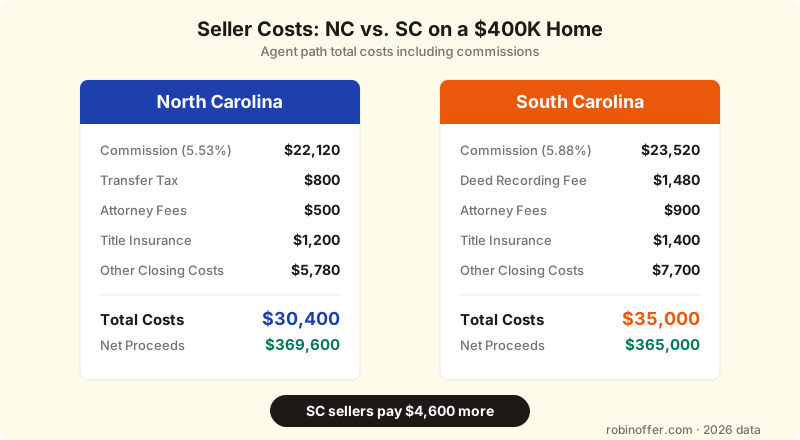
Imagine an identical home, same floor plan, same age, same condition, sitting right on the NC/SC border. One is in Pineville (NC), the other in Fort Mill (SC). Both are worth $400,000. Here's how the agent path costs stack up:
| Cost | Pineville, NC ($400K) | Fort Mill, SC ($400K) |
|---|---|---|
| Commission (5.53% NC / 5.88% SC) | $22,120 | $23,520 |
| Transfer tax / deed stamps | $800 | $1,480 |
| Attorney fees | $500 | $900 |
| Title insurance (seller's policy) | $1,200 | $1,400 |
| Other closing costs | $5,780 | $7,700 |
| Total agent path costs | $30,400 | $35,000 |
| Net proceeds (agent path) | $369,600 | $365,000 |
The SC seller loses $4,600 more to transaction costs on the same-priced home. Now compare the cash paths: a cash offer at $360,000 (10% discount) nets about $354,600 in NC and $352,800 in SC after minimal closing costs. The gap between cash and agent is $15,000 for the NC seller but only $12,200 for the SC seller. South Carolina's higher transaction costs make cash relatively more attractive there.
This is why we see more sellers in the Fort Mill, Indian Land, and Rock Hill corridor open to cash offers, the cost of the agent path is simply higher in South Carolina. If you're selling in York County, our Indian Land selling guide has county-specific cost breakdowns.
How much would you actually keep?
The net proceeds gap depends on YOUR home's value. Get a free estimate and we'll run both scenarios — cash offer and agent listing — side by side.
8. The NAR Settlement Changed One Part of the Equation
In August 2024, a $418 million settlement between the National Association of Realtors and a class of home sellers changed how buyer agent commissions work. If you're comparing cash offers to agent listings in 2026, you need to understand what actually changed, and what didn't.
What Changed
- Sellers no longer automatically pay the buyer's agent commission. Before August 2024, sellers typically paid both sides, 5–6% total.
- Buyer's agent compensation can no longer be listed on the MLS.
- Buyers must sign a written agreement with their agent before touring homes.
What Hasn't Changed (Yet)
- Average buyer agent commissions have barely moved: 2.34% in October 2024, versus 2.35% in August 2024.
- Most sellers in the Carolinas still offer buyer agent compensation to attract offers, often 2.5–3%.
- Total commission costs remain in the 5–6% range for the vast majority of transactions.
The settlement created a legal framework for commissions to drop, but the market hasn't followed yet. Sellers who refuse to offer buyer agent compensation risk getting fewer showings, which means longer time on market, which means higher carrying costs. The math is circular: saving 2.7% on buyer agent commission but adding 30 days of carrying costs at $2,200/month wipes out most of the savings on a $350K home.
For the cash vs. agent decision, the settlement hasn't significantly changed the math yet. If commission rates do drop meaningfully in the coming years, the agent path becomes more competitive, and the break-even cash discount (Section 3) shifts in the agent's favor.
How the Settlement Might Change the Math Over Time
If buyer agent commissions drop from 2.7% to 1.5% (a scenario some industry analysts project within 3–5 years), here's how the math shifts on a $350,000 home:
| Commission Scenario | Total Commission | Agent Path Net Proceeds | Cash Path Net (12% discount) | Gap |
|---|---|---|---|---|
| Current (5.5% total) | $19,250 | $306,200 | $303,380 | $2,820 agent |
| Buyer agent drops to 2% (4.8% total) | $16,800 | $308,650 | $303,380 | $5,270 agent |
| Buyer agent drops to 1.5% (4.3% total) | $15,050 | $310,400 | $303,380 | $7,020 agent |
| Seller pays listing agent only (2.8%) | $9,800 | $315,650 | $303,380 | $12,270 agent |
Lower commissions make the agent path more competitive. But notice that even in the most optimistic scenario, seller pays only the listing agent, carrying costs, repair concessions, and staging still eat a significant chunk. The cash path doesn't go away; it just needs a smaller discount to win.
9. Cash Offer vs. Realtor: Eight Situations Where Cash Wins
The math from Section 3 gives you the general framework. But real life isn't general, it's specific. Here's how the decision plays out in the situations we see most often in the Charlotte metro.
Cash Usually Wins
| Situation | Why Cash Wins | Typical Cash Discount |
|---|---|---|
| Home needs $20K+ in repairs | Financed buyers can't get loans on homes with major issues (roof, foundation, HVAC). Cash skips this entirely. | 15–25% |
| Pre-foreclosure with 60–90 days left | No time for MLS listing + 45-day close. Cash closes before the sale date. | 10–20% |
| Inherited property you don't want to manage | Out-of-state heirs paying taxes, insurance, and maintenance on an empty house. Every month is money lost. | 8–15% |
| Already moved and paying two mortgages | Double carrying costs make the "wait for full price" strategy extremely expensive. | 8–12% |
| Divorce where both parties need to close fast | Court-ordered sale deadlines. Neither party wants to pay carrying costs during proceedings. | 10–15% |
| Tenant-occupied and lease doesn't expire soon | Owner-occupant buyers won't offer on occupied homes. Investor buyers pay cash. | 10–20% |
| Title issues (liens, code violations) | Traditional buyers walk. Cash buyers often handle liens at closing. | 15–25% |
| You need the money in under 30 days | No amount of agent hustle can close a financed deal in under 30 days consistently. | 8–15% |
For homeowners facing foreclosure specifically, we have a detailed timeline guide for NC foreclosure and SC foreclosure that maps out exactly how much time you have at each stage. And if you're selling an inherited property, our NC inheritance guide covers the probate process and tax implications.
The Repair Cost Divide
This is the single most common reason we see the cash path win on the numbers. A home that needs a new roof ($8,000–$15,000), has knob-and-tube wiring ($12,000–$25,000 to rewire), or shows foundation issues ($5,000–$30,000 to repair) faces a brutal reality on the MLS: financed buyers either can't get loans approved on homes with these issues, or they negotiate massive concessions after inspection.
Consider a $320,000 Gastonia home with a 22-year-old roof and an HVAC system that's showing its age. An agent might list it at $320,000 and get an offer at $310,000. After inspection, the buyer asks for a $15,000 credit for the roof and $5,000 for the HVAC. You're now at $290,000, plus you've paid three months of carrying costs ($6,000), staging ($2,000), and commissions ($17,050). Net proceeds: roughly $265,000.
A cash buyer walks through the same house and offers $268,000. No commissions, no staging, minimal closing costs. They close in two weeks. Net proceeds after closing costs: roughly $264,000. Nearly identical, but you saved three months and all the hassle.
Now imagine the roof is actively leaking or the HVAC is dead. Financed buyers won't touch it. FHA and VA loans won't qualify. Your buyer pool shrinks to cash buyers and conventional loan buyers willing to take on a project. The listing path becomes the cash path by default, just with a longer timeline and more uncertainty.
Listing Usually Wins
| Situation | Why Listing Wins | Expected Agent Premium |
|---|---|---|
| Move-in ready home in a hot neighborhood | Multiple offers, bidding wars. The open market rewards desirable homes with above-ask prices. | 5–15% above cash offer |
| No time pressure and low carrying costs | If your mortgage is paid off or nearly so, waiting costs you very little. You can afford to hold for the right price. | 10–20% above cash offer |
| New construction or recently renovated | These homes photograph well, pass inspections easily, and attract financed buyers who pay market rate. | 8–15% above cash offer |
| Seller's market with under 3 months inventory | When buyers outnumber homes, the MLS is a competitive auction. Cash discounts make no sense here. | 10–20% above cash offer |
The Listing-Wins Sweet Spot in the Charlotte Metro
The Charlotte metro has micro-markets where listing with an agent is almost always the right call. These neighborhoods consistently sell fast, at or above ask, with minimal days on market, making the carrying cost and uncertainty arguments for cash much weaker:
- South Charlotte (Ballantyne, Providence): Median above $500K, strong school districts (Providence High, Ardrey Kell), high demand from relocating professionals. Homes in good condition often sell within 2–3 weeks with multiple offers.
- Fort Mill master-planned communities (Tega Cay, Baxter, Riverwalk): York County's $409K median hides the fact that desirable subdivision homes in the 29708 zip code can command $450K–$700K. The SC tax advantage attracts Charlotte commuters willing to pay top dollar.
- Concord and Harrisburg (close to I-85): The $375K median in Cabarrus County and proximity to the Eli Lilly campus are driving consistent demand. New construction competition means your existing home needs to be priced right, but well-priced listings move.
- Lake Norman communities (Cornelius, Davidson, Mooresville): Waterfront and water-access properties have a built-in premium that cash buyers simply won't pay for. The MLS is where you capture that lake premium.
If your home is in one of these areas, is in good condition, and you have no urgent timeline, listing with an agent is almost certainly the better financial decision. The question then becomes which agent, and that's a topic for a different guide.
How Capital Gains Tax Affects Both Paths
Whether you sell for cash or through a realtor doesn't change your tax obligation, but the price difference can change how much tax you owe. If you've lived in the home as your primary residence for at least 2 of the last 5 years, the first $250,000 in gain ($500,000 for married filing jointly) is excluded from federal capital gains tax.
Most Carolinas homeowners selling a primary residence fall well within this exclusion. But if you have significant equity, say you bought a Charlotte home for $180,000 in 2012 and it's now worth $450,000, the gain is $270,000, and the $20,000 over the single-filer exclusion would be taxable at 15% federally plus NC's flat 4.5% or SC's graduated rate (capped at 6.5%, with the $17,200 exemption).
Here's where the sale price matters: a $450,000 agent sale produces $270,000 in gain. A $405,000 cash sale produces $225,000 in gain, entirely within the $250,000 exclusion for a single filer. The $45,000 lower sale price eliminated the $3,900 in federal and state capital gains tax the agent-path seller would owe. That doesn't happen often, but for sellers right around the exclusion threshold, it's worth checking. Our cash offer guide covers tax implications in more detail.
The Hybrid Approach: List First, Then Accept Cash
Some sellers try a middle path: list with an agent for 30–60 days, and if the home doesn't sell, accept a cash offer. This sounds logical but has hidden costs.
First, the home has now been on market for 60 days. Cash buyers know this. The offer you get after 60 days of MLS exposure will be 3–5% lower than the offer you'd have gotten before listing, because the cash buyer knows you're motivated and the market has already passed on your home at the listed price.
Second, you've likely already spent $2,000–$4,000 on staging, photography, and minor repairs. That money is gone regardless of which path closes the sale.
Third, you've paid 2 months of carrying costs, $3,300–$7,200 depending on your price point.
The hybrid approach can work if you set clear expectations upfront: list for 30 days maximum, with a predetermined price reduction schedule, and a cash buyer on standby as your backup. But don't list at an aspirational price for 90 days and then expect a cash buyer to bail you out at a premium. The market doesn't reward indecision.
If you're considering this approach and your home is in the Charlotte metro, talk to us before you list. We can give you a cash offer that's good for 30 days while you test the MLS. If the market delivers a better deal, take it. If not, the cash offer is waiting. That's the kind of dual-perspective service that only works when the same company operates on both sides of the equation.
10. Your 15-Minute Decision Worksheet
You don't need a financial advisor to figure this out. You need a calculator, your last mortgage statement, and 15 minutes. Here's the framework we use with every homeowner who asks us, "Should I take a cash offer or list with an agent?"
Step 1: Know Your Carrying Costs
Add these up for one month:
- Mortgage payment (principal + interest): $______
- Property taxes (annual ÷ 12): $______
- Homeowners insurance (annual ÷ 12): $______
- HOA dues: $______
- Utilities: $______
- Maintenance (lawn, pest, pool, etc.): $______
- Total monthly carrying cost: $______
Step 2: Estimate Your Agent Path Net Proceeds
Start with your estimated market value (check Zillow, Redfin, or get a free valuation from ListRobin). Then subtract:
- Agent commissions (5.5% NC, 5.9% SC): −$______
- Seller closing costs (2.6% NC, 3.5% SC): −$______
- Staging and prep ($2,000–$5,000): −$______
- Estimated repair concessions (1–2%): −$______
- Carrying costs × estimated months to close (3–4 months avg): −$______
- Agent path net proceeds: $______
Step 3: Get a Real Cash Offer
Don't estimate the cash offer, get a real one. Request offers from 2–3 cash buyers, including at least one local company and one iBuyer if your home qualifies. Compare the written offers after any post-walkthrough adjustments. Then subtract your closing costs (1.5% NC, 2% SC for cash sales).
- Cash offer amount: $______
- Closing costs: −$______
- Cash path net proceeds: $______
Step 4: Compare and Decide
| Factor | Agent Path | Cash Path | Your Values |
|---|---|---|---|
| Net proceeds | $______ | $______ | |
| Time to close | 3–4 months | 2–3 weeks | |
| Certainty of close | ~95% | ~99% | |
| Effort required | Showings, repairs, negotiations | One walkthrough, one closing | |
| Risk of deal failing | 5% (restarts clock) | Minimal |
If the agent path nets more than 5% above the cash path, listing is likely worth the time and risk. If the gap is under 5%, the certainty and speed of cash likely outweigh the price difference, especially if you have time pressure, repair needs, or high carrying costs.
Step 5: The Questions Most People Forget to Ask Themselves
The worksheet gives you the financial answer. But four non-financial questions should factor into your decision:
- Can you handle showings for 2–3 months? If you have young children, pets, a home-based business, or a health condition that makes keeping the house show-ready stressful, that stress has a real cost even if it doesn't show up on a spreadsheet. Cash eliminates showings entirely, one walkthrough, done.
- Are you buying your next home simultaneously? If your purchase offer is contingent on selling your current home, sellers of your target home may reject you in favor of a non-contingent buyer. A cash sale on your current home removes that contingency and makes your purchase offer stronger. In competitive Charlotte-area neighborhoods, this can be the difference between getting your next home and losing it.
- What's your emotional bandwidth? Selling a home through an agent involves dozens of decisions over months: pricing strategy, offer negotiations, inspection responses, closing date coordination, repair disputes. A cash sale involves one decision: accept or decline the offer. If you're already dealing with a divorce, a death in the family, a job loss, or a relocation, minimizing decisions has value.
- Do you know what your home needs to compete on the MLS? Walk through your home with fresh eyes. Stained carpet, dated kitchen, old light fixtures, overgrown landscaping, these are the things that cause a financed buyer to offer 3–5% below asking and then negotiate another 2% after inspection. If your home needs $10,000–$15,000 in cosmetic updates to show well, factor those costs into the agent path even though most CMA presentations don't include them.
When the Worksheet Can't Decide for You
Sometimes the numbers are genuinely close, within $3,000–$5,000, and neither path has a clear financial advantage. When that happens, the tiebreaker is usually time. How much is your time worth? Listing a home requires an average of 15–20 hours of the seller's active involvement over 3–4 months: prep work, showings, negotiations, inspections, closing coordination. A cash sale requires maybe 3–5 hours total. If your time has high opportunity cost, you're launching a business, starting a new job in another city, handling a family crisis, the cash path's time savings alone can justify accepting a few thousand less.
The reverse is also true. If you're retired, living locally, have no time pressure, and your home is your largest asset, spending 3–4 months to potentially net $10,000–$20,000 more is entirely rational. The agent path rewards patience. The cash path rewards urgency. Neither is inherently better.
Ready to compare both paths for your home?
Get a free, no-obligation home value estimate from ListRobin — the starting point for every line item on the worksheet above.
11. What We'd Tell You Over the Kitchen Table
We've walked through the math, the hidden costs, the state-by-state differences, and the situational framework. Here's what it comes down to.
The cash offer vs. realtor decision is not about which path is "better." It's about which path is better for your house, your timeline, and your financial situation right now. A turnkey home in a hot Fort Mill neighborhood with low carrying costs should almost always list with an agent. An inherited property in Gastonia that needs a new roof and has been sitting vacant for six months should almost always go cash.
Most sellers fall somewhere in between, and that's exactly where the worksheet in Section 10 earns its keep.
Three things we want you to walk away with:
- Never compare sale price alone. A $350,000 sale price with an agent and a $308,000 cash offer can produce nearly identical net proceeds once you subtract commissions, closing costs, carrying costs, and repair concessions.
- Get real numbers, not estimates. Ask an agent for a CMA. Get 2–3 cash offers in writing. Then run the worksheet. Any decision made without real offers on the table is a guess.
- Your carrying cost is the tiebreaker. When the net proceeds gap is close, the seller with high carrying costs should take the faster, more certain path. The seller with low carrying costs can afford to wait.
One more thing we want to be direct about: the Charlotte metro market in summer 2026 is different from the market two years ago. Inventory is up 19%. Days on market have stretched. Sale-to-list ratios have dipped. This isn't a crash, prices are still rising 2–4% annually, but it's not the frenzy of 2021–2022 either. In a balanced market, the agent path takes longer and costs more in carrying costs than it did when homes sold in 10 days. That makes the cash path more competitive than it was during the seller's market peak.
If the market tightens again and inventory drops below 3 months, the MLS becomes a competitive auction and cash offers can't compete with bidding wars. But that's not where we are today.
How to Protect Yourself on Either Path
Whichever path you choose, a few non-negotiable protections apply:
- If listing with an agent: Get a CMA (comparative market analysis) from 2–3 agents before hiring one. Ask each agent how many homes they've sold in your zip code in the last 12 months. Negotiate the listing agreement term, 90 days, not 180. And build a price reduction plan before you list, so you're not making emotional decisions at day 45.
- If accepting a cash offer: Get offers from at least 2–3 buyers. Require proof of funds (bank statement or line of credit) before signing anything. Read the contract for assignment clauses, if the "buyer" plans to flip your contract to someone else, you're dealing with a wholesaler, not a buyer. If you're not sure what type of cash buyer you're dealing with, our guide to "We Buy Houses" companies breaks down the five business models and the red flags that distinguish legitimate operators from predatory ones. And hire your own attorney to review the contract, even if the buyer provides one. Our cash offer guide has a full contract clause checklist.
- On either path: Know your home's value. Check Zillow, Redfin, and Realtor.com estimates. Pull recent comparable sales within a half-mile. If you want a more precise number, get a free valuation from ListRobin. The seller who knows their home's value is the seller who doesn't get taken advantage of.
If you're selling in North Carolina or South Carolina and want both numbers, what an agent thinks your home will sell for and what a cash offer looks like, we do that. RobinOffer is a cash home buyer, not a licensed brokerage, and we work with a licensed real estate agent partner, Chamiese Evans of NorthGroup Real Estate. We'll give you the comparison for your specific home, with no obligation to choose either path. We've published guides for sellers across the Charlotte metro, from Belmont and Shelby to Lake Wylie and Tega Cay, because every city's math is a little different. Our seasonal selling guide can also help you time your listing if you decide to go the agent route.
The decision is yours. We just want to make sure you're making it with real numbers, not assumptions. Too many homeowners in the Carolinas accept the first cash offer they receive without knowing what their home would sell for on the MLS. And too many others list with an agent without understanding how carrying costs, repair concessions, and deal risk erode the premium they expected. Neither mistake is necessary, and this guide exists so neither happens to you.
12. Frequently Asked Questions: Cash Offer vs. Realtor
Is a cash offer better than listing with a realtor in NC?
It depends on your home's condition, timeline, and carrying costs. On a $350,000 NC home, the net proceeds gap between cash and agent can be as little as $2,820 after commissions, carrying costs, and repair concessions, making cash competitive when speed or certainty matters.
How much less is a cash offer than market value?
Cash buyers typically offer 8-25% below market value depending on buyer type. Individual cash buyers may offer 95-100% of market value, while investor and "We Buy Houses" companies typically offer 50-85%. The national average cash discount was 9% in 2025.
What are the average real estate commission rates in North Carolina and South Carolina?
The average commission in North Carolina is 5.53% (2.80% listing agent + 2.73% buyer's agent). In South Carolina, it's 5.88% (2.91% listing + 2.97% buyer's). SC's higher rates make the agent path more expensive relative to cash offers.
How fast can you close on a cash offer vs. a financed sale?
Cash transactions close in 7 to 21 days on average. Financed sales take 30 to 45 days after going under contract, plus 48 to 72 days on market in the Charlotte metro, roughly 78 to 117 total days from listing to close.
What percentage of financed home sales fall through?
Roughly 5% of pending financed sales don't close. Buyer financing denial accounts for 27.8% of cancellations, followed by the buyer being unable to sell their current home (21%) and changes in the buyer's financial situation (14.9%).
This guide was written by CC Evans, founder of RobinOffer. RobinOffer is a cash home buyer that works with a licensed real estate agent partner, Chamiese Evans of NorthGroup Real Estate (licensed in NC and SC). Data sources include NAR (2025 Profile of Home Buyers and Sellers), Redfin (Charlotte metro market data, May 2026), Freddie Mac (PMMS, July 2026), ATTOM Data Solutions, and the NC and SC Real Estate Commissions. Nothing in this guide constitutes legal, tax, or financial advice. Consult a licensed professional for advice specific to your situation.