
North Carolina Foreclosure Timeline
How Long Each Stage Takes
A day-by-day, statute-verified map of what happens next and what to do at each stage.
Also relevant: if your mortgage payoff is higher than expected net sale value, read Underwater Mortgage Options in North Carolina for retention-vs-sale decision math.
1. NC foreclosure timeline: the clock starts before most owners realize it
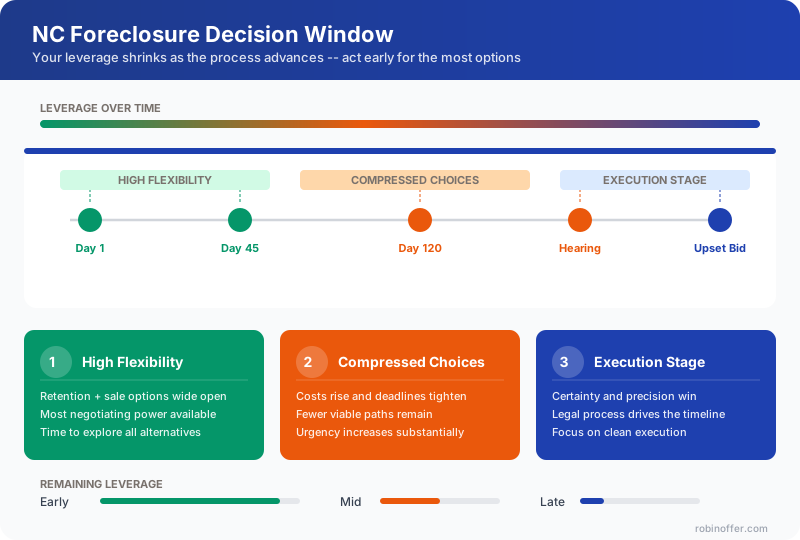
North Carolina foreclosure timeline starts the day your payment is missed, but the legal countdown that matters begins around day 36, then accelerates after day 120. If you wait for the auction notice, you are already in the most expensive, least flexible part of the process.
If you are here at 30, 60, or 90 days late, good. That is still the decision window. If you are here with a hearing date in hand, you are not out of options, but every choice now has a deadline attached to it. This guide is built to answer one practical question: what happens next in North Carolina, by day range, and what should you do at each stage?
We are going to stay laser-focused on the actual NC sequence: federal servicing rules, North Carolina pre-foreclosure notice requirements, Clerk hearing standards, notice and sale mechanics, upset-bid resets, and what happens after confirmation. No vague "contact your lender" fluff. You will get dates, triggers, and decision points.
If you want a decision framework (not just timeline mechanics), pair this with our NC foreclosure-avoidance playbook for keep-vs-sell scoring, call scripts, and 10-day sprint planning.
| Day Range | What Usually Happens | Leverage You Still Have | Primary Risk If You Wait |
|---|---|---|---|
| 1-35 | Missed payment, late fees, collections begin | Maximum workout flexibility | Compounding arrears |
| 36-44 | Servicer outreach duties are active | Early loss-mit package positioning | Paper-trail gaps |
| 45-119 | Written intervention notices and NC pre-foreclosure requirements | Modification / sale planning runway | False sense of time |
| 120+ | First legal filing allowed under federal rule | Still stoppable, but costlier | Hearing and legal cost escalation |
| Hearing to Sale | Notice periods, auction scheduling, publication | Sale-before-sale and legal defenses | Compressed deadlines |
| Post-Sale | 10-day upset-bid cycle and possible resets | Last practical equity recovery plays | Finality after confirmation |
2. Day 1 to Day 35: delinquency begins, but your best negotiating window is open
Day 1 is not a courthouse event. It is accounting. Your loan is past due, a late fee may post depending on your note terms, and servicing collections begin. In this period, many owners still believe they can "catch up next month" and avoid paperwork. Sometimes that is true. Often it is how two missed payments turn into five.
In practical terms, this first month is where outcomes diverge. Homeowners who build a written hardship file now tend to get cleaner loss-mit reviews later. Homeowners who improvise by phone only tend to get stuck in documentation loops. If you only remember one operational rule from this section, remember this: every call gets a timestamp, agent name, and summary in your own log.
What to collect immediately
- Most recent mortgage statement and escrow breakdown
- Income proof (pay stubs or self-employment packet)
- Two most recent bank statements
- Short hardship letter with date-specific trigger (job loss, medical, divorce, payment shock)
- Property condition notes if sale may become likely
| File Item | Why It Matters Later | How Long It Takes | Who Needs It |
|---|---|---|---|
| Hardship statement | Frames your loss-mit narrative | 30-60 minutes | Servicer underwriter |
| Income packet | Supports affordability test | 1-2 days | Modification team |
| Expense worksheet | Shows feasibility of workout | 45 minutes | Counselor + servicer |
| Property value baseline | Determines sell-vs-keep path | 1-3 days | You + listing/cash options |
If you are self-employed in NC, do not wait to assemble your documentation stack. The timeline friction for self-employed files is almost always missing or stale financials. Build it now while the clock is forgiving.
3. Day 36 to Day 119: mandatory outreach, NC pre-foreclosure notice, and your real decision fork
Federal servicing rules force structure onto this stage. Servicers are required to attempt live contact around day 36 and provide written intervention notices around day 45. North Carolina adds its own layer: under G.S. 45-102, a pre-foreclosure notice for home loans must go out at least 45 days before a foreclosure hearing notice filing.
That means this section is not just "collections pressure." It is the legal runway where you still have enough time to choose among three fundamentally different paths: keep, sell, or prepare to litigate process defects. Most people bounce between all three until it is too late to execute any of them cleanly.
The three-path decision framework in this window
| Path | Core Question | Best Fit Scenario | Execution Deadline Bias |
|---|---|---|---|
| Keep the home | Can payment be sustainably reworked? | Income shock was temporary or recoverable | Earlier is strongly better |
| Sell before sale | Is equity worth protecting now? | Payment permanently unaffordable | Needs marketing runway |
| Challenge process | Did lender fail statutory/procedural requirements? | Notice/standing/service defects exist | Requires hearing prep |
North Carolina's pre-foreclosure notice content requirements are not decorative. They include resource disclosures and contact pathways intended to route owners into counseling before hearing stage. If your notice package is incomplete, keep copies. That can matter later.
4. Day 120 and beyond: first legal filing becomes available, and costs start compounding fast
Under 12 CFR 1024.41(f), the servicer generally cannot make the first foreclosure notice or filing until a borrower is more than 120 days delinquent. You can verify the current language directly through CFPB regulation text and eCFR references. Once this threshold passes, NC procedural steps can move quickly if the file is clean.
This is where many homeowners psychologically shift from "I need an option" to "I need a rescue." That mindset is expensive. Every added legal step introduces attorneys' fees, posting/publication costs, and escalating arrears. In pure net-proceeds math, delay is not neutral; it is usually an invisible lien growing weekly.
What changes after 120 days
- Foreclosure filing gate is now legally open
- Loss mitigation is still possible, but time-to-decision matters more
- Documentation defects become harder to cure under pressure
- Sale strategy shifts from optimal pricing to certainty and speed tradeoffs
| Cost Layer | How It Enters the File | Who Ultimately Pays | How to Limit Damage |
|---|---|---|---|
| Late charges | Contractual payment default | Borrower/estate | Cure sooner, not later |
| Attorney fees | Foreclosure preparation and hearing | Borrower via payoff | Resolve before deeper litigation |
| Publication/posting | Statutory sale notice process | Borrower via sale/payoff | Avoid reaching sale phase |
| Carrying drag | Taxes, insurance, utilities while unresolved | Borrower | Decide keep/sell faster |
Owners in this stage should calculate an "equity burn rate" each month. If total carrying plus arrears growth is $2,100 monthly, a four-month delay can consume over $8,000 of your exit cushion before negotiation effects are counted.
For a deeper look at what equity is actually protected from creditors once judgments are involved, review our NC Homestead Exemption Guide. It helps separate protected vs exposed equity before you choose a timeline strategy.
Running out of time and considering a fast sale?
Tell us about your NC home and we'll send you a real, no-obligation cash offer — any condition, and you pick the closing date.
5. Hearing phase under G.S. 45-21.16: what the Clerk can decide, and what you must bring
In North Carolina power-of-sale cases, the file is heard as a special proceeding before the Clerk of Superior Court. The governing hearing mechanics live in G.S. 45-21.16. Notice timing and service method matter. If service defects exist, continuances can occur.
This is not a "show up and tell your story" hearing in the broad sense. The Clerk's scope is limited to specific statutory findings. That is exactly why preparation matters more than emotion. You are trying to show record-level defects or viable process-based defenses, not deliver a general hardship speech.
Hearing prep checklist
- Complete communication log with dates, names, and outcomes
- Copies of every servicer letter, including envelopes where possible
- Proof of any pending or submitted complete loss-mit application
- Payment history and disputed-account notes
- Any evidence of improper notice timing/content
- Counselor notes and attorney summary if represented
| Hearing Question Bucket | Evidence You Need | Common Owner Mistake | Better Move |
|---|---|---|---|
| Debt/default status | Servicer statements, payment records | Arriving with no documents | Bring indexed packet |
| Party authority/standing | Filed documents and assignment trail | Assuming "they must be right" | Review filed basis carefully |
| Notice compliance | Mailed notices, posting/service records | Ignoring envelope/service dates | Track timelines precisely |
| Procedural fairness | Loss-mit submission proof | Verbal-only claims | Use dated written proof |
North Carolina Judicial Branch foreclosure materials are worth reading before hearing week. Start at nccourts.gov foreclosure help topic so you understand venue and process language.
6. From hearing order to courthouse sale: publication, scheduling, and what can still stop the sale
If foreclosure is authorized, owners often believe the house is immediately gone. Not true. There is still a meaningful sequence before and around sale. You may still reinstate, complete a negotiated workout, execute a short sale, or close a traditional/cash sale if timing aligns.
That said, this is the stage where tactical mistakes are costly. Buyers sense deadline pressure. Listing strategy has to prioritize certainty, clean title coordination, and rapid document turnover. If you are still deciding whether to keep or sell here, set a hard internal cutoff date and stick to it.
Operational playbook in this stage
- Confirm exact sale date, time, and location details from filed notices
- Request written payoff updates with validity windows
- Run two-track exit modeling: market listing path vs. fast-cash certainty path
- Coordinate title review early if liens/judgments exist
- Do not rely on verbal pause promises
| Execution Choice | Typical Speed | Price Efficiency | Failure Risk Source |
|---|---|---|---|
| Conventional listing | Slower | Higher potential | Financing/appraisal delays |
| As-is investor sale | Fast | Lower | Buyer repricing / proof-of-funds issues |
| Workout + keep | Variable | N/A | Incomplete docs or payment infeasibility |
If you are evaluating cash offers at this point, compare net certainty, not headline price. Our cash offer guide for the Carolinas can help you sort buyer types and contract red flags quickly. If your payoff exceeds likely sale value, add our Underwater Mortgage Options in NC guide to your decision stack.
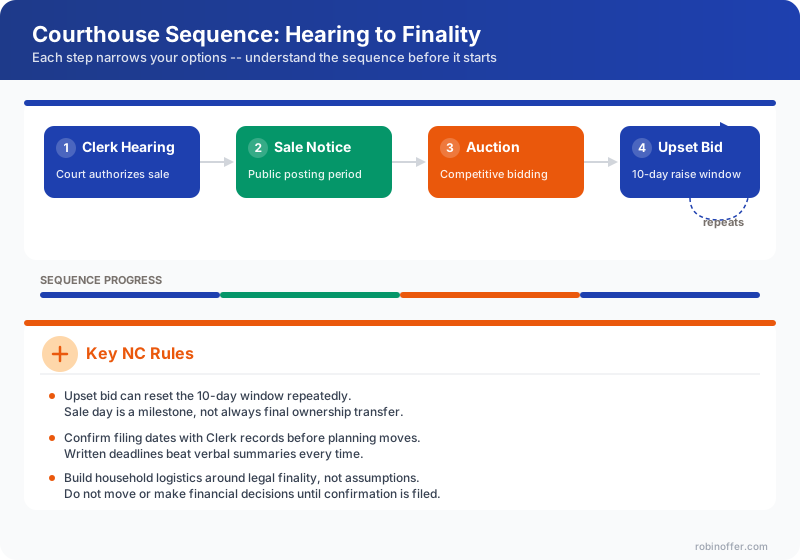
7. The 10-day upset-bid cycle (G.S. 45-21.27): why "sale day" is often not the real finish line
North Carolina's upset-bid mechanics are one of the most misunderstood parts of foreclosure timing. Under G.S. 45-21.27, eligible upset bids can reopen the cycle repeatedly, and each valid upset bid triggers another 10-day window.
Translation: even after the auction event, finality can move. For homeowners and heirs, this is sometimes the last chance to recover additional equity through a higher bid dynamic. It is not common as a do-it-yourself strategy, but it is real and it can matter when spread is large between opening bid and market value.
| Upset-Bid Rule Element | Current NC Standard | Strategic Implication | Practical Caution |
|---|---|---|---|
| Minimum increment | 5% or $750 minimum increase | Can ratchet price upward | Need qualified cash deposit |
| Deposit requirement | Filed with Clerk (cash/certified funds) | Filters unserious bidders | Execution details are strict |
| Window length | 10 days from report/last upset notice | Timeline can reset multiple times | Weekend/holiday counting rules apply |
| Successive bids | Allowed under statute | Finality may slide out | Do not assume day-1 certainty |
For families trying to plan a move, this stage is emotionally rough because it feels both over and not over. Set expectations correctly: confirmation and deed transfer are what matter for finality, not the first auction cry.
8. Life happens in parallel: inheritance, divorce, and tax trouble follow different clocks
Foreclosure almost never arrives alone. It overlaps with probate administration, domestic litigation, or tax delinquency files. Treating those as "later issues" is how owners lose control of timeline and title simultaneously. If county tax arrears are part of your file, track that clock with this NC property tax lien timeline guide so you can plan both enforcement streams together.
If your case includes one of these parallel tracks, use dedicated workflows instead of forcing everything into one generic plan:
- Inherited home in NC: probate-first selling decisions
- Statewide NC foreclosure options and resource breakdown
- How quick-sale contracts work when timeline pressure is high
- How timing assumptions change in distressed sale scenarios
Parallel-case risk map
| Parallel Issue | What It Changes in Foreclosure Timeline | Title/Closing Impact | Best First Call |
|---|---|---|---|
| Probate estate | Authority to sell may depend on estate status | Executor/administrator signatures required | Clerk/probate counsel |
| Divorce action | Occupancy/control may be disputed | Settlement/order terms can govern sale authority | Family-law counsel |
| Tax delinquency | Independent enforcement pressure | Lien payoff at closing | County tax office |
| HOA lien | Separate foreclosure risk stream | Payoff and estoppel timing matters | HOA + counsel |
The operational principle is simple: if there are two legal clocks, you must calendar both. Foreclosure-only planning fails when the second clock controls disposition authority.
9. NC timeline math: keep-vs-sell breakpoints using carrying cost and equity burn
This is where many decisions become obvious on paper even when they feel hard emotionally. Build your own monthly carry stack (mortgage shortage, taxes, insurance, utilities, minimum upkeep, and legal drift). Then project three scenarios for the next 30, 60, and 90 days.
| Model Input | Sample Amount | Why It Matters | Where To Verify |
|---|---|---|---|
| Monthly housing carry | $2,450 | Defines delay penalty | Statements + bills |
| Arrears and fees now | $12,800 | Immediate cure burden | Servicer reinstatement quote |
| Likely as-is sale net today | $41,000 | Baseline exit value | Title + offer sheet |
| Likely 60-day sale net | $34,500 | Delay-adjusted expectation | Carry + risk adjustments |
| Likely 90-day sale net | $28,000 | Compression risk estimate | Carry + concession assumptions |
When the model shows a rapid net decline, waiting for "a better market" is usually a story, not a strategy. In timeline-driven distress cases, certainty has financial value. So does speed.
Get Your Free, No-Obligation Cash Offer
Tell us about your NC home and we'll send you a real cash offer — any condition, no repairs, and you choose the closing date. Free and confidential.
10. 30-day action script by timeline stage (what to do this week, not someday)
Most homeowners do not need more information. They need sequence. Use the script below based on your current day range. Pick one track and execute it hard for 14 days. Drift is what kills outcomes.
If you are between day 1 and day 59
- Open a foreclosure file folder (digital + paper) tonight
- Call servicer loss-mit and request required-doc checklist in writing
- Call NC counseling line at 1-888-442-8188 and book appointment
- Build hardship + income packet within 72 hours
- Run a no-surprise home value and net estimate
If you are between day 60 and day 119
- Choose keep-or-sell by a hard date on your calendar
- If keeping: submit complete package and confirm receipt in writing
- If selling: begin listing or vetted-cash-buyer process now, not after hearing notice
- Create weekly timeline review with counselor/agent/attorney
- Track every new legal notice the day it arrives
If you are 120+ days or have hearing notice
- Request immediate reinstatement and payoff numbers
- Assemble indexed hearing packet in 48 hours
- Decide litigation posture vs. controlled exit
- Prioritize certainty in any sale contract terms
- Do not skip hearing preparation because "I am selling"
| Current Stage | Next 7 Days Priority | One Metric to Track | Escalate If |
|---|---|---|---|
| Early delinquency | Complete packet assembly | % docs submitted | Servicer keeps saying "incomplete" with no list |
| Pre-filing | Commit to keep or sell | Decision date hit/missed | You are still undecided at day 90+ |
| Post-120 / hearing | Record-ready response | Days to hearing | No counsel and no organized packet |
| Sale scheduled | Exit execution certainty | Contract readiness | Buyer financing or title uncertain |
11. Final reality check: timeline pressure is real, but so are your options when you act early
North Carolina's foreclosure process is fast compared with what many homeowners expect, but it is not instant. The timeline gives you windows. The earlier windows are cheaper and wider. The later windows are narrower and more expensive. That is the whole game. If you also own property in South Carolina, compare this with the SC judicial foreclosure timeline before making a cross-state strategy decision.
If your goal is to keep your home, structure and speed matter more than optimism. If your goal is to preserve equity and reset financially, certainty and execution matter more than headline price fantasies. Either way, you win by acting inside the right part of the clock.
For broader context and option deep-dives, use these companion guides:
- Complete NC foreclosure help guide
- How to compare cash offers safely
- Timing your sale in the Carolinas
12. NC foreclosure timeline checkpoint map: your primary objective at each stage
Sections 2 through 7 break down each timeline stage in detail. Use this checkpoint table as a quick-reference summary: find your current day range, confirm your primary objective, and identify the single most useful document to focus on this week.
| Timeline Checkpoint | Your Primary Objective | Most Useful Document | Avoid This Mistake |
|---|---|---|---|
| 1-35 days late | Build record and budget truth | Hardship + budget worksheet | Hoping for silent cure without plan |
| 36-75 days late | Choose strategy branch | Written servicer correspondence log | Phone-only communication |
| 76-119 days late | Execute chosen strategy | Complete packet receipt evidence | Staying undecided |
| 120+ days late | Minimize legal and net-value loss | Indexed hearing/sale file | Disorganized last-minute responses |
| Post-auction window | Plan around legal finality | Clerk filing timeline | Assuming sale-day finality |
13. Real-world NC timeline scenarios: how outcomes change when action starts early vs late
Foreclosure guidance is easier to trust when you can see how decisions play out over time. The scenarios below are composites built from common North Carolina patterns. They are not legal advice or promises. They are practical demonstrations of how timing interacts with cost, stress, and equity.
Scenario A: early action, retention path
A homeowner in central NC misses one payment after a temporary income interruption. By day 18, they call loss mitigation, document hardship in writing, and submit a complete package with counselor support by day 37. The servicer requests one update, received within 48 hours. Because the file is clean and early, review is smoother than expected. By day 74, a structured workout path is offered and accepted.
The case is not easy. The borrower still faces higher monthly pressure and tighter household budgeting. But the timeline never reaches hearing authorization. Net result: legal costs remain limited, credit damage is substantially lower than foreclosure outcome scenarios, and family disruption is controlled.
Scenario B: middle-stage action, controlled sale path
A homeowner in western NC falls 75 days behind due to medical disruption and reduced work hours. By day 82, it is clear retention affordability is weak even with a modification. Instead of spending six more weeks in indecision, they choose a controlled exit plan: documented payoff request, title check, clear communication with all lien parties, and fast but vetted buyer outreach.
A sale contract is executed before hearing-stage pressure peaks. Because process starts before maximum compression, negotiation remains reasonable, and closing certainty is higher than typical panic-phase dispositions. Net proceeds are lower than a perfect-market listing but significantly better than late-stage distress outcomes.
Scenario C: late action, hearing-stage scramble
A homeowner delays engagement until after service of hearing notice. They have scattered documents, no consolidated communication log, and conflicting verbal summaries from multiple call-center interactions. Stress is high. Time is low. The borrower still has options, but each option now requires intense, immediate coordination.
Could this still end in a decent outcome? Yes. But the execution risk is much higher. Buyers discount uncertainty. Legal/carrying costs rise. Emotional load spikes because every decision feels urgent and final. This is the most common pattern we see in avoidable equity loss cases.
Scenario D: post-sale misunderstanding and avoidable chaos
A family assumes sale-day means immediate finality and moves logistics too early. They miss upset-bid sequence implications, mis-time utility changes, and create avoidable housing transition stress. Proper timeline education would have reduced disruption even though core legal outcome remained the same.
| Scenario | Action Start Point | Primary Outcome Driver | Typical Stress Profile |
|---|---|---|---|
| Retention success | Before day 45 | Complete early documentation | Moderate, manageable |
| Controlled sale | Day 75-95 | Fast strategic decision and clean execution | High but stable |
| Hearing scramble | 120+ with notice served | Compressed decision windows | Very high, volatile |
| Post-sale confusion | After auction event | Poor understanding of upset-bid mechanics | Operationally chaotic |
Notice what these scenarios share: the law is the same, but outcomes differ because timing quality differs. You cannot control every hardship variable. You can control when and how you engage the timeline.
14. NC foreclosure document stack: what to keep, why it matters, and how to organize it
When time pressure hits, document quality becomes leverage. This section is intentionally tactical. If your file is messy today, use this framework to clean it in one evening. The goal is not perfection. The goal is decision-ready records that support whichever path you choose next.
Folder structure that works under pressure
- 01 Loan Core: note/deed references, most recent statements, escrow details
- 02 Timeline Log: every call/email/letter with date, contact, summary, next step
- 03 Loss-Mit Packet: hardship, income docs, budget, submission receipts
- 04 Legal Notices: pre-foreclosure notice, hearing notice, posting/publication copies
- 05 Sale Track: payoff letters, title notes, buyer proof, contract drafts
- 06 Resource Calls: counselor notes, attorney consult notes, agency contacts
Why this matters: when a servicer says "we did not receive X" or a buyer says "we need Y by tomorrow," organized files reduce failure risk. You are no longer searching your inbox under panic. You are executing from a controlled packet.
Non-negotiable records in North Carolina timeline cases
| Record | Purpose | Minimum Quality Standard | Where It Helps Most |
|---|---|---|---|
| Communication log | Tracks commitments and discrepancies | Date/time/name/summary/action | Hearing prep + servicer disputes |
| Submission proofs | Shows packet completion and timing | Portal screenshot or email confirmation | Loss-mit timeline disputes |
| Notice envelopes/copies | Supports notice timing analysis | Legible postmark and full page scans | Procedural review |
| Payoff/reinstatement letters | Defines cure and exit math | Dated amount with expiration date | Sale and negotiation planning |
| Title/lien snapshots | Prevents closing surprises | Current preliminary title data | Controlled sale execution |
Keep both digital and paper versions for hearing-critical documents. Digital is searchable. Paper is courtroom-proof when technology fails. Redundancy is not overkill in deadline-sensitive legal processes.
Common documentation failures and fast fixes
Failure: incomplete hardship narrative. Fast fix: use a one-page statement with three parts: trigger date, impact on income/expenses, and proposed stabilization plan.
Failure: stale bank statements. Fast fix: pull the latest statement set immediately and label clearly by month and account.
Failure: no proof of packet upload. Fast fix: re-upload and capture timestamp screenshot; send confirmation email summarizing what was submitted.
Failure: no single source of truth. Fast fix: appoint one person in the household to maintain the timeline log daily.
Want to know what a fast cash sale could look like?
Tell us about your home and we'll send you a real, no-obligation cash offer — no repairs, no showings, close on your timeline.
15. NC homeowner FAQ: timeline questions people ask when they are under pressure
How long does foreclosure usually take in North Carolina from first missed payment?
Many NC cases land in a broad 6-10 month range from first missed payment to completed sale sequence, but your timeline can be shorter or longer based on filing timing, hearing schedules, workout activity, and upset-bid resets. Use the timeline framework in this guide rather than relying on one fixed number.
Can foreclosure start before I am 120 days delinquent?
Federal servicing rules generally prohibit the first foreclosure notice or filing before a borrower is more than 120 days delinquent, with limited exceptions tied to specific legal contexts. Always verify current rule text and your case facts with counsel.
What does the NC 45-day pre-foreclosure notice requirement do for me?
It creates a mandatory notice runway before hearing filing in covered home-loan contexts and requires resource disclosures that can help borrowers access counseling and intervention pathways. It is a timing and information protection layer, not an automatic foreclosure stop.
If I got a hearing notice, is it already too late?
No. It is later, not necessarily too late. You can still pursue retention options, procedural defenses, or controlled sale outcomes, but execution speed and organization are critical at this stage.
What happens at the Clerk hearing in a power-of-sale case?
The Clerk reviews specific statutory issues, including debt/default and procedural factors, within limited hearing scope. This is why document quality and timeline precision matter more than broad hardship narratives unsupported by records.
Can I sell my house after hearing notice but before auction?
Often yes, depending on your exact timeline and your ability to execute quickly with clean title and reliable contract terms. In compressed windows, certainty often matters more than maximizing top-line price.
What is an upset bid, and why does it matter?
An upset bid is a qualifying higher bid filed after sale reporting. In NC, valid upset bids can extend the sequence through successive 10-day windows. This affects finality and planning.
Does sale day mean I have to move out immediately?
Usually no. Legal and practical finality often depends on post-sale process completion and any subsequent possession procedures. Build move planning around confirmed legal milestones, not assumptions.
Can I still apply for modification while sale pressure is rising?
You may still pursue loss mitigation, but outcomes depend heavily on timing, completeness, and procedural posture. Delayed or incomplete submissions carry high failure risk in late-stage windows.
Should I talk to a HUD-approved counselor if I already have an attorney?
Usually yes. These roles can complement each other. Counselors often help with packet quality and servicer process navigation while attorneys focus on legal rights and defenses.
What if my hardship is divorce-related and both names are on the loan?
You may face overlapping legal clocks. Coordinate foreclosure timeline with domestic orders and authority-to-sell issues early. Delayed coordination can block otherwise viable solutions.
What if the property is inherited and probate is still open?
Authority to act may depend on estate status and fiduciary powers. Foreclosure and probate clocks can run in parallel. Use estate counsel and timeline planning together, not sequentially.
Can property tax delinquency and mortgage foreclosure happen at the same time?
Yes. These can be separate enforcement streams. If both are active, your plan must account for both deadlines and payoff requirements. Track county tax-foreclosure milestones alongside your mortgage timeline.
How do I compare cash offers quickly without getting trapped?
Use net-sheet math, proof-of-funds verification, clear contract deadlines, and contingency review. Headline price alone is not enough in timeline-driven distress.
If I am 90 days late, what is the most important action this week?
Make a hard keep-vs-sell decision date and execute one strategy with full documentation. Indecision at this stage is usually the most expensive mistake.
What are the top three timeline mistakes NC owners make?
Waiting for certainty before acting, relying on verbal updates without a written record, and treating auction day as guaranteed finality without understanding upset-bid mechanics.
How often should I update my timeline log?
Every contact event, same day. Delay erodes accuracy, and accuracy is what protects your decision quality later.
Do I need to preserve envelopes and mailers?
Yes. Postmarks and mailing details can matter in notice-timing analysis. Scan everything before filing paper copies.
What if I feel frozen and cannot decide?
Use a 72-hour decision protocol: gather payoff, gather value estimate, and complete a counselor consult. Then set a decision date and commit to one path for 14 days before reassessing.
Where should I start if I only do one thing tonight?
Create your timeline log and put every event from memory in chronological order. That single step improves all next-step decisions.
16. County and court-practice variation: why NC timeline estimates differ by location
State statutes are statewide, but practical timing can vary by county workload, scheduling cadence, and local process administration. This is why one owner hears "it took forever" while another says "it moved overnight." Both can be true in different local contexts.
Variation does not mean unpredictability. It means your timeline plan should include local checkpoints. Ask local counsel or Clerk resources about hearing calendars, filing pacing, and document expectations. Then build your plan around confirmed local cadence rather than internet averages.
| Variation Driver | How It Can Affect Timeline | Planning Response | Who Can Confirm |
|---|---|---|---|
| Clerk calendar load | Hearing dates may queue differently | Track local setting intervals | Clerk office/counsel |
| Service logistics | Notice timing and continuances can shift dates | Monitor service record quality | Case file + counsel |
| Title complexity | Sale execution can slow | Start title review early | Closing/title professionals |
| Parallel legal matters | Authority and occupancy questions complicate process | Coordinate legal teams early | Counselors + attorneys |
If you are in a county with heavier foreclosure and civil calendars, your hearing date cadence may differ from nearby counties. Do not read that as "more time to delay." Use it as "more time to execute correctly." Extra days only help if they are used.
Likewise, if your county moves quickly, panic is not the answer. Compression can actually simplify decisions by forcing clarity. The workflow still works: document, decide, execute, verify.
17. Closing checklist: your NC foreclosure timeline command center
Use this as your one-page command center. Print it. Keep it visible. Run it every week until your case resolves.
| Weekly Control Item | Status (Done / In Progress / Blocked) | Owner | Due Date |
|---|---|---|---|
| Timeline log fully updated | |||
| Latest servicer statement saved | |||
| All requested docs submitted with proof | |||
| Counselor or attorney touchpoint completed | |||
| Keep-vs-sell decision date still valid | |||
| If selling: title/payoff/contract status reviewed | |||
| All notices scanned and filed | |||
| Next legal deadline confirmed in writing |
If your file is stalled, ask these three blunt questions:
- Am I missing documents, or am I avoiding a hard decision?
- Is my strategy still realistic with today's timeline stage?
- What action this week would most increase certainty?
North Carolina foreclosure timelines reward action discipline. You do not need to solve everything tonight. You do need to run the next correct step this week, then the next one after that.
See What We'd Pay for Your Home
Tell us about your home and we'll send you a real cash offer — any condition, close on the date you choose. Free, no-obligation, and confidential.
18. Financial recovery timeline after foreclosure pressure: rebuilding plan for months 1-24
Most timeline guides end at legal finality. Homeowners need the next chapter too. Whether you keep the home through a workout or exit through sale, you need a concrete 24-month recovery map. The difference between "we survived" and "we stabilized" is usually process, not luck.
Month 1-3 priorities: stabilize housing, stabilize cash flow, and stabilize records. If you retained the home, your mission is payment consistency and reserve rebuilding. If you exited, your mission is predictable housing cost, utility normalization, and elimination of recurring debt leak points.
Month 4-6 priorities: rebuild credit hygiene and emergency capacity. Pull credit reports, dispute clear inaccuracies, automate all essential payments, and target an emergency reserve equal to one month of bare-minimum expenses. This phase is boring by design, and that is exactly why it works.
Month 7-12 priorities: increase margin and reduce fragility. Add income where possible, trim recurring spending traps, and test your budget under stress assumptions (temporary overtime loss, vehicle repair, childcare disruption). If your plan only works in perfect months, it is not yet stable.
Month 13-24 priorities: strategic repositioning. For some households, this means preparing for future ownership. For others, it means optimized renting plus debt-light investing. Either path is valid. The only bad path is drifting back into payment volatility.
| Recovery Window | Primary Goal | Key Metric | Weekly Habit |
|---|---|---|---|
| Months 1-3 | Stop financial bleeding | On-time core bills % | Sunday cash-flow review |
| Months 4-6 | Build baseline resilience | Emergency fund balance | Automatic transfer day |
| Months 7-12 | Reduce fragility | Debt-to-income trend | Monthly expense audit |
| Months 13-24 | Strategic growth | Net worth direction | Quarterly plan reset |
If foreclosure pressure came from a known trigger like medical cost shock or variable-income volatility, build the new budget around that reality rather than pretending it was a one-time anomaly. Real recovery planning is honest planning.
Credit recovery sequencing that actually works
There is a lot of bad advice online about "quick score hacks." Ignore it. In post-distress recovery, credit quality improves through consistency, utilization control, and error correction over time. Focus on factors you can control:
- Keep all required accounts current, no exceptions
- Use small revolving balances and pay in full when possible
- Avoid opening unnecessary accounts during stabilization phase
- Dispute factual reporting errors with documentation
- Track progress monthly, not daily
If you exited through a sale-before-sale strategy and avoided completed foreclosure reporting, your recovery runway may be shorter than feared. If you experienced deeper derogatories, recovery still happens, just with more patience and discipline.
Housing decision framework after timeline stress
| Option | When It Makes Sense | Main Advantage | Main Risk |
|---|---|---|---|
| Stay as renter longer | Income still stabilizing | Flexibility and lower fixed risk | Rent inflation exposure |
| Re-enter ownership soon | Strong reserves + stable income | Long-term equity rebuilding | Premature fixed-cost load |
| Shared-family housing period | Short-term reset needed | Rapid savings acceleration | Household stress if expectations unclear |
The right choice is the one that keeps your payment stress index low for 12 consecutive months. Stability first. Pride second. This is one of those moments where practical beats performative.
Disclaimer: This educational guide is not legal, tax, or financial advice. Foreclosure rights and procedures depend on current law, loan documents, and case-specific facts. For case advice, consult a licensed North Carolina attorney and a HUD-approved housing counselor.
If unpaid property taxes are part of your risk stack, pair this with our NC Property Tax Lien Timeline guide so you can manage mortgage and tax deadlines together.
Free Checklist
Get the free Foreclosure Options Checklist
See every option before your sale date — reinstate, modify, forbearance, sell to protect your equity, and more. Email only, no phone, no spam. Unsubscribe anytime.