
Sell Your Inherited House
in North Carolina
NC probate, taxes, carrying costs, and every option for heirs, written in plain English, not legal jargon.
1. A Letter to You: What to Do When You Inherit a House in North Carolina
Selling inherited property in North Carolina is something thousands of families face every year, and the short answer to the question most heirs ask first is yes, you usually can. NC real property passes to the heirs at the moment of death, so in most cases you can sell an inherited house soon after, often before probate fully closes. This guide walks you through every step in plain English, and it starts with something more important than paperwork.
If you're reading this, chances are you just lost someone you love. A parent. A grandparent. An aunt or uncle who felt more like a second parent. And now, on top of everything you're dealing with, the grief, the arrangements, the emotional weight of it all, someone has told you that you've inherited a house in North Carolina.
Maybe you're sitting in the driveway of that house right now. Maybe you're 500 miles away, trying to figure this out between work meetings and school pickups. Maybe you're one of three siblings, and nobody agrees on what to do next.
Whatever your situation, I want you to know two things.
First: there is no rush to make a major decision right now. Despite what you might hear from people eager to buy the property (and they will call), you have time. Not unlimited time, carrying costs are real, and we'll talk about those, but enough time to make a smart decision instead of a desperate one.
Second: this guide was written for you, not for attorneys or real estate investors. I'm going to walk you through the entire process of inheriting property in North Carolina, probate, taxes, costs, your options, and how to sell if that's the right move, in plain English. No legal jargon. No sales pitch disguised as advice.
By the time you finish reading, you'll understand exactly where you stand and what to do next.
If the inherited property is in South Carolina, see our SC inherited property guide, the probate process is meaningfully different.
Your First 72 Hours: What to Do Right Now
You don't need to figure out everything today. But there are a few things that are genuinely time-sensitive. If I were sitting across from you right now, here's what I'd tell you to handle this week:
- Secure the property. If the house is now vacant, change the locks, make sure all doors and windows are locked, and set the thermostat to prevent frozen pipes (55°F minimum in winter). If there's a security system, make sure it's active. Forward the deceased's mail to a safe address.
- Locate the will. Check the deceased's home (filing cabinets, safe, desk drawers), their attorney's office, and the Clerk of Superior Court in their county. If there's no will, that's okay, we'll cover what happens in Chapter 2.
- Check the homeowner's insurance. This is urgent. Call the insurance company and notify them of the death. Most policies have vacancy clauses that can void coverage after 30 to 60 days of the home being unoccupied. Ask about adding yourself as an additional insured or converting to a vacant-property policy. Do not let the insurance lapse.
- Find out if there's a mortgage. Check the deceased's mail, bank statements, and any loan documents. If there's a mortgage, call the servicer to notify them of the death. They cannot call the loan due just because the owner died (the federal Garn-St. Germain Act protects you), but they need to know.
- Order death certificates, at least 10 certified copies. You'll need them for the bank, insurance company, mortgage servicer, court, title company, and more. The funeral home usually orders the first batch; if you need extras, contact the NC county Register of Deeds where the death occurred or NC Vital Records at (919) 733-3000.
- Cancel or redirect recurring payments. Check the deceased's bank accounts for auto-pay subscriptions (streaming, cell phone, gym, newspapers) that will continue draining funds. Notify credit card companies of the death. File a "deceased" notice with the three credit bureaus (Equifax, Experian, TransUnion) to prevent identity theft.
- Do not sign anything from anyone trying to buy the property. Investors and wholesalers monitor probate filings and obituaries. You may get letters, calls, or even people knocking on the door. Some are legitimate; many are not. Take your time.
What About the Belongings?
This is one of the hardest parts, and nobody talks about it enough. You're not just inheriting a house, you're walking into someone's life. Thirty years of furniture, clothing, photo albums, kitchen gadgets, holiday decorations, and the little things that remind you of them every time you open a drawer.
Here's what I'd suggest:
- You do not need to clear the house right away. Unless there's a specific reason (the property is being sold immediately, or there's a safety concern), the belongings can stay for now.
- Gather important documents first. Look for: the will, life insurance policies, bank and investment statements, property deed, mortgage documents, tax returns, vehicle titles, and any trust documents. Put these in a safe place.
- If there are multiple heirs, agree on a process before dividing anything. One approach: each person makes a list of the sentimental items that matter most to them, and you compare lists. If there's overlap, take turns choosing. For items nobody wants to keep, consider an estate sale.
- Estate sale companies typically charge 25%–40% of gross sales and handle everything, sorting, pricing, advertising, and conducting the sale. In larger metro areas like Charlotte, Raleigh, or the Triangle, expect to pay toward the lower end of that range due to more competition. Get at least two quotes.
- Donate what's left to Habitat for Humanity ReStore, Goodwill, or a local charity. Many will pick up for free, and you can deduct the fair market value on your taxes if you itemize.
Take a breath. Take photos. And give yourself permission to grieve while you handle the logistics. They don't have to happen separately.
2. How Probate Works in North Carolina
I know, "probate" sounds like something you hire a lawyer for and try not to think about. But if you've inherited a house in NC, you need to understand the basics, because North Carolina handles real estate in probate differently from most other states. And that difference is actually good news for you.
The Big NC Difference: Your House May Not Need Probate
In most states, inherited real estate has to go through the full probate process before it can be transferred to heirs. In North Carolina, real property generally passes directly to the heirs or devisees at the moment of death, it does not become part of the "probate estate" that gets administered by the executor.
What does that mean in plain English? It means the house may already be legally yours, even before probate is finished. You may not need to wait months for a court to tell you what you already own.
There are exceptions, the property does go through probate if:
- The will specifically directs the executor to sell the property
- The estate has debts that require selling real property to pay creditors
- The executor petitions the court to sell the property to cover estate expenses
But in the common scenario, parent dies, leaves house to kids, estate has enough cash or personal property to cover debts, the house passes directly. A probate attorney can confirm your situation for a consultation fee of $200–$500.
What to Bring to the Clerk of Superior Court
When you're ready to open the estate, bring the following to the Clerk's office in the county where the deceased lived:
- The original will (if there is one, copies are not accepted)
- A certified death certificate
- Your valid photo ID
- A completed Application for Probate (Form AOC-E-201, available on the NC Courts website or at the Clerk's office)
- Information about the deceased's assets and debts (approximate values are fine at this stage)
- Names and addresses of all heirs and beneficiaries
Call the Clerk's office before your visit to confirm their hours and any county-specific requirements. Some counties allow walk-ins; others require appointments.
What If There's a Will?
If the deceased left a will, the process goes like this:
- The will is filed with the Clerk of Superior Court in the county where the deceased lived
- The Clerk appoints the executor named in the will (called a "personal representative" in NC)
- The executor receives Letters Testamentary, this is the legal document that gives them authority to act on behalf of the estate
- The executor inventories assets, notifies creditors, pays debts, and distributes property according to the will
- Creditors have a minimum of 3 months to file claims after notice is published
What If There's No Will? (Intestate Succession)
If the person died without a will, which is more common than you might think, North Carolina's intestate succession laws determine who inherits what. Here's the simplified version:
| Surviving Family | Who Inherits (Real & Personal Property) |
|---|---|
| Spouse only, no children | Spouse inherits everything |
| Spouse + one child | Spouse gets first $60,000 of personal property + ½ of remainder; child gets the other ½ |
| Spouse + two or more children | Spouse gets first $60,000 of personal property + ⅓ of remainder; children split the other ⅔ |
| Children only, no spouse | Children split equally |
| No spouse, no children | Parents → then siblings → then extended family |
The Clerk of Superior Court appoints an administrator (instead of an executor) who gets Letters of Administration. The process is similar to a will-based probate, but with intestate distribution rules.
NC Probate: Who's In Charge?
Unlike most states that have a separate Probate Court, North Carolina uses the Clerk of Superior Court in each county to handle estate matters. The Clerk acts as the probate judge. You can find your county's Clerk office at nccourts.gov/locations.
Key contacts you may need:
- Probate attorney, not legally required, but strongly recommended. Expect $2,000–$5,000 for a straightforward estate, more if complicated.
- Real estate attorney, for title issues, deed transfer, and closing. May be the same person as your probate attorney.
- CPA or tax advisor, for capital gains, step-up basis calculation, and estate tax matters (Chapter 5).
3. How Long Does Probate Take in NC? Month-by-Month Timeline
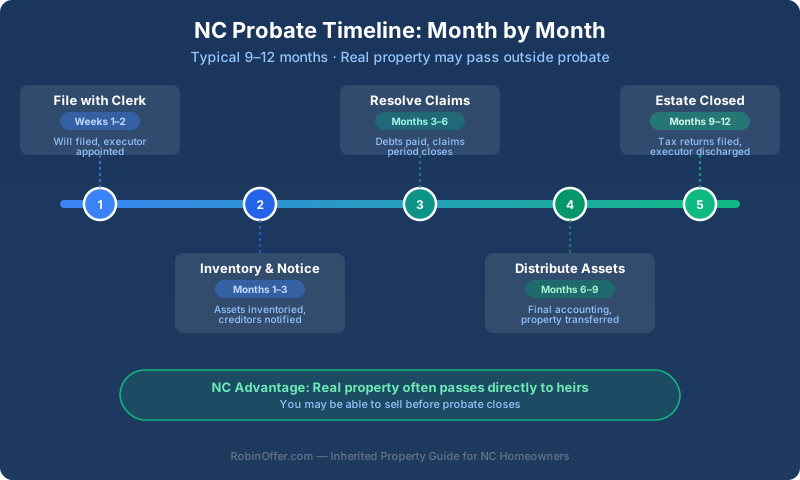
The first thing most heirs ask is how long all of this takes. For a typical NC estate: 9 to 12 months. Some straightforward estates wrap up in 6 months. Complicated ones, disputes, unclear wills, significant debts, can drag on for 18 months or more.
Here's what a typical timeline looks like:
| Timeframe | What Happens |
|---|---|
| Week 1–2 | File the will with Clerk of Superior Court. Apply for Letters Testamentary (with will) or Letters of Administration (no will). |
| Month 1 | Executor appointed. Estate bank account opened. Initial inventory of assets begins. Creditor notice published in local newspaper. |
| Months 1–3 | Full inventory filed with the Clerk. Property valuations obtained. Bills and ongoing expenses managed. Creditor claim period runs (minimum 3 months from notice). |
| Months 3–6 | Creditor claims resolved. Debts paid from estate funds. If real property needs to be sold to pay debts, court approval sought. Income tax returns prepared. |
| Months 6–9 | Final accounting prepared. Remaining assets distributed to beneficiaries. Deeds transferred if property is part of the estate. |
| Months 9–12 | Final estate tax returns filed (if applicable). Estate closed with the Clerk. Executor discharged. |
What Can Delay the Timeline
- Disputes among heirs, if siblings disagree about selling, this alone can add 6+ months
- Unclear or contested will, a will challenge can trigger a full court proceeding
- Title problems, liens, heirs' property complications (Chapter 7), or missing deeds
- Debts that exceed assets, insolvent estates require careful creditor prioritization
- Tax complications, federal estate tax issues (rare, only estates over $15M in 2026) or unreported income
- Out-of-state property, if the deceased owned property in another state, you'll need ancillary probate there too
Can You Sell Before Probate Is Finished?
This is one of the most common questions, and in NC, the answer is often yes.
Remember the NC difference from Chapter 2: if the real property passed directly to you as an heir (which is the default in NC), you may have the legal right to sell it even while probate is ongoing. You'll need:
- Clear title showing you as the owner (an attorney can help with this)
- Agreement from all co-heirs if there are multiple owners
- A real estate attorney to handle the closing
If the property is part of the probate estate (because the will directs a sale or debts require it), the executor needs either authority from the will or court approval to sell.
4. How Much Does It Cost? Probate Fees, Carrying Costs & Insurance Gaps
This is the chapter I wish someone had shown me before I learned it the hard way: an inherited house costs real money every single month you own it. The house isn't generating income (unless you rent it out, more on that in Chapter 8), but the bills keep coming. And they're bigger than most people expect. If delinquent county taxes are already part of the estate file, pair this chapter with our NC property tax lien timeline guide so heirs can prioritize legal deadlines.
NC Probate Costs
| Cost | Typical Amount | Notes |
|---|---|---|
| Court filing fees | $120–$200 | Varies by county |
| Probate administration fee | 0.4% of personal property value (max $6,000) | NC-specific; does NOT apply to real property that passes outside the estate |
| Attorney fees | $2,000–$5,000+ | Straightforward estate. Complex cases: $8,000–$15,000+ |
| Executor compensation | Up to 5% of estate receipts + 5% of disbursements | Family executors often waive this |
| Appraisal fee | $350–$500 | For property valuation (establishes step-up basis) |
| Title search | $200–$400 | To confirm clear title before sale |
Total probate costs for a typical NC estate: $3,000–$8,000. This comes out of the estate, not your personal funds.
Monthly Carrying Costs: The Silent Drain
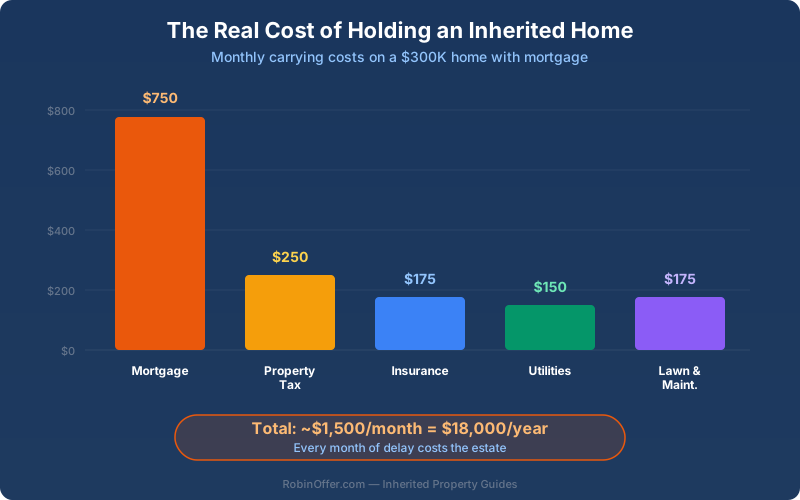
This is where the real money goes. Every month you hold the inherited property, you're paying for it, whether you live there or not.
| Expense | Monthly Estimate (on $300K NC home) | Annual |
|---|---|---|
| Property taxes | $175–$275 | $2,100–$3,300 |
| Homeowner's insurance | $150–$250 | $1,800–$3,000 |
| Utilities (electric, water, gas, even vacant) | $100–$200 | $1,200–$2,400 |
| Lawn care / exterior maintenance | $75–$150 | $900–$1,800 |
| HOA dues (if applicable) | $50–$300 | $600–$3,600 |
| Mortgage payment (if there's a remaining loan) | $1,200–$2,000+ | $14,400–$24,000+ |
| Unexpected repairs | $100–$300 (averaged) | $1,200–$3,600 |
That estimate is a starting point, not your number. Run your own mortgage, taxes, insurance and upkeep through our cost-of-waiting calculator to see what this specific house is costing.
The Insurance Gap Nobody Warns You About
This section could save you tens of thousands of dollars, so please read it carefully.
When the homeowner dies, their insurance policy doesn't automatically transfer to you. Most policies have specific provisions about:
- Change of ownership: The insurer needs to be notified. Some policies become void upon the owner's death unless the estate or heir updates the policy within a specified period.
- Vacancy: Most standard homeowner's policies exclude coverage, or sharply limit it, after the home has been vacant for 30 to 60 days. If the house sits empty during probate and something happens, you may not be covered.
- Named insured: Claims may be denied if the named insured is deceased and no one updated the policy.
What to do:
- Call the insurance company within the first week
- Ask about adding the estate or yourself as named insured
- If the home will be vacant for more than 30 days, ask about a vacant property endorsement or a standalone vacant-property policy (typically $1,000–$3,000/year)
- Document the property's condition with photos and video before leaving
Vacant Property Risks
An empty house deteriorates faster than you'd expect:
- Burst pipes, NC winters are cold enough. A single burst pipe in an unheated home can cause $10,000–$50,000 in water damage.
- Break-ins and vandalism, vacant homes are targets. Copper pipe theft is still common.
- HOA violations, unmowed grass, trash cans left out, or peeling paint can trigger fines that compound quickly.
- Municipal code enforcement, cities like Charlotte, Raleigh, and Greensboro have active code enforcement. Tall grass and overgrown vegetation can result in the city mowing the lawn and billing the estate $200–$500 per visit.
- Pest infestations, termites, rodents, and insects move in fast when a house sits empty.
- Hoarding conditions discovered at death, if the parent was a hoarder, the cleanout alone can cost $3,000–$40,000+ depending on severity — and the damage underneath is often worse. See our guide to selling a hoarder house for the full cost breakdown.
If you live out of state or can't check on the property regularly, consider hiring a property management company for short-term oversight. Expect to pay $100–$200/month for basic check-ins, lawn care coordination, and bill management.
What If the House Has a Mortgage?
If the deceased still had a mortgage, you have a few important protections and options:
The Garn-St. Germain Act (federal law) prevents the lender from calling the loan due when property transfers to a relative upon death. The bank cannot force you to pay off the mortgage immediately just because the owner died. This is a big deal.
Your options:
- Assume the mortgage, continue making the existing payments under the same terms. You don't need to qualify for a new loan.
- Refinance, replace the existing loan with a new one in your name. Makes sense if you plan to keep the property and rates are favorable.
- Sell the property, pay off the mortgage from the sale proceeds and keep the difference.
- Let the property go, if the mortgage balance exceeds the home's value (underwater), you are not personally liable for the difference unless you signed the promissory note. The lender's recourse is against the property, not you.
Important: keep making the mortgage payments (or arrange forbearance with the servicer) while you figure out your plan. Missed payments will trigger the foreclosure process, and that clock runs regardless of whether probate is still open.
What If the House Has a Reverse Mortgage?
A reverse mortgage is a completely different situation from a traditional mortgage, and it catches many heirs off guard. If the deceased had a reverse mortgage (common among homeowners 62+), the lender will send a "Due and Payable" notice within 30 days of the death. You typically have 6 months to act (with possible extensions to 12 months). Your options:
- Pay off the loan balance, from the estate or your own funds. You keep the house.
- Sell the property, use the proceeds to repay the loan. You keep the difference.
- Pay 95% of the appraised value, if the loan balance exceeds the home's value, you only owe 95% of the current appraised value (not the full balance). This is a key protection.
- Walk away, reverse mortgages are non-recourse loans. If you don't want the house, you can sign a deed in lieu of foreclosure. You owe nothing beyond the property itself.
Utility Transfers
The utility accounts are still in the deceased's name, but the bills keep coming. Contact each provider (electric, gas, water, internet, trash) within the first few weeks with a death certificate. You can either transfer service to your name, the estate's name, or keep it active while designating a responsible party. If the home will be vacant, ask about a minimum-use rate, some NC utilities offer reduced rates for unoccupied properties. Do not turn off water in winter (frozen pipes) or electricity if the home has a sump pump, security system, or refrigerator that needs to stay running.
Paying to maintain a home you didn't plan for?
Get a free, no-obligation cash offer on the property — any condition, no repairs or showings — before carrying costs eat into the estate.
5. Do You Pay Taxes on an Inherited House in NC?
This is the question that keeps heirs up at night, and the answer is better than you probably expect.
The Stepped-Up Basis: The Best Tax Rule You've Never Heard Of
When you inherit property, something very favorable happens to your tax basis. Instead of inheriting the deceased's original purchase price as your cost basis (which could be very low, they might have bought the house for $50,000 in 1985), your basis "steps up" to the fair market value on the date of death.
Let me show you why this matters so much:
| Scenario | Amount |
|---|---|
| Original purchase price (1985) | $50,000 |
| Fair market value at date of death (2026) | $325,000 |
| Your stepped-up basis | $325,000 |
| You sell for | $330,000 |
| Taxable capital gain | $5,000 |
Without the step-up, your capital gain would have been $280,000. With it, the gain is only $5,000. If you sell relatively soon after inheriting, you may owe little or no capital gains tax at all.
What If You Keep the Property for Years?
The stepped-up basis locks in at the date-of-death value. Any appreciation after that date is fully taxable when you eventually sell. If the house was worth $300,000 when you inherited it and you sell it ten years later for $400,000, you owe capital gains on $100,000.
Two things working in your favor:
- Inherited property automatically qualifies for long-term capital gains rates regardless of how long you hold it. Long-term rates (0%, 15%, or 20%) are lower than short-term rates.
- If you move in and live there as your primary residence for 2 of the 5 years before selling you can exclude up to $250,000 in gains ($500,000 for married couples) under the Section 121 exclusion, on top of the stepped-up basis.
If you're considering the "keep it" or "rent it" options (Chapter 8), factor in that the tax advantage diminishes the longer you hold the property.
North Carolina State Taxes on Inherited Property
- NC estate tax: None. North Carolina repealed its estate tax in 2013.
- NC inheritance tax: None. North Carolina does not have an inheritance tax.
- NC capital gains tax: Taxed as regular income at the flat NC rate of 3.99% (2026). This applies only to the gain above your stepped-up basis.
- Federal capital gains tax: 0%, 15%, or 20% depending on your income bracket. Most people fall in the 0% or 15% bracket. For the full breakdown of how all three tax layers stack on inherited property in NC, see our capital gains tax guide for NC home sellers.
Federal Estate Tax: Does It Apply to You?
Almost certainly not. The federal estate tax exemption for 2026 is $15 million per individual ($30 million for married couples). Unless the total estate (all assets, not just the house) exceeds that threshold, there is no federal estate tax. This exemption will be indexed for inflation in future years.
Revenue Stamps: NC's Transfer Tax
When you sell the inherited property, North Carolina charges Revenue Stamps (excise tax) at $1.00 per $500 of the sale price, effectively $2.00 per $1,000. On a $300,000 sale, that's $600. This is typically paid by the seller at closing.
Some NC counties also charge an additional land transfer tax (currently only Dare County and a few mountain communities). Check with a local real estate attorney.
6. Multiple Heirs & Disagreements: How to Handle It
If you're the only heir, skip ahead to Chapter 8. But if you inherited this property with siblings or other family members, read this carefully. I've seen families who were close their entire lives nearly stop speaking over an inherited house. The number-one thing that derails inherited property situations isn't probate or taxes or the market. It's family disagreements. And they almost always start because nobody had a direct conversation early enough.
How Co-Ownership Works
When multiple heirs inherit a property in NC, each person owns an undivided fractional interest. If three siblings inherit equally, each owns a one-third interest in the entire property, not a specific room or section of the house. This means:
- All owners must agree to sell the entire property. One person cannot unilaterally put the house on the market.
- Any co-owner can live in the property (but may owe the others "fair rental value" if only one person uses it).
- All co-owners are responsible for carrying costs, taxes, insurance, maintenance, in proportion to their ownership share.
- Any co-owner can sell or mortgage their own share, but who wants to buy one-third of a house? In practice, this rarely happens.
Common Disagreements and How to Resolve Them
"I want to sell, but my sibling wants to keep it."
This is the most common impasse. Options include:
- Buyout: The sibling who wants to keep the house buys out the other heirs at fair market value. Get an independent appraisal so everyone agrees on the number.
- Rent and share income: Rent the property out and split the income proportionally. This defers the sell/keep decision but requires agreement on a property manager and maintenance responsibilities.
- Mediation: A neutral mediator (typically $200–$400/hour, split among parties) can help families reach agreement without going to court. NC courts sometimes require mediation before allowing a partition action.
"We all want to sell, but we disagree on price, timing, or method."
Get two or three independent market valuations (CMAs from agents and/or a formal appraisal). Data defuses disagreements faster than arguments. Agree on a number range and a method (agent listing, cash sale, or FSBO) before you list.
When You Can't Agree: Partition Actions
If the family truly cannot reach agreement, any co-owner can file a partition action in NC Superior Court. There are two types:
- Partition in kind: The court physically divides the property among the owners (rare with houses, you can't split a house in two).
- Partition by sale: The court orders the property sold and divides the proceeds. This usually results in a below-market sale price because court-ordered sales attract investors looking for deals.
A partition action is expensive ($5,000–$15,000+ in legal fees) and slow (6–12 months). It should be a last resort. In almost every case, a negotiated buyout or mediated agreement produces a better outcome for everyone.
What the Court Actually Has to Decide (NC Gen. Stat. Chapter 46A)
Most articles stop at “a co-owner can force a sale.” That is only half true, and the other half is the part worth knowing if someone in your family is threatening one.
Partition in North Carolina is governed by Chapter 46A of the General Statutes. Three sections do the work:
- § 46A-21 establishes who may file: any cotenant, or the personal representative of a cotenant. This is the source of the rule that one heir out of five can start the process.
- § 46A-26 sets out the methods of partition — dividing the property itself, or selling it.
- § 46A-75 governs a sale in lieu of actual partition, and this is the one that matters most.
Actual division is the default. A sale is the exception. Under § 46A-75, a court may only order the property sold if it finds that dividing the property “cannot be made without substantial injury to any of the parties.” And the statute puts the burden on the person asking for the sale — they have to prove the substantial injury, not merely assert that selling would be simpler.
In deciding, the court weighs whether each co-owner’s share would be worth materially less divided than sold whole, whether division would materially harm anyone’s rights, and — the point almost nobody raises — whether a monetary adjustment could eliminate the injury instead. That adjustment is called owelty: where the land divides unevenly, the court can charge a payment against the more valuable share to even things up (§ 46A-51). Owelty is the reason “this house can’t be cut in half, so it must be sold” is not the automatic argument people assume it is.
The court also has to put its reasoning on the record: § 46A-75 requires specific findings of fact and conclusions of law supporting an order of sale.
What this means in practice. If a sibling is using “I’ll just force a sale” as leverage, the honest answer is: they can file, but they carry the burden, it costs them too, and the court has to be persuaded that no division and no owelty payment could work. That is usually enough to bring people back to a negotiated buyout — which is nearly always the better outcome anyway. If the property is heirs’ property, the additional UPHPA protections in Chapter 7 apply on top of everything here, including your right of first refusal.
This is general information about how the statute is written, not legal advice about your situation. Partition is one of the few areas where an hour with an NC real-estate attorney genuinely pays for itself.
If the property is in South Carolina instead, none of the above applies — SC partition sits under a different chapter with different standards. Start with selling an inherited property in South Carolina and how probate works in South Carolina.
How to Split the Proceeds
Once everyone agrees to sell, here's how the money actually gets divided:
- The closing attorney or title company distributes proceeds at closing
- Estate debts, attorney fees, and selling costs come out first
- If the property was part of the estate, the executor receives the proceeds into the estate account and distributes per the will or intestate law
- If the property passed directly to heirs (the NC default), each heir can receive their share as a separate check or wire transfer at the closing table
- Each heir reports their share of any capital gain on their own tax return, it's split proportionally
Get the split in writing before you list. A simple agreement signed by all heirs that says "each person receives X%" prevents arguments at the closing table.
7. Heirs' Property in NC: The Hidden Legal Risk
This chapter might not apply to you, and if it doesn't, that's great. But if the property has been in your family for more than one generation and was never formally transferred through a will or deed, please don't skip it. Heirs' property is one of the most common reasons inherited home sales fall apart in North Carolina, and the families it affects often have no idea there's a problem until they try to sell.
What Is Heirs' Property?
Heirs' property is land that has been passed down informally, without a will, without a deed transfer, and without going through probate, across one or more generations. The original owner died, and the family just… kept living there. Nobody went to court. Nobody updated the deed. And over time, the number of people with a legal ownership interest multiplied.
Here's how it happens: Grandma buys a house in 1960. She dies in 1990 without a will. Under intestate succession, her three children each inherit a one-third interest, but nobody records anything. One of those children dies in 2010, also without a will, passing their one-third interest to their three children. Now there are five owners. Fast forward to today, and there might be 8, 12, or even 20 people with fractional ownership interests in the same house, some of whom have never even seen the property.
Why It's a Crisis
Heirs' property creates serious problems:
- You can't sell it without the agreement (or court order) of every single co-owner
- You can't refinance it because no single person holds clear title
- You may not be able to insure it, some insurers won't write a policy without clear ownership
- You can't qualify for FEMA disaster assistance on it (this devastated families in western NC after Hurricane Helene)
- You can't use it as collateral for any loan
- Any co-owner can force a sale through a partition action, potentially selling the entire family property out from under everyone else
This issue disproportionately affects Black families in the Southeast. According to the USDA, heirs' property accounts for an estimated $28 billion in lost land equity among Black families in the South. NC State Extension estimates that 35%–50% of Black-owned land in the rural South is heirs' property.
NC Legal Protections
North Carolina adopted the Uniform Partition of Heirs Property Act (UPHPA) to provide protections when a co-owner files a partition action against heirs' property. Under the UPHPA:
- The court must order an appraisal to determine fair market value
- Co-owners who don't want to sell get a right of first refusal, a chance to buy out the petitioning owner at the appraised price
- If the property must be sold, the court must order an open-market sale (not a courthouse auction) to ensure fair price
- The court considers non-economic factors like sentimental value and long-term family connection to the land
How to Fix Heirs' Property
If you think the inherited property might be heirs' property, here's what to do:
- Get a title search to identify who is currently on the deed and trace the chain of ownership
- Identify all living heirs who may have a fractional interest
- Consult a real estate attorney experienced in heirs' property (not all are, ask specifically)
- File an affidavit of heirship or pursue a quiet title action to establish clear ownership
- Contact a legal aid organization that handles heirs' property: the NC Bar Foundation's Heir Property Pro Bono Project, Legal Aid of North Carolina, or NC A&T's Cooperative Extension heirs' property program
The cost to clear heirs' property title varies widely, from a few hundred dollars for a simple affidavit of heirship to $5,000–$10,000+ for a quiet title action. But it's far less expensive than losing the property altogether.
Dealing with heirs' property or unclear title in NC?
We work with inherited properties regularly and can make a cash offer once you're ready to sell — even before probate closes. No repairs, no showings, no obligation.
8. Your Options: Keep It, Sell It, or Rent It Out
You've done the hard work, probate, taxes, costs, potential complications. Now comes the question that's probably been in the back of your mind since Chapter 1: what do I actually do with this house?
There are three paths forward, and none of them is universally "right." The best choice depends on your finances, your timeline, and, honestly, how much bandwidth you have left.
Option 1: Keep It and Move In
When it makes sense:
- You need a home and the inherited property meets your needs
- The property is in good condition and in a location that works for your life
- You can afford the ongoing costs (taxes, insurance, maintenance, any remaining mortgage)
- Keeping the property has sentimental value worth the financial commitment
What to consider:
- You'll need to update the deed, insurance, and utility accounts into your name
- If there's a mortgage, you'll need to assume it or refinance
- Deferred maintenance may need immediate attention (roof, HVAC, plumbing)
- If there are multiple heirs, you'll need to buy them out or reach a formal agreement
Option 2: Rent It Out
When it makes sense:
- The property is in a desirable rental area
- Monthly rent would exceed your carrying costs by a meaningful margin
- You're prepared to be a landlord (or pay a property manager, typically 8%–10% of rent)
- You don't need the proceeds immediately
What to consider:
- Rental income is taxable. You'll owe federal and NC state income tax on net rental income.
- Landlord responsibilities are significant: tenant screening, maintenance, NC landlord-tenant law compliance, eviction procedures
- If you live far away, a property management company is almost essential
- You lose the stepped-up basis benefit if you hold the property for years and values appreciate, the capital gain when you eventually sell will be larger
Option 3: Sell the Property
When it makes sense:
- You don't want to be a homeowner or landlord for this property
- Carrying costs are draining estate funds or your personal finances
- Multiple heirs want to divide the proceeds
- The property needs repairs you can't or don't want to invest in
- You want to lock in the stepped-up basis tax advantage by selling while the gain is minimal
If selling is the right move, you have three methods: listing with an agent, selling for cash, or selling FSBO. We'll cover each in Chapters 9 and 10.
If the house is in the Charlotte metro, the numbers and timelines are specific enough that we broke them out separately, see sell an inherited house in Charlotte for a side-by-side of what each option actually nets you there.
A Decision Framework
Ask yourself these questions:
| Question | If Yes… |
|---|---|
| Do you live near the property? | Keep or rent are more practical |
| Do you live out of state? | Selling is usually simpler |
| Are there multiple heirs? | Selling and splitting proceeds avoids ongoing disputes |
| Does the property need major repairs? | Cash sale avoids repair investment |
| Do you need the money within 60 days? | Cash sale is the fastest option |
| Can you afford $1,500+/month in carrying costs? | If not, sooner sale protects the estate |
| Is the property in a strong rental market? | Renting can preserve the asset long-term |
What If There's a Tenant in the Property?
If the deceased was renting the property to a tenant, you inherit the lease agreement as the new landlord. The tenant's rights don't end because the owner died.
- An active lease must be honored until it expires. You step into the landlord's shoes with the same terms.
- A month-to-month tenancy can be ended with proper notice. NC requires 7 days' notice to terminate a month-to-month tenancy (or as specified in the lease).
- Send a "change of management" notice with your name and contact information so the tenant knows who to reach.
- Account for the security deposit, it transfers with the property. You're now responsible for returning it per NC landlord-tenant law.
- If you plan to sell you can sell with the tenant in place (investor buyers often prefer this) or wait for the lease to expire. Offering a cash incentive for the tenant to vacate early ("cash for keys") is faster and cheaper than eviction. For the full breakdown of all five selling paths, NC law, and net-proceeds math, see our guide to selling rental property with tenants in NC.
HOA Transfers and Fees
If the property is in an HOA community, contact the HOA immediately. You'll need to:
- Submit a change-of-ownership form with a death certificate
- Pay any transfer fee ($100 to several hundred dollars, check the HOA docs)
- Resolve any outstanding violations or fines that accumulated during the transition. If the lawn went unmowed or trash cans stayed out, fines may have been accruing.
- Confirm whether the HOA has rental restrictions if you're considering renting the property
Unpaid HOA dues create a lien against the property that must be cleared before any sale can close.
Get Your Free, No-Obligation Cash Offer
Tell us about the inherited property and we'll send a real cash offer — any condition, no repairs or showings, and you close on your timeline. Free and confidential.
9. How to Sell an Inherited House in NC Step by Step
So you've decided to sell. Good, that's the hardest part, just making the call. The process in North Carolina has a few extra steps compared to a normal home sale, but nothing you can't handle.
Step 1: Establish Your Legal Authority to Sell
Before you can sell, you need to prove you have the right to do so. In NC, this depends on your situation:
- Property passed directly to you (most common): You'll need documentation showing you're the rightful heir, typically an affidavit of heirship, a recorded deed, or Letters Testamentary plus the will. A real estate attorney will advise on what's needed for a clean closing.
- Property is part of the probate estate: The executor needs authority from the will or a court order to sell. Obtain Letters Testamentary from the Clerk of Superior Court.
- Multiple heirs: All co-owners must agree to sell and sign the listing agreement and deed at closing. Get written agreement from everyone before investing time or money in the sale process.
Step 2: Get a Property Valuation
You need to know what the property is worth for two reasons: (1) to price it for sale, and (2) to establish your stepped-up basis for tax purposes.
- Formal appraisal: $350–$500. Most reliable. Required if there are disputes among heirs or if the IRS questions the basis.
- Comparative market analysis (CMA): Free from a real estate agent. Good for pricing but may not hold up for tax purposes.
- Cash offer: A legitimate cash buyer will provide a free property evaluation. Useful for comparison even if you list traditionally.
Step 3: Clear Title Issues
Inherited property often has title complications that don't exist with a normal sale:
- Unpaid property taxes or liens against the deceased
- Unrecorded deeds or missing chain of title
- Heirs' property issues (Chapter 7)
- Judgments or mechanics' liens
A title search ($200–$400) will reveal any issues. Budget time and money to resolve them before listing. A real estate attorney is essential here, don't try to DIY title work on inherited property.
Step 4: Choose Your Selling Method
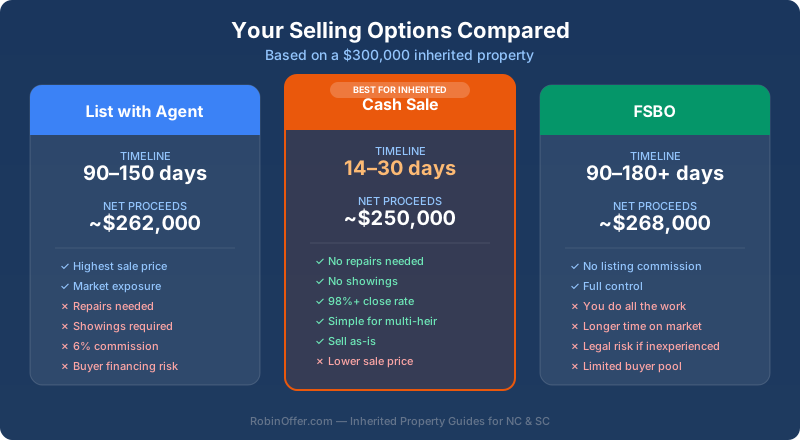
| Method | Timeline | Typical Net Proceeds ($300K home) | Best For |
|---|---|---|---|
| List with agent | 90–150 days | ~$262,000 (after 6% commission + closing costs) | Property in good condition, no time pressure |
| Cash sale | 14–30 days | ~$240,000–$260,000 | As-is condition, fast closing, multiple heirs |
| FSBO | 90–180+ days | ~$268,000 (if you avoid buyer's agent commission too) | Experienced sellers willing to invest significant time |
For inherited property specifically, there's a strong argument for at least getting a cash offer even if you plan to list, it gives you a baseline number and a backup option if the listing takes longer than expected and carrying costs mount. If you're listing traditionally and timing matters, see our guide on the best time to sell in the Carolinas. If the inherited property is in the Triangle, particularly in Apex, where values are around $584K and the Veridea development is reshaping west-side pricing, our Apex homeowner selling guide walks through every option with local net-proceeds math.
Step 5: Prepare the Property
If listing traditionally:
- Remove personal belongings (estate sale or donation, see Chapter 1)
- Deep clean the entire house
- Handle any repairs that would scare off buyers (roof leaks, HVAC issues, water damage)
- Consider basic staging if the home is empty
If selling for cash, most buyers will purchase as-is, you can skip repairs and even leave furniture behind in many cases.
Step 6: NC-Specific Closing Requirements for Inherited Property
At closing, be prepared for:
- NC Residential Property Disclosure Statement: Estates are exempt from the standard seller disclosure in most cases (since the heir may not have lived in the property). You'll check the "exempt" box, but still must disclose any known material defects.
- Revenue Stamps: $1.00 per $500 of sale price ($600 on a $300K sale).
- Deed type: The executor or heir will typically provide a Special Warranty Deed or Executor's Deed rather than a General Warranty Deed.
- Title insurance: The buyer's lender will require it. As the seller, you may need to provide an owner's title policy. Budget $1,000–$2,500.
- Attorney closing: NC is an attorney-close state, a licensed attorney must supervise every real estate closing. Budget $500–$800 for the seller's attorney.
10. How to Sell an Inherited House Fast in North Carolina
If you're reading this chapter, you're probably in one of two situations: either the carrying costs are eating you alive, or you've got multiple heirs who just want this done. Either way, a cash sale deserves serious consideration, not because it's always the best financial outcome, but because for inherited property specifically, it solves problems that a traditional listing can't.
Why Inherited Property and Cash Sales Are a Natural Fit
- As-is condition: Inherited homes often need updates or repairs that the heir doesn't want to invest in. Cash buyers purchase the property in its current condition, no repairs, no staging, no showings.
- Speed stops the bleeding: At $1,500–$1,750/month in carrying costs, every month matters. A cash sale in 14–30 days saves $1,500–$5,000+ compared to a 4–5 month traditional listing process.
- Simplifies multi-heir situations: Instead of coordinating multiple heirs through months of showings and negotiations, a cash offer gives everyone one number to agree on and a fast resolution.
- Out-of-state heirs: If you don't live near the property, managing showings, repairs, and agent communications from a distance is difficult. A cash sale minimizes coordination.
- Certainty of close: Cash deals close at 98%+ rates vs. ~85% for financed deals. No appraisal contingencies, no buyer mortgage falling through at the last minute.
Cash Sale vs. Traditional Listing: Side by Side
| Factor | List with Agent | Sell for Cash |
|---|---|---|
| Timeline to close | 90–150 days | 14–30 days |
| Repairs needed | Yes, typically $5K–$20K | None (as-is) |
| Showings | 10–30+ showings | One visit or none |
| Out-of-state seller friendly | Difficult to manage | Very manageable |
| Multiple heirs | All must agree on agent, price, repairs, showings | One offer, one decision |
| Carrying costs during sale | $4,500–$11,250+ (3–7.5 months) | $750–$2,625 (0.5–1.5 months) |
| Agent commission | 5%–6% ($15K–$18K on $300K) | $0 |
| Certainty of close | ~85% (deals fall through) | ~98%+ (no financing contingency) |
How to Get a Fair Cash Offer
Not all cash buyers are the same. To make sure you're getting a fair deal:
- Get multiple offers. Request cash offers from at least 2–3 different buyers. This gives you comparison points and negotiating leverage.
- Ask how they arrived at the number. A legitimate buyer will explain their valuation, comparable sales, estimated repair costs, and their margin. If they can't explain it, walk away.
- Watch for red flags: Pressure to sign immediately, non-refundable deposits they ask YOU to pay, assignment clauses (they're a wholesaler, not a buyer), and offers that seem too good to be true.
- Read the contract carefully. Have a real estate attorney review any purchase agreement before signing. This costs $200–$400 and is money well spent.
- Verify proof of funds. A legitimate cash buyer will provide a bank statement or letter from their bank showing they have the money. Ask for it.
For more on identifying legitimate cash buyers and avoiding scams, see our complete Cash Offer Guide for the Carolinas.
Selling an inherited house that still has a mortgage
Inheriting a house does not mean inheriting a paid-off house. If there is still a loan against the property, you have three practical paths, and none of them require you to keep making payments on a home you did not plan for.
First, the reassuring part. The federal Garn-St. Germain Act stops a lender from calling the full balance due simply because the property passed to an heir. You are not personally on the hook for the deceased's mortgage unless you signed the note yourself; the debt is secured by the house, not by you. That gives you room to decide without a bank forcing the timeline.
Your options, in plain terms:
- Sell and pay the loan off at closing. This is the most common choice. The outstanding balance is paid directly from the sale proceeds, and whatever equity is left is distributed to the heirs. Because inherited property gets a stepped-up basis, the capital gains owed on that equity is usually small if you sell soon after inheriting.
- Assume the existing loan. If the rate is better than today's and you want to keep the home, Garn-St. Germain generally lets an heir take over the existing mortgage rather than refinance.
- Refinance into your own name. If you want to keep the property and buy out other heirs, a refinance can free up the cash to do it.
The math that matters is simple: compare the mortgage payoff (principal, any past-due amount, and per-day interest) against a realistic sale price. If there is meaningful equity, a sale, whether on the open market or to a cash buyer, clears the loan and puts the remainder in the family's hands. If the payoff is close to or above the home's value, talk to the servicer and an attorney before doing anything, because a short sale or another option may be involved. A cash sale can help here because it can close before more interest, taxes, or deferred maintenance eat into the equity. See our cash offer guide for the Carolinas for the full trade-off.
Do all heirs have to agree to sell property in NC?
To sell the entire property in one clean transaction, yes: in North Carolina every co-owner on title has to sign off. If the heirs cannot reach agreement, any single co-owner can file a partition action, and the court can order the property sold and the proceeds divided. The NC Uniform Partition of Heirs Property Act adds protections for family land, including a right for the other heirs to buy out the person who wants to sell before any forced sale. Getting everyone aligned early, in writing, almost always nets more than a court-ordered sale.
Selling an inherited house in Charlotte, Greensboro, and Wilmington
Probate in North Carolina runs through the Clerk of Superior Court in the county where the person lived, so the exact office and the local market change with the city even though the state law behind them is the same everywhere.
Charlotte (Mecklenburg County)
Estates are filed with the Mecklenburg County Clerk of Superior Court in uptown Charlotte. Because the Charlotte metro moves quickly and carrying costs (taxes, insurance, HOA dues) add up fast on a vacant home, many out-of-town heirs choose to sell rather than hold. We broke the Charlotte numbers out separately: see selling an inherited house in Charlotte from out of state for a side-by-side of what each option nets.
Greensboro (Guilford County)
Guilford County estates are filed in Greensboro, with a second courthouse in High Point. Triad price points sit below Charlotte's, so the gap between a cash offer and a fully marketed listing is often smaller in dollar terms, which makes the speed-versus-price trade-off worth running carefully, especially if the inherited house still carries a mortgage.
Wilmington (New Hanover County)
New Hanover County estates are filed with the Clerk of Superior Court in Wilmington. Coastal inherited homes come with their own wrinkles, including higher windstorm and flood insurance and, for a second home rather than a primary residence, no capital gains exclusion on the sale, so build those carrying costs into any keep-versus-sell decision.
Want a cash offer on the inherited property?
No repairs, no showings, no waiting for a buyer's mortgage. In NC, you may be able to sell before probate closes — see what a cash offer looks like.
11. Common Mistakes That Cost NC Heirs Thousands
After working with dozens of families going through this, I keep seeing the same mistakes. Every one of them is avoidable, and every one of them costs real money that should have stayed in the family.
- Letting the insurance lapse. One uninsured incident, a fire, a burst pipe, storm damage, can cost the estate more than the property is worth. Keep coverage active from day one. (See Chapter 4.)
- Not getting an appraisal to establish the stepped-up basis. If you sell years later and can't document what the property was worth at the date of death, the IRS may use a lower figure, and you'll owe more in capital gains tax. The $350–$500 appraisal pays for itself many times over. (See Chapter 5.)
- Waiting too long to decide. At $1,500–$1,750/month in carrying costs on a $300K home, six months of indecision costs $9,000–$10,500. That money comes directly out of the inheritance. Set a deadline for a decision, 60 to 90 days after the funeral is reasonable.
- Not communicating with co-heirs early. The longer disagreements fester, the harder they are to resolve. Have an honest conversation about everyone's preferences early. If needed, bring in a mediator before positions harden. (See Chapter 6.)
- Signing contracts with the first person who calls. Investors monitor obituaries and probate filings. They're counting on you being overwhelmed and making a fast decision. Get multiple offers and have an attorney review any contract. (See Chapter 10.)
- Ignoring the mortgage. If the deceased had a mortgage, payments still need to be made. Missing payments triggers foreclosure proceedings regardless of probate status. Call the servicer, explain the situation, and arrange either continued payments or forbearance. (See Chapter 4.)
- Trying to clear title yourself. Heirs' property, missing deeds, and undischarged liens are complex legal issues. A real estate attorney experienced with inherited property will resolve these faster and more reliably than DIY efforts. (See Chapter 7.)
- Spending money on major renovations before selling. Unless the property is in such poor condition that it's unsellable, major renovations rarely return their full cost on an inherited property sale. A cash buyer purchases as-is. If listing traditionally, focus on cosmetic improvements only, paint, cleaning, basic curb appeal.
- Forgetting about the property's ongoing obligations. HOA dues, property taxes, utility bills, and lawn maintenance don't stop because the owner died. Set up automatic payments or designate someone to manage bills from day one.
- Not taking advantage of free resources. NC Legal Aid offers free legal assistance for qualifying residents. The NC Bar Association's Lawyer Referral Service provides initial consultations for $50. Many probate attorneys offer free initial consultations. Use them.
12. FAQ: Inherited Property in North Carolina
Do I have to go through probate to sell an inherited house in NC?
Not always. In North Carolina, real property often passes directly to heirs without going through the probate estate. If the property passed to you directly (the most common scenario when there's no will directing a sale and the estate can cover its debts), you may be able to sell without waiting for probate. Consult a NC probate attorney to confirm your specific situation.
How long does probate take in North Carolina?
Typically 9 to 12 months for a straightforward estate. The minimum creditor claim period is 3 months. Complex estates with disputes, contested wills, or significant debts can take 18 months or longer. See Chapter 3 for a month-by-month timeline.
Do you have to pay capital gains tax on inherited property in NC?
You may owe very little or nothing, thanks to the stepped-up basis. Your cost basis resets to the fair market value at the date of death. If you sell soon after inheriting, the taxable gain is minimal. NC has no estate or inheritance tax. See Chapter 5 for the full tax picture.
What is the stepped-up basis for inherited property?
When you inherit property, your cost basis "steps up" to the fair market value on the date the person died. If they bought the house for $80,000 and it was worth $300,000 when they passed, your basis is $300,000. If you sell for $305,000, you only owe capital gains tax on the $5,000 gain. Get an appraisal soon after the death to document this value.
Can one heir sell an inherited property without the other heirs' consent in NC?
No. All co-owners must agree to sell the entire property. If heirs can't agree, any co-owner can file a partition action in court, but this is expensive, slow, and usually results in a below-market sale. Mediation is almost always a better path. See Chapter 6.
What happens if you inherit a house with a mortgage in NC?
The federal Garn-St. Germain Act prevents lenders from calling the loan due when property transfers to an heir. You can assume the existing mortgage, refinance, or sell and pay off the balance from proceeds. You are NOT personally liable for the mortgage debt unless you signed the note. Keep making payments to avoid foreclosure while you decide. See Chapter 4.
What is heirs' property in North Carolina?
Heirs' property is land passed down without a will or formal title transfer, often across multiple generations. Each heir owns a fractional interest, creating unclear title that blocks sales, refinancing, and insurance. NC adopted the Uniform Partition of Heirs Property Act to protect against forced sales. See Chapter 7 for how to identify and resolve it.
How do I transfer inherited property into my name in NC?
It depends on how the property was held. If the property passed outside probate (common in NC), you may need an affidavit of heirship, an executor's deed, or a court order. A real estate attorney can prepare and record the appropriate deed with the county Register of Deeds. Expect $500–$1,500 for the legal work.
Can I sell an inherited house before probate is finished in NC?
Often yes. If the real property passed directly to you as an heir (the NC default), you can sell once you have clear title and all co-heirs agree. If the property is part of the probate estate, the executor needs authority from the will or court approval. See Chapter 3.
What happens if someone dies without a will in North Carolina?
NC intestate succession laws determine who inherits. The spouse typically receives the first $60,000 of personal property plus a portion of the estate; children share the remainder. Real property follows similar distribution rules. The Clerk of Superior Court appoints an administrator to handle the estate. See Chapter 2 for the full breakdown.
Ready to Take the Next Step?
Get a free, no-obligation cash offer on the inherited property — any condition, no repairs or showings, and close on your timeline. No pressure.
13. Planning Ahead: Making It Easier for Your Family
If you're reading this guide because you're thinking about your own situation, not because you've inherited, but because you want to make sure your family doesn't go through what this guide describes, this chapter is for you. Every problem in this guide is preventable with a few hours of planning.
Get a Will, and Tell Someone Where It Is
A straightforward will costs $300–$1,000 with an NC attorney. Without one, your family deals with intestate succession (Chapter 2), which may not match your wishes and is almost always slower and more expensive to administer. Store the original where your executor can find it: with your attorney, in a fireproof safe (make sure someone else has the combination), or pre-filed with the Clerk of Superior Court in your county.
Consider a Transfer on Death Deed
North Carolina adopted the Uniform Real Property Transfer on Death Act, which allows you to name a beneficiary on your property deed. At your death, the property transfers directly to that person, no probate, no court involvement. You can change or revoke the deed at any time during your lifetime. It doesn't affect your ownership rights while you're alive, and the beneficiary doesn't need to know about it or consent.
A TOD deed is simpler and cheaper than a trust for the specific goal of transferring a single property. An NC real estate attorney can prepare one for $200–$500.
Joint Ownership with Right of Survivorship
If you add a spouse or child to your deed as a joint tenant with right of survivorship (JTWROS), the property passes automatically at death with just a death certificate, no probate needed. This is simple and effective, but has real downsides: the co-owner's creditors can put a lien on the property, adding a non-spouse creates a taxable gift, and you can't undo it without the other person's consent. Talk to an attorney before going this route.
Living Trusts
A revocable living trust lets you transfer the property into the trust during your lifetime. At your death, the successor trustee distributes it to your beneficiaries without probate. Cost: $1,500–$4,000 to set up with an attorney. The most common mistake is creating the trust but never transferring the property deed into it, the trust only works if it's properly "funded." In NC, where real property often passes outside probate anyway, a trust is less critical for the house itself but valuable if you own property in multiple states or have complex distribution wishes.
Create a "Life File"
The single most practical thing you can do is organize your important documents in one place. Your family will need:
- Your will and any trust documents
- Property deed and mortgage information
- Homeowner's insurance policy
- Life insurance policies
- Bank and investment account information
- Vehicle titles
- A list of recurring bills and auto-pay arrangements
- Digital account passwords (or a reference to your password manager)
- Your attorney's name and contact information
- Your CPA or financial advisor's contact
Put it in a clearly labeled folder or binder, and tell at least two people where it is. This one step eliminates hours of frantic searching during the worst week of your family's life.
Have the Conversation
Every chapter in this guide about family disagreements (Chapter 6), heirs' property (Chapter 7), and costly mistakes (Chapter 11) traces back to one thing: nobody talked about it while they had the chance. Tell your family what you want to happen with the house. If the split is unequal, explain why. Name your executor and make sure they know what's expected. These conversations are uncomfortable, but they prevent the kind of fights that fracture families.
Keep Everything Current
Make sure property taxes and HOA dues are paid up. Keep the homeowner's insurance active and verify the coverage amount still reflects the property's value. If you have a mortgage, make sure your heirs know who the servicer is and where the statements are. Small loose ends become expensive problems when no one is there to handle them.
14. Your Next Step
You made it through the entire guide. That means you now know more about inheriting property in North Carolina than most attorneys would explain in a first consultation, and certainly more than anyone who's trying to buy the house from you is going to tell you.
Here's a quick recap of the three most common paths:
- If the house is in good condition and you can afford the carrying costs, keep it or rent it out, and take time to make the best long-term decision.
- If you want to sell but the house needs work or you have time to wait, list with a local agent to maximize your sale price.
- If you want a fast resolution, especially with multiple heirs, an out-of-state property, or a house that needs repairs, get a cash offer. You can close in as little as 14 days, sell as-is, and split the proceeds cleanly.
Whatever you decide, the worst option is doing nothing while carrying costs drain the inheritance at $1,500+ per month.
If you'd like to know what the property is worth, or just want to talk through your options with someone who has handled dozens of inherited property situations in North Carolina, we're here. No pressure, no obligation, and no one is going to try to trick you into signing something.
Get your free property evaluation and see where you stand.