
Selling a Fire-Damaged House in the Carolinas
Insurance proceeds, NC & SC disclosure rules, rebuild-vs-sell math, contractor vetting, and the tax moves that protect your equity.
Selling a fire-damaged house in North Carolina or South Carolina requires three steps: settle the insurance claim (average payout: $83,991), disclose the fire under NC Chapter 47E or SC Title 27, and choose between rebuilding, selling as-is, or demolishing. This guide covers all three paths.
If your house was recently damaged by fire and you're also dealing with an open insurance claim, our guide to selling a house as-is in NC covers the broader disclosure obligations and pricing strategies that apply to your situation. And if a cash offer is one of the paths you're weighing, our cash offer guide for the Carolinas breaks down how to evaluate what's fair.
For homeowners whose fire happened while they were already in financial distress — behind on payments, facing foreclosure — the SC foreclosure help guide and NC property tax lien timeline walk through the specific legal steps and deadlines that may be running alongside your fire recovery.
1. Your House Just Burned. Here's What Happens to Your Mortgage.
The fire marshal's truck has barely left. The insurance adjuster hasn't called yet. And the first thought in your head — after the shock — is probably: Do I still owe the bank?
Yes. The mortgage doesn't burn with the house.
Your lender's collateral just lost most or all of its value, and they know it. Here's what happens next, step by step, because nobody explains this part clearly and it drives every financial decision you'll make in the next six months.
The insurance check is not yours to spend
If you have a mortgage, your homeowner's insurance policy names both you and the lender on every claim check. That's not optional — it's a standard clause in virtually every mortgage contract in America. When the insurer writes a check for $180,000 in structural damage, that check is payable to "Jane Smith AND ABC Mortgage Company."
Your lender will endorse the check, deposit the funds into a loss-draft escrow account they control, and release money to you in stages as you rebuild. The typical release schedule looks like this:
| Stage | Amount Released | What the Lender Requires |
|---|---|---|
| Upfront | ~33% of the claim | Signed contractor agreement, building permits pulled |
| 50% completion | ~33% of the claim | Lender-ordered inspection confirming halfway done |
| 100% completion | Final ~33% | Final inspection, certificate of occupancy, lien waivers from contractors |
That's the theory. In practice, every lender's loss-draft department works differently, inspections get delayed, and the release can take weeks at each stage. Meanwhile, your contractor wants progress payments. You're living somewhere else and paying for it. And the mortgage on the burned house is still due on the first of the month.
What if you don't rebuild?
If you decide not to rebuild — and for a lot of homeowners, that's the right call — the lender has a decision to make. The insurance proceeds are supposed to restore their collateral. If you're not restoring it, the lender can apply the proceeds directly to the outstanding mortgage balance.
This is where the math gets ugly:
| Scenario | What Happens |
|---|---|
| Insurance payout > mortgage balance | Lender pays off the mortgage from the proceeds. You keep the difference. |
| Insurance payout = mortgage balance | Mortgage is paid off. You walk away with nothing from the insurance but no debt. |
| Insurance payout < mortgage balance | Lender takes the entire payout. You still owe the shortfall — on a house that no longer exists. |
That third scenario is more common than you'd think, especially for homeowners who were underinsured. According to the Insurance Information Institute, roughly two-thirds of American homes are underinsured by an average of 27%. If you bought your policy five years ago and construction costs have risen 30% since then, you may have a six-figure gap between what the insurer pays and what it costs to rebuild.
2. The Insurance Claim: A Homeowner's Field Guide
Before you can sell, rebuild, or walk away, you need to understand what your insurance will actually cover — and how long it takes to find out. The claim process after a house fire follows a predictable sequence, even if it never feels predictable when you're living it.
The timeline nobody shows you
| Step | What Happens | Typical Timeline |
|---|---|---|
| 1. File the claim | Call your insurer within 24 hours. They assign a claims adjuster. | Day 1 |
| 2. Fire marshal investigation | Local fire department determines cause — accidental, electrical, weather, or suspicious. Your insurer waits for this report before proceeding. | Days 1–14 |
| 3. Adjuster inspection | The insurer's adjuster walks the property, photographs everything, and creates a "scope of loss" document listing every damaged item. | Days 7–21 |
| 4. Scope of loss review | The adjuster's report becomes a line-item estimate. This is the number the insurer wants to pay. It is almost always lower than what it actually costs to fix. | Days 14–30 |
| 5. Negotiation | You (or your public adjuster) challenge low estimates, add missed items, and negotiate. This is where the real money is won or lost. | Days 30–90+ |
| 6. Payment | Once agreed, the insurer writes the check — payable to you AND your lender. | Days 45–120+ |
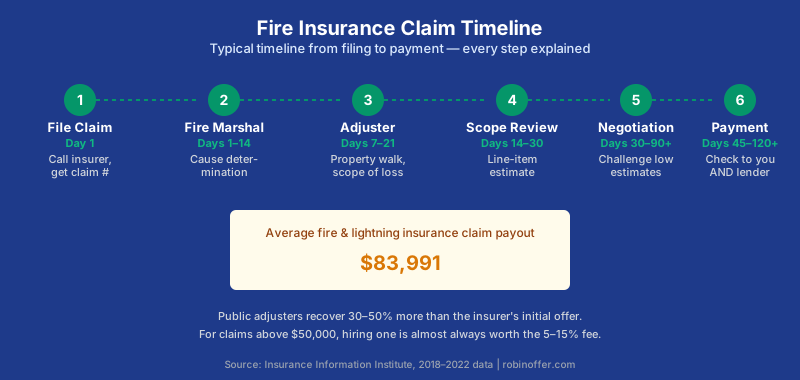
The national average fire and lightning insurance claim pays out $83,991, according to Insurance Information Institute data covering 2018–2022. That's five to six times the average homeowner's claim across all types. Fire claims are rare — roughly 1 in 430 homes file one in any given year — but when they happen, they're catastrophic.
Can you sell while the claim is still open?
Yes. There is no law in North Carolina or South Carolina that prevents you from selling a property with an open insurance claim. The claim follows the policy, not the property — so if you sell the house, you still own the claim unless you explicitly assign your rights to the buyer.
This matters because the most common path for selling a fire-damaged house involves settling the claim first, pocketing the insurance proceeds, and then selling the damaged property as-is. The buyer gets the house at a fire-damage discount. You get the insurance money plus the sale price. As long as the total exceeds your mortgage payoff, you walk away whole.
3. The Real Cost of Rebuilding vs. the Real Cost of Selling
This is the calculation that should drive your decision, and most people get it wrong because they only look at one side of the ledger.
What fire damage restoration actually costs
The national average for fire damage restoration is $27,477, with most projects falling between $3,083 and $52,031, according to Angi's 2026 data. But those numbers mask enormous variation by damage type:
| Damage Level | What It Looks Like | Restoration Cost Range | Per Sq Ft |
|---|---|---|---|
| Smoke/soot only | Contained kitchen fire, no structural damage, discoloration and odor | $3,000–$15,000 | $3.50–$7.00 |
| Moderate (partial structural) | One room gutted, adjacent rooms with smoke/water damage, some framing compromised | $15,000–$50,000 | $4.25–$6.50 |
| Severe (multi-room structural) | Multiple rooms destroyed, roof or floor joists compromised, extensive water damage from firefighting | $50,000–$100,000+ | $6.50–$20.00+ |
| Total loss | Structure is unsalvageable, demolition required, rebuild from slab or foundation | $100,000–$300,000+ | Full rebuild cost |
What most homeowners miss: the water damage from firefighting hoses often costs as much as the fire damage itself. A fire department can pump 1,000+ gallons per minute into a residential structure. That water saturates framing, subfloor, insulation, and drywall — and if it isn't extracted and dried within 48–72 hours, mold colonizes. Mold remediation alone runs $1,500–$9,000 for a typical residential job, and it has to happen before any reconstruction begins.
The hidden costs of rebuilding
Restoration cost is just the construction number. Here's what it actually costs to rebuild when you add everything up:
| Cost Category | Typical Range | Notes |
|---|---|---|
| Restoration / reconstruction | $15,000–$100,000+ | The construction work itself |
| Temporary housing | $1,500–$3,500/month | Covered by ALE (Additional Living Expenses) in most policies, but capped |
| Mortgage payments during rebuild | $1,000–$2,500/month | Still due every month, on a house you can't live in |
| Property taxes during rebuild | $150–$400/month | Still assessed on the pre-fire value in most jurisdictions |
| Insurance deductible | $1,000–$5,000 | Your out-of-pocket before coverage kicks in |
| Code upgrades | $5,000–$25,000 | If rebuilding triggers current code compliance — older homes hit hardest |
| Permit fees | $500–$3,000 | Varies by county; Mecklenburg County charges based on project value |
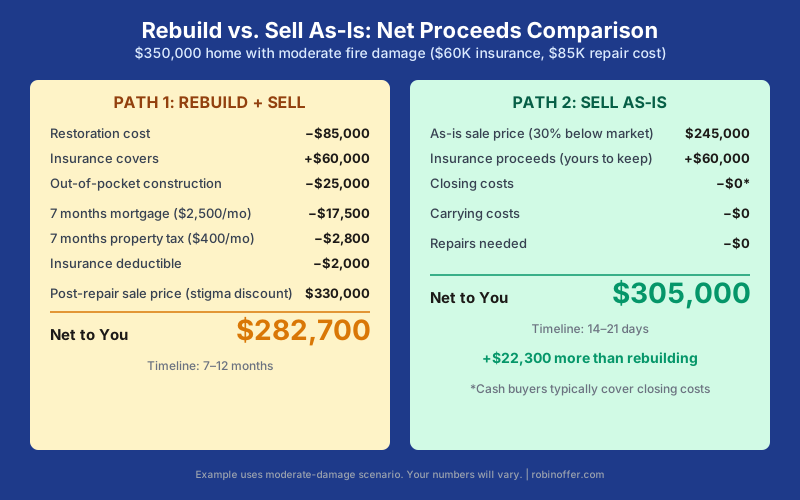
For a moderate fire in a $350,000 Charlotte-area home, the all-in rebuild cost including six months of carrying costs can easily reach $80,000–$120,000. If your insurance covers $70,000 of the construction, you're still out $30,000–$50,000 in carrying costs, deductibles, and code upgrades that insurance typically doesn't cover.
What a fire-damaged home sells for
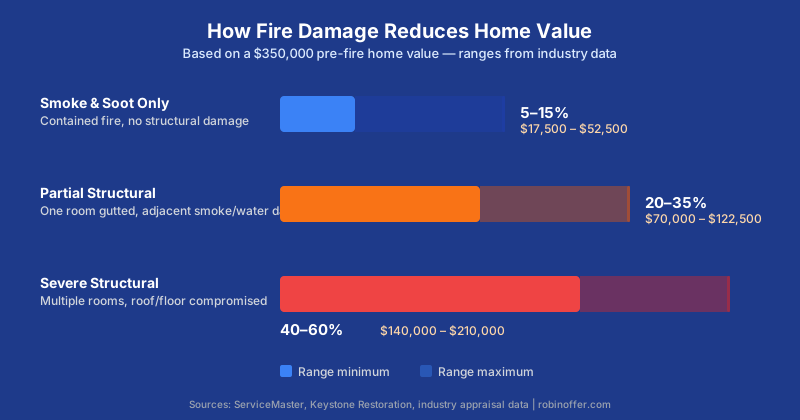
On the other side of the ledger: selling as-is. Fire damage reduces a home's value by a predictable range depending on severity:
| Damage Type | Typical Price Reduction | What Drives the Discount |
|---|---|---|
| Smoke/soot only (cosmetic) | 5–15% below market value | Lingering odor, discoloration, buyer perception |
| Partial structural damage | 20–35% below market value | Unknown scope of hidden damage, repair uncertainty |
| Severe structural damage | 40–60% below market value | Major reconstruction required, limited buyer pool |
Want to see the as-is number for your fire-damaged home?
Tell us about your property and we'll send you a real, no-obligation cash offer — any condition, close on your timeline.
4. NC vs. SC: What You Must Disclose About Fire Damage
Both Carolinas require sellers to disclose known defects — including fire damage — but the rules work differently. Getting this wrong doesn't just cost you a lawsuit. It can unwind the entire sale.
North Carolina disclosure rules
North Carolina's Residential Property Disclosure Act (NCGS Chapter 47E) requires every seller of a 1–4 unit residential property to complete the Residential Property and Owners' Association Disclosure Statement (RPOADS) and deliver it to the buyer before or at the time of the offer.
The form doesn't have a checkbox that says "fire damage." But fire damage triggers disclosures in multiple categories:
| Disclosure Category | Fire-Related Questions | What You Must Report |
|---|---|---|
| Structural | Foundation, walls, floors, roof condition | Any structural damage from the fire, even if repaired |
| Systems | HVAC, plumbing, electrical functionality | Heat damage to wiring, ductwork, plumbing |
| Water | Evidence of water damage | Water damage from firefighting (a category most sellers forget) |
| Environmental | Asbestos, hazardous materials | Smoke/soot contamination, exposed asbestos from pre-1980 construction disturbed by fire |
| Additions/Permits | Unpermitted work | Any post-fire repairs done without building permits |
For each question, sellers have three options: Yes (disclosing a known issue), No (stating no knowledge), or No Representation (making no claim either way). The "No Representation" option reduces your exposure but does not eliminate it. If you have actual knowledge of fire damage and mark "No Representation" to conceal it, that's fraud under NC law — and the buyer can sue for actual damages, attorney fees, and potentially rescission of the sale.
South Carolina disclosure rules
South Carolina's Residential Property Condition Disclosure Act (SC Code Title 27, Chapter 50) uses an "actual knowledge" standard. You must disclose what you genuinely know about the property's condition — but unlike NC, SC law imposes no affirmative duty to investigate. You don't have to go looking for problems you don't know about.
The SC disclosure covers nine categories, with fire damage falling under structural components (roof, chimneys, floors, foundation) and environmental hazards (asbestos, hazardous materials). Like NC, there is no specific "fire damage" checkbox, but a seller who knows about fire damage and omits it is liable for actual damages, court costs, and reasonable attorney fees under §27-50-70.
SC sellers also have a continuing duty to update the disclosure if they learn of new defects after the statement is delivered but before closing (§27-50-40(C)). If your insurance adjuster discovers additional damage during the claim process, you're obligated to amend the disclosure.
The "as-is" disclosure trap — both states
Here's the part that catches fire-damage sellers off guard: selling "as-is" does not exempt you from disclosure in either state. An as-is sale means you won't fix problems the buyer finds. It does not mean you can hide problems you already know about. The disclosure obligation is identical whether you sell through an agent, FSBO, or to a cash buyer.
The one exception in both states: court-ordered sales (including foreclosure auctions) and transfers between family members are exempt from the disclosure acts. If you're selling voluntarily to any third party, you disclose.
For the full question-by-question walkthrough of the NC disclosure form, see our NC seller disclosure guide — it covers the "No Representation" strategy, lead paint rules, and the five Charlotte-metro disclosure landmines that catch sellers off guard.
5. Sell a Fire-Damaged House or Rebuild? Damage Type Decides
Not all fire damage is the same, and the type of damage you have determines which selling path is realistic. A kitchen fire that scorched the cabinets and left smoke odor in the walls is a completely different animal from a fire that compromised roof trusses and floor joists.
Cosmetic damage (smoke, soot, discoloration)
If the fire was contained and the structure is intact, you're dealing with remediation, not reconstruction. Smoke and soot cleanup runs $3,000–$15,000 for a typical residential job. Air duct cleaning adds $250–$500. The house smells like a campfire for weeks, but the bones are fine.
Your options with cosmetic damage:
- Clean up and list traditionally. After professional remediation, many cosmetically damaged homes sell close to market value. You still disclose the fire history, but buyers are far more comfortable when they can see (and smell) that the damage has been addressed.
- Sell as-is to a cash buyer. Expect 5–15% below market. Faster than restoration + traditional listing, and you skip the remediation cost.
- Remediate and rent it out. If the numbers work as a rental and you're not under pressure to sell, this lets you hold the asset and recover value over time.
Structural damage (framing, roof, foundation)
When fire compromises the structure — charred joists, a collapsed section of roof, a cracked foundation from thermal expansion — the playing field shrinks dramatically. Here's why:
- Traditional buyers disappear. FHA and VA loans — which account for over 30% of home purchases nationally — require the home to meet habitability standards. A structurally damaged home fails inspection, and the buyer's financing falls through. That eliminates roughly a third of your buyer pool immediately.
- Conventional lenders back away too. Most conventional mortgage lenders won't finance a property that can't pass a standard appraisal, pushing your real buyer pool down to cash-only.
- Rebuild triggers code compliance. In both NC and SC, if the cost of repairs exceeds 50% of the building's pre-damage value, the entire structure must be brought up to current building codes — not just the damaged sections. For a 1970s ranch that was never updated, that code upgrade alone can cost $15,000–$25,000.
Your options with structural damage:
- Rebuild with insurance proceeds. Makes sense when insurance covers most of the cost, you can afford 6–12 months of carrying costs, and the home will appraise at or above its pre-fire value after repairs.
- Sell as-is to a cash buyer or investor. Expect 20–50% below pre-fire value depending on severity. Fastest path to closure. No carrying costs, no contractor risk.
- Demolish and sell the lot. When the structure is a total loss and the land has value — especially in Charlotte metro where lot prices have risen sharply — demolishing and selling the cleared lot can net more than selling a shell. Demolition runs $5,000–$25,000 for a typical residential structure.
6. Three Paths Forward: Rebuild, Sell As-Is, or Sell the Lot
You have three realistic options after a fire. Every other choice is a variation on one of these. Here's what each actually looks like in the Carolinas, with real numbers instead of generic advice.
Path 1: Rebuild and sell (or keep) at full market value
| Factor | Details |
|---|---|
| Best for | Cosmetic-to-moderate damage, strong insurance coverage, homeowner not under time pressure |
| Timeline | 4–12 months (permits + construction + listing + closing) |
| Out-of-pocket | Deductible ($1,000–$5,000) + code upgrades + carrying costs during rebuild |
| Expected sale price | 85–100% of pre-fire value (fire-disclosure stigma reduces it ~5–15%) |
| Risk | Contractor delays, insurance disputes, carrying cost overruns, stigma discount |
Path 2: Sell the damaged property as-is
| Factor | Details |
|---|---|
| Best for | Moderate-to-severe damage, homeowner needs speed, insurance proceeds retained separately |
| Timeline | 14–60 days (cash buyer close in 14–21 days, investor with financing 30–60) |
| Out-of-pocket | $0 in most cases — cash buyers cover closing costs |
| Expected sale price | 40–85% of pre-fire value depending on severity |
| Risk | Lowball offers from unvetted buyers, disclosure liability if not done properly |
Path 3: Demolish and sell the land
| Factor | Details |
|---|---|
| Best for | Total-loss structures where the lot has value (infill locations, desirable school districts) |
| Timeline | 60–120 days (demo permits + demolition + lot sale) |
| Out-of-pocket | $5,000–$25,000 for demolition; permit fees $500–$2,000 |
| Expected sale price | Lot value only — varies enormously by location |
| Risk | Environmental remediation requirements, lot zoning restrictions, asbestos abatement |
For most homeowners looking to sell a fire-damaged house in the Charlotte metro, Path 2 (sell as-is) is the path of least resistance — especially when combined with insurance proceeds. You collect the insurance payout, sell the damaged property to a cash buyer, and use the combined total to buy your next home or clear your mortgage. The as-is sale and the insurance claim are independent transactions — they don't interfere with each other as long as you settle the claim before assigning any rights to the buyer.
Get Your Free, No-Obligation Cash Offer
Tell us about your fire-damaged property and we'll send you a written cash offer — any condition, no repairs needed, and you pick the closing date. Free and confidential.
7. The Contractor Trap: Restoration Scams After a Fire
If you decide to rebuild, the most dangerous phase isn't the fire — it's what happens after. Contractor fraud reports nationwide jumped nearly 40% between 2023 and 2025, and fire-damaged homeowners are the single most targeted group.
The pattern is predictable. Within hours of a house fire — sometimes before the fire department has even cleared the scene — unlicensed contractors start showing up. They call themselves "restoration specialists." They hand out business cards. They offer to start work immediately. And they want a deposit.
Red flags that protect your wallet
| Red Flag | What It Actually Means |
|---|---|
| Shows up unsolicited within hours of the fire | "Storm chaser" — they monitor police/fire scanners and drive to the scene. They're hunting, not helping. |
| Asks for large upfront deposit (50%+ of the job) | Legitimate contractors bill on a progress-payment schedule. A big deposit is exit money. |
| Can't or won't show a license number | NC requires a general contractor license for projects $40,000+. SC requires a residential builder license for projects over $5,000. Ask for the number and verify it. |
| Offers to "work with your insurance" as their pitch | This often means they'll inflate the scope to extract more from the insurer — which is insurance fraud, and you're the policyholder on the hook. |
| No written contract or vague scope of work | A legitimate restoration contractor provides a detailed written scope, line-item estimate, timeline, payment schedule, and warranty terms. |
| Pressures you to decide today | Urgency is manufactured. A legitimate contractor understands that fire-damage decisions take time and involve insurance. |
How to vet a restoration contractor in NC and SC
- Verify the license. NC: check the NC Licensing Board for General Contractors. SC: check the SC LLR Residential Builder lookup.
- Confirm insurance. Ask for a certificate of general liability insurance ($175,000+ minimum in SC) and workers' compensation coverage. Call the insurer to verify the policy is active.
- Get three written bids. Not estimates — detailed, line-item bids with a scope of work, materials specified, timeline, and payment schedule.
- Check references and reviews. Not the ones on their website — Google reviews, BBB complaints, and direct calls to past clients who had fire-damage work done.
- Never pay more than 10–15% upfront. Industry standard for a legitimate restoration project is 10% to start, with progress payments tied to completed milestones.
8. Tax Rules Every Fire-Damaged Homeowner Should Know
The tax implications of selling or rebuilding a fire-damaged home are complicated enough that you should talk to a CPA. But here's what you need to know before that conversation so you can ask the right questions.
The "casualty gain" surprise
If your insurance payout exceeds your home's adjusted cost basis (what you paid for it plus improvements, minus depreciation), you have a taxable gain — even though you lost your home to a fire. The IRS calls this an involuntary conversion, and it's one of the cruelest surprises in the tax code.
Example: you bought your home for $180,000 fifteen years ago. You put $40,000 into improvements. Your adjusted basis is $220,000. The home was worth $380,000 when it burned. Insurance pays $350,000 on the claim. Your casualty gain: $350,000 − $220,000 = $130,000 in taxable gain — on a home you no longer have.
Three ways to reduce or defer the tax
| Strategy | How It Works | Requirements |
|---|---|---|
| Section 121 exclusion | Exclude up to $250,000 ($500,000 if married filing jointly) of gain on the sale of a primary residence | Lived in the home 2 of the last 5 years as primary residence. Applies to involuntary conversions. |
| IRC §1033 deferral | Defer the taxable gain by reinvesting the insurance proceeds into a replacement property of equal or greater value | Must replace within 2 years of the end of the tax year the gain was realized (4 years if the fire was in a federally declared disaster area) |
| Casualty loss deduction | If the fire was in a federally declared disaster area, you may deduct the unreimbursed loss (damage minus insurance payout minus $100 per event) from your federal taxes | Only available for federally declared disaster areas. The 2017 Tax Cuts and Jobs Act suspended this deduction for non-disaster casualty losses from 2018 through 2025. Check with your CPA whether Congress has extended or allowed the suspension to expire for 2026 and beyond. |
The §121 exclusion is the big one for most Carolina homeowners. If you've lived in the home as your primary residence for at least two of the last five years, you can exclude up to $250,000 of gain ($500,000 for married couples) — and that exclusion applies even when the "sale" is an involuntary conversion through fire. For most homeowners, this wipes out the casualty gain entirely.
The §1033 deferral is the safety net for gains above the §121 exclusion. If you reinvest the insurance proceeds into a replacement home of equal or greater value within the replacement period, you can defer the excess gain indefinitely. The standard replacement period is two years from the end of the tax year you received the insurance payout. For fires in a federally declared disaster area, that extends to four years.
9. How to Actually Sell a Fire-Damaged House in the Carolinas
You've done the math, you've decided to sell, and you need a practical checklist. Here's the step-by-step process, in order, from the day you decide to sell through closing.
Step 1: Settle (or understand) the insurance claim
Know your claim amount before you price the house. If the claim is settled, you know how much insurance money you're keeping. If the claim is still open, get a written estimate from the adjuster so you can calculate your total expected proceeds (insurance + sale price).
Step 2: Get a pre-sale property assessment
Hire a structural engineer ($400–$800 for a residential assessment) to document the damage. This report serves three purposes: it helps you price the home accurately, it gives buyers confidence in what they're buying, and it protects you from future claims that the damage was worse than you disclosed.
If you're selling a fire-damaged house as-is in NC, our as-is selling guide covers the broader pricing, buyer-pool, and due-diligence dynamics you'll encounter alongside the fire-specific issues below.
Step 3: Complete your disclosure forms
In NC: fill out the RPOADS form (Chapter 47E) honestly. Disclose the fire, the extent of damage, any repairs completed, and the insurance claim status. In SC: complete the Residential Property Condition Disclosure Statement under Title 27, Chapter 50. Mark every category where the fire caused damage.
Step 4: Price it correctly
A fire-damaged home is not a normal comp situation. Traditional comparable sales won't work because most homes that sell in your neighborhood didn't have fire damage. You need a price that reflects:
- Pre-fire market value (what the home was worth the day before the fire)
- Estimated repair cost to restore to pre-fire condition
- A buyer's discount for the risk, hassle, and stigma of fire-damage rehabilitation
A reasonable formula: Pre-fire value − (repair cost × 1.3) = starting ask price. The 1.3 multiplier accounts for the buyer's risk premium — they're taking on uncertainty, timeline, and the stigma factor that you're offloading. For a $350,000 home with $60,000 in estimated repairs: $350,000 − $78,000 = $272,000 as a starting point.
Step 5: Choose your buyer type
| Buyer Type | Typical Offer | Timeline to Close | Pros | Cons |
|---|---|---|---|---|
| Local cash buyer / investor | 40–70% of pre-fire value | 14–21 days | Speed, certainty, no financing contingency | Lowest price, vetting required |
| Renovation buyer (203k / HomeStyle loan) | 60–85% of pre-fire value | 45–90 days | Higher price, buyer finances repairs | Complex loan process, inspections, possible fall-through |
| Developer / builder | Lot value + partial structure value | 30–60 days | Best for total-loss properties in desirable areas | Only interested if the lot has development potential |
Step 6: Close and clear the lien
At closing, the sale proceeds pay off the mortgage first. If you also received insurance proceeds, those are yours separately — the sale and the claim are independent transactions. Make sure your closing attorney coordinates with the lender's loss-draft department to release any remaining insurance funds held in escrow.
If you're selling to a cash buyer, the closing process in both NC and SC uses an attorney (not a title company) to handle the transaction. This is one of the advantages of selling in the Carolinas — you have a licensed attorney reviewing every document, which provides a layer of protection that title-company states don't offer.
Deciding between rebuilding and selling as-is?
Get a real cash offer to compare against your rebuild estimate — no obligation, no pressure.
10. The Fire-Damage Stigma: How Disclosure Affects Resale Value
Even after a full restoration, a home with fire damage in its disclosure history sells for less than an identical home without that history. The discount is real, it's measurable, and ignoring it will cost you money.
What the research shows
Homes with disclosed fire damage sell for approximately 5–15% below comparable homes without fire history, even after full professional restoration. The discount is driven by buyer psychology, not by the actual condition of the repaired home.
Three factors determine how much the stigma costs you:
- Severity of the original fire. A kitchen fire that was contained to one room carries less stigma than a fire that destroyed two bedrooms and compromised the roof. Buyers imagine the worst — the more dramatic the fire was, the more they discount.
- Quality of documentation. Professional restoration with full permits, inspections, engineering reports, and before/after photos reduces the discount significantly. "We hired a licensed contractor and here's the county inspection sign-off" is worth 5–10 points of value compared to "yeah, my brother-in-law fixed it."
- Time since the fire. The stigma fades. A fire 10 years ago with documented repairs carries almost no discount. A fire six months ago carries the full weight.
How to minimize the stigma discount
- Get professional remediation with documentation. Keep every receipt, every permit, every inspection report. Create a fire-restoration binder that shows the buyer exactly what was done, who did it, and that it was inspected.
- Hire a structural engineer for a post-restoration assessment. A letter from a PE (Professional Engineer) confirming the structure is sound is worth thousands at negotiation time.
- Consider a home warranty. Offering a 1-year home warranty ($400–$600) signals confidence that the repairs will hold.
- Price it right from the start. Don't price at full market value and negotiate down — that just extends your days on market and lets the fire disclosure scare off buyers before they see the property. Price in the stigma discount upfront and attract serious buyers fast.
11. Fire Damage and the NC/SC Selling Timeline: A Side-by-Side Comparison
The selling process differs between North Carolina and South Carolina in ways that matter when fire damage is involved. Here's a practical comparison:
| Factor | North Carolina | South Carolina |
|---|---|---|
| Disclosure law | NCGS Chapter 47E — RPOADS form required | SC Code §27-50 — Property Condition Disclosure Statement |
| Disclosure standard | Actual knowledge — but "No Representation" option available per question | Actual knowledge only — no duty to investigate |
| Closing attorney requirement | Yes — attorneys handle all residential closings | Yes — attorneys handle all residential closings |
| Due diligence period | Negotiable (typically 14–30 days) — buyer can walk for ANY reason during this period and get their due diligence fee back as a maximum loss to the seller | No formal due diligence period — inspection contingencies are negotiated in the contract |
| Contractor licensing threshold | NC General Contractor License required for projects $40,000+ | SC Residential Builder License required for projects over $5,000 |
| Building code trigger for full compliance | Varies by jurisdiction — generally when repairs exceed 50% of pre-damage value | Same general rule — when repairs exceed 50% of pre-damage assessed value |
| Property tax during rebuild | Assessed on pre-fire value; apply to county tax office for temporary reduction | Assessed on pre-fire value; apply to county assessor for reassessment based on current condition |
| Typical cash-sale closing timeline | 14–21 days | 14–21 days |
One practical difference that matters: North Carolina's due diligence period gives the buyer a broad right to walk away for any reason during the inspection window. For a fire-damaged home, this means a buyer might use the due diligence period to get detailed repair estimates and then renegotiate the price downward — or simply walk away. In SC, the inspection contingency is more narrowly defined, which can provide slightly more deal certainty for the seller of a fire-damaged property.
For more on how NC's due diligence period works in practice, see our NC seller disclosure guide.
12. When to Sell a Fire-Damaged House for Cash
Not every fire-damaged home should be sold to a cash buyer. But for many homeowners in the Carolinas, it's the path that protects the most value when you account for all costs — not just the sale price.
A cash offer makes sense when:
- The structural damage disqualifies traditional financing. If the home can't pass an FHA, VA, or conventional appraisal, your buyer pool is cash-only by default.
- You can't afford the carrying costs during a 6–12 month rebuild. Mortgage + rent + property taxes + insurance on a home you can't live in adds up fast.
- Your insurance payout is the real money. When insurance covers most of the loss, the as-is sale price is supplemental income — speed and certainty matter more than maximizing it.
- You're in financial distress. Behind on the mortgage, facing foreclosure, dealing with a tax lien — a fire on top of existing financial pressure makes a fast sale the only realistic option.
- You're relocating. Managing a fire-damage rebuild from 500 miles away is a logistical nightmare. Selling as-is lets you close the chapter and move on.
A cash offer does NOT make sense when:
- The damage is purely cosmetic and your insurance covers it. Clean it up, sell at 90%+ of market value. A cash offer on a smoke-damaged home leaves too much on the table.
- The home is in a high-demand area with strong appreciation. In parts of Fort Mill, Lake Wylie, and south Charlotte, the lot value alone may be rising faster than your carrying costs during a rebuild.
- You have time and financial cushion. If you can carry the mortgage for 6–12 months while rebuilding, the repair-and-sell path almost always nets more.
If you're weighing a cash offer against rebuilding, our cash offer guide for the Carolinas walks through exactly how to evaluate an offer, what to watch out for, and how to tell a fair deal from a lowball.
See What We'd Pay for Your Home — As-Is
Tell us about your property and we'll send you a real cash offer. Compare it against the rebuild path before you decide. Free and confidential.
13. The Charlotte Metro Fire-Damage Landscape
The Charlotte metropolitan area — which includes Mecklenburg, York, Gaston, Cabarrus, Union, Lincoln, and Iredell counties — sees its share of residential fires every year. North Carolina fire departments respond to approximately 22,000 structure fires annually statewide, and the Charlotte Fire Department alone handles roughly 137,000 total calls per year.
What makes the Charlotte metro unique for fire-damaged homeowners:
- Strong land values. Even a severely damaged home in Charlotte, Fort Mill, or Huntersville sits on land that has appreciated significantly. In many neighborhoods, lot values have risen 20–40% since 2020. A total-loss structure on a desirable lot may be worth more as a cleared buildable lot than as a damaged structure.
- Active investor market. In April 2026, 36.5% of Charlotte metro single-family sales went to corporate or LLC buyers, with 73.4% of those paying cash, according to iBuyer.com's Charlotte Investor Report. That means fire-damaged homes in the metro have a deep pool of potential cash buyers.
- Two-state complexity. If your fire-damaged home is in York County (Rock Hill, Fort Mill, Tega Cay) versus Mecklenburg County (Charlotte), the disclosure requirements, contractor licensing thresholds, and tax implications differ. SC's $5,000 contractor licensing threshold versus NC's $40,000 threshold means more of your rebuild requires a licensed contractor in SC.
- Older housing stock in certain areas. Neighborhoods built in the 1950s–1970s — common in east Charlotte, parts of Gastonia, and older sections of Rock Hill — are more likely to have outdated wiring, asbestos-containing materials, and construction that doesn't meet current code. Fire in these homes triggers more extensive (and expensive) code-compliance upgrades.
14. Checklist: Protecting Yourself After a House Fire
Whether you rebuild, sell, or walk away, these steps protect your financial interests. Do them in this order.
First 48 hours
- Call your insurance company and file the claim. Document the date and time of your call and the claim number assigned.
- Photograph and video everything before cleanup begins. Walk the entire property with your phone. This is your evidence.
- Contact your mortgage servicer's loss-draft department (not general customer service) and ask for the release requirements in writing.
- Do NOT sign anything from contractors who show up at the scene. Say "I'll contact you after I speak with my insurance company" and nothing else.
- Secure the property — board up openings, lock what can be locked, turn off utilities if they haven't been shut off already.
First 30 days
- Get the fire marshal's report documenting the cause of the fire.
- Review your insurance policy's ALE (Additional Living Expenses) coverage to understand how long and how much temporary housing is covered.
- Request a copy of the adjuster's scope of loss report and review it line by line. Challenge anything that's missing or undervalued.
- Consider hiring a public adjuster if the claim exceeds $50,000.
- Hire a structural engineer ($400–$800) to assess the damage independently — don't rely solely on the insurance adjuster's assessment.
Before you decide: rebuild vs. sell vs. demolish
- Calculate the total rebuild cost including carrying costs, code upgrades, and out-of-pocket gap between insurance and actual repair cost.
- Get a cash offer (or two or three) to establish the as-is value of the property.
- Pull the county tax card and identify the land-value-to-improvement-value ratio.
- Talk to a CPA about §121 exclusion and §1033 deferral before you make any financial moves.
- Talk to a real estate attorney about disclosure obligations in your state.
If you decide to sell
- Settle the insurance claim before listing — or at minimum, get a written estimate from the adjuster.
- Complete the state-required disclosure form truthfully and completely.
- Price the home based on pre-fire value minus repair cost × 1.3 (risk multiplier).
- If selling to a cash buyer, verify their proof of funds and check references from other fire-damage purchases they've completed.
- Use a real estate attorney for closing — mandatory in both NC and SC anyway.
15. Your Next Step
A house fire forces decisions nobody prepares for. Whether you rebuild, sell as-is, or clear the lot and start fresh, the right choice depends on your insurance coverage, your financial position, and how much time and energy you have to manage a restoration project.
If you're a homeowner in the Charlotte metro — from Charlotte and Huntersville to Rock Hill, Fort Mill, and Gastonia — and you want to understand what your fire-damaged property is worth as-is, we can help. RobinOffer buys houses in any condition across the Carolinas. We'll walk the property, give you a written cash offer with no obligation, and you can compare it against the rebuild math before you decide anything.
No pressure, no storm-chaser tactics, no deposit required. Just the number, so you can make the decision with both paths in front of you.
16. Frequently Asked Questions About Selling a Fire-Damaged House
Can I sell a fire-damaged house in North Carolina or South Carolina?
Yes. There is no law in either state that prevents you from selling a fire-damaged property. You can sell while an insurance claim is still open — the claim follows the policy, not the property. Both NC and SC require you to disclose known fire damage to potential buyers, even in an as-is sale.
What happens to my mortgage if my house burns down?
The mortgage obligation continues regardless of the fire. Your insurance check is payable jointly to you and the lender. The lender deposits the funds into a loss-draft escrow account and releases money in stages — typically one-third upfront, one-third at 50% completion, and the final third upon completion — as you rebuild. If you choose not to rebuild, the lender can apply the insurance proceeds directly to the mortgage balance.
How much does it cost to restore a fire-damaged home?
The national average fire damage restoration cost is $27,477, with most projects falling between $3,083 and $52,031. Smoke and soot cleanup runs $3,000 to $15,000. Moderate structural repair costs $15,000 to $50,000. Severe structural damage with multi-room reconstruction can exceed $100,000. Water damage from firefighting hoses often costs as much as the fire damage itself.
How much does fire damage reduce a home's value?
Fire damage reduces a home's value by 5 to 60% depending on severity. Cosmetic smoke and soot damage typically reduces value 5 to 15%. Partial structural damage drops value 20 to 35%. Severe structural damage can reduce value 40 to 60% or more. Even after full professional restoration, the fire-disclosure stigma reduces resale value an additional 5 to 15%.
What are the tax implications of selling a fire-damaged house?
If your insurance payout exceeds your home's adjusted cost basis, you may have a taxable casualty gain. The Section 121 exclusion can exempt up to $250,000 ($500,000 for married couples) of gain on a primary residence. IRC Section 1033 lets you defer the gain by reinvesting insurance proceeds into a replacement property within 2 years (4 years for federally declared disasters). Consult a CPA for your specific situation.
This guide provides general information for homeowners in North Carolina and South Carolina. It is not legal, tax, or insurance advice. Consult a licensed attorney, CPA, and insurance professional for advice specific to your situation. Written by CC Evans, Founder, RobinOffer. Last updated September 2026.