
Selling a Hoarder House in the Carolinas
Cleanout costs by severity level, NC and SC disclosure rules, the inherited-hoarder overlap, and the net-proceeds math that decides whether to clean first or sell as-is.
Selling a hoarder house in the Carolinas costs $3,000–$40,000+ to clean out before listing — or nothing if you sell as-is to a cash buyer. This guide covers cleanout costs by severity level, NC and SC disclosure rules, the inherited-hoarder overlap, and the net-proceeds math that decides.
1. What Makes a House a "Hoarder House" — and Why the Label Changes the Sale
A hoarder house isn't just a messy house. The distinction matters because it changes three things simultaneously: your buyer pool, your disclosure obligations, and whether a lender will finance the purchase at all. Get the severity level wrong in either direction and you'll either overspend on a cleanout that doesn't move the sale price, or underspend and watch the listing sit for months while financed buyers can't close.
Hoarding disorder affects an estimated 2.5% of the general population — roughly 5 to 14 million Americans — and the rate rises to 6% of adults over 70, according to a meta-analysis of prevalence studies published in Psychology Today. That means roughly 1 in 17 elderly adults has clinically significant hoarding. The U.S. Senate Special Committee on Aging flagged hoarding as an emerging national crisis in a July 2024 report, calling for a coordinated federal response.
The Institute for Challenging Disorganization uses a five-level Clutter-Hoarding Scale that fire departments, social workers, and insurance adjusters all reference. Level 3 is the clinical pivot point — the level where a cluttered household becomes a hoarded one. Here's how each level maps to your selling situation:
| Level | What It Looks Like | Selling Impact | Typical Cleanout Cost |
|---|---|---|---|
| 1–2: Cluttered | Piles on counters, crowded closets, all rooms functional, no pest activity | List normally after decluttering; financed buyers can still purchase | $500–$2,000 (DIY possible) |
| 3: Moderate | 50%+ of floor space obstructed, at least one room unusable, light pest activity, possible odor | FHA/VA appraisers may flag health/safety deficiencies; buyer pool narrows to cash and renovation-loan buyers | $3,000–$8,000 |
| 4: Severe | Multiple rooms inaccessible, sanitation issues, visible mold or animal waste, blocked exits | No conventional financing possible; must sell as-is or fully clean and repair first | $8,000–$20,000 |
| 5: Extreme | Uninhabitable, active biohazard conditions, structural collapse risk, full PPE required for entry | Cash-only sale; most listing agents will decline the property; fire marshal may have cited the structure | $15,000–$40,000+ |
Levels 1 and 2 are decluttering projects you can handle with a dumpster rental and a long weekend. Levels 3 through 5 are where this guide earns its keep — the range where professional intervention, legal disclosure, and buyer-pool constraints change the math entirely. The Clutter Image Rating scale (a companion tool developed by researchers at Smith College) uses photographs of rooms at nine clutter levels. Scores of 4 and above indicate functional impairment severe enough to warrant professional help.
One thing to understand up front: the hoarding severity level doesn't just affect the cleanout cost. It determines whether the property can be appraised at all, whether standard title insurance companies will issue a policy without a clean inspection, and whether your insurance carrier will continue coverage during the selling period. Each level raises the stakes on all three fronts simultaneously.
2. The Cleanout Cost Breakdown — Real Numbers by Component
National averages are useless for budgeting a hoarder cleanout because they blend a $1,200 declutter with a $35,000 biohazard remediation into a single misleading number. What you need is a component breakdown so you can build a real budget for your specific situation. These costs reflect Charlotte metro pricing, which runs 5–15% below Northeast metro rates and roughly in line with other Southeast markets.
Junk Removal and Hauling
The first cost is getting the stuff out. You have two approaches: rent dumpsters and do it yourself, or hire a junk removal crew. Here's what each costs in the Charlotte area:
| Method | Charlotte Metro Cost | Best For |
|---|---|---|
| DIY with dumpster rental (10-yard) | $300–$525 per load | Level 2–3, no biohazards, you have help and time |
| DIY with dumpster rental (20-yard) | $420–$600 per load | Level 3, moderate volume, most popular residential size |
| DIY with dumpster rental (30-yard) | $500–$695 per load | Level 3–4, high volume, equivalent to about 9 pickup truck loads |
| Professional junk removal (per truckload) | $400–$700 per load | When you can't do it yourself or don't want to sort |
| Full cleanout crew (per day) | $800–$1,500 per day | Level 4–5, large homes, time pressure, or biohazard sorting |
A typical Level 3 house in the Charlotte metro needs 4–8 truckloads or 2–3 dumpster fills. At $400–$700 per truckload, that's $1,600–$5,600 just for hauling — before you touch the biohazard layer underneath. Charlotte dumpster rental costs average $381–$490 according to local market data, with dump fees adding $100–$115 per load. The 20-yard dumpster is the sweet spot for most residential hoarder cleanouts: it holds roughly 6 pickup truck loads and fits in a standard driveway.
A word about timing: most Charlotte-area dumpster companies allow 7–10 days per rental period. A Level 3 cleanout typically requires 2–3 rental periods, meaning 3–5 weeks just for the removal phase. If you're working weekends only, double that timeline. And the physical toll is real — a hoarder cleanout is heavy, dirty, emotionally draining work. Plan for 4–6 hours per session with breaks, and don't try to do it alone.
The DIY vs. Professional Decision
DIY cleanouts save money but cost time — lots of it. A Level 3 house might take a crew of 3–4 people working full days an entire week. If you're doing it on weekends, that's 4–6 weekends. Every weekend you spend clearing the house is a weekend the house isn't selling, which means another month of carrying costs. Here's the math on DIY vs. professional:
| Approach | Cost (Level 3, 1,600 sq ft) | Timeline | What You Handle |
|---|---|---|---|
| Full DIY (dumpster rental only) | $1,200–$1,800 (3 dumpster loads) | 4–6 weekends | All labor, sorting, hauling to curb, biohazard risk |
| Hybrid (you sort, crew hauls) | $2,500–$4,500 | 2–3 weeks | Sorting and deciding; crew handles heavy lifting and disposal |
| Full professional cleanout | $5,000–$8,000 | 3–5 days | Nothing — you point, they clear |
The hybrid approach is often the best value for inherited properties: you (or an estate liquidator) do the sorting pass to find valuables and important documents, then a cleanout crew handles the bulk removal. You get the cost protection of identifying hidden assets while avoiding the back-breaking labor of hauling 30-yard dumpsters worth of material to the curb.
One critical rule for any approach: never put anything in the dumpster that hasn't been sorted. Hoarder houses routinely contain valuable items in places you wouldn't expect. A wholesale "clear everything" approach by an unsupervised crew has destroyed irreplaceable documents, jewelry, and cash in too many estate cleanouts. Either sort first, or supervise the crew directly.
Biohazard and Specialized Remediation
Biohazard costs are the wild card. They're zero in a house that's simply full of stuff, and they can exceed the cleanout cost by 3–4 times in a house with animal contamination or mold. Here's what each biohazard service costs:
| Service | Cost Range | When It's Needed |
|---|---|---|
| Mold remediation | $1,500–$6,000 per area; up to $22,000 whole-house | Visible mold on walls/ceilings, musty smell, water damage hidden under clutter piles |
| Animal waste cleanup | $2,500–$15,000 | Pet urine soaked into subfloor, feces behind walls or in HVAC ducts, pest nesting in insulation |
| Human waste cleanup | $400–$1,500 | Non-functional bathrooms where containers were used as toilets — more common than people realize in Level 5 situations |
| Pest treatment (roaches, rodents, bed bugs) | $300–$1,200 | Active infestation visible during initial walkthrough, droppings in kitchen/pantry areas |
| Odor neutralization (ozone/hydroxyl treatment) | $200–$1,000 | Persistent smell after physical cleanout is complete — common with cat urine and smoke |
| Subfloor replacement (per room) | $1,500–$4,000 | Plywood saturated with urine, structural rot from standing water, termite damage revealed by cleanout |
| Duct cleaning and sanitization | $400–$800 | HVAC system contaminated with mold, rodent droppings, or debris from years of buildup |
Mold deserves special attention. In the Carolinas, our warm and humid climate means mold grows fast behind piles of clutter that trap moisture against walls. A hoarder house that would have a $2,000 mold issue in Arizona might have a $15,000 problem in Rock Hill because the moisture never had anywhere to go. If you can see mold on the wall surface, the remediation company will tell you to expect 3–5 times as much behind the drywall.
Total Cleanout Cost by Severity
| Severity | Cleanout Only | Cleanout + Repairs | Timeline |
|---|---|---|---|
| Level 2 (cluttered) | $500–$2,000 | $1,000–$5,000 | 1–2 weeks |
| Level 3 (moderate) | $3,000–$8,000 | $8,000–$25,000 | 2–4 weeks |
| Level 4 (severe) | $8,000–$20,000 | $20,000–$60,000 | 4–8 weeks |
| Level 5 (extreme/biohazard) | $15,000–$40,000 | $40,000–$80,000+ | 6–12 weeks |
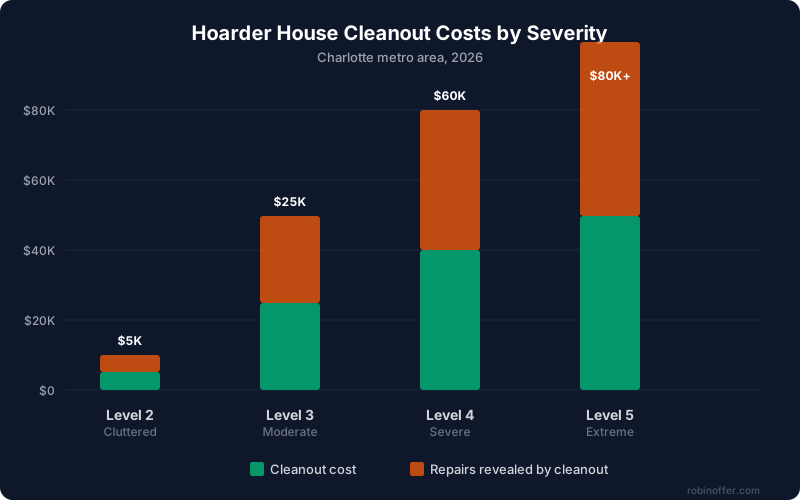
That "Cleanout + Repairs" column is where the real math lives. Cleaning a hoarder house just reveals the damage underneath. Damaged drywall from moisture trapped behind clutter piles. Failed plumbing from years of disuse or from frozen pipes that no one noticed because the basement was inaccessible. HVAC systems clogged with debris, rodent nests in ductwork. Electrical panels buried behind years of accumulation, with extension cords and power strips daisy-chained through the house creating fire risk. The repairs needed to list a hoarder house conventionally often double or triple the cleanout cost because the clutter was hiding the real problems.
3. The Inherited Hoarder House — When Grief Meets a $30,000 Decision
Roughly half the hoarder houses that come to market in the Charlotte metro area are inherited. The pattern is familiar: a parent passes away, and the adult children open the front door to find floor-to-ceiling accumulation they knew about — or suspected — but couldn't address while their parent was alive. The hoarding was the parent's choice, and pushing back risked the relationship. Now it's the children's problem, and it arrives alongside grief, probate paperwork, and sibling dynamics that make every decision harder.
As we covered in Section 1, hoarding peaks in adults over 70 — which is exactly why inherited hoarder houses are so common. The average age at diagnosis is around 50, but the condition worsens over decades, and the most severe cases are typically discovered only after death. The Baby Boomer generation is entering the age range where hoarding disorder peaks, and their children will inherit both the homes and the consequences.
Here's why the inherited hoarder house is the hardest version of this problem:
The Probate Clock Is Running
NC probate takes 3–12 months depending on estate complexity. SC probate has an 8-month creditor window before the estate can close. You're paying carrying costs the entire time — and you cannot legally sell, contract a cleanout, or make major decisions about a house you don't yet have authority over. The Letters Testamentary (or Letters of Administration if there's no will) give you legal standing, and getting those issued takes 2–6 weeks even in straightforward cases. For the full probate process and timeline in North Carolina, see our NC inherited property guide. For South Carolina, including the York County Probate Court at 1675 York Highway, see our SC inherited property guide.
The Sorting Problem
A standard estate cleanout means boxing up belongings for donation, sale, or disposal. A hoarder estate cleanout means sorting through mountains of undifferentiated material where valuable items are genuinely mixed with worthless clutter. Hoarders are often the only ones who understand their organizational system — if it can be called that. Stock certificates mixed with expired coupons. Jewelry in coffee cans. Cash in books, between mattresses, inside appliances, or taped behind framed pictures. A full cleanout of a hoarder house can't be a dumpster-and-go operation. Someone has to methodically examine everything, and that multiplies the timeline by 3–5 times compared to a standard cleanout.
The Sibling Problem
Multiple heirs rarely agree on pace or approach. One heir wants to preserve everything out of loyalty to the parent. Another wants to clear the house immediately to stop the bleeding on carrying costs. A third lives out of state and can't participate but has opinions about the process. These conflicts aren't just emotional — they're legal. In North Carolina, partition law (Chapter 46A, effective 2020) lets any co-owner petition the court to force a sale, but partition isn't the quick exit people assume. Under §46A-75, the court must try actual division (splitting the property physically) before ordering a sale, and the burden is on the party seeking sale to prove that division "cannot be made without substantial injury." Expect 6–12 months and $3,000–$8,000 in legal fees for a contested partition.
The Carrying Cost Trap
While you're navigating probate, sorting, and sibling disagreements, the house is costing money every month. On a $330,000 inherited home in Rock Hill (close to the city's median), the monthly carrying costs look like this:
| Monthly Cost | Estimate | 6-Month Total |
|---|---|---|
| Property taxes | $275–$350 | $1,650–$2,100 |
| Insurance (vacant/dwelling fire policy) | $170–$330 | $1,020–$1,980 |
| Utilities (minimum to prevent freeze/mold) | $100–$200 | $600–$1,200 |
| Lawn/exterior maintenance | $80–$150 | $480–$900 |
| Mortgage (if the parent had one) | $1,200–$1,800 | $7,200–$10,800 |
| Total (no mortgage) | $625–$1,030 | $3,750–$6,180 |
| Total (with mortgage) | $1,825–$2,830 | $10,950–$16,980 |
Six months of carrying costs on a mortgaged inherited home burns $11,000–$17,000. That's money leaving the estate — money the heirs will never see. Every month you delay the sale decision, the net proceeds shrink.
Inherited a hoarder house and not sure where to start?
Get a free, no-obligation cash offer on the property in any condition — no cleanout, no repairs, no showings — so you have a real number before committing to a cleanout.
4. NC vs. SC Disclosure Rules — What You Must Tell the Buyer
Both North Carolina and South Carolina require sellers to disclose known property conditions, and "as-is" does not exempt you from disclosure in either state. This catches sellers off guard because "as-is" feels like it means "buy it at your own risk, I'm not responsible." It doesn't. As-is means you won't fix problems — not that you don't have to tell the buyer they exist.
North Carolina: Chapter 47E
NC's Residential Property Disclosure Act (Chapter 47E) requires sellers to complete the Residential Property and Owners' Association Disclosure Statement (RPOADS) disclosing conditions they have actual knowledge of. The key phrase is "actual knowledge" — you're not required to hire an inspector or investigate. But you cannot hide what you know.
On a hoarder house, the disclosure items that matter most are:
- Structural damage: foundation cracks, wall damage, sagging floors, roof leaks
- Water damage: flooding history, moisture problems, standing water in crawlspace
- Pest infestation: current or past infestation where the damage hasn't been repaired — this hits nearly every hoarder house at Level 3+
- Environmental hazards: mold, lead paint (mandatory federal disclosure for pre-1978 homes), asbestos, radon
- Mechanical systems: HVAC, plumbing, electrical, water heater condition
For each item, you can mark "Yes," "No," or "No Representation." Many as-is sellers check "No Representation" across the board, thinking this shields them. It reduces exposure on items you genuinely don't know about, but if you have actual knowledge of a defect and choose "No Representation" to hide it, that's fraud under NC law. The statute of limitations is three years from closing. For the full breakdown of the RPOADS form, the "No Representation" strategy, and seven situations where selling as-is makes financial sense, see our NC as-is selling guide.
South Carolina: Title 27, Chapter 50
SC's Residential Property Condition Disclosure Act requires a similar disclosure statement covering structural components, mechanical systems, pest infestation, and environmental hazards. The standard is knowing disclosure: SC sellers who knowingly provide false or incomplete information face liability for actual damages, court costs, and potential attorney fee awards.
SC disclosure covers the same categories as NC — water supply, sewage systems, roof, foundation, HVAC, pest infestation, and environmental hazards including lead paint, asbestos, radon, and underground storage tanks. SC also requires disclosure of any existing lease or rental agreements and HOA governance — relevant if the hoarder property was a rental or is in a community with HOA restrictions on exterior maintenance.
The Estate Sale Exemption
This is the part most guides skip, and it matters enormously for inherited hoarder houses. Both states exempt specific types of transfers from the disclosure requirement entirely:
| Exemption | North Carolina (§47E-2) | South Carolina (§27-50-30) |
|---|---|---|
| Court-ordered transfers (estate administration) | Exempt | Exempt |
| Fiduciary transfers (executor/administrator) | Exempt | Exempt |
| Foreclosure sales | Exempt | Exempt |
| Transfers between family members | Exempt | Exempt |
| Both parties waive in writing | Exempt from §47E-4 only | Exempt |
| Transfers due to tax delinquency | Exempt | — |
If you're selling as executor or administrator of an estate — the most common scenario for inherited hoarder houses — you are exempt from the state disclosure form in both NC and SC. The rationale is practical: an executor who never lived in the house genuinely doesn't know what's behind the walls, and the law doesn't require them to pretend otherwise.
But there are two critical limitations to this exemption:
- Federal lead-paint disclosure still applies. The federal Lead-Based Paint Disclosure Rule (42 USC §4852d) has no estate exemption. If the home was built before 1978, the executor must provide the EPA's lead paint pamphlet and disclose any known lead paint, period.
- Common-law fraud still applies. Even without a state disclosure form, if you know the basement is full of black mold and you actively conceal it — or make affirmative misrepresentations — you're liable under common-law fraud principles that exist independent of the disclosure statute.
5. The Financing Wall — Why Most Buyers Can't Buy a Hoarder House
This is the single biggest reason hoarder houses sell for less than their cleaned-and-repaired value: the buyer pool shrinks dramatically because lenders won't finance the purchase.
FHA, VA, and USDA loans all require minimum property standards at appraisal. These aren't suggestions — they're binding conditions of the loan approval. A hoarder house at Level 3 or above typically fails on multiple standards simultaneously:
| Appraisal Requirement | How Hoarder Houses Fail | Consequence |
|---|---|---|
| Safe ingress and egress from all rooms | Blocked doorways, hallways impassable | Automatic fail — no exceptions |
| Functioning mechanical systems | HVAC inaccessible or untestable, plumbing frozen/failed | Appraiser cannot verify systems work |
| No health or safety hazards | Mold, pest infestation, animal waste, fire risk | Lender requires remediation before funding |
| Roof in serviceable condition | Roof damage hidden by ceiling-height clutter piles | Cannot be inspected = cannot be cleared |
| Foundation accessible for inspection | Crawlspace or basement completely blocked | Appraiser may refuse to complete the report |
| No peeling paint (pre-1978) | Peeling likely but hidden behind accumulated items | FHA/VA require lead paint testing if visible |
Conventional loans (Fannie Mae, Freddie Mac) have slightly looser standards on paper, but most conventional lenders follow similar guidelines in practice — their appraisers use the same inspection methodology, and an appraiser who can't access rooms can't complete the valuation. The result: a Level 3+ hoarder house can realistically only sell to cash buyers or to the rare buyer using a renovation loan (FHA 203(k) or Fannie Mae HomeStyle).
Renovation loans do exist, and they're designed for exactly this scenario — the buyer finances both the purchase and the renovation in a single loan. But they add complexity: the buyer needs contractor bids before approval, the lender holds funds in escrow and disburses as work completes, and the closing timeline stretches to 45–60 days minimum. Most buyers looking at $300,000 houses in the Charlotte suburbs simply don't pursue them. They move on to the next listing.
At the national level, cash purchases account for 41.7% of all home sales as of Q1 2026, according to ATTOM's Q1 2026 Home Sales Report. In the Charlotte metro specifically, 36.5% of single-family sales went to corporate or LLC buyers in April 2026, and 73.4% of those paid cash. The cash buyer pool is active and sizeable — it's just a different buyer pool than what a listing agent typically markets to through the MLS.
6. Clean-Then-List vs. Sell As-Is: The Net Proceeds Math
When you sell a hoarder house, this is the decision that actually matters. Strip away the emotional arguments and the generic advice and look at what each path nets you in real dollars. We'll use a $330,000 house — close to Rock Hill's median sale price — and run the math at two severity levels so you can see where the crossover point falls.
Scenario A: Level 3 Moderate Hoarder House
This is the house where reasonable people disagree. The clutter is serious but manageable, there's no significant biohazard, and the underlying structure is sound. A 1,600-square-foot ranch built in 1988, four bedrooms, good bones.
| Line Item | Clean-Then-List | Sell As-Is (Cash) |
|---|---|---|
| After-repair value | $330,000 | $330,000 (basis for offer calc) |
| Cash offer (80–90% of ARV) | — | $264,000–$297,000 |
| Cleanout cost | −$5,500 | $0 |
| Repairs revealed by cleanout | −$15,000 | $0 |
| Agent commission (5–6%) | −$16,500 to −$19,800 | $0 |
| Carrying costs (3 months at $1,800/mo) | −$5,400 | $0 |
| Seller closing costs (~2%) | −$6,600 | −$1,000 to −$2,000 |
| Net to seller | $277,700–$281,000 | $264,000–$297,000 |
| Time to cash | 3–5 months | 7–21 days |
At Level 3, the math is genuinely close. Cleaning and listing nets roughly $278,000–$281,000. The top of the cash offer range ($297,000 at 90% of ARV) actually exceeds the clean-then-list net, while the bottom ($264,000 at 80%) falls about $17,000 short. The question becomes: is the potential $17,000 upside worth 3–5 months of work and the risk that repairs come in higher than estimated?
Scenario B: Level 4–5 Severe/Extreme Hoarder House
Same house, but with animal waste damage, mold behind the bathroom walls, and a subfloor that needs replacement in three rooms. The kind of house where cleaning is a six-figure decision.
| Line Item | Clean-Then-List | Sell As-Is (Cash) |
|---|---|---|
| After-repair value | $330,000 | $330,000 (basis for offer calc) |
| Cash offer (80–90% of ARV) | — | $264,000–$297,000 |
| Cleanout cost | −$25,000 | $0 |
| Repairs (biohazard + structural) | −$40,000 | $0 |
| Agent commission (5–6%) | −$16,500 to −$19,800 | $0 |
| Carrying costs (6 months at $2,200/mo) | −$13,200 | $0 |
| Seller closing costs (~2%) | −$6,600 | −$1,000 to −$2,000 |
| Net to seller | $225,400–$228,700 | $264,000–$297,000 |
| Time to cash | 6–12 months | 7–21 days |
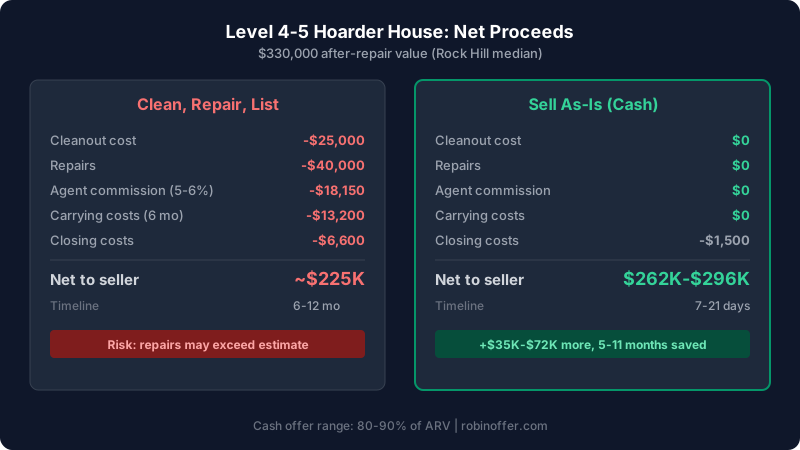
At Level 4–5, the as-is path wins by $35,000–$72,000 in net proceeds and 5–11 months in time. The clean-then-list path only makes financial sense if the house has unusual upside — waterfront on Lake Wylie, a premium lot in Fort Mill, a historic property in Rock Hill's downtown — that would command a sale price well above $330,000 after renovation, enough to overcome the $65,000+ in cleanout, repair, commission, and carrying costs.
Want to compare the numbers for your house?
We'll walk through the cleanout cost, repair scope, and cash offer math for your specific property — free and no obligation.
7. The Five Types of Buyers for a Hoarder House
Not all cash buyers are the same, and who you sell to matters as much as how you sell. The hoarder house market in the Charlotte area has five distinct buyer types, each with different offer ranges, closing speeds, and risk profiles. For a detailed breakdown of every buyer type operating in the Carolinas — including contract red flags, the NC/SC wholesaling laws, and a step-by-step background check — see our guide to "We Buy Houses" companies.
Here's how each buyer type handles a hoarder house specifically:
| Buyer Type | Offer Range (% of ARV) | Handles Cleanout? | Closing Speed | Watch Out For |
|---|---|---|---|---|
| Local fix-and-flip investor | 65–80% | Yes — has established crews and dumpster contracts | 7–21 days | Offers drop sharply on high-repair properties; may renegotiate after inspection |
| Buy-and-hold rental investor | 70–85% | Yes — plans to renovate for rental income | 14–30 days | May want a longer due diligence period to run rental projections |
| Wholesaler | 50–65% | No — assigns the contract to another buyer for a fee | Varies (30–60+ days) | May not actually close; can tie up your property for weeks while marketing it; check SC HB 4754 |
| iBuyer (Opendoor, Offerpad) | 85–93% minus service fees | Usually declines Level 3+ | 14–60 days | Service fees of 5–10% plus repair deductions; algorithm-driven, won't assess hidden damage |
| Local cash buyer (us) | 80–90% | Yes — any condition, cleanout included | 7–21 days | Get multiple offers so you can compare; always ask for proof of funds |
iBuyers like Opendoor and Offerpad are active in the Charlotte metro, including Rock Hill and Fort Mill. However, they typically decline hoarder houses above Level 2 — their algorithm-driven pricing models require photos and condition data they can't get from a house where rooms are inaccessible. Opendoor's 2024 FTC settlement (refund checks totaling $62 million to approximately 54,689 sellers) demonstrated that their headline offers frequently don't reflect the final net after repair deductions and service fees are applied. If an iBuyer makes an offer on a hoarder house, expect the deductions to be aggressive.
A note on wholesalers: SC enacted HB 4754 (Act No. 204) in May 2024, making it illegal to market a property for sale without legal ownership. Contract assignment itself is not banned — but advertising a property you only hold a contractual interest in is. In NC, HB 797 passed the House unanimously in April 2025 and would classify residential wholesaling as brokerage requiring a license, plus give homeowners a non-waivable 30-day right to cancel. That bill is not yet law (it sits in the Senate Rules committee), but the direction of regulation is clear: both states are moving to protect sellers from middlemen who lock up properties without the ability or intention to close.
8. The Hoarder House Walkthrough — What to Check Before Committing
Before you commit to either path — clean-then-list or sell as-is — do a structured walkthrough of the property. You need to answer three questions: (1) What severity level is this? (2) Are there biohazards? (3) Is there anything valuable buried in the clutter?
Safety First
- Never enter alone. Structural hazards are real in Level 4–5 houses. Weakened floors can give way. Heavy stacks of items can fall. If someone is injured in a hoarded property, getting help to them through blocked hallways is difficult.
- Wear an N95 mask and gloves at minimum. If you see animal waste, visible mold, or suspect rodent droppings, stop the walkthrough and call a professional biohazard assessor. Disturbing mold or rodent-contaminated materials without proper containment can spread spores and hantavirus throughout the house.
- Don't turn on utilities that have been off. Electrical systems buried under clutter can short-circuit. Water lines may have frozen and cracked. Gas lines may have been disconnected improperly. Have each utility inspected by the provider before restoration.
- Check for structural warning signs: sagging floors (test by walking slowly and feeling for bounce), water stains on ceilings (indicating active or past leaks), doors that won't close (suggesting foundation movement), cracks wider than 1/4 inch in foundation walls, and any smell of gas or sewage.
The Value Sort — Don't Skip This
Hoarders often keep genuinely valuable items mixed indistinguishably with worthless clutter. Before any cleanout — including a "dump everything" approach — invest time or money in identifying what's worth keeping:
- Financial documents: stock certificates, bonds, property deeds, insurance policies, bank statements. Check every envelope, folder, and box that contains paper.
- Jewelry and precious metals: often stored in unlikely containers (coffee cans, shoe boxes, taped to undersides of drawers). Hoarders with jewelry hoards may have substantial value in plain sight — but it looks like costume jewelry to an untrained eye.
- Collectibles: vintage items, first editions, antiques, art. What looks like clutter may include items that have appreciated significantly over decades of storage.
- Cash: hoarders frequently hide cash in books (between pages), inside appliance casings, between mattresses, in freezers, behind wall outlets, or inside hollow-core doors. Assume cash is hidden until proven otherwise.
An estate liquidator charges 25–35% of the value of items they sell, but they know what's worth pulling and what's not. On a property where the deceased was a lifelong collector, the value recovered can offset a significant portion of the cleanout cost — sometimes covering it entirely.
Assessing the Damage Beneath
Once you've done the safety walkthrough and value sort, you need to estimate what's underneath the clutter before committing to a selling path. You won't know the full picture until the cleanout starts, but certain signs visible during the walkthrough predict the repair scope:
| What You See | What It Usually Means | Expected Repair Cost |
|---|---|---|
| Musty smell, stains on lower walls | Moisture trapped behind clutter has caused mold growth on drywall and possibly subfloor | $1,500–$15,000 depending on spread |
| Strong ammonia smell, discolored floors | Animal urine has soaked into subfloor and possibly floor joists. Standard cleaning won't fix this. | $4,000–$20,000 (subfloor replacement + remediation) |
| Droppings in kitchen, gnaw marks on wiring | Active rodent infestation. Wiring damage creates fire risk and requires electrician assessment. | $800–$4,000 (pest treatment + electrical inspection) |
| Soft or bouncy floors | Structural damage to subfloor or floor joists from moisture, rot, or termites hidden by clutter | $3,000–$8,000 per affected area |
| Windows painted shut, no ventilation | Long-term moisture problems likely; check for condensation damage on frames and surrounding walls | $500–$2,000 per window replacement |
| Ceiling stains or bulging | Roof leak has been ongoing while hidden by clutter below. May need roof repair plus interior restoration. | $2,000–$12,000 depending on extent |
If your walkthrough reveals multiple signs from this table, the house is likely at the severe end of the repair spectrum. That's useful information: it tells you the cleanout cost is just the beginning, and the total investment to reach "listable condition" may approach or exceed the price discount a cash buyer would apply. At that point, the as-is path isn't a concession — it's a sound financial decision based on the actual scope of work.
9. Three Paths to Sell a Hoarder House — Side by Side
If you need to sell a hoarder house, you have the same three options every seller faces. The right choice depends on severity level, time constraints, and market position. Here's how they compare with Charlotte metro economics baked in.
Path A: Full Clean, Full Repair, List With an Agent
- Best for: Level 2–3 houses where cleanout cost is under $10,000, the repair bill is manageable, and the house is in a strong-demand market — Fort Mill ($530K median), Huntersville ($568K median), or Matthews ($481K median) — where median prices generate enough margin to absorb the costs
- Timeline: 3–6 months (cleanout 2–4 weeks + repairs 4–8 weeks + listing and closing 4–8 weeks)
- Cost: Cleanout ($3,000–$8,000) + repairs ($8,000–$25,000) + agent commission (5–6%) + carrying costs ($1,800–$2,800/month for the duration) + staging if the agent recommends it ($1,500–$3,000)
- Risk: Cleanout reveals worse damage than expected. Repairs go over budget. House sits longer than expected because the "former hoarder house" stigma lingers even after professional cleaning. Agent may push for a price reduction after 60 days on market.
Path B: Partial Clean, List As-Is With an Agent
- Best for: Level 3 houses where a basic cleanout makes the property showable — rooms accessible, floors visible, systems testable — even if cosmetic repairs aren't done
- Timeline: 2–4 months (cleanout 2–3 weeks + listing and closing 6–12 weeks)
- Cost: Cleanout only ($3,000–$8,000) + agent commission (5–6%) + carrying costs (2–3 months)
- Risk: Smaller buyer pool. Cash and renovation-loan buyers only once the appraiser flags condition issues. Longer days on market. Some listing agents won't take the property — they earn commission on closed sales, and an as-is hoarder house at Level 3 has a high fall-through rate.
Path C: Sell As-Is to a Cash Buyer — Zero Cleaning
- Best for: Level 4–5 houses, inherited properties where probate is consuming the heirs' time and patience, situations with external time pressure (pending foreclosure, job relocation, estate settlement deadlines, sibling disputes), or any case where the net-proceeds math in Section 6 shows the cash path netting more after all costs
- Timeline: 7–21 days from accepted offer to closing
- Cost: $0 upfront. Cash buyer handles all cleanout and repairs after closing. Seller pays only standard seller-side closing costs ($1,000–$2,000).
- Risk: Lower headline sale price (80–90% of after-repair value). Must vet the buyer carefully — see Section 10 and our vetting guide.
| Factor | Path A: Clean + List | Path B: Partial Clean + List As-Is | Path C: Direct Cash Sale |
|---|---|---|---|
| Upfront cost to seller | $11,000–$33,000 | $3,000–$8,000 | $0 |
| Agent commission | 5–6% of sale price | 5–6% of sale price | None |
| Timeline to close | 3–6 months | 2–4 months | 7–21 days |
| Buyer pool | Full market (after repairs) | Cash + renovation loans | Cash buyers only |
| Risk of cost overrun | High (hidden damage) | Medium | None (buyer assumes risk) |
| Your time and involvement | Heavy (managing contractors, inspections, showings) | Moderate | Minimal (one walkthrough, one closing) |
| Disclosure obligation | Full NC/SC form required | Full NC/SC form required | Full — unless estate exempt per §47E-2/§27-50-30 |
Get Your Free, No-Obligation Cash Offer
Tell us about the property and we'll send a real cash offer — any condition, no cleanout, no repairs, and you close on your timeline. Free and confidential.
10. Vetting Cash Buyers — The 30-Minute Check That Protects You
Hoarder house sellers are a magnet for wholesalers and unlicensed operators because the urgency is high and the seller's emotional bandwidth is low. The combination of distress, complexity, and a property that's difficult to sell through traditional channels makes you a target for people who make promises they can't keep. Protect yourself with these five checks before signing anything:
- Verify the company entity. NC: search the NC Secretary of State business search. SC: search the SC Secretary of State business filings. Look for: how long they've been registered, whether the registration is current, and whether the name matches what's on the contract. A company formed last month with no track record deserves extra scrutiny.
- Demand proof of funds. A real cash buyer will provide a bank statement or proof-of-funds letter from their financial institution showing they have the cash to close. This should be current (within 30 days) and show a balance that covers the purchase price. No proof of funds = no signed contract. A buyer who "needs to line up financing" is not a cash buyer.
- Read the contract for assignment language. If the contract allows the buyer to "assign" the agreement to another party, you may be dealing with a wholesaler who plans to flip the contract to an actual buyer for a markup. This is now restricted in SC under HB 4754. In any state, ask directly: "Are you the buyer, or are you planning to assign this contract to someone else?"
- Search for closed transactions. Google the company name + "reviews." Then go to the county Register of Deeds website and search for the company name in the grantee index — this shows properties they've actually purchased and closed on, not just contracted. A company with 20 closed transactions in Mecklenburg County is very different from a company with zero.
- Take 48 hours. Any buyer who says "this offer expires today" is counting on your stress to prevent you from doing due diligence. A legitimate cash offer will hold for 48–72 hours minimum. If a buyer pressures you to sign immediately, that tells you everything you need to know about how they'll behave between contract and closing.
11. Insurance, Liability, and the Holding Period
The time between inheriting (or deciding to sell) a hoarder house and actually closing the sale creates genuine financial and legal risk — in three areas most sellers don't see coming.
Homeowner's Insurance
Most standard homeowner's policies have a vacancy clause that voids coverage after 30–60 days of vacancy. Hoarder houses present a compounding problem: many carriers will cancel or refuse to renew once they learn about the hoarding condition itself, independent of vacancy. Fire hazard from blocked exits and flammable accumulation, pest infestation, and structural risk from deferred maintenance all trigger cancellation clauses in standard policies.
If the home is inherited, the existing policy typically terminates at the owner's death or within 30–60 days of it. You'll need to secure a vacant home policy or dwelling fire policy, which costs 2–3 times what a standard policy costs. For a $300,000 home in York County, expect $2,000–$4,000 per year for vacant dwelling coverage. Some carriers add surcharges for known hoarding conditions, and some decline to write the policy at all — particularly if the house has had a fire department citation or a code enforcement visit.
The gap between the prior owner's policy lapsing and the new coverage starting is a period of uninsured risk. If a fire, water main break, or weather event damages the property during that window, the loss is uninsured. Move quickly on replacement coverage.
Personal Liability
If someone is injured on the property — a neighbor, a trespasser, or even an unauthorized entrant — the property owner is potentially liable. This is especially relevant for hoarder houses because structural hazards are present but may not be visible, biohazards can cause illness, and the house may attract trespassers if it appears abandoned or distressed.
For estate executors specifically: consult the estate attorney about whether liability falls on the estate itself or on you personally during the holding period. NC and SC both have premises liability doctrines that impose duties on property owners, and the question of whether an executor is a "property owner" for liability purposes depends on how title has transferred. Letters Testamentary give you authority to manage the property, but the estate — not you personally — typically bears liability until title transfers. However, personal liability can attach if you make negligent decisions about the property (e.g., knowingly allowing someone to enter a structurally unsafe house without warning).
Code Enforcement
Hoarder houses at Level 4–5 frequently attract code enforcement attention, especially if the hoarding has visible exterior manifestations — items stacked on porches, blocked windows visible from the street, overgrown yards. Both NC and SC municipalities can issue violation notices with daily fines for continuing violations. In Charlotte, code enforcement can impose fines and ultimately place liens on the property. In SC municipalities, the general penalty under SC Code §5-7-30 allows fines of up to $500 per day for continuing violations.
If the property already has active code violations, the clock is running on fines that will accrue as a lien against the property. Selling quickly — to any buyer, at any price — may be the financially rational choice if daily fines are accumulating. Check with your city's code enforcement office to determine whether any notices have been issued. In the Charlotte metro, you can search active cases through the city's code enforcement portal. For York County SC municipalities, contact the city clerk or building department directly.
Property Tax Implications
Property taxes don't pause during probate or during a cleanout. If the prior owner had an over-65 homestead exemption (available in both NC and SC), that exemption terminates with the owner's death. The tax bill may increase substantially in the next assessment cycle. In SC, the assessment ratio jumps from 4% (owner-occupied) to 6% (non-owner-occupied) once the heirs take possession and don't occupy the home — a 50% increase in the assessment base that directly raises the annual tax bill. Factor this into your carrying cost estimate, especially if the cleanout-and-list path will span an assessment date.
12. How to Decide: Sell Your Hoarder House As-Is or Clean First
Answer these five questions to find your best path. Each question pushes the math in a specific direction, and stacking answers reveals the clear choice.

- What severity level is the house?
- Level 1–2 → Clean it yourself and list normally. This guide's math doesn't apply — you have a cluttered house, not a hoarder house.
- Level 3 → This is the genuine toss-up. Run the net-proceeds math from Section 6 with your actual numbers. The answer depends on your specific cleanout cost, repair scope, and local market conditions.
- Level 4–5 → Cash sale almost always wins on net proceeds because cleanout-plus-repairs consume so much of the sale price that the agent path can't recover the margin.
- Are there biohazards (mold, animal waste, pest contamination)?
- No → Cleaning is a straightforward labor-and-dumpster operation with predictable costs.
- Yes → Get an assessment before committing any money. Biohazard remediation can triple the cleanout cost and is notoriously difficult to estimate accurately before the clutter is removed — because the clutter is hiding the contamination extent.
- Is this an inherited property?
- No → You have flexibility on timing. You can choose when to start and how fast to move.
- Yes → Carrying costs are running from Day 1. Probate adds months of mandatory waiting. Multiple heirs add decision complexity. The estate sale exemption from state disclosure simplifies one piece. Time pressure favors the fastest path to closing.
- How much time do you have?
- 6+ months → Cleaning and listing can work if the math supports it and you have the emotional capacity to manage contractors, inspections, and showings on a property with a difficult history.
- 3–6 months → Tight for a full clean-repair-list cycle. Consider Path B (partial clean, as-is listing) if the house is Level 3, or Path C (cash sale) if Level 4+.
- Under 3 months → Cash sale. You won't finish a cleanout and renovation in time, and the carrying costs during a rushed process eat into whatever margin the higher sale price might generate.
- What does your local market look like?
- High-demand area (Fort Mill, Huntersville, Matthews, Belmont) → The investment in cleaning may pay off because buyer competition is stronger and renovated homes sell faster, reducing carrying costs.
- Average or cooling market → The carrying costs while waiting for a buyer eat the upside from cleaning. Every month on market is $1,800–$2,800 that comes directly out of your net proceeds.
If you answered "Level 4–5," "yes" to biohazards, "yes" to inherited, "under 3 months," or the market is slow — each answer pushes the math further toward selling your hoarder house as-is. Stack more than two of those answers and the as-is cash path isn't just the easier option. It's the financially better one.
The Emotional Factor
The five questions above are financial. But there's a sixth question that the spreadsheet can't answer: do you have the emotional capacity for this project?
Cleaning a hoarder house — especially a parent's house — is not like renovating a kitchen. You're touching every object your parent owned. You're making hundreds of keep-or-discard decisions an hour, each one carrying some weight. You're doing it while grieving, while managing siblings, while paying carrying costs. Families who start a cleanout with enthusiasm frequently stall at week two, when the emotional fatigue sets in and the progress feels invisible. The house becomes a source of dread. Visits get postponed. Months pass. The carrying costs continue.
There's no shame in choosing the path that ends the process cleanly. Selling as-is to a cash buyer means one walkthrough, one offer, one closing, and it's done. The financial math may be close enough that the deciding factor isn't which path nets $5,000 more — it's which path you can actually complete without the process consuming your life for six months.
If you want to see the math for your specific house — cleanout cost, repair scope, carrying costs, and what a cash offer actually looks like — reach out. We'll walk through the numbers with you, no pressure and no obligation, so you can make the decision with real data instead of guesses.
Ready to See the Numbers for Your Hoarder House?
Get a free cash offer on the property as-is — no cleaning, no repairs, no fees. Close when you're ready.
13. Frequently Asked Questions About Selling a Hoarder House
How much does it cost to clean out a hoarder house in the Carolinas?
Hoarder house cleanout costs range from $500–$2,000 for mild clutter (Level 2) to $15,000–$40,000+ for extreme biohazard conditions (Level 5). A moderate Level 3 cleanout in the Charlotte metro typically costs $3,000–$8,000 for removal alone, plus $8,000–$25,000 in repairs revealed underneath. Animal hoarding cases push costs to the highest tier due to subfloor replacement and biohazard remediation.
Can you sell a hoarder house without cleaning it first?
Yes. Cash buyers purchase hoarder houses in any condition — no cleanout, no repairs, no showings. The trade-off is a lower sale price (typically 80–90% of after-repair value), but you pay $0 upfront and close in 7–21 days. At Level 4–5 severity, the as-is cash path often nets more than clean-then-list after deducting cleanout costs, repairs, agent commissions, and carrying costs.
Do you have to disclose hoarding conditions when selling a house in NC or SC?
Both NC (Chapter 47E) and SC (Title 27, Chapter 50) require sellers to disclose known property conditions including structural damage, pest infestation, mold, and environmental hazards — all common in hoarder houses. However, estate sales (executor/administrator transfers) are exempt from the state disclosure form in both states. Federal lead-paint disclosure for pre-1978 homes still applies to estate sales.
How do you sell an inherited hoarder house?
Start probate to get legal authority (Letters Testamentary or Administration), get a biohazard assessment ($200–$500) before committing to a cleanout, and get a cash offer as a baseline number. Estate executors are exempt from NC/SC state disclosure forms. Carrying costs on a $330,000 inherited home run $1,800–$2,800/month with a mortgage, making speed valuable.
Can a buyer get a mortgage on a hoarder house?
Most buyers cannot. FHA, VA, and USDA loans require minimum property standards — safe exits, functioning systems, no health hazards — that Level 3+ hoarder houses fail. This limits the buyer pool to cash buyers and the rare buyer using a renovation loan (FHA 203(k) or HomeStyle), which adds 30–60 days to closing and requires contractor bids before approval.
This guide is for informational purposes only and does not constitute legal, financial, or real estate advice. North Carolina and South Carolina disclosure laws, property conditions, and real estate market conditions change. Consult a licensed real estate attorney in your state for advice specific to your situation. Guide researched and written by CC Evans, RobinOffer.