
'We Buy Houses' Companies: 5 Types and How to Vet Them
Not all cash buyers are the same species. Some close in 10 days with real money. Others tie up your home for months with a contract they never intend to close on. Here's how to tell the difference.
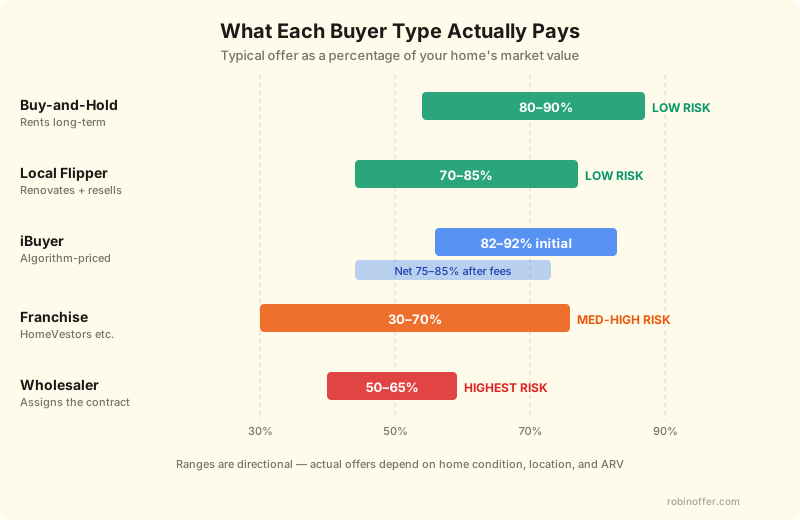
"We buy houses" companies in the Carolinas range from legitimate local investors who close in two weeks to wholesalers who never intend to buy your home. This guide covers the five types, the contract clauses that reveal which one you're facing, and your legal protections in NC and SC.
1. Every Bandit Sign Has a Business Model Behind It
You've seen them. Yellow signs at every intersection from Gastonia to Fort Mill: "We Buy Houses, Cash, Any Condition, Close Fast." Postcards in your mailbox. Cold texts from numbers you don't recognize. Facebook ads with stock photos of families holding novelty checks.
If you own a home in North Carolina or South Carolina, you're getting this marketing because the cash-buyer industry is enormous, and growing. Nationally, cash purchases made up 41.7% of all home sales in Q1 2026 according to ATTOM Data Solutions. In the Charlotte metro, 36.5% of single-family sales in April 2026 went to corporate or LLC buyers, and 73.4% of those purchases were all-cash. This is not a fringe market. It's roughly four out of every ten transactions.
The Charlotte investor market is also remarkably fragmented. In April 2026, 1,020 unique corporate entities split 455 tracked corporate purchases, nearly a one-to-one ratio. There's no single dominant buyer. Instead, it's a sea of small and mid-size operators: local flippers, out-of-state landlords, wholesalers, and franchise buyers, all competing for the same $250,000–$400,000 price tier that captures the heaviest investor activity. That fragmentation is actually good news for sellers, it means you have options, and no single company controls the market. But it also means the quality of the buyer sitting across your kitchen table can range from excellent to predatory, and there's no brand name that guarantees which one you're getting.
But "We Buy Houses" covers an enormous range of operations. Some will buy your home, close in 10 days, and hand you a check. Others will tie up your property for 60 days with a contract they never intend to close on, then sell that contract to someone else and pocket the spread. Others will lowball you by $80,000 and pressure you to sign before you've had time to think.
The problem isn't that cash buyers exist. Cash sales serve a real purpose, speed, certainty, no repairs, no showings. The problem is that most homeowners can't tell the difference between a legitimate buyer and a predatory one until they've signed something. This guide fixes that.
RobinOffer is a cash home buyer in the Charlotte metro. We buy in York County, Gaston County, Mecklenburg, and surrounding areas, and we work with a licensed agent through NorthGroup Real Estate. We've seen every variation of this industry from the inside, the legitimate operators, the wholesalers, the franchises, and the outright scams. What follows is everything we know about telling them apart.
If you're already past the vetting stage and want to understand how a cash offer stacks up financially, our cash offer vs. realtor comparison runs the full net proceeds math at four Carolinas price points. And if you're specifically comparing Opendoor or Offerpad to a local buyer, our iBuyer vs. cash buyer teardown breaks down their fee structures side by side.
2. Five Species of 'We Buy Houses' Company, and How Each One Makes Money
Not all cash buyers are the same species. Their business models determine what they'll offer, how they'll behave during the transaction, and what risks you're taking. Here's the taxonomy:
| Type | How They Make Money | Typical Offer | Uses Own Cash? | Risk to You |
|---|---|---|---|---|
| Local fix-and-flip investor | Buys, renovates, resells at retail | 70–85% of market value | Yes | Low (if vetted) |
| Buy-and-hold investor | Buys, rents long-term | 80–90% of market value | Yes | Low (if vetted) |
| iBuyer (Opendoor, Offerpad) | Algorithm-priced purchase, resells on MLS | 82–92% initial, minus 7–18% in fees/deductions | Yes | Medium (fee surprises after acceptance) |
| Franchise (HomeVestors/"We Buy Ugly Houses") | National brand, local franchisee buys | 30–70% of market value | Usually | Medium-High (documented pressure tactics) |
| Wholesaler | Contracts your home, sells the contract to someone else | 50–65% of market value | No, never | Highest (may never close) |
The first two, local flippers and buy-and-hold investors, are the traditional cash buyer. They see your home, make an offer backed by their own money, and close. The transaction is between you and them. Their offer is the number you get. No hidden fees, no assignment clauses, no middlemen.
iBuyers are technology companies that buy homes at scale using automated valuation models. Opendoor and Offerpad both operate in the Charlotte metro, including Rock Hill and Fort Mill in York County. The headline offer looks competitive, but the final number drops after service fees (Opendoor: 5%; Offerpad: up to 8%), closing costs, and post-inspection repair deductions that can run $5,000 to $30,000. We compared the iBuyer and local cash buyer models in detail in our Carolinas cash offer guide.
The last two, franchises and wholesalers, are where most homeowners get hurt. Franchises are real buyers that use high-pressure sales tactics documented in a federal investigation. Wholesalers are not buyers at all. Understanding the difference between these five types is the single most protective thing you can do before signing anything.
How to Identify Each Type at First Contact
| What You See or Hear | Most Likely Type |
|---|---|
| Bandit signs on telephone poles, handwritten | Wholesaler or franchise |
| Professional website with detailed reviews from local sellers | Local investor (flip or hold) |
| National TV commercials, 1-800 number, recognizable brand | Franchise (HomeVestors) or iBuyer |
| "I'll take over your mortgage payments" | Subject-to investor or scam, proceed with extreme caution |
| Contract includes "and/or assigns" language | Wholesaler |
| Online form for an "instant offer" with no property visit | Lead aggregator (sells your info to investors) or iBuyer |
| Walks your property before making an offer | Local investor, good sign |
| Unsolicited text message about buying your specific property | Wholesaler using a skip-tracing database to find distressed owners |
A Note About Lead Aggregator Websites
Some of the biggest "cash offer" websites are not buyers at all, they're lead generation companies. You fill out a form, they sell your contact information to 3–5 cash buyers in your area, and your phone starts ringing. There's nothing inherently wrong with this model (it's how many industries work), but you should know that you've just given your name, phone number, address, and property details to a company whose entire business is selling that information. If you want to compare cash offers, it's better to contact 2–3 buyers directly than to give a lead aggregator permission to contact you on behalf of whoever pays them the most.
Know your home's value before talking to any cash buyer
The single most important number in any cash-buyer conversation is what your home is actually worth. Get a free estimate first — then evaluate any offer against the real number.
3. Wholesaling: The Transaction Where Nobody Buys Your House
Wholesaling is the single biggest source of cash-buyer complaints in both Carolinas, and most homeowners don't know what it is until they're stuck in one.
Here's how it works: a wholesaler contacts you, by sign, postcard, text, or cold call, and makes what sounds like a cash offer on your home. You sign a purchase agreement. But the wholesaler has no intention of buying your house. Instead, they assign (sell) that purchase agreement to an actual investor, pocketing the difference as their fee. If they can't find an investor willing to pay more than they promised you, the deal falls through and you've wasted weeks or months.
How Wholesalers Find You
Wholesalers don't find sellers by accident. They use systematic data mining to identify homeowners in distress, and then reach out at your most vulnerable moment. Here's where they get your name:
- Tax delinquency lists, County tax offices publish lists of property owners behind on taxes. Wholesalers buy these lists and send targeted mail within days of publication.
- Pre-foreclosure filings, When a lender files a lis pendens (notice of pending lawsuit) in a foreclosure, it becomes a public court record. Wholesalers run daily searches on county public index systems to find new filings.
- Probate court filings, When someone dies and their estate enters probate, the case filing is public. Wholesalers target executors of estates that include real property, knowing the executor often lives out of state and wants a fast resolution.
- Code violation records, Municipal code enforcement actions are public. A homeowner with an active code violation is a homeowner under pressure.
- Absentee owner lists, Properties where the mailing address differs from the property address indicate an absentee owner. Wholesalers target these because absentee owners are more likely to sell at a discount.
- Skip-tracing databases, Commercial databases aggregate phone numbers, email addresses, and public records for specific property owners. The unsolicited text you got about selling your house? That's skip-tracing at work.
None of this is illegal. Public records are public. But understanding how a wholesaler found you changes the dynamic of the conversation. They didn't call because they care about your situation, they called because your name appeared on a list that signals distress. Their offer price reflects that leverage.
The Wholesaling Timeline, What Happens Behind Your Back
| Step | What You See | What's Actually Happening |
|---|---|---|
| 1. Contact | Buyer calls, texts, or knocks on your door | They found your name on a public distress list, tax delinquency, pre-foreclosure, probate filing, code violation |
| 2. "Offer" | Quotes you a price, typically 50–65% of market value | They need room for their assignment fee ($5K–$30K) AND the end buyer's renovation profit |
| 3. Contract | You sign a purchase agreement | The contract contains an assignment clause allowing them to transfer it to anyone |
| 4. Marketing | You wait. The "buyer" says they're preparing for closing. | They're shopping your contract to investor lists, Facebook groups, and local REI meetups |
| 5. Assignment | The wholesaler calls to say "we're ready to close" | They found a buyer and assigned the contract for a $5K–$30K fee you'll never see |
| 6. Closing (maybe) | You close with someone you've never met, or the deal collapses | If no investor wanted the deal, the wholesaler walks away with no consequences |
The Money You Leave on the Table
The wholesaler's profit is the gap between what they offered you and what the end buyer pays. On a home worth $300,000:
| Line Item | Amount |
|---|---|
| Your home's market value | $300,000 |
| Wholesaler's offer to you | $180,000 (60% of market value) |
| Wholesaler sells the contract to an investor for | $200,000 |
| Wholesaler's assignment fee (their profit) | $20,000 |
| Investor's plan: renovate for $40K, resell at $300K | $60K gross profit to the investor |
| Money you left on the table vs. a direct cash buyer at 80% | $60,000 |
A legitimate fix-and-flip investor buying the same house directly would have offered you $210,000–$255,000 (70–85% of market value). The wholesaler's middleman fee didn't just reduce your proceeds by $20,000, it reduced them by $60,000 because the wholesaler needed room for both their cut and the end buyer's margin. That $60,000 gap is not a negotiation outcome. It's a structural cost of selling through a middleman who adds no value to the transaction.

The Real Risk: Lost Time
The financial hit is bad. The time hit can be worse. When a wholesaler ties up your property for 30–90 days:
- You can't accept other offers
- You can't list with an agent
- If you're in foreclosure, the sale date keeps approaching
- If you're relocating, your departure date doesn't move
- If the deal falls through, you start over with less time, less leverage, and one more month of carrying costs
For homeowners in distress, the exact people wholesalers target, lost time is the most expensive thing in the transaction.
4. What NC and SC Law Says About Cash Buyer Operations
Both Carolinas have moved on wholesaling regulation, but they've taken different approaches, and one state's protections are significantly stronger right now.
South Carolina: HB 4754 (Law, Enacted May 2024)
South Carolina was among the first states to pass a dedicated wholesaling law. HB 4754 (Act No. 204) added Article 9 to Chapter 57, Title 40 of the SC Code of Laws. What it does:
- Defines wholesaling as having a contractual interest in purchasing residential real estate, then marketing the property for sale to a different buyer before taking legal ownership (SC Code 40-57-30(44))
- Prohibits licensed brokerage firms and their subagents from engaging in, representing, or assisting in wholesaling (SC Code 40-57-350)
- Prohibits marketing the property itself while holding only a contractual interest, including photos, street addresses, square footage, rental income details, or any physical description identifying the property
The critical nuance: the statute explicitly states that assigning or offering to assign a contractual right to purchase does not constitute wholesaling. But marketing the underlying property to find an assignee does. The SC Real Estate Commission began sending enforcement letters to investors suspected of illegal wholesaling in October 2024 and published a guidance document clarifying the line between permissible contract assignment and prohibited property marketing.
North Carolina: HB 797 (Pending, Passed House Unanimously, Awaiting Senate)
NC's wholesaling bill would be the strongest proposed homeowner protection of its kind in the country, but it is not yet law. HB 797, the "Residential Property Wholesaling and We Buy Houses Homeowner Protection Act", passed the NC House 103-0 on April 30, 2025 and was referred to the Senate Rules and Operations committee on May 1, 2025, where it currently sits.
If enacted, HB 797 would create these protections:
| Protection | What It Would Do | Proposed Statute |
|---|---|---|
| Broker license required | Classify residential wholesaling as brokerage activity | G.S. 93A-2(a3) |
| 30-day right to cancel | Non-waivable 30 days to cancel any wholesale purchase contract | G.S. 93A-89.2(a) |
| 14-point font notice | Cancellation rights printed above seller's signature line in 14pt font | G.S. 93A-89.2(e) |
| 10-day refund | Refund within 10 business days after cancellation | G.S. 93A-89.2(c) |
| Criminal penalty | Class 1 misdemeanor per transaction for unlicensed wholesaling | G.S. 93A-8 |
| Treble damages | Violations = per se unfair/deceptive trade practices; treble damages + AG enforcement | G.S. 75-1.1, G.S. 93A-89.3 |
Until this bill passes the Senate and is signed by the governor, these protections do not exist in NC law. However, the NC Real Estate Commission has already taken the position that many wholesale activities constitute unlicensed brokerage under existing statutes. The Commission investigates complaints through its Regulatory Affairs Division and has documented enforcement actions against unlicensed wholesaling operations, including one scheme where operators purchased properties at near-market value and immediately resold them to investors at $30,000–$55,000 markups using inflated appraisals.
NC vs. SC: How Each State Protects You Today
| Protection | North Carolina | South Carolina |
|---|---|---|
| Dedicated wholesaling statute | Pending (HB 797, passed House, in Senate committee) | Yes, HB 4754, enacted May 2024 |
| Attorney required at closing | Yes, N.C.G.S. 84-2.1 | Yes, SC Supreme Court: real estate closing = practice of law |
| Statutory right to cancel wholesale contracts | Pending (30 days, if HB 797 passes) | No statutory right (relies on closing attorney oversight) |
| Unlicensed activity enforcement | NCREC Regulatory Affairs Division | SCREC enforcement letters (active since Oct 2024) |
| Deed fraud as felony | Pending (SB 423, HB 235) | Pending (S.822, passed Senate, in House Judiciary) |
| Existing deed fraud penalty | Presenting false deed for recording = perjury (Class F felony) | Common law fraud; S.822 would add specific deed-theft felony |
Why the Attorney-at-Closing Requirement Matters More Than You Think
Both North Carolina and South Carolina are among a small number of states that require a licensed attorney to supervise every residential real estate closing. In most of the country, closings are handled by title companies without any attorney involvement, meaning no independent legal professional reviews the deed, the contract terms, or the wire instructions on the seller's behalf.
In North Carolina, N.C.G.S. 84-2.1 requires that the preparation of deeds, mortgages, and closing documents be performed by a licensed NC attorney. A title insurance policy cannot be issued without attorney certification of the title.
In South Carolina, the protection is even broader. The SC Supreme Court has ruled that handling a real estate closing constitutes the practice of law, period. A non-attorney closing is unauthorized practice of law, a felony carrying up to $5,000 in fines and 5 years imprisonment. The closing attorney must personally supervise document preparation, title examination (going back 40–60 years of county records), the closing ceremony, deed recording, and fund disbursement.
This matters because your closing attorney is structurally independent of the buyer. They work for the transaction, not for either party's interests. If the deed is wrong, the wire instructions look suspicious, or the contract terms don't match what was agreed to, the closing attorney is the person who catches it. That protection disappears if you use the buyer's attorney without hiring your own to review independently.
5. Nine Contract Clauses That Tell You Who You're Really Dealing With
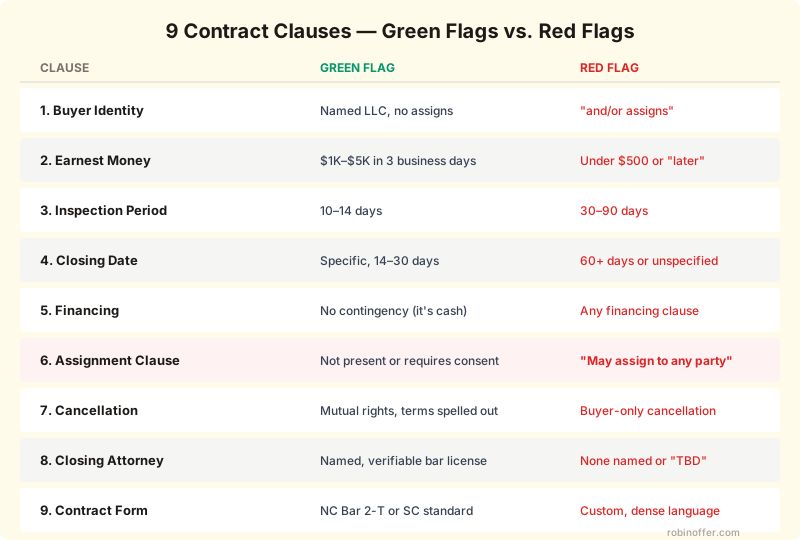
You don't need a law degree to spot a bad cash-buyer contract. You need to know which nine clauses to examine and what each one should, and shouldn't, say.
| # | Clause | Green Flag | Red Flag |
|---|---|---|---|
| 1 | Buyer identity | Named individual or registered LLC, no "and/or assigns" | "[Name] and/or assigns", signals a wholesaler |
| 2 | Earnest money | $1,000–$5,000, deposited within 3 business days | Under $500, or "to be deposited at a later date" |
| 3 | Inspection/due diligence | 10–14 days | 30–90 days (wholesaler needs time to find an end buyer) |
| 4 | Closing date | Specific date, 14–30 days out | "On or before" a date 60+ days away, or no date specified |
| 5 | Financing contingency | None, a real cash buyer doesn't need financing | Any financing contingency on a "cash" offer |
| 6 | Assignment clause | Not present, or "may not be assigned without seller's written consent" | "Buyer may assign this contract to any third party" |
| 7 | Cancellation terms | Mutual right to cancel; earnest money terms spelled out | Buyer can cancel for any reason at any time; seller cannot |
| 8 | Closing attorney | Named attorney with verifiable NC or SC State Bar license | No attorney named, or "to be determined" |
| 9 | Contract form | NC Bar Association standard (Form 2-T) or SC Bar standard | Custom contract with dense, unfamiliar language |
If a contract hits three or more red flags on this list, you are almost certainly dealing with a wholesaler or a predatory operator. A legitimate cash buyer, someone actually spending their own money to purchase your home, has no reason to use an assignment clause, no need for a 60-day inspection period, and no problem putting up real earnest money.
The Assignment Clause: The Most Important Sentence in the Contract
If the contract says "Buyer, and/or assigns," the person sitting across from you is not buying your house. They are buying the right to assign your contract to someone else. That's wholesaling. In South Carolina, marketing your property under that arrangement without a broker's license is now illegal under HB 4754. In North Carolina, the NCREC has signaled that many wholesale structures constitute unlicensed brokerage under existing law.
Ask this question directly: "Is there an assignment clause in this contract?" If yes, follow up: "Will you personally be the buyer at closing, or will someone else?" A legitimate buyer will say "I'm the buyer." A wholesaler will hedge, change the subject, or say "it depends on financing." The answer tells you everything.
Why the Contract Form Matters
In North Carolina, the standard residential purchase contract is the NC Bar Association and NC Association of REALTORS Joint Form 2-T. It's the form used in virtually every residential transaction in the state. A legitimate cash buyer will either use Form 2-T directly or use a substantially similar contract. If a buyer hands you a custom contract full of language you've never seen, especially one with broad exit clauses and minimal seller protections, that's a red flag serious enough to stop the conversation and consult your own attorney.
In South Carolina, standard contracts are published by the SC Association of REALTORS and SC Bar. The same principle applies: if the buyer's contract looks nothing like a standard real estate purchase agreement, treat it as a warning sign.
6. Proof of Funds: One Document, Zero Excuses
Any buyer who says "cash" should be able to prove it, immediately, not "once we get further into the process."
A legitimate proof of funds document includes:
- Bank letterhead with verifiable contact information for the banker
- Dated within the last 30 days (60 days is the outer limit; older than that is a yellow flag)
- Entity name matching the buyer on the contract, if the offer is from "Sunrise Properties LLC," the proof must show "Sunrise Properties LLC," not a personal account with a different name
- Balance at least equal to the offer price
- Banker's signature authorizing verification calls
What Counts as Proof of Funds, and What Doesn't
| Acceptable | Not Acceptable |
|---|---|
| Bank letter on letterhead, current month | Self-prepared spreadsheet showing "net worth" |
| Recent bank statement (sensitive info redacted) | Any bank statement older than 60 days |
| Brokerage statement showing liquid assets | "Comfort letter" from a non-bank lender |
| Wealth management letter confirming capacity | Screenshot of an account balance (easily fabricated) |
| Combined package from multiple verified accounts | "Transactional funding" confirmation (see below) |
The Transactional Funding Red Flag
"Transactional funding" or "flash funding" is when a wholesaler borrows money for a few hours to technically close on your home, then immediately resells it to the end investor the same day. The funds were never theirs, they exist for the duration of the closing ceremony and nothing more. If someone mentions transactional lending as their proof of funds, you're dealing with a wholesaler using a workaround, not a cash buyer. The money isn't theirs, the risk of the deal collapsing is higher, and the price you're getting almost certainly reflects the wholesaler's need to leave room for their fee and the end buyer's margin.
7. The 30-Minute Background Check (With Every URL You Need)
Before you sign anything, run this check. Every step is free and takes about 30 minutes total. Do it from your kitchen table with your phone and a cup of coffee.
| Step | Where | What You're Looking For | Time |
|---|---|---|---|
| 1. Google the company | google.com, search "[company name] reviews" | Detailed seller reviews describing real transactions, not generic 5-star reviews all posted the same week | 5 min |
| 2. BBB lookup | bbb.org | Accreditation status, complaint history, and how the company responded to complaints | 3 min |
| 3. NC business entity search | sosnc.gov | LLC/Corp registration, formation date, current good standing, registered agent | 3 min |
| 4. SC business entity search | businessfilings.sc.gov | Same checks for SC-registered entities | 3 min |
| 5. Verify closing attorney (NC) | ncbar.gov member directory | Attorney's active license status | 3 min |
| 6. Verify closing attorney (SC) | scbar.org lawyer finder | Attorney's active license in SC | 3 min |
| 7. Request proof of funds | Ask the buyer directly | Bank letter dated within 30 days, balance ≥ offer price, entity name matching the contract | 5 min |
| 8. Ask for seller references | Request 2–3 sellers they've closed with in your county in the last 6 months | Real people who can describe the experience. Call them. | 5 min |
If the buyer passes all eight steps, registered LLC in good standing, BBB accredited or clean complaint history, real Google reviews, named closing attorney with an active state bar license, proof of funds on bank letterhead, and references from recent sellers in your area, you're likely dealing with a legitimate operation. If they fail on two or more, proceed with extreme caution or walk away entirely.
What the Formation Date Tells You
When you look up the LLC on the Secretary of State's website, check when it was formed. An LLC registered last month is not automatically a scam, but it is a yellow flag. A company that's been registered for 3+ years, maintains good standing, and has reviews from real sellers in your county is a materially different risk than a brand-new entity with no track record, no reviews, and a UPS Store mailing address.
Green Flags vs. Red Flags, The Summary
| Green Flag | Red Flag |
|---|---|
| Detailed Google reviews from past sellers describing specific transactions | Clustered reviews all posted in the same week with generic language |
| BBB accredited with verifiable physical office address | UPS Store or virtual office address; no BBB profile |
| Proof of funds ready before the first meeting | "I'll get that to you later" or transactional funding confirmation |
| Uses NC Bar Form 2-T or SC standard contract | Custom contract with dense, unfamiliar language |
| Named closing attorney with active bar license | No attorney named; suggests using "just a notary" |
| Encourages you to take your time and get independent advice | "This offer expires today" or "I have other properties lined up" |
| Transparent offer formula, shows the math without being asked | Refuses to explain how they arrived at the price |
| Honest about when a cash sale doesn't make sense for you | Pushes cash sale regardless of your situation |
Selling an inherited property adds another layer of complexity to vetting. If you're going through probate while evaluating cash offers, our guides to selling inherited property in NC and selling inherited property in SC cover the legal requirements and the timeline pressure that wholesalers often exploit with estate executors.
Want to see what a vetted cash offer looks like?
RobinOffer provides proof of funds, a named closing attorney, transparent math, and a no-pressure written offer. Tell us about your property and we'll show you the numbers.
8. What ProPublica Found Behind the 'We Buy Ugly Houses' Signs
HomeVestors of America, the company behind the "We Buy Ugly Houses" brand, operates roughly 1,100 franchise offices across 47 states and the District of Columbia. They are the largest franchise "We Buy Houses" operation in the country. In May 2023, ProPublica and the Dallas Morning News published an investigation into how their franchisees actually operate.
The investigation was based on court documents, property records, company training materials, and interviews with 48 former franchise owners and dozens of homeowners. The findings:
- Franchisees were trained to "find the pain", identify emotional reasons a seller needed to sell and use those as leverage to close below-market deals
- Elderly and financially distressed homeowners were systematically targeted. One franchisee falsely told a 72-year-old woman with a hoarding problem that city code enforcement would take her house if she didn't sell immediately.
- Family members of elderly sellers attributed health declines and deaths to the stress of the transactions
- The company's proprietary valuation tool generated offers routinely at 30–70% of market value
- Some franchisees were not cut from the network even after documented violations
Following the investigation, HomeVestors CEO David Hicks retired, citing "recent press." The company overhauled its policies, including adding a mandatory 3-day seller cancellation window for all franchise contracts. HomeVestors maintains an A+ BBB rating nationally, though individual franchise complaint histories vary significantly by location.
The Franchise Model: Understanding What You're Actually Dealing With
When HomeVestors knocks on your door, you're not dealing with a national corporation. You're dealing with an individual franchisee who paid for the right to use the brand, the marketing system, and the lead-generation platform. Each franchisee is a separate LLC with its own capital, its own reputation, and its own approach. The national brand gives them credibility and deal flow. Everything else, the offer price, the negotiation, the closing, is the franchisee's call.
This matters because the franchise experience varies dramatically by location. A HomeVestors franchisee in Charlotte with 10 years of experience, a clean BBB record, and references from dozens of satisfied sellers is a fundamentally different operation than a new franchisee in another market with no track record. When you vet a franchise buyer, you're not vetting the brand, you're vetting the individual behind it. Check their specific LLC formation date, their specific Google reviews, and their specific BBB complaint history. The national A+ rating tells you nothing about the person sitting in your living room.
Other franchise or franchise-like operations in the Carolinas include WeBuyHouses.com (a network of independently operated local buyers using a shared brand), and various "We Buy" branded local companies that are not part of a formal franchise but use similar marketing. Apply the same vetting process to all of them: the brand name on the sign is less important than the LLC on the contract.
Should You Sell to a Franchise Buyer?
A HomeVestors franchisee or similar franchise can be a legitimate option, they have capital, they close, and they buy in any condition. But treat them like any other cash buyer:
- Run the 30-minute background check (Section 7) on the specific franchisee, not just the national brand
- Get the offer in writing before signing anything
- Compare the offer to at least one other cash offer and a rough listing estimate from a local agent
- Use the 3-day cancellation window. It exists because the pressure was real enough to force a policy change. Take all three days.
- Ask Question #4 from Section 11: "What is your offer formula?" A legitimate franchisee will explain the ARV, the repair estimate, their margin, and how they got to the number. If they can't or won't, the number is a guess at best and a lowball at worst.
9. Fair Offer or Lowball: The Math That Tells You
A "fair" cash offer is not whatever the buyer says it is. It's a function of your home's market value, its condition, and the buyer's business model. Here's how to check whether the number on the table is reasonable.
Step 1: Know Your Home's Approximate Market Value
Before entertaining any cash offer, get a rough market value from at least two independent sources:
- Redfin or Zillow estimate, free, instant, directionally correct (usually within 5–10% for standard homes in active markets)
- Comparative market analysis (CMA) from a local agent, also free (agents provide these to win listing appointments), and more accurate because a person evaluates your specific property against comparable recent sales
- A formal appraisal, costs $400–$600, most accurate, but usually not worth ordering unless the online estimates and the CMA disagree by more than 10%
Step 2: Apply the Right Discount for Your Situation
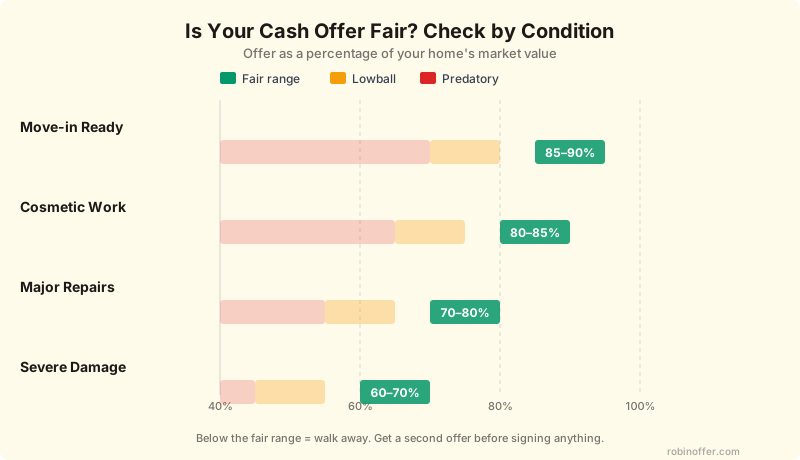
| Home Condition | Legitimate Cash Offer Range | Lowball Territory | Predatory Territory |
|---|---|---|---|
| Move-in ready | 85–90% of market value | Below 80% | Below 70% |
| Needs cosmetic work (paint, carpet, landscaping) | 80–85% | Below 75% | Below 65% |
| Needs major repairs (roof, HVAC, foundation) | 70–80% | Below 65% | Below 55% |
| Severe damage or uninhabitable | 60–70% | Below 55% | Below 45% |
Here's what that looks like in dollar terms for a Rock Hill home (median sale price approximately $330,000) with a new roof needed ($12,000) and cosmetic updates ($8,000):
| Buyer Type | Offer | % of Market Value | Verdict |
|---|---|---|---|
| Local investor A | $264,000 | 80% | Fair, accounts for repairs, leaves reasonable margin |
| Local investor B | $247,500 | 75% | Low end of fair, compare with other offers before deciding |
| Franchise buyer | $198,000 | 60% | Lowball, $66K below fair range for this condition |
| Wholesaler | $165,000 | 50% | Predatory, walk away |
If you're selling a home as-is and want to understand when the cash path genuinely beats a listing, our guide to selling as-is in NC covers the break-even math and the situations where carrying costs tip the balance.
Step 3: Factor In Your Carrying Costs
The cash offer looks worse in isolation than it does when you account for the cost of holding your home while it sits on the market. Every month you own a home, you pay for it whether it's listed or not:
| Monthly Carrying Cost | $330,000 Rock Hill Home |
|---|---|
| Mortgage payment (P&I at 6.5%, 30yr, 20% down) | ~$1,669 |
| Property taxes (SC 4% assessment, ~0.65% effective rate) | ~$179 |
| Homeowner's insurance | ~$150 |
| Utilities (if vacant, minimum service) | ~$120 |
| Maintenance / lawn care | ~$100 |
| Total monthly carrying cost | ~$2,218 |
At $2,218 per month, every extra month on the market costs you $2,218 in real expenses. If a cash buyer offers $280,000 and closes in 10 days, and a listing might net $310,000 after agent commissions (5–6%) but takes 90 days to close, you're comparing:
- Cash path: $280,000 net, in hand in 10 days. Total carrying cost during transaction: ~$740
- Listing path: $330,000 sale price − $19,800 commission (6%) − $4,950 closing costs (1.5%) = $305,250 net, but 90 days out. Total carrying costs: ~$6,654. And the deal might fall through, roughly 15% of financed contracts cancel before closing.
After carrying costs, the gap narrows: $279,260 (cash, net of 10-day carry) vs. $298,596 (listing, net of 90-day carry and commissions). That's still a ~$19,000 advantage for listing, but only if the listing goes perfectly. If the first buyer's financing falls through and you relist for another 60 days, your total carrying costs climb to $11,090 and net proceeds drop to roughly $294,000, now only about $15,000 more than the cash offer was on day one, and you've spent five months getting there.
Step 4: Compare Multiple Offers
Never accept the first cash offer without getting at least one more. Legitimate buyers expect this. Getting a second offer takes one phone call and 24–48 hours. It's the single highest-leverage action in this entire guide.
A buyer who says "this offer expires today" or "I can't hold this price" is using a pressure tactic, the same one ProPublica documented HomeVestors franchisees using on elderly homeowners. You have time. Use it. A real cash offer doesn't expire overnight.
Curious what your cash offer would actually be?
We'll walk your property, show you our proof of funds, and give you a written offer with no assignment clause and no expiration date.
10. Your Legal Protections When a Cash Deal Goes Wrong
If you've already signed a contract with a cash buyer and something goes wrong, the buyer won't close, the price changed after signing, or you suspect fraud, here's who to contact in each state.
North Carolina
| Problem | Where to File | What They Can Do |
|---|---|---|
| Unlicensed brokerage (wholesaling without a license) | NC Real Estate Commission, 919-719-9180 | Investigate, issue cease-and-desist, refer for criminal prosecution |
| Deceptive trade practices | NC Attorney General, 1-877-5-NO-SCAM | Enforcement action; private suit possible under G.S. 75-1.1 with treble damages |
| Deed fraud or forgery | Local District Attorney + county Register of Deeds | Criminal prosecution (presenting false deed = perjury, Class F felony under existing NC law) |
| Contract breach | Private attorney (NC State Bar referral: 800-662-7660) | Breach of contract action, specific performance, damages |
South Carolina
| Problem | Where to File | What They Can Do |
|---|---|---|
| Illegal wholesaling (marketing property without license) | SC Real Estate Commission (SCREC) | Enforcement letters, license discipline, prosecution referral |
| Consumer fraud | SC Attorney General | Investigation, enforcement, consumer mediation |
| Deed fraud | Local Solicitor's office + county Register of Deeds | Criminal prosecution; if S.822 passes, deed theft would be a felony (up to $5,000 fine + 5 years) |
| Contract breach / RESPA violations | Private attorney (SC Bar referral: 803-799-6653) | Breach of contract, RESPA violations carry treble damages for kickbacks (12 U.S.C. 2607) |
Deed Fraud: A Growing Risk in Both Carolinas
Deed fraud, where someone forges a deed to steal ownership of your home, is a growing national problem. The FBI documented approximately $397 million in real estate fraud losses in 2022. Both Carolinas have pending legislation to strengthen protections:
- NC SB 423 (Title Fraud Prevention Act), would require photo ID for deed recording, create a fraud detection alert system, and authorize civil penalties up to $10,000. Currently in Senate Judiciary. Not yet law.
- SC S.822 (deed theft felony), would make deed theft punishable by up to $5,000 fine and 5 years imprisonment. Passed the SC Senate and is currently in the House Judiciary committee. Not yet law.
You can protect yourself now: York County, SC offers a free deed fraud recording alert. Sign up at the York County Register of Deeds fraud alert portal to receive an email any time a document is recorded containing your name. It's reactive, it alerts you after a recording, not before, but catching a fraudulent filing quickly is far better than discovering it months later.
11. Twelve Questions That Make Predatory Buyers Walk Away
Ask these before signing anything. A legitimate buyer will answer every one without hesitation. A wholesaler or predatory operator will dodge, deflect, or disappear.
| # | Question | Why It Matters |
|---|---|---|
| 1 | "Are you the actual buyer, or will someone else be purchasing my home?" | Identifies wholesalers immediately |
| 2 | "Can you show me proof of funds today?" | Real buyers have it ready, see Section 6 |
| 3 | "Is there an assignment clause in your contract?" | If yes, they plan to sell the contract to someone else |
| 4 | "What's your offer formula? How did you arrive at this number?" | Legitimate buyers can explain their math: market value, condition adjustment, margin |
| 5 | "How many homes have you purchased in [my county] in the last 6 months?" | Tests local track record and verifiable experience |
| 6 | "Can I speak with 2–3 sellers you've closed with in my area recently?" | References from real sellers separate real operators from pretenders |
| 7 | "Who is your closing attorney? What's their bar number?" | Both NC and SC require attorney-supervised closings, a named attorney is non-negotiable |
| 8 | "What's the earnest money amount, and when does it get deposited?" | Real money deposited quickly = real commitment to the transaction |
| 9 | "What is the exact closing date?" | Vague or distant dates mean the buyer is waiting for an end investor to materialize |
| 10 | "Will the offer price change after your inspection?" | iBuyers and some investors do adjust post-inspection, honest buyers disclose this upfront |
| 11 | "What happens if you don't close by the contract date?" | A legitimate buyer specifies earnest money forfeiture; a wholesaler has nothing at stake |
| 12 | "Can I have 48 hours to review this contract with my own attorney?" | If they say no, if they push you to sign today, that's the biggest red flag in this guide |
If you're holding two or three offers and the numbers above still don't line up in your head, that's the point of this checklist, not a sign you're missing something. Our compare two cash offers calculator puts the terms side by side, shows the true net and the real close date on each one, and tells you which of these twelve questions you still haven't gotten an answer to for each buyer.
12. Making the Call
You've read the data, the law, the contract clauses, and the investigation findings. Here's the short version of what you now know that most homeowners don't:
- There are five distinct types of "We Buy Houses" companies. Only two, local investors and buy-and-hold buyers, actually purchase your home with their own money and close directly with you.
- Wholesalers tie up your property with a contract they never intend to close, then sell that contract to someone else for a fee that comes out of the discount on your home.
- South Carolina law (HB 4754, enacted May 2024) prohibits the marketing of residential property under a wholesale arrangement without a license.
- A bill in the NC legislature (HB 797) that passed the House 103-0 would give homeowners a non-waivable 30-day right to cancel wholesale contracts. It has not yet passed the Senate.
- Both NC and SC require an attorney at closing, pick your own, not the buyer's.
- Proof of funds, a named closing attorney, reasonable earnest money, and no assignment clause are the four non-negotiables.
If you're facing a time-sensitive situation, foreclosure, a job relocation, an inherited property in probate, or a home that needs more work than you can afford, a cash sale can be the right call. The speed and certainty are real. But the difference between a legitimate cash buyer and a predatory one can be $50,000 to $120,000 on the same house. That gap is worth 30 minutes of vetting.
When a Cash Sale Genuinely Makes Sense
Despite the risks outlined in this guide, cash sales exist for a reason. They solve real problems that the traditional market can't:
- Foreclosure deadline, If your sale date is 30–60 days away, a cash close in 10–14 days is the difference between losing your equity and walking away with a check. The discount is the price of speed, and it's worth it.
- Inherited property you've never lived in, An out-of-state executor managing a probate estate in York County doesn't want to stage, list, and manage showings from 500 miles away. A cash buyer eliminates 3–6 months of logistics.
- Major structural damage, A home that needs $50,000+ in foundation or fire damage repairs won't qualify for conventional financing. Cash is the only viable buyer pool.
- Divorce with a court-ordered sale deadline, When a judge has ordered the home sold by a specific date, a cash buyer who can close in two weeks removes the risk of contempt proceedings if a financed deal falls through.
- Job relocation with a start date, If your employer needs you in a different city in 30 days, carrying two mortgages while waiting for a listing to close isn't viable.
In all of these situations, the cash discount isn't money lost, it's the cost of certainty and speed, and it's a cost worth paying. The key is making sure you're paying that discount to a legitimate buyer and not losing an additional $30,000–$60,000 to a wholesaler or predatory operator on top of it.
Run the background check. Read the contract. Ask the twelve questions. Take your time.
And if you want to see what a no-pressure cash offer looks like from a buyer who'll answer every question in this guide, we're here. RobinOffer buys homes in York County SC, Gaston County NC, Mecklenburg County, and the surrounding Charlotte metro. We'll walk your property, show you our proof of funds, explain our math, and give you a written offer with no expiration date and no assignment clause. If a cash sale isn't the right move for your situation, we'll tell you that too.
Ready for a no-pressure cash offer?
Tell us about your home. We'll send you a written offer with transparent math — plus what we think the open market would pay, so you can compare.
13. Common Questions About 'We Buy Houses' Companies
Are "We Buy Houses" companies legitimate?
Some are, some aren't, and the only way to know is to vet the specific company, not assume based on the brand. Legitimate cash buyers are registered businesses that purchase homes with their own funds and close directly with the seller. They'll show you proof of funds, name a closing attorney, and provide references from recent sellers. Wholesalers, who market themselves as buyers but assign the contract to someone else, are the most common source of complaints. The fact that a company has a professional website, answers the phone, and shows up in a nice car does not tell you whether they're a direct buyer or a wholesaler. The contract does. Use the vetting checklist in Section 7 to tell the difference before you sign anything.
How much do "We Buy Houses" companies pay?
It depends entirely on the type of buyer and your home's condition. Reputable local investors, fix-and-flip or buy-and-hold, typically offer 80% to 90% of market value for a home in solid condition. Wholesalers, who never actually purchase the home, offer 50–65% because they need room for both their assignment fee and the end buyer's margin. HomeVestors and similar franchise buyers offer 30–70%, with the wide range reflecting the franchise model's focus on distressed properties. iBuyers like Opendoor (5% service fee) and Offerpad (up to 8% service fee) offer 82–92% initially but then subtract 7–18% in combined service fees, closing costs, and post-inspection repair deductions, so the final net to the seller is often lower than the headline number suggests. Section 9 walks through the math for each buyer type at a specific price point.
Is wholesaling real estate legal in the Carolinas?
In South Carolina, wholesaling residential property without a broker's license is prohibited under HB 4754 (enacted May 2024). In North Carolina, a bill (HB 797) that would classify wholesaling as brokerage requiring a license passed the House unanimously in April 2025 but has not yet passed the Senate. The NC Real Estate Commission has indicated that many wholesale activities already constitute unlicensed brokerage under existing statutes and investigates complaints.
What should I look for in a cash buyer's contract?
Four non-negotiables: (1) no assignment clause, or one requiring your written consent, (2) at least $1,000 in earnest money deposited within 3 business days, (3) a specific closing date within 14–30 days, and (4) a named closing attorney licensed in your state. Section 5 covers all nine clauses to check.
Can I cancel a contract with a "We Buy Houses" company?
It depends on the contract terms and your state. South Carolina has no statutory cancellation right specific to cash-buyer contracts, but your closing attorney can advise on your options under the specific contract language, many standard contracts include a due diligence period during which the seller can cancel. If NC's HB 797 passes, it would give NC sellers a non-waivable 30-day right to cancel wholesale purchase contracts, with required 14-point font cancellation notice above the signature line and a 10-business-day refund obligation. HomeVestors franchisees currently offer a 3-day cancellation window as company policy, implemented after the 2023 ProPublica investigation. Regardless of your state's statutory protections, the single best protection is reading the cancellation terms in the contract before you sign, and having your own attorney review them.
This guide was written by CC Evans and the RobinOffer team. We buy houses for cash in the Charlotte metro area, including York County SC, Gaston County NC, and Mecklenburg County NC. We are not attorneys and this guide is not legal advice. Consult a licensed attorney in your state for any legal questions about a real estate transaction.