
Selling an Inherited House in York County, SC
York County probate court steps, carrying costs, tax step-up math, and three selling paths compared — written for heirs in Rock Hill, Fort Mill, Tega Cay, Clover, York, and Lake Wylie.
1. Inherited a House in York County: What the First 30 Days Actually Look Like
Selling an inherited house in York County, SC starts at the Probate Court at 1675 York Highway, where appointments are required to open an estate. SC's 8-month creditor window, carrying costs, and the Deed of Distribution shape every decision — this guide covers each with real local numbers.
If someone in your family just passed and left a house in Rock Hill, Fort Mill, Tega Cay, Clover, York, or Lake Wylie, you are probably somewhere between grief and a growing pile of questions. Who has authority to sell? How long does probate take? What is the house even worth in its current condition? And what about the mortgage, the property taxes, the insurance that may already be lapsing?
Those are the right questions, and every one of them has a concrete answer in York County. This guide is specifically about inherited houses here — not a statewide overview, but the courthouse steps, the local filing details, and the math that applies to a $330K Rock Hill ranch or a $530K Fort Mill colonial. If your property is elsewhere in South Carolina, use our statewide SC inherited property guide. If you need the full probate-process walkthrough (appointment procedures, fiduciary duties, accounting requirements), our How Probate Works in South Carolina guide goes deeper on the legal mechanics.
Here is what this guide covers and what it does not. It covers the York County probate path, carrying costs with local tax rates, your selling options with real net-proceeds math, multi-heir situations, and the specific offices you will deal with. It does not replace an attorney. South Carolina closings are attorney-supervised, and inherited property adds title complexity that a guide cannot resolve for you.
The first-week checklist — York County specifics
- Secure the property. If the house is vacant, change the locks. Set the thermostat to at least 55°F — York County winters are mild but a burst pipe in a Rock Hill ranch costs $15,000–$30,000. Forward the deceased's mail through USPS.
- Call the insurance company. Most policies void after 30–60 days of vacancy. Ask about adding the estate as named insured or converting to a vacant-property policy ($1,000–$3,000/year). This is the single most urgent step.
- Locate the will. Check the home, the deceased's attorney, and the York County Probate Court itself — wills are sometimes filed with the court years before death. Search online at southcarolinaprobate.net/search ($2 per document to print).
- Order at least 10 certified death certificates. DHEC Vital Records in Columbia: (803) 898-3630, $12 standard / $17 expedited. You will need them for the bank, insurance, mortgage servicer, Probate Court, title company, and the Register of Deeds.
- Check for a mortgage. If there is one, call the servicer. The federal Garn-St. Germain Act prevents them from calling the loan due because of the owner's death. Keep making payments while you decide — foreclosure does not pause for probate.
- Do not sign anything from an investor. Investors monitor probate filings and obituaries. York County is small enough that you will hear from them quickly. Take your time.
2. Inside the York County Probate Court: The Office That Controls Your Timeline
Every inherited property sale in York County runs through one office: the York County Probate Court. Understanding how this office operates — not just the law, but the local mechanics — determines how fast you can move.
Where to go and who to call
| Detail | York County Probate Court |
|---|---|
| Current location | Moss Justice Center, 1675 York Highway, York, SC 29745 (temporary — Historic Courthouse under renovation) |
| Mailing address | P.O. Box 219, York, SC 29745 |
| Phone | (803) 684-8513 |
| Hours | Monday–Friday, 8:00 AM – 5:00 PM |
| Probate Judge | Carolyn E. Woodruff |
| Appointments | Required for all estate administrations — call first |
| Inventory sessions | Every 3rd Wednesday at 10:00 AM (no appointment needed) |
| Online records | southcarolinaprobate.net/search (1975–present) |
The appointment requirement catches families off guard. You cannot walk in with your documents and open an estate the same day. Call the office, schedule a time with the estate clerks, and bring your packet complete on the first visit. Incomplete filings get sent back, and that costs you another round on the calendar.
What to bring to your appointment
- The original will (if one exists — copies are not accepted)
- A certified death certificate
- Your valid photo ID
- Names, addresses, and dates of birth for all heirs and beneficiaries
- An estimate of the estate's assets and debts
- The filing fee: $95 base + 0.15% of the estate value over $100,000. On a $330,000 estate, that is approximately $440. On a $530,000 estate, approximately $740.
Beyond filing fees, expect attorney fees of $2,500–$6,000 for a straightforward estate (complex or contested estates can run $10,000+). Total probate costs — filing, attorney, appraisal, title search, creditor notice publication, and deed recording — generally run $3,500–$8,000 for a typical York County estate. These come out of the estate, not your personal funds.
Informal vs. formal: which track at Judge Woodruff's office
SC offers two probate paths. Most York County inherited-house estates take the informal track — no hearing, just an administrative filing that Judge Woodruff's office processes in weeks. You bring your completed packet to the scheduled appointment, the court reviews it, and if everything is in order, Letters Testamentary (or Letters of Administration if there is no will) are issued without a courtroom appearance.
Formal probate — with a judge presiding, hearing dates, and notice to all interested parties — kicks in when someone contests the will, disputes the appointment, or when the court orders it. That can stretch the process past 18 months and add significant attorney fees. In York County, the practical trigger is usually a sibling disagreement. If one heir objects, the court converts informal to formal, and the whole timeline resets. Section 6 covers multi-heir disagreements in detail.
3. The 8-Month Clock: Why SC Probate Takes Longer Than You Expect
South Carolina's creditor claim window runs approximately 8 months from the date the personal representative is appointed — longer than most states. This is the hard floor under your timeline: you generally cannot close the estate and distribute assets (including the house) until that window shuts.
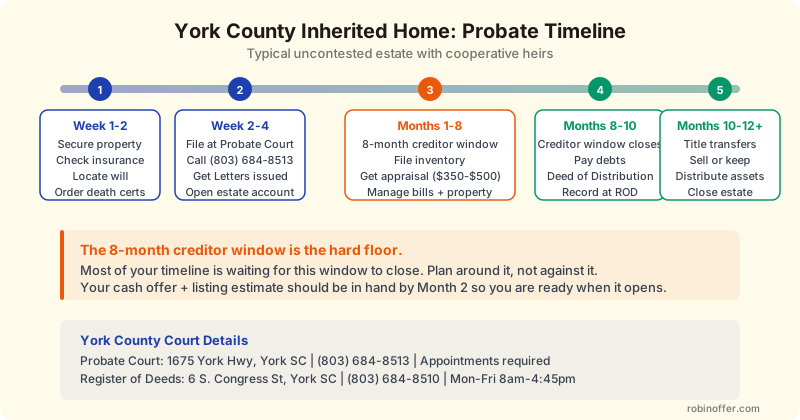
York County inherited-home timeline
| Timeframe | What happens | York County specifics |
|---|---|---|
| Week 1–2 | Secure property, locate will, order death certificates, check insurance | Call (803) 684-8513 to schedule appointment |
| Week 2–4 | File with Probate Court, apply for Letters Testamentary (with will) or Letters of Administration (no will) | Bring complete packet — appointments required |
| Month 1–2 | Personal representative appointed, estate bank account opened, creditor notice published in local newspaper | Publication in The Herald (Rock Hill) or The York Observer |
| Months 2–8 | Inventory filed, property appraised, bills managed, creditor claims received and resolved | Attend 3rd-Wednesday inventory session if needed |
| Months 8–10 | Creditor window closes, debts paid, Deed of Distribution petitioned | Record Deed of Distribution at Register of Deeds, 6 S. Congress St, York |
| Months 10–12+ | Deed recorded, property transferred to heirs or sold, estate closed | If selling: attorney-supervised closing per SC law |
Can you sell before the estate closes?
Yes — and in York County this is common when carrying costs are high and heirs want out. The personal representative petitions Judge Woodruff's office for authority to sell, which is typically granted when the will includes a power-of-sale clause or when selling is necessary to pay estate debts. If neither applies, all interested parties can consent in writing. The PR files Form 430ES (Petition to Sell Real Property) and, once approved, can list or accept a cash offer. Proceeds enter the estate account and are distributed per the will or intestate law after the creditor window closes.
What you cannot do: an individual heir cannot independently sell before the Deed of Distribution transfers title. Without that deed recorded at the York County Register of Deeds, no title company will insure the transaction.
The small-estate shortcut: does your estate qualify?
If the total probate estate (not counting non-probate assets like life insurance or retirement accounts with named beneficiaries) is worth $45,000 or less, you may bypass formal probate entirely using a small estate affidavit under SC Code §62-3-1201. This threshold was raised from $25,000 to $45,000 effective May 8, 2025 (Act No. 26, H.3472, signed unanimously). You must wait at least 30 days after death to use this path.
In practice, very few York County inherited houses qualify. At a median sale price of roughly $330,000 in Rock Hill and $530,000 in Fort Mill, the property value alone exceeds the threshold many times over. The small estate affidavit is more relevant when the house was the decedent's only probate asset and it transferred outside of probate (e.g., through a trust or joint tenancy with right of survivorship).
4. What the House Is Costing You Every Month: York County Carrying Costs
An inherited house does not wait for probate to finish costing money. From the day the owner passes, someone is paying the mortgage, the property taxes, the insurance, and the utilities — or those bills are piling up against the estate. Here is what that looks like in York County.
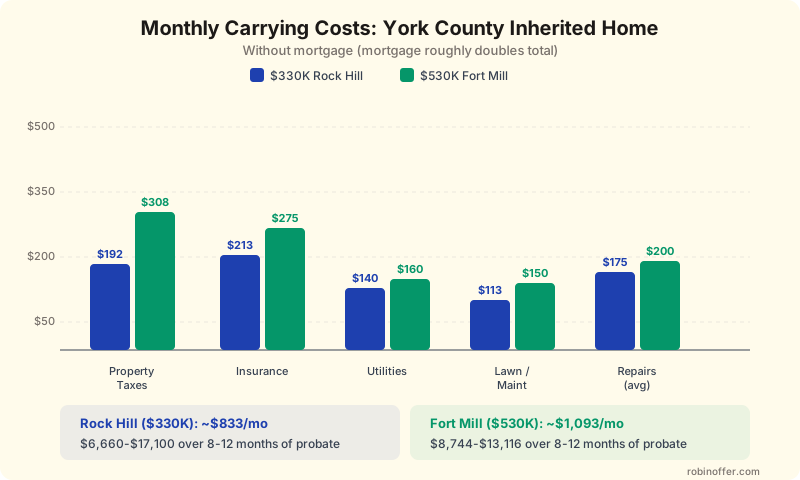
Monthly carrying costs on a typical York County inherited home
| Expense | Monthly estimate ($330K Rock Hill home) | Monthly estimate ($530K Fort Mill home) | Annual range |
|---|---|---|---|
| Property taxes (6% non-owner-occupied rate) | $165–$220 | $265–$350 | $2,000–$4,200 |
| Homeowner's insurance (or vacant-property policy) | $150–$275 | $200–$350 | $1,800–$4,200 |
| Utilities (electric, water, gas — even vacant) | $100–$180 | $120–$200 | $1,200–$2,400 |
| Lawn care / exterior maintenance | $75–$150 | $100–$200 | $900–$2,400 |
| HOA dues (if applicable) | $50–$350 | $100–$500 | $600–$6,000 |
| Mortgage payment (if remaining loan) | $1,200–$2,000+ | $2,000–$3,500+ | $14,400–$42,000+ |
| Unexpected repairs (averaged) | $100–$250 | $100–$300 | $1,200–$3,600 |
Without a mortgage: a Rock Hill inherited home runs roughly $640–$1,425 per month in carrying costs. Over the 8–12 months of probate, that is approximately $5,100–$17,100 coming out of the estate before you sell.
With a mortgage: the total roughly doubles. A Fort Mill home with a $2,500 mortgage payment and $1,200 in other carrying costs burns through $3,700 per month — $44,400 per year. Every month of delay in reaching a sale decision costs real money.
The property tax trap: owner-occupied vs. non-owner-occupied
South Carolina assesses owner-occupied homes at 4% of fair market value and non-owner-occupied homes at 6% — a 50% increase in the assessment ratio. When the owner dies and the house sits vacant, the assessment shifts to 6% at the next tax cycle. If the deceased qualified for the homestead exemption (available to homeowners 65+, disabled, or legally blind), that exemption also ends.
On a $330,000 Rock Hill home, the shift from 4% to 6% assessment raises the annual property tax by roughly $600–$900, depending on the local millage rate. This is not a penalty — it is the standard rate for property that is not someone's primary residence.
The insurance gap that catches every heir
When the homeowner dies, their insurance policy does not automatically transfer to you. Most policies have vacancy clauses that can void coverage after 30–60 days of an empty home. The named insured is deceased, which means claims can be denied. You need to call the insurance company in the first week and either add the estate as named insured, transfer the policy, or get a standalone vacant-property policy.
York County's climate creates specific risks for vacant homes. Summer humidity drives mold growth in sealed-up houses — especially in Rock Hill and Fort Mill, where HVAC systems running at minimal levels cannot control moisture. Winter freezes can burst pipes if the thermostat drops below 55°F. Have someone check the property at least monthly.
Carrying costs adding up on the inherited house?
Get a free, no-obligation cash offer on the property — any condition, no repairs or showings — so you have a real number to compare before carrying costs eat into the estate.
5. Taxes on an Inherited House in York County: The Step-Up That Changes Everything
If you sell an inherited house in York County, the tax picture is genuinely favorable — and the stepped-up basis is why.
How the stepped-up basis works
When you inherit property, your cost basis "steps up" to the fair market value on the date of death (IRC §1014). This eliminates decades of appreciation from your taxable gain.
| Scenario | Amount |
|---|---|
| Original purchase price (1995) | $85,000 |
| Fair market value at date of death (2026) | $330,000 |
| Your stepped-up basis | $330,000 |
| You sell 6 months later for | $325,000 |
| Taxable capital gain | $0 (you sold below basis) |
Without the step-up, your taxable gain would have been $240,000. With it, zero. Sell soon after inheriting, and you likely owe little or no capital gains tax. This is the single most important tax concept for heirs to understand.
Get the appraisal now, not later
A date-of-death appraisal ($350–$500) establishes your stepped-up basis with documentation the IRS will accept. Without it, proving your basis years later becomes a guessing game. Order the appraisal within the first few weeks of death, even if you do not plan to sell immediately.
What if you keep the house for years?
The stepped-up basis freezes at the date-of-death value. Any appreciation after that date is taxable. If you inherited a Rock Hill home at $330,000 and sell five years later for $390,000, you owe capital gains on $60,000 — but inherited property automatically qualifies for long-term rates regardless of holding period, and the Section 121 primary-residence exclusion ($250,000/$500,000 married) can apply if you move in. Our SC inherited property guide covers the full tax picture in detail.
South Carolina state taxes on inherited property
| Tax | SC rate | Notes |
|---|---|---|
| SC estate tax | None | SC has no state estate tax |
| SC inheritance tax | None | SC does not tax inherited assets |
| SC capital gains tax | 0%–6% (effective max ~3.4%) | SC allows a 44% deduction on net capital gains |
| Federal estate tax | Applies only to estates above ~$13M+ (indexed annually for inflation) | Does not apply to the vast majority of York County estates |
| SC deed recording fee | $1.85 per $500 of value | Split: $1.30 state + $0.55 county. Paid at closing. |
SC nonresident seller withholding — if you live out of state
If you inherited a York County house but live in another state, SC requires withholding on the sale. The standard rate is 7% of the recognized gain — not 7% of the sale price — when the seller provides the standard I-295 affidavit (your closing attorney will handle this). Without the affidavit, withholding is calculated on the full sale price. This is a common confusion point; make sure your attorney files the I-295.
6. Multiple Heirs and Sibling Disagreements: The Hardest Part of Selling
A single heir with a clear will and a cooperative estate attorney can move through probate on a clean timeline. Multiple heirs change everything. When two, three, or five siblings inherit a house together, every decision — sell or keep, price or discount, renovate or sell as-is — requires agreement or a legal mechanism to break the impasse.
How SC intestate succession divides a York County house
If there is no will, SC law (§62-2-102 and §62-2-103) sets the shares. Here is what that looks like on a $330,000 Rock Hill home:
| Surviving family | How it splits | Each share on a $330K home |
|---|---|---|
| Spouse only, no children | Spouse inherits entire estate | $330,000 |
| Spouse + 2 children | Spouse gets ½; children split ½ | Spouse: $165,000. Each child: $82,500 |
| 3 children, no spouse | Children share equally | Each: $110,000 |
| No spouse, no children | Parents → siblings → extended family | Varies by the number of heirs |
When three siblings each inherit a one-third interest in a $330,000 Rock Hill home, no one sibling can sell without the others. And when one wants to cash out, one wants to keep it, and one lives 800 miles away and will not return calls, the estate stalls. For the full state-level intestate rules, see our SC inherited property guide.
When heirs disagree: partition under SC law
If heirs cannot agree on what to do with the property, any co-owner can file a partition action. In South Carolina, partition is governed by statute, and the process generally works like this: the court first considers whether the property can be physically divided. If it cannot be divided without substantial injury to any party, the court may order a sale — but that is the exception, not the default. The burden of proving that a sale is necessary falls on the party requesting it.
A partition action in York County goes through the Circuit Court (not Probate Court) and adds months of legal proceedings plus attorney fees that come out of the sale proceeds. It is the nuclear option, and everyone loses money when it happens.
Practical alternatives to a partition fight
- Buyout: one heir buys out the others at fair market value. On a $330,000 home with three equal shares, each share is worth $110,000. The buying heir can finance this or use cash. Get an independent appraisal — do not negotiate from a guess.
- Agree to sell and split proceeds: the simplest path if everyone is willing. The personal representative lists or accepts a cash offer, the estate pays debts, and the net proceeds are divided per the will or intestate law.
- One heir keeps the property and pays rent to the estate: a short-term solution while the estate sorts out next steps, but it requires a written agreement on terms.
- Mediation: a neutral mediator helps heirs reach agreement without going to court. Costs $1,000–$3,000 total, split among the parties. Far cheaper than partition litigation.
7. Title Transfer and the Deed of Distribution: The Document That Unlocks the Sale
In South Carolina, real property must go through probate to transfer title from a deceased owner to the heirs. The key document is the Deed of Distribution — issued by the Probate Court after debts are paid and the estate is ready for distribution. Without it, you do not have marketable title, and no title company will insure a sale.
The title transfer sequence in York County
- Personal representative is appointed and receives Letters Testamentary (with will) or Letters of Administration (no will)
- Creditor notice is published; 8-month creditor window runs
- Estate debts are paid from estate funds
- Personal representative petitions Probate Court for Deed of Distribution
- Court issues Deed of Distribution transferring property to the designated heir(s)
- Deed is recorded at the York County Register of Deeds, 6 South Congress Street, York, SC 29745, phone (803) 684-8510
- Once recorded, the heir(s) hold marketable title and can sell
Recording the deed: what it costs and where to go
| Item | Fee | Notes |
|---|---|---|
| Base recording fee | $15 | Per document |
| Deed recording fee (transfer tax) | $1.85 per $500 of value | $1.30 state + $0.55 county |
| Certified copy | $10 | Per document — get at least two |
On a $330,000 property, the deed recording fee is approximately $1,221 (660 units of $500 × $1.85). On a $530,000 property, approximately $1,961. This is paid at the time of recording and is separate from any closing costs on a later sale.
The York County Register of Deeds office is open Monday through Friday, 8:00 AM to 4:45 PM. Online records are searchable from 1979 (deeds and plats) and 1982 (mortgages) at search.yorkdeeds.com. The office also offers a free property-recording fraud alert — you can set up email notifications whenever a document is recorded against your property's name. Sign up at the same search portal.
Title problems that inherited properties carry
Inherited houses in York County frequently arrive with title complications that a standard market listing does not. Common issues:
- Unreleased liens: old mortgages, judgment liens, or tax liens that were paid but never released of record
- Break in the chain of title: a prior owner died without probating, and the deed was never properly transferred
- Heirs' property: property passed down through generations without a will or recorded deed, creating multiple unnamed owners
- Encroachments or survey issues: fences, driveways, or outbuildings that cross property lines — common in older York County neighborhoods
A title search ($200–$400) before listing reveals these issues. It is far better to discover them while you have time to fix them than to have them surface during a buyer's due diligence and kill the deal.
Inherited house needs work you did not budget for?
We buy inherited homes in any condition in York County — no repairs, no showings, no financing delays. See what a cash offer looks like on your property.
8. York County's Housing Stock Reality: What Inherited Homes Actually Look Like
York County's median home was built around the year 2000, making the average house roughly 26 years old. But inherited homes are not average homes. They are, by definition, owned by the generation that bought them — often 20, 30, or 40 years ago. The house you inherit is almost certainly older than the county median, and it is carrying decades of deferred maintenance that the prior owner either could not afford or chose not to address.
What inherited homes in York County typically need
| System | Typical lifespan | What you will find in inherited homes | Replacement cost range |
|---|---|---|---|
| Roof (asphalt shingle) | 20–30 years | Original roof, missing shingles, visible wear | $8,000–$15,000 |
| HVAC | 15–20 years | Original unit, R-22 refrigerant (no longer manufactured) | $6,000–$12,000 |
| Water heater | 10–15 years | Rusted, inefficient, may be leaking | $1,200–$2,500 |
| Electrical panel | 25–40 years | 60-amp or 100-amp panel, may not support modern loads | $2,000–$4,000 |
| Plumbing | 40–70 years | Galvanized pipes corroding, low water pressure | $4,000–$15,000 (full repipe) |
| Foundation | Indefinite if maintained | Settling, cracks, moisture intrusion | $3,000–$25,000+ |
This is not a scare list — it is reality for houses built in the 1970s, 1980s, and 1990s that are now cycling through estate sales. A roof replacement alone can eat $12,000 from the estate, and most inherited homes need more than one system addressed.
The condition-vs-price decision
You have two choices with an inherited house that needs work: invest in repairs to sell at full market value, or sell as-is at a discount. Neither is inherently right — the math depends on the specific repairs, the local market, and how much time you have.
In York County, where the median days on market runs roughly 50–80 days depending on the city, a house that needs a new roof, HVAC, and cosmetic work will sit longer and attract fewer offers than a turnkey property. But spending $25,000–$40,000 on repairs during probate — when you do not yet have clear title and the estate is burning carrying costs — is a gamble. If the market shifts or the appraisal comes in low, you may not recover those dollars.
A cash sale skips this entire decision. A cash buyer purchases the house in its current condition, with no inspection contingencies, no appraisal requirements, and no financing delays. The trade-off is a lower sale price — typically 80% to 90% of market value — but the certainty and speed can be worth more than the discount, especially when carrying costs are running and multiple heirs want out.
9. Selling an Inherited House in York County: Every Path With Real Numbers
Once the estate can legally sell — either through personal representative authority during probate or after the Deed of Distribution — you have three paths for selling an inherited house in York County. Here is what each one looks like with real cost math.
Option 1: List with an agent
A traditional listing puts the house on the MLS, brings in buyer traffic, and typically produces the highest gross sale price. In York County, expect:
| Factor | Rock Hill ($330K home) | Fort Mill ($530K home) |
|---|---|---|
| Agent commissions (5–6%) | $16,500–$19,800 | $26,500–$31,800 |
| Repairs/prep | $5,000–$25,000 | $5,000–$30,000 |
| Closing costs (seller side) | $6,600–$9,900 | $10,600–$15,900 |
| Carrying costs during listing (3–4 months) | $1,900–$5,700 | $3,600–$8,400 |
| Timeline to close | 4–6 months | 3–5 months |
| Estimated net proceeds | $269,600–$301,000 | $443,900–$484,300 |
The listing path works best when the house is in reasonable condition, you have the time and capital for repairs, and heirs are aligned on the timeline. It works worst when the house needs major work, probate is still running, and heirs want different things.
Option 2: Sell For Sale By Owner (FSBO)
FSBO saves the listing agent's commission (2.5–3%) but requires you to handle marketing, showings, negotiations, and the legal paperwork — which in SC means coordinating with a closing attorney. On a $330,000 Rock Hill home, saving 3% means keeping $9,900. On a $530,000 Fort Mill home, $15,900.
For inherited properties, FSBO adds complexity. Buyers are wary of estate sales, title issues require careful disclosure, and the personal representative is a fiduciary who owes duties to the estate — not just to their own convenience. Most estate attorneys advise against FSBO for inherited properties unless the heir is experienced in real estate transactions.
Option 3: Sell to a cash buyer
A cash buyer purchases the house in its current condition — no repairs, no showings, no financing contingencies. In York County, the typical cash offer range is 80% to 90% of fair market value.
| Factor | Rock Hill ($330K home) | Fort Mill ($530K home) |
|---|---|---|
| Cash offer range (80–90% of value) | $264,000–$297,000 | $424,000–$477,000 |
| Agent commissions | $0 | $0 |
| Repairs | $0 | $0 |
| Closing costs (often covered by buyer) | $0–$3,300 | $0–$5,300 |
| Carrying costs (close in 2–4 weeks) | $320–$1,425 | $600–$2,100 |
| Timeline to close | 2–4 weeks after title clears | 2–4 weeks after title clears |
| Estimated net proceeds | $259,275–$297,000 | $416,600–$477,000 |
Notice how close the net proceeds are between paths — especially on the Rock Hill home. The listing path's higher gross price gets eaten by commissions, repairs, and months of carrying costs. The cash path's lower price comes with near-zero costs and a closing measured in weeks.
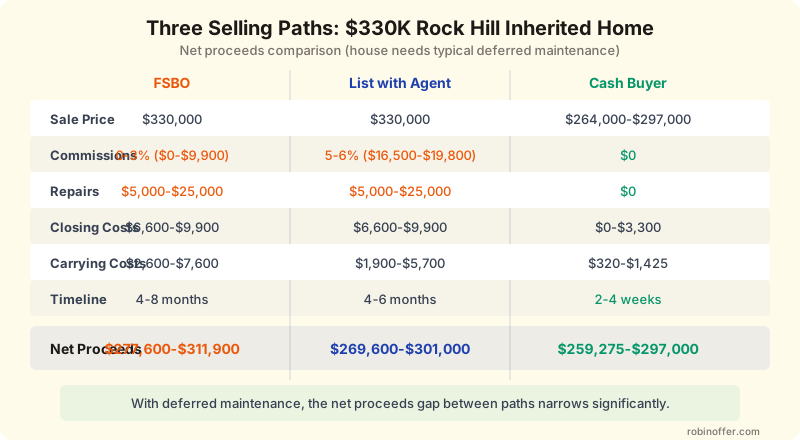
Side-by-side comparison
| Factor | List with agent | FSBO | Cash buyer |
|---|---|---|---|
| Highest gross price? | Yes | Possibly | No (80–90%) |
| Commissions | 5–6% | 0–3% (buyer's agent) | $0 |
| Repairs needed? | Usually yes | Usually yes | No |
| Timeline | 4–6 months | 4–8 months | 2–4 weeks |
| Certainty of closing | Moderate (financing, inspection, appraisal) | Lower | High |
| Best for inherited homes when… | House is in good condition, heirs can wait | Heir is experienced, house is turnkey | House needs work, heirs want closure, timeline is tight |
Get Your Free, No-Obligation Cash Offer
Tell us about the inherited property and we'll send a real cash offer — any condition, no repairs or showings, and you close on your timeline. Free and confidential.
10. The Master in Equity Connection: When Inherited Homes Face Foreclosure
The York County Master in Equity — the court office that conducts judicial foreclosure sales — operates from the York County Family Court at 1555 West Main Street in Rock Hill (temporarily relocated from the courthouse). Sales are held on the first Monday of every month, and the roster is posted online approximately three weeks ahead of each sale at publicindex.sccourts.org.
Why does this matter for inherited homes? Because inherited houses with existing mortgages are at elevated foreclosure risk. The owner has died, the automatic payments may have stopped, and the heirs — who may not even know about the mortgage — are not making payments while they figure out probate. The Garn-St. Germain Act prevents the lender from calling the loan due because of the death, but it does not prevent foreclosure for non-payment.
The inherited-home foreclosure timeline in SC
South Carolina foreclosure is judicial (court-based). From the first missed payment, the typical timeline runs 5–6 months uncontested, though it can stretch to 12+ months if the estate files a response. Here is how it overlaps with probate:
| Month | Foreclosure timeline | Probate timeline |
|---|---|---|
| 1–3 | Missed payments, servicer notices | Estate still being opened, no personal representative yet |
| 3–5 | Lis pendens filed, complaint served | Personal representative appointed, creditor notice published |
| 5–8 | Court hearing, judgment of foreclosure | Still in the creditor window — estate cannot close |
| 6–12 | Master in Equity sale scheduled | Creditor window closing, Deed of Distribution may be pending |
The risk is clear: foreclosure can overtake probate if no one is managing the mortgage. By the time heirs realize the payments have stopped, the lender may already be 3 months into the process.
What to do if the inherited house has a mortgage
- Keep making payments. This is the single most important action. Foreclosure does not pause for probate.
- Contact the servicer immediately. Notify them of the death and ask about loss-mitigation options. Many servicers will grant forbearance while the estate is being administered.
- Know your options: assume the existing mortgage (Garn-St. Germain gives you this right), refinance in your name, sell the property and pay off the balance, or — if the mortgage exceeds the home's value — walk away (you are not personally liable unless you signed the note).
- If the house has a reverse mortgage: the lender sends a "Due and Payable" notice within 30 days of death. You typically have 6 months (with possible extensions to 12 months) to sell, pay off the loan, or pay 95% of appraised value. Reverse mortgages are non-recourse — you will never owe more than the house is worth.
If you are already behind and a foreclosure filing has started, our South Carolina foreclosure help guide covers every option in detail. For immediate help, contact SC Housing or call a HUD-approved counselor through the HUD counselor locator at (800) 569-4287.
11. Local Resources: The York County Offices and Services You Will Actually Use
Here are the specific offices, phone numbers, and services that York County inherited-home sellers need. These are verified as of August 2026 — call to confirm hours before visiting, as county offices are temporarily relocated during courthouse renovations.
York County government offices
| Office | Address | Phone | What you need them for |
|---|---|---|---|
| Probate Court | 1675 York Highway, York, SC 29745 | (803) 684-8513 | Opening the estate, filing will, appointment, Deed of Distribution |
| Register of Deeds | 6 S. Congress Street, York, SC 29745 | (803) 684-8510 | Recording deeds, title searches, fraud alerts |
| Master in Equity | 1555 W. Main Street, Rock Hill, SC 29732 | (803) 628-3930 | Foreclosure sales, partition sales |
| Tax Office | 1070 Heckle Blvd, Suite 102, Rock Hill, SC 29732 | (803) 909-7272 | Property tax payments, delinquent tax info, assessment changes |
| Assessor's Office | York County Government Center | (803) 684-8526 | Property valuations, assessment ratio changes after owner's death |
Legal assistance
| Resource | Contact | What they help with |
|---|---|---|
| SC Lawyers Referral Service | (800) 868-2284 | Referral to local probate/real estate attorneys |
| Neighborhood Legal Assistance Program | (803) 327-9001 (Rock Hill office) | Free legal services for income-qualifying families |
| SC Bar Lawyer Referral | scbar.org | Find a probate attorney in York County |
| SC Legal Services | (888) 346-5592 | Free civil legal help for low-income residents |
Housing counseling
| Resource | Contact | What they help with |
|---|---|---|
| HUD-Approved Counselor Locator | (800) 569-4287 | Free foreclosure prevention counseling |
| SC Housing (schousing.com) | schousing.com | State housing assistance programs |
| DHEC Vital Records | (803) 898-3630 | Death certificates ($12 standard / $17 expedited) |
Online tools
- Probate court records: southcarolinaprobate.net/search (1975–present, $2/doc to print)
- Deed and mortgage records: search.yorkdeeds.com (deeds from 1979, mortgages from 1982)
- Foreclosure sale rosters: publicindex.sccourts.org/york
- Property recording fraud alert: free at search.yorkdeeds.com (click "recording alert")
12. Sell Your Inherited York County House: Which Path Fits Your Situation
If you are ready to sell an inherited house in York County, you now know the probate timeline, the carrying costs, the tax implications, and your selling options. Here is how to match your situation to a path.
Situation-based decision matrix
| Your situation | Best path | Why |
|---|---|---|
| House is turnkey, heirs agree, no mortgage pressure | List with an agent | Maximize gross price; you have time and the house shows well |
| House needs $20K+ in work, multiple heirs want out | Cash sale | No repair investment, fast closure, clean split of proceeds |
| One heir wants to keep the house | Buyout at appraised value | Clean break; buying heir takes mortgage or pays cash |
| Mortgage is behind, foreclosure risk | Cash sale (urgent) | Fastest path to payoff before Master in Equity sale date |
| House has title problems or heirs' property issues | Probate attorney first, then decide | Clear title before any sale path is possible |
| Estate is under $45K (excluding non-probate assets) | Small estate affidavit | Skip formal probate entirely under SC Code §62-3-1201 |
| You live out of state and cannot manage the property | Cash sale or agent with full delegation | Remote management of an inherited house is expensive and stressful |
The 30-day action plan
| Week | Action | Who handles it |
|---|---|---|
| Week 1 | Secure property, check insurance, locate will, order death certificates, check for mortgage | You or designated family member |
| Week 2 | Call York County Probate Court (803-684-8513), schedule appointment, gather documents | Designated personal representative |
| Week 3 | File with Probate Court, open estate bank account, notify mortgage servicer | Personal representative + attorney |
| Week 4 | Order date-of-death appraisal, get cash offer and listing estimate, convene heirs to decide | Personal representative + all heirs |
You do not have to decide everything in 30 days. But if you complete this checklist in the first month, you will have the legal authority, the property valuation, and the option comparison you need to make a smart decision rather than a pressured one.
What comes next
If you are leaning toward selling with an agent, explore our Rock Hill homeowner guide or Fort Mill homeowner guide for city-specific market data. If you want to understand the full probate process in detail, our How Probate Works in SC guide covers every step. If you are ready to see what a cash offer looks like on your inherited property, we will run the numbers for you — no obligation, no pressure, and no repairs required.
For broader guidance on cash offers in the Carolinas — how they work, what to expect, and how to vet a buyer — see our cash offer guide.
Ready to See the Numbers for Your Inherited Home?
Get a free, no-obligation cash offer on the inherited property — any condition, no repairs, and close when the estate is ready. No pressure.
13. Frequently Asked Questions About Selling an Inherited House in York County
How long does probate take in York County, SC?
SC probate typically takes 8 to 12 months due to the 8-month creditor claim window. Uncontested estates with cooperative heirs sometimes finish closer to 8 months; contested estates can stretch past 18 months.
Can I sell an inherited house in York County before probate is finished?
Yes, if the will grants the personal representative authority to sell real property, or if the court grants permission, or if all interested parties consent. The proceeds become estate assets distributed per the will or intestate law.
Do I pay capital gains tax on an inherited house in South Carolina?
Your cost basis steps up to the fair market value on the date of death. If you sell soon after inheriting, you likely owe little or no capital gains tax. SC has no state estate or inheritance tax. SC capital gains are taxed at an effective max of about 3.4% after the 44% deduction.
What is the York County Probate Court phone number and address?
York County Probate Court is temporarily at 1675 York Highway, York, SC 29745 (Moss Justice Center) while the historic courthouse is renovated. Phone: (803) 684-8513. Hours: Monday–Friday 8 AM–5 PM. Appointments are required for all estate administrations.
How much does probate cost in York County, SC?
Court filing fees are $95 base plus 0.15% of the estate value over $100,000. On a $330,000 estate, that is approximately $440. Attorney fees typically run $2,500–$6,000 for a straightforward estate. Total probate costs are generally $3,500–$8,000.
This guide is for informational purposes only and does not constitute legal, tax, or financial advice. South Carolina real estate closings require attorney supervision. Consult a licensed attorney and tax professional for guidance specific to your situation. All data is sourced from public records, Redfin, and official York County government resources and was verified as of August 2026.