
Concord: Speedway City, Lilly Campus, Real Selling Math
A local guide for Concord homeowners navigating a $375K median market with 12 distinct neighborhoods, $2B in new investment, and four selling paths.
Selling a house in Concord, NC in 2026 means navigating a $375,000 median market where homes average 52 days on market and buyers negotiate to 97.6% of list. This guide breaks down every selling option with Concord-specific numbers, neighborhood pricing, and net proceeds math.
Concord is not Charlotte's quiet suburb anymore. With 116,000 residents, a $2 billion Eli Lilly manufacturing campus shipping medicines to patients, 17 million annual visitors flowing through Concord Mills, and a downtown that just won a statewide design award for its Union Street transformation, this city has its own economic gravity. That changes how you sell here. Your buyer pool includes Eli Lilly engineers, Atrium Health nurses, NASCAR industry workers, and Charlotte commuters who discovered that 25 minutes on I-85 buys them a bigger yard and a lower tax bill. Understanding which buyer is most likely to walk through your door is the first step to pricing correctly.
1. What 116,000 Residents and 17 Million Visitors Mean for Your Home
Concord sits in a category most Charlotte-metro cities never reach: it is both a bedroom community and a destination. Charlotte Motor Speedway draws hundreds of thousands of race fans annually. The Coca-Cola 600 alone fills every hotel room in Cabarrus County and packs restaurants from Union Street to Derita Road. Concord Mills, the largest outlet and value retail shopping destination in North Carolina with over 200 stores, pulls roughly 15 million shoppers a year. SEA LIFE Aquarium, Great Wolf Lodge, the zMax Dragway, and the speedway's concert events fill hotel rooms year-round.
That tourism infrastructure creates something unusual for homeowners: a deep service-sector employment base that generates renter demand even when the for-sale market softens. The 4,000 jobs at Concord Mills alone represent a permanent demand floor for housing in the immediate area. When you add Atrium Health Cabarrus with over 4,500 employees, S&D Coffee with 1,100 workers, and Corning Incorporated, Concord has an employment diversity that Charlotte bedroom communities like Weddington or Marvin simply do not possess.
The population has grown 11% since the 2020 census, adding roughly 12,000 new residents in six years. Cabarrus County as a whole now tops 253,000 people and ranks as the 10th-largest county in North Carolina. That growth is not slowing. The city approved a $382.6 million budget for FY2026 without raising the property tax rate, a sign that the tax base is expanding on its own through new construction and commercial investment. Concord was named the #24 Best Place to Live nationally by Livability.com in 2026, the top ranking for any North Carolina city.
For sellers, this matters in a specific way: you are not selling into a thin buyer pool. The demand mix is diverse. First-time buyers priced out of south Charlotte look northeast. Move-up families from Kannapolis and Harrisburg look for better school zones and newer amenities, and that pipeline is set to deepen as $500M of investment lands in Kannapolis next door. Relocating Eli Lilly hires arrive with relocation packages and tight deadlines. Investors chase the $1,900 median rent. Each buyer type values different things. A Lilly engineer cares about commute time to the Poplar Tent corridor campus. A young family cares about Cabarrus County school ratings (math proficiency at 62%, reading at 58%, both above the state average). An investor cares about rent-to-price ratio and Section 8 qualification. Your pricing and marketing strategy should reflect which segment your home attracts.
| Concord Indicator | Current Value | Why Sellers Should Care |
|---|---|---|
| Population (2026 est.) | 116,559 | Large buyer pool; not reliant on a single employer or industry |
| Population growth since 2020 | +11.1% | Sustained demand supports home values better than stagnant markets |
| City budget (FY2026) | $382.6 million | Strong public services and infrastructure investment signal stability |
| Annual Concord Mills visitors | ~15 million | Tourism drives service-sector jobs and rental demand |
| Livability.com ranking (2026) | #24 nationally, #1 in NC | National recognition attracts relocation buyers who search online first |
| Cabarrus County Schools | 35,016 students, 44 schools | Above-average test scores attract families who will pay for school zone access |
2. Concord's Market Pulse: A $375K Median in a Buyer-Friendly Moment
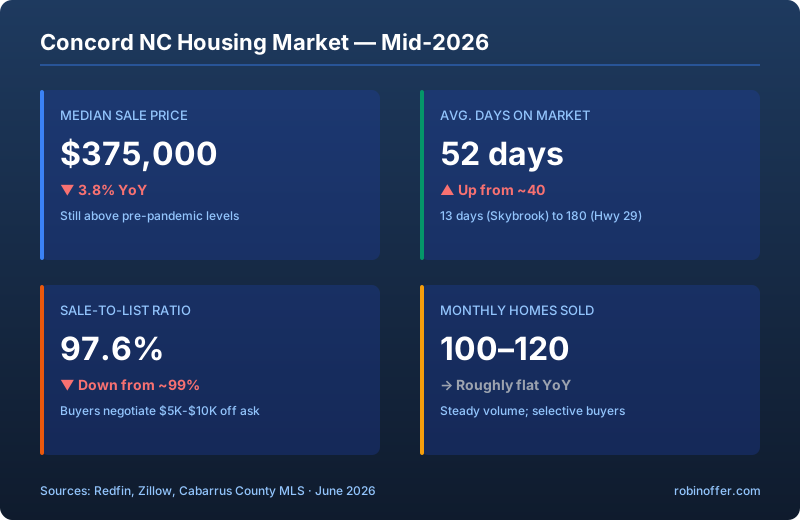
The Concord housing market in mid-2026 is what professionals call "somewhat competitive." That is a polite way of saying sellers still have leverage on well-prepared homes, but the days of multiple offers on everything are gone. The median sale price sits around $375,000, with the Zillow Home Value Index at $362,762, down 1.1% year-over-year. Homes are taking longer to sell than they did during the pandemic frenzy. The sale-to-list ratio has dipped to 97.6%, meaning most buyers are negotiating $5,000 to $10,000 off asking price.
But averages lie in Concord more than most cities. A move-in-ready home in Afton Ridge or Christenbury with updated systems and good curb appeal sells in 30 to 45 days, often with minimal negotiation. An older ranch along the Highway 29 corridor with a dated kitchen and deferred roof work can sit for 120 to 180 days, attracting only investors and bargain hunters who will negotiate hard. Your sub-market matters more than the city median. This is the most important sentence in this section: do not price your home based on the Concord average if your home is not average.
The price-band reality in Concord looks different from most Charlotte-metro cities because of the enormous spread between old and new inventory. New construction runs $200 to $240 per square foot, while older unrenovated homes price at $100 to $130 per square foot. That means a 2,000-square-foot new build lists at $400,000 to $480,000, and a same-size 1985 ranch in fair condition lists at $200,000 to $260,000. Both are "Concord homes" but they compete in completely different markets with completely different buyers.
Monthly transaction volume runs around 100 to 120 homes sold, roughly flat year over year. That tells us buyers are present and active but not frantic. They are comparison shopping. They are visiting multiple subdivisions. They are running their own payment calculators and checking builder incentive sheets. In this environment, your first-week pricing strategy determines whether you sell at a fair price in 45 days or chase price cuts for four months.
| Market Metric | Concord (Mid-2026) | YoY Change | What It Signals |
|---|---|---|---|
| Median sale price | $375,000 | -3.8% | Price correction after 2021-2023 run-up; still above pre-pandemic levels |
| Zillow Home Value Index | $362,762 | -1.1% | Broad softening but not a crash; values remain historically strong |
| Avg. days on market | 52 days (county avg) | Up from ~40 | Homes sitting longer; preparation and pricing matter more |
| Sale-to-list ratio | 97.6% | Down from ~99% | Buyers have negotiation room; overpricing costs you more than before |
| Monthly homes sold | ~100-120 | Roughly flat | Transaction volume is steady; buyers are present but selective |
| New construction price/sqft | $200-$240 | Stable | Builders are your competition if you are in the $300K-$450K range |
| Older home price/sqft | $100-$130 | Soft | Condition gap drives a massive per-sqft discount versus new builds |
3. The $2 Billion Bet: How Eli Lilly Reshapes Concord Real Estate
In January 2022, Eli Lilly announced a $1 billion investment in Concord. They purchased just over 400 acres at The Grounds at Concord, the former Philip Morris plant site, and broke ground on an 800,000-square-foot, five-building manufacturing campus. Then they doubled down. As demand for their injectable medicines surged, the investment grew to over $2 billion. The facility began commercial production and shipped its first medicines to patients at the end of 2024. Among its products are Mounjaro and Zepbound, two of the most in-demand pharmaceuticals on the planet.
The 589 new jobs are not warehouse positions. They are scientists, engineers, and manufacturing specialists earning an average salary above $70,000. Many are relocating from Indianapolis, Research Triangle Park, and other Lilly sites across the country. These workers need housing, and they need it in a reasonable commute radius from the northeast Concord campus off Poplar Tent Road. That creates a specific demand corridor: Poplar Tent Road, the George Liles Parkway area, Harrisburg-adjacent neighborhoods, and the newer subdivisions north of Concord Mills.
For context, this is the second-largest economic development announcement in the history of Cabarrus County. The first was the Philip Morris plant itself, which operated on the same site for decades before closing. The symbolism is not lost on anyone who has watched this county evolve. The Grounds at Concord went from closed factory to billion-dollar life sciences campus in less than three years. That transformation signals long-term economic confidence that directly supports property values.
Beyond direct employment, the Lilly campus generates supplier and service-sector jobs. Restaurants, daycares, auto repair shops, medical offices, and specialty retail all follow when 600 households with above-median income arrive in a market. Rowan-Cabarrus Community College has expanded training programs to support the advanced manufacturing workforce. Cabarrus College of Health Sciences feeds the healthcare pipeline. The downstream effect on home values is real but gradual. You will not see a 10% price spike overnight. What you will see is a floor under demand that protects Concord from the sharper downturns that hit one-industry towns.
Ford Performance Racing School also recently selected Charlotte Motor Speedway as headquarters for its new east coast venue, adding another employer to the motorsports cluster that already anchors this part of the county. Between NASCAR team operations, the speedway, and racing-adjacent businesses, the motorsports economy in Concord employs thousands of workers who might otherwise need to commute to Mooresville or Charlotte.
4. Downtown's Second Life and the Streetscape That Changed Union Street
If you have not walked downtown Concord lately, you are missing one of the best small-city turnaround stories in the Charlotte metro. The Union Street Streetscape project, completed with a ribbon cutting on May 3, 2025, delivered 22-foot-wide sidewalks, reduced travel lanes to 11 feet to calm traffic, added 11 parking spaces including two new ADA-accessible spots, installed smart light poles and decorative lighting, created outdoor dining and cafe zones, updated underground utilities, added public art installations, and created designated pedestrian drop-off zones.
The project earned a 2025 Award of Merit for Best Outdoor Space Improvement from the North Carolina Main Street and Rural Planning Center, with the award presented during the statewide ceremony on March 11, 2026. This is not just a nice thing to mention at dinner parties. It directly impacts how buyers perceive Concord. When a relocating family Googles "Concord NC downtown," they find photos of a walkable, inviting streetscape with local restaurants, boutiques, the historic Davis Theatre for performing arts, and the Cabarrus Arts Council. That perception shapes willingness to pay. Towns with revitalized downtowns consistently outperform comparable towns without them because buyers want a place, not just a subdivision.
The city is not stopping at Union Street. The FY2026 budget includes $1.8 million for the Clarke Creek Greenway, the first phase of the Cox Mill Loop project, part of an ambitious goal to build 30 miles of connected greenway by 2030. Four new police officer positions were funded specifically for downtown safety. Fire Station #13 is under construction. The $4.4 million allocated for street and sidewalk projects plus $3.7 million for annual resurfacing means roads and infrastructure are keeping pace with growth. The $1.8 million dedicated to affordable housing initiatives shows the city is also thinking about workforce housing, which matters for the service-sector employees who staff Concord Mills, the speedway, and the hospitality industry.
City Manager Lloyd Payne stated the FY2026 budget maintains service quality "without asking for more from taxpayers," achieved through strategic prioritization and a growing tax base that generates revenue without rate increases. For sellers, this sends a powerful message to buyers: Concord is investing in itself, and your tax rate is not going up to pay for it.
| Recent Concord Investment | Details | Impact on Sellers |
|---|---|---|
| Union Street Streetscape | 22-ft sidewalks, smart lights, outdoor dining; completed May 2025; NC Main Street Award winner | Raises downtown-adjacent home values; improves city perception for all sellers |
| Eli Lilly campus | $2B+, 800K sqft, 589 jobs, avg salary $70K+; shipping medicines since late 2024 | Creates sustained buyer demand in northeast Concord corridor |
| Clarke Creek Greenway | $1.8M Phase 1; part of 30-mile greenway plan by 2030 | Greenway-adjacent homes typically command 3-5% premiums |
| Fire Station #13 | New construction, funded in FY2026 budget | Improved response times lower insurance costs in served area |
| Avelo Airlines expansion | 3-aircraft base at Concord-Padgett Airport; flights to NY, FL, PR | Direct flights make Concord attractive for frequent business travelers |
| Concord Farms (proposed) | 557-acre, 1,896-unit mixed-use by D.R. Horton; sewer allocation denied, withdrawn | If eventually approved, would add significant housing supply to south Concord |
5. Twelve Neighborhoods, Twelve Price Tags: Where Your Home Fits
When you sell your house in Concord NC, the first thing to understand is that "I live in Concord" tells a buyer almost nothing about what your home costs. The range spans from $120,000 older homes along the Highway 29 corridor to $1 million-plus estates in Christenbury's gated section. Understanding where your home sits in this spectrum, and who your most likely buyer is, drives every decision from pricing to preparation to marketing channel.
The northeast quadrant of Concord, anchored by Poplar Tent Road and running toward Harrisburg, is where most new construction and higher-value subdivisions sit. Skybrook North, Christenbury, and newer Poplar Tent corridor communities command the strongest per-square-foot prices and sell the fastest. This is the corridor closest to the Eli Lilly campus, and relocation buyers naturally gravitate here because the commute is short and the neighborhoods are established.
The southwest side of Concord, including Moss Creek and areas near the Cabarrus-Mecklenburg county line, offers solid family neighborhoods at moderate price points. These communities attract Charlotte-adjacent buyers who want Cabarrus County schools and a Concord mailing address without paying Christenbury prices. Highland Creek, which straddles the Concord-Charlotte border, gives buyers access to a golf course and active community life with the flexibility of either city's services.
Downtown and south Concord represent the value tier. Older homes near Union Street or along the Highway 29 corridor can be genuine bargains for buyers willing to renovate, but they attract a fundamentally different buyer profile: investors, house hackers, first-generation homebuyers, and cash buyers looking for rental inventory. Selling in this tier requires patience, realistic pricing, and an understanding that your buyer may need FHA financing with its stricter property requirements.
| Neighborhood / Area | Typical Price Range | Character | Avg. Days on Market | Most Likely Buyer |
|---|---|---|---|---|
| Christenbury (gated) | $700K-$1.2M | Upscale, amenity-rich, manicured; townhomes from $300K | 45-75 | Executive relocations, move-up families |
| Skybrook / Skybrook North | $500K-$680K | Newer construction, top schools, community pool and trails | 13-30 | Dual-income families, Lilly/Atrium employees |
| Afton Ridge / Afton Village | $300K-$450K | Mixed new and established; walkable village center in Afton Village | 30-45 | Young families, first-time move-up buyers |
| Poplar Tent Corridor | $320K-$500K | Newer subdivisions, strong school zones, close to Lilly campus | 30-45 | Relocating professionals, commuters |
| Moss Creek | $350K-$425K | Master-planned, parks, family-oriented, southwest Concord | 35-50 | Families with school-age children |
| Highland Creek (Concord side) | $350K-$500K | Golf course, active social calendar; straddles Charlotte border | 30-50 | Golf enthusiasts, Charlotte-adjacent buyers |
| Rocky River Crossing | $280K-$380K | Established subdivision, quiet, well-maintained | 40-55 | Value-focused families, downsizers |
| Kellswater Bridge | $350K-$475K | Newer community, resort-style pool, walking trails | 35-50 | Young professionals, growing families |
| Quail Hollow | $250K-$350K | Established, 85% owner-occupied, neighborly feel | 45-60 | Owner-occupant buyers, local move-up |
| The Mills at Rocky River | $250K-$330K | Newer affordable construction, community amenities | 35-50 | First-time buyers, young couples |
| Historic Downtown | $180K-$350K | Charm and character; some need updating; walkable to Union Street | 60-120 | Investors, renovation buyers, downtown workers |
| Highway 29 / South Concord | $120K-$220K | Older ranches, larger lots, more affordable; some deferred maintenance | 90-180 | Investors, cash buyers, first-time budget buyers |
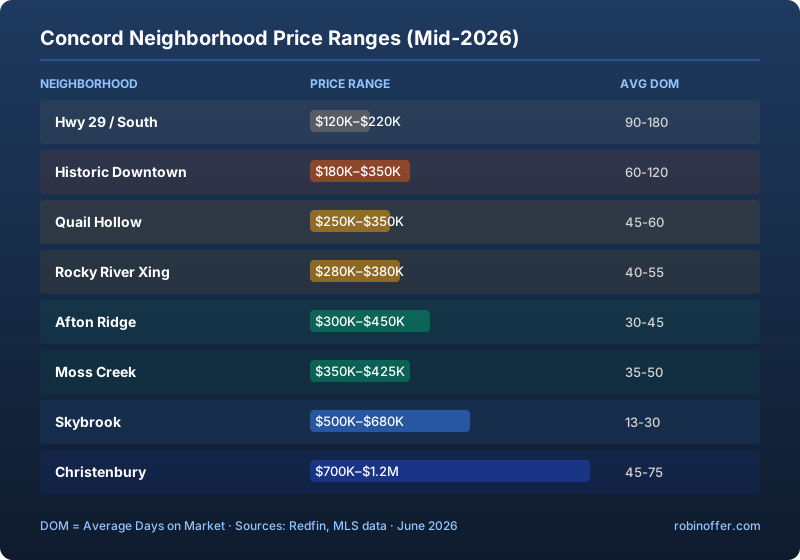
The gap between Skybrook's 13-day average and Highway 29's 120+ days is not a typo. It reflects fundamentally different buyer expectations. Skybrook attracts pre-approved families who have already narrowed their search to two or three subdivisions. They tour on Saturday, submit an offer Sunday, and enter due diligence by Wednesday. Highway 29 attracts price-sensitive buyers and investors who move slowly, negotiate hard, and may need FHA or VA financing with additional property condition requirements. Both can be sold well, but the strategy is completely different.
One pattern we see repeatedly: sellers in established neighborhoods like Rocky River Crossing or Quail Hollow pricing as if they were in Skybrook. Those are genuinely good neighborhoods with solid homeowner bases, but they attract a different buyer at a different price point. A $280K home in Rocky River priced at $340K does not become a Skybrook comp. It becomes a stale listing that sits through two price reductions before selling at $285K after 90 days and $6,000 in extra carrying costs.
See what your Concord home is worth
Get a real, data-driven estimate based on your specific neighborhood and recent comps.
6. I-85, Avelo Airlines, and Why Concord Is Not Just a Bedroom Community
Concord's position on I-85 makes it one of the most accessible cities in the Charlotte metro. Uptown Charlotte is 20 to 25 miles southwest, reachable in 25 to 35 minutes outside rush hour. During peak commute, that stretches to 45 to 60 minutes, particularly through the I-85/I-485 interchange. But the commute story has evolved beyond "how long to get to Charlotte." Concord now generates enough of its own employment that many residents work locally.
Consider the employer footprint: Eli Lilly (589 and growing), Atrium Health Cabarrus (4,500+), Charlotte Motor Speedway (roughly 1,000), Concord Mills (4,000), S&D Coffee (1,100+), Lowe's regional distribution center, and Corning Incorporated. Add the hundreds of small businesses, restaurants, and service providers that support a 116,000-person city, and you have a self-contained economy. That self-sufficiency is a selling point buyers increasingly value as remote and hybrid work reshapes commute tolerance. A Concord homeowner who works remotely three days a week only commutes to Charlotte twice, cutting the rush-hour pain in half.
Concord-Padgett Regional Airport adds another dimension that most Charlotte-metro bedroom communities cannot match. Avelo Airlines recently expanded to a three-aircraft base at the airport, with direct flights to New York (Long Island), New Haven, Albany, Rochester, Lakeland/Orlando, and San Juan. For business travelers or families with relatives up the East Coast, having a small, TSA-pre-check-friendly airport 15 minutes from home is a genuine lifestyle upgrade over fighting through CLT's congestion, parking garages, and terminal walks.
Concord also benefits from proximity without dependence. You can reach Charlotte's South End restaurants, NoDa breweries, and Bank of America Stadium in 30 minutes. But you do not need to. Downtown Concord's Union Street has its own restaurant row. Concord Mills has its own entertainment complex. The speedway has its own event calendar. This "access plus independence" combination is something most metro suburbs cannot credibly claim, and it shapes how savvy agents market Concord properties to out-of-state buyers. Buyers weighing the I-77 corridor instead of I-85 are often comparing you against Huntersville's $568K median, a higher price point with Lake Norman access and Birkdale Village walkability. Understanding that comparison helps you articulate what Concord offers that the I-77 side does not: a lower entry price, its own employment base, and an airport with direct flights.
For sellers, this self-sufficiency narrative is marketing gold. You are not selling "a place to sleep before driving to Charlotte." You are selling a city with its own economy, its own entertainment, its own award-winning downtown, and its own airport with direct flights to six cities. Lead with that when buyers ask "why Concord?"
The schools reinforce this story. Cabarrus County Schools serves 35,016 students across 44 schools, with math proficiency at 62% versus the 51% state average and reading proficiency at 58% versus 50% statewide. The 89% graduation rate ranks in the top 20% of NC districts. Three higher education institutions, Rowan-Cabarrus Community College, Cabarrus College of Health Sciences, and Barber-Scotia College, serve the area. For families with school-age children, these numbers move the needle on where they choose to buy. If your home is zoned for a top-rated elementary or middle school, that should be in the first sentence of your listing description.
7. Selling With an Agent in Concord: What the 52-Day Average Actually Costs
The traditional agent path remains the most common way to sell in Concord, and for homes priced above $300,000 in desirable neighborhoods, it often delivers the highest gross sale price. But "highest price" is not the same as "most money in your pocket." You need to subtract the real costs and weigh them against your timeline and stress tolerance.
On a $375,000 Concord home, here is what the agent path typically looks like:
| Cost Category | Typical Amount | Notes |
|---|---|---|
| Agent commission (total) | $18,750 - $22,500 | 5-6% of sale price; negotiable but standard in this market |
| Pre-listing prep (repairs, staging, photos) | $2,000 - $8,000 | Higher for older homes; minimal for move-in-ready properties |
| Carrying costs during listing (52 days avg) | $3,500 - $5,500 | Mortgage, taxes, insurance, utilities while waiting for a buyer |
| Buyer concessions (common in 2026) | $3,750 - $7,500 | 1-2% closing cost assistance is now expected in this market |
| NC excise tax | $750 | $1 per $500 of sale price; non-negotiable |
| Title insurance + attorney fees | $1,500 - $2,500 | Seller typically pays for owner's title policy in NC |
| Total cost to sell | $30,250 - $46,750 | 8-12.5% of sale price before mortgage payoff |
The biggest variable is time. If your home sells in 30 days, your carrying costs drop by a third. If it sits for 90 days because you overpriced by $15,000, those costs nearly triple, and you often end up reducing your price anyway. In Concord's current market, the sellers who net the most are not the ones who list highest. They are the ones who price accurately on day one and attract serious buyers in the first two weeks when listing freshness drives the most showing activity.
Choosing your agent also means understanding how commissions work in 2026. The total commission is typically 5 to 6% of the sale price, split between the listing agent and the buyer's agent. Following the 2024 NAR settlement changes, buyer agent compensation is more openly negotiated, but in practice most Concord listings still offer 2.5 to 3% to the buyer's side. Offering less can reduce your buyer pool since agents naturally prioritize listings that compensate them fairly. On a $375K home, the 0.5% difference between offering 2.5% and 3% to the buyer's agent is $1,875. That is not the place to save money if it means fewer showings and a longer time on market.
One Concord-specific factor to watch: new construction competition. With over 100 new construction listings active in the city at any time and builders like D.R. Horton, Pulte, True Homes, and Meritage offering incentives such as rate buydowns, upgraded appliances, and closing cost credits, your resale home must clearly justify its price relative to a brand-new alternative. If a buyer can get a new 3-bed/2.5-bath with a 10-year builder warranty for $380,000 and a 5.5% bought-down rate, your 2005 home at $375,000 better offer something the new build cannot: a mature lot with shade trees, a finished basement, a location the builders have not reached, or a school zone that builder lots are not zoned into.
Choosing the right agent also matters more in Concord than in smaller markets. You want an agent who knows the neighborhood micro-markets, understands the builder competition, and has a strategy for positioning resale homes against new construction. Ask agents specifically: "What is your plan to compete with the builder incentives on Poplar Tent Road?" If they look confused, keep interviewing. For seasonal timing guidance, see our analysis of the best time to sell a house in the Carolinas, which breaks down month-by-month patterns that apply directly to Concord.
8. Selling Without an Agent: FSBO Math on a $375K Concord Home
Going For Sale By Owner in Concord saves you the listing agent's commission, typically 2.5 to 3% of the sale price. On a $375,000 home, that is $9,375 to $11,250 you keep. The appeal is obvious: who would not want to pocket an extra ten thousand dollars? But the savings come with tradeoffs that are especially relevant in a market where buyers have options and new construction dominates the middle price tiers.
The first tradeoff is MLS exposure. In Concord, where new construction dominates the $300K-$450K range, being invisible on the MLS means competing against builders who are spending thousands on Google ads, model homes, and buyer agent incentives. You can mitigate this with a flat-fee MLS listing service ($300-$500) that puts your home on the MLS without a traditional listing agreement. But you will still need professional photos, a pricing strategy, and the time to handle showings, negotiations, and paperwork.
The second tradeoff is legal complexity. North Carolina requires a specific residential property disclosure form, and mistakes or omissions can create liability that costs far more than the commission you saved. You will still need a real estate attorney for closing, typically $500 to $1,000 in Cabarrus County. Most FSBO sellers in NC still offer a buyer's agent commission of 2.5 to 3% because roughly 87% of buyers use agents. Refusing to pay this does not save you money; it shrinks your buyer pool by seven-eighths. So the realistic FSBO savings are the listing side only: $9,375 to $11,250 minus your attorney fees, marketing costs, and the value of your time.
FSBO works best in Concord for homes with a clear advantage that sells itself: a premium lot in a sought-after subdivision, a price point with no new-build competition (under $250K or above $550K where builders are not active), or a motivated buyer you already know, such as a neighbor, a friend, or a tenant who wants to buy. If your home is a commodity-level listing competing against 15 other similar homes in the MLS including new builds with builder incentives, FSBO is an uphill battle. If you are considering selling as-is to simplify the process, our guide to selling a house as-is in NC covers the disclosure requirements and pricing implications.
| FSBO Factor | Concord Reality | Bottom Line |
|---|---|---|
| Commission saved (listing side) | $9,375-$11,250 | Real savings if you handle marketing, showings, and negotiations yourself |
| Buyer agent commission (still expected) | $9,375-$11,250 | Most Concord buyers use agents; refusing to pay this shrinks your pool dramatically |
| Attorney fees | $500-$1,000 | Required for closing in NC; non-negotiable |
| Marketing costs | $500-$2,000 | Professional photos, signage, flat-fee MLS listing, online ads |
| Time investment | 15-30 hours | Showings, phone calls, negotiations, paperwork, open houses |
| Net savings vs. agent | $6,375-$9,750 | Meaningful, but only if you sell at or near the same price an agent would get |
9. Cash Buyers in Concord: Who Is Buying, What They Pay, and Red Flags
Concord has an active cash buyer market. Companies like Mission Home Buyers (BBB A-rated), Bright Home Offer (over 500 properties purchased), New Again Houses (7-day close capability), Harmony Home Buyers, and Cash House Closers (buying 8-10 houses monthly in the Concord area) all operate here. The appeal is speed and certainty: most can close in 7 to 14 days, buy the home as-is without requiring any repairs, and eliminate the showings, staging, buyer financing contingencies, and appraisal risks that slow traditional sales.
The cost of that certainty is price. Cash buyers typically offer 70 to 85% of fair market value, sometimes less for homes needing significant work. On a $375,000 home in good condition, a cash offer might land between $262,500 and $318,750. That is a significant discount, often $55,000 to $112,000 less than what an agent-assisted sale would deliver. But for sellers facing foreclosure timelines, inherited properties sitting vacant and deteriorating, divorce settlements with court-ordered deadlines, or homes that would need $30,000 or more in repairs to list traditionally, the math can work out better than a six-month listing ordeal when you factor in carrying costs, repair investment, and the time value of having your money sooner. If that is your situation, you can sell your Concord house fast for cash and compare the net against a traditional listing.
Red flags to watch for: any company that pressures you to sign immediately, charges upfront fees before making an offer, requires you to pay for inspections or appraisals, or will not provide a written offer with a clear closing date and net proceeds breakdown. Legitimate cash buyers put their offer in writing, give you time to review it with an attorney, and do not charge the seller anything. The seller's only cost should be the property itself. If you are evaluating a cash offer, our full cash offer guide for the Carolinas walks through the buyer types, scam warning signs, and a side-by-side net proceeds comparison.
See what your Concord home is worth
Get a real, data-driven estimate based on your specific neighborhood and recent comps.
10. Keep It and Rent It: What $1,900 a Month Actually Means
Concord's rental market is healthy. The median rent is $1,900 per month as of June 2026, up 3% year-over-year. Single-family houses rent for a median of $2,052 per month. About 34% of Concord's 38,669 occupied housing units are renter-occupied, which means there is genuine demand for rental housing here, not just an apartment market propped up by large complexes. The demand comes from Concord Mills employees, Atrium Health staff, young professionals not yet ready to buy, and families relocating who want to rent before committing to a purchase.
| Rental Type | Median Monthly Rent | YoY Change |
|---|---|---|
| Studio | $999 | -27% |
| 1-Bedroom | $1,050 | -4% |
| 2-Bedroom | $1,400 | +3% |
| 3-Bedroom | $1,977 | +4% |
| 4+ Bedroom | $2,422 | +6% |
| Single-Family House | $2,052 | +1% |
But "healthy rental market" does not automatically mean "you should rent it out." The decision depends entirely on your specific numbers: your mortgage rate, your equity position, your appetite for landlord responsibilities, and your cash reserves for inevitable repairs. Let us run the math on a typical Concord scenario where you bought in the last five years with a market-rate mortgage:
| Monthly Rental Income vs. Costs | Amount |
|---|---|
| Gross monthly rent (3-bed house) | $2,052 |
| Mortgage payment (P+I on $300K at 6.8%) | -$1,956 |
| Property taxes ($375K at 0.996%) | -$311 |
| Insurance | -$150 |
| Maintenance reserve (1% of value / 12) | -$313 |
| Property management (10% of rent) | -$205 |
| Vacancy allowance (1 month/year) | -$171 |
| Monthly cash flow | -$1,054 |
That negative cash flow is common for Concord homeowners who bought recently with today's interest rates. You are paying over $1,000 out of pocket each month for the privilege of being a landlord. Renting makes more financial sense when you bought years ago with a sub-4% mortgage rate, when you own the home free and clear, or when the rent-to-price ratio exceeds 0.7% monthly. For your home to hit that ratio at a $375K value, it would need to rent for at least $2,625 per month, which is well above what most Concord single-family homes command unless they are larger 4+ bedroom properties in premium locations.
One scenario where renting does make sense in Concord: if you bought your home before 2022 with a mortgage rate below 4%, your monthly payment is likely $1,200 to $1,500 on the same home that rents for $2,052. In that case, you might clear $200 to $500 per month in positive cash flow even after expenses. You are also holding an asset that will likely appreciate over the next decade given Concord's growth trajectory. The key question is whether the effort and risk of being a landlord is worth that monthly return compared to selling, pocketing $80K-$100K in equity, and investing it differently.
The renting decision also requires honest self-assessment about landlord stress. A $5,000 HVAC replacement, a month of vacancy between tenants, or a tenant who stops paying and requires a formal eviction process through Cabarrus County courts can turn a break-even rental into a money-losing headache. If you have six months of reserves, a property manager you trust, and a long-term investment horizon, renting can build wealth. If you are renting because you "do not want to sell in this market," you are often better off selling and reinvesting the equity elsewhere.
11. Cabarrus County Taxes, Closing Costs, and the Net Sheet You Need
If you are selling a house in Concord NC, you need to build a net sheet before accepting any offer. The gap between what a buyer pays and what you take home is larger than most people expect, and surprise costs during closing are the number one source of seller frustration. Here are the tax rates that apply to your property, straight from the Cabarrus County Tax Administration for FY2025-2026:
| Tax Component | Rate per $100 of Assessed Value | Annual Cost on $375K Home |
|---|---|---|
| Cabarrus County | $0.576 | $2,160 |
| City of Concord | $0.42 | $1,575 |
| Combined (inside city limits) | $0.996 | $3,735 |
| Downtown Service District (if applicable) | +$0.16 | +$600 |
| Concord Rural Fire District (if outside city) | $0.125 | Varies by assessed value |
The combined county plus city rate of $0.996 per $100 means you pay $9.96 in property tax for every $1,000 of assessed value. On a $375,000 home inside Concord city limits, that is $3,735 per year, or about $311 per month. If your property is in the Downtown Service District, add another $600 per year. If you are outside city limits in the Concord Rural Fire District, the fire district rate of $0.125 replaces the city rate, bringing your total to $0.701 per $100 instead of $0.996. These differences matter for your closing cost proration, so verify your exact parcel's tax district before running your net sheet.
Now here is the full closing cost picture on a $375,000 sale:
| Closing Cost | Amount | Paid By |
|---|---|---|
| Agent commission (5.5% avg) | $20,625 | Seller |
| NC excise tax ($1 per $500) | $750 | Seller |
| Title insurance (owner's policy) | $800-$1,200 | Seller (typical in NC) |
| Attorney/closing fees | $500-$1,000 | Seller |
| Property tax proration | Varies | Split at closing based on closing date |
| HOA transfer/estoppel fees | $100-$500 | Seller (if HOA applies; most Concord subdivisions have HOAs) |
| Buyer concessions (1-2%) | $3,750-$7,500 | Seller (negotiated; standard in 2026 market) |
| Survey (if required) | $300-$500 | Varies by contract terms |
| Total seller costs | $26,825-$32,075 |
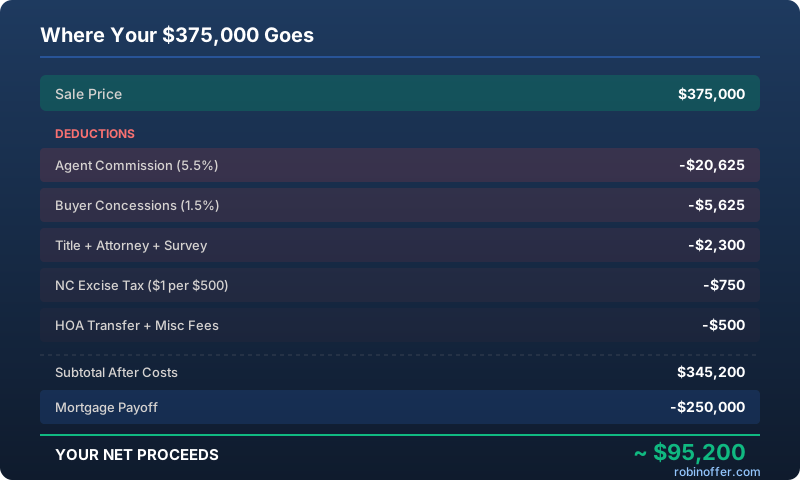
On a $375,000 sale with a $250,000 mortgage balance, your approximate net proceeds would be $92,925 to $98,175 after all costs and payoff. That is the number that matters, not the sale price your agent mentions at the listing appointment. If you want to explore seller closing costs in more detail, our Gastonia homeowner guide includes a similar net sheet breakdown with Gaston County tax rates for comparison.
12. When the Sale Is Not Simple: Inheritance, Divorce, and Financial Distress
Life does not always hand you a clean selling situation. If you are dealing with an inherited property, a divorce, or financial distress in Cabarrus County, the process has additional steps, timelines, and emotional weight you need to understand before you can choose a selling path.
Inherited Property in Cabarrus County
North Carolina requires probate for most estates that include real property. The Cabarrus County Clerk of Superior Court, located at 77 Union Street South in Concord (phone: 704-262-5500), handles the probate process. For estates under $20,000 in personal property with no real estate disputes, you may qualify for a small estate affidavit that skips formal probate. For larger estates or any situation where the property is the primary asset, expect the probate timeline to run 6 to 12 months before you can legally transfer the deed and sell.
During probate, the mortgage payments on the inherited property continue. Property taxes accrue. Insurance must be maintained. Vacant homes deteriorate. These carrying costs add up quickly and can consume a significant portion of the estate's value if the probate drags on or the heirs disagree on timing. Many heirs in this situation benefit from a direct cash sale that closes immediately after probate concludes, avoiding additional months of listing time and carrying costs. Our complete guide to selling inherited property in North Carolina covers the full probate timeline, tax implications including the stepped-up basis that can eliminate capital gains, and the options available to heirs at each stage.
Divorce and Property Division
North Carolina is an equitable distribution state, meaning marital property is divided "fairly" but not necessarily 50/50 by the court. On a $375,000 Concord home with $125,000 in equity, the division is either negotiated between the spouses through their attorneys or ordered by the court. The three most common approaches are: sell the home and split the net proceeds, one spouse buys out the other's equity share (which requires refinancing the mortgage in one name), or delay the sale via a separation agreement until a trigger event like the youngest child finishing high school.
The buyout math matters more than most divorcing couples realize. At $125,000 in equity with a 50/50 split, one spouse would need to pay the other $62,500. That requires a new appraisal, refinancing at current rates (likely 6.5-7% in 2026), and enough individual income to qualify for the full mortgage alone. Many spouses discover they cannot qualify on a single income, which forces the sale path regardless of preference. For a deeper look at the financial and legal considerations, see our guide to selling during divorce in the Carolinas.
Foreclosure and Financial Distress
North Carolina foreclosure is a judicial process that takes roughly 120 days from the initial notice of default to the foreclosure sale. Cabarrus County homeowners have options at every stage of that timeline: loan modification, forbearance agreement, repayment plan, short sale, deed in lieu of foreclosure, or selling the home for cash before the foreclosure completes. Each option has different implications for your credit score, your tax liability, and your ability to buy another home in the future.
If your financial distress is related to property taxes rather than the mortgage, Cabarrus County has its own timeline. Property tax liens in North Carolina attach on January 1 each year and become delinquent after January 5 of the following year. The county can begin advertising the property for tax lien sale after continued non-payment. If you are behind on property taxes, contact the Cabarrus County Tax Administration at 704-920-2166 to discuss payment plans before the lien sale process begins.
The critical principle is this: acting early preserves more options. A homeowner who calls their servicer after one missed payment has far more leverage than one who waits until the foreclosure notice arrives. HUD-approved housing counselors are available free of charge at 1-800-569-4287 and can negotiate with your lender on your behalf. Our North Carolina foreclosure help guide covers the full 120-day timeline and walks through all nine alternatives to foreclosure with their pros, cons, and credit impacts.
13. The Concord Prep Calendar: Decision to Keys in 90 Days
Here is a realistic timeline for selling a Concord home through the traditional listing path. This assumes you are in a saleable neighborhood with a home in reasonable condition. Adjust if you are going FSBO (add time for learning the process and self-marketing) or selling for cash (compress the entire timeline to 7 to 21 days).
| Week | Action | Details |
|---|---|---|
| Weeks 1-2 | Decide and prepare | Choose selling path. Get a pre-listing inspection ($300-$500). Fix safety and functional issues. Declutter and deep clean. Gather HOA documents, survey, and tax records. |
| Week 3 | Interview agents or prep FSBO | Talk to 2-3 agents with Concord experience. Ask about their new-construction competition strategy. Or set up flat-fee MLS listing for FSBO route. |
| Week 4 | Price, stage, photograph | Set list price based on YOUR neighborhood comps (not city median). Professional photos ($200-$400). Light staging for key rooms ($500-$1,500). Virtual tour if budget allows. |
| Week 5 | Go live on MLS | Launch listing Thursday or Friday for maximum weekend traffic. Schedule open house for first weekend. Have a price reduction plan ready if no showings after 14 days. |
| Weeks 5-12 | Market and show | Avg 52 days on market in Concord. Keep the house show-ready at all times. Respond to showing feedback same day. Monitor active and pending competition weekly. |
| Week 12-13 | Negotiate offer | Review price, due diligence fee ($2K-$5K typical), earnest money (1-2%), contingencies, and timeline. Counter within 24 hours to maintain momentum. |
| Weeks 13-17 | Under contract | Buyer's due diligence period (typically 14-21 days in NC). Home inspection, appraisal, title search, HOA document review. Attorney prepares closing documents. |
| Week 17-18 | Closing | Sign at attorney's office. Funds disburse same day or next business day via wire. Hand over keys and garage openers. |
14. Side-by-Side: Every Option With Concord Numbers
Here is the comparison that matters. All numbers assume a $375,000 home with a $250,000 mortgage balance, which represents roughly the median Concord scenario for a homeowner who purchased within the last decade.
| Factor | Agent Listing | FSBO | Cash Buyer | Rent It Out |
|---|---|---|---|---|
| Likely sale price | $375,000 | $355,000-$375,000 | $262,500-$318,750 | N/A (keep asset) |
| Total selling costs | $30,250-$46,750 | $15,000-$22,000 | $0-$2,000 | N/A |
| Net proceeds (approx.) | $78,250-$94,750 | $83,000-$110,000 | $12,500-$66,750 | Monthly cash flow |
| Timeline to cash in hand | 60-120 days | 60-150 days | 7-21 days | Ongoing income |
| Effort required from you | Moderate | High | Low | Moderate-High |
| Repairs needed before sale | Recommended for best price | Recommended for best price | None required | Required by law for tenant |
| Risk of deal falling through | Moderate (financing, appraisal) | Moderate-High | Low (no financing contingency) | Tenant risk, vacancy |
| Best for this situation | Move-in-ready homes above $300K in desirable neighborhoods | Strong negotiators with market knowledge and time | Speed needs, distress, as-is condition, inherited property | Low-rate mortgages, strong equity, long-term investors |
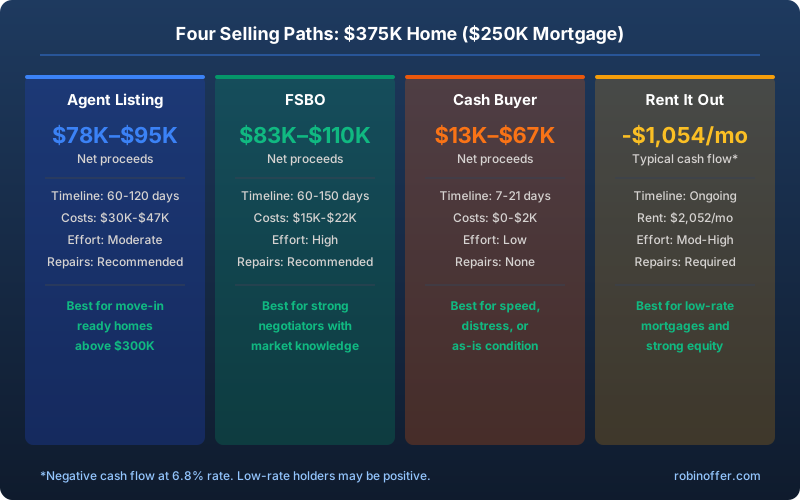
No single option is right for every seller. The "best" path depends on your timeline, your home's condition, your financial situation, and how much effort and stress you want to invest. If your home is turnkey in Skybrook or Christenbury, the agent path will almost certainly net you the most money. If you inherited a home on Highway 29 with $40,000 in deferred repairs, a water stain on the ceiling, and an HVAC system from 2001, a cash offer that closes in two weeks might put more money in your pocket than spending $40,000 on repairs, waiting three months to sell, and paying carrying costs the entire time.
The math is not emotional. The math does not care about what your neighbor sold for in 2022 during the pandemic frenzy. The math cares about your specific costs, your specific timeline, and your specific alternatives. Run the numbers for all four paths before you commit to one. And if you are not sure which path fits, that is exactly what a free net proceeds analysis is for. We will run your numbers against all four options and show you the spread so you can choose with confidence instead of guessing.
15. Cabarrus County Resources and Your Next Step
Here are the government offices and resources Concord homeowners use most often during a home sale. We have verified these contacts as of June 2026:
| Resource | Contact / URL | What You Need It For |
|---|---|---|
| Cabarrus County Tax Administration | 65 Church St SE, Concord | 704-920-2166 | cabarruscounty.us | Tax bill lookup, payment verification, assessed value confirmation |
| Cabarrus County Register of Deeds | 65 Church St SE, Concord | 704-920-2112 | cabarruscounty.us | Deed recording, lien searches, property records, mortgage satisfaction |
| Cabarrus County Clerk of Superior Court | 77 Union St S, Concord | 704-262-5500 | Probate filings, estate administration, foreclosure cases |
| City of Concord Planning and Development | concordnc.gov | Zoning verification, permits, code enforcement, variance applications |
| Cabarrus County Schools | 44 schools, 35,016 students | 89% graduation rate | School zone verification for buyer questions and listing accuracy |
| HUD Housing Counseling | 1-800-569-4287 (free, confidential) | Foreclosure prevention counseling, mortgage modification assistance |
Your Next Step: Sell Your House in Concord With Confidence
If you are a Concord homeowner thinking about selling, the most useful thing you can do right now is see what your home is actually worth in today's market. Not what Zillow says. Not what your neighbor sold for in 2022 when buyers were waiving inspections. A number based on current comps in your specific neighborhood, adjusted for condition, builder competition, and the buyer profile most likely to purchase your home. We will run a free, no-obligation analysis of your home and show you the net proceeds under each selling option: agent listing, FSBO, and cash offer. No pressure, no sales pitch, just the math you need to make a confident decision.
This guide was written by CC Evans and the RobinOffer team. Information is current as of June 2026. Market conditions, tax rates, and legal requirements change over time. Consult a licensed real estate professional and/or attorney for advice specific to your situation. This guide is for informational purposes only and does not constitute legal, financial, or real estate advice.
Want a cash offer on your Concord home?
Tell us your address and timeline and we will get you a no-obligation cash offer.