
Selling During Divorce in NC & SC
A practical homeowner guide to buyout vs sale decisions, net-proceeds math, and timeline-first execution when life is already complicated.
1. Are You Selling a House, Ending a Marriage, or Doing Both at Once?
Selling during divorce in North and South Carolina starts with one practical goal: protect equity while reducing conflict. The home is usually the largest shared asset, so your outcome depends on fast documentation, realistic net-proceeds math, and a timeline both spouses can actually execute.
That is why this guide starts with emotional reality before legal terminology. If you are in this situation, your first risk is not "making a bad legal argument." Your first risk is letting the process become reactive. Reactive decisions in divorce housing cases are expensive decisions: rushed repairs, poor listing timing, duplicated moving costs, avoidable legal hearings, or agreeing to a buyout number that was never stress-tested. You need a decision map that is practical enough to use while your life is noisy.
In the Carolinas, both states use equitable-distribution frameworks. That sounds straightforward, but it often surprises homeowners. Equitable does not automatically mean 50/50. It means the court can divide assets in a way the court sees as fair under state law and case-specific facts. That includes how the house is treated, whether one spouse can remain temporarily, whether sale proceeds are split now or later, and how mortgage, taxes, and repairs are handled while the case is pending.
This guide will walk through practical decisions in order: what to do in the first two weeks, what legal differences matter between NC and SC, when to choose buyout vs open-market sale vs fast cash sale, how to run net-sheet math without self-deception, and how to avoid the most expensive mistakes we see repeatedly. Keep these companion guides open if you want parallel decision support on timing and offer structures: cash-offer-guide-carolinas and best-time-to-sell-house-carolinas.
2. The First Split to Understand: Occupancy Rights vs Ownership Rights
One of the most expensive misunderstandings in divorce housing cases is assuming "the person living in the house owns the decision." Occupancy and ownership are related, but they are not the same. A spouse may occupy the home under a temporary arrangement while title remains jointly held. Another spouse may have moved out but still be equally exposed to mortgage default risk, tax liens, insurance lapses, and property deterioration.
Before discussing listing strategy, both spouses need a clean baseline file: deed ownership, mortgage account status, escrow status, insurance declarations, HOA obligations, utility history, and repair backlog. If this sounds obvious, it is because it should be. Yet many couples begin negotiating sale terms with incomplete records and contradictory assumptions about who has been paying what. That is how avoidable disputes become legal events.
A practical reset is to separate four buckets: (1) legal title, (2) possession/occupancy, (3) payment responsibility during pendency, and (4) final distribution after sale or buyout. Once those buckets are explicit, arguments become solvable. Without that structure, every conversation feels like a character attack because each spouse is talking about a different bucket while thinking they are discussing the same issue.
| Issue | What It Actually Controls | Common Mistake | Better Approach |
|---|---|---|---|
| Who lives in the home now | Daily logistics and temporary possession | Assuming occupancy decides final ownership split | Document occupancy as temporary unless ordered otherwise |
| Who is on deed | Recorded ownership interest | Ignoring deed because one spouse "moved out" | Treat title as active until formally changed |
| Who pays mortgage this month | Immediate default risk | Paying ad hoc without accounting credit | Track payment credits/debits in writing each month |
| Who decides if/when to sell | Disposition path and timing | Assuming unilateral control without order/agreement | Tie decision authority to signed agreement or court terms |
3. North Carolina Framework in Plain English: Equitable Distribution, Not Autopilot
North Carolina’s core statutory anchor for marital-property division is N.C.G.S. 50-20. In practice, that means the court identifies marital and divisible property, values it, and distributes it in an equitable manner. For homeowners, this usually means the house is not just "sold and split" by default. The path depends on timing, valuation evidence, debt structure, and whether one spouse can realistically assume the carrying costs.
North Carolina also matters procedurally: once divorce is filed, property claims and timing decisions can create leverage cliffs. Waiting too long to get your housing file organized often pushes both spouses toward a forced compromise that satisfies no one. If you are aiming for a buyout, you need current valuation, loan-payoff visibility, and refinancing feasibility, not optimism. If you are aiming for sale, you need timeline alignment with court process and occupancy transition, not generic online advice.
Another NC reality: temporary orders and case-management rules can shape what happens before final distribution. That means temporary possession, payment obligations, and listing timing should be discussed with legal counsel early, especially if there is conflict over who stays in the home or who controls property access for inspections, photography, or repairs.
The practical takeaway is simple. In North Carolina, housing outcomes during divorce are built, not discovered. The spouse who prepares cleaner records, clearer valuation support, and more realistic financing assumptions usually gets better negotiating results than the spouse who relies on moral arguments alone.
4. South Carolina Framework in Plain English: Similar Label, Different Texture
South Carolina uses equitable-apportionment principles under Title 20 domestic-relations statutes. Again, equitable does not automatically mean equal. The family court can weigh multiple factors, including contributions, financial circumstances, and other case-specific elements. For homeowners, the practical effect is similar to NC in one sense and different in another: you still need strong financial documentation, but the timing texture and local practice patterns can feel different from county to county.
Many SC homeowners underestimate how process and local court rhythms affect sale timing. Even when both spouses ultimately agree that the home should be sold, disagreement over list price, repair scope, possession date, or interim payment credits can stall execution. Every month of stall carries cash cost: mortgage, taxes, insurance, utilities, and deferred maintenance risk. The legal framework may be statewide, but operational friction is local and very real.
South Carolina homeowners should also use state and county self-help pathways carefully. They are useful for understanding process and forms, but they are not a substitute for case-specific legal advice where significant equity, debt disputes, or occupancy conflict exists. If you are considering a buyout in SC, your numbers need to withstand lender underwriting and court scrutiny, not just private agreement in a stressful week.
In short: NC and SC both reward preparation, but SC sellers often benefit from even tighter coordination between legal calendar and listing calendar because local implementation can vary in tempo.
5. The 14-Day Stabilization Plan: What to Do Before You Debate Strategy
The biggest tactical win in divorce home sales is usually achieved in the first two weeks: stabilize the file. Not decide everything. Stabilize everything. Your objective is to reduce ambiguity fast enough that strategy choices become numerical choices instead of emotional guesses.
Start with document centralization: deed, mortgage statements, escrow history, insurance, tax records, HOA ledger, utility averages, repair invoices, and any existing appraisals. Then create a one-page payment ledger: who paid what in the last 12 months and what is due in the next 90 days. Even if both spouses disagree on fairness, they should agree on facts. Facts are the floor.
Next, lock communication format. Use one shared written channel for housing decisions, even if legal counsel is involved in parallel. Verbal-only negotiation in divorce housing cases is a known failure pattern because memory diverges and trust decays. Written summaries reduce relitigation of old conversations.
Finally, set a decision timetable: by day 7 choose valuation method(s), by day 10 pick shortlist path (buyout, list, direct cash, or delayed decision with explicit trigger), by day 14 assign responsibilities for whichever path is selected. Delay without timetable is not neutrality. It is compounding cost.
| Day Window | Primary Objective | Minimum Deliverable |
|---|---|---|
| Days 1-3 | Data capture | Central folder with all ownership/debt/tax/insurance docs |
| Days 4-7 | Financial baseline | 12-month payment ledger + 90-day obligations map |
| Days 8-10 | Valuation setup | Agent CMA and/or appraisal schedule confirmed |
| Days 11-14 | Path selection | Written shortlist decision and assigned tasks |
6. Valuation Without Fantasy: CMA, Appraisal, and the Range You Should Actually Use
Divorce negotiations fail when one spouse shops for the highest possible number and the other shops for the lowest possible number. Both then claim objectivity. A better method is range-based valuation with explicit assumptions. In practical terms, run a primary value range using two inputs: a market-informed CMA and an independent appraisal when stakes justify it.
The CMA is useful for pricing strategy and near-term market behavior. The appraisal is useful for formal valuation and financing discussions, especially buyout conversations. If the two values differ, do not panic. Analyze why. Is one set of comps older? Are condition adjustments different? Is one model discounting a location issue the other underweighted? Disagreement in methods is normal. Hidden assumptions are the real problem.
For Carolinas divorce sales, use at least three pricing scenarios: conservative, base, and strong-market. Then connect each scenario to net proceeds after realistic costs. A list price is not a usable planning number until fees, concessions, repairs, and carrying costs are applied. Couples who negotiate from gross value alone almost always misjudge what each spouse actually receives.
If children are involved and school-calendar timing matters, include days-on-market assumptions in each scenario. Time is part of value. A theoretically higher price that requires an extra 90 days of carrying costs may produce worse net results than a slightly lower but faster, cleaner close.
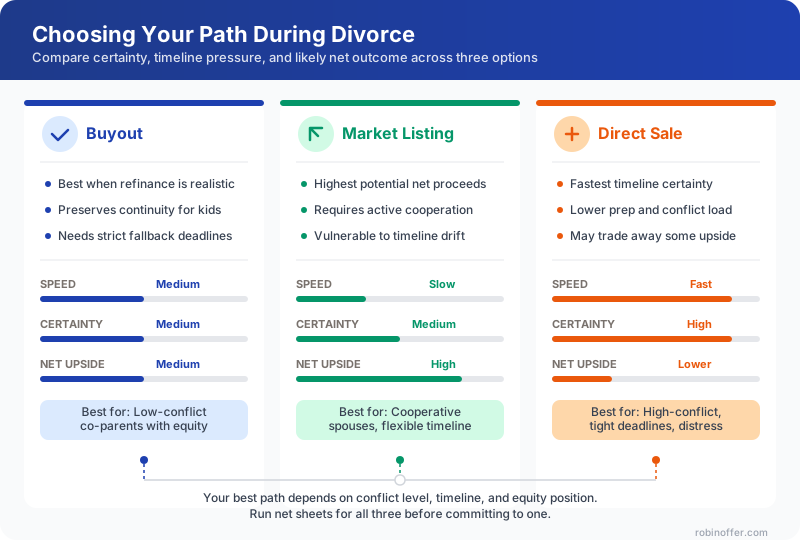
7. Buyout Path: When One Spouse Keeps the House (and When They Shouldn’t)
Buyouts are emotionally attractive because they preserve continuity and avoid showings, but many fail because affordability is assessed too loosely. A credible buyout is not "I think I can refinance." It is a documented pathway showing income support, debt-to-income viability, likely rate environment, cash required to equalize equity, and a timeline that does not expose both spouses indefinitely.
In both NC and SC, a buyout should answer five questions in writing: (1) what valuation number/range is being used, (2) what equity share is being paid and how, (3) when the departing spouse is removed from liability, (4) who pays interim carrying costs before refinance closes, and (5) what happens if refinance fails. Missing question five is the most common hidden risk.
A good buyout agreement includes a fallback trigger: if refinance approval is not secured by date X, then property is listed by date Y under pre-agreed terms. This protects both spouses from indefinite limbo. Without fallback language, one spouse can carry reputational and credit exposure long after practical cooperation has ended.
| Buyout Component | Minimum Standard | Red Flag |
|---|---|---|
| Valuation basis | Documented range with method disclosed | Single unverifiable number from one side |
| Equity equalization | Clear formula and payment date | "We’ll figure it out at closing" language |
| Liability release | Concrete refinance/removal deadline | No date for removing departing spouse |
| Interim payments | Written allocation + ledger treatment | Untracked verbal promises |
| Fallback plan | Automatic listing trigger if refinance fails | No consequence for missed financing milestones |
8. Open-Market Listing Path: Best for Maximizing Net, Hardest for Managing Conflict
Traditional listing can produce the strongest net outcome when home condition is strong, local demand is healthy, and both spouses can cooperate long enough to execute. The challenge is operational, not conceptual. Showings, staging, repairs, negotiation authority, and occupancy logistics create repeated opportunities for conflict that can sabotage value if not pre-structured.
A practical approach is to pre-approve decision rules before listing goes live: acceptable showing windows, repair budget cap, minimum documentation for offer acceptance, and which concessions require mutual sign-off. If one spouse is occupying the home, establish cleanliness and access expectations in writing, not as emotional demands after listing photos are taken.
Pricing strategy should include realistic concession assumptions for the micro-market. In some Carolinas submarkets, buyers expect credits for rate buydowns or deferred maintenance. Denying market reality because "we need this number" often prolongs days on market and shrinks leverage. A slightly lower list with disciplined execution can outperform an aspirational list that accumulates stigma.
For homeowners balancing legal deadlines, listing timeline must be synchronized with case timeline. If a court date or temporary order change could affect occupancy or signature authority, your agent and legal counsel should coordinate before launch.
9. Direct Cash Sale Path: Speed, Certainty, and the Price of Optionality
A direct cash offer can be the right tool when timeline certainty matters more than top-line price. In divorce settings, that is often true when conflict is high, house condition is rough, foreclosure risk is emerging, or one spouse needs to separate finances quickly for legal and emotional safety. Speed has value, but it must be measured explicitly, not assumed.
The right way to evaluate a cash offer is to compare net certainty, not gross price. Include avoided repairs, avoided carrying costs, reduced showing friction, reduced legal contention over listing operations, and probability of closing failure. If those avoided costs are large, a lower gross offer can be economically rational.
The wrong way is to treat any quick close as automatically fair. Multiple offers, transparent fee terms, and timeline clarity still matter. For Carolina homeowners, the best practice is to run a side-by-side decision matrix: projected net from market listing under three timing scenarios vs projected net from direct sale with high confidence close date.
If you are unfamiliar with this analysis format, use the detailed framework in cash-offer-guide-carolinas and bring that worksheet into divorce settlement discussions so everyone is comparing the same assumptions.
Want a simple way out of the marital home?
Get a free, no-obligation cash offer on the house — any condition, no repairs or showings — so both spouses have a clean sale option on the table.
10. Delayed Sale Path: Sometimes Rational, Often Overused
Some couples choose to delay sale for school-year stability, rate expectations, repair completion, or legal strategy. Delayed sale is not inherently bad. It becomes expensive when chosen without explicit carrying-cost allocation and trigger dates. "We’ll revisit in six months" is not a plan unless six months contains measurable milestones and consequences.
If you delay, specify who occupies, who pays which expenses, how payment credits are tracked, how major repairs are approved, and what event triggers listing (date certain, child milestone, refinance failure, or court milestone). Also define property-care standards. Deferred maintenance during delay can erase any hoped-for price gains.
Delayed sale can be especially risky when one spouse has low trust in the other’s maintenance discipline or financial reliability. In those cases, third-party oversight (agent check-ins, periodic condition reports, shared accounting) may be worth the administrative burden to prevent later disputes.
The core rule: delay should buy strategic advantage. If delay buys only emotional avoidance, it is usually a costly postponement rather than a solution.
11. Net-Sheet Reality Check: The Number Both Spouses Need Before Agreeing to Anything
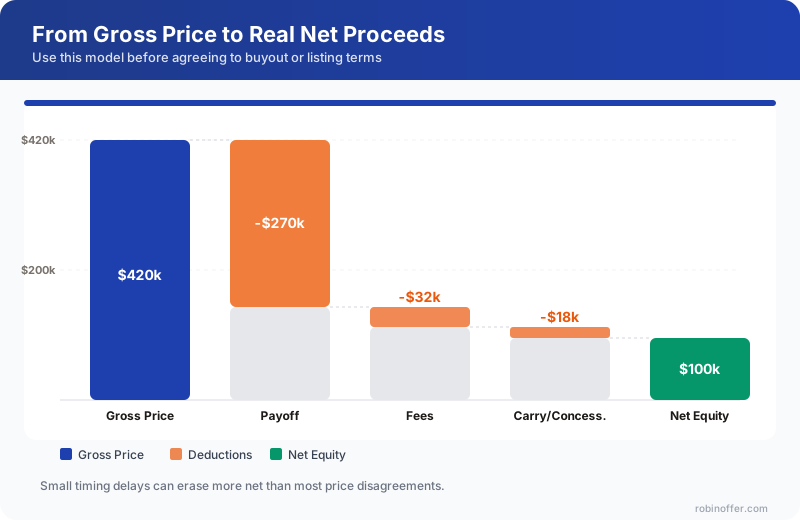
Divorce home negotiations should revolve around net proceeds, not list price slogans. A usable net sheet includes: expected sale price, mortgage payoff(s), estimated commissions, transfer taxes/recording costs, title/attorney fees, buyer concessions, repair credits, escrow adjustments, HOA prorations, and any court-ordered payment credits between spouses. Without this, every agreement is fragile.
Run at least three net sheets (conservative/base/upside). Then run a timeline adjustment. Every extra month before close has carrying costs that reduce net distributable equity. Many couples are shocked when a two-month disagreement costs more than the difference between their preferred price points.
Also model contingency risk. A financed buyer with inspections can produce a better price but higher fallout risk. A cleaner offer may close for less but with more certainty. In contested divorces, certainty often has hidden legal value because unresolved housing can keep other settlement terms frozen.
| Net Sheet Line Item | Why It Matters | Frequent Error |
|---|---|---|
| Payoff amount | Largest deduction from gross | Using old statement not current payoff |
| Commissions + closing costs | Predictable transaction expenses | Assuming headline rate without full fee stack |
| Concessions/credits | Common in negotiated contracts | Treating concessions as improbable outliers |
| Carrying costs to close | Erodes net every week | Ignoring timeline-related burn rate |
| Inter-spousal credits | Affects final split fairness | No ledger for interim payments |
12. Mortgage Risk During Separation: Protecting Credit While You Decide
Even in cooperative divorces, mortgage delinquency can happen by accident: each spouse assumes the other paid, autopay fails after account changes, or escrow spikes create unexpected shortfalls. During separation, that risk is amplified because communication bandwidth is low. The fix is procedural: explicit payment protocol while the home decision is pending.
Set one monthly checklist: payment date, source account, confirmation proof, ledger update, and acknowledgment by both parties (or counsel). If one spouse is responsible for payment temporarily, that responsibility should still be visible to both parties to reduce accusation cycles later.
If payment stress is emerging, do not wait for default letters. Use housing-counselor resources early: NCHFA and HUD-linked channels in NC, SC Housing and HUD-approved counseling pathways in SC. Early intervention gives more options than late-stage panic. If distress is severe, review both retention and disposition paths in parallel instead of serially.
Credit damage during divorce can outlast the marriage conflict itself. Protecting the mortgage file is not just about this house. It affects next-housing options for both spouses.
13. Tax and Carrying-Cost Nuance Across the Carolinas
Carrying costs are market-specific and jurisdiction-specific. In Mecklenburg County, for example, county tax rates are publicly posted (49.27 cents per $100 at the county level), while municipal layers and service fees alter total annual burden. In South Carolina, owner-occupied taxation and county millage frameworks create a different structure that still requires property-specific review.
Why this matters in divorce: two houses with similar estimated market value can have meaningfully different monthly carry burden depending on county, municipality, insurance trends, and HOA profile. Couples who ignore this often overestimate the viability of long delays or buyout plans.
Add insurance and deferred maintenance inflation to the same model. In the Carolinas, storm-related insurance volatility can quickly shift affordability assumptions. A buyout that worked on last year’s premiums may fail on this year’s premium plus updated escrow requirements.
Your decision model should therefore include a 12-month carry forecast, not just current-month snapshots. If projected carry growth materially reduces net value, a faster and cleaner disposition may be more rational than prolonged hold strategy.
14. Kids, Schools, and Location Decisions You Cannot Unmake Easily
For families with children, school assignment and routine stability influence housing decisions as much as equity math. In Charlotte-Mecklenburg, boundary tools are openly available and should be checked early when considering whether one spouse remains in-home. In Greenville County Schools, assignment lookup tools similarly help model what a move would change and when.
A common mistake is postponing school-impact analysis until after legal negotiations harden. That reverses priorities. If school continuity is a core objective, build it into the housing plan from day one. Sometimes that supports short-term occupancy by one parent. Sometimes it supports faster sale and relocation before a school-year transition becomes disruptive. There is no universal answer.
Also separate emotional language from legal language. Saying "the kids need stability" is true but incomplete. Stability has operational requirements: who can afford the home, who handles transportation, what backup plan exists if buyout fails, and how quickly each parent can secure housing near school zones if the property sells.
Done well, school-centered planning can reduce conflict by giving both spouses a shared non-financial priority to optimize. Done poorly, it becomes a rhetorical weapon that stalls practical decisions.
15. Pre-Sale Prep and Offer Discipline
Divorce sellers often overspend on prep because each spouse wants to signal competence or blame the other for house condition. The result is emotional renovation rather than return-on-investment renovation. Set a prep budget ceiling before quotes are requested, then classify work into three tiers: safety/compliance, marketability essentials, and optional cosmetics. Approve tier one and two first. Tier three only if projected net benefit is likely and timeline allows.
| Prep Tier | Examples | Default Decision Rule |
|---|---|---|
| Tier 1: Safety/required | Active leaks, electrical hazards, major HVAC failures | Fix quickly; document invoices |
| Tier 2: Marketability | Paint touchups, flooring patching, curb cleanup | Approve if likely to reduce DOM or increase offer quality |
| Tier 3: Optional cosmetic | Designer upgrades, nonessential remodels | Do only with evidence-backed ROI and mutual sign-off |
At offer stage, define acceptance rules before the first showing: minimum net threshold, acceptable close-date range, maximum concessions, repair-credit limits, and how tie-breakers are handled. Clarify whether counsel review is required before contract acceptance and how quickly it must occur. For financed offers, insist on transparent financing strength indicators and appraisal-risk handling. For cash offers, verify proof of funds and closing capacity. Document all accepted-offer logic in writing, because that record helps if disputes arise about whether one spouse "forced" a decision.
Get Your Free, No-Obligation Cash Offer
Tell us about the home and we'll send a real cash offer — any condition, no repairs or showings, and you close on your timeline.
16. Legal-Aid and Attorney Pathways: Use the Right Tool for the Right Problem
Not every homeowner needs full-service private representation for every housing decision, but nearly every homeowner benefits from legal triage in divorce property situations. North Carolina offers bar-association referral systems and public legal-information pathways; South Carolina offers bar referral, lawhelp resources, and legal-services intake channels for qualifying households.
Use private counsel when equity is large, conflict is high, or timeline risk is acute. Use legal-aid and self-help pathways when affordability is constrained and the issue is process navigation, form completion, or focused legal questions. These options are not mutually exclusive. Many households start with triage and escalate to private counsel for key milestones.
The operational rule is urgency: engage support before deadlines and before irreversible agreements. Late legal intervention is usually more expensive and less effective than early targeted guidance.
If you need fast entry points, these published channels are practical starts: NCBA lawyer referral resources, SC Bar legal-help pathways, LawHelpNC, LawHelpSC, and South Carolina Legal Services intake.
17. When One Spouse Won’t Cooperate: Practical Escalation Steps
Non-cooperation can look like many things: refusing access for photos, blocking repairs, ignoring listing timelines, disputing every invoice, or withholding signatures at critical moments. The worst response is improvisation. You need an escalation ladder that moves from informal resolution to formal action without skipping steps.
Step one is documentation: concise written notices with dates, requested action, and deadline. Step two is neutral framing: tie requests to agreed objectives (sale timeline, equity preservation, legal compliance), not personal blame. Step three is third-party mediation or counsel-facilitated resolution. Step four is formal motion practice if necessary.
The point of escalation is not punishment. It is preserving value and timeline. Every week of deadlock increases carrying costs and buyer risk. Even when conflict is intense, disciplined escalation can keep the transaction moving while legal issues are resolved in parallel.
18. Distress Signals: How to Know You’re Sliding Toward Forced-Sale Conditions
Some divorce cases begin as controlled planning and drift toward distress without anyone naming it. Watch for these signals: repeated late mortgage payments, insurance lapses or cancellation notices, escalating unsecured debt to cover housing costs, major deferred repairs, and inability to agree on even small listing steps. If three or more signals appear, treat the situation as time-sensitive distress.
At that point, run parallel tracks immediately: legal review, counseling/financial triage, and disposition comparison (market vs direct sale). Waiting for one track to resolve before starting others often creates avoidable foreclosure or pre-foreclosure pressure. Parallel processing is not panic. It is risk management.
Households in distress should prioritize certainty and damage containment. That may mean accepting a lower theoretical upside to avoid much larger downside risk. Pride-driven delay in this phase is expensive for both parties.
If foreclosure risk is entering the picture, use additional timeline resources like the North Carolina foreclosure timeline and the South Carolina foreclosure guide to understand what deadlines are approaching and where decision windows narrow.
19. Scenario Planning for the Next 90 Days: Three Playbooks
Most divorce-related housing outcomes over the next three months fit one of three playbooks. Playbook A: cooperative sale with market listing and controlled prep. Playbook B: buyout attempt with strict refinance milestones and automatic fallback listing. Playbook C: expedited direct sale to resolve liability and move on.
Choose one as primary, but define a backup trigger today. For example: if no acceptable offer by day 45, adjust pricing/terms; if refinance denial by day 30, shift to listing; if carrying-cost shortfall appears, activate expedited-sale pathway. Trigger-based planning prevents surprise pivots driven by crisis.
Each playbook should include role assignments: document owner, payment tracker, agent/counsel coordination lead, and move-planning lead. Divorce cases fail operationally when everyone assumes someone else is handling logistics.
| Playbook | Best Fit | Main Risk | Backup Trigger Example |
|---|---|---|---|
| A: Cooperative market listing | Moderate conflict, strong condition, manageable timeline | Offer-stage disputes | No contract by day 45 → price/term reset |
| B: Buyout first, listing fallback | One spouse wants to keep home and can likely qualify | Refi delays trap both parties | No firm approval by day 30 → list by day 37 |
| C: Expedited direct sale | High conflict, high distress, or severe timeline pressure | Leaving upside on table | Two offers below floor → short market test window |
20. Common Costly Mistakes (and Their Simple Fixes)
Mistake 1: Negotiating from gross price instead of net proceeds. Fix: Require three-scenario net sheets before any final decision.
Mistake 2: Treating verbal agreements as binding operations plan. Fix: Move all key housing terms into written summaries with dates and owners.
Mistake 3: Waiting for legal clarity before operational prep. Fix: Run legal and sale-prep tracks in parallel.
Mistake 4: Over-improving the house during conflict. Fix: Use tiered repair budgeting tied to likely market return.
Mistake 5: Assuming buyout works because one spouse "really wants" the home. Fix: Validate affordability and fallback plan before relying on intent.
Mistake 6: Ignoring school/child logistics until late. Fix: Include school-zone and schedule impacts in week-one planning.
Mistake 7: Delaying decisions because market might improve next season. Fix: Compare potential upside against guaranteed carrying burn and conflict cost.
Mistake 8: Letting non-cooperation go undocumented. Fix: Use escalation ladder with concise records and deadlines.
21. A Carolina-Specific Decision Matrix You Can Use Tonight
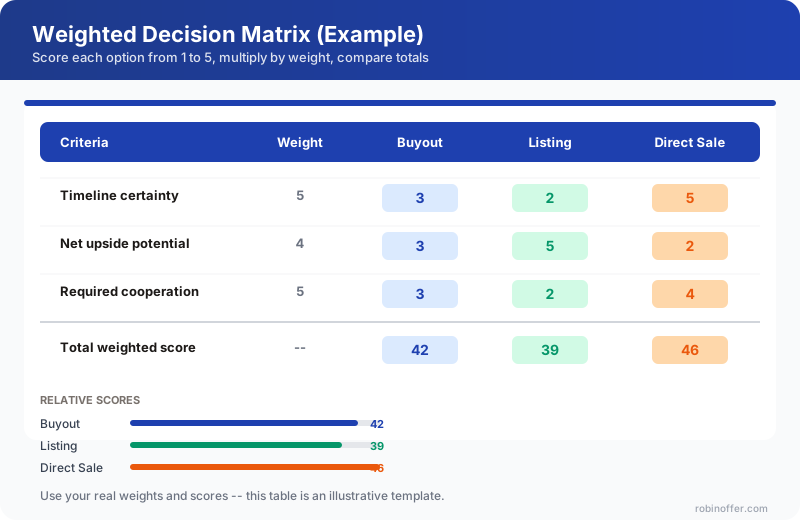
If you need a practical "what should we do" tool, score each path (buyout, market listing, direct sale, delayed sale) from 1-5 on the criteria below: affordability, timeline certainty, cooperation level, condition burden, legal complexity, and child-stability fit. Then weight criteria based on your case priorities and calculate totals. The highest weighted score is not automatic truth, but it gives both spouses a shared decision language.
Most couples discover that their disagreement is not really about price. It is about weighting. One spouse weights certainty and emotional closure. The other weights upside and continuity. A weighted matrix surfaces those values without pretending one side is irrational.
| Criterion | Weight (1-5) | Buyout | Market Listing | Direct Sale | Delayed Sale |
|---|---|---|---|---|---|
| Monthly affordability | |||||
| Timeline certainty | |||||
| Required cooperation | |||||
| Condition/repair burden | |||||
| Legal complexity exposure | |||||
| Child-stability alignment |
Once scored, commit to one primary path for 30 days, with predefined triggers for switching. This prevents decision churn and keeps both parties focused on execution rather than relitigation.
Want to sell the house fast and move on?
If you are balancing legal deadlines, kids, and housing costs, a cash offer lets you skip repairs and showings and close on a date that works for you.
22. The 30-60-90 Execution Checklist
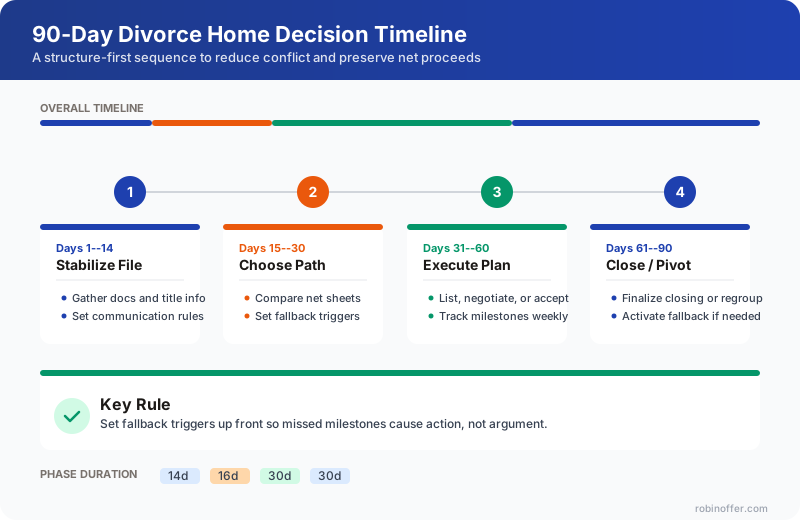
Days 1-30: Stabilize and choose
Centralize records, reconcile payment ledger, complete valuation work, select primary path, assign roles, and publish fallback triggers. If listing, finish prep scope and photo schedule. If buyout, open financing file immediately. If direct sale, collect and compare multiple offers with transparent net analysis.
Days 31-60: Execute primary path
Run weekly operations review. For listings: monitor showing feedback, adjust pricing/terms based on evidence, and maintain occupancy standards. For buyout: confirm underwriting milestones and lock fallback deadlines. For direct sale: complete diligence and verify close-readiness. Keep legal counsel updated if timeline intersects court milestones.
Days 61-90: Close or pivot without drama
If primary path is on track, finish closing logistics, move planning, and final payment-credit reconciliation. If primary path misses its milestones, activate fallback without renegotiating first principles. The fallback exists to protect equity and sanity; use it.
By day 90, the goal is not perfection. The goal is decisive progress with controlled downside.
23. Protecting Your Position: Whether You Stayed or Moved Out
If you are the spouse staying in the home: your best defense is a visible weekly checklist that proves diligence and reduces accusations. Track mortgage status, insurance status, property condition updates, repair log, utility confirmation, and showing-readiness status. In divorce processes, unrecorded effort often becomes disputed effort. Documentation is protective, not performative.
If you are pursuing a buyout, treat every week as underwriting prep: avoid new debt, maintain payment consistency, prepare income documentation early. If listing is likely, cooperate with prep and showing standards even if emotionally difficult. Buyers react to condition and access, not to fairness arguments between spouses. If safety or domestic conflict is a concern, prioritize safety planning and legal guidance immediately.
If you are the spouse who moved out: you may feel invisible operationally but still carry legal and financial exposure. You are often still tied to the mortgage, still affected by credit events, and still reliant on in-home cooperation for property preservation. The answer is structured oversight, not disengagement.
Set recurring written checkpoints: monthly payment proof, condition summaries, and status updates on agreed tasks. If you are funding carrying costs, insist on ledger discipline and define whether those payments are advances, credits, or shared obligations. For offer-stage decisions, know your minimum net threshold, acceptable dates, and concession limits before offers arrive. And resist using housing as leverage on unrelated disputes, because the carrying clock runs while leverage games are played.
24. Decision Brief and Document Packet
Before either spouse signs a final housing agreement, reduce the entire decision to one page: selected path, valuation basis, net scenario used, payment responsibilities, key dates, fallback trigger, and authority rules for offer decisions. Add a short risk paragraph: "What could break this plan, and what do we do if it breaks?" If the plan cannot fit one page clearly, it is probably too vague to execute under pressure.
Then assemble a complete document packet. Many delays homeowners blame on "the system" are actually documentation delays. A complete packet includes: deed and transfer documents, most recent mortgage statement and payoff contact, escrow details, insurance declarations page, property-tax records, HOA statements, utility history, repair records, any prior appraisals or CMAs, and a 12-month payment ledger showing who paid what.
| Packet Item | Primary User | Why It Speeds Decisions |
|---|---|---|
| Deed + ownership docs | Attorney, closing team | Confirms title position and signature requirements early |
| Mortgage + payoff channels | Agent, attorney, lender | Enables accurate net sheets and timing estimates |
| Tax/insurance/HOA records | Agent, buyer side, lender | Prevents late-stage closing surprises |
| Payment ledger | Mediator, attorneys | Reduces disputes over interim credits and obligations |
| Repair and condition file | Agent, buyers, negotiators | Improves pricing strategy and concession planning |
Also include a communication map: who can authorize what, which email addresses are approved for official housing updates, and whether attorney review is required before major decisions. When you are ready to move from analysis to action: finalize brief, schedule legal confirmation, run updated net sheet, and execute first milestone within 72 hours.
See What We'd Pay for Your Home
Get a free, no-obligation cash offer — any condition, no repairs or showings, and close on the timeline that fits your situation.
25. Choose the Path You Can Actually Execute
Selling during divorce in North Carolina or South Carolina is hard because it asks for disciplined financial decisions in the middle of personal disruption. The legal framework matters. Market timing matters. But execution discipline matters most. The households that exit this process in better shape are rarely the ones with perfect market conditions; they are the ones that build clear assumptions, clear roles, and clear triggers early.
Before you commit, run these gut-check questions: What valuation range are you using, and why? What is the expected net under conservative, base, and upside scenarios? Who is paying mortgage, tax, insurance, and utilities until close or refinance? What is the automatic fallback if your primary path fails? What are the top three failure points for your chosen strategy, and what is your response to each? What is your first concrete action in the next 72 hours?
If your answers are vague, you are not ready to commit yet. Tighten the assumptions, assign owners, and set dates. If your answers are clear, move quickly. Momentum after clarity is your best protection against backsliding into conflict loops.
If your case is cooperative, protect that cooperation with structure before stress tests it. If your case is high conflict, protect value with documentation and escalation discipline. If your case is financially stressed, choose certainty before pride. If creditor pressure or judgments are part of the picture, pair this with our NC Homestead Exemption Guide and SC Homestead Exemption Guide so your division plan reflects what equity is actually protected in your state.
For deeper option comparisons: cash-offer-guide-carolinas, best-time-to-sell-house-carolinas, and foreclosure-help-north-carolina. For Triangle-area homeowners, our Apex selling guide includes divorce-specific buyout math using Wake County's $584K median. Then pair that analysis with case-specific legal advice so your numbers and your orders are aligned.
Military households managing both relocation and legal transition should pair this guide with the Military PCS relocation guide for the Carolinas to structure timeline and carry-cost decisions.