
Lincolnton: Selling Smart in Lake Norman's Value Shadow
A practical Lincolnton seller guide covering Lake Norman spillover demand, NC 150 commute dynamics, and certainty-adjusted selling decisions.
In January 2026, the median closed price in Lincolnton was about $246,250, with homes averaging roughly 67 days on market. That single stat tells you almost everything about this city: buyers are here, but they are choosy. Lincolnton is no longer a place where almost any listing gets snapped up in a weekend. It is a market where strategy wins. If you are selling from Boger City, from a street near East Main Street, or from a newer pocket off NC 150, your result depends on how well you position your home for the exact buyer segment now using Lincolnton as Lake Norman's value alternative.
You do not need vague optimism. You need local numbers, timeline math, neighborhood context, and a realistic choice among your selling options. Below you will find the spillover dynamics from Mooresville and Denver, the NC 150 and US 321 commuting reality, Lincoln County tax and growth patterns, and the practical tradeoffs between listing traditionally, selling directly, or running a hybrid strategy.
1. Lincolnton in 2026: The "Lake Norman Budget Valve" Effect
Lincolnton has become what many Charlotte-area buyers quietly call a pressure-release market. When prices, HOA burdens, and competition feel too intense in Mooresville, Davidson, and lake-adjacent pockets of Iredell County, buyers move west and look for similar house size at a lower monthly payment. That buyer behavior is not theoretical. You can see it in search patterns, in showing conversations, and in how quickly fairly priced three-bedroom homes move when they are commute-viable to US 321, NC 150, or NC 27 routes.
Here is the key implication for sellers: your competition is not just "other Lincolnton listings." Your competition is a live menu that includes older Mooresville homes, Denver resales, and builder inventory farther east. Buyers are comparing payment, commute friction, and move-in readiness. That means your marketing must answer three questions immediately: why your location works, why your home's condition saves stress, and why your price is defensible against alternatives. If you cannot answer those in the first week, days-on-market stretches and negotiating leverage slips.
For many homeowners, this is the most useful mindset shift. You are not selling to people who woke up committed to one exact Lincolnton subdivision. You are selling to people choosing between markets. When you frame your property around decision friction (drive time, school fit, lot value, repair burden, closing certainty), you become easier to say yes to. That is the thread we will keep pulling through every section.
| Metric | Recent Lincolnton Signal | What It Means for Sellers |
|---|---|---|
| Median sale price | ~$246,250 (Jan 2026) | Affordability remains a core draw versus Lake Norman-adjacent markets |
| Days on market | ~67 days average | Pricing and preparation matter; this is not an "automatic" sale environment |
| Sale-to-list ratio | ~98.5% | Most homes still sell, but typically with some negotiation |
| Market posture | Somewhat competitive | Strong listings move; weak listings linger and chase price cuts |
2. Market Snapshot: Price Bands, Speed, and Negotiation Reality
Most Lincolnton sellers make one of two expensive mistakes: they either underprice out of fear and leave money on the table, or they overprice based on peak-era stories from 2021-2022. The current market rewards disciplined pricing inside realistic ranges. Think in price bands, not one magic number. A clean, updated home near commuting corridors can still outperform the city median. A tired property with deferred maintenance may need aggressive positioning to avoid months of carrying costs.
What matters most right now is substitutability. Buyers ask: "If I spend this much in Lincolnton, what else can I buy in Denver, Maiden, west Mooresville fringe, or farther into Catawba County?" If your home does not clearly win on either condition, lot, layout, or certainty, your list price becomes a ceiling, not a magnet. This is why strategic pre-listing repairs and honest pricing usually outperform high initial pricing followed by reductions.
Another practical point: the first 10-14 days still matter disproportionately. That is when buyer agents assume listing freshness and seller flexibility. Once a listing sits, buyers start inventing problems even when the house is solid. You can avoid this by preparing before launch: complete obvious repairs, write a disclosure packet that reads cleanly, and use photos that show real room scale. In this market, professionalism is a pricing strategy.
| Price Band | Typical Buyer Profile | Common Friction Point | Seller Advantage Move |
|---|---|---|---|
| Under $225K | Payment-sensitive first-time buyers and investors | Condition concerns and financing overlays | Handle safety/functional repairs up front; document improvements |
| $225K-$320K | Commuters priced out of higher-cost suburbs | Comparison versus newer builds farther out | Highlight lot size, established streets, and faster move-in timeline |
| $320K-$450K | Move-up households wanting space and certainty | Expectations for updates and systems age | Pre-list inspection and repair credits strategy |
| $450K+ | Niche buyers balancing quality and commute | Longer decision cycle, stricter feature filtering | Targeted marketing, cleaner disclosures, patient but disciplined pricing |
3. Lincolnton vs Mooresville: How Buyers Actually Compare You
The queue brief for this guide is right: Lincolnton often wins buyers who say, "I can't afford Mooresville for what I need." But sellers misread that sentence. It does not mean buyers will accept any condition or any price in Lincolnton. It means buyers want value spread. If your home gives them similar function at a materially lower payment, they move quickly. If that spread disappears because of overpricing or heavy repair needs, they pivot back toward their original search area.
When buyers compare Lincolnton and Mooresville-adjacent alternatives, they usually score properties on five things: commute reliability, bedroom count per dollar, lot usability, school preference, and expected near-term repair cost. You should pre-answer all five in your listing narrative and showing package. Sellers who do this well typically avoid the painful second month where feedback becomes repetitive: "liked it, but not at this price."
A practical way to frame value is monthly payment deltas. Even a $40,000-$90,000 purchase gap can create several hundred dollars of monthly breathing room depending on rate and taxes. For relocating households, that payment gap often funds daycare, vehicle costs, or renovation reserve. If your marketing highlights this clearly and honestly, you attract decision-ready buyers rather than casual browsers.
Robin's Take: In Lincolnton, the listing that wins is usually not the one with the biggest headline claim. It is the one that makes the buyer's payment-versus-commute decision feel obviously rational within five minutes of reading the listing.
| Comparison Lens | Lincolnton Seller Talking Point | Proof You Should Provide |
|---|---|---|
| Price-to-space | More square footage per dollar than Lake Norman-adjacent submarkets | Recent local comps with same bed/bath count |
| Move-in speed | Existing home can close in 30-45 days vs long builder timelines | Pre-title readiness and flexible close date language |
| Lot utility | Established lots often support real outdoor use | Survey, fence notes, and usable yard photos |
| Carrying risk | Lower acquisition price can reduce monthly pressure | Sample payment comparison worksheet |
4. Highway 150, US 321, and Commute Geography That Affects Price
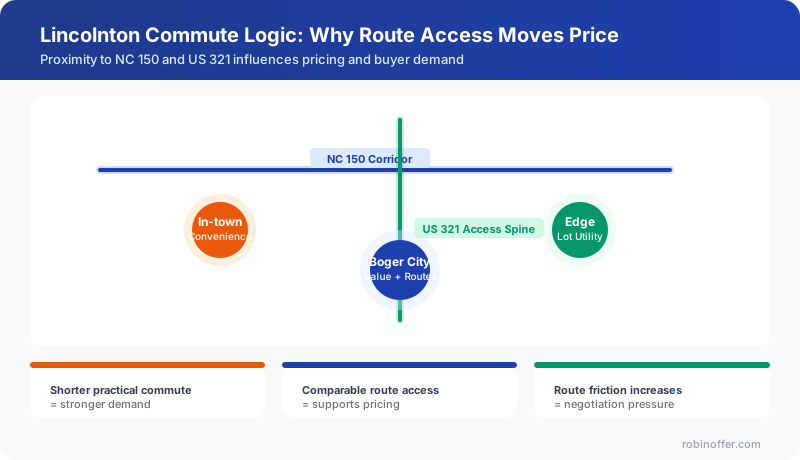
In Lincolnton, road access is pricing power. Homes that feel "close enough" to NC 150 connectors, US 321 routes, or predictable eastbound commute patterns command stronger buyer interest than similar homes with awkward access. This does not mean your home must sit directly on a highway. In fact, many buyers prefer a quieter interior street with efficient outbound routes. The point is functional commute time, not map distance.
Sellers often underuse this in their strategy. Instead of generic language about convenience, be specific: typical morning route options, practical access to Lincolnton's core services, and whether your location avoids known bottlenecks. If your home is in a spot that gives buyers options toward Denver, Mooresville adjacency, or Charlotte-bound work patterns, that should be visible in both copy and agent remarks. It can justify stronger pricing discipline.
Development planning around broader corridor growth also influences buyer confidence, even when projects are long horizon. Buyers do not need perfect certainty; they need reasonable confidence that the area remains connected and investable. Your job as a seller is to show that this location still makes sense for daily life over the next three to seven years, not just this month's listing cycle.
See what your Lincolnton home is worth
Get a real, data-driven estimate based on your specific neighborhood and recent comps.
5. Neighborhood Micro-Markets: Why "Lincolnton Average" Can Mislead You
There is no single Lincolnton market. There are multiple micro-markets with different buyer expectations and price elasticity. Some areas attract highly payment-driven buyers who will trade cosmetic updates for affordability. Other pockets attract households who will pay more for turnkey condition and predictable commute patterns. If you set price from a citywide average without micro-market adjustments, you either undershoot your potential or overestimate demand.
For example, Boger City references carry a different buyer expectation than older in-town streets or semi-rural fringe parcels. Homes near schools, major routes, or stable neighborhood identity can pull stronger early traffic. Homes with acreage or nonstandard layouts may need a narrower marketing strategy and longer runway. None of this is bad. It simply means your listing plan should be custom rather than copied from a different neighborhood's success story.
The easiest way to avoid mistakes is to use comp sets by use-case, not just radius. Compare your home to homes buyers would actually choose instead: similar lot function, similar age/condition profile, similar commute practicality. Then stress-test the number with current actives and pending listings, not only closed sales. Actives tell you where buyers are hesitating today.
| Micro-Market Type | Buyer Priority | Risk if Mispriced | What to Emphasize |
|---|---|---|---|
| Established in-town blocks | Character, convenience, manageable lot | Overpricing based on renovated outliers | Updated systems and walk/drive convenience |
| Boger City-adjacent pockets | Value + practical commute + family utility | Ignoring newer competition nearby | Space-per-dollar and true monthly cost |
| Edge/semi-rural properties | Privacy, land use flexibility, storage | Assuming broad buyer pool | Specific lifestyle use cases and property documentation |
| Newer subdivision inventory | Condition, layout efficiency, low hassle | Comping to fully upgraded spec homes | Move-in readiness and low immediate spend |
6. Lincoln County Growth, Taxes, and the Carrying-Cost Equation
Lincoln County has posted strong growth over the last decade, and that growth supports long-run demand narratives sellers like to cite. But in a real sale decision, what matters is monthly carrying cost while your home is listed. Every extra 30 days on market costs real money: principal and interest, insurance, county/city tax accrual, utilities, lawn maintenance, and opportunity cost if you are carrying a second housing payment. The market does not reimburse you for indecision.
Current publicly posted tax schedules for Lincoln County and City of Lincolnton show rates that should be incorporated into your net calculations. Inside city limits, combined rates differ from county-only properties and from special fire district overlays. Sellers who skip this detail often accept an offer that "looks fine" but misses their actual net target after prorations and concessions. Run your numbers early, not after offer excitement kicks in.
If your carrying cost is $1,900 to $3,200 per month depending on loan balance and expenses, waiting three extra months to chase a higher list price can erase perceived upside fast. This is where certainty-adjusted net beats ego pricing. The right offer is not always the highest headline. It is the one most likely to close cleanly within your time and stress constraints.
| Carrying-Cost Component | Typical Monthly Range | Notes for Lincolnton Sellers |
|---|---|---|
| Principal + interest | $1,100-$2,200 | Largest driver; verify exact payoff timing with lender |
| Property tax accrual | $150-$350 | Use county/city or county/fire-district rates based on parcel location |
| Insurance | $90-$220 | Do not cancel until deed records and funds disburse |
| Utilities + lawn + basic upkeep | $250-$500 | Vacant homes usually still require regular maintenance |
| Total monthly carry | $1,590-$3,270 | Multiply by expected days on market and escrow timeline |
7. Pre-Listing Work That Pays in Lincolnton (and Work That Usually Doesn't)
You do not need a full HGTV makeover to sell in Lincolnton. You need to remove buyer uncertainty. The highest-return pre-listing tasks are usually functional: fix active leaks, document HVAC service, resolve obvious electrical/safety issues, repair damaged flooring transitions, and clean up curb presentation. Buyers can live with dated finishes more easily than they can live with hidden risk. Your pre-list plan should signal "this home has been cared for" more than "this home was staged for Instagram."
Projects that often underperform include expensive kitchen overhauls in modest price tiers, custom design choices with narrow taste appeal, and luxury add-ons that do not match neighborhood ceilings. In this market, a $28,000 renovation might add less than half that in realized price if buyers still discount for location or layout constraints. Spend where it removes objections, not where it chases applause.
A pre-list inspection can be one of the smartest confidence plays, especially if your house is older or has known quirks. You are not doing it to become perfect. You are doing it to control the negotiation conversation. When you already know your issues and have either repaired them or priced them in, you reduce re-trade risk after contract. That is a huge advantage if your timeline is tight.
8. Three Selling Paths for Lincolnton Owners: Listing, Direct Sale, Hybrid
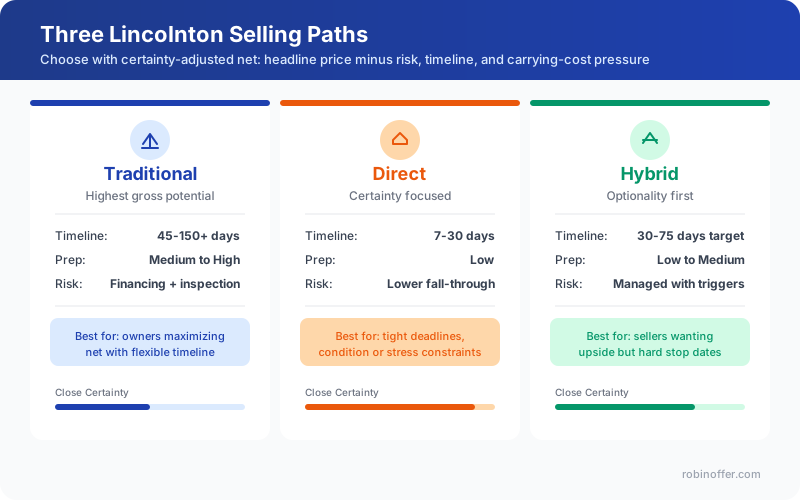
Most homeowners in Lincolnton realistically choose one of three paths. Path one is traditional MLS listing: usually highest gross potential, but with prep burden, showings, and greater contract fall-through risk. Path two is direct sale: typically lower gross but faster and more certain, especially useful when condition, timeline, or legal complexity is high. Path three is hybrid: prepare lightly, test market response quickly, then pivot to direct options if traction stalls.
The best path depends on your constraints, not internet ideology. If you need maximum net and have 90-150 days plus repair bandwidth, listing is often right. If you need certainty in 14-30 days, are managing inherited condition issues, or want to avoid buyer repair renegotiation, direct sale can be rational. Hybrid works well for owners who want to preserve upside but refuse to let the process drag indefinitely.
We recommend a written decision matrix before you launch. Define your minimum acceptable net, maximum acceptable timeline, and stress limits (number of showings, repair budget, financing risk tolerance). Then evaluate each path against those constraints. This removes emotional whiplash once offers arrive and protects you from the common mistake of chasing highest headline with weakest close probability.
Robin's Take: If your Lincolnton timeline is tight, pre-commit to a pivot date before listing. Deciding to pivot when you are already stressed leads to rushed concessions and weaker terms.
| Path | Estimated Net Potential | Typical Timeline | Best For |
|---|---|---|---|
| Traditional MLS listing | Highest in many scenarios | 45-150+ days | Sellers with prep capacity and flexibility |
| Direct cash or certainty sale | Lower gross, often lower stress | 7-30 days | Time-sensitive or condition-challenged situations |
| Hybrid (short test then pivot) | Balanced upside/risk | 30-75 days target window | Sellers wanting optionality with hard deadlines |
See what your Lincolnton home is worth
Get a real, data-driven estimate based on your specific neighborhood and recent comps.
9. Net Proceeds in Plain English: The Number You Actually Keep
Gross sale price is the loudest number in any conversation and often the least useful. Your real decision should be based on net proceeds after commissions (if listing), buyer credits, attorney fees, prorated taxes, payoff amount, and possible holding costs during contract. In North Carolina, closing is attorney-led, and clean paperwork plus title clarity directly affect timeline confidence. Build this into your expectations early.
Let's use a simple example. Suppose your Lincolnton home sells at $285,000 with a remaining mortgage payoff around $182,000. If you list traditionally and pay combined commissions plus standard seller-side closing costs and moderate concessions, your net may land materially below your first mental estimate. If contract takes longer and you carry for two extra months, the gap grows. Conversely, a slightly lower direct offer with faster close can sometimes produce a similar or better certainty-adjusted result.
None of this means "always take cash" or "always list." It means run side-by-side net sheets with honest assumptions. If someone cannot show you both gross and net with transparent line items, they are not helping you decide; they are helping you feel good. You deserve better than that.
| Line Item (Example) | Traditional Listing | Direct Sale Scenario |
|---|---|---|
| Contract price | $285,000 | $266,000 |
| Commissions / service spread | ~$15,675 (5.5%) | $0 commission structure |
| Seller closing + attorney + tax stamps | $2,500-$4,200 | $1,200-$2,800 (varies by terms) |
| Repairs / credits | $2,000-$8,000 | Often reduced or waived |
| Estimated carry during process | $3,000-$7,000 | $500-$2,000 |
| Mortgage payoff (example) | $182,000 | $182,000 |
| Estimated net | $84,000-$99,000 | $79,000-$88,000 |
10. North Carolina Legal and Process Checkpoints Sellers Should Not Skip
North Carolina has specific seller requirements that are easy to handle if you prepare and annoying if you ignore. You will generally complete the Residential Property and Owners' Association Disclosure Statement unless exempt. You should also be ready to disclose known material defects honestly. Trying to "save the deal" by minimizing known issues usually backfires later during inspection, due diligence, or lender review.
Because closings are attorney-managed in NC, title status and document quality deserve attention long before you go under contract. If there are estate documents, power-of-attorney questions, unreleased liens, or boundary quirks, address them now. Delayed title resolution is one of the fastest ways to lose a committed buyer. Even in a moderately competitive market, buyers do not wait forever when alternatives exist.
This is also where seller timeline realism matters. Contract-to-close often looks simple on paper but can lengthen when appraisal, insurance, repairs, or lender conditions stack up. Build schedule cushion if your next move depends on this sale. The smoother your file, the stronger your negotiating posture when buyers request concessions.
11. Tough Situations: Inheritance, Divorce, Delinquency, and Deferred Repairs
Real-world selling decisions are often driven by life events, not ideal timing. Lincolnton sellers dealing with inheritance, divorce, job relocation, or financial stress need a plan built around certainty first. If this is your situation, start with clarity: who has legal authority to sign, what the minimum acceptable net is, and what date matters most. Then choose process tactics that protect those constraints.
If you are managing an inherited property, begin with title and probate status before spending heavily on improvements. In some cases, cleaning out and stabilizing the property plus a transparent as-is strategy produces better net than trying to fully renovate with uncertain ROI. If you are navigating divorce timelines, written communication and neutral pricing logic reduce conflict and keep decisions anchored to facts rather than emotion. If a fast, as-is cash sale fits an inherited home or a rural parcel, you can sell your Lincolnton house fast for cash and compare the net against a traditional listing.
If there is delinquency pressure, speed and verified close probability matter more than maximizing headline value. A failed 60-day contract can cost more than a lower but certain 14-day close. Resources exist for housing counseling and legal aid support in North Carolina, and using them early can preserve options. Waiting until deadlines hit narrows choices fast.
If this section is where you are, also review our focused guides on NC foreclosure help, selling during divorce in the Carolinas, and selling inherited property in North Carolina for step-by-step scenarios.
| Situation | Primary Risk | First Action | Preferred Sale Profile |
|---|---|---|---|
| Inherited home | Title/probate delay | Confirm legal authority and lien status | Flexible strategy; as-is can be rational |
| Divorce-related sale | Decision gridlock | Agree on net/timeline guardrails in writing | Process transparency and clean comparables |
| Financial distress | Deadline compression | Map hard dates and backup options immediately | High-certainty close often best |
| Heavy deferred maintenance | Inspection renegotiation collapse | Pre-inspect and choose targeted repairs only | Either priced-in listing or direct path |
12. 90-Day Execution Plan for a Lincolnton Seller
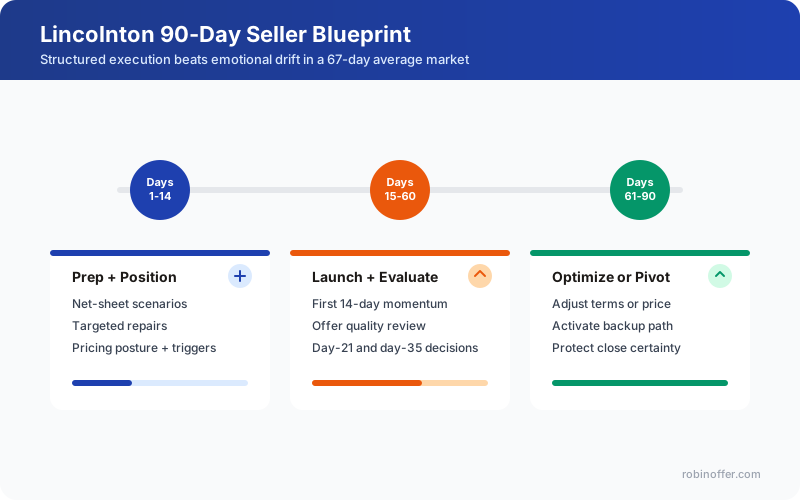
Most sellers need structure more than motivation. A 90-day plan keeps you from drifting. Days 1-14: define your path, gather documents, schedule pre-list touchups, and run net sheets for at least two scenarios. Days 15-35: launch with professional media, clear disclosures, and a pricing strategy tied to active competition. Days 36-60: evaluate traffic and offer quality against predefined thresholds, not wishful thinking. Days 61-90: adjust decisively or pivot paths if required.
Notice what is missing here: endless waiting. If your showing volume is low and feedback repeats price/condition concerns, the market is giving you data. Respect it. Small, timely adjustments outperform dramatic late-stage price cuts. Likewise, if you are getting traffic but weak offers, your positioning may be right while terms need optimization (credits, flexibility, minor repairs, closing window).
Execution discipline is the difference between sellers who feel in control and sellers who feel trapped. You cannot control rates or macro headlines, but you can control preparation quality, pricing honesty, response speed, and negotiation clarity. In Lincolnton's current environment, that is enough to materially improve outcomes.
Robin's Take: Day 21 is the honesty checkpoint. If traffic is weak or feedback is repeating, make one coordinated adjustment early instead of three emotional adjustments late.
13. Local Resource Stack: County Offices, Counselors, and Legal Support
Good decisions get easier when you know where to call. For recording and deed questions, Lincoln County Register of Deeds is a key office. For court and clerk contact pathways, the North Carolina Judicial Branch resources for Lincoln County are essential. For planning and zoning or land-use context, the City of Lincolnton Planning and Development pages help verify what can and cannot be done with a parcel. For school district basics, Lincoln County Schools central resources provide district contact direction.
If you are facing hardship, use formal support channels early. HUD-approved counseling directories (and NC Housing Finance Agency guidance) can connect homeowners with default counseling and budgeting help. Legal Aid of North Carolina serves Lincoln County through the Gastonia office coverage region. These are not "last resort" resources; they are proactive tools for protecting options before pressure escalates.
| Resource Type | Organization | How It Helps Sellers |
|---|---|---|
| Tax rates and local levy context | Lincoln County Tax Rates page | Validates county/city/fire district rates for net and prorations |
| Recording and deed records | Lincoln County Register of Deeds | Deed history, recording process, document logistics |
| Court and clerk directory | NC Judicial Branch (Lincoln County) | Clerk contact pathways for legal-process questions |
| Zoning and land-use references | City of Lincolnton Planning & Development | Zoning map, permitting links, subdivision and land-use references |
| Housing counseling | NCHFA / HUD-approved counselor lookup | Foreclosure prevention and housing stability planning |
| Civil legal support | Legal Aid of North Carolina | Potential support for housing-related legal issues |
14. Decision Framework + FAQ for Lincolnton Homeowners
If you only remember one thing from this guide, remember this: certainty-adjusted net is the decision metric that protects you. A higher offer with weak close probability can produce a worse life outcome than a slightly lower offer that closes when promised. Lincolnton's market gives prepared sellers real opportunity, especially those who position value against higher-priced Lake Norman alternatives. But success comes from disciplined execution, not guessing.
Before you sign anything, answer these five questions in writing: What is my minimum net? What is my real timeline? How much repair and showing burden can I tolerate? What happens if a buyer falls through? What backup path am I willing to use? These questions are simple, but they prevent expensive emotional decisions later.
If you want broader timing context, review our best time to sell in the Carolinas guide. If you are comparing direct sale offers, our cash offer guide helps you avoid common traps and compare options clearly. If you are in a legal-pressure scenario, use the dedicated guides linked above first, then make your sale-path call.
FAQ: Lincolnton Seller Questions
How long does it take to sell in Lincolnton right now?
A typical timeline can run from about 45 to 100+ days depending on condition, pricing, and financing path. January 2026 market data shows average marketing time around the mid-60-day range, then add contract-to-close time.
Is Lincolnton still attracting buyers priced out of Mooresville and Lake Norman areas?
Yes. The value-spread story remains real, but buyers still compare condition and commute practicality carefully. Sellers win when they show clear value and reduce uncertainty.
Should I renovate before selling?
Usually do targeted functional updates rather than full cosmetic overhauls. Fix things that trigger inspection concern, document maintenance, and avoid over-improving beyond neighborhood price ceilings.
Can a direct sale make sense in Lincolnton?
Absolutely, especially for tight timelines, inherited-condition homes, or owners who want to avoid repair/showing burdens. Compare offers using transparent net sheets and close-probability assumptions.
What local data points matter most for pricing?
Recent comparable closings, active competition in your micro-market, sale-to-list patterns, and commute-driven buyer preferences tied to NC 150/US 321 access all matter more than citywide averages alone.
Scenario Lab: Four Realistic Lincolnton Seller Profiles
Profile A: The Move-Up Family in Boger City. They own a 3-bed, 2-bath home and want to buy a larger property before the next school year. Their loan balance is moderate, and their biggest concern is lining up timing without carrying two payments for too long. In Lincolnton, this profile usually does best with a short pre-list prep sprint (two to three weeks), disciplined pricing just inside the likely buyer search band, and a backup plan if they do not receive a clean offer within the first 21 days. The hidden trap here is overconfidence from old market stories. If they list $20,000-$30,000 above realistic value and wait for "the right buyer," they can burn through $4,000-$7,500 in carrying costs while their purchase opportunity narrows.
Profile B: The Inherited Property on the Edge of Town. Siblings inherit an older Lincolnton house with outdated systems, a full attic, and deferred maintenance. They are tempted to renovate everything because a neighbor said "fixed-up homes are getting top dollar." But their risk is project drift: six months of contractor management, uncertain ROI, and growing family conflict. For this profile, the smartest play is often documentation first (title, liens, utility status), then a decision between a targeted cleanout + safety repairs + as-is listing versus direct sale. If the home needs $35,000 in work to chase an uncertain $40,000 premium, that is usually a bad risk-adjusted bet in this market.
Profile C: The Deadline Seller Facing Financial Pressure. This owner needs certainty because missed payments are stacking, and there is no appetite for a long listing runway. In Lincolnton, this profile should prioritize close probability over headline price. A financed buyer with a 45-day contract, aggressive repair requests, and appraisal uncertainty may be less attractive than a lower but cleaner offer that closes in 10-20 days. The key step is to run side-by-side net sheets with a time penalty. Every extra 30 days might cost $1,800-$3,200, and that can erase "higher" offer value quickly.
Profile D: The Relocating Professional with a New Job Start Date. They need a predictable close window and can do limited prep but not major renovation. This profile often succeeds with a hybrid strategy: list at market with polished presentation, set objective trigger points (showing count, offer threshold, days-on-market ceiling), and commit in writing to a pivot date if the market response is weak. This avoids both panic and denial. The result is usually better than emotional week-to-week changes.
Lincolnton Pricing Drill: How to Build a Defensible Number
When we build pricing logic for Lincolnton sellers, we start with three comp buckets: recently sold comparables, active competition, and pending listings. Sold comps anchor what buyers paid. Active listings show what buyers are currently rejecting or considering. Pending listings hint at where demand is accepting terms right now. Ignoring one of these buckets creates blind spots. Many overpriced listings look reasonable against six-month-old sold data but fail against current active alternatives.
Next, we apply adjustment discipline. Sellers often over-credit upgrades and under-credit location friction. A $12,000 kitchen refresh is not always a $12,000 value add. Meanwhile, an awkward commute route, road noise, or odd lot usability can create meaningful buyer discount pressure. In Lincolnton specifically, route practicality toward NC 150, US 321, and daily services can matter as much as interior finishes for the dominant commuter-buyer segment.
Then we pressure-test with financing reality. If your target buyer pool is FHA/VA/conventional payment-sensitive households, list pricing must survive appraisals and monthly affordability checks. A price that requires a buyer to "stretch and hope" produces weaker offers and tougher inspections. A price that fits buyer underwriting comfort usually produces better contract quality. Better contract quality often means fewer surprises and stronger net in the end.
Finally, we decide the launch posture: assertive, balanced, or velocity-focused. Assertive means pricing near upper comp support with excellent condition and strong demand signals. Balanced means pricing close to median support with room for normal negotiation. Velocity-focused means slightly sharper pricing to compress time, useful when carrying-cost pressure is high. The right posture depends on your constraints, not pride.
| Pricing Step | What to Check in Lincolnton | Common Seller Mistake | Better Alternative |
|---|---|---|---|
| Sold comp baseline | Last 90-180 days, similar use-case homes | Using only peak-season outliers | Use clustered median and explain variance |
| Active listing pressure | Homes buyers can pick today | Ignoring stronger active alternatives | Position to win on value and certainty |
| Pending signal | What is getting accepted now | Assuming pending means over-ask win | Use pending as demand-direction indicator |
| Condition adjustment | Systems age, roof, HVAC, deferred repairs | Overvaluing cosmetics | Prioritize objection-removal improvements |
| Launch posture | Timeline + stress + carrying-cost context | Choosing posture from emotion | Choose posture from net-risk math |
Offer Quality in Lincolnton: Not All Contracts Are Equal
Here is what most sellers learn too late: a contract is a probability package, not a guaranteed check. In Lincolnton, financed offers can absolutely be excellent, but you still need to evaluate each one across financing strength, due diligence behavior, repair expectations, appraisal risk, and timeline certainty. A higher number with weak financing documentation can be less valuable than a slightly lower number with cleaner terms and a realistic close path.
Start by asking for lender quality signals early. Is the buyer fully underwritten or only pre-qualified? Has income been verified or is this a surface pre-approval? What loan type is involved, and how sensitive is the scenario to appraisal variance? Then review due diligence and earnest money posture in the context of local norms. Tiny deposits with broad exit flexibility can increase your fall-through exposure.
Repair strategy is another major divider. In Lincolnton's age-diverse housing stock, inspection findings are normal. What matters is whether the buyer's agent is signaling reasonable requests or aggressive re-trade behavior. A buyer who submits a strong initial offer and then demands large post-inspection concessions can transform a good headline number into a mediocre net outcome. Set negotiation boundaries before this stage and stick to them.
Appraisal sensitivity is especially relevant when a home is priced at the edge of comp support. If your contract price is aggressive and buyer cash reserves are thin, appraisal gap risk increases. That does not mean avoid higher offers; it means evaluate the buyer's ability and willingness to bridge gaps if needed. Offer selection should blend price with close probability and timeline fit.
| Offer Dimension | Green Flag | Yellow Flag | Red Flag |
|---|---|---|---|
| Financing strength | Solid pre-approval with verified docs | Basic letter, limited detail | Unclear lender path or unstable qualification |
| Deposits and commitment | Meaningful earnest money and coherent deadlines | Low deposit but otherwise stable terms | Minimal commitment plus broad escape hatches |
| Inspection posture | Specific, reasonable concern framing | Open-ended language | Pattern of aggressive re-trade behavior |
| Appraisal resilience | Buyer has reserves or gap strategy | No stated gap plan | Tight DTI with no flexibility |
| Timeline certainty | Dates align with your constraints | Moderate mismatch but workable | Close date uncertainty threatens your next move |
Lincolnton Seller Mistakes We See Repeated (and How to Avoid Them)
Mistake 1: Listing before the home is truly show-ready. A rushed launch can poison your first two weeks. In Lincolnton, where buyers compare across multiple nearby markets, first impressions determine whether you get touring traffic or passive saves. Avoid this by delaying launch until photos, minor repairs, disclosures, and pricing rationale are all aligned.
Mistake 2: Believing one comp justifies a premium. Every seller can find one nearby sale that supports a higher number. The market does not care. Buyers see the whole menu. Build your pricing case from comp clusters and active alternatives, not one lucky closing.
Mistake 3: Ignoring carrying cost while "waiting for the right buyer." Carrying costs in Lincolnton are not abstract. At $2,200 monthly carry, four extra months can cost $8,800 before new repair or concession requests. That money often exceeds the premium sellers are trying to chase.
Mistake 4: No pivot plan. If you do not set trigger points, you end up negotiating against yourself in public with piecemeal price cuts. Establish in advance what you will do at day 21, day 35, and day 50 if traffic and offer quality are below target.
Mistake 5: Choosing an offer based only on gross number. In Lincolnton, many deals live or die in inspection, appraisal, and financing. Use certainty-adjusted net and choose the contract most likely to close on terms you can live with.
Neighborhood-Specific Talking Points You Can Reuse in Showings
Sellers ask for practical language all the time, so here are examples you can adapt without sounding scripted. If your home offers strong commuter access: "From this part of Lincolnton, you have practical route options toward NC 150 and US 321 without sitting directly on a high-traffic road." If your lot is a differentiator: "You get usable outdoor space here that is difficult to find in many newer communities at this price point." If your updates reduce near-term risk: "Major systems have been serviced and documented so a buyer is not inheriting guesswork in month one."
If your property is not turnkey, be honest but strategic. "This home is priced for buyers who want location and size first, then room to personalize over time." That framing attracts realistic buyers and filters out shoppers expecting perfect finishes at value pricing. In Lincolnton, clear positioning usually outperforms aspirational ambiguity.
You can also reinforce the regional value proposition without overselling it: "Many buyers compare this area with more expensive east-side alternatives. The reason they choose Lincolnton is payment efficiency and practical daily living, and this home is aligned with that decision logic." This language speaks to how people actually choose.
Cross-Link Resource Planner for Your Next Step
If your main question is timing, start with Best Time to Sell a House in NC & SC and run your carry-cost sensitivity first. If your main question is certainty versus price, read Sell Your House for Cash in the Carolinas before comparing offers. If legal or hardship pressure is driving your decision, prioritize Foreclosure Help in North Carolina. If family title complexity is involved, review Inherited Property in NC. If household transition is the issue, use Selling During Divorce in NC & SC.
These guides are most useful when used as workflow tools, not just reading material. Read one, capture your assumptions in writing, then request side-by-side net math for your exact Lincolnton property. When homeowners do this, decisions become calmer and far less expensive.
Final Action Checklist for Lincolnton Homeowners
Use this exact checklist in order. First, gather mortgage payoff, tax parcel details, utility averages, and known repair history. Second, choose your sale-path guardrails: minimum net, latest acceptable close date, and maximum prep spend. Third, build your comp set with sold + active + pending properties that match your use-case. Fourth, decide launch posture and pivot triggers. Fifth, prepare disclosures and document package before photos. Sixth, review every offer with certainty-adjusted net logic. Seventh, keep backup options live until funds clear.
If that sounds overly structured, good. Structured beats stressful. In a market like Lincolnton where outcomes vary widely by execution quality, process discipline is your edge.
Data Appendix: Lincolnton Seller Numbers You Can Recalculate Yourself
Homeowners trust decisions they can verify. So here is the recalculation framework in plain language. Start with your expected contract price. Subtract mortgage payoff request amount from your lender (ask for a projected payoff through a realistic close date, not just today's payoff). Subtract expected seller-side fees: attorney participation, recording and transfer-related charges, and tax prorations based on your parcel's county/city or county/fire district situation. If listing traditionally, subtract any commission arrangement and expected buyer concessions. Then subtract projected carrying cost between now and close. The result is your usable net estimate. Update this every two weeks while active in the market.
For Lincolnton households, this process is especially important because many owners are balancing one of three pressures: rising replacement housing costs, relocation deadlines, or accumulated maintenance needs. If you only track top-line price, you can accidentally choose the wrong contract. If you track net with timeline sensitivity, choices get clearer. For example, an offer that is $8,000 higher on paper but closes 60 days later with higher repair uncertainty may be inferior to a lower offer that closes 20 days faster and limits concession exposure.
You can also test tax sensitivity quickly. Lincoln County's published tax schedules identify county, city, and district rates per $100 of value. Use your tax card value as a baseline and check your parcel's current district context. Then estimate monthly tax accrual by dividing annual estimate by 12. Even if your exact prorations differ at closing, this gives you a realistic holding-cost figure. In Lincolnton planning, realistic beats perfect every time.
| Recalculation Step | Input You Need | Why It Matters in Lincolnton |
|---|---|---|
| 1. Start with expected contract price | List-price strategy and likely offer band | Anchors all downstream decisions |
| 2. Subtract mortgage payoff | Lender payoff statement with date estimate | Largest fixed deduction for many owners |
| 3. Subtract transaction fees | Attorney/closing/tax-stamp assumptions | Avoids false confidence from gross number |
| 4. Subtract concessions/repairs | Expected negotiation pressure by condition | Inspection dynamics are common in local stock |
| 5. Subtract carrying costs to close | Monthly PITI + utilities + upkeep | Timeline slippage directly erodes net |
| 6. Compare certainty-adjusted scenarios | Close-probability estimate per offer | Prevents high-headline/low-certainty mistakes |
What Buyers Say During Lincolnton Showings (and What It Really Means)
Buyer comments can sound random, but most fall into predictable categories. "I like the house, but I need to think about the commute" usually means your location value is not fully proven in the listing package. Solve this with better route context, not defensive explanations. "It feels priced high compared to what we saw" usually means your active competition is stronger than your positioning. Solve this with either a sharper price, stronger terms, or better presentation of condition advantages.
"We are worried about repairs" often means they detected uncertainty, not necessarily catastrophic defects. In Lincolnton's mixed-age housing inventory, uncertainty discounts are normal. Your fix is documentation: service records, receipts, maintenance notes, and clear disclosure language. Buyers pay more when they feel less risk. "We might wait for spring" can mean they are payment constrained and hoping rates improve. If many buyers say this, pricing to current affordability reality beats waiting for macro rescue.
As a seller, you should categorize feedback weekly into buckets: price, condition, location/commute, and terms. If one bucket dominates, act. If feedback is mixed, improve controllables and maintain discipline. If traffic collapses after day 21, your market position is likely off relative to alternatives. In Lincolnton, fast feedback loops win.
Extended FAQ: Practical Lincolnton Questions We Hear Every Week
Do I need to stage in Lincolnton, or is that only for higher-end homes?
You do not need luxury staging in every case, but you almost always need clean visual hierarchy. In Lincolnton, buyers compare quickly across several nearby markets and often review listings on phones first. A cluttered or poorly lit listing underperforms regardless of price tier. Light staging, room-purpose clarity, and strong photography usually produce better showing quality and less price friction. Think "confidence and clarity," not decoration.
How much should I budget for pre-list repairs?
A common practical range is $1,500 to $9,000 depending on condition, with most high-return spend focused on safety, functionality, and deferred maintenance. For Lincolnton homes in the core affordability bands, this usually beats expensive design-heavy remodels. The goal is to prevent inspection panic and re-trade leverage, not to create a designer showcase.
Should I accept an offer in the first weekend?
Sometimes yes, sometimes no. In Lincolnton, an early offer can be excellent if it is backed by strong terms, clear financing, and realistic diligence behavior. The key is not timing alone; it is quality. If the offer clears your certainty-adjusted net target and aligns with your timeline, saying yes early can be smart. Holding out for a maybe-better number without stronger terms can backfire.
How do school preferences affect saleability?
School-related preferences influence search behavior, but they are rarely the only decision factor. Commute route practicality, home condition, lot utility, and payment still dominate many Lincolnton decisions. Sellers should avoid overclaiming school impacts and instead present balanced, verifiable location benefits while encouraging buyers to confirm assignment details with official district resources.
What if my home has an older roof or HVAC?
Older systems are common and not automatically deal-killers. In Lincolnton, buyers are often willing to proceed when age is disclosed clearly and pricing reflects risk. What hurts deals is surprise. If systems are older, gather service records, disclose condition honestly, and choose between pre-emptive replacement, partial repair, or pricing concession strategy before going live.
How do I decide between "as-is" listing and direct sale?
Compare not just probable net but execution burden. If you can tolerate showings, uncertainty, and 45-120 day timelines, an as-is listing may still produce a strong outcome. If your timeline is compressed or your property condition creates high renegotiation risk, direct sale certainty can outperform emotionally and sometimes financially after carrying costs and concessions are included.
Can I sell while buying another home in the region?
Yes, but coordination risk is real. In Lincolnton this often requires either temporary housing flexibility, a negotiated occupancy window, or financing structure that can bridge timing gaps. Build your move plan around conservative close assumptions, not best-case timing. A smooth transition usually comes from contingency planning, not luck.
Should I price slightly low to create competition?
It can work, but only when market demand and product quality support a bidding response. In Lincolnton's somewhat competitive environment, underpricing without strong listing quality can attract low offers rather than clean competition. Use strategy intentionally: if speed is priority, slight under-market pricing may help; if maximum net is priority, balanced pricing with strong preparation may be better.
What should I do if there are no offers after 30 days?
Treat this as data, not failure. Audit your listing in four areas: price position versus active alternatives, photo quality and room clarity, showing accessibility, and repair/condition perception. Make coordinated changes, not random tweaks. If your timeline cannot tolerate extended marketing, activate your backup path immediately rather than drifting.
Do cash buyers always pay less?
Often, but not always once you include certainty, speed, and reduced repair burden. In Lincolnton, well-informed sellers compare cash offers against realistic listed-sale nets including carrying costs, commissions, concessions, and close-probability risk. That apples-to-apples comparison is the only honest method.
What about HOA transfer fees and neighborhood restrictions?
If your Lincolnton property is in an HOA, gather governing documents and known transfer or disclosure fees early. Buyers and agents dislike last-minute surprises, and delayed HOA docs can slow closings. Operational readiness here can be the difference between a smooth close and a stressful extension.
How should I handle multiple offers?
Define your ranking criteria before reviewing offers: net, certainty, timeline, and stress profile. Request highest-and-best with specific deadline and clear expectations. Then evaluate with a written matrix so you do not get pulled by emotion or headline-only thinking. In Lincolnton, the strongest contract quality often wins over the loudest number.
Lincolnton Seller Playbook by Timeline Pressure
If you have 120+ days: You can optimize for net with a full-market strategy. Complete targeted repairs, invest in high-quality media, and test pricing at the stronger end of supported range if condition and location justify it. Monitor early traffic and remain disciplined with feedback interpretation. The advantage of longer timeline is option value; do not waste it with indecision.
If you have 60-90 days: Prioritize balanced strategy. You still have room for strong market exposure, but your pivot triggers must be firm. In Lincolnton, we typically recommend a day-21 and day-35 checkpoint with pre-agreed actions. This protects you from the common "wait and hope" loop that erodes net through carrying costs.
If you have 30-45 days: Certainty should dominate. Consider a hybrid where you test listing response briefly only if launch quality is high and fallback options are pre-vetted. Otherwise, pursue direct or certainty-weighted pathways that align with your hard deadline.
If you have under 30 days: Treat this as a close-probability challenge, not a marketing challenge. Focus on offers and terms that can genuinely close on time with minimal contingencies. In high-pressure scenarios, preserving stability and avoiding failed contracts usually matters more than squeezing out marginal headline gains.
One Last Reality Check for Lincolnton Owners
You are not trying to win an argument with Zillow comments, neighbors, or old market memories. You are trying to exit a major asset on terms that protect your household. In Lincolnton, that means grounding decisions in real local comparisons, transparent net math, and honest timeline planning. When sellers do this, outcomes are usually strong even in imperfect conditions. When sellers avoid this, the process gets expensive fast.
If you want help implementing this framework, bring your exact numbers: payoff estimate, target dates, known repairs, and current alternatives you are considering. Then run the matrix. The right decision usually becomes obvious once the math and constraints are on one page.
Mini Case Study: Two Lincolnton Sellers, Two Different Outcomes
Seller One listed a Lincolnton home at what they called a "negotiation cushion" price. The house had strong bones but visible deferred maintenance and older mechanical systems. During the first 30 days, showings were decent but feedback repeated the same line: price did not match condition versus nearby alternatives. They resisted adjusting because one old comp supported their number. By day 52, they made a noticeable price reduction, accepted a financed offer, then lost additional net through inspection concessions and extended close timing. End result: they closed, but net proceeds landed below what an earlier realistic launch likely would have produced.
Seller Two owned a similar-size Lincolnton property in a different micro-market. They invested in targeted pre-list repairs, documented systems, and launched with a price aligned to current active competition rather than optimistic outliers. They also set a written rule: if no qualified offer by day 21, they would either adjust terms or pivot. They received a strong offer inside three weeks and closed on schedule with limited renegotiation. End result: slightly lower headline than their original hope, but higher certainty-adjusted net and much lower stress.
The lesson is not that one strategy always wins. The lesson is that strategy plus discipline beats improvisation. In Lincolnton's current market, most expensive mistakes happen after launch: delayed adjustments, emotional pricing defense, and contract-quality blind spots. If you build your framework before listing, you reduce those risks dramatically.
Seller Communication Scripts That Keep Deals Moving
Good communication can preserve leverage. Here are practical scripts. If a buyer asks for broad post-inspection credits: "We are open to reasonable safety and functionality items. Please provide a prioritized list tied to material concerns, and we will respond quickly." If a buyer agent pushes appraisal fear before appraiser data exists: "We understand valuation sensitivity and priced against current local alternatives. If there is a documented appraisal gap, we can revisit with evidence-based options."
If you need to decline weak terms without killing the conversation: "We appreciate the offer and interest in this Lincolnton property. At current terms, it does not meet our net and timeline requirements. If your buyer can improve X and Y, we are ready to move quickly." This keeps tone professional while protecting your boundaries. If timing matters most, say that clearly: "Our decision priority is close certainty by [date], then net." Serious buyers will self-sort.
When sellers communicate constraints early, negotiations usually become faster and cleaner. Vagueness invites pressure. Clarity invites solutions. In a city like Lincolnton where many buyers are evaluating multiple nearby markets simultaneously, fast and clear responses can be a real competitive advantage.
Final Checklist Before You Sign the Winning Contract
Run this final pre-sign checklist. Confirm buyer identity and lender strength. Confirm deposits and critical deadlines in writing. Confirm your net after all known deductions and probable concessions. Confirm your move logistics if close date shifts by 7-14 days. Confirm backup plan if this contract terminates. Confirm that your emotional stress level matches the selected path. If any box is uncertain, pause and fix it before signing.
At the closing table, most regret comes from things sellers did not clarify early. In Lincolnton, you can avoid that by treating your sale like a project with milestones, not a single event. The more upfront clarity you create, the easier the finish line becomes.
Need a second corridor-market benchmark? Review Kings Mountain homeowner selling options and Shelby homeowner selling options to compare carry-cost and path-selection decisions across Cleveland/Lincoln commuter contexts, or see our Cramerton homeowner selling guide for a compact Gaston County riverfront market closer to the Charlotte side of the corridor.
Want a cash offer on your Lincolnton home?
Tell us your address and timeline and we will get you a no-obligation cash offer.