
NC Homestead Exemption Guide
What $35,000 really protects, where it fails, and how to protect more of your equity under pressure.
1. The $35,000 question: what North Carolina's homestead exemption actually covers
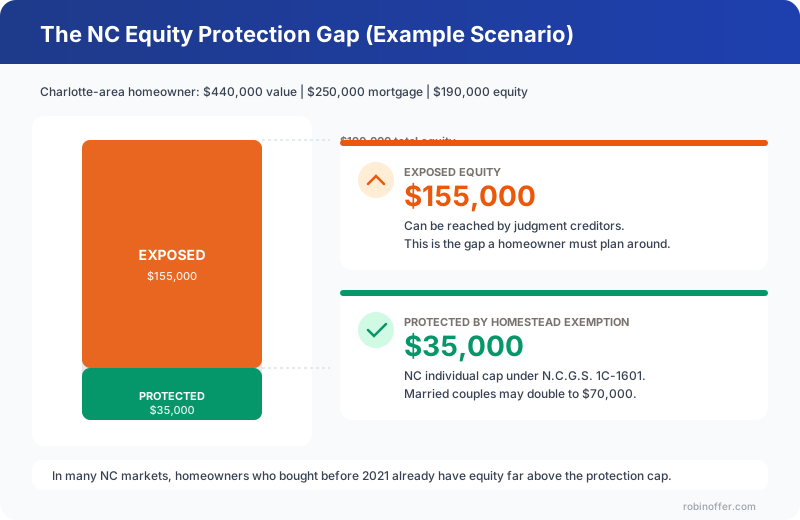
North Carolina's homestead exemption protects up to $35,000 of equity in your primary residence from creditors and judgment liens under N.C. Gen. Stat. § 1C-1601. That sounds like a safety net until you compare it to the median Charlotte-area home price of $440,000 and realize the gap between what you own and what the law shields is enormous.
We get calls about this all the time. A homeowner in Mecklenburg County gets a judgment against them (maybe a medical bill that went to collections, maybe a business debt that turned personal) and someone tells them not to worry because North Carolina has a homestead exemption. Then they look up the number and their stomach drops.
$35,000. That is the ceiling for an individual debtor in NC. If you are married and both names are on the deed, you can double it to $70,000. If you are 65 or older, unmarried, and your spouse who co-owned the property has passed away, you get $60,000. Those are the three tiers, with no inflation adjustment built into the statute and no county-by-county variation. $35,000 in Mecklenburg is the same $35,000 in rural Robeson County, even though home values in those two places occupy different universes.
Here is what that actually looks like for a homeowner right now:
| Homeowner Profile | Estimated Home Value | Remaining Mortgage | Equity | Exemption Available | Equity at Risk |
|---|---|---|---|---|---|
| Charlotte homeowner, individual | $440,000 | $250,000 | $190,000 | $35,000 | $155,000 |
| Charlotte married couple, joint deed | $440,000 | $250,000 | $190,000 | $70,000 | $120,000 |
| Gaston County homeowner, individual | $275,000 | $150,000 | $125,000 | $35,000 | $90,000 |
| Long-time owner, mortgage paid off | $375,000 | $0 | $375,000 | $35,000 | $340,000 |
| Recent buyer (purchased 2023) | $400,000 | $360,000 | $40,000 | $35,000 | $5,000 |
| Senior 65+, surviving spouse | $375,000 | $0 | $375,000 | $60,000 | $315,000 |
That last column is the one that matters. For most NC homeowners who have lived in their home for more than a few years, the homestead exemption covers a fraction of their equity. The only profile where the exemption does its job is the recent buyer who has barely built equity yet, and that person usually is not the one facing creditor problems.
2. Two programs, one confusing name: the tax break versus the creditor shield
Before we go deeper, we need to clear up the most common confusion we hear. North Carolina has two completely different programs that both use the word "homestead," and mixing them up can lead to bad decisions.
| Feature | Creditor Protection Homestead Exemption | Property Tax Homestead Exclusion |
|---|---|---|
| What it does | Protects home equity from judgment creditors | Reduces your property tax bill |
| Governing law | N.C. Gen. Stat. § 1C-1601 | N.C. Gen. Stat. § 105-277.1 |
| Who qualifies | Any NC resident who is a debtor | Age 65+ or totally/permanently disabled |
| Income limit | None | $38,800 (2025) |
| Amount | $35,000 in equity (individual) | Greater of $25,000 or 50% of appraised value excluded from tax |
| Must file to claim? | Yes, within 20 days of creditor notice | Yes, annual application with county tax office |
| Stops foreclosure? | Not from your mortgage lender | No, reduces taxes only |
| Available to everyone? | Yes, regardless of age | No, age 65+ or disabled only |
The property tax homestead exclusion is a genuinely helpful program for seniors and disabled homeowners. If you qualify, you can exclude the greater of $25,000 or 50% of your home's appraised value from property taxes. On a $300,000 home, that could save you $1,000 or more annually depending on your county's tax rate. Pending legislation (House Bill 432, the "Protect Our Homes Act") would double the floor to $50,000 starting July 2026. If you're a senior weighing whether to keep your home or move to something smaller, our senior's guide to downsizing in NC breaks down how these tax breaks factor into the stay-vs-go math.
But neither of these programs does what most people think when they hear "homestead exemption." Neither one prevents your mortgage lender from foreclosing. Neither one stops the IRS from enforcing a federal tax lien. They are useful tools in very specific situations, and understanding exactly what each one does (and does not do) is the whole point of this guide.
The property tax exclusion application process
If you are 65 or older (or totally and permanently disabled) and your 2025 income was $38,800 or less, contact your county tax office before the application deadline, typically June 1 of each year. You will need proof of age or disability, proof of ownership and occupancy, and income verification. The exclusion applies to your principal residence only. If approved, the taxable value of your home drops by the greater of $25,000 or half the appraised value.
Disabled veterans have a separate, more generous program. Currently, the first $45,000 of appraised value is excluded. House Bill 432 would increase this to the lesser of $100,000 or 50% of appraised value if enacted.
3. The legal architecture: where NC's creditor protection comes from and how it works
North Carolina's creditor protection homestead exemption has roots in the state constitution. Article X of the NC Constitution has protected homesteads since Reconstruction, originally to prevent families from losing their farms to creditors. The General Assembly sets the dollar amount (currently $35,000) with the constitutional floor at just $1,000.
The current statute, N.C. Gen. Stat. § 1C-1601, spells out exactly what the exemption covers:
- Real property used as your residence (house, condo, townhouse)
- Personal property used as a residence (mobile home, manufactured home)
- Cooperative ownership interest used as a residence
- Burial plot for you or a dependent
The exemption protects your equity, not the full property value. If your home is worth $300,000 and you owe $270,000 on the mortgage, your equity is $30,000. That falls under the $35,000 cap, so a judgment creditor cannot force a sale. But if you owe $200,000, your equity is $100,000, and only $35,000 of it is protected. A creditor holding a judgment could theoretically force a sale, pay off your mortgage, give you $35,000, and take the remaining $65,000.
How to claim the exemption
The homestead exemption is not automatic. When a creditor obtains a judgment and sends you a "Notice of Right to Have Exemptions Designated," you have a short window to act.
| Step | What Happens | Deadline | Consequence of Missing It |
|---|---|---|---|
| 1. Receive notice | Creditor serves notice of your exemption rights | Clock starts ticking | |
| 2. File motion or request hearing | File a "Motion to Claim Exempt Property" with schedule of assets, OR request a hearing before the Clerk | 20 days from receipt of notice | Exemptions are permanently waived |
| 3. Serve creditor | Serve copy of motion and schedule on judgment creditor | Same filing deadline | Motion may be rejected |
| 4. Creditor may object | Creditor has 10 days to challenge your claimed exemptions | 10 days after service | If no objection, exemptions stand |
| 5. Court rules | If disputed, Clerk or judge determines which property is exempt | Varies by court calendar |
That 20-day window is not negotiable. If you do not file or request a hearing within 20 days of receiving the notice, you waive your right to claim any exemptions under Article 16. The judgment creditor can then pursue your property, including your home, without the homestead shield in place.
The wildcard exemption
NC has a lesser-known companion to the homestead exemption: the wildcard. Under § 1C-1601(a)(2), you can apply up to $5,000 of any unused homestead exemption to any other property. If you only needed $30,000 of your $35,000 homestead to cover your home equity, you could use the remaining $5,000 to protect a car, bank account, or other asset. If you use the full $35,000 on your home, the wildcard is zero. It is a shared pool, not an add-on.
4. The four creditors your homestead exemption cannot stop
This is the section most homeowners need to read twice. The NC homestead exemption has explicit exceptions carved into the statute: categories of debt where the protection simply does not apply. No matter how much or how little equity you have, these creditors can reach your home.
| Creditor Category | Why the Exemption Fails | Statute Reference | What They Can Do |
|---|---|---|---|
| Mortgage lender / deed of trust holder | You voluntarily pledged the property as collateral | § 1C-1601(e) | Foreclose under power of sale (N.C. is non-judicial) |
| IRS and federal tax liens | Federal supremacy clause overrides state exemptions | U.S. Constitution, Art. VI | Place lien, potentially force sale (rare for primary residence) |
| County/city property tax liens | Explicitly excluded from homestead protection | § 1C-1601(e); Chapter 105 | Advertise and sell at tax lien auction after one year of delinquency |
| Mechanics, contractors, materialmen | Work performed on the property creates a statutory lien | § 1C-1601(e); Chapter 44A | File lien and foreclose to collect for unpaid work |
There is a fifth category that often catches homeowners off guard: pre-existing liens. If a creditor recorded a lien against your property before you claimed the homestead exemption, that lien survives. The exemption only protects against future enforcement actions, not liens already attached to your title.
The mortgage exception in practice
This is the one that frustrates people most. If you are behind on your mortgage and the lender initiates foreclosure under North Carolina's power-of-sale process, the homestead exemption offers zero protection. It was never designed to interfere with consensual liens, meaning debts you agreed to secure with your home when you signed the mortgage documents.
The same applies to home equity lines of credit (HELOCs), second mortgages, and any other loan where you pledged the house as collateral. If you signed a deed of trust, the homestead exemption does not apply to that lender.
The IRS exception: federal law wins
The homestead exemption is a creature of state law, and when it runs up against a federal tax lien, state law loses. The Supremacy Clause of the U.S. Constitution means the IRS can attach a lien to your home regardless of any state-level protection. That said, the IRS is generally reluctant to force the sale of a primary residence to collect tax debts and typically does so only in cases involving substantial amounts. But the legal authority exists, and the homestead exemption cannot stop it.
HOA assessment liens: the quiet threat
North Carolina's Planned Community Act (Chapter 47F) gives homeowners associations a statutory lien for unpaid assessments. This lien can, in theory, lead to foreclosure. While it does not fall neatly into the four explicit statutory exceptions, HOA liens in NC operate under their own statutory framework and can bypass homestead protections through their dedicated enforcement mechanism. If you are behind on HOA dues, do not assume the homestead exemption will protect you.
5. How your neighbors across the state line are better protected
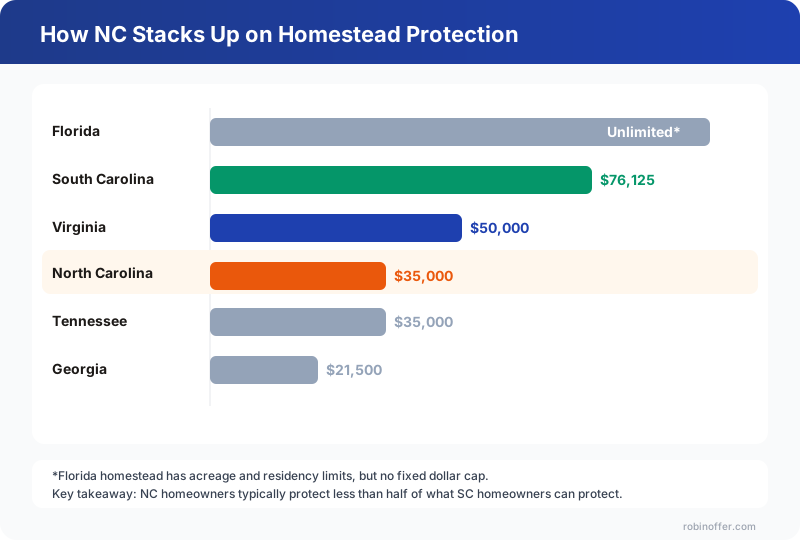
If NC's $35,000 cap feels low, that is because it is, and among Southeast states, North Carolina ranks near the bottom. Your neighbors in South Carolina get more than double the protection. Cross over to Florida and the exemption is unlimited.
| State | Individual Exemption | Married Couple (Joint) | How It Adjusts | Can Use Federal Exemption? |
|---|---|---|---|---|
| North Carolina | $35,000 | $70,000 | No automatic adjustment | No |
| South Carolina | $76,125 | $152,250 | Inflation-adjusted every 2 years | No |
| Virginia | $50,000 | $100,000 | Auto-adjusts every 3 years | No |
| Tennessee | $35,000 | $52,500 | No automatic adjustment | No |
| Georgia | $21,500 | $43,000 | No automatic adjustment | No |
| Florida | Unlimited | Unlimited | N/A, no cap | No |
| Federal (if state allows) | $31,575 | $63,150 | Adjusted every 3 years for CPI | Only in states that opt in |
A few things jump out from this table:
- South Carolina gives you $76,125 and adjusts it for inflation every two years. The last adjustment was July 2024. NC has not adjusted its amount in over a decade.
- Virginia doubled its exemption from $25,000 to $50,000 in July 2024 and built in automatic three-year adjustments. NC's legislature has not followed.
- NC does not allow the federal exemption. In states that do, debtors can choose between state and federal exemptions. North Carolina forces you to use the state system. The current federal homestead exemption is $31,575, close to NC's $35,000, so it would not help much anyway, but the loss of optionality matters for other exemption categories.
- Only Georgia is worse. At $21,500, Georgia has the lowest homestead exemption in the Southeast. NC is second-lowest, tied with Tennessee for individual filers.
6. Tenancy by the entirety: NC's real shield for married homeowners
Most articles about NC's homestead exemption miss this entirely. If you are married and own your home in North Carolina, you probably have a much stronger protection than the $35,000 homestead exemption, and you may not even know it.
It is called tenancy by the entirety (TBE), and it works like this: when a married couple owns real property in NC, the law treats them as a single legal entity for ownership purposes. Neither spouse individually owns a divisible share, and the whole property belongs to the marriage.
Why TBE matters more than the homestead exemption
| Protection Feature | Homestead Exemption (§ 1C-1601) | Tenancy by the Entirety |
|---|---|---|
| Dollar limit | $35,000 individual / $70,000 joint | No dollar limit, full property value |
| Protects against individual spouse's debts | Up to the cap only | Full protection, creditor of one spouse cannot force sale |
| Protects against joint debts | Up to the cap only | No, both spouses owe = TBE does not help |
| Protects against IRS liens | No | No, federal supremacy overrides |
| Must file paperwork to claim | Yes, 20-day deadline | No, automatic for married couples in NC |
| Requires both spouses on deed | Yes (to double the exemption) | Yes (TBE only available to married couples) |
The key advantage: TBE has no dollar cap. If your home is worth $500,000 and the debt belongs to only one spouse, a creditor cannot force a sale to collect. The $500,000 is fully shielded. Compare that to the homestead exemption, which would leave $465,000 exposed for a single filer or $430,000 exposed for a couple.
How TBE is created in NC
Good news: you probably already have it. In North Carolina, tenancy by the entirety is the default form of ownership when a married couple acquires real property during their marriage. If the deed does not say otherwise, you own as tenants by the entirety. You did not have to check a box or file anything; it happened automatically.
There are situations where TBE might not apply:
- The deed explicitly states a different ownership form (joint tenants, tenants in common)
- You bought the property before marriage and never added your spouse to the deed
- The property was inherited by one spouse only
- You are not legally married
The limits of TBE
TBE is powerful but not bulletproof:
- Joint debts destroy the protection. If both spouses signed for a credit card, both spouses cosigned a business loan, or both spouses owe the IRS, TBE does not help. The creditor of both owners can reach the property.
- Divorce ends TBE. The moment you divorce, tenancy by the entirety converts to tenancy in common, and the creditor of one ex-spouse can now pursue that ex-spouse's share.
- Federal liens pierce TBE. The IRS does not care about state property law. A federal tax lien can attach to one spouse's interest in TBE property.
- Only applies to real estate. TBE in NC does not protect bank accounts, vehicles, or other personal property. It is a real-property shield only.
Need to know how much equity you actually have?
Your protected equity starts with your home's value. Get a free estimate from ListRobin to see where you stand before making any decision.
7. The equity gap: what $35,000 actually means in today's NC housing market
Numbers do not lie, so let us put NC's homestead exemption in the context of what homes actually cost across the state right now.
| NC Market | Median Home Value (2025-2026) | Typical Equity (10+ Year Owner) | Homestead Coverage | Percentage Protected |
|---|---|---|---|---|
| Charlotte (Mecklenburg) | $440,000 | $200,000+ | $35,000 | ~17% |
| Raleigh-Durham (Wake) | $445,000 | $210,000+ | $35,000 | ~17% |
| Asheville (Buncombe) | $420,000 | $190,000+ | $35,000 | ~18% |
| Wilmington (New Hanover) | $400,000 | $175,000+ | $35,000 | ~20% |
| Gastonia (Gaston) | $275,000 | $125,000+ | $35,000 | ~28% |
| Rural NC (statewide median) | $332,000 | $150,000+ | $35,000 | ~23% |
In no NC market does the homestead exemption cover even 30% of a typical long-time homeowner's equity. In Charlotte and the Triangle, the state's two largest metros, it covers less than one-fifth. If you're a Wake County homeowner weighing your options, our Apex homeowner selling guide breaks down the full equity picture, including how the $584K median and rapid appreciation affect your net proceeds under each selling path.
How the gap compounds over time
Consider a homeowner who bought in Charlotte's Steele Creek neighborhood in 2015 for $220,000 with a $200,000 mortgage. Today that home is worth roughly $380,000 and the mortgage balance is around $165,000. Their equity is $215,000.
The homestead exemption covers $35,000. The remaining $180,000 is exposed. If a creditor obtains a judgment for $50,000, they can theoretically force a sale: the $380,000 sale price pays off the $165,000 mortgage, the homeowner gets $35,000 (their exempt amount), the creditor takes $50,000, and the homeowner keeps the remaining $130,000. The homeowner still walks away with money, but they lost their home and $50,000 in equity to do it.
Now imagine that same homeowner had bought in Rock Hill, South Carolina instead. South Carolina's homestead exemption is $76,125. The creditor's $50,000 judgment cannot be satisfied because the homeowner's exempt equity ($76,125) plus the mortgage payoff ($165,000) exceeds what a forced sale would recover after costs. The home stays.
The equity-rich trap
ATTOM Data reports that 43.59% of Charlotte-area properties are "equity rich," meaning the mortgage balance is 50% or less of the estimated value. Statewide, that figure is 33.5%. These are homeowners sitting on substantial wealth in their homes. And the NC homestead exemption protects a sliver of it.
The homeowners most vulnerable to the equity gap are actually the most financially stable ones: long-time owners who have paid down their mortgages and benefited from appreciation. Paradoxically, the exemption works best for the people who need it least (recent buyers with minimal equity) and fails the people who have the most to lose.
A note on legislative status: South Carolina and Virginia adjust their homestead exemptions for inflation automatically. North Carolina's $35,000 cap requires affirmative legislation to change and has not been updated in over a decade. As of February 2026, no pending bill addresses the creditor protection amount. House Bill 432 ("Protect Our Homes Act") would expand the property tax exclusion but does not touch the $35,000 creditor shield.
8. Bankruptcy and your NC home: when $35,000 decides everything
If you are considering bankruptcy in North Carolina, the homestead exemption becomes the single most important number in the equation. It determines whether you keep or lose your home.
Chapter 7: the $35,000 threshold
Chapter 7 bankruptcy is the "liquidation" option. A court-appointed trustee reviews your assets, sells non-exempt property, and uses the proceeds to pay creditors. Any qualifying debt that remains is then discharged.
Here is how the homestead exemption works in Chapter 7:
| Your Equity Level | What Happens in Chapter 7 | Practical Outcome |
|---|---|---|
| Equity ≤ $35,000 (individual) or ≤ $70,000 (married, joint deed) | Home is fully exempt, trustee cannot sell it | You keep your home and discharge other debts |
| Equity slightly above the exemption | Trustee may decide the sale is not worthwhile after costs | You might keep your home, but it is the trustee's call |
| Equity significantly above the exemption | Trustee sells the home, pays mortgage, gives you $35K, distributes rest to creditors | You lose your home but keep $35,000 and discharge debts |
Important: North Carolina does not allow you to use federal bankruptcy exemptions. You must use the NC state exemptions. The federal homestead exemption is currently $31,575 (for cases filed between April 2025 and March 2028), which is slightly less than NC's $35,000. Even if federal were available, it would not help for the homestead specifically. But federal exemptions can be more generous for other asset categories, and losing that option narrows your planning flexibility.
Chapter 13: keep the home, pay over time
Chapter 13 is the reorganization option. Instead of liquidating assets, you propose a 3-to-5-year repayment plan. You keep your property, including your home, as long as you make the plan payments.
For NC homeowners with more than $35,000 in equity, Chapter 13 is almost always the better path if the goal is keeping the home. You will pay at least as much as creditors would have received in a Chapter 7 liquidation, but you do it over time while staying in your house.
| Bankruptcy Factor | Chapter 7 | Chapter 13 |
|---|---|---|
| NC homestead exemption role | Determines if you keep or lose home | Determines minimum plan payment amount |
| Filing fee | ~$338 | ~$313 |
| Attorney cost range (NC) | $1,000–$2,500 | $2,500–$5,000 |
| Keeps home? | Only if equity ≤ exemption | Yes, if you make plan payments |
| Timeline | 3–6 months to discharge | 3–5 year repayment plan |
| Income requirement | Must pass means test (income below median or pass expense test) | Must have regular income |
| Credit score impact | Stays on credit report 10 years | Stays on credit report 7 years |
The 1,215-day rule
Federal law adds one more wrinkle. If you purchased your home within 1,215 days (about 40 months) before filing bankruptcy, there is a federal cap of $214,000 on the homestead exemption, regardless of what state law allows. This primarily affects states with higher or unlimited exemptions (like Florida), but NC filers should be aware of it.
For NC homeowners, the practical impact is minimal since the state cap ($35,000) is far below the federal cap ($214,000). But if you recently moved to NC from a state with a higher exemption, this rule could affect which state's exemptions you use.
9. Real-world scenarios: how the homestead exemption plays out in five NC households
Legal concepts become clearer when you see them applied to actual situations. These five scenarios are composites based on common situations we see across the Charlotte metro and statewide.
Scenario 1: The medical debt spiral in Huntersville
Sarah, 52, owns a townhouse in Huntersville worth $340,000 with $180,000 left on the mortgage. Her equity is $160,000. After an unexpected surgery and a gap in insurance coverage, she accumulated $45,000 in medical debt that went to collections. The collection agency obtained a judgment.
Sarah's homestead exemption covers $35,000 of her $160,000 in equity, leaving $125,000 exposed. In theory, the creditor could force a sale, but in practice, the creditor would need to weigh the cost (attorney fees, court costs, the time value of money) against the likely recovery. Many medical debt holders settle for a fraction of the judgment amount, often 30-50 cents on the dollar, when the debtor offers a lump sum payment.
Sarah's best move: consult a bankruptcy attorney about Chapter 13 (which would let her keep the home and pay creditors over 3-5 years) or negotiate a lump-sum settlement by borrowing against the home's equity through a HELOC or refinance. If she can settle the $45,000 judgment for $20,000-$25,000, she preserves her home and most of her equity. For Huntersville homeowners weighing whether to sell, stay, or tap equity, our Huntersville homeowner selling options guide covers current market values and net proceeds math across every path.
Scenario 2: The married couple in Gastonia with one spouse's business debt
Michael and Janet own their Gastonia home jointly, purchased during marriage, so they hold it as tenants by the entirety. Value: $280,000. Mortgage: $90,000. Equity: $190,000. Michael's landscaping business failed and he personally guaranteed $75,000 in business loans that went to judgment.
This is where TBE saves them. Because the debt is only in Michael's name and the property is owned as tenants by the entirety, the creditor of one spouse cannot force the sale of TBE property. Michael and Janet's home is fully protected, not by the $35,000 homestead exemption, but by TBE's unlimited shield against individual-spouse creditors.
If Michael and Janet were to divorce, however, TBE would immediately convert to tenancy in common, and Michael's $95,000 share of equity would become reachable by the $75,000 judgment creditor. Timing matters enormously in cases like this.
Scenario 3: The retiree in Hickory with a paid-off home and a tax lien
Robert, 71, owns his Hickory home free and clear. Value: $250,000. Equity: $250,000. His wife passed away three years ago. Robert owes $18,000 in delinquent property taxes to Catawba County.
Robert qualifies for the elevated $60,000 homestead exemption (65+, unmarried, deceased spouse who co-owned the property), but it does not matter. Property tax liens are explicitly excluded from homestead protection under § 1C-1601(e). Catawba County can and will pursue the property for delinquent taxes regardless of the exemption.
Robert should apply for the property tax homestead exclusion (the tax break program, not the creditor shield) which would reduce his annual tax burden going forward. He should also contact his county tax office about a payment plan for the delinquent amount. If the delinquency is severe enough, selling the home and downsizing may be the cleanest solution. He would capture the full $250,000 in equity minus selling costs and the $18,000 tax debt, keeping over $200,000 for a fresh start.
Scenario 4: The Charlotte investor who lost the rental game
David bought his primary residence in South End for $520,000 in 2021 with $460,000 financed. He also bought a rental property in NoDa that lost money and resulted in a $90,000 judgment after a tenant dispute and failed investment. His primary home is now worth $550,000 with $430,000 remaining on the mortgage. Equity: $120,000.
David's homestead exemption covers $35,000 of his $120,000 in equity. The remaining $85,000 is exposed. Because the rental property was the source of the judgment (not the primary residence), the creditor would need to pursue a general judgment lien against David's assets, including his home equity. David should explore Chapter 13 bankruptcy, which would let him keep his home while proposing a repayment plan that accounts for his income, expenses, and the value of his non-exempt assets.
Scenario 5: The recent buyer in Kannapolis with minimal equity
Maria bought a home in Kannapolis in early 2024 for $295,000 with a $280,000 mortgage. Current value: $305,000. Equity: $25,000. Maria has a $30,000 personal loan judgment against her.
This is the rare scenario where the homestead exemption actually works as designed. Maria's $25,000 in equity falls entirely within the $35,000 cap. The judgment creditor cannot force a sale because there would be nothing left after paying the mortgage and the exempt amount. Maria keeps her home. The creditor may pursue other assets (bank accounts, wages through garnishment) but cannot touch the house.
Start with what your home is worth
Before weighing sell vs. keep, get a free home value estimate from ListRobin so you know your real equity position.
10. When selling makes more financial sense than trying to protect your equity
Sometimes the smartest move when you are facing creditor action is not to fight for an exemption that covers a fraction of your equity. Instead, sell your home on your own terms, satisfy the debt, and keep what is left.
The math that matters
Consider this scenario. You own a $350,000 home in Charlotte with $120,000 remaining on the mortgage. A creditor has obtained a $60,000 judgment against you. Here are your options:
| Path | What Happens | You Walk Away With |
|---|---|---|
| Do nothing (forced sale) | Creditor forces sale. Home sells at auction (often below market). Mortgage paid. You get $35K exemption. Creditor takes $60K. Remainder to you. | ~$95,000 (if auction brings $310K after costs) |
| Sell voluntarily (agent) | List at market value. Pay 5-6% commission + closing costs. Pay mortgage. Negotiate with creditor from position of strength. Pay judgment. | ~$140,000 (after $21K commission, $8K costs, $120K mortgage, $60K judgment) |
| Sell voluntarily (cash buyer) | Accept cash offer at ~85-90% of market value. Close in 2-3 weeks. No commission. Pay mortgage. Pay judgment. | ~$125,000 (at $310K cash offer, minus $120K mortgage, minus $60K judgment, minus $5K costs) |
The voluntary sale nets $30,000-$45,000 more than a forced sale because you control the process, the timing, and the price. You avoid the stigma and uncertainty of a court-ordered auction. You can also sometimes negotiate the judgment amount down as part of the settlement, since creditors often accept less when they know they are getting paid voluntarily.
Five scenarios where selling beats fighting
- Your equity dramatically exceeds the exemption. When you have $200,000 in equity and the exemption covers $35,000, you are protecting 17.5% and exposing 82.5%. Sell, pay debts, and keep the rest.
- The judgment is growing. Post-judgment interest accrues at 8% in NC (the legal rate under G.S. 24-1). A $50,000 judgment becomes $54,000 after one year. Delay costs you money.
- Tax liens are involved. The homestead exemption does not protect against property tax liens or IRS liens. If those are the issue, the exemption is irrelevant. Sell before penalties and interest compound further.
- You are facing foreclosure anyway. If your mortgage lender is also pursuing you, the homestead exemption is doubly irrelevant. A proactive sale captures equity that foreclosure would destroy.
- You want a fresh start. Sometimes the psychological weight of judgment liens, collection calls, and legal proceedings makes selling the right decision even when the math is close. A clean break can be worth more than the numbers show.
The net proceeds comparison for your situation
The key question is not "does the homestead exemption apply?" It is "what do I actually keep under each scenario?" Run this math for your own numbers:
| Calculate This | Your Number | How to Find It |
|---|---|---|
| Current home value | $________ | Zillow estimate, recent comps, or CMA from an agent |
| Mortgage payoff amount | $________ | Call your servicer for a payoff quote (valid 30 days) |
| Your equity (value minus mortgage) | $________ | Simple subtraction |
| Total judgment/debt amount | $________ | Court records or creditor statement |
| Homestead exemption available | $________ | $35K (individual), $70K (married/joint), $60K (65+ surviving) |
| Unprotected equity (equity minus exemption) | $________ | This is what is at risk |
| Net if you sell voluntarily | $________ | Home value minus mortgage, minus selling costs, minus debt |
If your "net if you sell voluntarily" is higher than your homestead exemption amount, selling puts more money in your pocket than what the law would protect in a forced sale. That is the decision point.
If you want help running these numbers with your actual home value, we break down the comparison between cash offers and traditional listing in detail, including what you should expect from each path and how to spot lowball offers.
11. The intersection with divorce, inheritance, and financial distress
Life events do not happen one at a time. A homeowner facing a creditor judgment is often also going through a divorce, managing an inherited property, or dealing with broader financial distress. Below is how the homestead exemption interacts with each.
Divorce and the homestead exemption
Divorce changes the homestead equation in two important ways:
- TBE protection ends. The moment your divorce is final, tenancy by the entirety converts to tenancy in common. Creditors of either ex-spouse can now pursue that person's share of the property, and if one spouse had been shielded by TBE during the marriage, that shield disappears overnight.
- The doubled exemption may shrink. A married couple filing jointly gets $70,000 in homestead protection. After divorce, each individual gets $35,000, but only for their own share of the property. If one spouse is awarded the home and has the judgment against them, they are back to $35,000 on the full equity.
If you are going through a divorce and one spouse has significant debts, the timing of property transfers, title changes, and divorce finalization relative to creditor actions matters a great deal. This is territory where a specialized divorce and real estate attorney earns their fee.
Inherited property
When you inherit a home in NC, the homestead exemption applies only if you use it as your primary residence. If you inherit your parents' home in Gastonia but live in Charlotte, that inherited property gets zero homestead protection from your creditors and is fully exposed.
The 65+ surviving spouse provision (the $60,000 exemption) is specifically designed for situations where one spouse passes away and the surviving spouse remains in the home. It requires that the property was previously owned as tenants by the entirety or joint tenants with rights of survivorship, and the co-owner must be deceased. If you inherited a home from a parent, not a spouse, this elevated exemption does not apply.
If you have inherited property and are also facing financial distress, our guide on selling inherited property in NC covers the timeline and process for selling inherited real estate.
Foreclosure and the homestead exemption
This bears repeating: the homestead exemption does not protect you from mortgage foreclosure. If you are behind on payments and facing foreclosure in North Carolina, the exemption is not your tool. Your options are loan modification, forbearance, reinstatement, pre-foreclosure sale, short sale, or deed in lieu of foreclosure. The homestead exemption only becomes relevant if you have other creditors in addition to the mortgage lender.
12. Free legal help and housing counseling for NC homeowners
If you are reading this guide because you have a judgment against you and you are trying to figure out your next move, do not try to handle it alone. North Carolina has genuine, no-cost resources staffed by people who handle these cases every day.
| Organization | What They Provide | How to Reach Them | Who Qualifies |
|---|---|---|---|
| Legal Aid of North Carolina | Free legal representation in civil matters including bankruptcy and housing | legalaidnc.org, online application | Low-income NC residents |
| NC Pro Bono Resource Center | Connects you to volunteer attorneys | ncprobono.org | Anyone who cannot afford an attorney |
| Stubbs Bankruptcy Clinic (Campbell Law) | Pro bono bankruptcy assistance | Through Legal Aid referral | Qualifying debtors |
| Charlotte Center for Legal Advocacy | HUD-certified housing counselors | charlottelegaladvocacy.org | Charlotte metro residents |
| NC Housing Finance Agency | Free foreclosure prevention counseling | 1-888-442-8188 | Any NC homeowner |
| NC Housing Counseling Network | HUD-approved counseling statewide | (919) 881-0707 | Any NC resident |
| NC Judicial Branch | Foreclosure process information and court forms | nccourts.gov, Help Topics > Housing | Public resource |
A few notes on these resources:
- Legal Aid of North Carolina is the broadest resource. They handle bankruptcy filings, creditor disputes, and housing cases. Income limits apply, but they are more generous than most people assume. Apply online even if you are not sure you qualify.
- HUD-approved housing counselors are free and work for you, not your lender. If you are facing foreclosure alongside creditor judgments, a counselor can help coordinate across both problems.
- The 20-day exemption deadline waits for nobody. If you received a notice of right to claim exemptions, contact Legal Aid or an attorney within the first week. The first week, not the second or third.
13. A practical action checklist: what to do depending on your situation
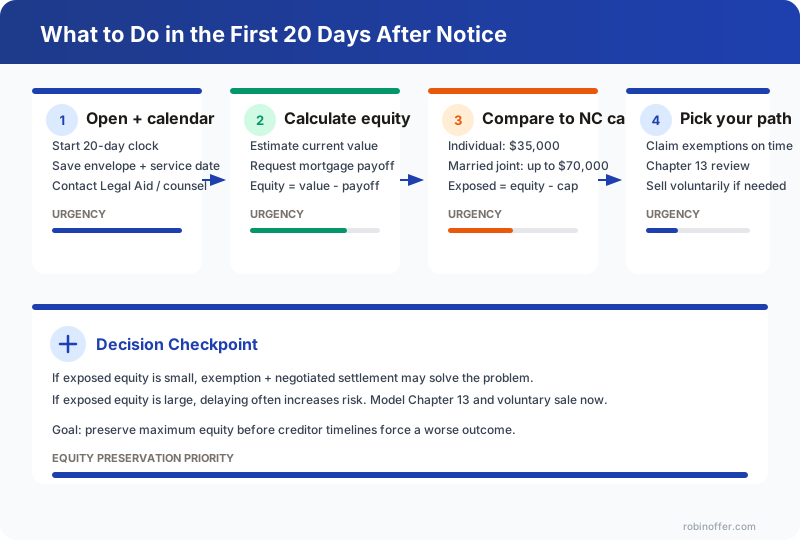
Depending on where you are right now, here is what we recommend:
If you just received a judgment or creditor notice
- Open every piece of legal mail immediately. Look for "Notice of Right to Have Exemptions Designated."
- Count 20 days. That is your deadline to file a motion claiming exempt property. Mark it on your calendar with a 10-day reminder.
- Contact Legal Aid of North Carolina (legalaidnc.org) within 3 business days. If you do not qualify for Legal Aid, call the NC Pro Bono Resource Center (ncprobono.org).
- Determine your equity. Get a quick home value estimate (Zillow, Redfin) and call your mortgage servicer for a payoff amount. Subtract to find your equity.
- Compare equity to exemption. If your equity is at or below $35,000 (individual) or $70,000 (married), the exemption likely covers you. If it is above, you need a strategy (keep reading).
If your equity significantly exceeds the exemption
- Consult a bankruptcy attorney (Legal Aid or private). Chapter 13 may let you keep your home while repaying creditors over 3-5 years.
- Run the sell-vs-fight math. Use the worksheet in Section 10. If selling nets you more than the exemption would protect in a forced sale, consider a voluntary sale.
- Check your ownership structure. If you are married and both on the deed, TBE may provide full protection if the debt is only in one spouse's name.
- Negotiate the judgment. Creditors sometimes accept a lump sum payment for less than the full judgment amount. This is called a satisfaction of judgment. An attorney can facilitate this.
If you are a senior or disabled homeowner
- Claim the property tax homestead exclusion. Contact your county tax office before June 1. This will not stop creditors but will reduce your property tax burden.
- Check if you qualify for the $60,000 exemption. You must be 65+, unmarried, and your deceased spouse must have co-owned the property as TBE or JTWROS.
- Apply for disability-related tax relief if applicable. The disabled veteran exclusion covers the first $45,000 (potentially $100,000 if H.B. 432 passes).
If you are considering moving to another state
Be aware of the 730-day residency requirement. To use a new state's bankruptcy exemptions, you must have lived there for at least two years before filing. If you are planning a move to a state with better protections (like South Carolina's $76,125 or Florida's unlimited exemption), the clock starts when you establish domicile. Moving purely to access a more favorable exemption is a decision that requires legal counsel because courts can and do scrutinize forum shopping.
Facing a deadline? Know your number first.
A fast, free home value estimate from ListRobin gives you the equity figure you need to move quickly and confidently.
14. Frequently asked questions about NC's homestead exemption
Does the NC homestead exemption automatically protect my home?
No. Unlike some states where the homestead exemption applies automatically, North Carolina requires you to affirmatively claim it. When a creditor obtains a judgment and serves you with a "Notice of Right to Have Exemptions Designated," you must file a motion to claim exempt property or request a hearing before the Clerk within 20 days. If you miss that window, you permanently waive your exemption rights for that judgment. This is one of the most critical deadlines in NC debtor law, and many homeowners lose their protections simply because they did not open their mail or respond in time.
Can I protect more than $35,000 if I add my spouse to the deed?
Adding your spouse to the deed can help in two ways. First, if both spouses are on the deed, married couples filing jointly in bankruptcy can double the homestead exemption to $70,000. Second, adding your spouse creates tenancy by the entirety (for married couples in NC), which provides unlimited protection against creditors of only one spouse. Timing matters, though. If you add your spouse to the deed after a judgment has already been recorded, a court may view this as a fraudulent transfer designed to avoid creditors. Any deed changes should be done well before any creditor issues arise, and preferably with legal counsel.
What happens to my homestead exemption if I sell my home and buy another one?
The homestead exemption follows your primary residence, not a specific property. If you sell one home and buy another in NC, the exemption applies to your new primary residence. The proceeds from the sale, however, are not automatically protected during the transition period. If there is a gap between selling one home and purchasing another, a creditor could potentially reach those funds. North Carolina does not have a specific statute protecting sale proceeds during a transition the way some states do. Plan accordingly, ideally with a simultaneous closing or by placing proceeds into a protected account structure recommended by your attorney.
Does the homestead exemption protect my home from a lawsuit I have not lost yet?
The homestead exemption only becomes relevant after a creditor obtains a judgment. If someone has sued you but the case has not been decided, there is no judgment to enforce and the homestead exemption is not yet in play. You should be aware, though, that a plaintiff can file a lis pendens (notice of pending litigation) against your property, which clouds your title and makes selling or refinancing difficult while the case is pending. If you are facing a lawsuit that could result in a significant judgment, consult an attorney about asset protection strategies before a judgment is entered.
Can I claim the homestead exemption on a mobile home or manufactured home?
Yes. The NC homestead exemption under § 1C-1601(a)(1) covers "personal property that the debtor or a dependent of the debtor uses as a residence." This includes mobile homes and manufactured homes whether they sit on land you own, land you lease, or in a mobile home park. The $35,000 cap applies to your equity in the home itself (and the land, if you own it). For manufactured homes on leased land, the exemption covers your equity in the structure. If you own both the home and the land, the combined equity is measured against the $35,000 cap.
My home is in a trust. Does the homestead exemption still apply?
It depends on the type of trust. If your home is in a revocable living trust that you control, NC courts have generally allowed the homestead exemption because you retain the beneficial interest in the property. If the home is in an irrevocable trust, the situation is more complex. Because you have given up ownership and control, the property may not qualify for the homestead exemption, but it may also not be reachable by your personal creditors, depending on the trust terms. Trust-based asset protection planning is an area where an estate planning attorney's guidance is essential. Do not assume your trust protects you the same way the homestead exemption would, or vice versa.
What is the difference between a judgment lien and a mortgage lien on my home?
A mortgage lien is a consensual lien. You agreed to it when you signed your mortgage documents. You voluntarily pledged your home as collateral. The homestead exemption cannot override this agreement; your mortgage lender retains the right to foreclose if you default.
A judgment lien is a non-consensual lien. It attaches to your property because a court ordered it after a creditor won a lawsuit. This is the type of lien the homestead exemption is designed to address. When a judgment is recorded in the county where your property is located, it becomes a lien on your real estate. But the homestead exemption can shield up to $35,000 of equity from enforcement of that lien.
The distinction matters because homeowners sometimes confuse being "protected" from all liens when in fact the homestead exemption only shields against certain non-consensual creditor actions.
Should I wait to file bankruptcy in case NC raises the exemption amount?
Usually, waiting is risky unless your attorney has a specific timeline-based strategy. Lawmakers periodically propose larger protection amounts, and homeowners assume waiting a few months could preserve more equity. In practice, delay often creates bigger problems than any potential benefit from a future law change.
First, there is no guarantee a proposal becomes law, and even if it passes, the effective date may be months away. Second, creditors do not pause collection while you wait. Wage garnishment risks, bank levies, and foreclosure timelines keep moving. Third, interest, penalties, and attorney fees can increase your total debt during that waiting window, reducing the equity you hoped to protect.
There is also a technical bankruptcy issue: exemptions are generally determined on the filing date. If you file before a new exemption takes effect, you do not automatically receive the higher amount later, and if you wait and a judgment creditor forces a sale first, you may lose options permanently. The better question is not "could the amount increase," but "what action today gives me the highest probability of keeping my house or preserving my equity?"
For some homeowners, immediate Chapter 13 filing is the right move. For others, negotiating the debt or selling voluntarily produces a cleaner outcome. A local bankruptcy attorney can model both paths with your actual equity and debt numbers in under an hour, and that analysis is worth far more than gambling on legislation timing.
See what your home is worth today
Get a free, no-pressure home value estimate from ListRobin to anchor your next-step plan for your equity.
15. The bottom line: what every NC homeowner should know
North Carolina's homestead exemption is a real legal protection, but its $35,000 cap has not kept pace with home values. For most NC homeowners, especially in the Charlotte metro, the Triangle, and other appreciating markets, it covers a fraction of their equity.
Here are the five things worth remembering:
- $35,000 is the ceiling for individual homeowners. $70,000 for married couples on a joint deed. $60,000 for qualifying seniors. That is it.
- The exemption does not stop your mortgage lender, the IRS, property tax collectors, or contractors from enforcing liens against your home.
- Tenancy by the entirety is a stronger protection for married couples with no dollar cap. It is automatic for married NC homeowners, but only works against individual-spouse debts.
- You must claim the exemption within 20 days of receiving notice from a creditor. Miss that deadline and you lose it.
- If your equity far exceeds the exemption, selling voluntarily almost always puts more money in your pocket than a forced sale or a bankruptcy that costs you the home.
The worst decision is doing nothing. Whether you claim the exemption, file for Chapter 13, negotiate a settlement, or sell your home, action preserves options. Inaction closes them.
If you want to understand what your home is worth and see the math for your specific situation, we will run a free analysis. No pressure, no obligation, just the numbers you need to make a decision that protects your family.
This guide is for educational purposes and does not constitute legal advice. Homestead exemption claims, bankruptcy filings, and creditor negotiations involve legal rights and deadlines that require professional guidance. Consult a licensed attorney in North Carolina before taking action on any creditor-related matter. Guide written by CC Evans, Founder of RobinOffer.com. Data current as of February 2026.