
Apex, NC: The Research Triangle's Most-Wanted Zip Code and What Your Home Is Worth in It
Market data, Veridea development impact, neighborhood pricing, and net-proceeds math for every selling path — built with Apex numbers, not national averages.
1. The Peak of Good Living, And What It's Worth Right Now
Selling a house in Apex NC means pricing into a market where the typical home value is $584,000, fueled by Research Triangle demand, top-rated schools, and the $3 billion Veridea development. Most homes sell in 45 days at roughly 97% of list price. This guide covers every selling path with Apex-specific numbers.
Start with understanding what you actually have. In 2010, Apex had 37,476 residents. Today it has more than 73,000. That is not gradual growth. That is a town that nearly doubled in fifteen years, and the people moving in were not looking for a cheap place to park. They came for the Research Triangle jobs, the top-rated schools, and a downtown Salem Street that feels more like a European village square than a suburban strip mall. They came and they paid, and the typical Apex home now sits at $584,000.
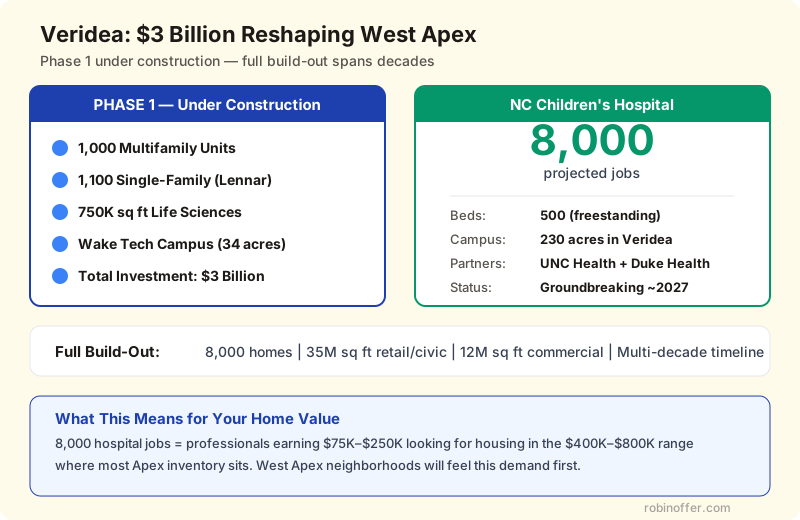
Then, in fall 2025, a New York-based developer called RXR broke ground on Veridea, a $3 billion, 1,100-acre mixed-use development in West Apex. Phase 1 alone includes 1,000 apartments, 1,100 single-family homes by Lennar, and 750,000 square feet of life sciences space. On 230 of those acres, UNC Health and Duke Health are building North Carolina Children's Hospital, a 500-bed freestanding facility projected to create 8,000 jobs. That is not a neighborhood. That is a small city being built inside your zip code.
So here you are: sitting on property in a market that has already proven its demand, inside a metro (Raleigh-Durham) that keeps climbing every "best places" list, in a town that just attracted the single largest development investment in its 150-year history. The question is not whether your home has value. The question is what you do with it, and that is what this guide is for.
Every realistic option is laid out in the sections that follow. Selling with an agent, going FSBO, accepting a cash offer, converting to a rental, or staying put and riding the appreciation wave. We cover the math for each path using Apex's actual numbers (not national averages, not Raleigh citywide stats) but the prices, taxes, and timelines that apply to your street. We also cover the harder scenarios too: probate through Wake County courts, equitable distribution in a North Carolina divorce, and the foreclosure timeline when life throws something unexpected at your mortgage.
If you are weighing the timing question (whether spring, summer, or fall gives you the best price), our Carolina seasonal selling guide breaks that down month by month with regional data.
2. Apex in Spring 2026: A $584K Market Where Pricing Strategy Wins
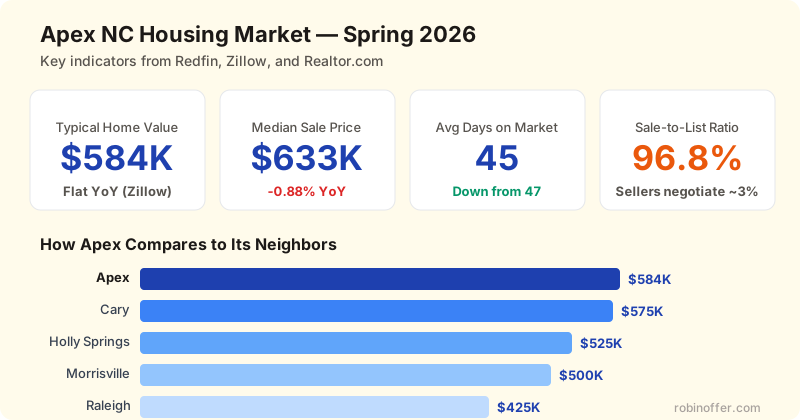
Apex's housing market in early 2026 sits in an unusual position. Prices are high by almost any regional standard. The $633,000 median sale price puts Apex above Cary, well above Raleigh, and in a different stratosphere from Charlotte-area suburbs. But the market is balanced, not frenzied. Homes sell at roughly 97% of list price. The average property takes 45 days to find a buyer, and most listings receive a single offer. This is not a market where you slap a price on and wait for a bidding war. This is a market that rewards homework.
What Apex Homes Are Actually Selling For
| Indicator | Spring 2026 | 12-Month Trend |
|---|---|---|
| Median Sale Price (Redfin) | $633,000 | Down 0.88% |
| Typical Home Value (Zillow ZHVI) | $584,174 | Essentially flat |
| Median Listing Price (Realtor.com) | $595,000 | Stable |
| Active Listings (Movoto, Mar 2026) | Median ask $661,000 | Rising asking prices |
| Homes Sold (Dec 2025) | 114 homes | Up from 92 (prior year) |
| Average Days on Market | 45 days | Down from 47 |
| Sale-to-List Ratio | ~96.78% | Homes sell 2-3% below ask |
| Offers Per Home (avg) | 1 | Single-offer market |
Sources: Redfin (December 2025), Zillow Home Value Index (2026), Realtor.com, Movoto, Houzeo. Market data changes; request a current evaluation for the most up-to-date numbers.
Why the Algorithms Undercount Apex, and Why This Guide Uses $584K
You will see two numbers throughout this guide: the $584K Zillow Home Value Index (ZHVI) and the $633K median sale price. We benchmark most calculations to the ZHVI because it represents the typical Apex home, since the median sale price is pulled upward by luxury closings in Bella Casa and Shepherd's Vineyard. When you request your personalized analysis, we will use comps from your specific neighborhood.
Zillow's Home Value Index estimates the typical Apex home at $584,174. Actual closed sales in December came in at $633,000. That $49,000 gap exists because automated valuation models cannot see what is happening on the ground: the Veridea groundbreaking, the NC Children's Hospital announcement, the Salem Street streetscape project. These are catalysts that have not yet fully translated into comparable sales data. If you rely on an algorithm's estimate to price your home, you risk leaving real money behind.
Always get a Comparative Market Analysis from an agent who knows Apex's micro-markets. The difference between a Bella Casa listing at $950,000 and a Haddon Hall townhome at $420,000 is not just square footage. It is lot character, school zone, walkability to Salem Street, and proximity to the coming Veridea infrastructure. No algorithm captures that nuance.
How Apex Compares to Its Neighbors
| Town | Typical Home Value | How It Compares |
|---|---|---|
| Apex | $584,000 | Benchmark |
| Cary | ~$575,000 | Close peer, slightly lower |
| Holly Springs | ~$525,000 | $59K below Apex |
| Raleigh (citywide) | ~$425,000 | $159K below Apex |
| Morrisville | ~$500,000 | Tech corridor, smaller footprint |
Apex commands a premium over every neighbor except Cary, and the gap is not closing. The "Peak of Good Living" premium (schools, downtown charm, community culture) is a real factor that buyers pay for. When a family relocating from the Bay Area for a Research Triangle Park job sees what $584,000 buys in Apex versus $1.5 million in Cupertino, the value proposition sells itself.
Market Forecast: 2026 and Beyond
Analyst projections point to 2-4% price appreciation for Apex homes in 2026, with existing home sales volume expected to increase 2-14% depending on mortgage rate movements. The demand fundamentals are strong: Research Triangle employment is growing, the Veridea and NC Children's Hospital projects will draw thousands of new workers who need housing, and Apex's school ratings continue to attract families who can pay premium prices. The constraint is inventory. If more homeowners list, prices moderate. If they hold, limited supply continues to support current values.
3. Veridea, NC Children's Hospital, and the $3 Billion Reshaping of West Apex
Veridea is not a normal subdivision. It is a billion-dollar institutional bet on West Apex, and understanding what it means for your property value is worth the detail below.
What Veridea Actually Is
Veridea is a 1,100-acre mixed-use development by RXR, a New York-based real estate company managing $22 billion in assets. This is not a local spec builder testing the market. This is institutional capital that evaluated every emerging suburb in the Southeast and chose Apex. The total investment: $3 billion.
Phase 1, which broke ground in fall 2025, includes:
- 1,000 multifamily residential units
- 1,100 single-family homes built by Lennar
- 750,000 square feet of life sciences lab and office space
- Wake Tech Community College satellite campus, 340,000 square feet across 34 acres
When fully built out, Veridea will contain 8,000 residential units, 35 million square feet of retail, hospitality, and civic space, and 12 million square feet of commercial and life sciences facilities. It will be its own small city within Apex's borders.
NC Children's Hospital: The Anchor That Changes Everything
In July 2025, UNC Health and Duke Health announced that North Carolina Children's Hospital, the state's first and only freestanding independent children's hospital, would be built on 230 acres within Veridea. The project includes a 500-bed hospital, an outpatient care center, a 103-bed behavioral health facility, and a research and education enterprise. The projected economic impact: 8,000 jobs.
Eight thousand jobs at a children's hospital campus are not warehouse positions or seasonal retail work. These are physicians, nurses, researchers, administrators, and support staff earning professional salaries, exactly the income profile that drives housing demand in the $400,000-$800,000 range where most of Apex's inventory sits. When those 8,000 workers start looking for homes near their workplace, every homeowner in West Apex and the broader Apex market will feel the effect.
| Veridea Component | Scale | Status (March 2026) |
|---|---|---|
| RXR Master Plan (total) | $3 billion, 1,100 acres | Phase 1 under construction |
| Phase 1 Multifamily | 1,000 units | Under construction |
| Phase 1 Single-Family (Lennar) | 1,100 homes | Under construction |
| Life Sciences Campus | 750,000 sq ft | Phase 1 |
| Wake Tech Campus | 340,000 sq ft on 34 acres | Planned |
| NC Children's Hospital | 500 beds, 230 acres, 8,000 jobs | Site selected July 2025, groundbreaking ~2027 |
| Full Build-Out | 8,000 homes, 47M+ sq ft commercial | Multi-decade timeline |
Other Projects Reshaping Apex
Sweetwater: A $275 million mixed-use community already under active construction and sales. The 165-acre development includes 100,000 square feet of commercial office space, 350,000 square feet of retail, 347 single-family homes, and 63 townhomes. Off Highway 64 and I-540, it is positioned as modern luxury with village-scale convenience. Between Sweetwater (347 homes) and Veridea Phase 1 (1,100 homes), roughly 1,450 new-construction units are entering the Apex market, against a backdrop where Apex sold 114 existing homes in December 2025. That is significant competition for resale sellers, particularly at overlapping price points. If you are selling a resale home in the $500K-$700K range, you are competing with builder incentives, warranty packages, and move-in-ready finishes.
Salem Street Streetscape Project: Construction is slated to begin in 2026 on a curbless, pedestrian-friendly redesign of Apex's historic downtown spine. Pavers, outdoor tables, improved lighting, and trees will replace the current configuration, making the street flat from building front to building front. If you own a home within walking distance of Salem Street, this project directly enhances your property's walkability premium.
Downtown Parking Expansion: The main downtown lot began expansion in January 2025, adding 152 new spaces. More parking means more visitors, which means more foot traffic for Salem Street businesses, and a stronger case for the walkability premium that downtown-adjacent homes command.
4. The Research Triangle Engine: RTP, Duke, UNC, and Your Home's Demand Floor
You already know the Triangle is a strong economy; you live here. The reason this section matters for your sale is more specific: the Triangle's employer diversity creates a demand floor under Apex home values that most suburban markets do not have. When you price your home, you are pricing into a buyer pool fed by 200,000+ jobs across healthcare, tech, government, and higher education. That breadth is your insurance policy against a single-employer downturn.
Why RTP Proximity Matters for Your Home Value
When a pharmaceutical company opens a 500-person lab at RTP, those 500 workers need housing. Some choose Durham, some choose Cary, but a disproportionate number choose Apex because the schools are excellent, the commute via US-64 and I-540 is manageable (20-30 minutes off-peak), and Salem Street gives them a downtown experience that RTP's office parks lack. That dynamic has played out repeatedly for decades, and it is why Apex's population grew from 37,000 to 73,000 while many similar-sized NC towns stayed flat.
The Triangle's economic diversity is the key. This is not a one-employer town. The major demand drivers include:
- Research Triangle Park: 60,000+ employees, 375+ companies, life sciences and tech hub
- Duke University and Health System: Durham's largest employer, 40,000+ employees, 15 miles east
- UNC-Chapel Hill and UNC Health: 30,000+ employees, 20 miles northwest
- NC State University: Raleigh's anchor institution, 12 miles northeast
- Epic Games: Headquartered in Cary (7 miles), employing 2,000+ with continued growth
- SAS Institute: Also in Cary, one of the world's largest private software companies
- Red Hat (IBM): Downtown Raleigh headquarters
This diversity means that even if one sector contracts, others sustain demand. The Triangle did not experience the housing crash of 2008-2010 the way Florida or Nevada did, partly because the economic base is so broad. That resilience translates directly to your home value. If you are PCSing or relocating for work, the Triangle's job depth also means strong buyer demand for your home.
The $144K Income Floor
Apex's median household income is $144,135, far above the Raleigh metro median of roughly $78,000 and the national median of $75,000. That number is not an accident. It reflects the concentration of dual-income professional households where both adults work in research, tech, healthcare, or higher education. Those incomes support the $584,000 home values that define the Apex market, and as long as the Triangle economy grows (and it has grown every decade for sixty years), that income-to-price ratio remains sustainable.
Commute Reality Check
| Destination | Off-Peak Drive | Primary Route |
|---|---|---|
| Research Triangle Park | 20-30 min | I-540 / US-64 |
| Downtown Raleigh | 18-25 min | US-64 / I-440 |
| RDU International Airport | 20-25 min | I-540 |
| Cary (Epic Games, SAS) | 10-15 min | US-64 / US-1 |
| Durham / Duke University | 25-35 min | I-540 / I-40 |
| UNC-Chapel Hill | 30-40 min | I-540 / I-40 |
| Jordan Lake Recreation | 10-15 min | US-64 West |
The I-540 toll road changed Apex's commute calculus. Before it opened, driving to RTP from West Apex meant surface roads or a long loop on I-40. Now, the toll route cuts the trip to 20 minutes in most conditions. That is roughly the same commute time as living in North Raleigh, but with better schools, a walkable downtown, and home prices that, while high for North Carolina, are a fraction of comparable tech-suburb markets in California, Virginia, or Massachusetts.
5. The School Premium: How Apex's Rankings Drive Home Values
Here is a data point that every Apex homeowner should understand: homes in top-rated school zones sell for a measurable premium. National studies put it at 5-10% above comparable homes in lower-rated zones. In Apex, where the schools are not just "good" but genuinely exceptional by state and national standards, that premium is baked into every transaction.
Apex Schools That Move the Market
| School | Level | Ranking / Grade | Why It Matters for Sellers |
|---|---|---|---|
| White Oak Elementary | Elementary | #2 in NC (SchoolDigger) | Homes in this zone see premium demand from families |
| Math & Science Academy of Apex | Elementary (Magnet) | #8 in NC, 10 stars | STEM-focused magnet draws tech-sector families |
| Apex Friendship Elementary | Elementary | A (Niche), 10 stars | Serves newer western neighborhoods |
| Apex Elementary | Elementary | A- (Niche), #141 in NC | Serves established downtown neighborhoods |
| Apex Middle School | Middle | A- (NeighborhoodScout) | Strong bridge between elementaries and high school |
| Apex High School | High | #175 of 641 NC high schools | High graduation rates, strong academics |
| Apex Friendship High | High | Newer, growing | Serves fast-growing western Apex |
White Oak Elementary's #2 state ranking and the Math and Science Academy's #8 ranking are not abstract honors. They are data points that show up in real estate searches. When a family moving from Boston or San Jose searches "best schools near RTP," Apex appears at the top. Those families have high household incomes, pre-approval for substantial mortgages, and a specific list of school zones they will buy in. If your home sits in one of those zones, you have a competitive advantage that no staging or renovation can replicate.
School Zone and Your Listing Strategy
Wake County Public School System uses proximity-based zones, which means your specific address determines your school assignment. When listing your home, your agent should prominently feature the assigned school names and ratings. A listing that says "zoned for White Oak Elementary (#2 in NC)" immediately qualifies the property in the eyes of school-focused buyers, and in Apex, that is a large percentage of the buyer pool.
If you are in one of Apex's newer neighborhoods served by Apex Friendship High School, highlight that school's growing reputation and its newer facilities. Buyers choosing between an established neighborhood zoned for Apex High and a newer one zoned for Apex Friendship are comparing more than just the school. They are comparing home age, lot size, HOA dues, and community amenities. But the school assignment is often the tiebreaker.
6. Ten Neighborhoods, Ten Price Points: Where Your Home Fits in the Apex Market
Apex is not one market. A $350,000 ranch near Haddon Hall and a $1.1 million custom home in Bella Casa share a zip code and nothing else: different buyers, different timelines, different optimal strategies. Knowing which Apex you are selling in is the first step toward making the right decision.
Downtown Apex / Salem Street
Price range: $350,000–$700,000. The walkability play.
The historic heart of Apex, centered on Salem Street, a district named to the National Register in 1994. Craft breweries like Bombshell Beer Company, restaurants like Anna's Pizzeria and The Hound, boutiques, and the weekly farmers market make this the most walkable neighborhood in Apex. The housing stock is mixed: original 1920s-1940s bungalows alongside infill construction and renovated older homes. The Salem Street Streetscape Project beginning in 2026 will further enhance walkability with curbless, pedestrian-first design.
Buyer profile: Young professionals and couples who prioritize walkability over square footage, downsizers who traded a Scotts Mill colonial for a downtown cottage, empty nesters from across the Triangle who want a walkable retirement lifestyle, and investors buying close to the infrastructure improvements.
Best selling strategy: Agent sale. Downtown proximity commands a premium that MLS exposure captures. Stage to emphasize the lifestyle, so your listing photos should include the view toward Salem Street, the walking path to downtown, and any outdoor living space. Buyers paying for walkability want to see the walk.
Bella Casa
Price range: $800,000–$1,000,000+. The luxury established market.
West Apex's premier community with larger lots, stone and brick exteriors, and covered porches. Built between 2005 and 2015 with quality construction and luxury appointments. Walking distance to Salem Street, six minutes to Beaver Creek Crossings shopping, ten minutes to Jordan Lake. The annual food truck festival signals the kind of community engagement that affluent buyers seek.
Buyer profile: Dual-income professional households earning $200K+, corporate relocators with relocation packages, and move-up buyers already in the Apex market looking for their "forever home."
Best selling strategy: Agent sale, absolutely. At this price point, professional staging ($3,000-$5,000) pays for itself multiple times over. Bella Casa buyers are comparing your home to new construction in Sweetwater and to Cary's Preston community, so your agent needs to articulate why established character, mature landscaping, and no HOA surprises beat a spec build. Price precisely: overpricing a $950K home by $50K can cost you three extra months on market, which is $4,000+ in carrying costs per month.
Haddon Hall
Price range: $400,000–$800,000+. The diversity-of-options neighborhood.
Eight hundred homes spanning single-family, townhouses, and condos, all within 1.7 miles of downtown. Lap pool, playground, two tennis courts, and a clubhouse provide community amenities. The wide price range (from $400K condos to $800K+ single-family) means this neighborhood serves multiple buyer segments simultaneously.
Best selling strategy: Depends on your unit type. Condos and townhomes move fastest in spring when relocating professionals are searching. Larger single-family homes compete with Scotts Mill and Beaver Creek at similar price points, so differentiate on proximity to downtown and community amenities.
Scotts Mill
Price range: $500,000–$800,000. The tree-lined family pick.
Modern homes on tree-lined streets with community pool, playgrounds, and walking trails. A short drive from both downtown and Beaver Creek Commons. The stately, peaceful atmosphere attracts families who want space and safety without sacrificing convenience. This is the neighborhood where you see kids riding bikes after school.
Best selling strategy: Agent sale timed for March-May when family buyers are searching for summer moves. Lead your listing with the school zone assignment, trail access, and community pool. Homes in Scotts Mill that photograph well (natural light, mature trees, well-maintained landscaping) sell faster because the listing photos capture the neighborhood's character.
Beaver Creek
Price range: $450,000–$700,000. The convenience premium.
Built in the early 2000s with 2,500-4,200 square foot homes, Beaver Creek's central location near Beaver Creek Crossings shopping and dining is its defining asset. This is the neighborhood where you walk to Target, grab dinner at a dozen restaurant options, and still get home in time to mow the lawn. For buyers who value convenience over charm, Beaver Creek wins.
Best selling strategy: Agent sale. Emphasize proximity to retail and dining. The Beaver Creek Crossings address is recognizable to every Triangle buyer. These homes compete on location and floor plan rather than character, so pricing accuracy and condition matter more than staging drama.
Shepherd's Vineyard
Price range: $650,000–$800,000. The midsize sweet spot.
Family-oriented community with 1,877-2,881 square foot homes. The median price of approximately $768K positions Shepherd's Vineyard in the upper-middle of Apex's market, affordable compared to Bella Casa, but with more space and privacy than downtown or Haddon Hall.
Sweetwater
Price range: $500,000–$900,000+. The new-construction competitor.
The $275 million planned community off Highway 64 and I-540 includes 347 single-family homes, 63 townhomes, 100,000 square feet of commercial office space, and 350,000 square feet of retail. Sweetwater is building an entire village, and that is both good news and a challenge for existing Apex homeowners. Good news because it validates Apex's demand and brings new amenities, but a challenge because your resale home now competes directly with builder incentives, new-construction warranties, and move-in-ready finishes.
If you are selling against Sweetwater: Price your resale home to reflect the value of established landscaping, a known neighborhood character, and no construction noise. Sweetwater buyers who cannot wait 6-12 months for a build will consider your resale home, but only if the price delta is compelling.
Abbington
Price range: $400,000–$800,000. The custom-home corridor.
Traditional and Colonial-style custom homes with mature trees. Abbington's established character attracts buyers who want architectural personality rather than subdivision uniformity.
Salem Village
Price range: $450,000–$750,000. Downtown-adjacent charm.
A mix of new and resale homes near Salem Street in the 2,317-4,436 square foot range. Close enough to walk to downtown events, far enough to avoid the noise. Salem Village offers a blend of proximity and space that appeals to families who want both.
Veridea (Emerging)
Price range: TBD, likely $500,000+ for Phase 1 homes.
Lennar is building 1,100 single-family homes in Phase 1 of the Veridea development. When these homes come to market, they will establish a new price floor for West Apex. If you own in nearby communities (Bella Casa, Scotts Mill, or the Salem Street corridor), the Veridea comps will either lift or compress your value depending on how the market absorbs the new inventory. Watch the Phase 1 pricing announcements carefully.
Want to see what your Apex home is worth?
Get a real value estimate with neighborhood-specific comp data for your address.
7. Selling a House in Apex NC: Agent, FSBO, or Cash Buyer
If you are selling a house in Apex NC, the first decision is which path to take. Before choosing, look at where the money goes, and where it stays, for a typical $584,000 home.
Side-by-Side: Selling a $584K Apex Home
| Path | Likely Sale Range | Your Costs | Net to You | Clock |
|---|---|---|---|---|
| Agent Sale (MLS) | $565,000–$584,000 | $35,000–$58,000 (6-10%) | $506,000–$549,000 | 45-120 days |
| FSBO (flat-fee MLS) | $540,000–$575,000 | $16,000–$20,000 (3-4%) | $520,000–$559,000 | 60-180+ days |
| Cash Buyer | $408,000–$555,000 | $0–$35,000 (0-6% fee) | $408,000–$520,000 | 7-30 days |
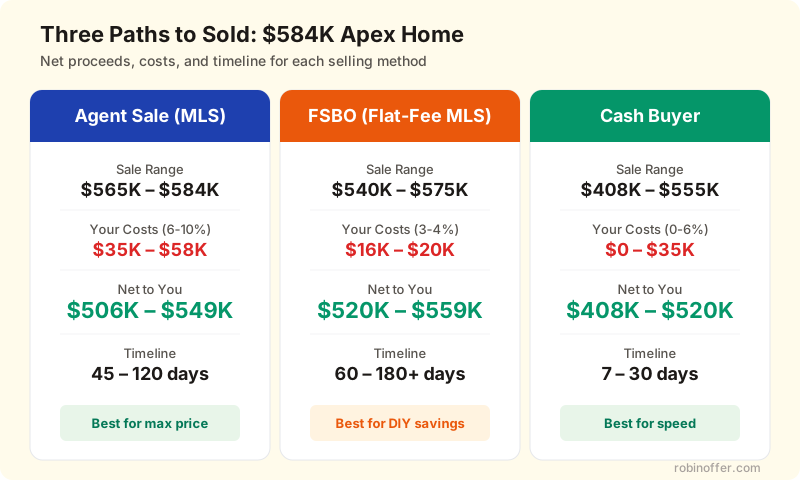
The potential spread between highest and lowest net exceeds $140,000. But the highest net is not always the best option. Timeline, property condition, and personal circumstances determine which column actually applies to your situation.
7a. Sell With an Agent
For most Apex homeowners, an agent-assisted MLS sale produces the highest net proceeds. The process begins with selecting a listing agent who operates inside Apex's micro-markets, someone who understands why Bella Casa commands $950K while Haddon Hall condos trade at $420K. That agent delivers a Comparative Market Analysis rooted in actual closed sales within your neighborhood, your school zone, and your home's condition class.
From there: preparation, professional photography (critical in a market where listings average 45 days), MLS launch, showings, negotiation, and closing. In Apex's current balanced market, expect the full arc from listing to keys to run 45-120 days depending on price point and condition. Homes priced right in Scotts Mill or Beaver Creek can still move in 30-45 days. Homes that enter $20,000 above fair value in a single-offer market simply sit until a price reduction brings them in line. For strategic timing advice on when to list, review the agent commission math in your market, and understand how Apex's balanced conditions affect your negotiating leverage.
Agent Sale: Where the Money Goes
| Fee Category | Range on $584K Home | Notes |
|---|---|---|
| Listing Agent Commission | $14,600–$17,520 (2.5-3%) | Negotiable; NC average ~2.81% |
| Buyer's Agent Concession | $14,600–$17,520 (2.5-3%) | Post-NAR settlement: no longer mandatory |
| Staging & Photography | $700–$3,500 | Essential in a 45-day-DOM market |
| Pre-Listing Inspection | $350–$450 | Optional; catches surprises before buyers do |
| Repairs / Concessions | Varies, avg ~2% ($11,680) | Higher in balanced markets where buyers negotiate |
When agent sale makes sense: You have 60-120 days, your home is in show-ready condition, and maximizing sale price is the priority. Especially strong for Bella Casa, Scotts Mill, Beaver Creek, and any home in a premium school zone where MLS exposure reaches the right buyer pool.
7b. Sell FSBO (For Sale By Owner)
The FSBO pitch: skip the listing agent commission (2.5-3%) and keep $14,600-$17,520 on a $584,000 home. The reality is more complicated. You become the marketer, photographer, negotiator, scheduler, and transaction coordinator. You price without MLS comparable sales access, and you handle every showing and every call.
National data shows FSBO homes sell for approximately 10-15% less than agent-assisted sales on average. On a $584,000 Apex home, that gap could wipe out the commission savings and then some. Saving $15,000 in commission but selling for $60,000 less is not a savings.
The middle ground: Flat-fee MLS services like Houzeo list your home on the MLS for $300-$500, syndicated to Zillow, Realtor.com, and Redfin. Pair that with a buyer's agent co-op offer (2.5-3%) and you get full MLS exposure while eliminating the listing commission. Net savings: $12,000-$15,000, if you can handle the transaction management yourself.
When FSBO makes sense in Apex: You already have a buyer lined up (common in tight-knit neighborhoods where a neighbor's friend is looking), you have real estate experience, or you are selling a downtown cottage in the $350K-$450K range where the premium school zone and walkability practically sell themselves. If this is your first sale, hire an agent.
7c. Sell to a Cash Buyer
The fastest path from decision to deposit. Cash buyers in the Apex area can typically close in 7-30 days with no financing contingencies, no appraisal requirements, and no repair requests. But speed comes at a cost, typically 10-40% below market value depending on the buyer type and your home's condition. For a full look at how cash offers work and how to protect yourself, see our complete cash offer guide for NC and SC.
Cash Buyers Operating in Apex
| Buyer Category | Typical Offer | Closing Speed | Ideal Scenario |
|---|---|---|---|
| "We Buy Houses" Investors | $350K–$408K (60-70% ARV) | 7-14 days | Major repairs needed, urgent timeline |
| iBuyers (Opendoor, Homeward) | $496K–$555K (85-95%) | 14-30 days | Move-in-ready homes in top school zones |
| Cash Offer Platforms | $438K–$555K (varies) | 7-30 days | Comparing multiple competing offers |
| Individual Cash Buyers | $467K–$584K (80-100%) | 14-30 days | Clean offers, no contingencies |
Several companies actively buy homes in the Apex market. NC HomeBuyers (919-864-1088) covers Apex and Wake County. 919 HomeBuyers (919-670-4766) operates locally in the Triangle. Moved Homes (919-300-5164) serves Apex and all of North Carolina. Easy Sale HomeBuyers (919-887-8452) is a family-owned Wake County operation. Cardinal House Buyers specializes in fast closings across the Apex area.
When a cash sale makes sense in Apex: You need to close before a relocation deadline, the home needs $50,000+ in repairs that you cannot fund, you are dealing with probate or divorce complications that make a traditional sale impractical, or you simply value certainty over maximum dollars. At Apex price points, the difference between a 70% cash offer ($408,000) and a full-market agent sale ($570,000) can be $160,000, so always get multiple offers and compare. Start with a free RobinOffer evaluation to see your numbers.
8. Keep It and Earn: When Renting or Staying Put Beats Selling
Selling is not always the best financial move, especially in a market where most homeowners locked in mortgage rates between 2.5% and 4% during 2020-2022 and now face 6.5-7% rates if they buy again. Before you list, run the math on two alternatives.
Rent It Out
Apex Rental Market: The Numbers
| Bedroom Count | Asking Rent (Monthly) | Trend |
|---|---|---|
| 1-Bedroom Apartment | $1,454 | Stable |
| 2-Bedroom Apartment | $1,649 | Slight softening |
| 3-Bedroom House | $2,051 | Strong demand |
| Single-Family Home (all types) | $2,100 | Premium market |
| Average Apartment (all sizes) | $1,625 | Down 2.13% YoY |
Sources: RentCafe, Zillow Rental Index, Apartment List (February 2026).
The $2,100 median single-family rent in Apex is the headline number. Apartment rents have softened slightly (down 2% year-over-year), but whole-home rents remain strong because the renter pool for houses includes families zoned for Apex schools who cannot or choose not to buy at $584K.
Running the Rental Math on a $584K Apex Home
Take a 4-bedroom, 2.5-bath home in Scotts Mill valued at $584,000 with a remaining mortgage of $350,000 at 3.5% (locked during the 2020-2021 window). Monthly PITI: approximately $2,200. Achievable rent for a 4-bedroom in this neighborhood: $2,400-$2,600.
| Monthly Income and Expenses | Estimate |
|---|---|
| Gross Rent | $2,500 |
| Mortgage + Insurance + Taxes (PITI) | - $2,200 |
| HOA Dues (typical Scotts Mill/Beaver Creek) | - $125 |
| Property Management (10%) | - $250 |
| Maintenance Reserve (1% of value / 12) | - $487 |
| Vacancy Allowance (5%) | - $125 |
| Net Monthly Cash Flow | - $687 |
The math is honest: at Apex price points, most rentals will not produce positive monthly cash flow when you include management, maintenance reserves, and vacancy allowance. You are likely $400-$600 per month negative. But that is not the full picture. Your tenant is paying down approximately $8,000-$10,000 per year in mortgage principal, and your property is appreciating at a projected 2-4% annually ($11,680-$23,360 on a $584K home). If you can absorb the monthly shortfall, you are building wealth faster through the rental than you would through a savings account.
When renting makes sense: You have a sub-4% mortgage rate you do not want to surrender, you can cover the monthly shortfall from other income, and you are willing to be a landlord (or pay a property manager 10%). If you are relocating but plan to return to the Triangle within 3-5 years, renting preserves your position in a market that is likely to appreciate.
When renting does not make sense: Your mortgage rate is 5%+ (the cash flow gap becomes unsustainable), you need the equity for your next purchase, or you have no appetite for landlord responsibilities. North Carolina is landlord-friendly (no rent control, reasonable eviction timelines), but managing a rental from a distance still requires attention.
Stay Put and Build Equity
If you locked in a mortgage rate below 4%, that rate is a financial asset worth more with each passing year. Selling a home with a 3.25% mortgage and buying a comparable home at 6.75% would cost you roughly $850 more per month on a $400,000 loan, which is $10,200 per year, or $102,000 over a decade.
Instead of selling, consider tapping your equity through a Home Equity Line of Credit. On a home worth $584,000 with $350,000 owed, a HELOC could unlock $70,000-$100,000 for renovations, a second property, or other needs, all while your low first mortgage rate stays intact.
At Apex's current price per square foot (approximately $195-$240 depending on neighborhood), strategic renovations can also shift your competitive position. A kitchen remodel ($20,000-$45,000 in Apex's price tier) or a primary bathroom upgrade ($12,000-$25,000) can recoup 60-80% at resale while making the home more livable for you in the meantime.
Sell Now, Hold, or Rent? A Decision Framework
Lean toward selling now if:
- You are relocating out of the Triangle and cannot manage a rental from a distance
- You need the equity for your next purchase (especially if buying into a higher-priced market)
- Your mortgage rate is 5%+ and carrying costs are straining your budget
- Your home needs $30,000+ in deferred maintenance that will only get more expensive
Lean toward holding 2-3 years if:
- You have a sub-4% mortgage rate and can comfortably carry the payment
- Your home is in West Apex or another area directly affected by Veridea demand
- You do not need the equity immediately and can afford to wait for the hospital-driven demand wave
- You are willing to absorb $687/month in negative cash flow if renting, or continue living in the home
Lean toward renting if:
- You are leaving the area temporarily (1-3 years) and plan to return
- You locked in a rate below 3.5% and the rate differential makes selling and re-buying prohibitively expensive
- Your home is in a top school zone where rental demand from families priced out of buying is strong
- You can sustain negative cash flow and are betting on appreciation over monthly income
9. Apex Disclosure Landmines: Radon, Veridea Construction, and the HOA Rules Buyers Will Ask About
In a market where relocating buyers from New York and California expect polished disclosure packets, the NC Residential Property Disclosure Statement protects your six-figure net proceeds from post-closing litigation. The form is not optional. Selling "as-is" does not exempt you. You must disclose all known material defects, and the key word is "known": you are not required to go hunting for problems, but you must honestly report everything you already know about. Apex sellers face five specific disclosure items that rarely surface in lower-priced NC markets.
What the NC Form Covers
The disclosure addresses structural components, plumbing, electrical, HVAC, water and moisture issues, environmental hazards (lead paint if pre-1978, asbestos, radon), pest and termite history, HOA details, and zoning considerations including easements and encroachments. You must deliver this form to the buyer before the purchase contract is signed.
Apex-Specific Disclosure Items
Several issues are particularly relevant for Apex sellers:
- Radon levels: Wake County is in EPA Zone 2 for radon (moderate risk). If you have ever tested for radon and received elevated readings (above 4 pCi/L), you must disclose that result. Even if you installed a mitigation system, disclose both the original reading and the mitigation. Buyers in Apex, particularly those relocating from areas without radon concerns, will ask about this.
- HOA rules and upcoming assessments: Most Apex neighborhoods have HOAs, and many have architectural review committees that restrict modifications. If you know about upcoming special assessments, reserve fund shortfalls, or pending litigation involving the HOA, disclose it. A $5,000 special assessment surprise at closing kills deals.
- Construction activity near your property: If you are selling near the Veridea development zone, the Sweetwater construction, or the Salem Street Streetscape project, disclose what you know about planned construction, expected timelines, and any noise or traffic impacts. Most buyers in these areas welcome the development, but they deserve to know what the next 12-24 months look like from their front porch.
- Well and septic systems: Some homes in western Apex and unincorporated Wake County areas use well water or septic systems rather than municipal utilities. NC law requires specific disclosure about well water quality testing and septic system age, condition, and last inspection date.
- Flood zone proximity: If your property sits in or near a FEMA-designated flood zone (common along Apex's creek systems and near Jordan Lake), disclose the designation and any history of flooding or flood insurance claims.
Who Is Exempt
New construction from builders, court-ordered sales (foreclosure, bankruptcy, probate), government-owned properties, and transfers between family members are generally exempt. Everyone else completes the form.
10. Costs of Selling a House in Apex NC: Closing Costs, Taxes, and Net Proceeds
This is the section where all the neighborhood data, market analysis, and selling strategies converge into one number: what you actually walk away with. Here is every cost, broken down for a $584,000 Apex home sale.
Seller Closing Costs in Wake County
| Fee | Your Share | Paid By |
|---|---|---|
| NC Excise Tax (Revenue Stamps) | $1,168 ($1 per $500) | Seller (customary) |
| Agent Commission (5.5% total) | $32,120 | Seller (negotiable) |
| Closing Attorney | $750–$1,250 | Each party hires own |
| Title Search | $50–$200 | Typically buyer |
| Recording Fees | ~$540 | Split varies |
| Prorated Property Taxes | Varies by closing date | Seller pays through closing |
| HOA Transfer Fee | $100–$200 (if applicable) | Seller |
| HOA Estoppel Letter | $100–$500 (if applicable) | Seller |
| Home Warranty (optional) | $400–$600 | Seller (as buyer incentive) |
| Wire / Transfer Fees | $35–$50 | Seller |
Sample Net Sheet: Selling a $584,000 Apex Home
| Description | Dollar Impact |
|---|---|
| Sale Price | $584,000 |
| Mortgage Payoff (est.) | - $350,000 |
| Agent Commission (5.5%) | - $32,120 |
| NC Excise Tax | - $1,168 |
| Closing Attorney | - $1,000 |
| Prorated Property Taxes | - $2,550 (half-year est.) |
| HOA Transfer / Estoppel | - $400 |
| Misc. Fees (recording, wire) | - $600 |
| Estimated Net Proceeds | $196,162 |
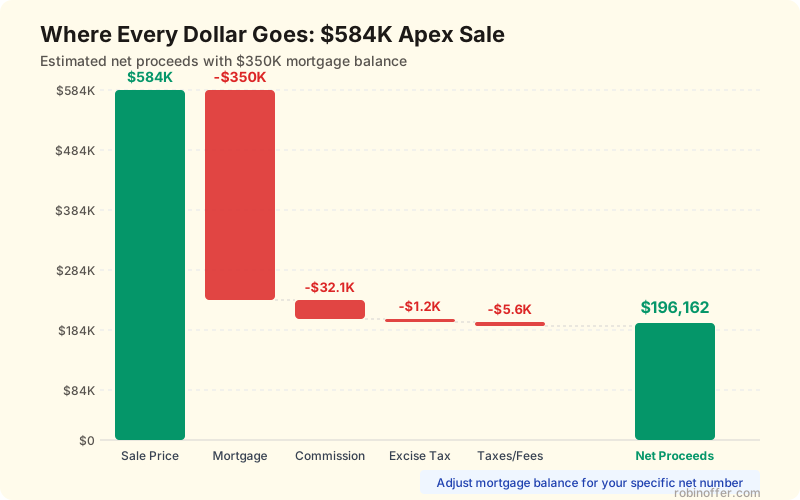
That $196,162 is your walk-away money on a $584,000 sale with $350,000 remaining on the mortgage. We use the $584K Zillow Home Value Index rather than the $633K median sale price because ZHVI better represents the typical Apex home, since the median is pulled upward by luxury sales in Bella Casa and Shepherd's Vineyard. Adjust the mortgage payoff to your actual balance for a more precise estimate. If you are thinking about selling during a divorce, the net sheet changes because you are dividing this number. Your actual mortgage balance, neighborhood comps, and condition adjustments will shift these numbers, so get your personalized net sheet across all three selling paths.
Wake County Property Tax Rates
| Component | Rate per $100 Assessed |
|---|---|
| Wake County | $0.5171 |
| Town of Apex (Municipal) | $0.356 |
| Combined (County + Town) | $0.8731 |
On a home assessed at $584,000, the combined annual property tax is approximately $5,099. Wake County completed a property revaluation in 2024, and the FY2026 county rate of 51.71 cents includes a 0.36-cent increase. The Apex municipal rate of 35.6 cents includes a 1.6-cent increase tied to the 2021 voter-approved Transportation Bond. When comparing Apex taxes to other Triangle towns, note that Wake County's effective rate of approximately 1.10% is higher than the NC state median of 0.82% but is the cost of Wake County's infrastructure, school system, and services.
Capital Gains Exclusion
If you have lived in your Apex home as your primary residence for at least two of the last five years, you can exclude up to $250,000 in capital gains from federal taxes ($500,000 for married couples filing jointly). For most Apex homeowners, even those who bought in 2015 when prices were significantly lower, this exclusion covers the entire gain. If your appreciation exceeds the exclusion threshold, consult a tax professional before closing. North Carolina has no separate state capital gains exclusion, but the federal exclusion applies to your NC return as well.
NC Homestead Exemption
North Carolina offers a Homestead Exclusion for homeowners age 65 or older, or those who are totally and permanently disabled, with an income of $36,700 or less. This excludes the greater of $25,000 or 50% of the appraised value from property tax. On a $584,000 Apex home, the exclusion could save a qualifying homeowner approximately $2,550 per year. For the full breakdown of eligibility requirements and application process, see our NC homestead exemption guide.
Apex Government Resources
| Office / Agency | How to Reach Them |
|---|---|
| Town of Apex (Town Hall) | 73 Hunter St, Apex 27502 | 919-249-3400 | apexnc.org |
| Apex Utilities | 919-362-8676 |
| Apex Town Clerk | 73 Hunter St, 2nd Floor | 919-249-1260 |
| Apex Planning & Development | apexnc.org/193/Current-Projects |
| Wake County Tax Administration | wake.gov/departments-government/tax-administration |
| Wake County Register of Deeds | 300 S. Salisbury St, Raleigh | 919-856-5460 |
| Wake County Clerk of Court | 919-792-4000 | nccourts.gov (Wake County) |
See what your Apex home is worth
Get a real, data-driven estimate based on your specific neighborhood and recent comps.
11. When the Sale Is Not Your Choice: Wake County Probate, $584K Equitable Distribution, and the Pre-Foreclosure Window
At $584,000, an Apex home caught in probate, divorce, or mortgage distress carries higher financial stakes than the same scenario in a $290K market. The equity at risk is larger, the buyout math is more demanding, and carrying costs during any delay burn through $3,500+ every month. Here is what each scenario looks like with Apex numbers.
Inherited an Apex Home?
If you have recently lost someone and inherited a property in Apex, take a breath. There are important steps, but there is no immediate rush.
NC Probate Process: Most inheritances go through probate. File a petition with the Clerk of Superior Court in Wake County (919-792-4000), provide the death certificate and will (if one exists), and the court appoints an executor or administrator. The executor inventories assets, pays debts from the estate, and distributes what remains. The process typically takes 90 days to 18 months. You generally cannot sell the property until the executor has legal authority, which the will may or may not grant directly. For the full step-by-step process, timelines, and tax implications, see our complete NC inherited property guide.
Stepped-up basis: This is the tax provision that most benefits heirs. Your cost basis for capital gains purposes is the home's fair market value at the date of death, not what the original owner paid. If your parent bought a home for $120,000 in 1998 and it was worth $584,000 when they passed, your basis is $584,000. If you sell for $590,000, you owe capital gains on only $6,000.
NC excise tax exemption: Property transferred by inheritance is exempt from the NC excise tax. On a $584,000 property, that saves the estate $1,168.
If heirs disagree: North Carolina allows a "partition action," a court-ordered sale when co-owners cannot agree. The court can order the property sold and proceeds divided. Mediation through the Wake County courts is almost always a better first step and costs far less than litigation.
Real estate attorneys in Apex who handle probate sales: WZ Law Group (wzlawgroup.com), Savage & Godfrey (apexlawyer.com, Mr. Godfrey has practiced since 1978), and Moore & Alphin (moorealphin.com, real estate law exclusively) all serve the Apex and Wake County area.
Selling During a Divorce
North Carolina is an equitable distribution state, meaning marital property is divided "equitably," which does not always mean 50/50. The family home is typically the largest asset to divide, and in Apex, that means a $584,000 asset with complex financial implications.
Your options during NC divorce:
- Sell and split proceeds: The cleanest option. List the home, close, and divide the net proceeds per your separation agreement. Timeline: 60-120 days for the sale, plus negotiation time.
- One spouse buys out the other: Requires a professional appraisal or agreed-upon value, then a refinance into one spouse's name. At Apex's $584K median, the buyout amount could be $100,000+ depending on equity, which is a significant refinance.
- Continue co-owning temporarily: Sometimes both parties agree to hold the property until kids finish a school year, a market improves, or another trigger occurs. This requires a detailed written agreement covering who pays the mortgage, insurance, taxes, and maintenance, and what happens if one party defaults.
Buyout math on a $584K Apex home: If the home is worth $584,000 with $350,000 owed, equity is $234,000. An equitable split gives each spouse roughly $117,000. The buying spouse needs to refinance $467,000 ($350K mortgage + $117K buyout) at current rates, approximately $3,030/month at 6.75% versus $1,572/month P&I at the original 3.5%. That $1,458/month increase ($17,496/year) is the true cost of keeping the home. Many buyers-out find that the math does not work at current rates.
Behind on Your Apex Mortgage?
If you have missed mortgage payments, you have more options than you might think, and time is your most valuable asset. The further behind you fall, the fewer options remain. If property taxes are the issue rather than your mortgage, see our guide to catching up on property taxes in the Carolinas.
Your options, from earliest to latest intervention:
- Reinstatement: Pay all missed payments plus late fees to bring the loan current. The simplest path if you can access the funds.
- Loan modification: Your lender changes the terms (lower rate, extended term, or adding missed payments to the balance). Contact your servicer's loss mitigation department directly.
- Forbearance: Temporary reduction or suspension of payments while you resolve the financial hardship.
- Repayment plan: Resume regular payments plus an extra amount each month to catch up.
- Pre-foreclosure sale: Sell the home before the foreclosure process completes. At Apex's $584K values, most homeowners have sufficient equity to sell, pay the mortgage, cover costs, and walk away with money. This is often the best outcome when keeping the home is not viable.
- Short sale: If you owe more than the home is worth (uncommon in Apex given recent appreciation), the lender agrees to accept less than the full balance.
- Deed in lieu: You voluntarily transfer the title to the lender instead of going through foreclosure. Less damaging to your credit than a foreclosure, but still significant.
For the complete NC foreclosure timeline, your legal rights, and free resources available to Wake County homeowners, see our NC foreclosure help guide.
Free foreclosure counseling near Apex: Triangle Family Services (919-821-0790, HUD-approved, tfsnc.org) offers free housing counseling including mortgage delinquency resolution. The NCHFA Housing Counselor Finder (nchfa.com) connects you with certified counselors statewide. Call the HUD national hotline at 800-569-4287 for immediate referral to a local counselor.
Legal aid for Wake County residents: Legal Aid of North Carolina, Raleigh Office (1-866-219-5262) provides free civil legal services for income-qualifying residents, including housing cases. The Wake County Legal Support Center (919-792-5374, inside the Wake County Courthouse) offers free information about applicable laws, deadlines, and resources.
12. The Apex Clock: 14 Days to MLS, 45 Days to Offer, and Why the DD Fee Changes Your Risk
Whether you sell through an agent, FSBO, or cash buyer, the timeline has distinct phases. Here is what each looks like using Apex-specific timelines.
Agent Sale Timeline
| Stage | Duration | What You Are Doing |
|---|---|---|
| Agent Selection & CMA | Week 1-2 | Interview 2-3 agents, review comparable sales, agree on pricing strategy |
| Home Prep & Staging | Week 2-4 | Repairs, declutter, professional photography, listing copy |
| Active on MLS | Week 4 onward | Showings, open houses, feedback, potential price adjustments |
| Under Contract | Day of offer | Negotiate terms, sign purchase agreement |
| Due Diligence (NC) | 14-30 days post-contract | Buyer inspections, appraisal, title search, buyer can exit during this period |
| Closing Preparation | Final 2-3 weeks | Final walkthrough, lender clearance, closing attorney prepares documents |
| Closing Day | Day 60-120 from listing | Sign documents, hand over keys, receive funds (usually wired next day) |
NC Due Diligence note: North Carolina's due diligence period is unique. The buyer pays a non-refundable due diligence fee directly to the seller (typically $2,000-$10,000 in Apex, depending on price point). During the due diligence period, the buyer can terminate for any reason, but they lose the fee. This system gives sellers more certainty than many states' contingency-based contracts. Once due diligence expires, the earnest money deposit becomes non-refundable as well.
Cash Sale Timeline
| Stage | Duration | What You Are Doing |
|---|---|---|
| Request Offers | Day 1-3 | Contact 3-5 cash buyers, schedule property visits |
| Receive & Compare Offers | Day 3-7 | Review offers, terms, proof of funds, proposed timelines |
| Accept Offer | Day 7-10 | Sign purchase agreement, open escrow |
| Title & Closing Prep | Day 10-25 | Title search, closing attorney prepares deed and settlement statement |
| Closing Day | Day 14-30 | Sign, hand over keys, receive payment |
13. See the Numbers for Your Home
This guide gave you the data, the options, and the math. But data about the Apex market is not the same as data about your home. Your neighborhood, your lot, your condition, your school zone, and your mortgage balance create a financial picture that is unique to you.
Here is what we can do: run your specific numbers across all three selling paths (agent sale, FSBO, and cash offer) and show you the net proceeds for each. No pressure, no commitment, and no obligation. We have done this for hundreds of homeowners in the Triangle and we will do it for you.
Whether you are selling a house in Apex NC this month, thinking about holding for the Veridea and NC Children's Hospital demand wave, or just curious about where you stand, the first step is knowing your numbers. Get your free home evaluation from RobinOffer.
This guide was written by CC Evans for RobinOffer and is intended for informational purposes only. It does not constitute legal, financial, or tax advice. Real estate laws, market conditions, and tax regulations change; consult qualified professionals for advice specific to your situation. Data sources include Redfin, Zillow, Realtor.com, Movoto, Houzeo, RentCafe, Apartment List, Wake County Government, Town of Apex, SchoolDigger, Niche, NeighborhoodScout, U.S. Census Bureau, and RXR. All data is current as of March 2026 and is subject to change.
Want a cash offer on your Apex home?
Tell us your address and timeline, and we will get you a no-obligation cash offer.