
Relocating and Need to Sell Your NC Home Fast
Five selling paths ranked by speed, dual-housing carrying cost math, IRS Section 121 partial exclusion, NC remote closing mechanics, and a week-by-week execution playbook.
1. The 90-Day Countdown Most NC Sellers Don't Know They're On
Relocating and need to sell your house fast in North Carolina? You have five realistic paths, from a 7-day cash close to a 90-day agent listing, and the right one depends on your timeline, your carrying costs, and whether your employer covers the gap.
Most NC sellers don't realize they're running two clocks at once. Clock one: your start date at the new job, your lease signing in the new city, or whatever hard deadline is pulling you out of NC. Clock two: the 55-to-90-day average it takes to sell a house in this state from listing to closing. When those clocks overlap, every week you hesitate costs real money.
North Carolina drew 84,000 net domestic migrants between July 2024 and July 2025, the largest state-to-state gain in the country. But migration works both ways. Thousands of NC homeowners leave every year for new jobs in Texas, for family in Florida, for promotions in New York. And most of them discover the same thing: selling a home under a relocation deadline is a fundamentally different process than selling when you have all the time in the world.
This guide covers the five ways to sell a house fast in NC when you're relocating, the carrying-cost math that should drive your decision, and the legal and tax mechanics that most relocation articles skip entirely. We built it for the homeowner who just accepted an offer letter, got a transfer notice, or decided that the next chapter starts somewhere else, and now needs a plan for the house they're leaving behind.
If your relocation is military-driven, we wrote a separate guide specifically for that: military PCS relocation in the Carolinas. It covers VA loan assumptions, SCRA protections, and PCS-specific timelines. This guide is for everyone else, corporate transfers, new job offers, family moves, retirement relocations, and the growing wave of return-to-office mandates pulling remote workers back to physical offices.
Already underwater on your mortgage? Read our underwater mortgage options guide before making a move, the math changes when your payoff exceeds market value.
And if you're selling an inherited property as part of a relocation, maybe you've been managing a parent's house from across the state and you're finally ready to let go, our inherited property guide for NC covers the probate timeline, stepped-up basis rules, and how to sell without being local.
2. Where NC Relocators Are Going, And Why That Changes How You Sell
Not all relocations create the same selling pressure. A move from Charlotte to Raleigh gives you weekend access to prep your home for showings. A move from Asheville to Seattle means you're managing a sale from 2,500 miles away. The distance and the timeline together determine which selling path makes sense.
The Three Relocation Profiles
| Profile | Typical Timeline | Distance | Best Selling Path |
|---|---|---|---|
| Corporate transfer with relo package | 60–90 days | Often out of state | Agent listing with employer support, or BVO program |
| New job offer (no relo package) | 30–60 days | Varies | Aggressive pricing for speed, or cash buyer |
| Family/lifestyle move (self-directed) | Flexible, but carrying costs tick | Varies | Traditional listing if time allows, hybrid if not |
About 60% of employers offer some form of relocation assistance, according to the 2025 Atlas Corporate Relocation Survey. But "relocation assistance" ranges from a $5,000 lump sum for an entry-level renter to a $90,000+ comprehensive package for an executive homeowner. The median homeowner package runs about $63,685. Whether your employer covers closing costs, temporary housing, or home-sale assistance shapes every decision that follows.
The 44% statistic matters here: nearly half of employees who decline relocation offers cite concerns about selling their home or affording a new mortgage as the primary reason. In a market where 30-year fixed rates sit at 6.5%, that hesitation is rational. But declining a career opportunity because you're afraid of the selling process is a different kind of cost, one that doesn't show up on a spreadsheet.
The Charlotte Metro Magnet, and the Charlotte Metro Exit
Charlotte is the center of NC's relocation gravity. In the last quarter of 2025, 33% of Charlotte homebuyers were searching to move out of the metro. The top inbound markets? New York, Washington DC, and Los Angeles, people chasing lower costs and more space. But the reverse flow is real too: Charlotte professionals leave for Austin, Nashville, Denver, and the Bay Area every month. If you're leaving the Charlotte metro, you're selling into a market that still attracts out-of-state buyers, which means your buyer pool is larger than you might assume.
Raleigh-Durham is the other NC anchor. The Research Triangle's tech corridor (Apple, Google, Epic Games, Lenovo) creates constant two-way relocation traffic. Sellers leaving Raleigh for Silicon Valley or Seattle are often selling to buyers coming in from those same places. That cross-pollination keeps demand stable even when national conditions cool.
Inbound vs. Outbound: What Migration Data Tells NC Sellers
| Market | Top Inbound Sources (2025) | Top Outbound Destinations | Net Migration Effect |
|---|---|---|---|
| Charlotte | New York, DC, Los Angeles | Austin, Nashville, Phoenix | Net positive, more moving in than out |
| Raleigh-Durham | DC, New York, San Francisco | Austin, Charlotte, Denver | Net positive, tech jobs drive sustained inflow |
| Asheville | Florida, DC, Atlanta | Greenville SC, Charlotte | Balanced, lifestyle buyers offset outmigration |
| Wilmington | Northeast corridor, Charlotte | Raleigh, Myrtle Beach | Slowing, inventory building in 2026 |
If you're selling in a net-positive migration market (Charlotte, Raleigh), your buyer pool is replenished by out-of-state transplants. These buyers often have urgency of their own, a start date, a lease ending, kids to enroll, and they're more willing to move fast on a well-priced listing. That works in your favor as a relocating seller. (If school zones are driving your buyer's timing in Charlotte, two new CMS schools open fall 2026 and some zones are moving.)
3. Five Selling Paths for NC Relocators, Ranked by Speed
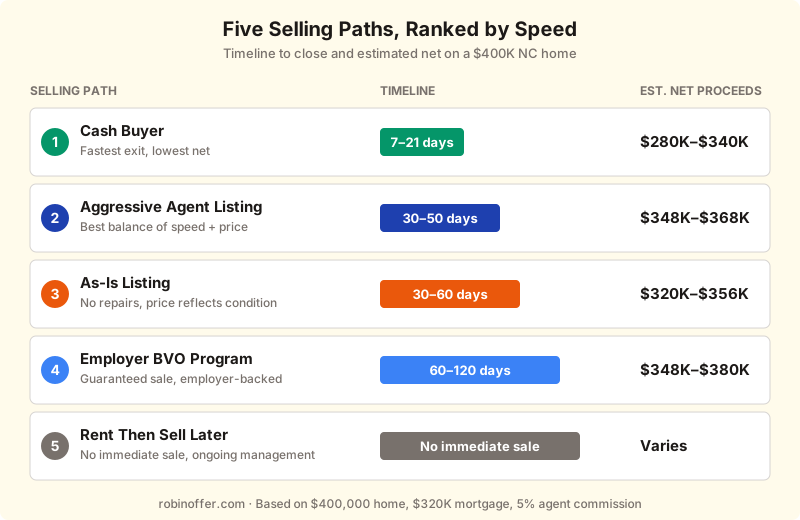
Every selling path involves a trade-off between speed, net proceeds, and your personal bandwidth. Here's how the five options stack up when you're relocating out of North Carolina.
Path 1: Cash Buyer (7–21 Days to Close)
A direct cash sale is the fastest exit. Companies like Opendoor (active in Charlotte and Raleigh-Durham), NC Cash Home Buyers, and regional investors can close in as little as one to three weeks. The trade-off is price: cash buyers typically offer 50–70% of fair market value, though iBuyers like Opendoor tend to land closer to 85–95% with service fees factored in.
When a cash sale makes sense for relocators: your start date is in three weeks, you can't manage a listing from out of state, or the carrying costs of waiting exceed the price discount. On a $400,000 home, a 10% discount costs $40,000, but three months of dual housing at $3,500/month costs $10,500, plus the mental bandwidth of remote-managing a sale during your first 90 days at a new job.
For a deeper breakdown of cash buyer types and how to evaluate offers, see our cash offer guide for the Carolinas.
Path 2: Aggressive Agent Listing (30–50 Days)
Price your home 2–3% below comparable sales, invest in professional photography and staging, and hit the market hard with maximum exposure in the first 72 hours. In the current NC market, homes priced right are going under contract in about 30 days. Add 25–30 days for a financed buyer's closing period, and you're looking at 55–80 days total.
The trick for relocators: pre-negotiate your timeline. Tell your agent your hard deadline. A good listing agent will structure the offer review to prioritize buyers with strong financing and short contingency periods over buyers offering top dollar with 45-day due diligence windows. In NC, the due diligence period is negotiable, you can push for 14 days instead of the standard 21–30.
One overlooked tactic: offer a closing cost credit of $3,000–$5,000 to buyers who can close within 30 days. This attracts buyers who are pre-approved and ready to move. Yes, it reduces your net, but it compresses the timeline, which reduces your carrying costs by potentially more than the credit itself. On a 45-day acceleration, you save roughly $3,800 in dual-housing costs, which more than offsets a $3,000 buyer credit.
Path 3: Sell As-Is (30–60 Days)
Skip the repairs, skip the staging, disclose everything, and price accordingly. This works when your home has deferred maintenance that would take weeks to fix, weeks you don't have. NC law still requires the RPOADS disclosure form regardless of as-is status, but you're not obligated to fix what you disclose.
Our selling as-is in NC guide covers the full legal framework. The short version: as-is is a negotiating position, not a legal shield. Buyers can still inspect, still walk away, and still negotiate. But it attracts the right pool, investors and renovation-loan buyers who expect condition issues and price for them.
Path 4: Rent It Out and Sell Later (No Immediate Sale)
If your equity position is strong and you can cover the mortgage with rental income, converting to a rental buys you time to sell when the market is better or when you're not under deadline pressure. NC's renter-occupied rate is about 34%, so there's demand, particularly in Charlotte and Raleigh, where median rents for a 3-bedroom house run $1,800–$2,200 per month.
The catch for relocators: remote property management is a real job. Budget $1,200–$2,400 annually for a property manager (8–10% of monthly rent), plus a vacancy reserve of one month's rent per year. If you're relocating to a high-cost city where your cash flow is already tight, adding landlord risk may not be the right play.
The Rent-vs-Sell Decision Framework
Ask yourself four questions before choosing to rent instead of sell:
| Question | If Yes → Rent | If No → Sell |
|---|---|---|
| Does market rent cover mortgage + taxes + insurance + management fee? | Positive cash flow, rental is viable | You're subsidizing the tenant, sell |
| Can you handle a $5,000–$10,000 emergency repair from out of state? | Financial cushion exists | One HVAC failure could break the budget |
| Are you willing to be a landlord for 2+ years? | Mindset is ready | You'll resent the property within six months |
| Is there a tax reason to hold? (e.g., approaching 2-year IRS mark) | Timing delay saves capital gains tax | No tax advantage to holding |
Path 5: Employer BVO (Buyer Value Option) Program
If your employer offers a Buyer Value Option or Guaranteed Buyout program through a relocation management company, this may be your best path. The company appraises your home, you list it on the open market for a set period (usually 60–90 days), and if it doesn't sell, the relocation company buys it at the appraised value, minus a service fee that typically runs 3–5%.
Not every employer offers this. Of those that do, the qualification criteria can be strict (employment tenure, home condition, market eligibility). But if it's available to you, it removes the downside risk entirely: you have a guaranteed sale price with a known timeline.
Side-by-Side: All Five Paths
| Selling Path | Timeline | Expected Net (on $400K home) | Your Effort Level | Best For |
|---|---|---|---|---|
| Cash buyer | 7–21 days | $280K–$340K | Minimal | Urgent deadline, can't manage from afar |
| Aggressive listing | 30–50 days | $348K–$368K | Moderate (agent handles most) | 30+ day runway, wants top market price |
| As-is listing | 30–60 days | $320K–$356K | Low | Deferred maintenance, no time/money for repairs |
| Rent then sell | No immediate sale | Depends on hold period | Ongoing (or hire manager) | Strong equity, rental income covers mortgage |
| Employer BVO | 60–120 days | $348K–$380K | Low | Employer offers program, removes downside risk |
Need to sell your NC home fast for your move?
Get a free, no-obligation cash offer on your home — any condition, no repairs, and close on the timeline your relocation needs.
4. The Dual-Housing Trap: Carrying Cost Math That Changes Everything
The number that should drive every relocation selling decision isn't your home's value, it's your weekly carrying cost. Most NC homeowners don't calculate this number until they're already paying two mortgages, and by then the math has been running against them for weeks.
What Dual Housing Actually Costs
Here's a realistic breakdown for a NC homeowner with a $400,000 home and a $320,000 mortgage at 5.2% (a rate many current owners locked in during 2020–2022):
| Monthly Expense | Amount | Weekly Cost |
|---|---|---|
| Mortgage payment (P&I) | $1,756 | $405 |
| Property taxes (NC average) | $283 | $65 |
| Homeowner's insurance | $167 | $39 |
| HOA dues (if applicable) | $150 | $35 |
| Utilities (vacant home minimum) | $120 | $28 |
| Lawn care / maintenance | $100 | $23 |
| Total monthly carry | $2,576 | $595 |
That's $595 per week or $85 per day. Every day your NC home sits unsold while you're paying rent or a mortgage at your new location, you're burning $85. Over a 90-day listing period, that's $7,650, on top of whatever you're paying at the new place.
The Break-Even Question
Here's where the math gets sharp. If a cash buyer offers you $340,000 and an agent listing could fetch $380,000 but takes 90 days longer, the carrying cost of waiting is $7,650. Add the agent commission difference (5% of $380,000 = $19,000 vs. zero commission on a cash sale), and the net difference narrows dramatically:
| Scenario | Sale Price | Commission | Carrying Cost | Net Proceeds |
|---|---|---|---|---|
| Cash buyer (close in 14 days) | $340,000 | $0 | $1,190 | $338,810 |
| Agent listing (close in 75 days) | $380,000 | $19,000 | $6,375 | $354,625 |
| Agent listing (close in 120 days) | $375,000 | $18,750 | $10,200 | $346,050 |
The agent listing still wins in most scenarios, but not by as much as people assume. And if the listing stretches past 90 days (which happens to about 30% of NC listings), the gap between cash and listing net proceeds shrinks to under $10,000. At that point, you're paying a lot of money for a lot of stress.
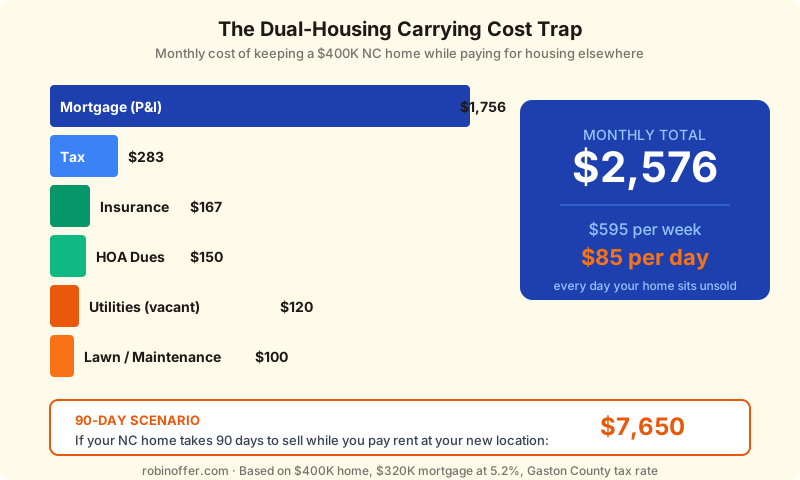
That $85 a day is a Charlotte-market average, not your number. Run your own mortgage, taxes, insurance and upkeep through our cost-of-waiting calculator to see your real weekly burn rate.
5. What Your Employer Relocation Package Actually Covers
If your employer is paying you to move, the relocation package can dramatically change your selling calculus. But most employees don't read the fine print until they're mid-move and discover the coverage is thinner than they assumed.
What's Typically Included (And What's Not)
| Benefit | Common Coverage | What's Usually Excluded |
|---|---|---|
| Home sale assistance | BVO program, or closing cost reimbursement | Home repairs, staging, price gaps below appraised value |
| Temporary housing | 30–60 days in corporate housing or per diem | Extensions beyond initial period, pet surcharges |
| Moving expenses | Household goods transport, two cars | Boat storage, specialty items, excess weight |
| House-hunting trips | 1–2 trips for buyer and spouse | Children's travel, extended stays |
| Mortgage assistance | Rate differential, points buydown | Down payment, mortgage qualification gap |
| Loss-on-sale protection | Some executive packages cover losses | Rarely available below VP level |
The average homeowner relocation package runs $63,685 according to WHR Global's 2024–2025 data. But the range is massive: entry-level renters get $5,000–$15,000, mid-level homeowners get $15,000–$35,000, and executive homeowners get $55,000–$90,000+. About 61% of companies plan to increase their relocation budgets in 2026.
The Home-Sale Assistance Gap
Here's what most relocating homeowners don't realize: home-sale assistance is the most expensive benefit for employers. Closing costs alone run 7–9% of the home's value in NC, roughly $28,000–$36,000 on a $400,000 home. Many employers cap their home-sale assistance or structure it as a reimbursement rather than a direct payment. That means you may need to front the closing costs and get reimbursed after the sale.
If your employer uses a relocation management company (like SIRVA, Cartus, or Altair Global), they may offer a BVO or Guaranteed Buyout program. These programs appraise your home, give you a window to sell on the open market, and then buy it at appraised value if it doesn't sell. The catch: appraisals in shifting markets can come in below what you think your home is worth, and the service fee (3–5%) comes off the top.
Tax Treatment of Relocation Benefits
Here's something that catches relocating homeowners off guard: most relocation benefits are taxable income. If your employer reimburses $15,000 in moving expenses, that $15,000 shows up on your W-2 as additional compensation. The Tax Cuts and Jobs Act of 2017 eliminated the moving expense deduction for everyone except active-duty military (through at least 2025, and extended through 2026 by subsequent legislation for military members).
Some employers offer "tax gross-up" on relocation benefits, they pay you enough extra to cover the tax hit so the reimbursement feels like a true reimbursement. Not all do. Ask specifically: "Does the package include tax gross-up on relocation benefits?" The difference between a grossed-up and non-grossed-up $20,000 reimbursement is roughly $6,000–$7,000 in federal and state taxes.
| Relo Benefit | Tax Treatment | With Gross-Up | Without Gross-Up |
|---|---|---|---|
| $15,000 moving cost reimbursement | Taxable as income | Employer pays ~$5,250 extra to cover taxes | You owe ~$5,250 at tax time |
| $8,000 temporary housing | Taxable as income | Employer pays ~$2,800 extra | You owe ~$2,800 |
| $25,000 home sale loss-on-sale | Taxable as income | Employer pays ~$8,750 extra | You owe ~$8,750 |
Estimates based on 35% combined federal + NC state marginal tax rate. Your actual rate may differ.
6. NC Disclosure and Closing Mechanics When You're Already Gone
Selling a home in North Carolina while you're physically somewhere else is completely doable, thousands of NC closings happen remotely every year. But you need to set up the paperwork correctly, or you'll create delays that cost real money.
The Disclosure Requirement Doesn't Change
Even if you're selling from out of state, NC law requires you to provide two disclosure forms to the buyer: the Residential Property and Owners' Association Disclosure Statement (RPOADS) under N.C.G.S. Chapter 47E, and the Mineral and Oil and Gas Rights Mandatory Disclosure Statement (MOGS). You can answer "No Representation" to individual questions if you're genuinely unsure about a condition, but you cannot skip the form entirely.
The RPOADS covers structural conditions, systems (HVAC, plumbing, electrical), water issues, environmental hazards, legal encumbrances, and unpermitted work. Complete this form before you list, not during the due diligence period. Your agent can walk you through it over a video call, and you can sign electronically.
Three Ways to Close Without Being There
| Method | How It Works | Best For | Watch Out For |
|---|---|---|---|
| Remote Online Notarization (RON) | Video call with NC-certified notary, sign electronically | Most relocating sellers, fastest and simplest | Must use a platform approved by NCSEC; attorney must still supervise |
| Mail-away closing package | Attorney mails documents, you sign before a local notary and return | Sellers in areas with limited tech access | Slower, allow 5–7 business days each way; FedEx recommended |
| Power of Attorney (POA) | Grant specific POA to a trusted person to sign on your behalf | Sellers who are overseas or completely unavailable at closing | Lender and title insurer must pre-approve the POA; use specific (limited) POA only |
Remote Online Notarization has been permanently legal in NC since July 2023 under House Bill 776 (the Remote Online Notarization Act). The notary must be NC-certified for RON, the audio-video session is recorded and retained for 10 years, and the entire transaction is supervised by a licensed NC attorney. This is the preferred method for most relocating sellers, it's faster than mail and simpler than a POA.
Power of Attorney: When You Need It and How to Set It Up
If you absolutely cannot be present (even virtually) for the closing, say you're on a flight to Tokyo or in a remote area without reliable internet, a Specific Power of Attorney lets someone sign on your behalf. NC law recognizes out-of-state POAs under N.C.G.S. § 32C-3-303, but the closing attorney will need an opinion from a lawyer in the state where the POA was signed confirming it was properly executed.
Two additional approvals are required: your lender must approve the use of a POA for the payoff, and the title insurance company must pre-approve the document. Start this process at least two weeks before your expected closing date. A specific (limited) POA is strongly preferred over a general POA, it names the exact property, the specific transaction, and an expiration date.
The Attorney Requirement: NC Is Not a DIY-Closing State
North Carolina requires a licensed attorney to supervise every residential real estate closing. This is non-negotiable and applies even for cash sales, even for all-cash transactions, and even when both parties agree to waive it. The attorney prepares the deed, reviews the title, handles the settlement statement, and ensures the closing is legally proper. Typical attorney fees for a seller-side closing run $500–$800. If you're managing from out of state, your closing attorney becomes your most important local contact, they're the person who ensures everything happens correctly without you being there.
Ask your agent for attorney recommendations before you leave NC. You want an attorney who is comfortable with RON closings, responsive to email, and willing to communicate on your schedule (especially if you're in a different time zone).
7. The Tax Break Most Relocating Sellers Miss
Here's something most relocation guides skip entirely: if you've lived in your NC home for less than two years, you may still qualify for a capital gains exclusion on your sale. Most people think the IRS requires a full two years of ownership and use to claim the Section 121 exclusion ($250,000 single / $500,000 married filing jointly). That's the standard rule. But there's an exception specifically designed for job-related moves.
The Section 121 Partial Exclusion for Employment Changes
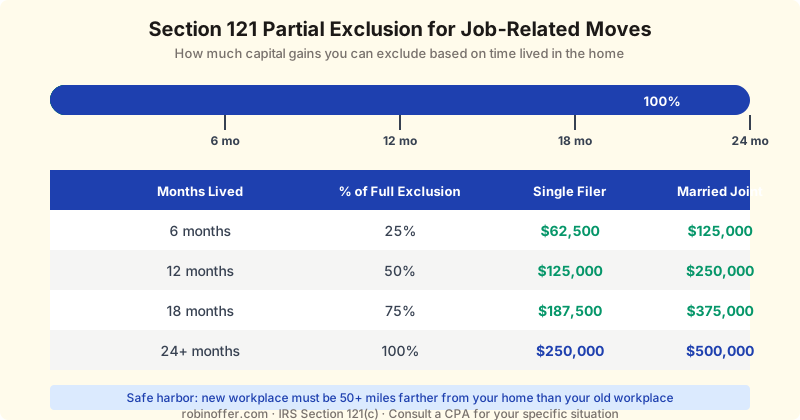
Under IRS Section 121(c), if you sell your primary residence before meeting the two-year requirement because of a change in employment, you may claim a partial exclusion. The exclusion is prorated based on how long you lived in the home relative to 24 months.
| Months Lived in Home | Percentage of Full Exclusion | Single Filer Exclusion | Married Filing Jointly Exclusion |
|---|---|---|---|
| 6 months | 25% | $62,500 | $125,000 |
| 12 months | 50% | $125,000 | $250,000 |
| 18 months | 75% | $187,500 | $375,000 |
| 24+ months | 100% | $250,000 | $500,000 |
The 50-Mile Safe Harbor
The IRS provides a "safe harbor" for employment-related moves: if your new workplace is at least 50 miles farther from your NC home than your previous workplace was, the partial exclusion applies automatically. You don't need to prove anything beyond the distance. Moving from Charlotte to Raleigh (170 miles)? Qualifies easily. Moving from Durham to a new office in Research Triangle Park that's only 12 miles away? Doesn't qualify.
Unforeseen Circumstances Also Qualify
Beyond job-related moves, the partial exclusion also applies if the sale was caused by unforeseen circumstances: divorce, death, natural disaster, unemployment, or a change in employment that doesn't meet the 50-mile test but is involuntary (layoff, company closure). Keep documentation, offer letters, termination letters, transfer orders, in case of an audit.
The Math That Matters
Say you bought a home in Charlotte 14 months ago for $380,000 and you're selling it for $430,000 because you got a job in Atlanta. Your gain is $50,000. Under the partial exclusion (14/24 = 58.3%), you can exclude approximately $145,833 (single) or $291,667 (married). Since your gain is only $50,000, the entire gain is excluded. You owe zero federal capital gains tax.
Without knowing about the partial exclusion, that same seller might think they owe 15% long-term capital gains on $50,000, which is $7,500. That's $7,500 that stays in your pocket if you know the rule exists.
NC State Capital Gains Tax: The Additional Layer
North Carolina taxes capital gains as ordinary income at a flat rate of 3.99% (as of tax year 2026, down from 4.25% in 2025). The Section 121 exclusion applies at the federal level, which also reduces your NC taxable income because NC starts with federal adjusted gross income. If your gain is fully excluded under Section 121 (or the partial exclusion), you owe zero state capital gains tax as well. If only part of your gain is excluded, the remaining gain is taxed at 3.99% on your NC return. On a $50,000 gain that's fully excluded: $0 NC tax. On a $100,000 gain where only $50,000 is excluded: $50,000 × 3.99% = $1,995 NC tax. These numbers add up, especially on higher-value homes in Charlotte, Raleigh, and Asheville where gains can reach six figures.
One more detail for relocators who bought recently: if you've owned the home for less than one year, any gain is taxed as short-term capital gains, which means ordinary income rates at both the federal and state level. That pushes the federal rate from 15% to potentially 22–35%, depending on your bracket. Yet another reason the partial exclusion matters.
8. NC Metro Market Reality: How Fast Homes Actually Sell in Your City
North Carolina isn't one market, it's a collection of metro areas with different price points, different demand levels, and critically different timelines. If you're trying to plan a relocation sale, you need the numbers for your specific city, not a statewide average.
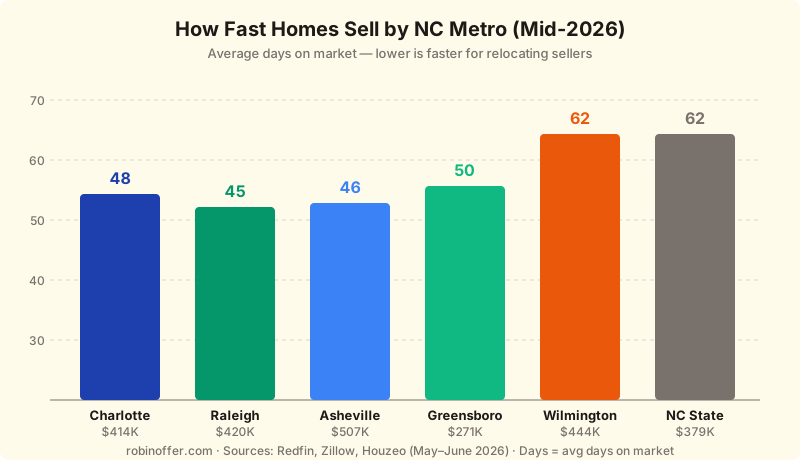
Current Market Snapshot by NC Metro (Mid-2026)
| Metro Area | Median Sale Price | Avg Days on Market | Sale-to-List Ratio | Months of Supply |
|---|---|---|---|---|
| Charlotte | $414,000 | 48 days | ~97% | 3.5 |
| Raleigh | $420,000 | 45 days | ~97% | 3.3 |
| Durham | $418,000 | 45 days | ~97% | 3.4 |
| Asheville | $507,000 | 46 days | 96.4% | 3.0 |
| Wilmington | $444,000 | 62 days | ~97% | 4.1 |
| Greensboro | $271,500 | 50 days | 98.2% | 3.2 |
| NC Statewide | $378,655 | 62 days | ~97% | 5.6 |
Sources: Redfin, Zillow, and Houzeo market data as of May–June 2026.
What This Means for Relocating Sellers
Charlotte and Raleigh are still the fastest markets in NC. If you're selling in either metro and price correctly, expect an accepted offer in 25–35 days and closing 25–30 days after that. Total timeline: 50–65 days. You have the best shot at a traditional listing that closes before your relo deadline.
Asheville moves fast but at a higher price point, which means fewer buyers. The 46-day DOM is deceptive, entry-level homes under $400K sell faster, while homes above $600K can sit for 90+ days. If your Asheville home is in the upper price range, build in extra timeline or consider an iBuyer.
Wilmington is the market where relocating sellers need the most caution. The 62-day DOM average is up from 27 days a year ago, a huge deceleration. Inventory is building, and homes are sitting. If you're selling in Wilmington under a tight deadline, aggressive pricing or a cash buyer may be the smart play.
Greensboro is the value market, low prices, reasonable speed, and the highest sale-to-list ratio in the state (98.2%). Relocating sellers in the Triad usually have the cleanest path to a quick traditional sale because the price point attracts more qualified buyers.
Fayetteville and military-adjacent markets move on assignment-season cycles. If you're in Fayetteville, Jacksonville, or near Fort Liberty and your relocation isn't military-related, you're competing with a constant flow of PCS sellers who are often willing to accept lower prices for speed. Price more aggressively than you think you need to, your competition is motivated.
Seasonal Timing Still Matters for Relocators
If you have any flexibility in when you list, the data strongly favors April through June. Spring listings in NC sell 11–17 days faster and command 2–5% higher prices than the annual average. On a $400,000 home, that spring premium is $8,000–$20,000. If your start date is in August, listing in May gives you the best shot at capturing both speed and price.
If you're listing in December or January, expect a slower market. The winter discount runs 3–8% below the annual average, which means you may need to price 5–10% below spring-comparable sales to attract buyers during the holiday dead zone. For winter-timeline relocators, a cash buyer starts to look more attractive because the price gap between cash offers and winter market prices narrows considerably.
For the complete month-by-month breakdown, read our best time to sell guide for both Carolinas.
Get Your Free, No-Obligation Cash Offer
Tell us about your property and your move deadline. We'll send a real cash offer — any condition, no repairs, and you close on your timeline. Free and confidential.
9. Bridge Loans, HELOCs, and the Buy-Before-You-Sell Decision
The hardest financial puzzle for relocating homeowners isn't selling, it's the gap between buying in the new city and selling in NC. Do you buy first and risk carrying two payments? Sell first and risk renting while you search? Or use a financial product to bridge the gap?
Bridge Loan vs. HELOC: The 2026 Numbers
| Feature | Bridge Loan | HELOC |
|---|---|---|
| Typical rate (June 2026) | 8–11% | 7.3% |
| Origination fee | 1–2% of loan amount | Usually none |
| Time to fund | 5–10 business days | 2–6 weeks |
| Loan term | 3–12 months | 10-year draw, 20-year repay |
| Repayment trigger | Due when old home sells | Flexible, draw as needed |
| Best for | Need full down payment immediately | Want flexibility, have time to set up |
The Real Cost of Bridging
A bridge loan on $150,000 (your down payment for the new house) at 9% for three months costs about $3,375 in interest plus a $2,250 origination fee (1.5%). Total cost: $5,625 to bridge the gap. If your old home sells in month two, the cost drops to $4,500. If it takes five months, you're looking at $8,000+.
A HELOC on the same $150,000 at 7.3% costs $913 per month in interest only. Over three months: $2,738. No origination fee. The HELOC is cheaper, but it takes longer to set up (2–6 weeks), which means you need to apply before you start the relocation process. If you wait until you've already accepted the new job and found a house, it may be too late for a HELOC.
A Third Option: Buy-Before-You-Sell Programs
A newer category of financial product has emerged specifically for relocating homeowners: buy-before-you-sell programs offered by companies like Knock, Homeward, and Orchard. These programs let you make a non-contingent (effectively cash) offer on your new home while simultaneously listing your old one. The company provides bridge funding and guarantees the purchase of your old home if it doesn't sell within a set period, typically 90–120 days.
The fees vary: Knock charges a "convenience fee" of 1.25–1.75% of your new home's value, Homeward charges a service fee of 2.4%, and Orchard typically wraps costs into their listing service. On a $400,000 new home purchase, that's $5,000–$9,600 in additional fees. Compare that to the $5,625 bridge loan cost and the potential carrying cost savings, and the math may or may not work in your favor depending on your timeline.
When to Just Sell First
Bridging products make sense when you've found your dream home in the new city and can't risk losing it. But in most relocation scenarios, selling first and renting temporarily is the lower-risk path. Yes, you'll move twice. Yes, that's annoying. But you eliminate the dual-payment risk entirely, you negotiate from strength as a cash-ready buyer at your destination, and you avoid the worst-case scenario: paying three monthly obligations (old mortgage + new mortgage + bridge loan) when the old home doesn't sell as fast as you planned.
Monthly housing costs in that worst-case scenario: old mortgage ($1,756) + new mortgage (~$2,400 at 6.5% on $380K) + bridge loan interest ($913) = $5,069 per month. That's $1,268 per week. If it lasts four months, you've spent $20,276 on overlapping housing.
10. Your Week-by-Week Relocation Selling Playbook
Here's the execution plan, assuming you've just received a job offer or transfer notice and need to sell your NC home on a 60–90 day timeline.
Weeks 1–2: Decision and Setup
| Task | Why It Matters | Who Handles It |
|---|---|---|
| Calculate your weekly carrying cost | This number drives every decision that follows | You (use Section 4 of this guide) |
| Check employer relo benefits | May include BVO, temporary housing, closing cost reimbursement | HR / relocation management company |
| Interview 2–3 listing agents | Ask specifically about their relocation seller experience and remote-management process | You |
| Complete RPOADS and MOGS disclosure forms | NC law requires these before or at time of offer | You + agent |
| Get a pre-listing inspection ($300–$500) | Identify deal-killing issues before buyers find them | Licensed inspector |
| Research Section 121 partial exclusion eligibility | Could save you $7,500+ in capital gains tax | Your CPA or tax advisor |
Weeks 3–4: Market Preparation
| Task | Why It Matters | Who Handles It |
|---|---|---|
| Professional photography and virtual tour | 90%+ of buyers start online, photos are your first showing | Agent's photographer |
| Declutter and light staging | Staged homes sell 3–10 days faster on average | You or staging company |
| Set an aggressive list price | In a relocation, speed matters more than squeezing every dollar | Agent (with your carrying-cost math as context) |
| Set up a cash-buyer backup plan | Get a cash offer in writing, even if you don't use it, it's your floor | You or agent |
| Apply for a HELOC or bridge loan if needed | If you plan to buy before selling, start the financing process now | Your lender |
Weeks 5–8: Active Listing and Offer Management
| Task | Why It Matters | Who Handles It |
|---|---|---|
| Go live on MLS | Maximum exposure in the first 72 hours is critical | Agent |
| Review offers against your carrying-cost deadline | A slightly lower offer that closes in 30 days may net more than a higher offer that closes in 60 | You + agent |
| Negotiate due diligence period down to 14 days | Standard NC due diligence is 21–30 days; push for shorter | Agent |
| If no offers by day 14: activate cash-buyer backup | Don't wait until week 8 to change strategy | You |
| Coordinate remote closing setup (RON or mail-away) | Start early, RON requires NC-certified notary scheduling | Closing attorney |
Weeks 9–12: Closing and Transition
| Task | Why It Matters | Who Handles It |
|---|---|---|
| Manage inspection response within 48 hours | Fast responses keep the deal on your timeline | Agent + you |
| Confirm wire instructions directly with closing attorney | Wire fraud is real, never rely on emailed wire instructions alone | You + closing attorney |
| Arrange final utility disconnection after closing | Keep lights on for buyer's final walkthrough | You |
| Submit relo reimbursement paperwork to employer | Most programs require documentation within 30–60 days of closing | You |
| File Section 121 partial exclusion with next tax return | Use IRS Form 8949 and Schedule D, attach documentation | Your CPA |
The Decision Tree: What Changes When Offers Don't Come
The hardest part of selling under a relocation deadline isn't the execution, it's knowing when to change course. Most sellers wait too long to pivot. Here's a decision framework based on where you are in the process:
| Week | Signal | Action |
|---|---|---|
| Week 1–2 | 20+ showings, multiple inquiries | Hold price, the market is responding. Expect offers within days. |
| Week 1–2 | Fewer than 5 showings | Price reduction of 2–3% immediately. You launched too high. |
| Week 3–4 | Showings but no offers | Feedback review. Usually a condition issue, a staging gap, or a floor plan concern. Address the top complaint. |
| Week 3–4 | Offers below ask by 10%+ | The market is telling you the price. Consider the best offer vs. carrying costs of waiting. |
| Week 5–6 | No viable offers after price reduction | Activate cash-buyer backup. Get written offers from 2–3 companies. |
| Week 7+ | Listing feels stale | Either accept best current offer, take the cash buyer, or convert to rental. |
The Fallback Timeline
If your home hasn't sold by week 10 and you need to leave, you have three options:
- Accept the best current offer, even if it's below asking. Calculate whether the carrying cost of waiting exceeds the price gap.
- Switch to a cash buyer. Get offers from 2–3 companies and compare. With a motivated seller, some cash buyers will close in 7–10 days.
- Convert to a rental. Hire a property manager, sign a lease, and sell later when the market improves or when you can manage the process with less time pressure. Budget 8–10% of monthly rent for management fees.
For more on selling when you're running out of time, our best time to sell guide has month-by-month data for both Carolinas, including when to avoid listing if you can help it.
11. NC Closing Costs for Relocating Sellers: The Full Net Sheet
Before you celebrate a sale price, subtract the costs. NC seller closing costs run 2.5–3% of the sale price for transactional costs alone, plus commissions if you're using an agent. Here's the complete breakdown on a $400,000 sale.
| Cost Item | Amount | Who Pays | Notes |
|---|---|---|---|
| Agent commission (5%) | $20,000 | Seller | Negotiable; some agents offer 4% flat |
| NC excise tax (revenue stamps) | $800 | Seller | $1 per $500 of sale price, NC state law |
| Attorney fees | $500–$800 | Seller | NC requires attorney-supervised closing |
| Title search / title insurance | $400–$600 | Varies | Seller usually pays owner's policy in NC |
| Prorated property taxes | $0–$1,500 | Seller | Depends on closing date relative to tax billing cycle |
| HOA transfer fees | $200–$500 | Seller | If HOA, includes estoppel letter |
| Recording fees | $50–$100 | Seller | County register of deeds |
| Wire transfer fee | $25–$50 | Seller | For proceeds disbursement |
| Total (with 5% commission) | $21,975–$24,350 | 5.5–6.1% of sale price | |
| Total (cash buyer, no commission) | $1,975–$3,550 | 0.5–0.9% of sale price |
On a $400,000 home with a $320,000 mortgage payoff, a traditional agent sale nets you approximately $55,650–$58,025 after all costs. A cash buyer sale at $340,000 nets you approximately $16,450–$18,025, dramatically less, but the trade-off is speed and zero ongoing risk.
NC excise tax is calculated as $1 per $500 of the sale price. On a $400,000 sale: $400,000 ÷ $500 = 800 × $1 = $800. The seller pays this at closing, and it's collected by the register of deeds when the deed is recorded.
12. What Happens to Your NC Home When You Leave It Vacant
If you're already gone and the house is sitting empty, you have a new set of problems that listing agents and relocation articles rarely discuss. A vacant home is not just an unsold asset, it's a liability that degrades in ways occupied homes don't.
Insurance Changes Immediately
Most standard homeowner's insurance policies include a vacancy clause: if the home is unoccupied for 30–60 consecutive days (varies by carrier), coverage is reduced or voided. Vandalism, water damage from burst pipes, and theft are commonly excluded after the vacancy threshold. You need to notify your insurer and switch to a vacant-home policy, which typically costs 50–60% more than standard coverage.
| Risk | Why Vacant Homes Are More Exposed | Prevention Cost |
|---|---|---|
| Burst pipes / water damage | No one home to notice leaks; HVAC turned off in winter | $15–$30/month (smart water sensor + winterization) |
| Vandalism / break-in | Dark houses with overgrown yards attract attention | $50–$100/month (lawn + exterior lights on timer) |
| Mold / moisture | No climate control, especially in NC humidity (May–September) | $40–$80/month (keep HVAC running at 78°F, dehumidifier) |
| Code violations | Overgrown lawn, visible neglect can trigger municipal fines | $100–$200/month (lawn service) |
| Squatters | NC law makes removal complicated once established | $0 (have a neighbor check weekly; change locks) |
Total vacancy maintenance budget: $205–$410 per month, on top of your regular carrying costs. Add this to the $2,576 monthly carry from Section 4 and a vacant NC home costs $2,781–$2,986 per month, $93–$100 per day.
The Showing Problem
Vacant homes show poorly. A house with no furniture, no personal touches, and echo-chamber acoustics makes buyers feel like something is wrong. Studies from the National Association of Realtors show staged homes sell 73% faster than empty ones. If your home is vacant, spending $1,500–$3,000 on virtual staging (digital furniture in listing photos) or $2,000–$4,000 on partial physical staging can be the difference between a 30-day sale and a 90-day ordeal.
A practical alternative: leave behind key furniture if you don't need it in your new location. A couch, a dining table, beds in the primary and one secondary bedroom, and some kitchen items. Your agent can handle showings with a lockbox and smart lock, you don't need to be present. Many relocating sellers donate the remaining furniture after closing rather than paying to move it.
13. The Return-to-Office Wave: A New Kind of Forced Relocation
There's a category of relocating seller that barely existed three years ago: the remote worker who bought a home in North Carolina during the pandemic and is now being called back to an office in another state. More than half of Fortune 100 companies now require five-day in-office workweeks, up from just 5% in 2023. That shift is creating a wave of forced sellers who didn't plan to move.
The RTO Seller's Unique Problem
Pandemic-era NC buyers often purchased at peak prices (2021–2022) with historically low mortgage rates (2.5–3.5%). Many are now sitting on homes worth less than what they paid, while their locked-in rate is 3–4 percentage points below current market rates. That creates a painful double bind:
| Scenario | Purchased (2021–2022) | Current Value (2026) | Equity Position | Rate Lock-In Loss |
|---|---|---|---|---|
| Charlotte suburb | $425,000 at 2.9% | $410,000 | -$15K (underwater or thin) | New mortgage at 6.5% = +$850/month |
| Raleigh neighborhood | $480,000 at 3.2% | $460,000 | -$20K | New mortgage at 6.5% = +$780/month |
| Asheville mountain home | $550,000 at 3.0% | $515,000 | -$35K | New mortgage at 6.5% = +$1,050/month |
If you're in this position, sitting on negative or thin equity with a sub-4% mortgage rate, selling triggers two losses: the equity gap and the rate gap. The rate gap is real money: moving from a 3% rate to a 6.5% rate on a $400,000 mortgage costs an extra $850 per month, or $10,200 per year. Over the life of a 30-year loan, that's a quarter of a million dollars in additional interest.
Three Strategies for RTO Sellers
- Negotiate remote or hybrid before selling. If your company is mandating RTO, negotiate first. Many employers are willing to grant exceptions for top performers or employees who would be expensive to replace. The cost of your relocation package alone might justify a hybrid arrangement.
- Rent the NC home instead of selling. If market rent covers your mortgage payment, converting to a rental preserves your low rate. You can rent in the new city and keep the NC home as an investment. When rates eventually drop, refinance and sell then, or keep it as a long-term rental. Read our selling rental property with tenants guide if you decide to sell later with a tenant in place.
- Ask for mortgage differential assistance. Some employers offer programs that subsidize the difference between your old rate and the new one for 12–24 months. This is increasingly common in 2026 as employers recognize that rate lock-in is the #1 barrier to employee mobility.
If your home is genuinely underwater (you owe more than it's worth), read our underwater mortgage guide for NC before making any decisions. A short sale, deed-in-lieu, or negotiated forbearance may be options your lender will consider.
14. Put a Number on It: Get Your NC Home's Relocation Sale Value
You've got the data, the math, the legal framework, and the timeline. Now you need numbers specific to your house, your neighborhood, and your relocation deadline. That's what we do.
RobinOffer is a cash home buyer, not a licensed brokerage, and we work with a licensed real estate agent partner, Chamiese Evans of NorthGroup Real Estate. We work with relocating homeowners across North Carolina, running comparable analyses, building net proceeds worksheets across multiple selling paths, and giving you a direct answer about what your home will actually sell for and how fast. If a cash offer makes the most sense for your timeline, we'll make one. If listing with an agent will net you more money even after carrying costs, we'll tell you that instead.
Every relocating seller gets the same three deliverables from us, free and with no obligation:
- A comparative market analysis based on your home's condition, location, and recent comparable sales, not an algorithm estimate.
- A dual-path net proceeds worksheet showing what you'd walk away with under a cash sale vs. an agent listing, including carrying costs for your specific timeline.
- A realistic timeline estimate for your metro area, so you can align your relocation calendar with your selling calendar.
Get in touch through our contact page or request a free home valuation. We respond within 24 hours with a custom analysis for your property.
See What We'd Pay for Your Home
Send us your property details and we'll follow up, often within a day, with a real cash offer, any condition, no obligation, close on your relocation timeline.
15. Frequently Asked Questions About Relocating and Selling Fast in NC
How fast can I sell my house in North Carolina if I am relocating?
It depends on the selling path. A cash buyer can close in 7-21 days. An aggressive agent listing typically takes 30-50 days to get an accepted offer, plus 25-30 days to close. Total traditional timeline: 55-80 days. In the Charlotte and Raleigh metros, homes priced correctly go under contract in about 30 days.
What are the carrying costs of keeping my NC home while relocating?
On a typical $400,000 NC home with a $320,000 mortgage, monthly carrying costs run about $2,576, or $85 per day. This includes mortgage payment, property taxes, insurance, HOA dues, utilities, and maintenance. Every day the home sits unsold while you pay for housing at your new location, you are burning $85.
Can I sell my NC home remotely if I have already moved?
Yes. North Carolina permanently legalized Remote Online Notarization (RON) in July 2023. You can sign closing documents via video call with an NC-certified notary. Alternatives include mail-away closing packages or granting a specific Power of Attorney. NC still requires a licensed attorney to supervise the closing.
Do I owe capital gains tax if I sell my NC home before living there two years?
You may qualify for a partial exclusion under IRS Section 121(c) if you sell because of a change in employment. The exclusion is prorated: 12 months of use yields a 50% exclusion ($125,000 single / $250,000 married). The safe harbor requires your new workplace to be at least 50 miles farther from your home than your old workplace.
Should I use a bridge loan or HELOC when relocating from North Carolina?
A bridge loan funds faster (5-10 days) at 8-11% interest with a 1-2% origination fee. A HELOC is cheaper (7.3% in June 2026, usually no origination fee) but takes 2-6 weeks to set up. If your timeline is tight and you need funds immediately, a bridge loan works. If you can plan ahead, a HELOC saves money.
This guide was written by Chamiese Evans, a licensed Realtor and the founder of RobinOffer and ListRobin. All market data is sourced from Redfin, Zillow, NC REALTORS, Freddie Mac, and government agencies as of June 2026. Tax information is for educational purposes only, consult a licensed CPA or tax attorney for advice specific to your situation.