
Belmont: Where Lake Wylie Meets Main Street
$470K median, dock rights worth $200K-$400K, 2,400 new homes in the pipeline, and a college town economy most people overlook. Every option compared with real Belmont data.
1. A Letter to You, the Belmont Homeowner
You can see Charlotte's skyline from the South Fork bridge, but it feels like a different world over here, doesn't it?
Belmont has always had this thing about it: close enough to the city that you can be at CLT in ten minutes, far enough that your neighbors still wave when you walk to Stowe Park. Maybe you bought into Eagle Park when those Charleston-style townhomes were just going up. Maybe your family has been in Catawba Heights since the mill days. Maybe you moved down from New York or DC, saw the lake, fell in love, and never left.
Whatever your story, something's shifted. Maybe the kids launched and four bedrooms feel like two too many. Maybe you inherited your parents' place on Catawba Street and you're not sure whether to keep it, rent it, or let it go. Maybe a job transfer is pulling you to Raleigh or back up north. Or maybe you've just been watching your equity climb (your home's worth $150,000 more than when you bought it) and you're starting to wonder.
So we put this together. All of it: the market numbers, the tax math, the neighborhood breakdown, the options you probably haven't considered yet. Everything in here is Belmont-specific. The data is from your zip code. The tax rates are yours. The rental math uses what landlords actually charge on your street, not some national average that means nothing.
We'll get into the tough stuff too: probate, divorce, foreclosure. Nobody likes talking about those, but if that's where you are, you deserve real answers, not vague platitudes.
No pressure. No pitch. Just what you need to make a good decision.
2. The Belmont Market: Where Lake Wylie Meets Main Street
Belmont isn't Gastonia, and it isn't Charlotte. It isn't one market, either. It's four distinct markets sharing a single zip code, and that's why algorithms get Belmont wrong almost every time.
There's the waterfront market ($1M-$3M+) where McLean, Reflection Pointe, and Lakestone Cove sales skew the average to $605K. There's the walkable downtown market ($350K-$1M) driven by lifestyle buyers choosing Belmont over Dilworth and NoDa. There's the family corridor ($360K-$650K) where Vineyards, South Point, and Belwood compete directly with new construction. And there's the value tier ($200K-$475K) in Catawba Heights, Abbey Place, and Abbington Woods, where infrastructure investment is quietly reshaping what's possible.
Pull a Zestimate for "Belmont, NC" and you get one number. The reality is a $160K premium over the county median that exists for very specific reasons, and understanding which market your home sits in is the difference between pricing it right and watching it sit for 90 days.
Belmont Home Prices at a Glance
| Metric | Current Data | Year-Over-Year Change |
|---|---|---|
| Median Sale Price (Belmont) | $470,000 | Up 21.2% |
| Average Home Value (Zillow ZHVI) | $395,316 | Up 1.2% |
| Median Price Per Sq. Ft. (28012) | $250 | Up 3.1% |
| Average Sale Price (28012, 12-mo) | $605,000 | Skewed by lakefront sales |
| Gaston County Median | $308,950 | Down 2.3% |
| NC State Median | $367,600 | -- |
Data sourced from Redfin, Zillow, and Gaston County public records as of February 2026. Market conditions change, so request a current evaluation for the latest numbers.
How Fast Are Homes Selling?
| Metric | Current | Last Year |
|---|---|---|
| Average Days on Market | 70-76 days | 35 days (Jan 2024) |
| Homes Sold Within 30 Days | 60-68% | Higher |
| Hot Homes (well-priced, good condition) | ~33 days | -- |
| Sale-to-List Price Ratio | ~98% | Closer to 100% |
| Active Inventory | 288 homes | Lower |
The market slowed from the frenzy of 2023-2024, but it hasn't collapsed. About two-thirds of homes still sell within 30 days when they're priced right. That other third? Those are the overpriced listings sitting there while buyers scroll past. With 288 homes competing for attention and only 19-41 selling each month, the price you pick on day one basically determines everything. And timing matters more than people think: January saw just 19 sales while June peaked at 41. Listing in spring or early summer puts you in front of the largest buyer pool.
Days on market spiked to 81 in January 2025 but improved to 49 by December, and current February 2026 listings are showing 70 days. The market is finding its footing, but it's favoring homes that are priced honestly and show well. The median listing price in Belmont right now is $532,000 (4% lower than a year ago), which tells you sellers are already adjusting expectations downward. The days of throwing out a number and hoping for a bidding war are over.
Market Temperature
Redfin gives Belmont a Compete Score of 34 out of 100, "somewhat competitive." That's lower than you'd expect for a town this desirable. Zillow still technically classifies it as a seller's market, but on the ground, it feels more balanced. Homes are selling about 2% below list price on average. The ones that are staged well, priced accurately, and in walkable or waterfront locations? Those still go at or above list in about 33 days. Everything else takes patience.
Where Are Buyers Coming From?
This matters when you're thinking about how to market your home.
About 69% of Belmont buyers are already in the Charlotte metro. They know the area and they're picking Belmont on purpose. The remaining 31% are searching to move out, mostly toward Myrtle Beach, Columbia, and Asheville.
On the inbound side, buyers from New York, Washington D.C., and Los Angeles are actively looking here. These are people coming from markets where $470,000 buys a one-bedroom condo, so Belmont's combination of waterfront living, a walkable downtown, and Charlotte proximity feels like a steal to them. If you're selling, that's a buyer pool worth reaching.
Charlotte Metro Context
Belmont sits at the bridge between Charlotte energy and Gaston County roots. You're 14 miles from Uptown (17-25 minutes off-peak, 45-60 in rush hour via I-85) and 10 minutes from CLT Airport. The Charlotte region is adding 157 new residents a day and is projected to grow from 2.4 million to 4.6 million by 2050. When Charlotte gets more expensive, people look west, and Belmont is the first thing they find.
The big future play is the LYNX Silver Line, a planned light rail connecting Belmont through Uptown Charlotte to Matthews, with 30 stations across 29 miles. Construction isn't expected until the 2030s, but the planning alone has already started influencing land values along the corridor. If you're thinking about timing, the Silver Line isn't here yet, but the anticipation is already showing up in prices. For homeowners in neighboring markets, we have a companion guide for Gastonia, a guide for Rock Hill, SC, and a Lake Wylie two-track seller guide.
3. The $640M Transformation: What's Coming to Belmont
Belmont doesn't have a single headline-grabbing mega-project like Gastonia's FUSE District. What it has might be more powerful: a dozen simultaneous investments across healthcare, energy, residential, and infrastructure, all reshaping the city from every direction at once. The total we've identified is over $640 million, with potential for over $1 billion.
Major Development Projects
| Project | Details | Investment | Status |
|---|---|---|---|
| CaroMont Regional Medical Center - Belmont | 54-bed hospital on 28-acre campus with surgery center and specialty clinics | Part of $400M+ system | Opened Jan 2025 |
| Duke Energy Battery Storage (Allen Site) | 50 MW Phase 1; 167 MW Phase 2 (Duke's largest); former coal plant conversion | $100M+ (potential $1B countywide) | Phase 1 online Nov 2025 |
| Belmont Abbey Performing Arts Center | 1,000-seat theater, dance studio, art gallery | $60M | Design announced Sept 2025 |
| Carolina Riverside (Del Webb) | 809 single-family homes (55+); 19,000 SF clubhouse; river trails | Private | Under construction |
| Imperial Mills Redevelopment | 70 townhomes, 250 apartments, 56,000 SF commercial | Private | Sketch plan under review |
| McLean Master-Planned Community | 965 home lots on 670 acres; Lake Wylie shoreline; trails, marina, retail | Private | Active / Multiple phases |
| Riverview at South Fork | 676 single-family + attached + multi-family with retail; 556 acres | Private | Planning / Approved |
| Downtown Expansion (West of Main St.) | 15-acre site that would double downtown's size; 2-4 story mixed-use | TBD | Developer selection underway |
Add those residential numbers up: over 2,400 new homes are in the pipeline across Carolina Riverside (809), McLean (965), Riverview at South Fork (676), and smaller projects. For a city of 16,000 people, that's enormous. We'll talk about what that means for your sale in section 6.
Infrastructure That Changes Your Commute
| Project | What It Does | Status |
|---|---|---|
| $25M Safe Routes to Schools (Federal Grant) | Safety improvements across 8 corridors and 5 intersections; sidewalks, crosswalks, traffic calming | Awarded 2025 |
| I-85 Widening | US 321 (Exit 17) to NC 273 (Exit 27), ~9.8 miles | Planning |
| Sloan's Ferry Bridge Replacement | New Wilkinson Blvd bridge over Lake Wylie | Planning |
| Catawba Crossings | 6.5-mile new road with 2 bridges; direct route to CLT Airport area | Feasibility complete; 20+ year horizon |
| Abbey Creek Greenway | 1.2-mile flagship trail connecting Riverfront Park, downtown, and recreation complex | Design funded |
4. Lake Wylie, Dock Rights, and the Waterfront Premium
Lake Wylie is the defining asset of Belmont real estate. It's what separates this market from every other western Charlotte suburb, and it's the reason the average sale price in 28012 hits $605K while the county median sits at $309K. If you own waterfront property, or anything near the lake, this section is the most important one in the guide.
The Lake Wylie Market
Belmont's waterfront tier (McLean, Reflection Pointe, and Lakestone Cove) represents the top of the local market. McLean South Shore starts at $1.3M for new construction across 670 acres with Lake Wylie shoreline, trails, marina, and retail. Reflection Pointe is gated, with homes routinely clearing $2M. Lakestone Cove is a boutique 15-lot enclave on the Catawba River. These are Belmont's trophy properties: custom homes with docks, panoramic views, and resort-style amenities.
The buyer pool at this level is specific and national. Charlotte executives, out-of-state relocators from New York and D.C., retirees consolidating wealth into a waterfront lifestyle. These buyers aren't comparing your home to a ranch in South Point. They're comparing it to Lake Norman, Lake Keowee, and lakefront communities in the Carolinas and beyond. The marketing has to match.
Dock Rights: The Single Biggest Value Variable in Belmont
Here's what most people don't realize about Lake Wylie: you can't just build a dock because you own waterfront property. Lake Wylie's lakebed is owned and controlled by Duke Energy under a federal FERC operating license. Every pier, dock, and shoreline modification requires written authorization from Duke Energy Lake Services before construction begins.
The permit process works like this:
- Apply to Duke Energy Lake Services for a shoreline permit
- Permit fees run $350-$1,000+ (base fee plus habitat enhancement fees)
- Permits are valid for one year and must be in place before construction
- Duke evaluates the application based on shoreline conditions, environmental impact, and FERC compliance
- Not every waterfront lot qualifies, because some shoreline conditions or environmental restrictions make docking impossible
The value impact is enormous. A waterfront lot with a permitted dock and boat lift can be worth $200K-$400K more than a comparable lot without dock rights. That's not an exaggeration. It's the single largest value variable in Belmont real estate. If your property has an existing permitted dock, that permit is a serious financial asset. Lead with it in your listing. Get your permits organized and ready for buyer review before you go live.
You can verify your permit status with Duke Energy Lake Services at 800-443-5193 or LakeServices@duke-energy.com.
The Outdoor Recreation Premium
Lake Wylie isn't the only draw. Belmont is the closest municipality to the U.S. National Whitewater Center (a 1,300-acre outdoor recreation hub about 1.3 miles away) and minutes from the Daniel Stowe Conservancy's 380 acres of trails and lakefront gardens on Lake Wylie. You're a kayak launch away from the Catawba River at Kevin Loftin Riverfront Park. These aren't just nice things to mention in a listing; they're why people choose Belmont over every other suburb in the metro, and they're part of the waterfront premium that drives pricing above the county median.
Waterfront Selling Strategy
Selling a waterfront or lake-adjacent home in Belmont requires a different playbook than selling a home in the family corridor or value tier.
Agent selection matters more here than anywhere else in Belmont. You need a luxury specialist with lake experience, someone who understands dock valuations, FERC compliance, and the relocation buyer network. A Charlotte-focused agent who lists one Belmont home a year won't understand why a dockable lot in McLean is worth $400K more than the one without dock rights. Drone photography, lifestyle marketing, and connections to the high-net-worth and relocation buyer networks are essential.
Expect 90-180 days to close at this price point. The buyer pool for $1.5M+ lake homes is small and specific. Patience is part of the strategy. Marketing should emphasize the lifestyle, not just the square footage, because waterfront buyers are buying a way of living, not just a house.
Short-Term Rental Potential for Waterfront Properties
If you're not ready to sell, waterfront and downtown properties have strong short-term rental potential. Belmont adopted a short-term rental ordinance in December 2022 that's relatively permissive: STRs are allowed in any zoning district where residential and lodging uses are permitted, and the city uses a complaint-based system rather than requiring universal permits. You only need a formal permit if your property racks up more than 4 verified code violations in 12 months or 2 in 30 days. No exterior advertising is allowed.
Check your HOA covenants first, because communities like McLean and Reflection Pointe may restrict short-term rentals regardless of what the city allows. But for an unencumbered Lake Wylie waterfront property, nightly rates could significantly outperform the $2,087/month long-term benchmark. Contact Planning and Zoning at 704-901-2610 for current fee schedules and compliance details.
Hurricane Helene: Waterfront Disclosure Considerations
After September 2024, this needs extra attention. Hurricane Helene brought extreme rainfall to the region (estimated at a 1,000+ year recurrence interval), and the Catawba River surged, flooding parts of Lake Wylie. The City of Belmont issued voluntary evacuations for four streets. Across Gaston County, 6 structures were destroyed and 105 sustained major damage. If your waterfront property experienced any water intrusion, flooding, or damage during Helene or any other event, you must disclose it on the NC disclosure form, even if repairs are complete. Properties near the South Fork Catawba River, Catawba River, and low-lying creek corridors should know their FEMA flood zone designation (check msc.fema.gov with your address). More on disclosure requirements in section 10.
See what your Belmont home is worth
Get a real, data-driven estimate based on your specific neighborhood and recent comps.
5. Belmont Abbey College: The Quiet Economic Engine Next Door
This one gets overlooked. While everyone focuses on lake values and new construction, Belmont Abbey College quietly creates a steady, recession-resistant demand pool for housing that benefits specific neighborhoods in ways that don't show up in the headline data.
Record Enrollment and Growing Programs
Belmont Abbey hit a record 1,741 students in Fall 2025 (a 3.2% increase) with 134 graduate students across 8 programs. The growth isn't just in enrollment numbers but in the type of programs the college is adding, and those programs have direct implications for housing demand.
The nursing program, launched in 2022 in partnership with CaroMont Health, graduated its first BSN class in May 2024 and keeps expanding. A new Master of Health Administration program adds another pipeline of graduate students and working professionals. These aren't 18-year-olds living in dorm rooms. They're nursing students doing clinical rotations at the new CaroMont Belmont hospital campus, healthcare professionals pursuing graduate degrees while working, and faculty members looking for homes near campus.
Two new residence halls opened on campus, absorbing some undergraduate demand. But the real housing impact comes from everyone else: faculty, staff, adjunct instructors, nursing students with families, and graduate students who need off-campus housing within a reasonable commute of both the college and CaroMont's medical facilities.
The $60M Performing Arts Center
In September 2025, the college announced a $60M Performing Arts Center: a 1,000-seat theater, dance studio, and art gallery. That's a signal that the institution is investing at a scale that will draw more faculty, more events, and more cultural tourism to this side of Belmont. For homeowners in adjacent neighborhoods, that investment translates into sustained demand and foot traffic that supports property values.
Which Neighborhoods Benefit
The college's impact on housing demand is most direct in three areas:
- Catawba Heights: the 1940s mill village immediately adjacent to campus. Faculty and staff looking for affordable proximity to work drive consistent interest. The neighborhood also benefits from its position between the college, the new CaroMont hospital, and the U.S. National Whitewater Center.
- Historic District: walkable to campus, with character homes that appeal to faculty and administrators seeking small-town charm. The National Register designation and its 15% state tax credit for qualified rehabilitation add value for buyers willing to invest in these properties.
- Abbey Place: sits between Belmont, McAdenville, and Cramerton in a quiet family pocket that's convenient to campus. Affordable entry points attract first-time buyers, including college staff and younger faculty.
The CaroMont Connection
The nursing program's partnership with CaroMont Health isn't just academic. It creates a geographic cluster of healthcare-related housing demand. CaroMont's new 54-bed Belmont hospital opened in January 2025 on a 28-acre campus adjacent to the college's area of influence. Nursing students, medical staff, and healthcare administrators all need housing within commuting distance of both institutions. That's a demand pool that doesn't disappear in a recession, doesn't depend on interest rates, and will only grow as both the college and the hospital expand.
6. Selling Against 2,400 New Homes: Your Advantage
Here's something most Belmont sellers don't think about until they're already listed: you're not just competing with other resale homes. You're competing with Del Webb's sales center on South Fork, McLean's model homes on Lake Wylie, and the renderings for Imperial Mills' 70 townhomes downtown. With 2,400+ new residences in the pipeline (Carolina Riverside at 809, McLean at 965, Riverview at South Fork at 676, plus smaller projects), Belmont is essentially building a small town on top of its current 6,000 housing units. That changes the game for every existing homeowner trying to sell.
What Builders Bring to the Table
New construction has advantages that resale homes simply can't replicate. A buyer walks into a Del Webb model at Carolina Riverside and sees a professionally staged 2,100-square-foot ranch with quartz countertops, an open floor plan designed for how people actually live in 2026, and a 19,000-square-foot clubhouse with indoor and outdoor pools. Everything is under warranty (10 years structural, 2 years systems). Energy costs run 20-30% below a comparable 2010-era home thanks to tighter insulation, low-E windows, and high-efficiency HVAC. And builders sweeten deals with mortgage rate buydowns (sometimes 1-2 full points), closing cost credits of $5,000-$15,000, and free appliance packages. At Carolina Riverside, base prices start at $437K and run to $947K, right in the middle of Belmont's $470K median.
What Your Existing Home Offers That No Builder Can
But new construction has blind spots, and your home fills every one of them.
You're selling a finished neighborhood (mature trees, an established HOA, neighbors who actually know each other), not a construction zone where the lot next door is a mud pit and framing crews are hammering at 7 AM. Your lot is almost certainly bigger than what builders are offering in new communities, where density pressure has shrunk side yards to single digits. A buyer can close on your home in 30-45 days instead of waiting 8-14 months for a build. Your systems are proven: you know the roof handles a Gaston County thunderstorm, and you can tell a buyer exactly what the January power bill was. And in Belmont specifically, you may have something no new build can touch: walkability to downtown (Eagle Park, Historic District), established waterfront access (Reflection Pointe, Vineyards), or a lot in a mature neighborhood where the views and tree canopy took 20 years to develop.
The Price Reality
| Factor | New Construction (Belmont) | Existing Home (Belmont) |
|---|---|---|
| Median Price | $437K-$947K (Del Webb); $1.3M+ (McLean South Shore) | $470K (Belmont median) |
| Price/Sqft | $260-$350+ (varies by builder) | $250 (Belmont median) |
| Lot Size | Smaller (builder density, esp. townhomes) | Typically larger in established areas |
| Move-In Timeline | 8-14 months from contract | 30-45 days from contract |
| Buyer Pool | Relocators, retirees (55+), first-time | Everyone |
That price-per-square-foot gap is your positioning advantage. At $250/sqft versus $260-$350+ for new builds, resale homes offer a value entry point that budget-conscious buyers, investors, and anyone unwilling to wait a year will find hard to ignore.
Five Moves That Close the Gap
- Get a pre-listing inspection ($350-$500). This removes the surprises buyers fear most. When someone is choosing between your 2012 home and a new build with a 10-year warranty, uncertainty is your enemy. A clean inspection report presented upfront kills the risk narrative before it starts.
- Offer a home warranty ($400-$600). It matches the builder's warranty confidence. A one-year warranty covering major systems and appliances tells buyers they're protected even if the water heater is eight years old.
- Show actual utility costs. Buyers assume older homes cost more to heat and cool. If your January electric bill is $180, put that in the listing description. Real numbers beat assumptions, and Belmont's mild climate means many existing homes perform better than buyers expect.
- Invest in professional staging ($1,000-$5,000). You're competing with builder model homes staged by professionals. Your empty or cluttered living room can't compete with that on a phone screen. In a market where DOM averages 70+ days, first impressions determine whether buyers even schedule a visit.
- Price at or below $250/sqft. Make the value gap undeniable. When a buyer can get your 1,800-sqft home for $450K while a comparable Del Webb starts at $490K+, the math speaks for itself. Don't price aspirationally in a market where builders are spending thousands on rate buydowns to move inventory.
7. Belmont Neighborhoods: Five Markets in One Zip Code
Belmont isn't one market. It's at least five distinct ones. The strategy that works for an Eagle Park townhome is completely wrong for a Catawba Heights bungalow. Here's how the city actually breaks down, and what that means for how you should approach your sale.
The Waterfront Tier: McLean, Reflection Pointe, Lakestone Cove
Price range: $1.1M-$3M+. Belmont's trophy properties: custom homes on Lake Wylie and the Catawba River with docks, panoramic views, and resort-style amenities. This tier is covered in depth in section 4, including dock rights, Duke Energy FERC permits, the $200K-$400K dock value premium, waterfront selling strategy, and Hurricane Helene disclosure considerations.
Best selling strategy: Agent sale with a luxury lake specialist. Expect 90-180 days. The buyer pool is small, national, and very specific: Charlotte executives, out-of-state relocators, waterfront lifestyle retirees. Drone photography, lifestyle marketing, and the relocation buyer network are essential.
The Walkable Premium: Eagle Park & Historic Downtown
Price range: $350K-$1M+. Eagle Park's Charleston-style townhomes and Craftsman singles (David Weekley, Saussy Burbank, JCB Urban) are steps from Main Street. The Historic District (on the National Register since 1996 with 264 buildings) has Tudor Revival, Bungalow, and Colonial Revival homes with character that no new build will ever replicate.
Best selling strategy: Agent sale, leaning hard into the lifestyle. Walkability is Belmont's rarest asset. Almost no other Charlotte-metro suburb has a genuine pedestrian-scale downtown. Market accordingly: Friday nights at String Bean, Saturday mornings at the Farmers Market, Sunday walks to Stowe Park. Buyers in this tier are choosing Belmont over Dilworth or NoDa because they want the small-town feel with Charlotte access. If you're in the Historic District, highlight the 15% state tax credit for qualified rehabilitation in your listing materials. DOM here tends to run shorter than the city average when the price is right.
The Family Corridor: Vineyards on Lake Wylie, South Point, Belwood
Price range: $360K-$650K. This is where most of Belmont's transactions happen. Vineyards offers resort-style amenities (kayak launch, pools, pickleball) at $375K-$520K. South Point Ridge and South Point Village have larger family homes up to 3,765 sqft near top-rated schools. Belwood mixes older and newer construction across a wide price spread.
Best selling strategy: Agent sale, priced against new construction. These neighborhoods compete most directly with Carolina Riverside (Del Webb) and the coming builds at Riverview at South Fork. Your advantage is established community with mature landscaping and systems that have been tested through actual seasons. But you need to price at or below $250/sqft to make the value gap obvious to buyers who are also looking at new builds. Professional photography and staging are essential, because you're one thumb-scroll away from a builder's model home on every buyer's phone.
The Value Tier: Catawba Heights, Abbey Place, Abbington Woods
Price range: $200K-$475K. Catawba Heights is Belmont's most affordable entry point, a 1940s mill village that's quietly benefiting from its proximity to the new CaroMont hospital, downtown, Belmont Abbey College (see section 5), and the U.S. National Whitewater Center. Abbey Place sits between Belmont, McAdenville, and Cramerton in a quiet family pocket. Abbington Woods is a small, tucked-away community of about 50 homes.
Best selling strategy: depends on the condition of the home. Move-in-ready homes here do well with an agent, since first-time buyers using FHA and conventional loans are actively shopping this price point, and MLS exposure gets you competitive offers. For homes that need significant work, a cash buyer may actually net you more when you factor in repair costs, carrying costs, and the 70+ days you'd sit on market. Catawba Heights in particular has strong investor interest because of its redevelopment potential and proximity to new infrastructure. At $200K-$350K, the dollar gap between a cash offer and a traditional sale is smaller than it is at the $470K median.
The 55+ Communities: Carolina Riverside & The Conservancy at McLean
Price range: $250K-$947K. Carolina Riverside (Del Webb) is actively building, with 809 homes planned with a 19,000-sqft clubhouse, pools, and river trails. Resales here compete directly with the builder's sales center, and that's a real challenge. The Conservancy at McLean is sold out (resales only), with low-maintenance ranch homes inside the broader McLean master plan.
Best selling strategy: Agent sale with 55+ marketing expertise. Your buyer pool is specific: active retirees, often relocating from the Northeast or downsizing from larger Charlotte-area homes. They're comparing your resale to Del Webb's new-build incentives, which include rate buydowns and closing cost credits. What you emphasize: immediate move-in (no 8-14 month build wait), established landscaping, a home that's been through a full cycle of seasons, and usually a lower price per square foot than new construction.
8. Three Ways to Sell Your Belmont Home
Every selling method has trade-offs. The table below puts all three approaches side by side for a typical $470,000 Belmont home so you can see where the money goes and where it stays.
Net Proceeds Comparison: $470K Belmont Home
| Method | Expected Offer | Fees & Costs | Estimated Net | Timeline |
|---|---|---|---|---|
| Agent Sale (MLS) | $470,000 (list) | ~8-10% ($38K-$47K) | $423,000-$432,000 | 45-120 days |
| FSBO (no buyer agent) | $440,000-$460,000 | ~3-4% ($13K-$18K) | $422,000-$447,000 | 60-180+ days |
| Cash Buyer / iBuyer | $317,000-$445,000 | $0-6% service fee | $317,000-$415,000 | 7-30 days |
The spread is significant, potentially $100,000+ between the highest and lowest net. But timeline, effort, property condition, and your personal circumstances all determine which column actually applies to you.
8a. Sell With an Agent
For most Belmont homeowners, listing with an agent still puts the most money in your pocket. But Belmont has nuances that a Charlotte-focused agent might miss entirely.
Start by interviewing listing agents, and make sure they actually know Belmont. An agent who sells in Ballantyne but lists one house a year in Gaston County won't understand why a McLean lot with a dock is worth $400K more than the one next to it, or why Catawba Heights at $250K is a smarter investment than it looks on paper. Ask for a free Comparative Market Analysis (CMA) that uses Belmont-specific comps, not county-wide averages that blur everything together.
Then comes prep: decluttering, professional photography (non-negotiable when your home is competing at the $470K+ level), staging if it's vacant, and targeted repairs. Your agent lists on the MLS, which feeds Zillow, Redfin, Realtor.com, and everything else. If your buyer pool is cross-shopping along the Catawba corridor, compare assumptions in our Mount Holly homeowner selling options guide to sharpen your pricing narrative.
In today's Belmont market, expect the full process, from listing to closing, to take 45 to 120 days depending on price point. Homes under $500K that are priced honestly move in 30-45 days. Luxury and waterfront properties above $1M can take 90-180 days because the buyer pool at that level is just smaller.
Which neighborhoods do best with agents: Waterfront properties need a luxury specialist (see section 4). Eagle Park and the Historic District sell on lifestyle, so your agent should know Main Street's story. The Family Corridor competes with new construction, so pricing precision matters most. The Value Tier depends on condition: move-in ready homes get the biggest agent advantage, while fixer-uppers may do better as cash sales.
What It Costs to Sell With an Agent in Belmont
| Cost Item | Typical Range | Notes |
|---|---|---|
| Listing Agent Commission | 2.5-3% of sale price | Negotiable; NC avg. ~2.81% |
| Buyer's Agent Commission | 2.5-3% of sale price | No longer required; still common as concession |
| Staging & Prep | $1,000-$5,000 | Higher range for luxury; essential in this market |
| Professional Photography | $300-$800 | Drone shots for waterfront/lake views are worth it |
| Pre-Listing Inspection | $350-$500 | Optional but recommended to avoid surprises |
| Repairs / Concessions | Varies | Expect buyer requests; budget 1-2% of sale price |
8b. Sell For Sale By Owner (FSBO)
The math looks tempting: skip the listing agent's commission on a $470,000 Belmont home and that's $11,750-$14,100 you keep. But the full picture is more complicated.
You're the marketer, the photographer, the negotiator, the scheduler, and the project manager. In Belmont, that means pricing accurately in a market with a $200K-to-$3M range (without MLS sold data, you're guessing), taking professional-quality photos (phone photos won't cut it at this price point), writing a listing description that sells the lifestyle, marketing on Zillow FSBO and Facebook Marketplace, hosting every showing, negotiating with buyer's agents who do this every day, and coordinating with a closing attorney (required in NC).
In North Carolina, every closing has to go through a licensed attorney, and that's $900-$1,500 whether you have an agent or not. And you'll likely still offer 2-3% to the buyer's agent just to get showings. So that $14,100 you thought you were saving might shrink to $2,350-$4,700 once you do the real math.
Flat Fee MLS, A Middle Ground: Services like Houzeo will place your home on the MLS for $300-$500 flat instead of a percentage commission. That syndicates your listing to Zillow, Redfin, Realtor.com, and every buyer agent's search feed. Pair it with a 2.5-3% buyer's agent co-op offer and you get close to full-service reach for a fraction of the cost. You still handle showings, negotiations, and everything else, but at least your property reaches the full buyer pool. Zillow also offers a free "For Sale By Owner" listing option.
When FSBO works in Belmont: You already have a buyer lined up (a neighbor, a friend, a family member), you've done this before, or your home is in a location so desirable it generates its own demand, like a waterfront lot that gets calls without any marketing.
8c. Sell to a Cash Buyer or iBuyer
This is the fastest way to go from "I need to sell" to "money in my account." But speed has a cost, and in Belmont, that cost is steeper than most places because your home is likely worth more than the county average.
| Type | What They Pay | Speed | Best For |
|---|---|---|---|
| "We Buy Houses" Investors | 60-70% of after-repair value | 7-14 days to close | Distressed homes, urgent sales |
| iBuyers (Opendoor, Offerpad) | 85-95% of market value | 7-45 days to close | Move-in ready homes |
| Cash Offer Marketplaces (HomeLight, Clever) | Varies; competing offers | 7-30 days | Comparing options quickly |
| Individual Cash Buyers | 80-100% of market value | 14-30 days | Clean, no-contingency offers |
Belmont-Specific Cash Buyers: Several companies actively buy homes here, including RobinOffer. Mission Home Buyers is BBB A-rated and buys as-is with no fees or commissions. Harmony Home Buyers covers all Charlotte-area counties, pays closing costs, and handles foreclosure situations. Queen City Home Buyers provides cash offers within 24-48 hours. Travis Buys Homes has 20+ years in the business and buys as-is. M1 Property Group can close in as few as 7 days. Tiffany Property Investments LLC offers cash within 24 hours and closes in 7-14 days. CLT Home Solutions covers the Charlotte area including Belmont with quick-close cash purchases. Opendoor and Offerpad both serve the Charlotte metro. Opendoor charges a 5% service fee plus ~1% closing costs; Offerpad charges 6% plus ~1% and includes a free local move within 50 miles.
See what your Belmont home is worth
Get a real, data-driven estimate based on your specific neighborhood and recent comps.
9. Alternatives to Selling: Rent or Stay
Selling is not the only move. Depending on your mortgage rate, equity position, and tolerance for landlord duties, holding your Belmont property could be the stronger financial play, or it could cost you nearly $1,000 a month. Here's the honest math for both paths.
Rent It Out
Belmont Rental Market Snapshot
| Property Type | Median Monthly Rent | Notes |
|---|---|---|
| All Types | $1,427-$1,839 | Varies widely by source and property type |
| 1-Bedroom Apartment | $1,279-$1,323 | 11% below Charlotte 1BR rents |
| 2-Bedroom Apartment | $1,542-$1,565 | 11% below Charlotte 2BR rents |
| 3-Bedroom House | $2,087 | On par with Charlotte 3BR |
| 4-Bedroom House | $1,875-$2,795 | Limited supply; only ~1% of units |
| Single-Family Home (avg.) | $2,025-$2,100 | Down 7.7% YoY |
Only about 31-34% of Belmont's housing is renter-occupied, compared to 45% in Gastonia. Belmont skews heavily toward owners. The rental pool is smaller, but so is the supply, which keeps rents relatively stable. Single-family rents did soften 7.7% year-over-year, probably because new apartment inventory (Chronicle Mill's 238 units, plus new construction) absorbed some demand.
Running the Numbers: Rent vs. Sell
Say you own a 3-bedroom home valued at $470,000 with $300,000 remaining at 5.5% interest. Your monthly PITI runs about $2,450. You could rent it for roughly $2,025-$2,100. If you caught that, yes, you'd be underwater before you even account for management or maintenance.
| Monthly Income/Expense | Amount |
|---|---|
| Gross Rent | $2,087 |
| PITI (Mortgage + Tax + Insurance) | - $2,450 |
| Property Management (10%) | - $209 |
| Maintenance Reserve (1% of value/12) | - $392 |
| Monthly Cash Flow | - $964 |
NC Landlord Essentials: North Carolina is generally considered landlord-friendly, with no rent control, and eviction procedures are more straightforward than in states like California or New York. Security deposits are capped: up to one and a half months' rent for month-to-month leases, two months' rent for longer leases. Deposits must be held in a trust account at a licensed NC bank or savings institution, not in your personal checking account. You're required to give tenants the bank name and address within 30 days of the lease start.
The Short-Term Rental Alternative: If long-term rental math doesn't work, short-term rentals (Airbnb, VRBO) might, especially for waterfront or downtown properties. See section 4 for details on Belmont's 2022 STR ordinance, HOA restrictions, and nightly rate potential for Lake Wylie waterfront properties.
Stay Put and Build Equity
The Rate Lock Advantage
If you locked in a rate below 4% during 2020-2021, you're sitting on a financial asset that doesn't exist anymore. Current rates are around 6.7%, and Redfin reports the average monthly mortgage payment for a Belmont home has hit $3,121, which is $577 higher than a year ago. On a $470,000 home, the difference between 3.5% and 6.7% is roughly $900 per month. That's $10,800 a year, just in extra interest. If you sell and buy something comparable in Belmont at today's rates, you're paying more for the same life. Your low rate is worth protecting, so don't give it up without running the numbers.
Tap Your Equity Without Selling: HELOC
If you've owned your Belmont home for more than a few years, you're probably sitting on real equity. On a home worth $470,000 with $300,000 remaining, a HELOC could unlock $50,000-$85,000 for renovations, debt consolidation, education costs, or whatever you need, all without touching your first mortgage rate. HELOC rates are variable and currently run 8-9%, but you only pay interest on what you draw. Your primary mortgage stays exactly where it is.
Renovate to Increase Value
At $250 per square foot, strategic renovations can add real value. Adding 200 square feet of finished space could add $50,000 on paper. Kitchen updates, bathroom remodels, adding a deck or screened porch (huge for a lake community), finishing a basement. All of these increase both your comfort and your eventual resale number.
And there's something unique to Belmont: if you're in the National Register Historic District, you may qualify for a 15% state tax credit on qualified rehabilitation for owner-occupied homes, or 20% federal + 15-25% state credits for income-producing properties. That turns a $60,000 renovation into a $51,000 net investment, and a home worth significantly more.
The Wait-and-See Strategy
Belmont's development pipeline ($640M+ in investment, 2,400+ new homes, a brand-new hospital, Duke Energy's $100M+ battery storage facility, and the planned Silver Line) builds a strong case for long-term appreciation. Population is growing at 1.5% per year, Charlotte is adding 157 residents daily, and Belmont's Main Street economy is outperforming the rest of the state.
That said, the 2,400-home construction pipeline could soften prices temporarily if inventory outpaces demand. The honest take: Belmont's long-term trajectory is clearly upward, but the next 12-24 months will depend on interest rates and how fast those new homes get absorbed. If you don't need to sell, patience will likely reward you.
10. NC Disclosures, Closing Costs, and What You'll Keep
Before you list, sign a contract, or accept a cash offer, you need to understand three things: what North Carolina requires you to tell buyers, what selling actually costs, and what you'll walk away with after everything is paid. This section covers all three.
What You Must Disclose
North Carolina requires most sellers to complete the NC Residential Property and Owners' Association Disclosure Statement, which covers material facts about your property's condition. You have to deliver it to the buyer before they make an offer, not at closing or during inspections, but upfront.
The form covers known issues across major categories: structural components (roof, foundation, walls), mechanical systems (HVAC, plumbing, electrical), water and moisture (past leaks, flooding, drainage), environmental hazards (lead paint in pre-1978 homes, asbestos, radon), pest and termite history, easements and encroachments, zoning issues, and HOA obligations including fees and pending assessments.
This is a knowledge-based disclosure, meaning you're reporting what you already know, not hiring an inspector to go find problems. But "I didn't know" is a weak defense when the evidence suggests otherwise.
Three Belmont-Specific Disclosure Considerations
Water, flooding, and Hurricane Helene. This needs extra attention after September 2024. Helene brought extreme rainfall (estimated at a 1,000+ year recurrence interval), and the Catawba River surged, flooding parts of Lake Wylie. The City of Belmont issued voluntary evacuations for four streets, and across Gaston County, 6 structures were destroyed and 105 sustained major damage. If your property experienced any water intrusion, flooding, or damage during Helene or any other event, you must disclose it, even if repairs are complete. Properties near the South Fork Catawba River, Catawba River, and low-lying creek corridors should know their FEMA flood zone designation (check msc.fema.gov with your address). Flood insurance in North Carolina averages $874-$1,128/year through NFIP, with preferred-risk policies in lower-risk zones averaging around $467/year. For waterfront-specific considerations, see section 4.
Historic District restrictions. If you're in Belmont's National Register Historic District, disclose any architectural review requirements, renovation restrictions, or design guidelines that affect what a new owner can do with the property. Some buyers see that designation as a selling point. Others need to understand the limitations before they commit.
HOA and community obligations. Belmont's newer communities (Vineyards on Lake Wylie, Eagle Park, McLean, Carolina Riverside) all have HOA fees, covenants, and restrictions that buyers need to know about. Reflection Pointe's HOA runs ~$1,180 semi-annually. The Conservancy at McLean charges ~$190/month. These aren't optional; they're mandatory disclosures.
What happens if you don't disclose: NC law gives buyers remedies if they discover undisclosed defects after closing. That can mean rescission (unwinding the sale entirely), repair costs, and legal damages. And selling "as-is" does not get you off the hook. It means you're not agreeing to make repairs, not that you can hide known problems.
Closing Costs Breakdown
Here's what you'll actually pay when you sell a home in Belmont. These numbers are specific to Gaston County, NC. Want to see the math for your home? Get a free evaluation and we'll break down your estimated net proceeds.
| Closing Cost | Amount | Who Pays |
|---|---|---|
| NC Excise Tax (Revenue Stamps) | $1 per $500 of sale price (0.2%) | Seller (customary) |
| Listing Agent Commission | 2.5-3% | Seller |
| Buyer's Agent Commission | 2.5-3% | Negotiable (often seller-paid) |
| Closing Attorney Fees | $900-$1,500 | Each party hires own |
| Title Search | $50-$200 | Typically buyer |
| Recording Fees | ~$540 average in NC | Split varies |
| Prorated Property Taxes | Your share through closing date | Seller |
| HOA Transfer Fee | $100-$500 (if applicable) | Seller |
| Home Warranty (optional) | $400-$600 | Seller (as buyer incentive) |
| Wire/Transfer Fees | $35-$50 | Seller |
| Termite Inspection (WDI Report) | $75-$150 | Negotiable (often seller in NC) |
| Mortgage Payoff | Remaining balance + accrued interest | Seller |
Sample Net Sheet: Selling a $470,000 Belmont Home
| Line Item | Amount |
|---|---|
| Sale Price | $470,000 |
| Mortgage Payoff (est.) | - $300,000 |
| Agent Commission (5.5%) | - $25,850 |
| NC Excise Tax | - $940 |
| Closing Attorney | - $400 (seller's portion) |
| Prorated Property Taxes | - $2,477 (half-year at $1.054/$100) |
| Misc. Fees (recording, wire, HOA) | - $750 |
| ESTIMATED NET PROCEEDS | $139,583 |
Capital Gains: Why Most Belmont Sellers Owe Less Tax Than They Think
If you've lived in your Belmont home as your primary residence for at least 2 of the last 5 years, IRS Section 121 lets you exclude up to $250,000 in capital gains (single filers) or $500,000 (married filing jointly) from federal income tax. The 2 years don't have to be consecutive, and you can use this exclusion once every 2 years.
What that means in practice: if you bought for $320,000 and sell for $470,000, your gain is $150,000. Married filing jointly? The entire gain is excluded, meaning zero federal capital gains tax. Even for homeowners with dramatic appreciation (buying at $250K in 2018 and selling at $470K today for a $220K gain), the exclusion covers the full amount for joint filers and most of it for single filers.
This exclusion does not apply to rental or investment properties. If you converted your primary residence to a rental and have been living elsewhere, the rules get complicated fast, so talk to a tax advisor.
For Landlords: The 1031 Exchange Option
If you own a rental or investment property in Belmont, a Section 1031 "like-kind exchange" lets you defer capital gains taxes by reinvesting your sale proceeds into another qualifying investment property. On a Belmont rental that's appreciated $150K+, that could mean $30,000-$45,000 in deferred federal and state taxes. The deadlines are strict: 45 calendar days to identify replacement properties after closing, and 180 calendar days to complete the purchase. A Qualified Intermediary (QI) has to hold the funds, and you can't touch the money. Get your QI lined up before you list.
Property Taxes
Belmont / Gaston County Tax Rates (2025)
| Tax Component | Rate (per $100 of assessed value) |
|---|---|
| Gaston County | $0.5990 |
| City of Belmont | $0.4550 |
| Combined (City + County) | $1.0540 |
| Vehicle Tag Fee | $15.00/vehicle |
On Belmont's median home value of $470,000, that comes out to roughly $4,954 per year. That's higher than Charlotte ($0.7572 combined, or ~$3,559 on the same home) but slightly lower than Gastonia ($1.069 combined). Properties inside Belmont city limits don't pay a separate fire district tax, since fire service is included in the municipal rate.
How Belmont Compares
| City | Combined Rate (per $100) | Annual Tax on $470K Home |
|---|---|---|
| Belmont | $1.0540 | $4,954 |
| Gastonia | $1.0690 | $5,024 |
| Mount Holly | $1.0040 | $4,719 |
| Charlotte | $0.7572 | $3,559 |
Homestead Exclusion
North Carolina offers a Homestead Exclusion for homeowners 65 or older, or those who are totally and permanently disabled, with income of $38,800 or less (2025 limit). The exclusion is the greater of $25,000 or 50% of appraised value. Disabled veterans get a $45,000 exclusion. Applications are due by June 1 before the tax year. With two active 55+ communities in Belmont (Carolina Riverside and The Conservancy at McLean), this exemption is relevant to a meaningful chunk of the market.
There's also a Circuit Breaker program for homeowners with income between $38,801 and $58,200, where property taxes get capped at 5% of your total income.
The 2027 Revaluation Warning
Gaston County's last revaluation was in 2023. The next one is scheduled for 2027. If you're selling in the next year or two, your current assessed value probably still reflects 2023 market conditions. If you're staying through 2027, expect your assessed value, and potentially your tax bill, to catch up to recent appreciation. At $470K medians and 21% year-over-year price growth, the 2027 revaluation could meaningfully increase property taxes for homeowners who've seen big gains. Factor that into your stay-vs-sell math.
Key Government Resources
| Resource | Contact / URL |
|---|---|
| Gaston County Tax Office | gastongov.com/583/Tax-Office | 704-866-3158 |
| Property Tax Lookup | gastonnc.devnetwedge.com |
| City of Belmont Planning & Zoning | cityofbelmont.org/departments/planning-and-zoning/ | 704-901-2610 |
| Gaston County Economic Dev. | gaston.org | 704-718-0528 |
| City of Belmont (General) | cityofbelmont.org | 704-825-5586 |
| Gaston County Register of Deeds | gastongov.com/730/Register-of-Deeds | 704-862-7680 |
| Gaston County Clerk of Court | nccourts.gov/locations/gaston-county | 704-852-3100 |
| NC Dept. of Revenue | ncdor.gov |
See what your Belmont home is worth
Get a real, data-driven estimate based on your specific neighborhood and recent comps.
11. Life Happens: Inheritance, Divorce, and Financial Distress
Nobody plans for these situations, but they're among the most common reasons a Belmont home goes on the market. If that's where you are, you deserve clear information, not vague platitudes. Here's what you need to know for each scenario.
Inherited a Belmont Home?
If you've recently lost someone and inherited a property in Belmont, I'm sorry. There's no rush on any of this, but there are steps you should understand so you can make good decisions when you're ready.
The NC Probate Process: Most inheritances in NC have to go through probate. In Gaston County, that means filing a petition with the Gaston County Clerk of Superior Court (325 Dr. MLK Jr. Way, Gastonia, NC 28052, 704-852-3100), providing the death certificate, the will (if there is one), and a preliminary estate inventory. The court appoints an executor (named in the will) or an administrator (if there's no will), who inventories all assets, pays outstanding debts and taxes, and distributes what's left to the heirs. The whole process typically takes 90 days to 18 months. During that time, you generally can't sell unless the will specifically grants the executor authority to sell real estate without court approval.
Belmont-specific context: Belmont has a lot of generational homeowners, particularly in Catawba Heights and the Historic District, so inherited properties come up more often than you might expect. And there's a huge difference between inheriting a $250K Catawba Heights bungalow and inheriting a $1.5M Lake Wylie waterfront home. The tax implications, carrying costs, and buyer pools are completely different. A $250K inheritance is straightforward, since the numbers are manageable and the buyer pool is deep. A $1.5M lakefront estate comes with carrying costs that can run $8,000-$10,000 per month (mortgage, taxes, insurance, maintenance, dock upkeep) while you work through probate. Get specific advice for your specific property.
Tax implications: Good news first: North Carolina has no state inheritance tax and no state estate tax. The federal estate tax only kicks in for estates above $13.99 million (2025 threshold). Most Belmont families won't owe estate taxes. You do get a "stepped-up basis," meaning your cost basis is the home's fair market value at the date of death, not what it was originally purchased for. If your parent bought in Catawba Heights for $60,000 in 1985 and the home is worth $280,000 today, your basis is $280,000. Sell for $290,000 and you only owe capital gains on $10,000. And the NC excise tax (transfer tax) does NOT apply to property inherited by decree of a will, so on a $470,000 Belmont property, that's $940 you keep. File with the Gaston County Register of Deeds (704-862-7680) to transfer the deed.
Planning ahead: If you're reading this not because you inherited a home but because you own one and want to make things easier for your family, a revocable living trust ($1,500-$3,000 to set up) avoids probate entirely. At Belmont's $470K median and many waterfront properties well above $1M, the cost of a trust is a fraction of the carrying costs, legal fees, and family stress that a complicated probate creates. Other options include joint tenancy with right of survivorship, transfer on death deeds, and gifting the property during your lifetime.
What if heirs can't agree? Under NC law, if some heirs want to sell and others want to keep the property, a "partition action" can force a sale through the court. It's expensive, adversarial, and slow. Mediation is almost always a better first step.
Between Catawba Heights bungalows and Lake Wylie estates, inherited property in Belmont raises questions that go well beyond a standard probate filing. Our step-by-step guide to selling inherited property in North Carolina covers every scenario in detail, from carrying costs to heirs' property protections.
Selling During a Divorce?
Divorce is one of the most common reasons a Belmont home goes on the market, and the financial stakes here are higher than in most Gaston County communities because of what your home is worth.
Your three options:
Option A: Sell and split the proceeds. The cleanest path. List the home, sell it, pay off the mortgage, deduct selling costs, and divide what's left per your separation agreement. North Carolina is an equitable distribution state, so property gets divided fairly, but not necessarily 50/50.
Option B: One spouse buys out the other. This means refinancing the mortgage into one name and paying the departing spouse their equity share. On a Belmont home worth $470,000 with $300,000 remaining, the equity is $170,000, so a buyout runs roughly $85,000. The question is whether one spouse can qualify for a $300,000 mortgage alone at 6.7%. That's a $2,450/month PITI payment before maintenance.
Option C: Continue co-owning temporarily. Common when kids are in Belmont schools and one parent wants to keep things stable. This requires a detailed written agreement covering who pays the mortgage, taxes, maintenance, and what happens when you eventually sell.
NC law: You must be separated for at least one year before filing for divorce. Many couples sell during the separation period. Having a clear separation agreement that addresses the home is essential.
Practical considerations: Both spouses have to agree on the listing agent, listing price, and acceptance terms. If you can't agree, the court can order the sale. If both parties just want a clean, fast break, particularly when the separation is contentious, a cash offer with a 7-14 day close eliminates weeks of showings, staging conflicts, and joint decision-making. On a $470K Belmont home with $170K in equity, each spouse walks away with roughly $72,000-$85,000 after costs in an equal split.
Behind on Payments?
If you're behind on your mortgage or dealing with financial difficulty, here's the most important thing: you have options, and the earlier you act, the more of them you keep.
The NC Foreclosure Timeline: North Carolina uses non-judicial foreclosure through a deed of trust. After 3-6 months of missed payments, the lender issues a Notice of Default with 90 days to cure. If there's no resolution, the lender files for a foreclosure hearing, after which a sale date is set (typically 10 days later). The property is sold at public auction to the highest bidder.
Options Before Foreclosure
| Option | What It Means | Best For |
|---|---|---|
| Reinstatement | Pay all missed payments + fees to get current | Temporary hardship that's resolved |
| Loan Modification | Negotiate new terms (lower rate, extended term) | Long-term income reduction |
| Forbearance | Temporary pause or reduction in payments | Short-term hardship (medical, job loss) |
| Short Sale | Sell for less than owed; lender forgives difference | Underwater mortgages |
| Sell Before Auction | List or sell to a cash buyer before foreclosure sale | When you have equity; preserves credit |
| Deed in Lieu | Voluntarily transfer title back to lender | Last resort; slightly less credit damage than foreclosure |
Liens on your property: A lien is a legal claim against your property for an unpaid debt, and every one has to be resolved before you can sell with clear title. Common types in Belmont: tax liens (unpaid Gaston County property taxes, which at $4,954/year add up fast), mechanic's liens (from unpaid contractor work, filed within 120 days of the last work performed), judgment liens, and HOA liens (in communities like Vineyards, Eagle Park, McLean, or Reflection Pointe). At Belmont's $470K median, most homeowners have enough equity to resolve liens through the sale proceeds, but you need to know they exist before you list.
See what your Belmont home is worth
Get a real, data-driven estimate based on your specific neighborhood and recent comps.
12. Your Selling Timeline: Decision to Keys
From "I think I want to sell" to "the money hits my bank account," here's what the timeline actually looks like in Belmont, and what each month of waiting costs you.
The Traditional Sale Timeline
| Phase | Timeline | What Happens |
|---|---|---|
| Decision & Prep | Weeks 1-3 | Get a CMA, interview agents, complete NC disclosure form, schedule pre-listing inspection, declutter, stage, photograph |
| Go Live on MLS | Week 4 | Listing launches, syndication to Zillow/Redfin/Realtor.com, first showings (the first 14 days generate the most buyer attention) |
| On Market | Weeks 5-14 | Belmont's current avg: 70-76 days DOM. Hot homes (well-priced, staged) move in ~33 days. Reassess pricing by week 6 if no offers. |
| Under Contract | Weeks 14-18 | Buyer inspection (7-10 days), repair negotiations, appraisal, title search, mortgage underwriting |
| Closing | Week 18-20 | Final walkthrough, closing at attorney's office, deed recorded at Gaston County Register of Deeds, proceeds wired |
Total: 4-5 months for a typical Belmont home. Waterfront and luxury properties above $1M can stretch to 6-8 months because the buyer pool is smaller at that level.
The Cash Offer Timeline
| Milestone | Traditional Sale | Cash Offer |
|---|---|---|
| Decision to listing/offer | 2-3 weeks | 1-3 days |
| On market | 70-76 days | -- |
| Offer to closing | 30-45 days | 7-14 days |
| Total timeline | 4-5 months | 2-3 weeks |
| Contingencies | Inspection, appraisal, financing | None or minimal |
The Carrying Cost Factor
Every month your home sits on the market costs real money. On a $470,000 Belmont home with a $300,000 mortgage at 5.5%, monthly carrying costs run roughly: ~$2,450 PITI, plus utilities (~$200-$300), plus lawn care and maintenance (~$150-$200). That's about $2,800-$2,950 per month, roughly $700 a week. A 76-day listing plus a 35-day close means nearly four months of carrying costs before you see a dime. If you're already paying for housing somewhere else, that number matters a lot.
Want a cash offer on your Belmont home?
Tell us your address and timeline and we will get you a no-obligation cash offer.
13. Your Next Step: Getting a Free Home Evaluation
You made it through all 13 sections. You now know what every option looks like for your specific situation, backed by Belmont's numbers, Belmont's tax rates, Belmont's rental math, and Belmont's development pipeline.
So what now?
Start with a Free, No-Obligation Home Evaluation
Whether you're leaning toward selling, renting, or staying put, the first step is the same: find out what your home is actually worth today. Not a Zestimate, and not what Zillow's algorithm thinks about zip code 28012. A real Comparative Market Analysis from someone who knows the difference between a McLean waterfront lot and a Catawba Heights bungalow, because that difference is about $1.5 million. Learn more about our team.
At RobinOffer.com, we provide free home evaluations for Belmont homeowners. No obligation. No follow-up you didn't ask for. Just the numbers so you can decide with confidence.
What a Robin Offer Evaluation Includes
- What your home would likely sell for today, based on the latest MLS data for your specific neighborhood
- How much you'd actually walk away with under each option (agent sale, FSBO, cash buyer)
- What you could earn monthly if you rent it out, and whether that math actually works at your price point
- How Belmont's $640M+ development pipeline, Lake Wylie waterfront dynamics, and Silver Line plans affect your specific location
- A conversation about your situation, on your timeline, at your pace
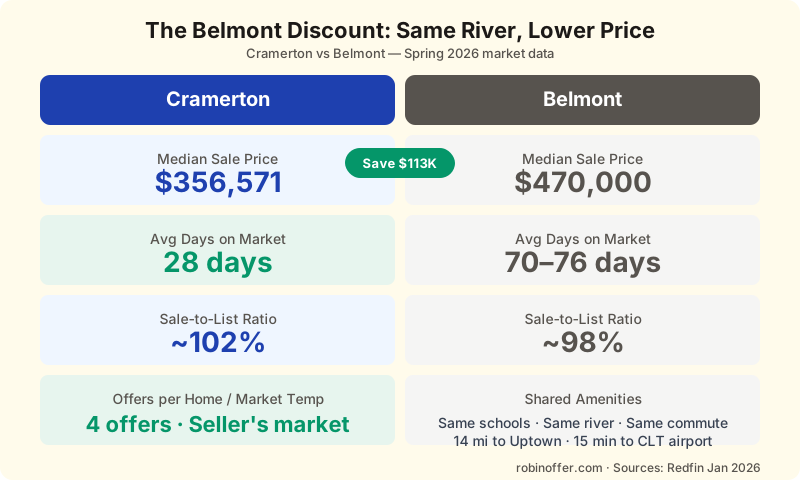
If you are comparing nearby micro-markets, see our Gastonia homeowner selling options guide for a larger-market playbook, the Cramerton homeowner selling guide for a same-river price comparison, the Lowell homeowner selling options guide for commute-centered pricing decisions, or the Mount Holly guide for a similar small-town perspective.
Disclaimer: This guide is for informational purposes only and does not constitute legal, financial, or tax advice. Market data is sourced from Redfin, Zillow, Rocket Homes, Movoto, RentCafe, Zumper, Gaston County public records, and other third-party sources as of February 2026. Always consult with licensed professionals (real estate agents, attorneys, tax advisors) before making real estate decisions. RobinOffer.com is committed to providing transparent, honest information to Belmont homeowners.
For a smaller-town contrast with similar buyer substitution patterns, read Kings Mountain homeowner selling options and compare timeline certainty versus headline net tradeoffs.