
Chapel Hill, NC: Selling in the Shadow of a 237-Year-Old University
A practical Chapel Hill homeowner guide for UNC-driven pricing, campus-gradient positioning, and choosing the right selling path with real Orange County data.
1. The $605K Question: What Your Chapel Hill Home Is Really Worth Right Now
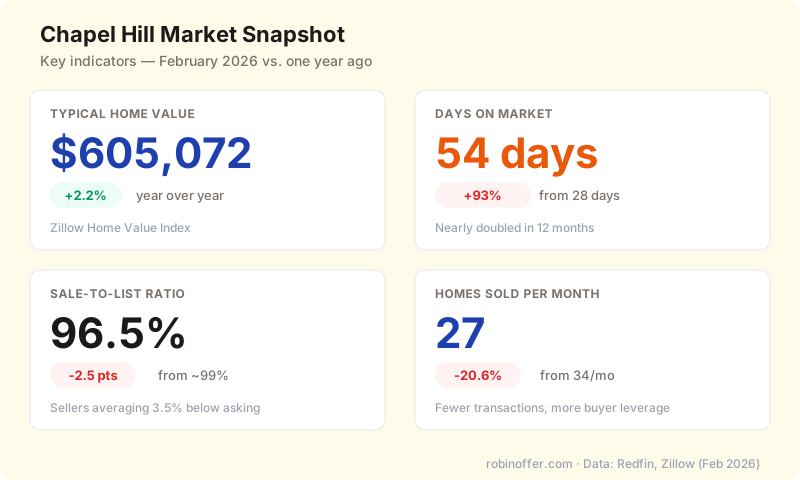
Selling a house in Chapel Hill NC puts you in a market where UNC's 30,000-student campus drives persistent demand, but 54-day listing times and a 96.5% sale-to-list ratio signal real cooling. This guide breaks down your options, true costs, and what you'll actually walk away with in 2026.
The typical Chapel Hill home is worth $605,072. That number is 40% higher than Raleigh and 35% above Durham, two cities with more Fortune 500 headquarters, more apartment towers, and more buildable land. So why does a town of 62,000 people, where the median age is about 25 and the biggest employer is a university, command the highest home prices in the Triangle?
Because you're not just selling a house in Chapel Hill. You're selling proximity to a 237-year-old institution that employs 13,000 people, treats over a million patients a year at UNC Hospitals, and brings in 30,000 students who need somewhere to live. That's not a normal demand driver. It's a gravitational force.
But here's what most Chapel Hill homeowners don't know: the market has shifted. Homes are sitting 54 days on average, nearly double last year's 28. Sale prices are averaging 3.5% below asking. And the number of homes sold per month has dropped from 34 to 27. This isn't 2022 anymore.
This guide is built for you, the Chapel Hill homeowner sitting on a property that's probably appreciated significantly over the past decade and wondering what the smart move is right now. Maybe you bought in Meadowmont when it was still new. Maybe you inherited a place in Dogwood Acres. Maybe you're an empty nester in Governor's Club whose kids went to East Chapel Hill High and never came back. Maybe you own a rental near Franklin Street and you're tired of dealing with tenants.
Whatever your situation, the next 15 sections will give you the numbers, the options, and the math to make a decision you won't second-guess. We'll use Chapel Hill data only, not "Triangle averages" or "national trends." Your house, your tax rate, your neighborhood.
2. A Market That's Shifting, Not Collapsing
Chapel Hill's housing market in early 2026 is doing something it hasn't done in years: giving buyers breathing room. That doesn't mean values are falling off a cliff. The Zillow Home Value Index still shows 2.2% annual appreciation. But the frenzy is over, and the numbers tell a clear story about where we are right now.
Chapel Hill Home Prices
| Indicator | February 2026 | Change from Last Year |
|---|---|---|
| Median Sale Price (Redfin) | $520,000 | -0.48% |
| Typical Home Value (Zillow ZHVI) | $605,072 | +2.2% |
| Median Price per Square Foot | $256 | -10.0% |
| Competitiveness Rating | Somewhat Competitive | Cooling |
How Fast Are Chapel Hill Homes Selling?
| Speed Indicator | Today | One Year Ago |
|---|---|---|
| Average Days on Market | 54 days | 28 days |
| Sale-to-List Price Ratio | 96.48% | ~99% |
| Homes Sold per Month | 27 | 34 |
| Average Offers per Listing | 2 | 3-4 |
Data sourced from Redfin (February 2026) and Zillow Home Value Index (2026).
Two numbers jump out. First, days on market nearly doubled, from 28 to 54. That's a significant shift for Chapel Hill sellers. A year ago, a well-priced home in Southern Village or Lake Hogan Farms might draw three offers in a weekend. Today, you might wait nearly two months for the right buyer.
Second, the price-per-square-foot dropped 10%. That's the number that matters most for appraisals and comparative pricing. If your Chapel Hill home was worth $300 per square foot in early 2025, it's closer to $256 now. On a 2,200-square-foot home, that's a $96,800 difference on paper.
The market hasn't crashed. Chapel Hill values are still above where they were two years ago. But the window where you could list at any price and attract a bidding war has closed. If you want to understand how seasonal timing affects your sale price in the Carolinas, that math matters even more in a cooling market like this one.
3. The UNC Effect: How 30,000 Students and 13,000 Employees Move Your Home Value
No other city in our coverage area (not Gastonia, not Fort Mill, not Rock Hill) has a single institution that shapes the housing market the way UNC Chapel Hill does. The university is the reason this town exists, and it's the reason your home is worth what it is.
UNC Chapel Hill was founded in 1789. It's the oldest public university in the United States, consistently ranked in the top five nationally, and it's not going anywhere. That permanence matters. Companies relocate, military bases close, and manufacturing plants shut down. But a 237-year-old flagship university with a $4.7 billion endowment (FY 2024), a medical school, and a basketball program that fills a 21,750-seat arena? That's the kind of demand anchor that keeps property values stable long-term.
Here's what UNC puts into the Chapel Hill housing market every single year:
- 30,000+ enrolled students, the ones who don't fit in dorms need apartments, rented houses, and shared rooms near Franklin Street
- 13,000+ university employees (faculty, researchers, administrators, and staff), many of whom want to live close to campus
- UNC Health Care / UNC Hospitals, the largest employer in Orange County, with physicians, nurses, and specialists who earn well above the area median
- Visiting scholars and researchers, including post-docs, sabbatical faculty, and conference attendees who create short-term rental demand
- Parents and alumni who buy Chapel Hill homes to be close to their kids, or who return after graduation because they fell in love with the town
This isn't abstract. Walk down Franklin Street on a Saturday in October. The restaurants are full, the shops have lines, and every house within a mile of campus has a "No Parking" sign on the lawn because of football traffic. That energy translates directly into housing demand.
The university's influence also creates something unusual: a two-sided market. On one side, you have long-term homeowners in neighborhoods like Dogwood Acres, The Oaks, and Lake Hogan Farms, families who bought for the schools, the community, and the proximity to campus. On the other side, you have investors holding rental properties near Franklin Street and Rosemary Street, collecting $1,500 per room per month from students who don't want to live in dorms. These two markets operate on completely different logic, and understanding which one your property sits in will determine your best selling strategy.
4. $500 Million in New Construction: What South Creek and Carolina North Mean for Your Equity
Chapel Hill has historically been difficult to build in. Strict development rules, environmental protections, and limited available land have kept housing supply tight, which is part of why prices are so high. But that's changing. Over the next decade, several major projects will add hundreds of new homes to a market that isn't used to absorbing this much inventory.
Chapel Hill Development Pipeline
| Project | Scale | Investment | When |
|---|---|---|---|
| South Creek (Beechwood Carolinas) | 815 homes: 120 apartments, 606 condos, 89 townhomes + commercial/restaurant | $500 million | Groundbreaking complete; ~8-year buildout |
| Carolina North (UNC) | 2,200+ undergraduate beds, graduate housing, STEM research, mixed-use residential, hotel | $8M Phase 1 planning | RFQs spring 2026; groundbreaking summer 2027 |
| Coker Place (Chappell Residential) | 40 townhomes + 67 condominiums | Townhomes $600Ks-$900Ks; Condos $300Ks-$715K | Phase 1 selling now; Phase 2 spring 2026 |
| Hillside Trace | 190 affordable apartments (<60% AMI) | Community Home Trust partnership | Approved May 2025 |
| Tanyard Branch Trace | 48 apartments on Jay Street | Town-initiated | Projected completion 2026 |
| UNC New Dormitories | First new dorms since 2002 | $110 million | Under construction |
South Creek is the one to watch. At $500 million and 815 homes, it's the largest private development in Chapel Hill history. It's going up on 120 acres along South Columbia Street, with condos starting in the $300Ks, townhomes from the $600Ks, and a nature preserve with walking trails on 80 of those acres. About 15% of the condo and townhome units will be below-market-rate, which means Chapel Hill is getting both luxury and accessible inventory at the same time.
Carolina North is the university's play. UNC is turning 230 acres of the former Horace Williams Airport site, 1.6 miles north of the main campus, into a massive learn-live-work campus extension. Phase 1 includes 2,200 undergraduate beds, graduate housing, and STEM research space. If that housing absorbs student demand that currently flows into the private rental market near campus, landlords in neighborhoods like Northside and downtown Chapel Hill could see their tenant pool shrink.
For context, UNC's new dorms alone represent a $110 million investment, at roughly $300,000 per bed, the most expensive dorm construction in the university's history. But they're needed: enrollment growth has outpaced campus housing for over two decades, and that gap has been filled by the private rental market in surrounding neighborhoods.
5. The Campus Gradient: How a Two-Mile Drive Can Mean $400,000
In most Triangle cities, pricing follows a predictable pattern: newer construction on the outskirts is cheaper, older homes closer to downtown are pricier if they're renovated. Chapel Hill follows a different logic. Here, your home's value is largely determined by one variable: how close you are to UNC's campus.
Chapel Hill Pricing by Distance from Campus
| Distance from UNC | Typical Price Range | Example Neighborhoods |
|---|---|---|
| Walking distance (<1 mile) | $500,000–$1,500,000+ | Downtown/Franklin Street, Greenbridge condos, Greenwood, Northside |
| Short drive (1–3 miles) | $500,000–$2,000,000+ | Dogwood Acres, The Oaks, Lake Hogan Farms, Meadowmont |
| Chapel Hill orbit (3–7 miles) | $350,000–$900,000+ | Southern Village, Winmore, Carrboro |
| Extended Chapel Hill (7+ miles) | $386,000–$1,489,000 | Briar Chapel (Chatham County) |
| Luxury/gated (any distance) | $800,000–$4,000,000+ | Governor's Club |
The 1-to-3-mile ring from campus is where Chapel Hill's most expensive established neighborhoods sit. Dogwood Acres, The Oaks, and Lake Hogan Farms benefit from campus proximity without the noise, parking headaches, and student foot traffic of the Franklin Street corridor. A renovated four-bedroom in Dogwood Acres ($735K median) offers a UNC professor a five-minute bike commute. That convenience commands a premium that doesn't exist in Raleigh or Durham suburbs.
Governor's Club breaks the distance rule entirely. It's roughly 8 miles from campus in a gated community with a Jack Nicklaus-designed golf course, and it has the highest prices in Chapel Hill at a $1.13 million median that's up 12% year-over-year (Redfin, trailing 12 months). Luxury buyers aren't paying for campus proximity. They're paying for the Chapel Hill address, the school district, and the lifestyle.
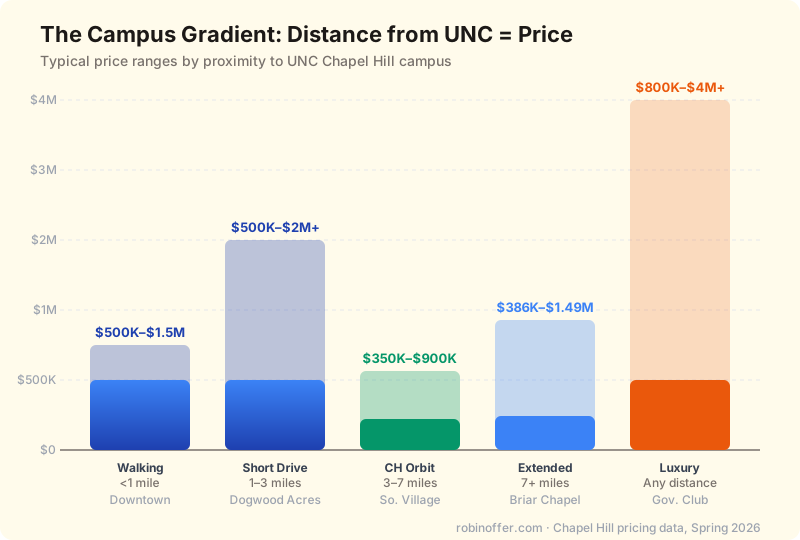
Understanding where your home falls on this gradient matters because it determines who your buyer is. If you're close to campus, you're selling to faculty, hospital employees, and investors. If you're in Briar Chapel, you're selling to families who want Chapel Hill schools without Chapel Hill prices. If you're in Governor's Club, you're selling to executives commuting to Research Triangle Park or retirees who want a golf community with a UNC basketball season-ticket perk.
The gradient also affects how your home appraises. Chapel Hill appraisers pull comparable sales from a tight geographic radius, and the price differences between neighborhoods just two miles apart can create appraisal challenges. A $900K home in Dogwood Acres won't comp against a $500K home in Winmore, even though both carry a Chapel Hill address and the same school district. If you're selling in a premium neighborhood, make sure your agent pulls comps from within that neighborhood specifically, not from "Chapel Hill" broadly.
6. Chapel Hill, Carrboro, or Durham: Where Triangle Buyers Are Putting Their Money
Chapel Hill doesn't exist in a vacuum. Triangle homebuyers are constantly weighing Chapel Hill against Carrboro (right next door) and Durham (12 miles east). Each offers a different value proposition, and understanding the comparison helps you price your Chapel Hill home accurately.
Triangle City Comparison
| Category | Chapel Hill | Carrboro | Durham |
|---|---|---|---|
| Typical Home Value | $605,072 | $550,000–$650,000 | $448,000 |
| Chapel Hill Premium | ~5-10% | ~35% | |
| Property Tax Rate (per $100) | $1.2862 | $1.2652 | $1.3987 |
| School District | CH-Carrboro City Schools (A+) | CH-Carrboro City Schools (A+) | Durham Public Schools (B) |
| Walkable Downtown | Franklin Street | Weaver Street Market area | American Tobacco Campus / Downtown |
| UNC Commute | 0–10 min | 5–15 min | 20–30 min |
| RTP Commute | 20–30 min | 25–35 min | 15–25 min |
| Population | ~62,000 | ~22,000 | ~310,000 |
| Vibe | University town, Southern charm | Progressive, artsy, small-town | Urban renaissance, food scene |
The Carrboro comparison trips up a lot of Chapel Hill sellers. Carrboro is functionally the same market. It shares the Chapel Hill-Carrboro City Schools district, it's a five-minute drive from UNC, and it has its own walkable downtown anchored by Weaver Street Market and Cat's Cradle (the legendary indie music venue). Homes in Carrboro tend to run 5-10% below comparable Chapel Hill properties, mostly because of the address. If you're selling a $600K Chapel Hill home and a similar Carrboro home lists at $540K, your buyer is going to notice.
Durham is a different story. At a $448K typical home value, Durham offers 35% more house for the dollar. That gap has been narrowing. Durham's population has nearly doubled in 20 years and its food, arts, and tech scenes are nationally recognized. But Chapel Hill's school district advantage remains significant. East Chapel Hill High ranks #12 in North Carolina; Chapel Hill High ranks #18. No Durham public high school cracks the top 30. For families with school-age children, that gap justifies the $150K+ premium.
Research Triangle Park sits between all three cities, roughly 15-25 minutes from each. If your buyer works at Cisco, IBM, EPA, or one of the biotech firms in RTP, they're choosing between Chapel Hill's schools and prestige, Carrboro's quirky affordability, and Durham's urban energy. Your job as a Chapel Hill seller is to make sure your listing speaks to whatever advantage your specific location offers.
7. Thirteen Neighborhoods, Thirteen Price Tags
Chapel Hill is not one housing market. A $280K Meadowmont condo and a $4 million Governor's Club estate technically share the same school district and the same town council, but they operate on completely different market dynamics. Here's where prices actually stand, neighborhood by neighborhood.
Luxury Tier: $800K and Above
Governor's Club is Chapel Hill's most prestigious address. A gated community with a Jack Nicklaus-designed golf course, swimming, tennis, and estate homes on large wooded lots. The median sale price hit $1.13 million in the past 12 months, up 12% year-over-year. That increase bucks the broader Chapel Hill cooling trend and suggests luxury buyers are still competing hard for limited inventory here. Average list prices hover around $2 million. If you own in Governor's Club, you're selling to a small pool of high-net-worth buyers (often executives, physicians, or retirees), and pricing strategy matters more than speed.
The Oaks / Chapel Hill Country Club features estate-style homes on spacious lots surrounding the Chapel Hill Country Club. Custom-built, mature oak trees, and a classic affluent-suburban feel with homes ranging from $700K to over $2 million. HOA fees are minimal at $100 per year (country club membership is separate). This is old Chapel Hill money: quiet streets, big yards, and residents who've been here for decades.
Premium Tier: $500K–$1M
Meadowmont is the master-planned community that set the standard for Chapel Hill mixed-use development. Village center with restaurants, shops, a YMCA, and medical offices. Single-family homes from $800K+, townhomes from $600K–$900K, and condos starting in the high $200Ks. The 12-month median of $886,500 is down 9% year-over-year (Redfin), which tells you even premium Chapel Hill neighborhoods aren't immune to the market shift. Proximity to UNC Hospitals and the Friday Center for Continuing Education makes this a magnet for medical professionals.
Southern Village was one of the first New Urbanist communities in the Triangle. The walkable town center with Lumina Theater, local restaurants, and a Saturday farmers market makes this Chapel Hill's most lifestyle-oriented neighborhood. Homes range from $400K to $900K+, with a median around $664K. Located on US 15-501 south of downtown, it's a more accessible entry point than Meadowmont while offering similar walkability and community feel.
Lake Hogan Farms has upscale single-family homes built in the 1990s–2000s with spacious lots, traditional Southern architecture, community pool, tennis courts, and walking trails. Prices range from $600K to over $1.1 million. Popular with families for the school district and the neighborhood events that make this feel like a small town inside Chapel Hill.
Dogwood Acres is one of Chapel Hill's most beloved neighborhoods. Mature trees, walkability to campus, and an eclectic mix of mid-century and renovated homes give it a character that newer developments can't replicate. The median home price sits around $735K, and homes here don't stay listed long because demand from UNC faculty is persistent. This is the kind of neighborhood where people stay for 30 years.
Mid-Range Tier: $300K–$600K
Winmore is an urban village centered around a Village Green where neighbors actually gather (movie nights, food truck events, community block parties). Mix of condos, townhomes, and single-family homes from $370K to $600K+. The tight-knit community feel makes Winmore punch above its weight in Chapel Hill's competitive market.
Downtown Chapel Hill / Franklin Street is the walkable urban core where UNC's campus meets restaurants, shops, and bars. Property types range from historic homes to Greenbridge luxury condos ($300K–$1.5M+). Sellers here compete with student rental demand, which can be a selling point (investor buyers) or a headache (noise, parking). The downtown service district adds $0.055 per $100 in supplemental property taxes, an extra cost that some sellers forget to disclose.
Carrboro (Adjacent) is technically a separate town, but functionally part of the Chapel Hill market. Shares the same school district. Weaver Street Market, Cat's Cradle, and a strong local food scene give it a distinct identity: progressive, artsy, bike-friendly. Homes range from $350K to $800K+, and buyers who are priced out of Chapel Hill proper often land here. If you're a Chapel Hill seller, Carrboro is your closest competitor for budget-conscious buyers.
Briar Chapel is a 900-acre master-planned community in northern Chatham County, about 10 miles from downtown Chapel Hill. With 2,500+ homes planned and 1,300+ built, it's massive: 24 miles of trails, multiple pools, community gardens, and a dog park. Average sale price around $600K, with townhomes starting at $386K and estate lots reaching $1.49M. HOA fees run $150 per month ($85 more for townhomes). The Chapel Hill address and school-adjacent positioning make it attractive to families, but the Chatham County location means different tax rates.
Historic and Emerging
Northside is historically the largest African American community in Chapel Hill, centrally located near UNC's campus. Northside has faced significant gentrification pressure. The Jackson Center and Community Empowerment Fund actively work to preserve the neighborhood's character and help long-time residents stay. Homes range from $250K to $600K+. If you're selling in Northside, your buyer pool includes both investors eyeing student rental conversions and community-minded buyers who value the neighborhood's cultural significance.
Greenwood was developed in the 1930s as a community for artists and intellectuals, Greenwood has evolved from affordable and bohemian to increasingly expensive. Original homes in the $300Ks sit alongside new construction above $1.8 million. The wide price range makes Greenwood one of Chapel Hill's most eclectic neighborhoods, and one of the most interesting for sellers, because your marketing strategy depends entirely on which end of that range you fall on.
Coker Place (New Construction) includes 107 new homes by Chappell Residential: 40 townhomes from the high-$600Ks to $900Ks and 67 condominiums from the low-$300Ks to $715K. Phase 1 is selling now; Phase 2 condos launch spring 2026. If you're selling a townhome or condo in Chapel Hill right now, Coker Place is your direct competition: new finishes, new appliances, builder warranties.
8. Selling a House in Chapel Hill NC: Three Paths, Three Different Checks
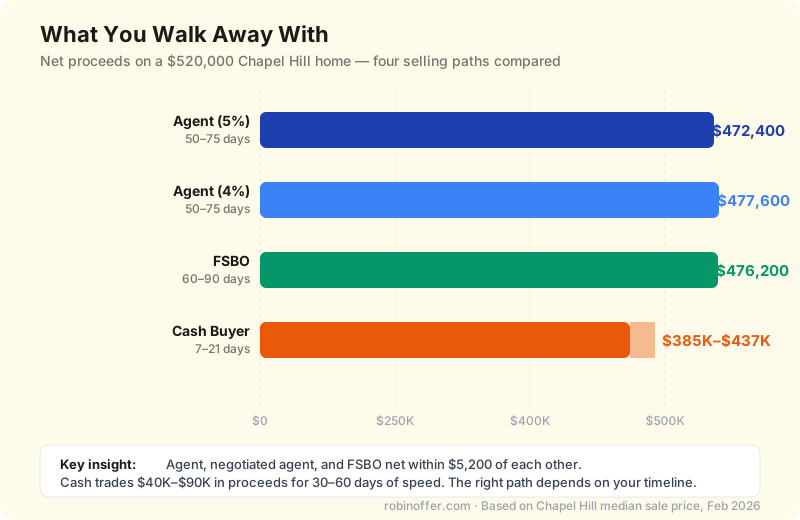
If you're selling a house in Chapel Hill NC, you have the same three options as everywhere else. What changes is the math, and in Chapel Hill, the math looks different than it does in most North Carolina cities because of the price point, the tax burden, and the buyer pool.
What You'll Walk Away With: $520K Chapel Hill Home
| Selling Path | Likely Sale Price | Total Costs & Commissions | Your Net Proceeds | Days to Close |
|---|---|---|---|---|
| List with Agent (full service) | $520,000 | ~$47,600 (5% commission + closing) | ~$472,400 | 50–75 days |
| List with Agent (negotiated 4%) | $520,000 | ~$42,400 | ~$477,600 | 50–75 days |
| FSBO (For Sale By Owner) | $494,000 (estimated 5% lower) | ~$17,800 (2.5% buyer agent + closing) | ~$476,200 | 60–90 days |
| Cash Buyer / iBuyer | $390,000–$442,000 (75-85% FMV) | $0–$5,000 | $385,000–$437,000 | 7–21 days |
Estimates based on Chapel Hill median sale price of $520K, February 2026. Agent-path costs include estimated repair concessions and buyer credits, common in Chapel Hill's cooling market. Actual results depend on condition, location, and market timing.
8a. Sell with an Agent
At Chapel Hill's price point, agent commission is real money. On a $520,000 sale at 5%, that's $26,000 in commission before you pay for closing costs, transfer taxes, or your remaining mortgage. Some Chapel Hill sellers are negotiating that down to 4% (saving $5,200), especially if their home is in a desirable neighborhood where the agent's marketing effort is minimal.
The Chapel Hill agent market is shaped by the university. Many top-performing agents specialize in specific neighborhoods or buyer types. One agent dominates Meadowmont listings, another works primarily with UNC faculty relocations, another handles Governor's Club luxury sales. The right agent for a $350K Carrboro ranch is not the right agent for a $1.5M Oaks estate. Ask any prospective agent how many homes they've sold in your specific neighborhood in the past 12 months. If the answer is zero, keep looking.
In a 54-day-average market, your listing agent's pricing strategy is critical. Overpricing by even 5% in Chapel Hill can mean sitting through two or three price reductions while your listing goes stale. A home that sits on the market for 90+ days in Chapel Hill gets labeled as "something must be wrong with it," especially among the university buyer community, which is small, well-informed, and talks.
8b. Sell It Yourself (FSBO)
FSBO saves you the listing agent's commission (typically 2.5-3%) but comes with tradeoffs. FSBO homes in Chapel Hill tend to sell for about 5% less than agent-listed properties, which on a $520,000 home offsets most of your commission savings. You'll still likely offer a 2.5% buyer's agent commission, putting your total cost at around $13,000 in commission plus $4,800 in other closing costs.
Chapel Hill's FSBO market has one advantage most markets don't: a dense network of educated, motivated buyers. UNC faculty and hospital staff relocating to Chapel Hill often search aggressively on their own before engaging an agent. If you're in a neighborhood that UNC employees target (Dogwood Acres, Meadowmont, Southern Village), a well-photographed FSBO listing on Zillow and the Triangle MLS can reach your buyer without paying a listing agent.
The risk is legal complexity. North Carolina requires specific disclosures, and Orange County real estate closings involve an attorney (not a title company). Without an agent guiding the transaction, you'll need to be comfortable managing inspections, appraisals, contract negotiations, and the disclosure requirements yourself. A Chapel Hill real estate attorney will charge $800-$1,500 for closing services.
8c. Sell to a Cash Buyer
Cash buyers offer speed and certainty at the cost of sale price. In Chapel Hill, expect offers between 75-85% of fair market value, or $390,000 to $442,000 on a $520K home. We wrote a separate guide to cash offers in North Carolina and South Carolina that breaks down how these offers work, who the buyers actually are, and what contract clauses to watch for.
Several cash buying companies actively operate in Chapel Hill:
| Company | Coverage | What to Expect |
|---|---|---|
| Turner Home Team | Chapel Hill and surrounding areas | Local buyer, licensed realtor, 65+ homes in past 3 years |
| Green Street Home Buyers | Chapel Hill and NC statewide | One of the largest NC home buyers, hundreds purchased |
| Mission Home Buyers | Chapel Hill, NC | BBB A-rated, as-is purchases |
| Carolinas Homebuyers | NC and SC statewide | Not agents, property buyers, as-is |
| 919 Home Buyers | Triangle area (Chapel Hill, Durham, Raleigh) | Local Triangle cash buyer |
| We Buy Houses | National franchise, Chapel Hill chapter | National brand with local operators |
A cash sale makes sense when speed matters more than price: foreclosure deadlines, divorce settlements, inherited properties that need to be liquidated, or homes that need extensive repairs that you can't afford. It makes less sense when you have time and a move-in-ready home in a desirable neighborhood. A $520K Chapel Hill home in good condition listed with an agent will almost certainly net you $35,000-$85,000 more than the best cash offer.
See what your Chapel Hill home is worth
Get a real, data-driven value estimate for your address using recent Orange County comparable sales.
9. The College Town Landlord Play: When $1,500-per-Room Rent Changes Everything
Most sellers' guides treat renting as the consolation prize, what you do when you can't sell. In Chapel Hill, renting is sometimes the smarter financial move. The numbers might surprise you.
Chapel Hill Rental Income by Property Type
| Configuration | Monthly Rent (Chapel Hill) | Annual Gross |
|---|---|---|
| Studio apartment | $1,479 | $17,748 |
| 1-bedroom apartment | $1,455–$1,633 | $17,460–$19,596 |
| 2-bedroom apartment | $1,730–$2,065 | $20,760–$24,780 |
| 3-bedroom house | $2,550 | $30,600 |
| 4-bedroom near campus (by room) | $6,000 ($1,500/room × 4) | $72,000 |
Sources: RentCafe (2026), Apartment List, Daily Tar Heel, Axios Raleigh. The per-room rate near Franklin Street reflects single-occupancy off-campus apartments billing ~$1,500/month per room.
Look at that last row. A four-bedroom house near Franklin Street or Rosemary Street, rented by the room to students at $1,500 each, generates $72,000 in annual gross revenue. Even after property taxes ($6,700), insurance ($2,400), maintenance ($5,000), and a 5% vacancy factor ($3,600), you're looking at roughly $54,300 in net operating income. On a home worth $600,000, that's a 9% cap rate, well above the 5-6% most Triangle investors target.
Not every Chapel Hill home works as a rental. The student rental premium only applies within about a mile of campus. A three-bedroom in Briar Chapel renting for $2,550 per month on a $600K home produces a much leaner return, around 3.5% after expenses, which barely beats a savings account. And the management headaches of student renters (lease turnover every August, wear and tear, noise complaints) are real costs that don't show up on a spreadsheet.
If you're considering the landlord route, Chapel Hill also has strong property management companies that specialize in student rentals. They handle tenant screening, maintenance calls, and the August turnover cycle for 8-10% of monthly rent. On a $2,550/month three-bedroom, that's about $2,550 per year in management fees, and worth it if you don't live nearby or don't want 11pm phone calls about a broken water heater.
One operational detail that catches first-time Chapel Hill landlords off guard: the August turnover. UNC's academic calendar means that most student leases run August to July. Every August, a wave of tenants moves out and a new wave moves in. You'll need to budget for turnover costs: cleaning ($300-$500), minor repairs ($200-$800), and potentially a week of vacancy. Experienced Chapel Hill landlords start marketing their August vacancies by February, when incoming graduate students and faculty begin their housing search. Wait until June and you're competing against every other landlord in town for the same shrinking pool of renters.
10. What Chapel Hill Sellers Must Put in Writing
Whether you list with an agent, sell to a cash buyer, or keep the property as a rental and sell later, whenever you do sell, North Carolina requires every residential seller to complete the NC Residential Property Disclosure Statement, a multi-page form covering structural condition, water damage, environmental hazards, plumbing, electrical systems, and more. You're not required to hire an inspector, but you are required to disclose any material facts you know about the property's condition. Lying by omission can result in a lawsuit after closing.
Chapel Hill has a few disclosure quirks that other NC cities don't:
- Downtown Service District tax: Properties in the downtown Chapel Hill service district pay an extra $0.055 per $100 in property taxes. If your home is in this district, disclose it. Buyers who budget for the standard $1.2862 rate will be unpleasantly surprised by the $1.3412 rate at closing.
- HOA fees in master-planned communities: Meadowmont, Briar Chapel, Southern Village, Lake Hogan Farms, and Winmore all have HOA fees that range from $100/year to $150/month. North Carolina law requires disclosure of HOA fees, rules, and any pending special assessments.
- Lead paint: Many Chapel Hill homes predate 1978, especially in established neighborhoods like Dogwood Acres, Greenwood, and Northside. Federal law requires lead paint disclosure on pre-1978 homes regardless of whether you've tested for it.
- Flood zones and stormwater: Chapel Hill has strict stormwater management ordinances. Some properties near Morgan Creek, Bolin Creek, and other waterways may be in FEMA flood zones. Check your property's flood designation before listing. A buyer's lender will.
- Radon: Orange County has moderate radon potential. While NC law doesn't require radon testing before sale, many Chapel Hill buyers request it, and having a test result available speeds up negotiations.
One more Chapel Hill-specific consideration: Orange County conducted its most recent property revaluation in 2025, which reset assessed values to current market levels. If your tax value jumped significantly (say, from $450K to $605K), your buyer will see that new assessed value and mentally calculate their future tax burden before they make an offer. A $605K assessed value at the $1.2862 rate means $7,782 per year in property taxes. At $649 per month, that's a material addition to a mortgage payment. Be prepared for buyers, especially first-time buyers comparing Chapel Hill to Durham or Carrboro, to use your tax burden as a negotiating lever.
The practical advice: fill out the disclosure form honestly and thoroughly. When in doubt, disclose more rather than less. A buyer who discovers an undisclosed issue after closing has legal standing in North Carolina to pursue damages. An honest disclosure, even of an imperfection, protects you.
11. Closing Costs, Transfer Taxes, and the Check You'll Actually Deposit
Chapel Hill closings are handled by an attorney, not a title company, and that's standard in North Carolina. But Chapel Hill's higher price point means higher total closing costs in absolute dollars. Here's what a typical seller pays on the median-priced $520,000 Chapel Hill home.
Seller's Net Sheet: $520,000 Chapel Hill Sale
| Expense | Seller Pays | Detail |
|---|---|---|
| Agent commission (5%) | $26,000 | Negotiable; some Chapel Hill agents work at 4% |
| NC excise tax (revenue stamps) | $1,040 | $1 per $500 of sale price; paid by seller in NC |
| Attorney/closing fees | $800–$1,500 | Buyer typically hires the closing attorney in NC, but seller may have separate counsel |
| Title insurance (owner's policy) | $0–$1,200 | Buyer usually pays in NC; seller may pay lender's policy payoff |
| Home warranty (if offered) | $400–$600 | Optional; common in Chapel Hill as buyer incentive |
| Prorated property taxes | $2,800–$3,900 | Based on $1.2862 rate; depends on closing date |
| HOA transfer fees | $0–$500 | Applies in Meadowmont, Southern Village, Briar Chapel, etc. |
| Repair credits / concessions | $0–$10,000+ | Negotiated based on inspection; more common in a cooling market |
| Mortgage payoff | Varies | Your remaining loan balance plus per-diem interest |
On a $520,000 sale with a 5% commission, the typical Chapel Hill seller pays approximately $31,000–$48,000 in total selling costs before their mortgage payoff, with the high end reflecting repair concessions and buyer credits that are increasingly common in a cooling market. That leaves roughly $476,000–$489,000 in gross proceeds. Subtract your remaining mortgage balance, and what's left is your check.
The NC excise tax (sometimes called "revenue stamps") costs $1 per $500 of sale price, always paid by the seller. On a $520K sale, that's $1,040. Unlike some states, North Carolina does not have a separate county transfer tax on top of the state excise tax. That's one cost where Chapel Hill sellers catch a break compared to states like Connecticut or New York.
What If You've Owned for 20 Years?
Chapel Hill has some of the longest average ownership tenures in the Triangle. If you bought a home in Dogwood Acres for $275,000 in 2005 and it's now worth $735,000, you've gained roughly $460,000 in equity. After selling costs of approximately $55,000 (assuming a paid-off mortgage), you'd walk away with about $680,000. And if you've lived in the home for at least two of the past five years, the first $250,000 of that gain ($500,000 for married couples filing jointly) is tax-free under the federal capital gains exclusion.
12. When Life Forces a Sale: Inheritance, Divorce, and Financial Pressure in Orange County
Not every Chapel Hill sale starts with "we've been thinking about downsizing." Some start with a phone call you weren't expecting. Here's what each situation looks like with Chapel Hill-specific numbers.
Inherited a Chapel Hill Home
Orange County probate is handled through the Clerk of Superior Court in Hillsborough (919-644-4500). North Carolina's intestate succession laws determine who inherits if there's no will, and with Chapel Hill's high property values, the stakes are significant. A $735K inherited home in Dogwood Acres creates different tax and family dynamics than a $250K inherited home in most NC cities.
The stepped-up basis is your biggest tax advantage. If your parents bought their Chapel Hill home for $180,000 in 1998 and it's worth $700,000 at the time of their passing, your cost basis becomes $700,000, not $180,000. If you sell for $710,000, you only owe capital gains taxes on $10,000, not $530,000. For the complete walkthrough of NC probate timelines, costs, and inheritance taxes, see our guide to selling inherited property in North Carolina.
One Chapel Hill-specific challenge: out-of-state heirs. UNC attracts students from all 50 states, many of whom never return to Chapel Hill after graduation. When their parents pass, these heirs inherit a Chapel Hill home they can't easily manage from California or New York. Carrying costs on a vacant $605K Chapel Hill home (property taxes, insurance, maintenance) run roughly $1,200 per month. That clock starts ticking the day you inherit, and every month you delay selling is money out of the estate.
Selling During Divorce
North Carolina is an equitable distribution state, meaning marital property is divided "equitably," which doesn't always mean 50/50. A Chapel Hill home worth $605,000 with $200,000 remaining on the mortgage represents $405,000 in equity to divide. The court considers factors including each spouse's financial contribution, earning capacity, and custody arrangements.
In practice, most divorcing Chapel Hill couples take one of three paths: sell the home and split proceeds, one spouse buys out the other's equity share, or the custodial parent remains in the home until the youngest child finishes school (common in Chapel Hill because of the school district's value). A buyout on $405,000 in equity means one spouse needs to come up with roughly $202,500, whether through refinancing, other assets, or a combination. At Chapel Hill's price point, that's a significant number that many people can't swing.
The school district angle makes Chapel Hill divorces more complicated than most. East Chapel Hill High is ranked #12 in North Carolina, and parents who fought to buy into the district aren't eager to leave. Courts in Orange County frequently order that the family home remain occupied by the custodial parent until the youngest child graduates. That can mean five, ten, or fifteen years of one spouse carrying a home they can't sell. If you're in this situation, your attorney should consider a buyout with a deferred sale date, where the departing spouse retains their equity share and receives it when the home eventually sells. This protects both parties' financial interests while keeping the kids in their school. For the full walkthrough of NC equitable distribution law and how it affects your home sale, see our guide to selling during divorce in the Carolinas.
Behind on Your Chapel Hill Mortgage
Chapel Hill's foreclosure rate is lower than the state average, consistent with its high-income demographic. But 62 pre-foreclosure listings across Chapel Hill zip codes suggest that some homeowners are under real financial pressure. The combination of high property taxes ($6,700+ per year) and a cooling market can squeeze homeowners who bought at the peak or whose income has changed.
In North Carolina, foreclosure is non-judicial and moves faster than many homeowners expect. For the day-by-day breakdown of how the NC foreclosure timeline actually works, including hearing procedures and upset-bid rules, read our NC foreclosure timeline guide. For a broader look at all your options, from reinstatement to deed-in-lieu, our NC foreclosure help guide covers the nine paths available to North Carolina homeowners.
If you're behind on payments, here are your Chapel Hill-specific resources:
- Legal Aid of NC, Central Carolina Office (Carrboro): 205 W. Main Street, Suite 203, Carrboro. Helpline: 1-866-219-5262. Free legal services for income-qualifying residents covering housing, foreclosure, and consumer protection. Walk-in hours Mon-Fri 8:30am-4:30pm, evening hours Mon and Thu 5:30pm-8:30pm.
- NC Housing Finance Agency: 1-888-442-8188. Free housing counseling regardless of foreclosure stage. Counselors negotiate with servicers on your behalf.
- UNC School of Law, Legal Clinics: Free legal assistance through law student clinics supervised by faculty. A resource unique to Chapel Hill that isn't available in most NC cities.
- HUD National Housing Counseling Hotline: 800-569-4287. Free connection to HUD-approved counselors.
13. Property Taxes at $1.29 per $100: What You're Paying and Where the Money Goes
Chapel Hill property taxes are among the highest in the Triangle, and they're something every buyer will ask about. Understanding the breakdown helps you anticipate buyer objections and explain the value they're getting, especially the school district.
Chapel Hill Property Tax Rate Breakdown (FY2025-2026)
| Tax Layer | Rate per $100 Assessed Value | Annual on $520K Home |
|---|---|---|
| Orange County | $0.6383 | $3,319 |
| Chapel Hill-Carrboro City Schools | $0.1479 | $769 |
| Town of Chapel Hill | $0.5000 | $2,600 |
| Total (standard, Rate Code 22) | $1.2862 | $6,688 |
| Downtown Service District supplement | $0.0550 | $286 |
| Total (downtown, Rate Code 32) | $1.3412 | $6,974 |
Source: Orange County Tax Administration, FY2025-2026. Assessed value equals fair market value in NC with no assessment ratio discount.
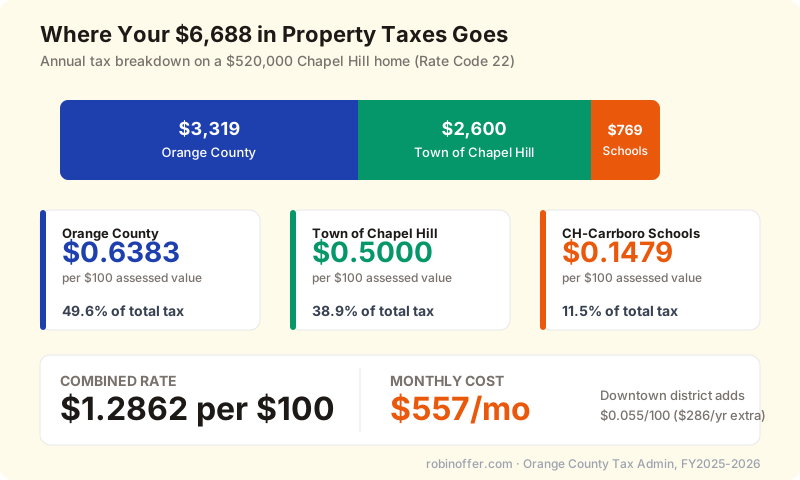
On the typical $605K Chapel Hill home, annual property taxes run approximately $7,782, or $649 per month. That's roughly $200 per month more than a comparable tax burden in Durham, even though Durham's tax rate is technically higher ($1.3987 per $100), because Durham applies property taxes to a lower typical home value.
The school district supplement ($0.1479) is unique to Chapel Hill and Carrboro. It's one of only a handful of special school tax districts in North Carolina, and it funds the Chapel Hill-Carrboro City Schools system that earns an A+ rating from Niche, sends 93% of students to graduation, and places two high schools in the state's top 20. That $769 per year is essentially tuition for a public school system that performs at private school levels. When buyers balk at Chapel Hill's property taxes, that's the counter-argument.
Chapel Hill Government Resources
| Office | Phone / Email | Address or Website |
|---|---|---|
| Chapel Hill Town Hall | 919-968-2743 | 405 MLK Jr. Blvd, Chapel Hill, NC 27514 / townofchapelhill.org |
| Planning Department | 919-968-2728 / planning@townofchapelhill.org | townofchapelhill.org/planning |
| Orange County Tax Administration | 919-245-2100 / tax@orangecountync.gov | 228 S. Churton St, Hillsborough / orangecountync.gov/728/Tax-Administration |
| Orange County Register of Deeds | 919-245-2676 | 228 S. Churton St, Suite 300, Hillsborough / orangecountync.gov/3010/Register-of-Deeds |
| Orange County Clerk of Court | 919-644-4500 | Orange County Courthouse, Hillsborough / nccourts.gov/locations/orange-county |
| Property Records Search | web.co.orange.nc.us/publicwebaccess/ |
Note that most Orange County government offices are located in Hillsborough, the county seat, about 12 miles north of Chapel Hill. If you need to record a deed, pull tax records, or file probate paperwork in person, plan for the drive to Hillsborough.
If your Chapel Hill property taxes are past due, Orange County charges a 2% penalty the day after the deadline and accrues 0.75% monthly interest after that. Our guide to catching up on delinquent property taxes in the Carolinas walks through your options, including payment plans, partial payments, and how to prevent a tax lien sale.
14. Selling a House in Chapel Hill NC: From "I'm Thinking About It" to "Sold"
Selling a house in Chapel Hill NC in 2026 takes longer than it did in 2024. Here's a realistic timeline for each path, based on current market speed.
Chapel Hill Selling Timeline by Path
| Step | Agent Sale | Cash Sale |
|---|---|---|
| Prep and pricing | 1–3 weeks | Not required |
| Photography, staging, listing | 1 week | Not required |
| On market / offer period | 40–60 days (avg 54) | 24–72 hours for offer |
| Under contract / due diligence | 21–30 days | 7–14 days |
| Closing | 2–3 days (attorney handles) | 1–2 days |
| Total: decision to deposit | 10–15 weeks | 2–4 weeks |
Two notes on Chapel Hill-specific timing. First, the academic calendar matters. August and January, when new UNC faculty, hospital staff, and graduate students arrive, create buyer surges. Listing in June or July to catch August arrivals is one of the best seasonal strategies for Chapel Hill sellers. For a month-by-month breakdown of when to list in the Carolinas, see our guide to the best time to sell in NC and SC.
Second, Orange County closings can take slightly longer than Mecklenburg or York County closings because the Register of Deeds office in Hillsborough operates on limited hours and recording can take 2-3 business days. Build that into your timeline if you have a hard deadline, like a job start date or a purchase contingency on your next home.
What to Do This Week If You're Thinking About Selling
- Look up your home's tax value. Visit Orange County's property search portal at web.co.orange.nc.us/publicwebaccess/ and compare it to recent sales in your neighborhood. If your tax value is more than 10% below recent comps, you may have a revaluation surprise coming that affects your buyer's tax expectations.
- Check your mortgage payoff. Call your lender and request a payoff statement. You need this number to calculate your actual net proceeds.
- Walk your house like a buyer. Stand at the front door. What do you see? The tree that needs trimming? The mailbox that's been crooked for three years? First impressions drive offers, and in a 54-day market, you can't afford to give buyers a reason to scroll past your listing.
15. What Happens Next
You've read the data. You know what Chapel Hill homes are selling for, what the closing costs look like, and what your options are. Now the question is: which path is right for your specific situation?
That depends on details this guide can't cover: your mortgage balance, your home's condition, your timeline, and what you're planning to do next. A Chapel Hill homeowner sitting on $400K in equity in Meadowmont has different priorities than someone inheriting a $300K condo near campus.
If you want to see the numbers for your actual house, we'll run them for free: a clear net proceeds estimate based on your address, your condition, and your timeline. Whether you're leaning toward listing with an agent, testing the cash offer market, or running the rental math first, the evaluation covers all three paths side by side.
Start by requesting a free Chapel Hill home evaluation. We'll send you a report with your estimated market value, comparable recent sales in your neighborhood, and a side-by-side comparison of what you'd net through each selling path. It takes about two minutes, and it gives you the one thing this guide can't: numbers specific to your house.
This guide was written by CC Evans and the RobinOffer team using data sourced from Redfin, Zillow, Orange County Tax Administration, the Town of Chapel Hill, UNC Chapel Hill, RentCafe, and public records as of March 2026. Market conditions change. Verify critical numbers with a local professional before making financial decisions. Nothing in this guide constitutes legal, tax, or financial advice.
Want a cash offer on your Chapel Hill home?
Tell us your timeline and property condition and we will get you a no-obligation cash offer.