
Capital Gains Tax When Selling a Home in NC
Federal exclusion rules, NC's 3.99% state rate, six Charlotte metro scenarios from $0 to $34,000+, and seven legal strategies to minimize your bill.
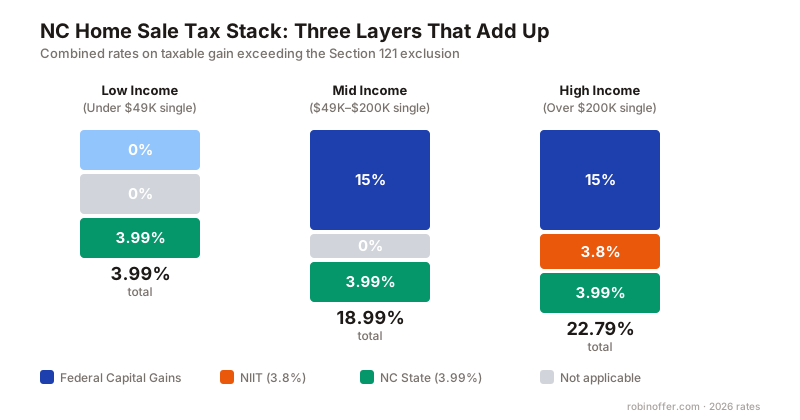
Capital gains tax when selling a home in North Carolina combines federal rates (0–20%) with NC's flat 3.99% state rate. Most sellers who owned and lived in the home for two-plus years owe nothing, the $250,000 single / $500,000 married exclusion covers it.
That said, "most homeowners owe nothing" isn't much comfort if you're one of the ones who does. Charlotte metro home prices have roughly doubled since 2016. A house you bought for $215,000 in Gastonia might be worth $400,000 today. If you're single, that's $185,000 in gain, safely under the $250,000 exclusion. But if you inherited that house, or rented it out for a few years, or got divorced and your ex kept the equity, the math changes fast. This guide runs through every scenario so you know your number before you call an agent.
1. The NC Capital Gains Tax Question Every Seller Asks
"Will I owe taxes when I sell my house?" We hear this from almost every homeowner who contacts us, and the anxiety is usually worse than the reality. Here's the direct answer:
If you owned your home and lived in it as your primary residence for at least two of the last five years, you can exclude up to $250,000 of gain (single) or $500,000 (married filing jointly) from both federal and NC state tax. That's the Section 121 exclusion, and it's the single most generous tax break homeowners get.
For most Charlotte metro sellers, that exclusion covers the entire gain. A married couple who bought a $300,000 home in Fort Mill in 2019 and sells for $475,000 today has a $175,000 gain, well within their $500,000 exclusion. Zero tax. Federal or state.
But NC adds a layer that national guides tend to skip: the state taxes capital gains at a flat 3.99% rate (2026). There's no preferential state rate for long-term gains like there is federally. So when your gain does exceed the exclusion, you're paying federal plus state, and potentially a 3.8% federal surtax on top of that. Section 5 runs the math on six real Charlotte metro scenarios.
2. The Federal Exclusion That Protects Most Sellers
The Section 121 exclusion is the most important tax rule in residential real estate. Congress created it in 1997 to replace the old once-in-a-lifetime exclusion and the rollover rules. Here's exactly how it works.
The Two Tests You Must Pass
| Test | Requirement | Details |
|---|---|---|
| Ownership test | Own the home for 2+ years | Must own for at least 24 months during the 5-year period ending on the sale date. The 24 months do not need to be consecutive. |
| Use test | Live in it as primary residence for 2+ years | Must use as your main home for at least 24 months during the same 5-year period. Temporary absences (vacation, short work trips) count as use. |
| Frequency limit | Haven't claimed exclusion in last 2 years | You can use this exclusion only once every two years. If you excluded gain on a previous home sale within 24 months, you can't claim it again. |
Both tests run on the same five-year window, but the periods don't need to overlap. You could own the home for years 1–3, rent it out for years 3–4, then move back in for years 4–5, and still qualify, because you owned for 5 years and lived in it for 3 years within the window.
Exclusion Amounts
| Filing Status | Maximum Exclusion | When It Zeroes Out Your Tax |
|---|---|---|
| Single / Head of Household | $250,000 | Gain under $250K = $0 tax |
| Married Filing Jointly | $500,000 | Gain under $500K = $0 tax |
| Married Filing Separately | $250,000 each | Each spouse can exclude up to $250K on their share |
For the $500,000 married exclusion, both spouses must meet the use test (lived there 2+ years) and at least one must meet the ownership test. If only one spouse meets both tests, the maximum is $250,000, not $500,000.
One detail most articles miss: these amounts haven't been adjusted for inflation since 1997. The $250,000/$500,000 thresholds are the same ones Congress set nearly 30 years ago. With Charlotte metro prices roughly doubling since 2016, more sellers are bumping into the single-filer cap than at any point since the law was written.
The Partial Exclusion (Under 2 Years)
Sold your home before hitting the two-year mark? You may still qualify for a partial exclusion if the sale was due to:
- Job relocation, your new primary workplace is at least 50 miles farther from the home than your old workplace was
- Health reasons, a doctor recommended the move for medical care, or a change in physical/mental condition made it difficult to maintain the home
- Unforeseen circumstances, death, divorce, job loss, multiple births from a single pregnancy, natural disaster
The formula: (months you qualified ÷ 24) × maximum exclusion. A single filer who lived in the home for 15 months before a PCS military transfer gets $250,000 × (15/24) = $156,250 partial exclusion. That's still enough to cover most short-term gains in the Charlotte market. For military families relocating through the Carolinas, our PCS relocation guide covers the full moving timeline.
3. NC's 3.99% Layer: How State Tax Stacks on Top
Here's what national capital gains guides won't tell you: North Carolina adds its own tax on top of whatever you owe the IRS.
| Tax Layer | Rate | Applies To |
|---|---|---|
| Federal long-term capital gains | 0%, 15%, or 20% | Gain exceeding Section 121 exclusion (if held 1+ year) |
| Federal short-term capital gains | 10–37% (ordinary income) | Gain on home held under 1 year |
| Net Investment Income Tax (NIIT) | 3.8% | Investment income when MAGI exceeds $200K (single) / $250K (married) |
| NC state income tax | 3.99% flat | All taxable capital gains, no preferential rate |
NC uses a flat tax, everyone from minimum-wage workers to millionaires pays the same 3.99% rate (2026). Capital gains are treated identically to wages. There's no state-level equivalent of the federal 0% bracket for lower-income sellers. If you have taxable gain after the Section 121 exclusion, NC takes 3.99% of it, period.
The NC Tax Trajectory
NC has been cutting its income tax rate for years under legislation passed in 2021 (HB 334):
| Tax Year | NC Rate | Note |
|---|---|---|
| 2024 | 4.50% | |
| 2025 | 4.25% | |
| 2026 | 3.99% | Current year |
| 2027+ | 3.49% | Scheduled reduction |
If you're selling in late 2026 and your gain is going to be taxable, note that waiting until January 2027 could save you 0.50 percentage points in NC tax, that's $500 on every $100,000 of taxable gain. Not life-changing, but worth considering if your timeline is flexible.
NC Conforms to Federal Section 121
Good news: NC starts its income tax calculation from federal adjusted gross income. That means the Section 121 exclusion automatically flows through to your NC return. If the IRS says your first $250,000 (or $500,000) of gain is excluded, NC excludes it too. You don't need to claim a separate state exclusion, it's built in.
4. Your Adjusted Basis: The Number That Shrinks Your Tax Bill
Your taxable gain isn't simply "sale price minus what you paid." It's sale price minus your adjusted basis minus your selling expenses. The higher your adjusted basis, the lower your taxable gain. And most homeowners leave money on the table because they don't track improvements.
Building Your Adjusted Basis
| Category | Examples | Adds to Basis? |
|---|---|---|
| Original purchase price | What you paid for the home | Yes |
| Qualifying closing costs (at purchase) | Title insurance, attorney fees, recording fees, transfer taxes, survey costs | Yes |
| Capital improvements | New roof, HVAC, kitchen remodel, bathroom addition, new windows, driveway, deck, finished basement | Yes |
| Assessment-funded improvements | Sidewalks, sewer connections paid through special assessments | Yes |
| Repairs & maintenance | Painting, fixing leaks, patching drywall, replacing a broken window | No (unless part of a larger remodel project) |
| Homeowner's insurance | Annual premiums | No |
| Property taxes | Annual tax payments | No |
The Improvement Tracker Every NC Homeowner Needs
Say you bought a home in Belmont for $280,000 in 2017. Over 9 years, you put in a new HVAC ($8,500), replaced the roof ($12,000), remodeled the kitchen ($22,000), and added a screened porch ($15,000). Your qualifying purchase closing costs were $4,200. Here's how basis stacks up:
| Item | Amount | Running Adjusted Basis |
|---|---|---|
| Purchase price | $280,000 | $280,000 |
| Closing costs at purchase | $4,200 | $284,200 |
| HVAC replacement (2019) | $8,500 | $292,700 |
| Roof replacement (2020) | $12,000 | $304,700 |
| Kitchen remodel (2022) | $22,000 | $326,700 |
| Screened porch (2024) | $15,000 | $341,700 |
| Total adjusted basis | $341,700 |
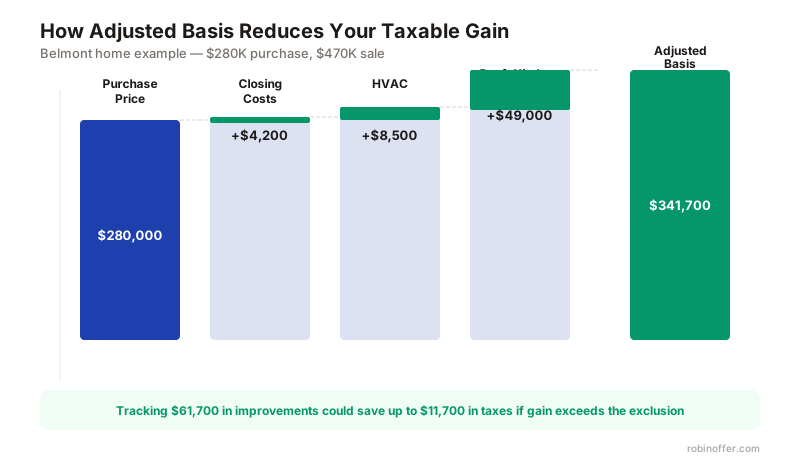
If that Belmont home sells for $470,000, the gain is $470,000 − $341,700 = $128,300. Without tracking improvements, the gain would be $470,000 − $280,000 = $190,000, a $61,700 difference. At 15% federal + 3.99% NC, that's nearly $11,700 in unnecessary tax if the gain exceeded the exclusion.
For most primary residence sellers, the exclusion covers the whole gain anyway. But if you're close to the limit, improvements are the difference between zero tax and a five-figure bill.
Selling Expenses That Reduce Your Gain
These aren't added to basis, they're subtracted from the sale price to calculate your gain:
- Real estate agent commissions (typically 5–6% of sale price)
- Staging costs
- Attorney/closing fees on the sell side
- NC excise tax / revenue stamps ($1 per $500 of sale price, or 0.2%)
- Title insurance if seller-paid
On a $400,000 sale with 5.5% commissions, you're subtracting roughly $22,000 in commissions + $800 in excise tax + $500 in attorney fees = $23,300 in selling expenses before you even calculate the gain. For the full breakdown of every NC closing cost, see our guide to closing costs for sellers in North Carolina.
Want to know what you'll actually walk away with?
Capital gains is only part of the picture. Use ListRobin's free net proceeds calculator to estimate what you'll pocket after commissions, closing costs, and your mortgage payoff.
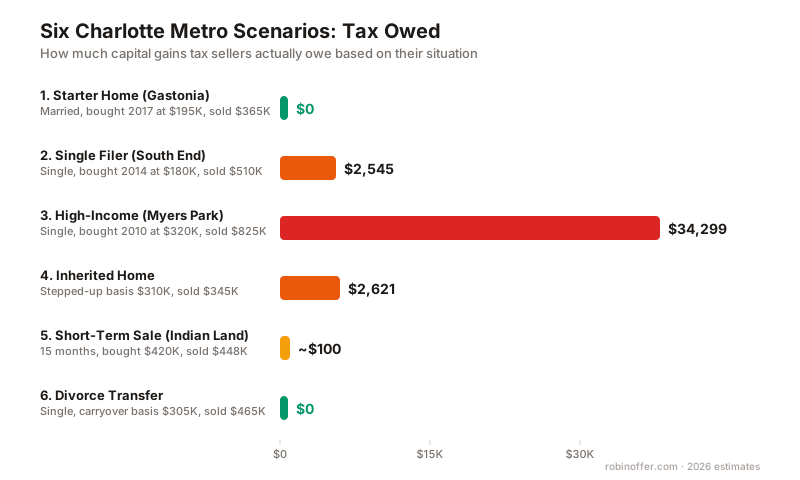
5. Six Charlotte Metro Scenarios, From Zero Tax to $34,000+
Abstract tax rules are hard to feel. Let's make them concrete with scenarios using real Charlotte metro price levels. These show exactly when you owe, when you don't, and why.
Scenario 1: The Starter Home Seller (Zero Tax)
| Detail | Amount |
|---|---|
| Bought in 2017 (Gastonia) | $195,000 |
| Improvements over 9 years | $18,000 |
| Adjusted basis | $213,000 |
| Sale price (2026) | $365,000 |
| Selling expenses | $22,500 |
| Net gain | $129,500 |
| Section 121 exclusion (married) | $500,000 |
| Tax owed | $0 |
This is the most common Charlotte metro scenario. Married couple, owned and lived there 5+ years, gain well under the exclusion. Zero federal. Zero NC. They keep every dollar of equity. For more on selling options in Gastonia, see our Gastonia homeowner guide.
Scenario 2: The Single Filer Approaching the Limit
| Detail | Amount |
|---|---|
| Bought in 2014 (Charlotte / South End area) | $180,000 |
| Improvements | $35,000 |
| Adjusted basis | $215,000 |
| Sale price (2026) | $510,000 |
| Selling expenses | $31,600 |
| Net gain | $263,400 |
| Section 121 exclusion (single) | $250,000 |
| Taxable gain | $13,400 |
| Tax | Rate | Amount |
|---|---|---|
| Federal long-term capital gains | 15% | $2,010 |
| NC state tax | 3.99% | $535 |
| NIIT (MAGI under $200K) | 0% | $0 |
| Total tax | $2,545 |
A single filer who bought early in Charlotte's boom and saw massive appreciation. The $35,000 in tracked improvements saved roughly $6,600 in tax that would have been owed on a larger gain. If this seller were married filing jointly, the $500,000 exclusion would make the tax $0.
Scenario 3: The High-Income Seller Exceeding the Exclusion
| Detail | Amount |
|---|---|
| Bought in 2010 (Myers Park / Charlotte) | $320,000 |
| Improvements | $55,000 |
| Adjusted basis | $375,000 |
| Sale price (2026) | $825,000 |
| Selling expenses | $49,500 |
| Net gain | $400,500 |
| Section 121 exclusion (single) | $250,000 |
| Taxable gain | $150,500 |
| MAGI | $310,000 (salary + gain) |
| Tax | Rate | Amount |
|---|---|---|
| Federal long-term capital gains | 15% | $22,575 |
| NIIT (MAGI exceeds $200K) | 3.8% | $5,719 |
| NC state tax | 3.99% | $6,005 |
| Total tax | $34,299 |
This is where it stings. A high-income single filer with a luxury home in Charlotte sees the triple stack: federal + NIIT + NC state. The combined effective rate on the taxable gain is 22.79%. If this seller were married filing jointly, the $500,000 exclusion would cover the full gain, $0 tax. Filing status alone is a $34,299 swing.
Scenario 4: The Inherited Home (No Exclusion Available)
| Detail | Amount |
|---|---|
| Parent bought home (1995) | $85,000 |
| Fair market value at death (2024) | $310,000 |
| Stepped-up basis | $310,000 |
| Sale price (2026) | $345,000 |
| Selling expenses | $21,200 |
| Net gain | $13,800 |
| Tax | Rate | Amount |
|---|---|---|
| Federal long-term capital gains | 15% | $2,070 |
| NC state tax | 3.99% | $551 |
| Total tax | $2,621 |
Without the stepped-up basis, the gain would be $345,000 − $85,000 − $21,200 = $238,800, and the tax would be roughly $45,000. The stepped-up basis saved this heir over $42,000. But note: this heir did NOT live in the home as their primary residence for two years, so the Section 121 exclusion doesn't apply. The entire $13,800 gain is taxable. If the heir had moved in and lived there for two years before selling, the exclusion would have covered it entirely. For the full inherited property playbook, see our guide to selling inherited property in NC.
Scenario 5: The Short-Term Seller (Under 2 Years)
| Detail | Amount |
|---|---|
| Bought in March 2025 (Indian Land, SC) | $420,000 |
| Sale price June 2026 (15 months later) | $448,000 |
| Selling expenses | $27,500 |
| Net gain | $500 |
| Section 121 exclusion | Not available (under 2 years, no qualifying event) |
| Taxable gain | $500 |
Even without the exclusion, the selling expenses eat most of the appreciation. Short-term sellers in a flat market often find their real enemy isn't capital gains tax, it's the 5–6% in commissions and closing costs. On a $448,000 sale, the $27,500 in selling expenses dwarfs any tax on a $500 gain. A cash buyer eliminates commissions and gets the seller more net proceeds. See our guide to cash offers in NC and SC for how that math works.
Scenario 6: Divorce, One Spouse Keeps the Home
| Detail | Amount |
|---|---|
| Bought jointly in 2016 | $275,000 |
| Home transferred to one spouse in 2023 divorce | (carryover basis: $275,000) |
| Improvements before and after divorce | $30,000 |
| Adjusted basis | $305,000 |
| Sale price (2026) by remaining spouse | $465,000 |
| Selling expenses | $28,500 |
| Net gain | $131,500 |
| Section 121 exclusion (single, now divorced) | $250,000 |
| Tax owed | $0 |
Key rule: when a home is transferred between spouses as part of a divorce, the receiving spouse inherits the original cost basis, no step-up. But the receiving spouse can count the time the other spouse owned and used the home toward the 2-year tests. So even though the remaining spouse technically became sole owner in 2023, they get credit for joint ownership and use since 2016. The $131,500 gain is comfortably within the $250,000 exclusion. For more on how divorce affects your home sale, see our guide to selling during divorce in the Carolinas.
6. Inherited a House? The Stepped-Up Basis Changes Everything
When you inherit property, the IRS resets the cost basis to the fair market value on the date the person died. This is called the stepped-up basis, and it's the single most valuable tax benefit heirs get.
Say your parents bought a house in Kings Mountain for $65,000 in 1992. By the time they pass in 2025, it's worth $260,000. Without the step-up, your basis would be $65,000, and selling for $260,000 would create a $195,000 taxable gain. With the step-up, your basis is $260,000. Sell for $265,000 and your gain is just $5,000.
Critical Rules for NC Heirs
| Rule | What It Means |
|---|---|
| Basis resets to date-of-death FMV | Decades of unrealized appreciation disappear from the tax calculation |
| Automatically qualifies as long-term | Inherited property is always taxed at long-term rates (0/15/20%), no matter how quickly you sell |
| Section 121 does NOT auto-apply | The exclusion requires YOU to have owned and used the home as YOUR primary residence for 2+ years. Inheriting it doesn't start that clock, moving in does. |
| NC taxes the gain at 3.99% | NC follows federal rules on stepped-up basis but applies its flat rate to any taxable gain |
| Get an appraisal immediately | A $350–$500 appraisal at the time of death documents your stepped-up basis. Without it, the IRS may use a lower figure years later. |
The Section 121 Play for Heirs
If the inherited home is in a desirable area and the heir doesn't need to sell immediately, there's a powerful strategy: move into the home, live there for two years, then sell. The gain since the stepped-up basis date will likely be modest (2 years of appreciation), and the Section 121 exclusion will cover it entirely.
Example: You inherit a home worth $310,000 in 2024. You move in. You sell in 2027 for $345,000. Your gain is $35,000. Section 121 exclusion wipes it out, $0 tax.
Compare that to selling in 2024 without moving in: $35,000 gain × (15% federal + 3.99% NC) = approximately $6,650 in tax. Two years of living in the home saved $6,650.
Our guide to selling inherited property in North Carolina covers the full probate timeline, multiple-heir negotiations, and all eight options you have with an inherited home.
7. Selling After Divorce: The Basis Transfer That Catches People
When a home is transferred between spouses as part of a divorce decree, the IRS treats it as a nontaxable event under Section 1041. No gain is recognized at the time of transfer. But there's a catch: the receiving spouse inherits the original cost basis, not the current market value.
How Divorce Affects Your Capital Gains Math
| Situation | Basis Rule | Section 121 Test |
|---|---|---|
| Home transferred in divorce | Carryover basis (original purchase price + improvements) | Receiving spouse can count both spouses' ownership and use time |
| Home sold during divorce | Each spouse reports their share of gain | Both spouses can claim their own $250K exclusion if tests met |
| One spouse bought out | Buying spouse keeps carryover basis | Buying spouse counts both spouses' time |
The transfer-basis rule means the receiving spouse could have a very low basis on a high-value home. If a couple bought for $200,000 in 2012 and the home is worth $500,000 at the time of divorce in 2023, the spouse who keeps the home has a basis of $200,000, not $500,000. If they sell in 2026 for $520,000, their gain is $320,000. As a single filer with a $250,000 exclusion, $70,000 is taxable.
| Tax on $70,000 Taxable Gain | Rate | Amount |
|---|---|---|
| Federal long-term capital gains | 15% | $10,500 |
| NC state tax | 3.99% | $2,793 |
| Total | $13,293 |
If that same couple had sold the home during the divorce and both claimed their $250,000 exclusion, the entire $320,000 gain would have been excluded. The $13,293 tax bill is entirely a timing and strategy issue. For more on navigating a home sale during divorce, see our selling during divorce guide.
8. Rental Conversions and the Depreciation Trap
If you converted a rental property into your primary residence (or vice versa), the tax math gets significantly more complicated. Two things work against you: nonqualified use periods and depreciation recapture.
Nonqualified Use Periods
For homes purchased after January 1, 2009, time the property was used as anything other than a primary residence (rental, vacation home, vacant) is called "nonqualified use." The portion of gain attributable to nonqualified use periods cannot be excluded, even if you otherwise meet the ownership and use tests.
The formula: (nonqualified use periods ÷ total ownership period) × gain = non-excludable gain.
Depreciation Recapture
Any depreciation you claimed while renting the property is "recaptured", meaning it's taxed at 25% when you sell, regardless of your income level. Depreciation recapture cannot be excluded by Section 121.
A Charlotte Metro Example
| Detail | Amount |
|---|---|
| Bought in 2016 as rental (Mount Holly) | $185,000 |
| Rented 2016–2020 (4 years) | |
| Converted to primary residence 2020 | |
| Lived in it 2020–2026 (6 years) | |
| Total ownership: 10 years | |
| Depreciation claimed (4 years rental) | $26,900 |
| Adjusted basis ($185K − $26.9K depreciation) | $158,100 |
| Sale price (2026) | $355,000 |
| Selling expenses | $21,900 |
| Total gain | $175,000 |
| Gain Component | Calculation | Amount |
|---|---|---|
| Depreciation recapture | $26,900 at 25% | $6,725 tax |
| Nonqualified use portion | 4 rental yrs ÷ 10 total yrs = 40% of $148,100 remaining gain | $59,240 taxable |
| Excludable gain | 60% of $148,100 | $88,860 (excluded via Section 121) |
| Total taxable gain | $26,900 + $59,240 | $86,140 |
| Tax Breakdown | Rate | Amount |
|---|---|---|
| Depreciation recapture (federal) | 25% | $6,725 |
| Federal capital gains on $59,240 | 15% | $8,886 |
| NC state tax on $86,140 | 3.99% | $3,437 |
| Total tax | $19,048 |
Compare that to a primary-residence-only seller with the same gain: $0 tax. The rental years and depreciation turned a tax-free sale into a $19,048 bill. If you're considering selling a property that was previously rented, make sure your CPA runs this full calculation. For more context on selling rental properties, see our guide to selling a house as-is in NC, which covers scenarios where a property needs work.
9. Seven Strategies to Legally Reduce Your Capital Gains Tax
If your gain is going to exceed the Section 121 exclusion, or you're selling a property that doesn't qualify, here are the legitimate strategies NC homeowners use to reduce the bill.
Strategy 1: Meet the 2-Year Tests Before Selling
This is the simplest and most powerful strategy. If you're at 20 months of ownership and use, waiting 4 months saves you the entire tax bill. Even a partial exclusion (if you must sell early for work, health, or unforeseen circumstances) can be worth hundreds of thousands of dollars.
Strategy 2: Track Every Capital Improvement
We covered this in Section 4, but it bears repeating: every dollar of documented improvement is a dollar subtracted from your taxable gain. A $15,000 screened porch saves $2,850 in taxes (at 19% combined federal + NC) if your gain exceeds the exclusion.
Strategy 3: Time Your Sale for January
If you close in December 2026, you owe taxes by April 2027. If you close in January 2027, you don't owe until April 2028, an extra year to invest or earn interest on that money. Plus, NC's rate drops to 3.49% in 2027, saving 0.50% on the state portion. On a $100,000 taxable gain, that's a $500 state tax savings. Our best time to sell guide covers seasonal and tax timing in detail.
Strategy 4: Harvest Capital Losses
Capital losses from stocks, bonds, or other investments offset capital gains dollar-for-dollar. If you have a $50,000 taxable gain from your home sale and a $30,000 loss in your investment portfolio, selling those losing positions in the same tax year reduces your taxable gain to $20,000.
Strategy 5: Manage Your Income in the Sale Year
The federal capital gains rate depends on your total taxable income. A seller with $40,000 in taxable income (below the $49,450 single threshold) pays 0% federal on long-term gains. Timing the sale during a low-income year, between jobs, early retirement, sabbatical, can drop the federal rate from 15% to 0%. At that point you'd only owe NC's flat 3.99%.
Strategy 6: Use the 1031 Exchange (Investment Properties Only)
A Section 1031 exchange lets you defer capital gains tax on investment property by reinvesting the proceeds into another qualifying property within strict timelines (45 days to identify, 180 days to close). This does not work for primary residences, only for investment and rental properties. But if you're selling a rental in Mecklenburg County and buying another investment property, it's the cleanest way to defer the entire gain.
Strategy 7: File Jointly if Possible
The difference between a $250,000 exclusion (single) and a $500,000 exclusion (married filing jointly) is the most impactful factor in most capital gains tax calculations. For couples where both spouses meet the use test, filing jointly eliminates tax on gains that would be fully taxable for a single filer.
See your estimated net proceeds
Taxes affect your bottom line, but so do commissions, closing costs, and your remaining loan balance. ListRobin's calculator adds it all up so you know your real walk-away number.
10. NC vs. SC: Which State Treats Your Gain Better?
If you're selling on the state line, Fort Mill vs. Charlotte, Indian Land vs. Weddington, Lake Wylie vs. Belmont, you might wonder whether the grass is greener across the border. Here's the honest comparison.
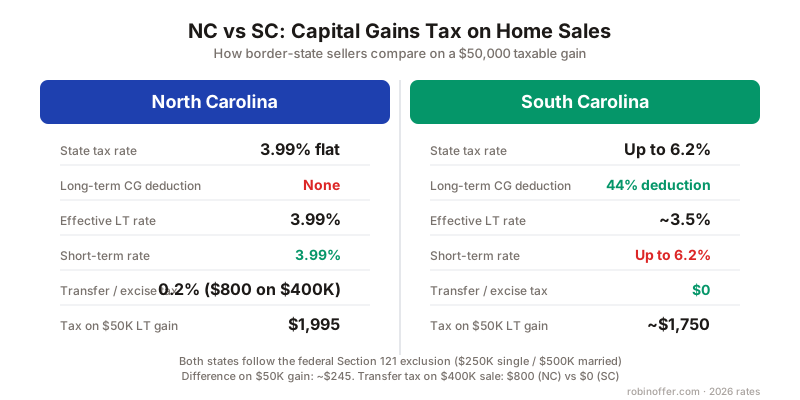
| Factor | North Carolina (2026) | South Carolina (2026) |
|---|---|---|
| State tax rate | 3.99% flat | Up to 6.2% (graduated brackets) |
| Capital gains treatment | Taxed as ordinary income at 3.99% | 44% deduction on net long-term gains |
| Effective long-term capital gains rate | 3.99% | ~3.5% (after 44% deduction) |
| Short-term capital gains rate | 3.99% | Up to 6.2% (no deduction) |
| Real estate transfer tax | $1 per $500 (0.2%) | None |
| Section 121 conformity | Yes, follows federal exclusion | Yes, follows federal exclusion |
| Future rate trajectory | Dropping to 3.49% in 2027 | Reducing gradually under 2022 legislation |
The Bottom Line for Border Sellers
For long-term capital gains, SC's effective rate (~3.5%) is slightly lower than NC's (3.99%). But the difference is narrow, on a $50,000 taxable gain, you'd save roughly $245 in SC. Most sellers won't notice.
For short-term gains (homes held under 1 year), NC wins decisively. NC's flat 3.99% beats SC's graduated rate that can reach 6.2%. On a $30,000 short-term gain, you'd pay $1,197 in NC vs. up to $1,860 in SC.
The bigger difference is the transfer tax. NC charges $1 per $500 (0.2%) while SC charges nothing. On a $400,000 sale, that's $800 in NC excise tax that SC sellers don't pay. This has nothing to do with capital gains, but it's a closing cost that affects your net proceeds. See our Fort Mill homeowner guide or Indian Land guide for SC-specific selling details.
11. The Math Mistakes That Cost NC Sellers Thousands
These are the errors we see most often from homeowners who try to calculate their capital gains tax without professional help, or worse, from homeowners who assume they don't need to calculate it at all.
Mistake 1: Not Tracking Improvements
Every undocumented improvement is money left on the table. A $12,000 roof replacement that you can't prove to the IRS doesn't reduce your basis. At a 19% combined tax rate (15% federal + 3.99% NC), that's $2,280 in extra tax you didn't need to pay.
Mistake 2: Forgetting NC's State Tax
National capital gains calculators show federal tax only. NC sellers need to add 3.99% on top. On a $100,000 taxable gain, that's $3,990 the calculator didn't mention.
Mistake 3: Assuming Section 121 Is Automatic
The exclusion requires both the ownership AND use tests. Inheriting a home doesn't start your clock. Renting it out interrupts it. Moving out for a job for three years could blow the five-year window. Always confirm you meet both tests before assuming you qualify.
Mistake 4: Confusing Excise Tax With Capital Gains Tax
NC's excise tax ($1 per $500, or 0.2% of the sale price) is a transfer tax paid at closing. It's not a capital gains tax. It applies to every sale regardless of profit. The silver lining: it's a selling expense that reduces your gain. But don't confuse the two, paying $700 in excise tax doesn't mean you've "paid your capital gains tax." Our NC due diligence period guide explains how the unique NC contract structure handles these costs.
Mistake 5: Missing the NIIT Surtax
The 3.8% Net Investment Income Tax hits singles above $200,000 MAGI and couples above $250,000. These thresholds haven't been adjusted for inflation since 2013, more sellers hit them every year. On a $150,000 taxable gain above the threshold, the NIIT adds $5,700 that many sellers don't see coming.
Mistake 6: Not Getting an Appraisal for Inherited Property
Without a date-of-death appraisal, the IRS can challenge your stepped-up basis. A $400 appraisal now can save thousands in tax later. The alternative, reconstructing the home's value years after the fact using old comparable sales, is expensive, unreliable, and exactly the kind of thing an auditor will push back on.
Mistake 7: Thinking 1031 Exchanges Work for Primary Residences
They don't. Section 1031 applies only to investment and business property. Your primary residence is explicitly excluded. If a "tax advisor" suggests a 1031 exchange on your personal home, find a new advisor.
12. Your Capital Gains Tax Checklist Before You List
Before you sign a listing agreement or accept a cash offer, run through this checklist. Each item takes five minutes or less and can save you thousands.
| # | Checklist Item | Why It Matters |
|---|---|---|
| 1 | Confirm you've owned the home 2+ years | Qualifies you for the Section 121 exclusion |
| 2 | Confirm you've lived in it as primary residence 2+ of last 5 years | Second requirement for Section 121 |
| 3 | Haven't claimed the exclusion on another home sale in the last 2 years | Frequency limit, one exclusion per 2 years |
| 4 | Gather receipts for all capital improvements | Each dollar of improvement reduces your taxable gain |
| 5 | Calculate your adjusted basis (purchase + closing costs + improvements) | Lower gain = lower tax |
| 6 | Estimate your gain (expected sale price − selling expenses − adjusted basis) | If under $250K (single) or $500K (married), you owe $0 |
| 7 | Check if you'll owe NIIT (MAGI over $200K single / $250K married) | Adds 3.8% surtax on investment income including capital gains |
| 8 | Consider timing: can you close in January vs. December? | Defers tax by a full year; NC rate drops to 3.49% in 2027 |
| 9 | Talk to a CPA if your gain is close to or exceeds the exclusion | The $200–$400 CPA bill can save thousands in tax strategy |
| 10 | Get a date-of-death appraisal if you inherited the property | Documents your stepped-up basis, the IRS may challenge it later |
When to Call a CPA vs. When You Don't Need One
You probably don't need a CPA if: You've owned and lived in your home for 2+ years, you're married filing jointly, and your estimated gain is under $400,000. The Section 121 exclusion covers you, and the calculation is straightforward.
You definitely need a CPA if:
- Your gain exceeds or is close to $250,000 (single) or $500,000 (married)
- You inherited the property
- You're going through a divorce
- The property was rented at any point
- You used part of the home for business (home office depreciation)
- You're a high earner who may owe the NIIT
- You haven't lived in the home for 2 full years
The $250-$400 you spend on a CPA consultation is the best money you'll spend in the entire selling process if any of those situations apply to you. And if you're a senior homeowner thinking about downsizing, our senior's guide to downsizing in NC covers the tax breaks, transaction costs, and five paths forward that go beyond capital gains.
Ready to see what you'll net?
Get a clear estimate of your net proceeds after commissions, closing costs, and payoff with ListRobin's free home sale calculator.
13. Frequently Asked Questions About NC Capital Gains Tax
Do I have to pay capital gains tax when selling my house in North Carolina?
Most NC homeowners who lived in their home for at least two years owe nothing. The federal Section 121 exclusion lets you exclude up to $250,000 of gain (single) or $500,000 (married filing jointly). NC follows this exclusion automatically. You only owe tax on gain exceeding the exclusion, at 0-20% federal plus NC's flat 3.99% state rate.
What is the NC capital gains tax rate on home sales in 2026?
North Carolina taxes capital gains at a flat 3.99% rate in 2026. This is on top of federal capital gains tax (0%, 15%, or 20% depending on income). NC does not have a preferential rate for long-term gains, the same 3.99% flat rate applies to all income including capital gains. The rate drops to 3.49% in 2027.
How do I calculate capital gains on selling a home in NC?
Your capital gain equals: sale price minus selling expenses (commissions, closing costs) minus your adjusted basis (purchase price + qualifying closing costs + capital improvements). If the result is under $250,000 (single) or $500,000 (married) and you meet the 2-year ownership and use tests, you owe $0. Gain above the exclusion is taxed at federal rates plus NC's 3.99%.
Do I pay capital gains tax on inherited property in North Carolina?
Inherited property gets a stepped-up basis equal to fair market value at the date of death. This often eliminates most or all capital gains. However, the Section 121 exclusion does NOT automatically apply, you must have owned and used the home as YOUR primary residence for 2+ years. If you sell without living in it, any gain above the stepped-up basis is taxable at 15% federal plus 3.99% NC.
How does NC capital gains tax compare to South Carolina?
NC has a flat 3.99% rate on all capital gains. SC offers a 44% deduction on net long-term capital gains, making the effective rate approximately 3.5%. For long-term gains, SC is slightly cheaper by about 0.49%. For short-term gains, NC's flat 3.99% beats SC's graduated rates that can reach 6.2%. Both states follow the federal Section 121 exclusion.
Disclaimer: This guide provides general information about capital gains tax as it applies to home sales in North Carolina. It is not tax advice. Tax laws change, and your specific situation may involve factors not covered here. Consult a licensed CPA or tax attorney before making tax-related decisions about your home sale. Information is current as of June 2026.