
Closing Costs for Sellers in North Carolina
Every fee, tax, and commission NC sellers pay at closing — with net proceeds math at four price points and six costs you can negotiate down.
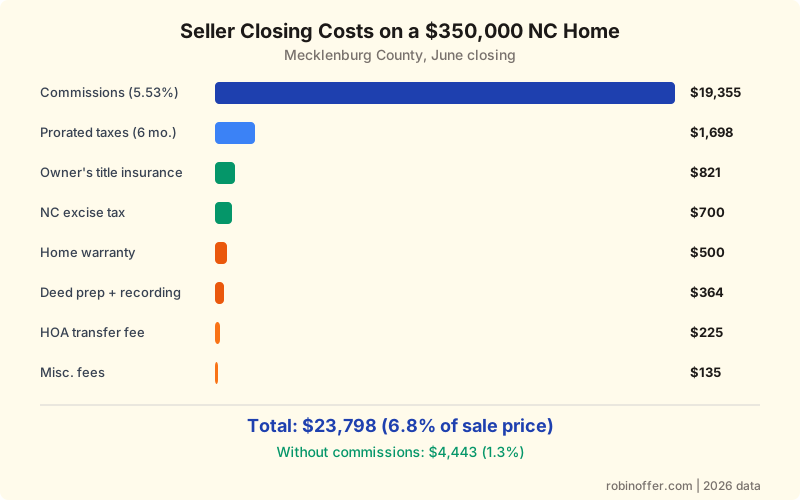
Closing costs for sellers in North Carolina typically run 8–10% of the sale price when you include agent commissions, roughly $28,000–$35,000 on a $350,000 home. Strip out commissions and you're looking at 2–3% in excise taxes, attorney fees, title insurance, and prorated property taxes.
If you're looking at a cash offer instead, our guide to cash offers in NC and SC breaks down what those buyers actually pay, and what they don't.
1. The Number on Every NC Seller's Mind
You've looked at your Zestimate. You've subtracted your mortgage balance. You've imagined the check. And then your agent mentions closing costs, and suddenly that number shrinks by five figures.
Here's the part that stings: most NC sellers don't find out the full cost of selling until they get their closing disclosure three days before settlement. By then, it's too late to negotiate anything. The contracts are signed, the movers are booked, and the wire instructions are queued.
We built this guide so that doesn't happen to you. Every dollar a North Carolina seller pays at closing is listed here, with the actual amounts, who's responsible, and where you have room to push back. Whether you're selling a starter home in Kannapolis or a lakefront property in Mooresville, the mechanics are the same. The math changes. The line items don't.
Two things make NC closing costs different from most states. First, North Carolina is an attorney state. A licensed NC attorney must supervise your closing, not a title company, not a notary, not a paralegal with a stamp. That changes the cost structure compared to states where a $200 title company handles everything. Second, NC uses a due diligence system instead of traditional contingencies, which means the money flows differently during the contract period. We'll cover both in detail.
And one thing that applies everywhere: the biggest closing cost by far is the real estate commission. It's typically 2–3x larger than all other costs combined. The NAR settlement in August 2024 changed how commissions work, but the total hasn't dropped as much as sellers hoped. Section 7 has the current numbers.
2. Every Line Item on Your NC Closing Statement
This is the full inventory of closing costs for sellers in North Carolina. Every cost you might see on your settlement statement, organized by who typically pays and whether it's negotiable. We're using a $350,000 sale in Mecklenburg County as the reference point, adjust up or down for your area.
| Cost Item | Amount on $350K Sale | Who Typically Pays | Negotiable? |
|---|---|---|---|
| Listing agent commission | $9,800 (2.80%) | Seller | Yes |
| Buyer's agent commission | $9,555 (2.73%) | Seller (usually) | Yes |
| NC excise tax (revenue stamps) | $700 | Seller | No |
| Owner's title insurance | $821 | Seller (NC custom) | Sometimes |
| Attorney / settlement fee | $500–$800 | Buyer (usually) | Yes |
| Deed preparation | $250–$400 | Seller | Rarely |
| Title search | $200–$400 | Buyer (usually) | Yes |
| Recording fees | $64 | Seller | No |
| Prorated property taxes | $283–$3,112 | Seller (Jan 1 to close) | No |
| HOA transfer / disclosure fee | $225 | Seller | Rarely |
| Home warranty (if offered) | $400–$600 | Seller | Yes |
| Wire transfer fee | $35–$50 | Seller | No |
| Mortgage payoff processing | $50–$250 | Seller | No |
Add it up on a $350,000 Mecklenburg County home with a June closing, and the seller-side total lands around $23,500–$25,000, roughly 6.7–7.1% of the sale price. Drop commissions and you're at $3,500–$5,000, or about 1–1.4%.
Notice the range on prorated property taxes. That's not a typo. A seller closing in January owes about one month of taxes ($283 in Mecklenburg). A seller closing in November owes eleven months ($3,112). The closing date matters more than most sellers realize, we'll cover the timing play in Section 11.
A few items won't appear on every statement. If there's no HOA, that $225 disappears. If you don't offer a home warranty, drop another $400–$600. And if you've already paid off your mortgage, the payoff processing fee vanishes. The non-negotiable core, excise tax, title insurance, deed prep, recording, and prorated taxes, runs about $2,000–$3,600 regardless.
3. NC Excise Tax: The Fee That Follows Every Deed
Every time a deed changes hands in North Carolina, the state collects an excise tax. It used to involve physical stamps on the document, that's why old-timers call them "revenue stamps." Today it's just a fee paid to the Register of Deeds at recording, but the name stuck.
The Rate
The NC excise tax rate is $1.00 per $500 of the sale price (or any fraction of $500). That works out to $2.00 per $1,000, or 0.2% of the sale price. The rate is set by N.C. General Statute § 105-228.30 and hasn't changed since 1991.
The math is simple: divide your sale price by $500, round up to the next whole number, multiply by $1.00.
| Sale Price | NC Excise Tax | Effective Rate |
|---|---|---|
| $200,000 | $400 | 0.200% |
| $275,000 | $550 | 0.200% |
| $350,000 | $700 | 0.200% |
| $450,000 | $900 | 0.200% |
| $500,000 | $1,000 | 0.200% |
| $750,000 | $1,500 | 0.200% |
Who Pays and When
The seller pays the excise tax. It's collected at the closing table and remitted to the Register of Deeds when the deed is recorded. Half goes to the county general fund, half goes to the state. The deed won't be recorded without it, there's no delaying or negotiating this one.
Exemptions Worth Knowing
The excise tax doesn't apply to every transfer. Key exemptions under N.C.G.S. § 105-228.29 include:
- Transfers by will or inheritance (no sale involved)
- Transfers between spouses as part of a divorce decree
- Gifts with no monetary consideration
- Court-ordered transfers
- Deeds of trust and mortgages (these secure debt, not convey ownership)
If you're selling an inherited property in North Carolina, you won't owe excise tax on the inheritance transfer itself, only on the subsequent sale to a buyer.
4. Owner's Title Insurance: NC's Custom That Adds $500–$1,700
Title insurance is one of the most misunderstood closing costs. There are two types, and in North Carolina, the seller typically pays for one of them.
Two Policies, Two Purposes
- Owner's title insurance protects the buyer against title defects, undisclosed liens, forged signatures in the chain of title, recording errors, boundary disputes. It's a one-time premium paid at closing that covers the buyer for as long as they own the home. In NC, the seller customarily pays for this policy, because the seller has the legal duty to convey clear title.
- Lender's title insurance protects the mortgage lender. The buyer pays for this policy. It's required by virtually every lender and covers the loan amount, not the purchase price.
NC Rates Are State-Regulated
Unlike most closing costs, title insurance premiums in North Carolina are not negotiable. They're set by the NC Title Insurance Rating Bureau (NCTIRB) and approved by the NC Department of Insurance. Every licensed title insurer charges the same base premium, roughly $2.17 per $1,000 of coverage.
| Home Sale Price | Owner's Policy (Seller Pays) | Lender's Policy (Buyer Pays) | Combined |
|---|---|---|---|
| $200,000 | $495 | $150 | $645 |
| $300,000 | $712 | $175 | $887 |
| $350,000 | $821 | $188 | $1,009 |
| $400,000 | $929 | $200 | $1,129 |
| $500,000 | $1,146 | $225 | $1,371 |
| $750,000 | $1,689 | $300 | $1,989 |
Can the Buyer Pay Instead?
Who pays for owner's title insurance is a matter of local custom, not state law. In most Charlotte-area transactions, the seller pays. But in some NC markets, particularly in the Triangle (Raleigh-Durham) and Triad (Greensboro-Winston-Salem), the custom varies, and it's sometimes negotiated to the buyer's side. Your purchase contract specifies who pays, and this is one of those line items you can negotiate during the offer stage.
If you're selling to a cash buyer or investor who doesn't require a lender's policy, you may still want to provide owner's title insurance. A buyer who discovers a title defect after closing can come back against you for breach of warranty. The insurance policy shifts that risk to the insurer.
Want a net sheet for your NC home?
ListRobin's free home sale calculator subtracts commissions, closing costs, and your mortgage payoff to estimate what you'll actually walk away with.
5. Why North Carolina Makes You Hire a Lawyer to Close
If you've bought or sold a home in Georgia, Florida, or Texas, you probably closed through a title company. Walk in, sign papers, walk out. In North Carolina, that's not legal.
NC is one of roughly fifteen "attorney states" where a licensed attorney must supervise residential real estate closings. This comes from N.C. General Statute §§ 84-2.1 and 84-4, reinforced by the NC State Bar's Authorized Practice Advisory Opinion 2002-1. Preparing deeds, examining titles, and conducting closings are all considered the practice of law in this state. A title company can issue insurance, but it can't run the closing.
What the Attorney Actually Does
This isn't just a formality. Your closing attorney handles:
- Title examination, searching 30+ years of recorded documents to verify clear title, including a 10-year NC judgment search and 20-year federal judgment search per the Marketable Title Act
- Deed preparation, drafting the general warranty deed that transfers ownership (the most common deed type for NC residential sales)
- Settlement statement review, verifying every number on the closing disclosure matches the contract terms
- Lien resolution, clearing any judgments, tax liens, unreleased deeds of trust, or encumbrances before the deed can be recorded
- Escrow management, holding and disbursing funds under the Good Funds Settlement Act (N.C.G.S. Chapter 45A), which requires that all closing funds be "collected" before disbursement
- Recording, filing the deed and deed of trust with the county Register of Deeds, ensuring the excise tax is paid and the transfer is properly documented
What It Costs
| Service | Typical NC Range | Charlotte Metro Average |
|---|---|---|
| Attorney / settlement fee | $500–$1,250 | $550–$800 |
| Title search | $200–$400 | $200–$300 |
| Deed preparation | $250–$400 | $250–$350 |
| Technology / e-recording | $75–$150 | $100 |
| Rush closing surcharge | $150–$400 | $200 |
| Total (standard closing) | $1,025–$2,200 | $1,100–$1,550 |
In most NC transactions, the buyer selects and pays for the closing attorney. The seller typically pays for deed preparation ($250–$400) and sometimes a share of the settlement fee if negotiated in the contract. On a seller net sheet, expect $300–$500 for your attorney-related costs.
How to Choose One
The buyer usually picks the closing attorney, but if you're selling FSBO or to a cash buyer, you may need to find one yourself. Three things to check:
- NC State Bar membership, verify at ncbar.gov
- Title insurance agent license, most closing attorneys are also licensed title agents who can issue title insurance at the state-regulated rate
- Flat-fee structure, hourly billing at $250+/hour adds up fast; most residential closing attorneys charge a flat fee, and a good one will send you the full fee schedule upfront
6. NC's Due Diligence System: Money That Moves Before Closing
If you've sold a home in another state, you're used to contingencies, the buyer makes an offer with a financing contingency, an inspection contingency, maybe an appraisal contingency. Each one can kill the deal at different points. North Carolina does it differently, and the difference affects how (and when) money changes hands during the selling process.
How It Works
Instead of individual contingencies, NC uses a single due diligence period, a negotiated window (typically 14–30 days) during which the buyer can investigate the property, secure financing, and complete inspections. The buyer pays two separate deposits:
| Deposit Type | Paid To | Refundable? | Typical Amount |
|---|---|---|---|
| Due diligence fee | Seller (directly) | No, seller keeps it regardless | $500–$2,000+ |
| Earnest money | Escrow (closing attorney) | Yes, if buyer terminates during DD period | ~1% of purchase price |
During the due diligence period, the buyer can walk away for any reason, bad inspection, cold feet, found a better house. The seller keeps the due diligence fee, but the earnest money goes back to the buyer. If the buyer walks after the due diligence period expires, the seller keeps both.
What This Means for Seller Closing Costs
The due diligence fee isn't a closing cost, it's money received by the seller. At closing, the due diligence fee is credited toward the buyer's purchase price. But here's the part sellers sometimes miss: if the deal falls through during due diligence, you keep the fee but you've lost time. The weeks your home was under contract are weeks it wasn't on the market. In a declining market, that time has a cost.
In competitive Charlotte-area neighborhoods, due diligence fees can run $3,000–$10,000 or more. That's not just earnest money theater, it's real compensation for taking the home off the market. When evaluating multiple offers, the due diligence fee signals how serious the buyer is. A $5,000 due diligence fee on a $350,000 home says "I'm not walking away from this." A $500 fee says "I'm still looking."
The Inspection and Repair Negotiation
Here's where due diligence intersects with closing costs: during the due diligence period, the buyer will likely request a home inspection ($350–$500, buyer pays). If the inspection reveals issues, a failing HVAC, a roof leak, foundation concerns, the buyer may request repairs or a price reduction. This happens before the due diligence period expires, so the buyer still has the leverage of walking away.
If you agree to a repair credit instead of fixing the issue, that credit shows up on your closing statement as a reduction in your net proceeds. A $5,000 repair credit is functionally the same as a $5,000 closing cost, it reduces what you walk away with. For a full breakdown of how the DD period works, what the fee covers, and the four scenarios where a refund is possible, see our complete NC due diligence period guide.
7. Real Estate Commissions After the NAR Settlement
Until August 2024, the commission math was simple: the seller paid a total commission (typically 5–6%), the listing broker split it with the buyer's broker, and everyone moved on. The NAR settlement changed the mechanics, even if the dollars haven't moved as much as the headlines suggested.
What Changed
- Listing agents can no longer offer buyer-agent compensation through the MLS. Before, the MLS listing would say "2.5% to buyer's agent." That field is gone.
- Buyer's agents must sign a written agreement with their client specifying their compensation before touring homes. This is new as of August 17, 2024.
- Commission splits are decoupled. Each side negotiates separately. Sellers can still offer buyer-agent compensation, they just can't do it through the MLS.
- NC's 2025 Regulatory Reform Act now allows buyer-agent compensation to appear in preprinted offer forms. This practically means commissions are still being negotiated in the contract, just through a different mechanism.
What Hasn't Changed (Yet)
In practice, most Charlotte-area sellers still offer buyer-agent compensation. Why? Because a home that doesn't offer it gets fewer showings. Buyer's agents steer their clients toward listings that pay, and until buyer-paid commissions become the norm, sellers who refuse to offer compensation are cutting their buyer pool.
| Commission Component | NC Average (2026) | Charlotte Metro | Range |
|---|---|---|---|
| Listing agent | 2.80% | 2.80% | 1.50%–3.50% |
| Buyer's agent | 2.73% | 2.73% | 2.00%–3.00% |
| Total commission | 5.53% | 5.53% | 4.00%–6.00% |
On a $350,000 sale, the average total commission is $19,355. That's the single largest closing cost for every NC seller, bigger than all other costs combined.
Commission Costs Across NC Price Points
| Sale Price | Listing Agent (2.80%) | Buyer's Agent (2.73%) | Total Commission |
|---|---|---|---|
| $200,000 | $5,600 | $5,460 | $11,060 |
| $300,000 | $8,400 | $8,190 | $16,590 |
| $400,000 | $11,200 | $10,920 | $22,120 |
| $500,000 | $14,000 | $13,650 | $27,650 |
| $750,000 | $21,000 | $20,475 | $41,475 |
Three Ways to Lower It
- Negotiate the listing-side rate. In a hot market with multiple offers, many listing agents will drop to 2.0–2.5%. You won't know until you ask. Agents competing for a $500,000 listing in Ballantyne have more room to negotiate than agents working a $200,000 listing in east Charlotte, the total dollars are higher even at a lower percentage.
- Offer a flat fee to the buyer's agent. Instead of 2.73% ($9,555 on $350K), offer a flat $7,000 or $8,000. Buyer's agents will still show the house. This saves more on higher-priced homes.
- Sell FSBO and offer buyer-agent compensation only. You eliminate the listing-side commission entirely. More on this in Section 9.
8. Your Net Proceeds at Four Price Points
This is where closing costs for sellers in North Carolina get real, the complete waterfall from sale price to the check you deposit. We're using Charlotte-area data, Mecklenburg County tax rate (0.97%), average commission (5.53%), and a June closing date (6 months of prorated taxes).
Mortgage payoff varies by seller, so we show two numbers: gross proceeds (before mortgage) and a net example assuming a typical remaining balance.
$225,000 Sale (Gastonia / Kings Mountain Range)
| Line Item | Amount | Running Total |
|---|---|---|
| Sale price | $225,000 | $225,000 |
| Agent commissions (5.53%) | −$12,443 | $212,557 |
| NC excise tax | −$450 | $212,107 |
| Owner's title insurance | −$549 | $211,558 |
| Deed prep + recording | −$364 | $211,194 |
| Prorated property taxes (6 mo.) | −$1,091 | $210,103 |
| HOA transfer fee | −$225 | $209,878 |
| Misc. fees (wire, payoff, courier) | −$135 | $209,743 |
| Gross proceeds (before mortgage) | $209,743 | |
| Example mortgage payoff ($155,000) | −$155,000 | $54,743 |
| Net to seller | $54,743 |
At this price point, closing costs (excluding the mortgage payoff) consume $15,257, about 6.8% of the sale price. The seller walks away with just 24% of the original price in cash, assuming the example mortgage balance.
$350,000 Sale (Charlotte Median Range)
| Line Item | Amount | Running Total |
|---|---|---|
| Sale price | $350,000 | $350,000 |
| Agent commissions (5.53%) | −$19,355 | $330,645 |
| NC excise tax | −$700 | $329,945 |
| Owner's title insurance | −$821 | $329,124 |
| Deed prep + recording | −$364 | $328,760 |
| Prorated property taxes (6 mo.) | −$1,698 | $327,062 |
| HOA transfer fee | −$225 | $326,837 |
| Home warranty (offered) | −$500 | $326,337 |
| Misc. fees (wire, payoff, courier) | −$135 | $326,202 |
| Gross proceeds (before mortgage) | $326,202 | |
| Example mortgage payoff ($230,000) | −$230,000 | $96,202 |
| Net to seller | $96,202 |
Total closing costs here: $23,798 (6.8%). The dollar amount is higher, but the percentage stays roughly the same because commissions, the biggest cost, scale linearly with price.
$500,000 Sale (Fort Mill / South Charlotte Range)
| Line Item | Amount | Running Total |
|---|---|---|
| Sale price | $500,000 | $500,000 |
| Agent commissions (5.53%) | −$27,650 | $472,350 |
| NC excise tax | −$1,000 | $471,350 |
| Owner's title insurance | −$1,146 | $470,204 |
| Deed prep + recording | −$414 | $469,790 |
| Prorated property taxes (6 mo.) | −$2,425 | $467,365 |
| HOA transfer fee | −$225 | $467,140 |
| Home warranty (offered) | −$500 | $466,640 |
| Misc. fees (wire, payoff, courier) | −$185 | $466,455 |
| Gross proceeds (before mortgage) | $466,455 | |
| Example mortgage payoff ($310,000) | −$310,000 | $156,455 |
| Net to seller | $156,455 |
$750,000 Sale (Lake Norman / Ballantyne Range)
| Line Item | Amount | Running Total |
|---|---|---|
| Sale price | $750,000 | $750,000 |
| Agent commissions (5.53%) | −$41,475 | $708,525 |
| NC excise tax | −$1,500 | $707,025 |
| Owner's title insurance | −$1,689 | $705,336 |
| Deed prep + recording | −$464 | $704,872 |
| Prorated property taxes (6 mo.) | −$3,638 | $701,234 |
| HOA transfer fee | −$225 | $701,009 |
| Home warranty (offered) | −$600 | $700,409 |
| Misc. fees (wire, payoff, courier) | −$185 | $700,224 |
| Gross proceeds (before mortgage) | $700,224 | |
| Example mortgage payoff ($420,000) | −$420,000 | $280,224 |
| Net to seller | $280,224 |
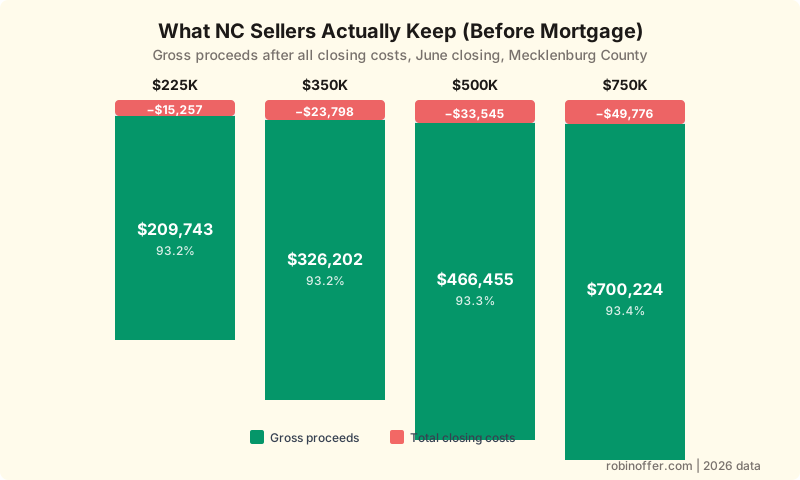
The Pattern Worth Noticing
| Sale Price | Total Closing Costs | % of Sale | Non-Commission Costs | Non-Commission % |
|---|---|---|---|---|
| $225,000 | $15,257 | 6.78% | $2,814 | 1.25% |
| $350,000 | $23,798 | 6.80% | $4,443 | 1.27% |
| $500,000 | $33,545 | 6.71% | $5,895 | 1.18% |
| $750,000 | $49,776 | 6.64% | $8,301 | 1.11% |
9. Agent, FSBO, or Cash Buyer: Three Closing Cost Scenarios
The selling method you choose changes the closing cost math dramatically. Here's the same $350,000 Charlotte-area home sold three different ways.
| Cost Item | List with Agent | FSBO (offer buyer-agent comp) | Cash Buyer / iBuyer |
|---|---|---|---|
| Listing agent commission | $9,800 (2.80%) | $0 | $0 |
| Buyer's agent commission | $9,555 (2.73%) | $9,555 (2.73%) | $0 |
| NC excise tax | $700 | $700 | $700 |
| Owner's title insurance | $821 | $821 | $821 |
| Deed prep + recording | $364 | $364 | $364 |
| Prorated property taxes | $1,698 | $1,698 | $1,698 |
| HOA transfer fee | $225 | $225 | $225 |
| Home warranty | $500 | $500 | $0 |
| Misc. fees | $135 | $135 | $135 |
| Likely sale price discount | $0 | −$7,000 (est. 2%) | −$35,000 to −$52,500 (10–15%) |
| Total seller costs | $23,798 | $20,998 | $3,943 |
| Effective sale price after discount | $350,000 | $343,000 | $297,500–$315,000 |
| Gross proceeds | $326,202 | $322,002 | $293,557–$311,057 |
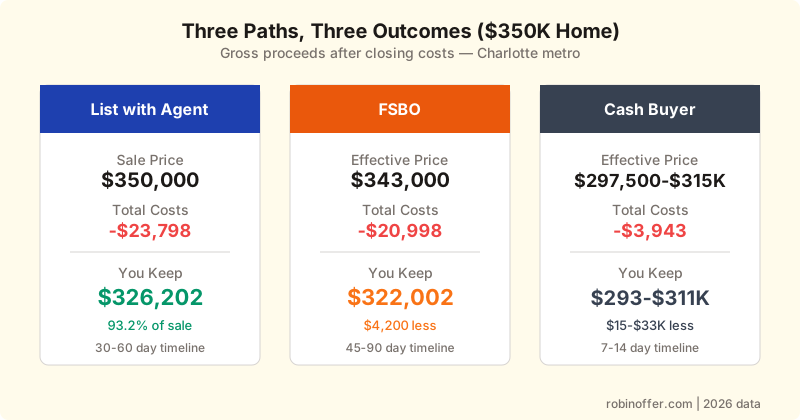
When Each Path Makes Sense
Agent path: Costs more in fees but typically delivers the highest sale price. Most homes in the Charlotte metro still sell through agents, and the MLS exposure generates competitive offers that often offset the commission. If your home is in good condition, in a desirable neighborhood, and you have 45–60 days, this is usually the path that maximizes your net. The 5.53% average commission hurts, but a well-priced, well-marketed listing often sells above asking in hot neighborhoods, sometimes enough to cover the commission difference entirely.
FSBO path: Saves the listing commission ($9,800 in this example) but may sacrifice sale price and takes significantly more of your time, photography, showings, marketing, contract negotiation, and coordinating with the buyer's agent. You'll need to draft or review the Offer to Purchase and Contract (Form 2-T), handle the due diligence negotiations, and ensure all NC disclosure requirements are met. In the Charlotte metro, where median days on market is 48, FSBO homes typically sell for 2–5% below agent-listed comparable sales. That said, FSBO works well when you already have a buyer lined up, a neighbor, a family member, a tenant, and you're essentially formalizing a deal both parties have already agreed to.
Cash buyer path: Has the lowest closing costs and the fastest timeline, often 7–14 days to close. No appraisal required, no lender delays, no buyer financing that falls through. But the sale price is typically 10–15% below market value, and some cash buyer companies charge service fees or "assignment fees" on top of the discount that aren't always disclosed upfront. If speed matters more than dollars, a relocation deadline, a pending foreclosure, an inherited home you can't maintain, the cash path makes sense despite the lower price. We break down the cash buyer landscape in our guide to selling a house as-is in NC.
See what you'll net after closing costs
Plug in your numbers and ListRobin's calculator shows your estimated net proceeds after commissions, closing costs, and payoff — free, no strings.
10. Six Closing Costs You Can Push Back On
Not everything on the closing statement is set in stone. Here's where you have room, and where you don't.
Negotiable
| Cost | How to Negotiate | Typical Savings |
|---|---|---|
| Listing agent commission | Interview 3+ agents. Ask for competitive rates in your market segment. Hot neighborhoods in spring = leverage. | 0.25–1.0% of sale price |
| Buyer's agent compensation | Offer a flat dollar amount instead of a percentage. Or let the buyer negotiate with their own agent. | $1,000–$3,000 |
| Home warranty | Don't offer one unless the buyer requests it. Or cap it at $400 for a basic plan. | $400–$600 |
| Seller concessions | If the buyer asks for closing cost help, counter with a smaller credit or a price reduction instead. | Varies |
| Owner's title insurance | In some NC counties, custom allows the buyer to pay. Check with your agent or attorney. | $500–$1,500 |
| Attorney fee split | The contract determines who pays what. Seller can negotiate to pay only deed prep. | $200–$500 |
Locked In
| Cost | Why You Can't Change It |
|---|---|
| NC excise tax | Set by state statute at $1/$500. No exceptions for residential sales. |
| Recording fees | Uniform statewide schedule set by the NC Association of Registers of Deeds. |
| Prorated property taxes | Calculated based on assessed value and the days you owned the home that year. Math, not negotiation. |
Seller Concession Limits by Loan Type
If the buyer asks you to cover some of their closing costs (a "seller concession"), federal loan rules cap how much you can contribute:
| Loan Type | Max Seller Concession | On a $350K Sale |
|---|---|---|
| Conventional (<10% down) | 3% of sale price | $10,500 |
| Conventional (10–24% down) | 6% of sale price | $21,000 |
| Conventional (25%+ down) | 9% of sale price | $31,500 |
| FHA | 6% of sale price | $21,000 |
| VA | 4% of loan amount | ~$13,300 |
| USDA | 6% of sale price | $21,000 |
Concessions can't exceed the buyer's actual closing costs and can't be applied to the buyer's down payment. If a buyer asks for $15,000 in concessions but their closing costs are only $10,000, the lender will reject the excess $5,000.
Here's the workaround savvy agents use: instead of a $10,000 seller concession, raise the sale price by $10,000 and offer the same $10,000 back as a credit. The buyer finances the credit into their mortgage, the seller's net stays the same, and the concession is more likely to fit within the lender's limits. This only works if the home appraises at the higher price, otherwise the appraiser kills the deal.
11. The Calendar Trick: How Your Closing Date Shifts What You Owe
NC property taxes run on a calendar year, January 1 through December 31. Bills go out in the fall and are due by January 5 of the following year. At closing, the seller is responsible for taxes from January 1 through the closing date, and the buyer picks up the rest.
This creates a real cost difference depending on when you close.
| Closing Month | Months Seller Owes | Prorated Tax on $350K (Mecklenburg) | Prorated Tax on $350K (Gaston County) |
|---|---|---|---|
| January | 1 | $283 | $222 |
| March | 3 | $849 | $666 |
| June | 6 | $1,698 | $1,331 |
| September | 9 | $2,546 | $1,997 |
| November | 11 | $3,112 | $2,441 |
| December | 12 | $3,395 | $2,663 |
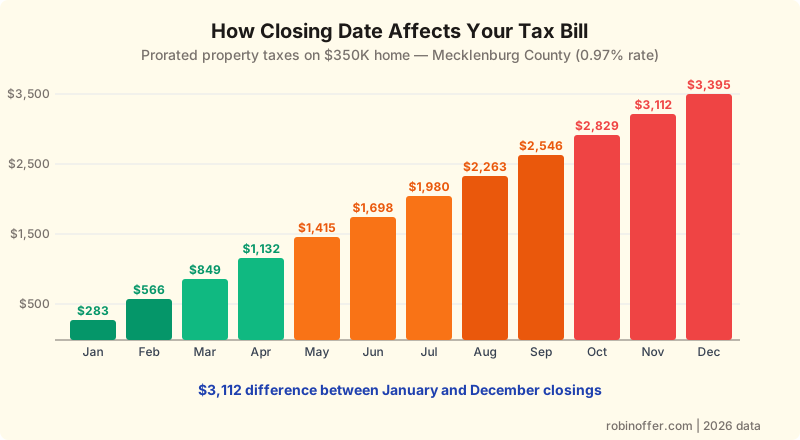
The difference between a January closing and a December closing on a $350,000 Mecklenburg County home is $3,112 in prorated taxes. That's real money, enough to cover the excise tax, recording fees, deed prep, and wire transfer combined.
But Timing Isn't Just About Taxes
Before you rush to close in January, remember: the spring selling season (April through June) typically delivers 5–12% higher sale prices in the Charlotte metro. If waiting until May adds $15,000 to your sale price but costs an extra $1,400 in prorated taxes, the math is obvious, you net $13,600 more by waiting.
The real timing strategy isn't "close in January to save on proration." It's "know how proration affects your net sheet so you can make an informed trade-off." If you're weighing timing decisions, our guide to the best time to sell in the Carolinas has the month-by-month market data.
Property Tax Rates Vary Significantly by County
The county you're in changes the proration math considerably. Here's how the annual property tax bill compares on a $350,000 home across major Charlotte-metro counties:
| County | Approximate Effective Tax Rate | Annual Tax on $350K | Monthly Proration |
|---|---|---|---|
| Mecklenburg (Charlotte) | 0.97% | $3,395 | $283 |
| Gaston (Gastonia, Belmont) | 0.76% | $2,660 | $222 |
| Union (Waxhaw, Indian Trail) | 0.79% | $2,765 | $230 |
| Cabarrus (Concord, Kannapolis) | 0.73% | $2,555 | $213 |
| Iredell (Mooresville, Statesville) | 0.67% | $2,345 | $195 |
| Lincoln (Lincolnton) | 0.72% | $2,520 | $210 |
| York County, SC (Fort Mill, Rock Hill) | 0.55% | $1,925 | $160 |
A Mecklenburg County seller closing in June pays $1,698 in prorated taxes. A Gaston County seller closing on the same date pays $1,331, a $367 difference on the same home value. York County, SC sellers pay even less, but they also face South Carolina's higher excise tax (0.37% vs. NC's 0.20%).
12. When Closing Costs Shrink Your Capital Gains Tax Bill
Most articles about closing costs ignore the tax implications entirely. That's a mistake, because several of your closing costs are deductible from capital gains, and in NC, where capital gains are taxed at 3.99% on top of federal rates, every deduction matters. Our complete guide to capital gains tax when selling a home in NC covers six scenarios and seven strategies to reduce your bill.
How Capital Gains Work on a Home Sale
Your capital gain is:
Sale price − purchase price − cost basis adjustments − selling expenses = taxable gain
Cost basis adjustments include capital improvements you made to the home, a new roof, a kitchen remodel, an added bathroom, a finished basement. Routine maintenance (painting, fixing a leak, replacing a water heater) doesn't count. Keep your receipts.
If you've owned and lived in the home as your primary residence for at least 2 of the last 5 years, you can exclude up to $250,000 (single filers) or $500,000 (married filing jointly) of that gain. This is the Section 121 exclusion, and NC honors it, if the gain is excluded federally, it's excluded from NC income tax too.
Which Closing Costs Reduce Your Gain
| Closing Cost | Tax Treatment | On $350K Sale |
|---|---|---|
| Agent commissions | Deducted from sale price (reduces gain) | $19,355 |
| NC excise tax | Deducted from sale price (reduces gain) | $700 |
| Title insurance | Deducted from sale price (reduces gain) | $821 |
| Attorney / deed prep fees | Deducted from sale price (reduces gain) | $650 |
| Recording fees | Deducted from sale price (reduces gain) | $64 |
| Staging and marketing costs | Deducted from sale price (reduces gain) | Varies |
| Home warranty (provided to buyer) | Not deductible | $500 |
| Prorated property taxes | Deductible on Schedule A (itemizers only) | $1,698 |
| Mortgage payoff interest | Deductible on Schedule A (itemizers only) | Varies |
On a $350,000 sale, you can deduct approximately $21,590 in selling expenses from your gain before applying the Section 121 exclusion. For most primary residence sellers, the exclusion wipes out any remaining gain entirely.
When Capital Gains Tax Actually Hits NC Sellers
You'll owe capital gains tax if:
- Your gain exceeds the $250K/$500K exclusion (increasingly common with homes bought before 2015 in Charlotte's appreciating markets)
- You haven't lived in the home 2 of the last 5 years (rental properties, second homes, homes you moved out of too early)
- You're selling an investment property (no Section 121 exclusion at all)
| Tax Layer | Rate (2026) | On $100K Taxable Gain |
|---|---|---|
| Federal long-term capital gains | 0%, 15%, or 20% | $15,000 (at 15% bracket) |
| Net Investment Income Tax (NIIT) | 3.8% (high earners) | $3,800 |
| NC state income tax | 3.99% flat | $3,990 |
| Maximum combined rate | 27.79% | $22,790 |
NC's Declining Tax Rate Is Good News for Sellers
North Carolina has been steadily cutting its flat income tax rate. In 2025 it was 4.25%; in 2026 it dropped to 3.99%. It's scheduled to fall further, 3.49% in 2027 and 2.99% in 2028, contingent on revenue triggers that have already been met. If you're selling an investment property with a large gain, timing the sale to a lower-rate year can save meaningful money. The difference between selling in 2025 (4.25%) versus 2028 (2.99%) on a $200,000 gain is $2,520 in NC taxes alone.
If you're selling a rental or investment property, consider a 1031 exchange to defer capital gains by reinvesting in another investment property. The exchange must be structured before closing, talk to your CPA before listing. For more on the tax considerations of selling rental properties, see our guide to selling rental property with tenants in NC.
Nonresident Sellers: The 4% Withholding Rule
If you no longer live in North Carolina when you sell your NC property, the buyer is required to withhold 4% of the gross sale price and remit it to the NC Department of Revenue. On a $350,000 sale, that's $14,000 withheld, money you won't see until you file your NC tax return and claim a refund for any overpayment. If you're a nonresident seller, plan for this cash flow hit and factor it into your moving timeline.
13. What Happens on Closing Day in North Carolina
You've accepted an offer, survived the due diligence period, and the buyer's lender issued a clear-to-close. Now what? Here's the closing day process from the seller's perspective.
Before Closing Day
- 3+ business days before: The closing attorney sends the buyer a Closing Disclosure (CD), a federal TRID requirement. As the seller, you'll receive a settlement statement showing your side of the transaction. Review every line item. Compare it to the estimates in this guide. If a number looks wrong, call the attorney immediately.
- 1–2 days before: The lender wires funds to the closing attorney's escrow account. North Carolina is a "wet funding" state under the Good Funds Settlement Act (N.C.G.S. Chapter 45A), meaning funds must be collected before the attorney can disburse. No personal checks over $5,000, everything moves by wire or cashier's check.
- Day of: The buyer does a final walkthrough of the property (not a second inspection, just confirming the condition matches the contract). Make sure you've moved out, left the home broom-clean, and removed all personal property unless otherwise agreed.
At the Closing Table
In North Carolina, the seller and buyer often sign at the same closing table, though the closing attorney can arrange separate signing appointments if that's easier (common in divorce sales or when the seller has already relocated). Here's what the seller signs:
| Document | What It Does |
|---|---|
| General warranty deed | Transfers ownership to the buyer with full title warranties |
| Settlement statement (HUD-1 or ALTA) | Details every charge, credit, and disbursement |
| 1099-S certification | Confirms sale price for IRS reporting (or certifies exclusion) |
| Seller's affidavit | Swears there are no undisclosed liens, judgments, or encumbrances |
| Lien payoff authorization | Authorizes the attorney to pay off your mortgage from proceeds |
| NC excise tax declaration | Certifies the sale price for excise tax calculation |
| FIRPTA affidavit | Certifies you are a U.S. person (or triggers foreign seller withholding) |
Signing typically takes 20–30 minutes for the seller, less than the buyer, who has a mountain of loan documents. Bring a government-issued photo ID. If you can't attend in person, the attorney can arrange a "mail-away" signing package for an additional $200–$350.
After Signing: Settlement vs. Closing
Here's a distinction unique to NC practice: settlement (signing documents) and closing (recording the deed and disbursing funds) can happen on different days. You might sign on Tuesday, but the deed isn't recorded until Wednesday when the attorney confirms all funds are collected and the lender authorizes disbursement.
Once the deed is recorded with the Register of Deeds, the attorney disburses proceeds. Your net check is typically wired to your bank account on the same day as recording, arriving within 24 hours. If you chose a paper check instead of a wire, expect to wait 1–2 days for delivery.
One common source of confusion: the "closing date" on your contract is the target date, not a guarantee. Lender delays, title issues, appraisal problems, and even wire transfer timing can push the actual closing by 1–5 days. The standard NC contract (Form 2-T) includes a 14-day grace period, if one party is the "Delaying Party" but acting in good faith, the other party must wait 14 days past the settlement date before declaring a breach. Build a buffer into your moving plans. Don't schedule your movers for 8 AM on closing day.
14. Extra Costs for Estates, Divorces, Rentals, and Short Sales
Standard closing costs assume a straightforward sale, one owner, clear title, no legal complications. If your situation is more complex, expect additional costs that won't show up in any online calculator.
Estate / Inherited Property Sales
| Extra Cost | Typical Range | Notes |
|---|---|---|
| Probate attorney fees | $2,000–$5,000+ | Required if no will or if will must be probated |
| Letters Testamentary / Administration | $100–$300 | Court filing to authorize the sale |
| Additional title search (estate) | $200–$400 | Verifying chain of title through the estate |
| Estate attorney deed preparation | $350–$600 | Special warranty deed or executor's deed, more complex than standard |
| Property preservation costs | $1,000–$5,000 | Lawn care, utilities, insurance, maintenance while vacant |
The stepped-up basis is the silver lining: inherited property gets a cost basis equal to its fair market value at the date of death, which often eliminates capital gains entirely. If your mother bought a home for $85,000 in 1998 and it's worth $320,000 at her death, your cost basis is $320,000, not $85,000. If you sell for $325,000, your taxable gain is only $5,000.
NC probate typically takes 90 days for uncontested estates with a valid will, and 6–12 months if there are disputes or no will. During that time, someone is paying carrying costs. Our guide to selling inherited property in NC walks through the full probate-to-sale process, including the Summary Administration shortcut for smaller estates.
Divorce Sales
| Extra Cost | Typical Range | Notes |
|---|---|---|
| Divorce attorney (real estate portion) | $1,500–$5,000 | Review of equitable distribution agreement |
| Court-ordered appraisal | $350–$600 | Required if spouses disagree on value |
| Partition action (if contested) | $5,000–$15,000+ | Rare but expensive, court forces the sale |
| Quitclaim deed (buyout scenario) | $250–$400 | One spouse transfers interest to the other |
In NC, property transferred between spouses as part of a divorce decree is exempt from excise tax, that's one cost you don't have to worry about. If one spouse is buying out the other rather than selling to a third party, the buyout transfer is also excise-tax-exempt. Both spouses must sign the deed unless one has a court order granting sole authority. For the full breakdown, see our guide to selling during a divorce in the Carolinas.
Rental / Investment Property Sales
| Extra Cost | Typical Range | Notes |
|---|---|---|
| Depreciation recapture tax (federal) | 25% of depreciation claimed | Cannot be avoided; only deferred via 1031 exchange |
| NC capital gains tax | 3.99% of gain | No Section 121 exclusion for investment property |
| Lease termination / cash-for-keys | $500–$3,000 | If tenant has remaining lease; offering cash to vacate early |
| Estoppel certificate | $100–$250 | Required by buyer's attorney, verifies lease terms and deposits |
| 1031 exchange accommodator | $750–$1,500 | Required if deferring gains through a like-kind exchange |
Depreciation recapture is the tax surprise most landlords don't see coming. If you've claimed $40,000 in depreciation on a rental property over 10 years, the IRS taxes that $40,000 at 25% when you sell, regardless of your income bracket. That's $10,000 in federal tax on top of your capital gains tax. The only way to defer it is a 1031 exchange into another investment property, which must be identified within 45 days of closing and completed within 180 days.
Short Sales
| Extra Cost | Typical Range | Notes |
|---|---|---|
| Lender approval timeline | 60–120+ days | Extends carrying costs (mortgage, insurance, taxes) significantly |
| Short sale negotiation (if agent handles) | Included in commission | Some agents charge more for short sale expertise; ask before listing |
| Deficiency judgment risk | Varies | NC allows lenders to pursue the deficiency, the difference between what you owe and what the home sells for |
| Tax on forgiven debt (1099-C) | Ordinary income rates | Unless you qualify as insolvent or the Mortgage Forgiveness Debt Relief Act applies |
If your mortgage balance exceeds your home's value, a short sale may be an option, but the "closing costs" expand to include the tax consequences of forgiven debt and the risk of a deficiency judgment. NC is a recourse state, meaning your lender can sue you for the shortfall even after the short sale closes. Negotiating a waiver of deficiency is critical. If you're facing this situation, our guide to avoiding foreclosure in NC covers all the alternatives.
Ready to see your real net proceeds?
Get a clear estimate of what you'll walk away with after every seller cost using ListRobin's free home sale calculator.
15. Your NC Seller Closing Cost Playbook
You now know every closing cost for sellers in North Carolina, every line item, every rate, and every negotiation lever. Here's the playbook:
- Get your home valued. You can't estimate closing costs without knowing your likely sale price. Get a free home valuation to start with real numbers, not Zillow guesses.
- Build a net sheet. Use the waterfall tables in Section 8 as a template. Plug in your mortgage balance, your county's tax rate, and your expected sale price. The result is your estimated check.
- Interview agents before you sign. Get commission quotes from at least three agents. Ask about the listing-side rate specifically, that's where you have the most leverage. Don't sign a listing agreement on the first meeting.
- Ask your closing attorney for a cost estimate. Before the buyer picks their attorney, ask your agent which attorneys they recommend and request a fee schedule. Most are happy to provide one. Compare at least two.
- Choose your closing date strategically. If you have flexibility, consider how property tax proration affects your net. Early-year closings save on proration; spring closings typically deliver higher sale prices. Run the trade-off math.
- Don't agree to concessions reflexively. If the buyer asks for 3% in closing cost assistance, counter with 1.5%, or offer a price reduction instead, which doesn't count against concession limits and may actually help the buyer's financing.
- Talk to a CPA about capital gains. Especially if this isn't your primary residence, you've lived there less than 2 years, or your gain exceeds $250K/$500K. With NC's declining tax rate, timing matters.
- Evaluate the due diligence fee alongside the price. A $340,000 offer with a $5,000 due diligence fee may be worth more than a $345,000 offer with a $500 fee, because the higher fee signals a buyer who won't walk away.
Want to See Your Numbers?
We build custom net sheets for NC homeowners, no obligation, no pressure. Tell us about your home, and we'll run the closing cost math for your specific situation: your county, your mortgage balance, your timeline. We'll show you what each selling path looks like, agent, FSBO, or cash, so you can choose with real numbers instead of estimates.
16. Frequently Asked Questions About NC Seller Closing Costs
How much are closing costs for sellers in North Carolina?
NC seller closing costs typically run 8-10% of the sale price when you include agent commissions, roughly $28,000-$35,000 on a $350,000 home. Without commissions, expect 2-3% in excise taxes, attorney fees, title insurance, and prorated property taxes.
What is the NC excise tax on real estate?
The NC excise tax (revenue stamps) is $1.00 per $500 of the sale price, which equals 0.2% or $2.00 per $1,000. On a $350,000 sale, the excise tax is $700. The seller pays this fee at closing, it is set by state statute and cannot be negotiated.
Who pays closing costs in North Carolina, buyer or seller?
Both parties pay closing costs in NC. Sellers typically pay agent commissions (5.53% average), excise tax, owner's title insurance, deed preparation, recording fees, and prorated property taxes. Buyers typically pay attorney/settlement fees, lender's title insurance, loan fees, and the appraisal.
Why does North Carolina require an attorney at closing?
NC is one of roughly fifteen "attorney states" where a licensed attorney must supervise residential closings. This is required by N.C. General Statute §§ 84-2.1 and 84-4. The attorney handles title examination, deed preparation, escrow management, and recording. Sellers typically pay $300-$500 for deed preparation.
Can I negotiate closing costs as a seller in NC?
Yes, six closing costs are negotiable: listing agent commission, buyer's agent compensation, home warranty, seller concessions, owner's title insurance (who pays), and attorney fee split. Three costs are locked in: NC excise tax, recording fees, and prorated property taxes. Your strongest negotiating position is before signing the listing agreement.
This guide was researched and written by CC Evans. Every figure reflects 2026 North Carolina closing costs and tax rates. Real estate transactions involve complex legal and financial decisions, consult a licensed NC attorney and CPA for advice specific to your situation. Last updated June 2026.