
Charlotte: Fifteen Markets in One City
A local guide for Charlotte homeowners navigating a $420K median market with 15 neighborhoods, $8 billion in development, and five selling paths.
Sell your house in Charlotte, NC in 2026 by choosing among five paths: agent listing, FSBO, cash offer, renting, or renovate-and-hold. Here is the math at Charlotte's $420,000 median — and why which of the city's fifteen neighborhoods you are in changes everything.
Charlotte is not one housing market. It is fifteen, stacked inside the same city limits, ranging from $340,000 ranch homes near UNC Charlotte to $2.8 million estates in Eastover. A Steele Creek seller and a Myers Park seller share a mayor and a county tax assessor, but almost nothing else about their sale will look the same. This guide is built around that reality. We are not going to tell you "Charlotte is a great place to sell" — we are going to show you what your specific path looks like, with the numbers, the timeline, and the tradeoffs for each option.
If you are looking at the metro more broadly, we have guides for Huntersville to the north, Matthews to the southeast, Concord along the I-85 corridor, and Belmont across the Catawba River. Charlotte is the hub. These suburbs orbit it. But the dynamics inside Charlotte's city limits are complex enough to fill their own guide — and that is what this is.
1. The City That Adds 157 Residents a Day Still Has a Selling Problem
Charlotte added roughly 157 new residents per day between 2023 and 2024 — over 61,000 people in two years. It is the 14th-largest city in the United States and the second-fastest-growing large city since 2020, behind only Fort Worth. Two-thirds of in-migrants are between 20 and 34 years old, drawn by banking jobs, lower costs than the Northeast, and a metro area that still feels navigable.
You would think that kind of demand would make selling easy. It does not. Three forces complicate the picture:
- Inventory is climbing. Charlotte had roughly 2,407 homes on the market in January 2026, up 10.4% year-over-year. Months of supply rose to 2.4 from 1.8 a year ago. That is still technically a seller's market, but the negotiating leverage that existed in 2022 is gone.
- Days on market stretched. The average Charlotte home sat for 63 days before closing in January 2026, up 19% from the previous year. Speed no longer favors the seller by default — preparation and pricing do.
- The price gap between neighborhoods is enormous. The $420,000 citywide median is mathematically correct and practically useless. A seller in University City is competing in a $340,000 market against new construction. A seller in SouthPark is in a $663,000 market against renovated ranches. Citywide statistics describe neither one accurately.
2. Charlotte by the Closing Table: What $420K Buys in 2026
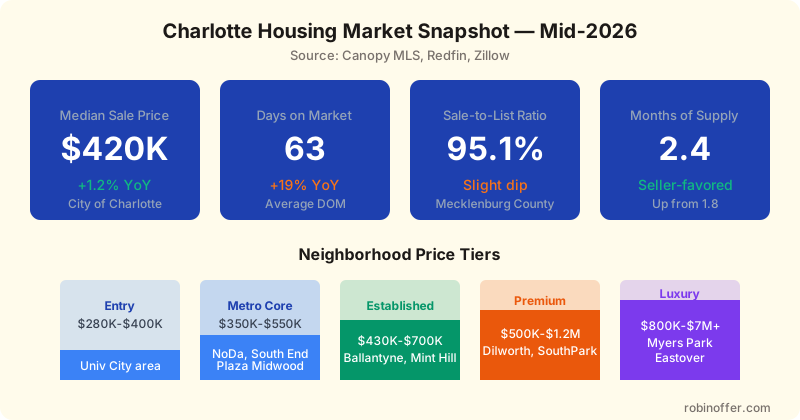
Charlotte Housing Market, Mid-2026
| Metric | Charlotte Value | Year-Over-Year | What It Signals |
|---|---|---|---|
| Median sale price (city) | $420,000 | +1.2% to +2.4% | Modest appreciation — equity is growing, not surging |
| Average sale price (city) | $556,391 | +1.8% | Luxury sales pull the average far above the median |
| Average days on market | 63 days | +19% | Preparation matters more than it did a year ago |
| Sale-to-list ratio | 95.1% | Slight dip | Overpricing costs you — homes sell at 95 cents on the listed dollar |
| Months of supply | 2.4 | Up from 1.8 | Still seller-favored, but negotiation leverage has weakened |
| Active listings (city) | ~2,400 | +10.4% | More competition for sellers than any point since 2019 |
| Compete score (Redfin) | 57 / 100 | — | "Somewhat Competitive" — some bidding wars, but not the norm |
Data sourced from Canopy MLS (January 2026 regional report), Redfin, and Zillow through August 2026. Market conditions shift. Get your home's current value for the latest numbers specific to your property.
Charlotte in the Metro Context
| City | Median Sale Price | Drive to Uptown | Positioning |
|---|---|---|---|
| Charlotte (citywide) | $420,000 | — | Metro hub; highest tax rate, most inventory, most buyer diversity |
| Huntersville | $568,000 | 17-25 min | Lake Norman corridor; I-77 Express Lanes premium |
| Matthews | $481,000 | 15-25 min | County-line school split; Mecklenburg vs. Union buyer pools |
| Concord | $375,000 | 25-35 min | I-85 corridor; Eli Lilly campus; lower entry point |
| Fort Mill, SC | $530,000 | 20-30 min | SC tax advantage; 13th fastest-growing city 20K+ |
| Belmont | $445,000 | 15-20 min | Lake Wylie + Main Street; $640M development pipeline |
| Rock Hill, SC | $330,000 | 25-35 min | Affordable SC entry; Knowledge Park reinvention |
3. $8 Billion Breaking Ground: Iron District, Eastland Yards, and the Projects Repricing Your Neighborhood
Charlotte has over $8 billion in active development reshaping the city. If you own a home within a mile of any of these projects, your comps are changing — and most sellers do not know it yet.
Major Development Projects Affecting Home Values
| Project | Location | Investment | What It Does to Nearby Home Values |
|---|---|---|---|
| Iron District | Former Charlotte Pipe & Foundry (Uptown/South End border) | $1B+ (55 acres) | Phase 1 breaks ground 2026: 208K sq ft office, 500 residential units, 120K sq ft retail. South End and Dilworth sellers get new comps within 18 months. |
| Eastland Yards | Central Avenue (former Eastland Mall) | 80 acres | Park construction underway. East Charlotte's defining reinvention. Plaza Midwood and Shamrock Hills sellers should watch absorption rates closely. |
| Queensbridge Collective | South End | $725M | Two-building mixed-use. Completion ~2028. Adds density and walkability to an already hot corridor. |
| The Bowl at Ballantyne (Phase 2) | Ballantyne | Undisclosed | Green space, dining, boutique hybrid-work offices. Reinforces Ballantyne as a self-contained live-work community. |
| LYNX Silver Line | Belmont → Center City → Matthews | $9B+ (29 mi, 30 stations) | Projected ~2030. When route alignment firms up, expect a price premium within a half-mile of planned stations — the same premium the Blue Line created in South End. |
| Charlotte Gateway Station | North Tryon (Uptown) | $15.5M temporary; full station by 2030 | Replaces aging Amtrak facility. North Tryon and NoDa sellers benefit from improved transit connectivity. |
| Uptown pipeline | Center City | $2.4B combined | 4,866 new apartments, 1.2M sq ft office, 1,501 hotel rooms under construction or starting by 2027. |
4. The Corporate Relocation Engine: JPMorgan, Scout Motors, and 37,000 New Jobs
Charlotte added 37,000 jobs between December 2024 and December 2025. The unemployment rate sits well below the national average. The pipeline includes over 7,000 additional jobs and $1.4 billion in investment across active incentive negotiations. Here is what that means for sellers:
Major Corporate Moves Affecting Charlotte Housing Demand
| Company | What They Are Doing | Jobs | Where It Affects Housing |
|---|---|---|---|
| JPMorgan Chase | New SouthPark corporate office; 5 new branches | ~1,000 | SouthPark, Ballantyne — mid-to-high buyer pool |
| Scout Motors | Corporate HQ | 1,000+ | South Charlotte / Airport corridor — broad price range |
| TD Bank | Tripled Charlotte footprint; 10-year lease in Ballantyne | Hundreds | Ballantyne area specifically |
| Citigroup | Expanding Charlotte operations | 500+ | Broad — avg salary ~$131,800 supports $500K+ home purchases |
| Charles Schwab | Signed lease at 110 East tower, South End | Undisclosed | South End, Dilworth, Wilmore |
| PSA Airlines | HQ relocated from Dayton, OH near CLT airport | ~400 | Steele Creek, Airport corridor, west Charlotte |
| TTX Company | Rail freight HQ to Charlotte | 150 | $14.5M Mecklenburg County investment |
| Coinbase | Customer service center | 150 | Tech-sector footprint growth |
Charlotte is the second-largest banking center in the United States after New York. Bank of America's headquarters sits in Uptown. Truist Financial, Wells Fargo's East Coast hub, and now JPMorgan, Schwab, TD, and Citi all operate significant Charlotte offices. Over 100,000 financial services jobs anchor the metro economy.
For sellers, the corporate pipeline matters because it creates relocating buyers — people who move to Charlotte with a job offer, a signing bonus, and a deadline. Relocating buyers are the most motivated segment of any market. They do not have the luxury of waiting six months to find the perfect house. If your home is priced right and shows well, a corporate relo buyer is the person most likely to write a clean offer above a lowball.
5. Fifteen Neighborhoods, Five Price Tiers: Where Your Charlotte Home Sits
The most important number in your sale is not the citywide median. It is the price per square foot in your neighborhood. Charlotte's neighborhoods sort into five distinct tiers, and each tier has its own buyer pool, its own competition, and its own timeline.
Charlotte Neighborhood Price Tiers
| Tier | Neighborhoods | Typical Price Range | Buyer Profile | DOM |
|---|---|---|---|---|
| Tier 1 — Entry | University City, Mountain Island, West Charlotte | $280K–$400K | First-time buyers, investors, UNC Charlotte staff | 45–70 days |
| Tier 2 — Metro Core | NoDa, South End, Plaza Midwood, Steele Creek | $350K–$550K | Young professionals, remote workers, creatives | 30–55 days |
| Tier 3 — Established Suburban | Ballantyne, Pineville, Mint Hill | $430K–$700K | Families, corporate relocations, move-up buyers | 40–65 days |
| Tier 4 — Premium | Dilworth, SouthPark | $500K–$1.2M | Dual-income professionals, empty nesters downsizing into walkability | 50–80 days |
| Tier 5 — Luxury | Myers Park, Eastover | $800K–$7M+ | Executives, inherited wealth, multi-property buyers | 60–120+ days |
Key Neighborhoods in Detail
Myers Park — Charlotte's most iconic address. Mansion-lined Queens Road, Myers Park Country Club, top-rated public schools. Prices run from $400K condos to $5M+ estates, with an average luxury sale near $2.5 million. Buyers here expect mature landscaping, hardwood floors, and a certain kind of quiet. Sellers compete against homes that have been immaculately maintained for decades.
Eastover — The wealthiest neighborhood in Charlotte by average sale price (~$2.86M). ZIP 28207 ranks among the most expensive in North Carolina. This is old-money Charlotte — estate homes on generous lots, minimal new construction, and a buyer pool that values discretion and privacy. Homes here can sit for 4-6 months because the buyer pool is small and specific.
South End — The trendiest corridor in the city. Former industrial warehouses converted into breweries, restaurants, and lofts. The Rail Trail and LYNX Blue Line make this the most walkable and transit-accessible neighborhood in Charlotte. Median around $525K. Sellers here compete against a steady stream of new construction condos, so condition and character are your differentiators.
Plaza Midwood — The arts and food hub. Central Avenue has the highest concentration of independent restaurants in Charlotte. Housing stock ranges from 1920s bungalows to fully renovated single-family homes. Overall median ~$480K, but single-family homes run $830K–$985K because the bungalow-to-renovation spread is huge. If your house is unrenovated, a developer will buy it — but they will pay lot value, not home value.
NoDa — North Davidson arts district. Gallery crawls, live music, textile mill heritage. The Blue Line extension brought transit access and pushed prices to ~$465K median. The buyer pool is younger and more creative than most Charlotte neighborhoods. Charm sells here. Sterile renovations do not.
Dilworth — Charlotte's first streetcar suburb, established in 1891. Tree-lined streets, early 20th-century architecture, Freedom Park, East Blvd dining. Prices range $500K to $1.2M. The historic district designation means some homes carry design review requirements — check before you renovate.
SouthPark — Upscale suburban. Premier shopping at SouthPark Mall and Phillips Place, luxury condos to estates. Median ~$663K, up about 6% year-over-year. The JPMorgan corporate campus expansion nearby adds demand at the high end.
Ballantyne — The master-planned community that essentially built its own suburb. Golf courses, corporate campuses (Ally Financial, MetLife), newer construction. Prices run $450K–$700K. The drive to Uptown is 30-45 minutes, which means Ballantyne buyers are commute-tolerant professionals who value neighborhood amenities over proximity.
University City — UNC Charlotte's campus anchors this north Charlotte market. Blue Line access, Research Park employment, and a median near $340-$410K make it the most affordable entry into Charlotte. However, recent price softening (down 4-8% YoY by some measures) and steady new apartment construction mean sellers need sharp pricing.
Steele Creek — South Charlotte's growth frontier. More affordable than Ballantyne to the east, with a mix of new construction and established subdivisions. Median ~$355-$415K, but recent data shows a 6-7% YoY dip. Sellers here are competing against builders offering incentives.
Mountain Island — Northwest Charlotte, lake-adjacent living without the Lake Norman price tag. Median ~$395K, down about 4% YoY. Quieter and more affordable than the east side, with appeal to buyers who work near the airport or in Uptown and want space.
Pineville — Southern suburb with Carolina Place Mall and a mix of established and new construction. Median ~$433-$445K. Convenient I-485 access and proximity to both Ballantyne and the SC border.
Mint Hill — More land, larger lots, and a more rural feel than adjacent Matthews. Median ~$580K reflects the lot size premium. Sellers here attract families who want space and Mecklenburg County schools without the density of inner-ring neighborhoods.
The New Construction Problem
Charlotte had roughly $2.4 billion in Uptown construction alone starting or underway by 2027 — including 4,866 new apartments. Outside the core, builders are active in Steele Creek, University City, Ballantyne, and along every I-485 interchange with available land. For existing homeowners, new construction creates a specific competitive challenge: builders offer buyer incentives (rate buydowns, closing cost coverage, upgrade packages) that you cannot match.
The way to compete against new construction is not to pretend it does not exist. Acknowledge the builder competition and sell what they cannot offer: established landscaping, known neighbors, walkable school routes, and a home that is not sitting in a construction zone. In Charlotte's inner-ring neighborhoods — Dilworth, Plaza Midwood, NoDa, Myers Park — new construction is limited by zoning and historic district rules. Those neighborhoods are supply-constrained by design, and sellers there benefit from scarcity.
In outer-ring neighborhoods — Steele Creek, University City, the Ballantyne periphery — the builder competition is real. If your home is in one of these areas and needs cosmetic work, budget $5,000-$10,000 for pre-listing updates (fresh paint, new hardware, professional cleaning) or expect to price 3-5% below the new construction competition. Buyers who choose a resale home over new construction are doing it for value — your price needs to reflect that equation.
CMS School Assignments and Home Values
Charlotte-Mecklenburg Schools (CMS) is the second-largest school district in North Carolina with 181 schools serving 147,000+ students. School assignments affect home prices measurably — homes zoned for Ardrey Kell (9/10), Myers Park High (8/10), and Providence High (8/10) carry premiums of $20,000-$80,000 over comparable homes in lower-rated school zones. CMS undergoes periodic reassignment, and a zone change can shift home values overnight.
If your home is in a high-rated school zone, lead with it in your listing. If CMS has announced upcoming reassignments that affect your zone, disclose it proactively — buyers will discover it during due diligence, and surprises kill deals. The CMS boundary map is available at cmsmapp.cms.k12.nc.us and your listing agent should verify the current assignment before you go live.
See what your Charlotte home is worth
Get a data-driven estimate based on your specific neighborhood and price tier — not a citywide average.
6. The Light Rail Premium and the I-77 Toll: How Transit Prices Charlotte
Charlotte's LYNX Blue Line is the single biggest infrastructure driver of home values in the city. Homes within a half-mile of a Blue Line station carry a measurable price premium — studies have estimated 4-11% above comparable homes without transit access. The line runs from UNC Charlotte through NoDa, Uptown, South End, and down to Pineville/I-485.
Transit Infrastructure and Price Impact
| Infrastructure | What It Does | Neighborhoods Affected | Price Signal |
|---|---|---|---|
| LYNX Blue Line (active) | 18.9-mile light rail, 26 stations | University City, NoDa, Uptown, South End, Scaleybark, Pineville | 4-11% premium within 0.5 mile of stations |
| LYNX Silver Line (planned ~2030) | 29 miles, 30 new stations, Belmont to Matthews | West Charlotte, Center City, Independence corridor, Matthews | Premium not yet priced in; smart money is watching route alignment |
| I-77 Express Lanes | Toll-managed lanes, Uptown to Mooresville | Huntersville, Cornelius, Davidson, north Charlotte | Reduced commute time supports prices in Lake Norman corridor |
| Charlotte Douglas Airport (CLT) | 53.6M passengers (2025); American Airlines' 2nd-largest hub | Steele Creek, West Charlotte, Mountain Island | Airport proximity is a double-edged sword: job access up, noise down |
| I-485 outer loop | Complete beltway encircling the metro | Every suburban neighborhood | Interchange proximity = commercial development = buyer interest |
Airport Proximity: The Double-Edged Sword
Charlotte Douglas International Airport (CLT) handled 53.6 million passengers in 2025 — its second-busiest year on record. It is American Airlines' second-largest hub. The airport is a major employer and economic engine for southwest Charlotte, driving demand in Steele Creek, Mountain Island, and the Arrowood Road corridor.
But proximity to CLT cuts two ways. Homes under the flight path deal with noise that buyers can hear during showings. If your home is within two miles of the airport, expect the noise question during due diligence. Be prepared with an honest answer and, if your windows are newer double-pane or triple-pane, emphasize the sound insulation. Homes in the flight path that address noise proactively sell at a modest discount (3-5%) rather than the 8-10% penalty that surprises create.
7. How to Sell Your House in Charlotte NC With an Agent: The $420K Net Sheet
Most Charlotte homes sell through a listing agent. The standard process: hire an agent, prep the home, set the price, go live on Canopy MLS, field showings, negotiate offers, close at an attorney's office. Here is what that costs and what you keep on a home at Charlotte's $420,000 median.
Agent Sale Net Proceeds — Charlotte Median
| Line Item | Amount | Notes |
|---|---|---|
| Sale price | $420,000 | At the citywide median; your neighborhood tier will differ |
| Listing agent commission (3%) | -$12,600 | Post-NAR settlement; negotiable but this is the local norm |
| Buyer agent commission (2.5%) | -$10,500 | Seller concession to buyer's agent; can be negotiated |
| NC excise tax ($2 per $500) | -$1,680 | State-mandated; no avoiding it |
| Attorney/closing fees | -$1,200 | NC is an attorney-close state |
| Title search and insurance | -$800 | Seller's share |
| Repairs/concessions | -$3,000 | Typical negotiated amount in 2026 |
| Home warranty for buyer | -$500 | Common seller concession |
| Other (recording, HOA docs, prorations) | -$820 | Varies by property |
| Estimated net proceeds | $388,900 | 92.6% of sale price |
These figures assume a $420,000 list price, a sale at 95.1% of list, and standard 2026 commission rates. Your actual net depends on your specific sale price, agent negotiation, and buyer concessions. Get a customized estimate.
The 5.5% total commission (3% listing + 2.5% buyer agent) is the current Charlotte norm after the NAR settlement changed how buyer agent compensation works. Some agents charge less; some charge more. The key question is not "what is the lowest commission" but "what is the lowest net cost relative to your sale price?" An agent who charges 6% but gets you $10,000 more on the sale price has outperformed an agent who charges 4% and underprices your home.
When to List in Charlotte
Charlotte's selling season follows the same pattern as most Sun Belt metros, but corporate relocations add a second peak that smaller suburbs do not have.
| Window | What Happens | Seller Advantage |
|---|---|---|
| March–May | Peak listing season. Families want to close before the school year. Maximum buyer pool. | Highest prices, shortest days on market, most competitive offers. |
| June–August | Volume stays high but urgency fades. Inventory rises. Families who missed spring are still looking, but with less pressure. | Good market but more competition from other sellers. Pricing must be sharper. |
| September–October | Corporate relo season. Companies finalize Q4 moves, and relocating employees need homes before year-end. Charlotte's financial sector drives this harder than most cities. | Motivated, well-funded buyers. Less competition from other sellers who pulled listings after summer. |
| November–February | Slowest period. Holiday disruptions, short days for showings, smaller buyer pool. | Buyers who shop in winter are serious. Less competition, but lower volume means fewer offers and potentially longer time on market. |
The spring window (March–May) consistently produces the highest sale prices in Charlotte. But the fall relo window (September–October) is underrated — it is when Charlotte's financial-sector employers are moving people, and those buyers come with relocation packages that cover closing costs, temporary housing, and competitive offers. If you miss spring, do not wait until next spring. List in September.
8. FSBO in a City Where Half the Housing Is Renter-Occupied
Charlotte has a 49% renter-occupied housing rate — nearly half the city's 368,000+ households rent rather than own. That matters for FSBO sellers because a large share of potential buyers are navigating their first purchase, and first-time buyers overwhelmingly use agents. If you go FSBO and decline to offer buyer-agent compensation, you are cutting yourself off from the largest segment of the Charlotte buyer pool.
FSBO Scenarios — Charlotte Median
| FSBO Scenario | Sale Price | Buyer Agent | Closing Costs | Net Proceeds |
|---|---|---|---|---|
| Full price, offer 2.5% BAC | $420,000 | -$10,500 | -$5,000 | $404,500 |
| 5% below market (common FSBO discount) | $399,000 | -$9,975 | -$5,000 | $384,025 |
| Full price, no BAC offered | $420,000 | $0 | -$5,000 | $415,000 |
The third scenario looks best on paper. In practice, offering zero buyer-agent compensation in Charlotte means your home does not appear in filtered MLS searches that most agents run for their clients. You can list on Zillow, Redfin, and social media, but the 87% of Charlotte buyers who work with an agent may never see your listing.
FSBO works best in Charlotte when you already know your buyer — a neighbor, a friend, a family member — or when your property is in a tier where investors dominate (sub-$350K). Investors do not use buyer's agents. They will call you directly, and they will negotiate hard.
9. Cash Buyers in Charlotte: iBuyers, Local Investors, and the 36.5% Corporate Share
In April 2026, 36.5% of all single-family sales in the Charlotte metro went to corporate or LLC buyers. Of those, 73.4% paid cash. That is not a small-town investor market — 1,020 unique corporate entities made 455 purchases in a single month. Charlotte's cash buyer landscape is deep, fragmented, and diverse.
Cash Buyer Types in Charlotte
| Type | Typical Offer Range | Timeline | What to Watch |
|---|---|---|---|
| iBuyers (Opendoor, Offerpad) | 90-95% of market value minus service fee (5-8%) | 14-30 days | Net is often 85-90% after fees and repair deductions. Opendoor is active in Charlotte; Offerpad charges up to ~8% in reported fees. |
| Local investors | 80% to 90% of market value | 7-21 days | Look for proof of funds, references, and a track record. QC Home Buyers and Carolina Home Cash Offer are established local operators. |
| Fix-and-flip companies | 65-75% of after-repair value | 7-14 days | Lowest offers, fastest closes. They are buying your home at a wholesale price and reselling after renovation. |
| National franchises (HomeVestors / "We Buy Ugly Houses") | 70-85% of market value | 14-30 days | Franchise quality varies by operator. A 2023 ProPublica investigation documented concerns about targeting elderly homeowners. Verify local franchise reputation independently. |
| Buy-and-hold rental investors | 80-90% of market value | 14-30 days | Looking for rent yield, not flip margins. Better offers on homes that already have tenants or are in strong rental areas. |
Cash sales nationally hit 41.7% of all home purchases in Q1 2026, the highest share in over a decade. Charlotte mirrors this trend. The advantage for sellers is speed and certainty: no appraisal contingency, no financing fall-through, and a close in as few as 7 days. The disadvantage is price — cash buyers pay less because they are absorbing risk and providing convenience.
If you are weighing a cash offer against a traditional sale, read our cash offer guide for the Carolinas — it walks through the math, the scam checklist, and the legal protections NC provides.
10. Keep It and Rent: What $2,049 a Month Means Against a $3,300 Tax Bill
Charlotte's rental market is cooling. Rents have declined for 11 consecutive quarters year-over-year. A wave of new apartment construction has pushed the overall vacancy rate down to 6.2% as absorption catches up with supply. But the fundamentals for single-family rentals differ from the apartment market — single-family tenants sign longer leases and pay more per month.
Charlotte Rental Market Snapshot (September 2026)
| Metric | Value | Source |
|---|---|---|
| Median rent (all types) | $1,381 | Apartment List |
| 1-bedroom median | $1,256 | Apartment List |
| 2-bedroom median | $1,369 | Apartment List |
| 3-bedroom median | $2,049 | Zumper |
| YoY rent change | -2.7% | Apartment List |
| Renter-occupied households | 49% (180,679 HH) | Carolina Property Management / Census |
| Vacancy rate (multifamily) | 6.2% (Q1 2026) | Matthews Real Estate Investment Services |
Should You Rent or Sell? The Math on a $420K Charlotte Home
| Line Item | Monthly | Annual |
|---|---|---|
| Gross rental income (3BR house) | $2,049 | $24,588 |
| Property taxes ($0.7857/$100) | -$275 | -$3,300 |
| Insurance (landlord policy) | -$200 | -$2,400 |
| Maintenance (1% of value) | -$350 | -$4,200 |
| Property management (10%) | -$205 | -$2,460 |
| Vacancy allowance (5%) | -$102 | -$1,229 |
| Net operating income | $917 | $10,999 |
| Mortgage (if applicable, $336K at 7%) | -$2,236 | -$26,832 |
| Cash flow (with mortgage) | -$1,319 | -$15,833 |
If you own the home free and clear, the $917/month net income represents a 2.6% return on a $420K asset. That is below what a Treasury bond pays. If you have a mortgage — particularly one at today's 7% rates — you are cash-flow negative by over $1,300 a month.
Renting makes financial sense in Charlotte primarily when: (1) you have no mortgage, (2) you already own the home and plan to return within 2-3 years, or (3) your home is in a high-demand rental submarket (South End, NoDa, University City) where single-family rentals command a premium above the citywide median.
11. Property Taxes at $0.7857 per $100: Mecklenburg's Rate and the Towns Around It
Charlotte homeowners pay two layers of property tax: the Mecklenburg County rate and the City of Charlotte rate. NC assesses property at 100% of market value — there is no assessment ratio like SC's 4%/6% system.
2026-2027 Property Tax Rates in the Charlotte Metro
| Jurisdiction | Combined Rate per $100 | Annual Tax on $420K Home | Annual Tax on $600K Home |
|---|---|---|---|
| Charlotte (county + city) | $0.7857 | $3,300 | $4,714 |
| Huntersville | $0.7202 | $3,025 | $4,321 |
| Cornelius | $0.6858 | $2,880 | $4,115 |
| Davidson | $0.7687 | $3,229 | $4,612 |
| Matthews | $0.7722 | $3,243 | $4,633 |
| Mint Hill | $0.7177 | $3,014 | $4,306 |
| Pineville | $0.7927 | $3,329 | $4,756 |
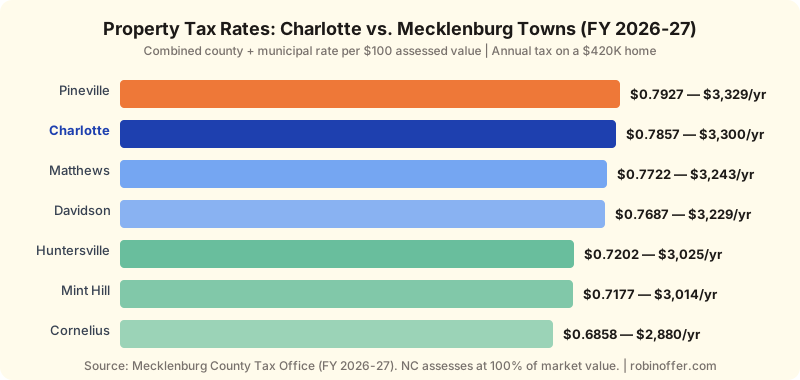
Recent change: Charlotte implemented a 1.89-cent property tax increase per $100 of assessed value for fiscal year 2026-2027, directed primarily toward public safety. The city rate rose from $0.2741 to $0.2930. Mecklenburg County held its rate steady at $0.4927.
For sellers, property taxes matter because they affect buyer affordability calculations. A buyer comparing a $420K home in Charlotte (annual tax $3,300) to a $420K home in Cornelius (annual tax $2,880) saves $420 per year on taxes alone — that is $35/month off their debt-to-income ratio. In a market where mortgage qualification is tight, that difference moves homes.
If you are over 65 and own your Charlotte home, check whether you qualify for the NC homestead exclusion — it exempts the first $25,000 of assessed value if your income is under $36,700. Our NC homestead exemption guide walks through the full qualification criteria.
12. What Charlotte Sellers Actually Keep After Closing
Closing Cost Breakdown — Charlotte Seller at $420K
| Cost Category | Amount | Notes |
|---|---|---|
| NC excise tax | $1,680 | $2 per $500 of sale price; state-mandated, no exceptions |
| Attorney/settlement fee | $1,000–$1,400 | NC requires attorney closings; fees vary by firm |
| Title search | $300–$500 | Confirms clear title; seller typically pays |
| Title insurance (owner's policy) | $400–$700 | Often optional but commonly offered to buyer |
| Survey | $400–$600 | Required if buyer's lender mandates it; negotiable |
| HOA transfer/disclosure docs | $150–$500 | If applicable; Charlotte has heavy HOA coverage |
| Recording fees | $50–$150 | County clerk charges |
| Prorated taxes | Varies | You owe from Jan 1 through closing date |
| Home warranty (if offered) | $400–$600 | Common buyer concession; optional |
| Total closing costs (excl. commission) | $4,380–$5,630 | ~1.0–1.3% of sale price |
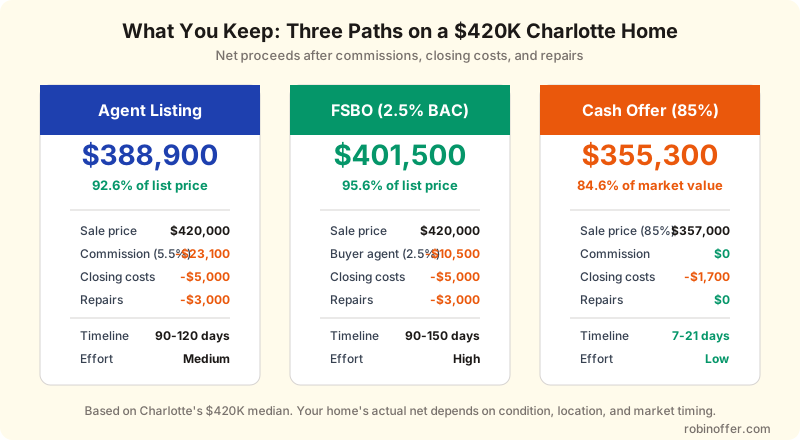
What You Keep: Three Scenarios
| Scenario | Sale Price | Commission | Closing | Repairs | Net to Seller |
|---|---|---|---|---|---|
| Agent sale (5.5% commission) | $420,000 | $23,100 | $5,000 | $3,000 | $388,900 |
| FSBO (2.5% BAC only) | $420,000 | $10,500 | $5,000 | $3,000 | $401,500 |
| Cash offer (85% of value) | $357,000 | $0 | $1,700 | $0 | $355,300 |
These scenarios use Charlotte's $420K median. Your property will differ. To see the net proceeds specific to your home, start with a home value estimate.
Want the net proceeds for your specific home?
We build a net proceeds comparison across agent listing, FSBO, and cash offer paths using your Charlotte address and neighborhood comps.
13. NC Disclosure, Due Diligence, and Charlotte's Unpermitted-Work Problem
North Carolina requires sellers to complete a Residential Property and Owners' Association Disclosure Statement (RPOADS). This is the form where you disclose known defects — roof age, foundation issues, pest history, water intrusion, environmental hazards, and any material facts that could affect value.
Charlotte sellers face three specific disclosure issues that suburbs often do not:
Charlotte-Specific Disclosure Challenges
| Issue | Why Charlotte Is Different | What You Must Do |
|---|---|---|
| Unpermitted work | Charlotte's older housing stock (pre-1990 homes in Dilworth, Plaza Midwood, NoDa) frequently has additions, finished basements, or HVAC replacements done without permits. The city's code enforcement team is active. | Disclose all known unpermitted work. Buyers will discover it during due diligence. Undisclosed unpermitted work is grounds for a lawsuit after closing. |
| HOA overlay | Charlotte has one of the highest concentrations of HOA-governed communities in NC. Ballantyne, Steele Creek, and University City subdivisions nearly all carry HOA obligations. | Provide HOA docs, current dues, special assessments, and reserve fund status. Buyers' lenders require this for underwriting. Budget $150-500 for the transfer package. |
| Flood zone proximity | Briar Creek, McAlpine Creek, and Little Sugar Creek corridors put parts of Dilworth, Sedgefield, and east Charlotte into FEMA flood zones. Post-2018 remapping expanded affected areas. | If any part of your lot is in a FEMA zone, it must be disclosed. Flood insurance costs ($1,500-4,000/yr) significantly reduce your buyer pool. |
NC Due Diligence Period
NC's due diligence period is unlike any other state. Here is the structure:
- Due diligence fee — a non-refundable payment from buyer to seller at contract signing. In Charlotte, this ranges from $1,000 to $10,000+ depending on price point. This is your money to keep even if the buyer walks away.
- Due diligence period — typically 14-30 days. During this time, the buyer can terminate for any reason and lose only the due diligence fee (not the earnest money deposit).
- Earnest money — held in escrow and refundable until the due diligence period expires, then applied to closing costs.
The key seller risk: during due diligence, the buyer can back out for $2,000-$5,000 (the DD fee) even if your home is perfect. This is NC law, not a negotiation — it protects buyers, and sellers must plan for it.
For sellers dealing with as-is conditions — deferred maintenance, foundation issues, aging systems — our NC as-is selling guide walks through how to price and position a home when repairs are not in the budget.
14. When Life Complicates the Sale: Probate, Divorce, and Pre-Foreclosure in Mecklenburg
Not every home sale happens because someone decided it was time. Sometimes life makes the decision for you. Here are the three most common forced-sale scenarios in Charlotte, with the Mecklenburg County specifics that matter.
Inherited Property and Mecklenburg County Probate
When a Charlotte homeowner dies, the estate goes through Mecklenburg County probate. NC filing costs: $120 base fee plus 40 cents per $100 of personal property and proceeds of realty sold through the estate (capped at $6,000). The NC creditor claim window is approximately 3 months from the date of notice to creditors.
Common Charlotte-specific complications:
- Multiple heirs who disagree. NC Chapter 46A governs partition. A cotenant can petition for partition, but actual physical division is the default — a sale is the exception. Under Section 46A-75, a court may order a sale only if division "cannot be made without substantial injury to any of the parties," and the burden is on the party seeking the sale. Do not assume "any heir can force a sale." That is a misstatement of the law.
- Deferred maintenance on inherited homes. Homes held by elderly owners often have 10-20 years of deferred maintenance. A cash buyer can close in 7-14 days without requiring repairs. An agent-listed sale will require at least a pre-inspection and probably $5,000-15,000 in repairs.
- Capital gains on inherited property. Heirs receive a stepped-up basis to the date-of-death value. If your parent bought the home for $120,000 in 1998 and it is worth $420,000 at death, your basis is $420,000 — no capital gains tax on an immediate sale at that price.
Our NC inherited property guide covers the full probate timeline, tax implications, and options for selling with or without all heirs in agreement.
Selling During a Divorce in NC
NC requires a 12-month separation before divorce is final. During that period, the home is typically the largest shared asset requiring division. At Charlotte's $420K median, equitable distribution could mean one spouse buying out the other for roughly $210,000 (half the equity after mortgage payoff) or selling and splitting the proceeds.
If neither spouse can afford the buyout and you need to sell, the options are the same as any seller — but the timeline is compressed by legal deadlines and the emotional weight of the situation. A cash sale can close in 2-3 weeks and remove the property from the divorce equation entirely. For the full legal and financial framework, see our Carolinas divorce selling guide.
Pre-Foreclosure in Mecklenburg County
NC foreclosure is primarily a power-of-sale (non-judicial) process. The timeline from first missed payment to foreclosure sale is typically 120-150 days. Mecklenburg County foreclosure filings have been rising — tracking the national trend as pandemic forbearance programs expired.
Your options before the sale date:
- Reinstate the loan — pay all past-due amounts plus fees.
- Loan modification — work with your servicer to restructure terms.
- Short sale — sell for less than the mortgage balance with lender approval.
- Cash sale — sell to an investor before the foreclosure date. This preserves your credit score relative to a completed foreclosure.
If you are behind on payments, our NC foreclosure avoidance guide lays out the full timeline and every option you have at each stage.
Mecklenburg County Foreclosure Resources
Mecklenburg County has several free resources specifically for homeowners facing financial distress. NCHFA (NC Housing Finance Agency) operates a foreclosure prevention hotline at 919-877-5700 and can connect you with HUD-approved counselors in Charlotte who will review your finances, contact your servicer, and help you evaluate options at no cost. This is not a sales pitch — HUD-approved counseling is federally funded and free.
Legal Aid of North Carolina provides free legal representation for qualifying Mecklenburg County homeowners facing foreclosure. If your servicer has sent a notice of default or you have received a hearing date, call 1-866-219-5262. They can review whether your servicer followed the required notice procedures and whether you have grounds to contest the timeline.
If you are a veteran, the NC Department of Military and Veterans Affairs can connect you with VA mortgage assistance programs that civilian homeowners do not have access to. Charlotte's military-connected population — through Fort Liberty (formerly Bragg) families and CLT airport-based PSA Airlines employees — makes this a relevant resource for more Charlotte homeowners than you might expect.
Renovation ROI in Charlotte: What Pays and What Does Not
If you are considering holding the home and renovating before selling, here is what the Charlotte market actually rewards. The Remodeling Magazine Cost vs. Value Report and local agent data suggest these returns for the Charlotte metro:
| Project | Typical Cost | Value Added | ROI | Worth It? |
|---|---|---|---|---|
| Garage door replacement | $4,500 | $4,200 | 93% | Yes — highest ROI, most visible curb appeal fix |
| Minor kitchen remodel | $28,000 | $22,000 | 79% | Yes — but only if the existing kitchen is genuinely outdated (pre-2005) |
| HVAC replacement | $8,000–$12,000 | $8,000–$10,000 | 75–90% | Yes — Charlotte buyers will walk from a 15+-year-old system |
| Bathroom remodel (mid-range) | $25,000 | $16,000 | 64% | Maybe — only if the bathroom is the worst room in the house |
| Major kitchen remodel | $80,000+ | $45,000 | 56% | No — you will not recover half the cost in most Charlotte neighborhoods |
| Swimming pool | $50,000–$80,000 | $15,000–$25,000 | 30–35% | No — pools narrow the buyer pool and add liability |
The general rule in Charlotte: cosmetic improvements (paint, hardware, landscaping, light fixtures) return 80-100% of cost. Structural or luxury improvements (pools, additions, major kitchen guts) return under 60%. If you have $10,000 to invest before selling, spend it on paint, deep cleaning, landscaping, and fixing anything a home inspector will flag. Do not spend it on a bathroom renovation.
15. Sell Your House in Charlotte NC: What Each Path Nets on a $420K Home
| Path | Estimated Net | Timeline | Effort | Best For |
|---|---|---|---|---|
| Agent listing (5.5%) | $388,900 | 90-120 days | Medium (prep + showings) | Well-maintained homes with time to sell; highest net for most sellers |
| FSBO (2.5% BAC) | $401,500 | 90-150 days | High (you handle everything) | Experienced sellers; investor-heavy markets; known buyer exists |
| Cash offer (85%) | $355,300 | 7-21 days | Low (no prep/showings) | Distress, inherited homes, deferred maintenance, tight timelines |
| Rent it out | $917/mo NOI (no mortgage) | Ongoing | High (landlord duties) | Free-and-clear owners; plan to return within 2-3 years |
| Renovate and hold | Varies by ROI | 6-12 months | Very high | Under-improved homes in appreciating neighborhoods (South End, NoDa) |
Net proceeds estimates assume Charlotte's $420K median, standard 2026 costs, and typical transaction terms. Your home's actual net depends on condition, location, and market timing.
16. Mecklenburg County Resources and Verified Contacts
Government Offices
| Office | What You Need It For | Contact |
|---|---|---|
| Mecklenburg County Tax Assessor | Property valuation, tax bill inquiries, revaluation appeals | tax.mecknc.gov | 980-314-4226 |
| Mecklenburg County Register of Deeds | Deed transfers, lien searches, deed-fraud alerts | mecknc.gov/deeds | 980-314-2500 |
| Mecklenburg County Clerk of Superior Court | Probate filings, estate administration | meckrod.manatron.com | 704-686-0400 |
| Charlotte Code Enforcement | Permit verification, code violations, retroactive permits | charlottenc.gov/code-enforcement | 311 |
| Charlotte-Mecklenburg Planning Department | Zoning verification, development plans, rezoning cases | charlottenc.gov/planning | 704-336-2205 |
Housing Counseling and Legal Resources
| Resource | What They Do | Contact |
|---|---|---|
| NC Housing Finance Agency (NCHFA) | Foreclosure prevention counseling, mortgage assistance programs | nchfa.com | 919-877-5700 |
| HUD Approved Counseling Agencies (Charlotte) | Free foreclosure counseling, budgeting, homebuyer education | hud.gov/findacounselor |
| Legal Aid of North Carolina | Free legal services for qualifying homeowners — foreclosure, landlord-tenant, probate | legalaidnc.org | 1-866-219-5262 |
| Mecklenburg County Bar Association | Lawyer referral service for real estate, probate, divorce | meckbar.org | 704-375-8624 |
| Charlotte Center for Legal Advocacy | Housing rights, discrimination complaints, wrongful eviction defense | charlottelegaladvocacy.org |
Charlotte-Specific Tools
| Tool | What It Shows You | URL |
|---|---|---|
| Mecklenburg County Property Tax Lookup | Your current assessed value and tax bill | tax.mecknc.gov |
| Charlotte Zoning Map | Your property's zoning designation and allowed uses | maps.charlottenc.gov |
| CLTfind (Charlotte Permit Search) | Building permit history for any Charlotte address | cltfind.charlottenc.gov |
| FEMA Flood Map Service Center | Whether your property is in a FEMA flood zone | msc.fema.gov/portal/search |
| Canopy MLS (via agent) | Comparable sales, active listings, market statistics | Available through your listing agent |
17. Run the Numbers for Your House
If you want to sell your house in Charlotte NC in 2026, this guide gives you the framework. The next step is plugging in your address, your home's condition, your timeline, and your financial situation to see which path works for you. We do that for free — no obligation, no pressure, just the math.
If you want to compare what an agent listing, FSBO, and cash offer would actually net on your specific Charlotte home, start with a home value estimate. If your situation is urgent — foreclosure timeline, inherited property, divorce deadline — and you want a cash offer with a close date you choose, fill out the form below. We will get back to you within 24 hours with a no-obligation number.
Charlotte is fifteen markets in one city. The right selling strategy depends on which one you are in, what your home looks like, and what your life needs right now. We are here to help you figure that out.
Data in this guide sourced from Canopy MLS (January 2026 regional report), Redfin, Zillow, Apartment List, Zumper, ATTOM Data, iBuyer.com Charlotte Investor Report (April 2026), Mecklenburg County tax records, the Virtuance Charlotte Property Tax Guide, and Capital Analytics Association. Market conditions change — verify current data before making financial decisions. This guide is for informational purposes and does not constitute legal, tax, or financial advice. Consult with a licensed attorney, CPA, or financial advisor for decisions specific to your situation.
Written by CC Evans, founder of RobinOffer. We buy houses for cash in the Charlotte metro area.
Want a cash offer on your Charlotte home?
Share your address and timeline and we will get you a no-obligation cash offer — free, no pressure, just the math.