
Selling Rental Property with Tenants in South Carolina
Five paths compared: investor sale, vacant listing, cash-for-keys, MLS with tenants, or cash buyer, with SC law, tax math, and real net proceeds for each.
1. Your Lease Is the Whole Ballgame
Selling rental property with tenants in SC turns on three things: your lease type, your tenant's cooperation, and which buyer pool you are targeting. Whether the tenancy is month-to-month or fixed-term determines which of five selling paths is available and which one nets you the most money.
Most landlord advice online treats "selling with tenants" as a single problem. It is not. A cooperative tenant on a month-to-month agreement is a completely different situation from a hostile tenant with eight months left on a lease. The path that nets you the most money depends on three variables:
- Lease type and remaining term. Month-to-month tenancies in South Carolina can be terminated with 30 days' written notice under the SC Residential Landlord and Tenant Act (S.C. Code Ann. Section 27-40-770). Fixed-term leases survive the sale, so the new owner inherits them.
- Tenant cooperation. A tenant who keeps the house clean and accommodates showings is an asset. A tenant who refuses access and lets the yard go is a liability that can cost you 10 to 20 percent of your sale price.
- Your target buyer. Investors want occupied properties with income. Retail buyers want vacant possession. You cannot market to both at the same time without confusing everyone.
This guide walks through five distinct paths for selling rental property with tenants in South Carolina, the laws that govern each one, and the math that tells you which path puts the most money in your pocket. We use York County and the South Carolina side of the Charlotte metro for our examples because that is where we operate, but the legal framework applies statewide.
A quick note on who this guide is for: we are writing for the SC landlord who owns one to five rental properties and is thinking about selling one or all of them. Maybe you are tired of the landlord life. Maybe you inherited a rental you never wanted. Maybe you are relocating and managing from out of state is burning you out. Or maybe the tenant situation has gotten bad enough that you just want out. Whatever your reason, there is a path, and the math will tell you which one makes the most financial sense for your specific situation.
2. SC Landlord-Tenant Law When You Sell: What Transfers, What Doesn't
South Carolina residential tenancies are governed by the South Carolina Residential Landlord and Tenant Act, found at S.C. Code Ann. Title 27, Chapter 40. If you own a rental in SC, this is the statute that controls notice periods, security deposits, access rights, and what a tenant is entitled to when the property changes hands. It is worth reading the sections that touch your sale before you list.
Start with the most important principle: a lease generally survives a sale. Under long-settled South Carolina property law, a valid lease is an interest in the property, and a buyer who takes title takes it subject to any existing lease. The lease does not vanish because you sold the house. The new owner steps into your shoes as landlord and must honor the tenant's remaining term. This is true whether or not the lease document mentions transferability. A buyer cannot evict a tenant simply because the property sold.
The Rules Every SC Landlord-Seller Must Know
| Rule | SC Authority | What It Means for Your Sale |
|---|---|---|
| A lease survives the sale | SC property law (buyer takes subject to the lease) | The buyer inherits any existing fixed-term lease and cannot evict a tenant just because they bought the property |
| Month-to-month: 30-day notice | S.C. Code Ann. Section 27-40-770 | Either party may terminate a month-to-month tenancy with at least 30 days' written notice before the termination date stated in the notice |
| Week-to-week: 7-day notice | S.C. Code Ann. Section 27-40-770 | A week-to-week tenancy requires at least 7 days' written notice to terminate |
| No self-help eviction | S.C. Code Ann. Section 27-40-660 | You cannot lock the tenant out, remove belongings, or shut off essential services. Only a magistrate's court order can force removal |
| Security deposits must be handled correctly | S.C. Code Ann. Section 27-40-410 | Deposits are either transferred to the buyer or accounted for and returned to the tenant, on a strict timeline |
Notice the headline difference from North Carolina: South Carolina requires 30 days' notice to end a month-to-month tenancy, not the 7 days that NC allows. If you have read NC landlord guides or you own property on both sides of the state line, do not carry the 7-day rule across the border. In SC, plan your month-to-month exit around a full 30-day notice period tied to the rental period.
Notice Requirements by Tenancy Type
| Tenancy Type | Notice to Terminate | SC Authority | Practical Impact on Your Sale |
|---|---|---|---|
| Week-to-week | At least 7 days | Section 27-40-770 | Rare for single-family rentals, but the fastest periodic exit |
| Month-to-month | At least 30 days | Section 27-40-770 | Standard path to vacant possession; give notice before the rental period you want to be the last |
| Fixed-term (6 mo, 1 yr, etc.) | Cannot terminate early | Lease governs | Sell with the tenant in place or wait for expiration |
That 30-day window is the reality for most SC single-family rentals, since month-to-month is the common holdover status once a fixed term ends. If your tenant is month-to-month and cooperative, you can realistically have vacant possession within roughly six to eight weeks: deliver a proper 30-day notice, give the tenant time to move, then list.
Showing the Property: What SC Law Actually Says
The Residential Landlord and Tenant Act gives you a right of access, but it is not unlimited. Under S.C. Code Ann. Section 27-40-530, a landlord may enter the unit to inspect, make repairs, or show the property to prospective buyers, and the statute directs the landlord to give the tenant at least 24 hours' notice of intent to enter and to enter only at reasonable times. The tenant is not to unreasonably withhold consent.
Here is the part most articles miss: the statutory access right helps, but a hostile tenant can still make showings miserable inside that framework. If your lease also includes a clear clause allowing showings during a sale, you are on firmer ground and can set expectations up front. If your lease is silent, you still have the 24-hour access right under Section 27-40-530, but you will get far better cooperation by negotiating a showing schedule with the tenant rather than leaning on the statute. That negotiation might involve a rent reduction or another incentive.
What Happens When a Tenant Won't Leave: The SC Ejectment Timeline
If a tenant refuses to vacate after proper notice, your only legal option is the court eviction process. In South Carolina this is called ejectment, and it runs through the magistrate's court under S.C. Code Ann. Title 27, Chapter 37 (Ejectment of Tenants). Self-help evictions, such as changing locks, removing belongings, or cutting off essential services, are prohibited under Section 27-40-660 and can expose you to tenant damages. Here is what the court process generally looks like:
| Step | What Happens | SC Authority |
|---|---|---|
| 1. Application | Landlord, agent, or attorney applies to the magistrate for ejectment | Chapter 37 |
| 2. Rule to Vacate | Magistrate issues a written rule requiring the tenant to vacate or show cause; the tenant has 10 days after service to respond | Section 27-37-20 |
| 3. No Response | If the tenant does not vacate or answer within 10 days, the magistrate issues a warrant of ejectment | Section 27-37-40 |
| 4. Hearing (if contested) | If the tenant answers, the magistrate hears the case like any other civil matter; either party may demand a jury | Sections 27-37-60, 27-37-80 |
| 5. Writ of Ejectment | If the landlord prevails, the magistrate issues a writ of ejectment, generally within 5 days, and the constable or sheriff removes the tenant | Section 27-37-100 |
An uncontested ejectment can move relatively quickly once the 10-day rule period runs. A contested case, where the tenant raises defenses such as improper notice, retaliation, or a failure-to-maintain claim, can stretch out for weeks or longer, especially if either side demands a jury or appeals. Between filing costs, service, possible attorney fees, and lost rent during the process, a contested SC eviction adds up in a hurry, which is exactly why the cash-for-keys route in Section 6 is so often cheaper and faster than fighting a hostile tenant in court.
3. Five Paths to Selling Rental Property with Tenants in SC
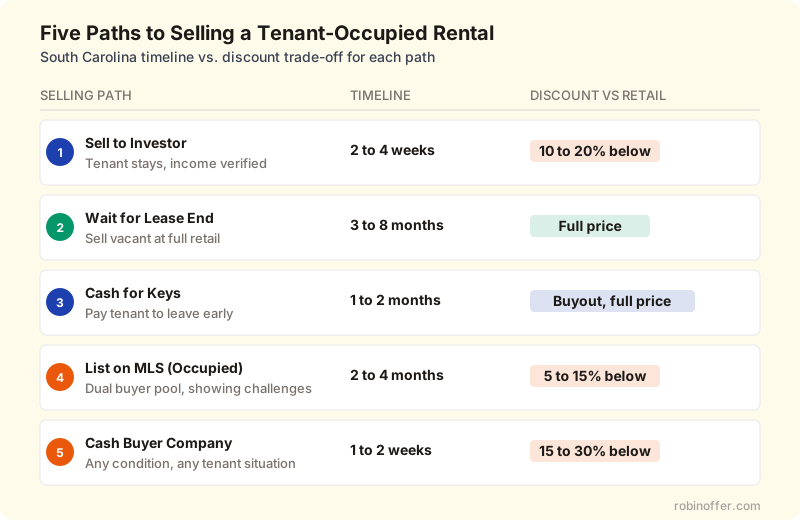
Every tenant-occupied sale falls into one of five paths. They are not equally good for every situation. The right one depends on your lease type, your timeline, and how much you are willing to leave on the table for speed.
| Path | Best When | Typical Timeline | Expected Discount vs. Vacant-Retail |
|---|---|---|---|
| Sell to investor (tenant stays) | Good tenant, below-market rent, you want speed | 2 to 4 weeks | 10 to 20 percent below retail |
| Wait for lease end, sell vacant | Lease expires within 3 to 6 months, strong retail market | 3 to 8 months total | Full market value |
| Cash-for-keys early exit | Fixed-term lease, cooperative tenant, you need speed | 1 to 2 months | Buyout cost but full market price |
| List on MLS with tenants | Cooperative tenant, house shows well, dual buyer pool | 2 to 4 months | 5 to 15 percent below retail |
| Sell to cash buyer company | Problem tenant, legal complexity, you need certainty | 1 to 2 weeks | 15 to 30 percent below retail |
We break down each path with real numbers in Sections 4 through 8. But first, a rule that applies to all five: tell your tenant before you list. South Carolina does not legally require you to notify a tenant that you are selling, but surprising them is a guaranteed way to turn a cooperative tenant into a hostile one. A five-minute conversation saves weeks of headaches.
4. Sell to an Investor with the Tenant in Place
This is the fastest path when you have a reliable tenant paying on time. Investors do not want vacant properties. They want income-producing assets with a track record. Your paying tenant is a feature, not a bug.
What Investors Look At (It Is Not Curb Appeal)
Retail buyers care about granite countertops and fresh paint. Investors care about three numbers:
| Investor Metric | What It Measures | Why It Matters |
|---|---|---|
| Net Operating Income (NOI) | Annual rent minus operating expenses (taxes, insurance, maintenance, vacancy reserve) | The income the investor is actually buying |
| Cap Rate | NOI divided by purchase price, the investor's yield | Sets the price an investor will pay for a given income stream |
| Cash-on-Cash Return | Annual cash flow divided by total cash invested | Measures return after financing |
Here is how the math works on an illustrative York County example. Say you own a 3-bedroom ranch renting for $1,500 a month. These figures are a worked example, not a market quote, so plug in your own numbers:
| Line Item | Annual Amount |
|---|---|
| Gross Rental Income | $18,000 |
| Property Taxes | -$1,900 |
| Insurance | -$1,200 |
| Maintenance Reserve (10 percent) | -$1,800 |
| Vacancy Reserve (5 percent) | -$900 |
| Property Management (8 percent) | -$1,440 |
| Net Operating Income | $10,760 |
At a 6.5 percent cap rate, an investor prices this property at $10,760 divided by 0.065, or roughly $165,500. If the same house would sell to a retail buyer for $200,000 vacant, you are looking at about a $34,500 discount, or roughly 17 percent. That is the premium you pay for speed and certainty.
Is it worth it? Sometimes, absolutely. If your monthly carrying costs (mortgage, taxes, insurance) run $1,500 or more and you are looking at months of waiting for the lease to expire and then listing, that gap narrows fast.
How to Market to Investors
Investors want documentation, not staging. Prepare these before you list or reach out to buyers:
- Rent roll with the current rent amount, payment history for the last 12 months, and any late payments or gaps
- Lease copy with all amendments and addenda
- Operating expense history, including property taxes, insurance premiums, and maintenance costs for two to three years
- Capital expenditure log for any major repairs or replacements such as roof, HVAC, or water heater, with dates
- Property condition notes, an honest assessment of deferred maintenance items
The tenant's payment track record is your selling point. An investor seeing 24 consecutive months of on-time payments will pay more than one looking at a ledger with gaps and late fees. If you have been sloppy about documenting rent collection, start organizing now. Bank statements showing deposits work as backup proof.
Where to Find Investor Buyers
Individual investors, not institutional funds, are the most likely buyers for a single-family rental in SC. Here is where to reach them:
- Local investor groups. Real estate investor associations across the Charlotte metro and Upstate hold regular meetings where active buyers look for deals. Walk in with your property package and you can get offers the same night.
- Investor-friendly agents. Some agents specialize in investment properties and maintain buyer lists, so they can market your property directly to qualified investors without a public MLS listing if you prefer discretion.
- Online investor marketplaces. Platforms like Roofstock and BiggerPockets let you list tenant-occupied properties specifically to investors, including out-of-state buyers looking for turnkey rentals with tenants already in place.
- Direct outreach. If your property sits in a neighborhood where other homes are investor-owned, those landlords may want to expand on the same street. A letter to neighboring rental owners costs almost nothing and occasionally produces the best offer.
The key difference from a traditional listing is that you are not competing on aesthetics. You are competing on yield. An investor who can earn 7 percent on your property will pay more than one who can only earn 5.5 percent, even if the houses are identical. Your job is to prove the income, not pretty up the kitchen.
Want to know what your rental property is worth?
Every selling path starts with an accurate value. Get a free estimate of your property's worth from ListRobin before you choose a route.
5. Wait for the Lease to Expire and Sell Vacant
If your lease expires within three to six months and the retail market is strong, waiting is usually the most profitable play. A vacant, staged home typically sells for several percent more than an identical tenant-occupied property, and it attracts the full buyer pool, not just investors.
The Carrying Cost vs. Premium Calculation
The math has to justify the wait. Here is an illustrative comparison using a $260,000 property renting at $1,600 a month with five months left on the lease:
| Factor | Sell Now to Investor | Wait 5 Months, Sell Vacant |
|---|---|---|
| Expected Sale Price | $221,000 (15 percent investor discount) | $260,000 (full retail) |
| Rent Collected During Wait | $0 | $8,000 (5 months at $1,600) |
| Carrying Costs During Wait | $0 | -$7,500 (mortgage, taxes, insurance) |
| Prep Costs (paint, carpet, staging) | $0 | -$3,500 |
| Agent Commission (5 to 6 percent) | $0 (direct sale) | -$15,600 |
| Net Proceeds | $221,000 | $241,400 |
| Time to Cash | 2 to 3 weeks | 7 to 8 months |
In this example, waiting nets you roughly $20,400 more, but it takes seven to eight months longer. Whether that is worth it depends on what else you are doing with your time and capital. If you are relocating, paying two mortgages, or dealing with a difficult tenant, speed might be worth $20,400.
The Non-Renewal Process
For fixed-term leases approaching expiration, you usually do not need to do anything special beyond declining to offer a renewal, but read your lease carefully. Many SC residential leases include an auto-renewal clause. Some convert to month-to-month at the end of the term, which is what you want. Others renew into another full fixed term unless you give written non-renewal notice by a stated deadline. Miss that deadline and you can be locked in for another year.
For month-to-month tenancies, issue the 30-day termination notice under S.C. Code Ann. Section 27-40-770. Deliver it before the start of the rental period you want to be the tenant's last, and use certified mail or personal delivery so you have proof if the tenant disputes it.
Turnover Prep: What Vacant-Possession Sales Need
Tenants do not maintain a home the way owners do. After move-out, budget for these common turnover items:
| Turnover Item | Typical Cost Range | Impact on Sale Price |
|---|---|---|
| Professional deep clean | $200 to $400 | Must-do; buyers notice immediately |
| Interior paint (full house) | $2,000 to $4,000 | Highest ROI prep item; often returns several times the cost |
| Carpet replacement or refinish floors | $1,500 to $4,000 | Required if visibly worn; FHA and VA appraisers flag stained carpet |
| Landscaping cleanup | $300 to $800 | Curb appeal drives first impressions and initial offer prices |
| Minor repairs (fixtures, patches, caulk) | $500 to $1,500 | Prevents inspection-driven renegotiation |
| Typical Total | $4,500 to $10,700 |
Turnover prep on a rental property typically runs several thousand dollars depending on how long the tenant lived there and how well they maintained the home. A tenant who has been there five years will need more work than one who moved in 18 months ago. This is a cost investors do not incur, which is part of why the investor-sale path looks increasingly attractive to landlords who do not want to deal with renovation.
6. Negotiate an Early Exit: The Cash-for-Keys Play
Cash-for-keys is exactly what it sounds like. You pay the tenant a lump sum to voluntarily terminate the lease early and move out by a specific date. It is not a legal process. It is a business negotiation. And in many cases it is the most cost-effective path to vacant possession when a fixed-term lease has significant time remaining.
What a Cash-for-Keys Deal Looks Like in SC
| Lease Time Remaining | Typical Buyout Range | What the Tenant Typically Gets |
|---|---|---|
| 1 to 3 months | $1,500 to $2,500 | Cash plus full security deposit return |
| 4 to 6 months | $2,500 to $4,000 | Cash plus deposit plus one month free |
| 7 to 12 months | $3,500 to $7,000 | Cash plus deposit plus moving assistance |
These ranges reflect what we commonly see in the Charlotte metro and broader SC market. They are negotiable. A tenant in a tight rental market with few options will negotiate harder. A tenant who was already thinking about moving might take less.
How to Structure the Agreement
Never hand over cash without a signed agreement. A cash-for-keys deal should include:
- A specific move-out date, a calendar date, not "within 30 days"
- Property condition requirements, with "broom-clean" as the minimum standard and all belongings removed
- A payment schedule, with half on signing and half on verified move-out as the standard structure
- A lease termination clause that explicitly states the lease ends on the move-out date
- Security deposit disposition, spelling out whether the deposit is returned in full or applied per the agreement
- A key return procedure covering all keys, garage remotes, and access cards at move-out
Have a South Carolina real estate attorney draft the agreement. SC does not provide a standard form for this. It is a custom contract, and a poorly drafted one can leave you exposed if the tenant takes the money and does not leave.
The Cash-for-Keys Conversation: How to Start It
The approach matters more than the number. Here is language that works:
"I have decided to sell the house. Your lease is valid and any new owner would honor it, so your housing is protected. But I am wondering if you would be open to a different arrangement. I would pay you [amount] plus return your full security deposit if you are willing to move out by [date]. This would give you cash to put toward your next place, and I would also help with [first month's rent at the new place / moving costs]. No pressure. If you would rather stay through the lease, that is your right and I respect it."
Two things make this work: acknowledging the tenant's legal rights first, so they do not feel threatened, and framing the buyout as a benefit to them (cash in hand) rather than as something you need from them. Landlords who lead with "I need you out" get worse outcomes than those who lead with "here is what I am offering."
When Cash-for-Keys Doesn't Work
This approach assumes a cooperative tenant. If your tenant is combative, behind on rent, or simply refuses to negotiate, cash-for-keys is off the table. You are left with two options: wait for the lease to expire, or sell to an investor who is willing to inherit the situation. Do not waste time or money trying to negotiate with someone who has no interest in leaving.
A special note on tenants who are behind on rent: you might think an ejectment makes more sense than paying a non-paying tenant to leave. Financially, it usually does not. A contested SC eviction takes weeks and costs real money in filing fees, service, attorney time, and lost rent. A modest cash-for-keys payment to a non-paying tenant who agrees to leave quickly is often cheaper, and you recover the property faster. Think of it as paying to stop the bleeding, not rewarding bad behavior.
7. List on the MLS with Tenants Still Occupying
This is the hardest path to execute well, but it preserves access to the largest buyer pool. You are marketing to both investors (who want the tenant) and retail buyers (who want the tenant gone). The challenge is managing showings, keeping the property presentable, and navigating a tenant who may or may not cooperate.
Why Tenant-Occupied Listings Take Longer
Tenant-occupied listings consistently attract fewer showings, fewer offers, and more days on market than vacant homes. The reasons are practical, not mysterious. A tenant's personal belongings make it harder for buyers to picture themselves in the home. Showing windows get restricted to times that work for the tenant. The yard and interior may not be maintained to sale standards. And many buyers, especially those using FHA or VA financing, simply scroll past occupied listings because they want vacant possession at closing.
Making It Work: Showing Logistics
Under S.C. Code Ann. Section 27-40-530 you have a right of access with at least 24 hours' notice, and a tenant is not to unreasonably withhold consent. But the statute is a floor, not a strategy. Here is what actually produces a clean showing experience:
- Limit showing windows. Agree on specific days and times, for example Tuesday and Thursday from 10 a.m. to 4 p.m. This respects the tenant's schedule and sets clear expectations for buyer agents.
- Offer a rent reduction. A $100 to $200 monthly discount during the listing period buys cooperation. It costs you far less than the price hit you take from a hostile-tenant showing experience.
- Give the tenant advance notice of each showing. Even though the law allows 24 hours, same-day surprises breed resentment. The more notice you give, the cleaner the house will be when buyers walk through.
- Consider a cleaning stipend. Paying a cleaning service before the first weekend of showings costs a couple hundred dollars and makes a real difference in buyer perception.
Pricing Strategy for Occupied MLS Listings
If you are listing with tenants, price for reality. An occupied home with restricted showings and belongings everywhere is not the same product as a staged, vacant home. Two common approaches:
- Price at retail minus 5 to 8 percent. This accounts for the showing limitations and buyer inconvenience and attracts savvy buyers and investors who are willing to work with the tenant situation.
- Price at full retail with a "vacant at closing" promise. If the tenant's lease expires before your expected closing date, you can market at full value with a clause guaranteeing vacant possession. This works when lease expiration and closing timing align, but if the tenant does not leave on schedule, you have a problem.
Work with an agent who has experience listing tenant-occupied properties. Not all agents do. RobinOffer is the buyer, not a licensed brokerage, so if you decide the listing path is right for you, our licensed SC agent partner Chamiese Evans can walk you through it, or you can bring your own agent. Either way, ask any agent how many occupied listings they have closed in the last two years before you sign a listing agreement.
Disclosure Requirements When Selling with Tenants
South Carolina requires sellers of most residential property to complete the South Carolina Residential Property Condition Disclosure Statement. Landlord sales carry a twist that owner-occupant sales do not: you may not have set foot in the property in months. Practically, that means:
- Tenant-reported issues are disclosable. If the tenant texted you about a leaky faucet, a broken window, or bathroom mold, those belong on the disclosure even if you have not personally inspected them. Texts and emails count as knowledge.
- You cannot claim ignorance on deferred maintenance. If you skipped annual HVAC service for three years, that is a known condition. Disclose it.
- Access limitations are not an excuse. If you cannot inspect because the tenant will not allow it, note that on the form, but still disclose everything you do know, including secondhand reports.
8. Sell to a Cash Buyer Company
When the tenant situation is complicated, such as back rent, property damage, lease disputes, or a tenant who simply will not cooperate, selling to a cash buyer company removes the landlord headache entirely. The buyer inherits the property, the lease, and the tenant. You walk away with a check.
How Cash Buyer Sales Work with Tenants
Cash buyer companies, including us at RobinOffer, purchase rental properties in a wide range of conditions and tenant situations. The process typically looks like this:
- Property evaluation. We assess the property value, current lease terms, tenant history, and condition. Sometimes this is done without entering the unit.
- Cash offer. You receive a written offer, usually within a couple of business days. The offer factors in the tenant situation, remaining lease term, and any deferred maintenance.
- Closing. If you accept, we can close on a short timeline, often in a week or two, with no appraisal, no financing contingency, and no lender-required repairs.
- Tenant transition. We notify the tenant of the ownership change and manage the relationship going forward.
The trade-off is price. Cash buyers offer below full retail, and tenant-occupied properties with complications sit at the lower end of that range. But when you factor in the alternative, which is months of carrying costs, potential eviction expenses, attorney fees, and lost rent, the gap narrows or disappears.
How Cash Offers Are Calculated for Tenant-Occupied Properties
Most cash buyers start with the after-repair value (ARV) of the property and work backward. For a tenant-occupied rental, the calculation shifts depending on the buyer's strategy:
- Hold-and-rent buyer. Prices based on cap rate and NOI, similar to an individual investor. The offer typically lands at the higher end of the cash range because they are keeping the tenant and avoiding turnover costs.
- Fix-and-flip buyer. Prices at ARV minus repair costs minus profit margin minus tenant removal costs. The offer lands lower because they are factoring in the time and cost of getting the tenant out, renovating, and reselling.
- Wholesale buyer. Prices lowest because they plan to resell the contract to another investor. Be cautious with wholesalers. Their offers are the lowest and their contracts often include assignment clauses that let them flip the deal without ever closing.
When you get a cash offer, ask the buyer directly: "Are you planning to keep the tenant or remove them?" Their answer tells you which formula they used and whether the offer makes sense relative to the property's actual value.
When a Cash Sale Makes the Most Sense
| Situation | Why Cash Sale Wins |
|---|---|
| Tenant behind on rent three or more months | Stops the bleeding immediately; no more lost rent or eviction costs |
| Property has code violations or deferred repairs | Cash buyer takes the property as-is; no repairs required |
| Out-of-state landlord | Eliminates remote management and repeated trips |
| Inherited rental with an unknown tenant | Buyer handles tenant research, lease review, and the relationship |
| Multiple properties in a portfolio exit | A single transaction, one closing, one check |
Several companies actively purchase tenant-occupied properties across South Carolina. We recommend getting at least three offers before accepting any one, because the spread between the highest and lowest can be $10,000 or more. For a deeper comparison of cash buyer types and how to evaluate their offers, read our cash offer guide for the Carolinas.
See what your rental is worth
Get a free, no-obligation estimate of your property's market value from ListRobin, the starting point for comparing your options.
9. The Tax Reality: Capital Gains, Depreciation Recapture, and the 1031 Escape Hatch
Selling a rental property triggers taxes that selling your primary residence does not. The Section 121 exclusion ($250,000 single, $500,000 married) that shelters most homeowner gains does not apply to investment property. When you sell a rental in South Carolina, you face a federal tax bill plus a state tax bill, and planning ahead can materially change what you keep.
The Federal Piece
| Tax Component | Rate | What It Applies To |
|---|---|---|
| Federal Long-Term Capital Gains | 15 to 20 percent | Sale price minus adjusted basis (the appreciation portion) |
| Depreciation Recapture | Up to 25 percent (federal) | Total depreciation claimed during ownership (unrecaptured Section 1250 gain) |
| Net Investment Income Tax | 3.8 percent | If your modified AGI exceeds $200,000 single or $250,000 married |
Depreciation recapture catches many landlords off guard. If you owned a rental for 10 years and claimed depreciation deductions along the way, that depreciation is taxed when you sell, at a federal rate up to 25 percent, regardless of your ordinary bracket. It is not optional. The IRS taxes the recapture whether you actually claimed the deductions or not. This is the "allowed or allowable" rule.
How South Carolina Taxes the Gain
South Carolina does not have a separate capital gains tax rate. Instead, it taxes capital gains as part of your income, but it gives investment-property sellers a meaningful break: South Carolina allows a deduction of 44 percent of net capital gain from assets held longer than one year. In other words, only 56 percent of a qualifying long-term gain is subject to SC income tax, at the state's graduated rates.
South Carolina's top marginal income tax rate has been on a downward path in recent years and sits in the low-to-mid 6 percent range for 2026. Because the exact top rate is being adjusted year to year under recent tax legislation, treat any single rate figure as approximate and confirm the current-year rate with your CPA. The structural point is what matters for planning: the 44 percent long-term deduction means your effective South Carolina rate on a long-term gain is well below the headline marginal rate.
A worked example, using round numbers rather than a promise of your exact bill: on a $100,000 long-term capital gain, South Carolina's 44 percent deduction removes $44,000, leaving $56,000 taxable at the state's graduated rates. That structure typically produces a low-single-thousands state tax figure on a gain of this size, far less than if the full gain were taxed. Depreciation recapture is treated as gain that flows through your federal return, so how much of it benefits from the state long-term deduction is fact-specific. Do not guess. Have a CPA run your actual numbers.
The 1031 Exchange: Defer Everything
A 1031 exchange lets you defer 100 percent of your federal capital gains and depreciation recapture taxes by reinvesting the proceeds into another investment property. South Carolina conforms to the federal 1031 rules, so the state tax is deferred along with the federal tax.
The timeline is strict:
- 45 days to identify replacement property after your sale closes
- 180 days to close on the replacement property
- Proceeds must go through a qualified intermediary. You cannot touch the money.
- The replacement property must be of equal or greater value to defer the full gain
A 1031 exchange only works if you are buying another investment property. If you are exiting real estate entirely, you pay the tax bill. This is why many landlords who planned to sell one rental and take a break end up exchanging into another property instead. The tax hit changes the calculus.
10. Security Deposits, Estoppels, and Closing Day Documents
The paperwork for selling a tenant-occupied property is more complex than a typical residential sale. Skip any of these documents and you invite post-closing disputes among you, the buyer, and the tenant.
Security Deposit Transfer (Governed by SC Law)
S.C. Code Ann. Section 27-40-410 governs security deposits in South Carolina. When you sell a rental property, you have two practical options:
- Transfer the deposit to the new owner. The buyer assumes responsibility for the deposit going forward. The deposit amount appears as a credit to the buyer on the closing statement, and the tenant should be notified in writing of the transfer and the new owner's information.
- Account for and return the deposit to the tenant. Under Section 27-40-410, once the tenancy ends and possession is delivered, the landlord must provide the tenant with an itemized written statement of any deductions and return any balance due within 30 days. If you go this route as part of the sale, the new owner then collects a fresh deposit from the tenant.
Two SC-specific points worth flagging. First, the tenant is required to give you a forwarding address in writing for the deposit accounting to run properly. Second, the penalty for getting this wrong is real: a landlord who wrongfully withholds a deposit can be liable to the tenant for up to three times the amount wrongfully withheld, plus attorney fees. Most closings use Option 1 because it is simpler for everyone, but make sure your closing attorney itemizes the deposit correctly on the settlement statement either way.
The Estoppel Certificate
An estoppel certificate is a document signed by the tenant confirming the key terms of their tenancy as of a specific date. It is not created by statute. It is a transactional protection that establishes exactly what the buyer is inheriting. A properly drafted estoppel confirms:
| Estoppel Element | What It Confirms | Why the Buyer Needs It |
|---|---|---|
| Current monthly rent | The exact amount the tenant is paying | Verifies the income the investor is buying |
| Lease term and expiration | Start date, end date, renewal terms | Confirms how long the tenant has the right to occupy |
| Security deposit amount | What the tenant originally paid | Confirms the liability being transferred |
| Prepaid rent | Any months paid in advance | Prevents the buyer from double-collecting |
| Outstanding disputes | Any claims, complaints, or repair requests | Discloses potential liabilities |
| Side agreements | Verbal promises such as pet permissions or parking | Prevents "but the landlord said I could" arguments |
If your lease includes a provision requiring the tenant to sign an estoppel certificate upon request, the tenant must comply, and refusal is a lease violation. If your lease does not include that provision, you will need to ask the tenant to sign voluntarily. Most cooperate when asked.
Assignment of Leases
At closing, you sign an Assignment of Leases document that formally transfers your rights and obligations as landlord to the buyer. Your closing attorney prepares this, but make sure it includes:
- All active leases and their key terms
- Security deposit amounts and transfer confirmation
- Any pending maintenance requests or repair obligations
- Tenant contact information
- A representation that you have disclosed all known lease-related issues
- HOA status, if the property is in a homeowners association, including any rental cap, landlord registration requirement, and whether the HOA estoppel and transfer fees are seller-paid or buyer-paid
Tenant Notification Letter
After closing, the tenant should receive written notification of the ownership change. This letter, usually sent jointly by buyer and seller, should include the new owner's name and contact information, where rent payments should now be sent, confirmation of the security deposit transfer, and assurance that the lease terms remain unchanged.
11. The York County and SC-Side Charlotte Metro Rental Market
If you are selling a rental on the South Carolina side of the Charlotte metro, in York or Lancaster County, you are operating in one of the fastest-growing corners of the region. Understanding how investors think about your property helps you price correctly regardless of which selling path you choose.
Why SC-Side Rentals Draw Investor Interest
Several structural factors keep investor demand strong for single-family rentals in this area:
- Population growth. York County has been one of South Carolina's fastest-growing counties for years, driven by Charlotte-commuter demand in Fort Mill, Tega Cay, Clover, and Lake Wylie. Growing rooftops mean a deep tenant pool, which investors like.
- Cross-border tax dynamics. Some Charlotte-area renters and investors weigh South Carolina's tax profile against North Carolina's. That interest supports demand for SC-side rentals.
- School-district pull. Highly regarded districts in parts of York County support both rents and resale values, which strengthens the case an investor can make on a property.
We are deliberately not quoting a single "current median" figure here, because rental and price data move quarter to quarter and a stale number does you more harm than good. Instead, pull live comparable rents and sale prices for your specific ZIP code before you set a price, and use the worked examples in Sections 4 and 5 as a framework rather than a market quote.
Matching Your Property to the Right Buyer
Where your property sits shapes who your most likely buyer is. A home in a premium, appreciation-driven submarket like Tega Cay or waterfront Lake Wylie tends to attract buyers who accept a lower cap rate in exchange for long-term value growth. A home in a more affordable, cash-flow-driven area tends to attract yield-focused investors who care most about the income and are less sensitive to finish level. Different buyers mean different marketing and different pricing. Identify which one your property serves before you list.
For neighborhood-level selling strategy in specific SC-side cities, we have published guides for Rock Hill, Fort Mill, Tega Cay, Clover, Lake Wylie, and York.
12. The Landlord Seller's Penalty Box: Eight Moves That Backfire
We have worked with landlords across the Carolinas. These are the mistakes we see over and over, and the ones that cost the most money.
1. Trying to Evict Instead of Negotiating
A contested SC ejectment takes weeks and stacks up filing costs, service, possible attorney fees, and lost rent. A cash-for-keys agreement is usually cheaper and faster. The math almost always favors negotiation. The only time eviction makes sense is when the tenant is actively damaging the property or will not respond to any communication.
2. Using North Carolina's 7-Day Rule in South Carolina
This one bites landlords who own on both sides of the state line or who read an NC guide by mistake. In North Carolina you can terminate a month-to-month tenancy with 7 days' notice. In South Carolina the requirement is 30 days under Section 27-40-770. If you serve a 7-day notice on an SC month-to-month tenant, it is defective, and you will have added weeks to your timeline.
3. Forgetting About the Auto-Renewal Clause
Many SC residential leases automatically convert to month-to-month, or in some cases renew for another full term, when the original term expires. If your lease renews into a fresh 12-month term and you miss the non-renewal deadline, you just added a year to your selling timeline. Read the renewal clause today, not when you are ready to list.
4. Mishandling the Security Deposit
Under Section 27-40-410, failing to properly transfer or account for and return a security deposit can expose you to liability of up to three times the amount wrongfully withheld, plus attorney fees. Your closing attorney should handle the transfer, but verify it appears correctly on the settlement statement, and make sure you have the tenant's written forwarding address if any balance is being returned.
5. Changing Locks or Shutting Off Utilities
Self-help eviction is illegal in South Carolina. Changing locks, removing doors, cutting water or power, or seizing the tenant's belongings all violate Section 27-40-660. The tenant can recover damages, and courts do not look kindly on landlords who bypass the legal process. No matter how frustrated you are, go through the magistrate's court.
6. Listing Without Telling the Tenant First
There is no SC law requiring you to notify a tenant before listing. But showing up with a photographer and a for-sale sign without a heads-up guarantees a hostile tenant, and hostile tenants sabotage showings. Five minutes of conversation prevents weeks of conflict.
7. Selling Without an Estoppel Certificate
When the buyer discovers after closing that the rent is lower than you represented, because the tenant has texts showing you agreed to a temporary reduction, you are going to hear from a lawyer. The estoppel certificate (Section 10) prevents this by getting the tenant's written confirmation of the lease terms. Skip it at your peril.
8. Not Running the 1031 Exchange Timeline
If you plan to reinvest in another rental, a 1031 exchange can defer a large tax bill, but you have to set it up before closing, not after. The qualified intermediary must be in place, and the sale proceeds can never touch your bank account. Landlords who close first and think about taxes second lose this option permanently.
13. Selling Rental Property with Tenants: Your Decision Framework
You have read the options for selling rental property with tenants in SC. Now pick one. This framework narrows five paths to one based on your actual situation, not what sounds good in theory.
Start With Three Questions
- What does your lease say? Month-to-month versus fixed-term determines which paths are even available.
- How fast do you need the money? Under 30 days eliminates everything except Path 1 (investor sale) and Path 5 (cash buyer).
- Is the tenant cooperating? A cooperative tenant opens all five paths. A hostile tenant limits you to Path 1, 2, or 5.
Decision Matrix
| Your Situation | Best Path | Expected Timeline | Net vs. Vacant Retail |
|---|---|---|---|
| Month-to-month, cooperative tenant, no rush | Serve 30-day notice, then sell vacant (Path 2) | 7 to 11 weeks | Full market value |
| Month-to-month, need speed | Sell to investor with tenant (Path 1) | 2 to 3 weeks | 80 to 90 percent of retail |
| Fixed-term, 1 to 3 months left, cooperative | Wait for expiration, then sell vacant (Path 2) | 2 to 5 months | Full market value |
| Fixed-term, 4 to 12 months left, cooperative | Cash-for-keys (Path 3), then sell vacant | 2 to 4 months | Full market minus buyout |
| Fixed-term, 4 to 12 months left, hostile tenant | Sell to investor or cash buyer (Path 1 or 5) | 1 to 4 weeks | 70 to 85 percent of retail |
| Good tenant, strong income, you want max speed | Sell to investor (Path 1) | 2 to 4 weeks | 80 to 90 percent of retail |
| Deferred maintenance plus tenant issues | Cash buyer company (Path 5) | 1 to 2 weeks | 70 to 85 percent of retail |
| Portfolio exit, multiple properties | Cash buyer company (Path 5) or investor bundle | 2 to 4 weeks | 75 to 85 percent of retail |
The Net Proceeds Comparison You Should Run
Before you pick a path, run this calculation for your specific property. Plug in your actual numbers, not averages from articles.
| Line Item | Your Numbers |
|---|---|
| Estimated sale price (on your chosen path) | $________ |
| Minus: mortgage payoff | -$________ |
| Minus: closing costs (1 to 3 percent seller-side) | -$________ |
| Minus: agent commission (if applicable, 5 to 6 percent) | -$________ |
| Minus: tenant buyout (if applicable) | -$________ |
| Minus: carrying costs until closing | -$________ |
| Minus: prep and repair costs (if selling vacant) | -$________ |
| Plus: rent collected during waiting period | +$________ |
| Estimated Net Proceeds | $________ |
Run this for two or three paths side by side. The best path is rarely the one with the highest sale price. It is the one with the highest net proceeds on the timeline that works for your life.
Real Scenario: Three Paths Compared for a $230,000 York County Rental
Let's put it together with a concrete example. You own a 3-bedroom, 2-bathroom home in York County with a tenant paying $1,500 a month. The lease runs through December 2026. It is June 2026. The home would sell for $230,000 to a retail buyer. The dollar figures below are illustrative, meant to show the shape of the decision rather than to quote your market.
| Factor | Path 1: Investor Sale Now | Path 3: Cash for Keys + Retail | Path 2: Wait for December + Retail |
|---|---|---|---|
| Sale Price | $195,500 (15 percent discount) | $230,000 | $230,000 |
| Tenant Buyout | $0 | -$3,500 | $0 |
| Rent Collected | $0 | $3,000 (2 months) | $9,000 (6 months) |
| Carrying Costs ($1,400/mo) | $0 | -$5,600 (4 months) | -$11,200 (8 months with listing time) |
| Turnover and Prep | $0 | -$5,500 | -$5,500 |
| Agent Commission | $0 | -$13,800 (6 percent) | -$13,800 (6 percent) |
| Estimated Net | $195,500 | $204,600 | $208,500 |
| Months to Close | About 1 month | About 4 months | About 8 months |
The gap between the fastest and slowest option is about $13,000, spread across roughly seven extra months. Whether those months are worth $13,000 to you is a personal decision. If you are a retired out-of-state landlord paying property management fees and fielding maintenance calls, Path 1 might be worth every penny of the discount. If you are local, patient, and have the cash for turnover prep, Path 2 gives you the most money.
If you want to see the math for your specific property, we will run the numbers for free. No pressure, no obligation, just the comparison that helps you decide. We buy rental properties throughout South Carolina, and we will tell you honestly if listing or waiting is the better move for your situation. You can reach RobinOffer at (704) 712-2717.
If your mortgage payoff exceeds your expected net sale price, or if a divorce or an inheritance adds another layer, our related guides cover those situations for the Carolinas: selling during a divorce, how probate works in South Carolina, and selling inherited property in South Carolina. If your property is in North Carolina rather than SC, read our companion guide to selling rental property with tenants in NC, since the notice periods and statutes differ between the two states.
Start with your property's value
Before comparing the five selling paths, get a free home value estimate from ListRobin so your numbers are grounded in reality.
14. Frequently Asked Questions About Selling a Tenant-Occupied Rental in SC
Can I sell a rental property with tenants still living in it in South Carolina?
Yes. A valid lease generally survives a sale in South Carolina, so a buyer takes the property subject to any existing lease. You can sell to an investor who keeps the tenant, list on the MLS, or sell to a cash buyer company. The tenant cannot be evicted simply because the property sold, and the new owner must honor the remaining lease term.
How much notice do I need to give a month-to-month tenant in SC before selling?
South Carolina requires at least 30 days' written notice to terminate a month-to-month tenancy under the SC Residential Landlord and Tenant Act (S.C. Code Ann. Section 27-40-770). The notice must be given before the termination date stated in the notice. This is different from North Carolina, which allows a 7-day notice.
When does a landlord have to return a security deposit in South Carolina?
Under S.C. Code Ann. Section 27-40-410, after the tenancy ends and possession is delivered, the landlord must provide an itemized written statement of any deductions and return any balance due within 30 days. When selling, the deposit is commonly transferred to the buyer as a closing credit instead. Wrongfully withholding a deposit can expose the landlord to up to three times the amount wrongfully withheld plus attorney fees.
What is a tenant estoppel certificate and why does it matter when selling a rental?
An estoppel certificate is a document the tenant signs confirming the key terms of their tenancy as of a specific date: current rent, lease term and expiration, security deposit amount, prepaid rent, and any side agreements. It protects the buyer by establishing exactly what they are inheriting and prevents post-closing disputes over rent amounts or verbal promises.
How much less will I get selling a tenant-occupied property vs. vacant in SC?
Selling to an investor with tenants in place typically brings 10 to 20 percent below vacant retail value. Listing on the MLS with tenants results in roughly 5 to 15 percent less due to fewer showings and longer days on market. Cash buyer companies offer more below retail but close quickly and handle the tenant situation.
This guide was written by CC Evans, founder of RobinOffer, and reflects South Carolina law as of July 2026. Real estate and landlord-tenant law change, and the facts of your situation matter. Talk to a licensed South Carolina real estate attorney and a CPA before making decisions based on this guide. RobinOffer is a home buyer, not a law firm or your attorney, and we are here to help you understand your options.