
Senior's Guide to Downsizing in NC
Property tax breaks, five paths forward, real downsizing math, Charlotte metro 55+ communities, and a 90-day action plan built for NC seniors.
Downsizing for seniors in NC means navigating property tax exclusions worth up to 50% off your bill, a $250,000/$500,000 capital gains shield, and a market where the median home is $375,000. This guide covers the real math and NC-specific rules most national articles skip.
Here's what I know from talking to hundreds of NC homeowners over 60: the house that raised your kids isn't the house that fits your life anymore. Maybe the stairs are getting harder. Maybe you're paying $3,200 a year in property taxes on bedrooms nobody sleeps in. Maybe your neighbors have all turned over and the block doesn't feel the same. Whatever the reason, you're here because you're weighing whether to stay or go, and you want the numbers before you decide. That's exactly what we're going to give you.
1. NC's Silver Tsunami by the Numbers
North Carolina isn't just aging, it's aging faster than almost every other state in the Southeast. Understanding where the numbers are headed helps you see why the market for downsizer homes is shifting right now.
| Demographic Metric | Current (2025) | Projected 2030 | Change |
|---|---|---|---|
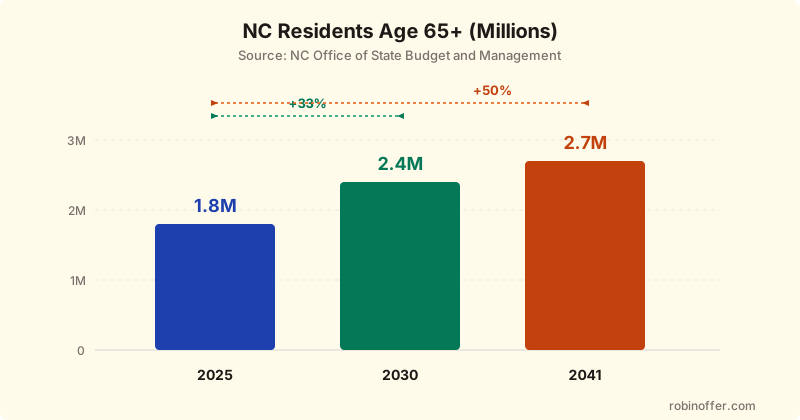
| NC residents age 65+ | 1.8 million | 2.4 million | +33% |
| NC residents age 85+ | 198,000 | ~250,000 | +26% |
| Counties with more seniors than children | 86 of 100 | 90+ of 100 | Growing |
| Homeownership rate, 65+ | 78.4% | ~78% | Stable |
| Median age of repeat homebuyer (NAR) | 62 years | All-time high |
That 78.4% homeownership rate is the highest of any age group, and it means roughly 1.4 million NC seniors own the home they're living in right now. According to the NC Office of State Budget and Management, the 65+ population will grow 50% to 2.7 million by 2041, with the six largest urban counties absorbing more than a third of that growth.
The growth isn't uniform across the state, either. Brunswick County on the coast has seen its 65+ population surge by 54% in the last decade, the fastest growth rate in NC. Dare County (the Outer Banks) grew by 49%, and Orange County (Chapel Hill) by 48.5%. Meanwhile, Onslow County near Camp Lejeune has the lowest share of seniors at just 10%, because the military population skews young. Transylvania County in the mountains has the highest share at 33%, one in three residents is 65 or older.
What does this mean for you? Two things. First, you're not alone, this is a generational wave, not a personal crisis. Second, the demand side of the equation is shifting. NAR's 2026 generational trends report found that baby boomers now make up 42% of all homebuyers and 55% of all sellers. The typical repeat buyer is 62 years old, the oldest on record. There's a massive cohort making the same decision you are, which means the market for smaller, single-story homes is getting competitive while the supply of larger family homes is growing.
The median monthly Social Security benefit in North Carolina is $1,657. For many seniors, that's their primary income, and it needs to cover housing, healthcare, food, and everything else. When your property taxes, insurance, and maintenance on a 2,400-square-foot house eat up $1,800/month, Social Security barely covers the roof over your head. That math is driving a lot of the downsizing conversation across the state.
Here's another way to think about it: the average annual cost to maintain a single-family home is $10,593. For a townhome, it's $8,759. For a condo, it's $3,258. That $7,335 annual gap between a single-family home and a condo equals $611 per month, more than a third of the median Social Security check. Over 10 years, that's $73,350 in maintenance costs you could redirect toward healthcare, travel, or simply living more comfortably.
2. What Your Home Is Actually Worth, and What You'll Keep
Before you can make any downsizing decision, you need to know three numbers: what your home will sell for, what you'll owe in taxes and fees, and what lands in your bank account after everything is settled.
The NC Market Right Now
| Market Indicator | NC Statewide (May 2026) | Trend |
|---|---|---|
| Median sale price | $375,000 | Up 1.0% YoY |
| Median days on market | 62 days | Up 11 days YoY |
| Months of supply | 5.59 | Balanced market |
| Homes sold (May) | 12,906 | Up 5.2% YoY |
| Sold above list price | 15.5% | Down 2.2 pts YoY |
| Active listings | 68,804 | Up 11.6% YoY |
A balanced market with 5.59 months of supply is actually good news for downsizing seniors. You're not in a panic-sell situation, and buyers aren't in a frenzy that makes your purchase stressful. You have time to plan. The rising inventory, up 11.6% year over year, means more options when you're shopping for your next place, too.
One thing to watch: homes are sitting 11 days longer than last year. That 62-day median matters when you're coordinating a sale, a purchase, and a move. Your timeline needs to account for the possibility that your house takes two months to sell, not two weeks.
Net Proceeds: The Number That Matters
Let's run the math on a typical NC senior's home. Say you've lived in your 3-bedroom ranch in the Charlotte metro for 22 years. You bought it for $185,000, put $40,000 into a kitchen remodel and new HVAC, and it's worth $380,000 today.
| Line Item | Amount | Notes |
|---|---|---|
| Sale price | $380,000 | Based on comparable sales |
| Agent commission (5%) | -$19,000 | Negotiable; some agents offer senior discounts |
| Closing costs (seller) | -$4,500 | ~1-2% typical in NC |
| NC excise tax | -$760 | $1 per $500 of sale price |
| Attorney fee | -$800 | NC requires attorney closings |
| Mortgage payoff | $0 | Paid off (common for 22-year homeowner) |
| Net proceeds | $354,940 | |
| Capital gain | $155,000 | $380K - $225K adjusted basis |
| Capital gains tax owed | $0 | Under $250K single / $500K married exclusion |
That $354,940 is your working number. It's what you have to fund whatever comes next, a smaller home, a condo, a 55+ community, or even a rental while you figure things out.
When the Tax Bill Isn't Zero
The Section 121 exclusion protects most sellers. But if you're single and your gain exceeds $250,000, or if you inherited the home and never lived in it, or if you converted it to a rental at some point, the math changes. NC taxes capital gains at a flat 3.99% on top of federal rates. On a $100,000 taxable gain, that's $3,990 to the state alone, plus 15% federal ($15,000) and potentially a 3.8% net investment income tax ($3,800). Total: $22,790.
For a deeper look at how NC taxes capital gains and the Section 121 exclusion rules, our capital gains tax guide for NC home sellers breaks down six real scenarios including inherited property and divorced sellers.
3. The Rate Lock Dilemma: When Your 2.8% Mortgage Feels Like Golden Handcuffs
If you refinanced or bought during 2020-2021, you might be sitting on a mortgage rate between 2.5% and 3.5%. Today's 30-year fixed rate is around 6.5%. That gap makes moving feel financially insane, even when the house no longer fits your life.
But here's what most articles about the "rate lock" miss: a huge percentage of NC seniors don't have a mortgage at all.
| Your Mortgage Situation | How Current Rates Affect You | Recommended Strategy |
|---|---|---|
| Mortgage-free (paid off) | No rate impact, you're buying with cash from equity | Strongest position; you can negotiate aggressively as a cash buyer |
| Low balance ($40K-$80K remaining) | Minimal, your equity covers the new home after payoff | Pay off remaining balance from sale proceeds, buy next home outright |
| Locked at 2.5-3.5% with $150K+ balance | Significant, new mortgage at 6.5% doubles your payment | Run the carrying cost comparison in Section 7; consider a bridge strategy |
| Underwater or tight equity | Selling may not generate enough for a down payment | Consider renting, staying put, or exploring a reverse mortgage (Section 6) |
According to NAR, older boomers stayed in their homes an average of 15 years before selling. For a 70-year-old who bought in 2010-2011 with a 30-year mortgage, they've made 15 years of payments and likely owe less than half the original balance. Many NC seniors in this cohort have less than $60,000 remaining, or nothing at all.
The Cash Buyer Advantage
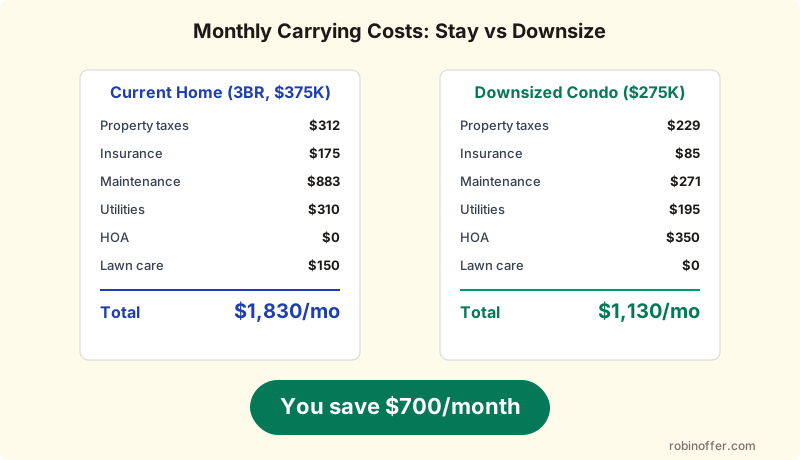
If you're mortgage-free, the rate discussion is irrelevant, and you have a superpower most buyers don't. You sell for $375,000, net roughly $350,000 after seller-side costs (commissions, closing costs, excise tax), and buy a $275,000 condo outright. No mortgage. No rate lock. You pocket the $75,000 difference and your monthly housing costs drop from $1,830 (taxes, insurance, maintenance, lawn care) to $1,130 (HOA, taxes, insurance).
Cash buyers also close faster (21 days vs. 45+ with a mortgage), which makes your offer more competitive. In a balanced market where homes sit for 62 days, sellers love the certainty of a cash close. You can often negotiate $5,000-$10,000 off the asking price by offering speed and certainty.
When You Do Have a Mortgage Balance
Let's say you still owe $120,000 at 3.2%. Your current P&I payment is about $520/month. If you sell for $375,000 and buy a $275,000 condo, you'd net roughly $230,000 after paying off the mortgage and covering transaction costs. That's enough to put $200,000 down on the condo, leaving a $75,000 mortgage at today's 6.5% rate, about $474/month. Your P&I actually drops by $46/month, plus you save on maintenance and utilities. The rate is higher, but the balance is so much lower that the payment shrinks anyway.
The breakpoint is when your remaining mortgage balance is large relative to your equity. If you owe $200,000 on a $375,000 home, your net after selling is roughly $150,000. A $275,000 condo would require a $125,000 mortgage at 6.5%, $790/month. That's $270/month more than your current payment. In that scenario, staying put might make more financial sense unless the lifestyle benefits of downsizing outweigh the cost.
4. Five Paths for Seniors Downsizing in NC
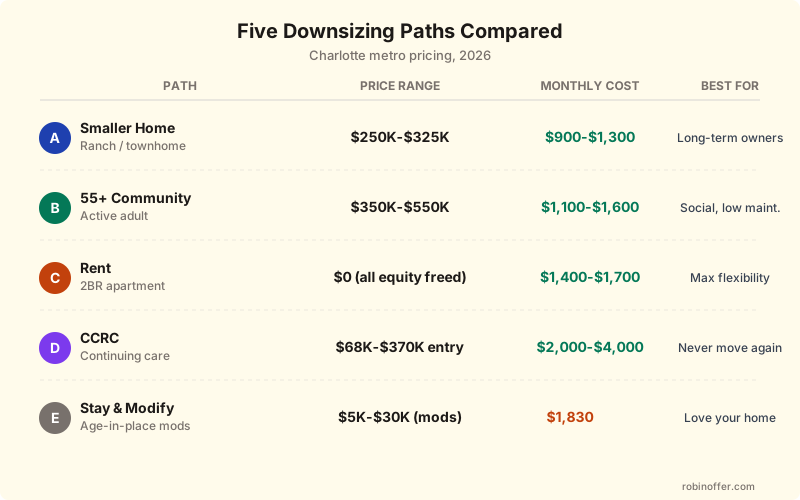
Downsizing for seniors in NC isn't one thing. It's five different decisions disguised as one word. Each path has different costs, timelines, tax implications, and lifestyle trade-offs. Let's walk through them with real NC numbers. (A sixth path is gaining ground in the Charlotte area: moving into a backyard unit on an adult child's property. See our piece on building an ADU for an aging parent in Charlotte.)
Path A: Buy a Smaller Home
The most common move. You sell the 3-bedroom and buy a 2-bedroom ranch, townhome, or patio home. In the Charlotte metro, a well-maintained 2-bedroom rancher runs $250,000-$325,000 depending on location and age. In the Triad or eastern NC, that range drops to $180,000-$260,000.
Best for: Couples or singles who want to own, want control over their space, and plan to stay 10+ years.
Watch out for: HOA fees in newer neighborhoods can run $200-$400/month. Factor that into your monthly budget, it eats into the "savings" from downsizing. Also check the age of major systems (roof, HVAC, water heater) in any resale home. Buying a "smaller" home with a 20-year-old roof just trades one maintenance headache for another.
The ideal scenario: you buy a 5-10-year-old home where the major systems still have life left. A 2015-built townhome in Matthews or Indian Trail gives you modern energy efficiency, a newer roof, and a one-car-garage lifestyle without the premium of new construction.
Path B: Move to a 55+ Active Adult Community
Charlotte metro has dozens of 55+ communities, Cresswind Charlotte, Regency at Palisades, Trilogy Lake Norman, and more. These are purpose-built for downsizers with one-story floor plans, included lawn care, and amenity packages (pools, fitness centers, pickleball courts, walking trails).
Best for: Social butterflies who hate yard work and want a built-in community of peers. Also ideal for people moving from out of state who don't have existing social networks in NC.
Watch out for: HOA fees typically run $250-$500/month and cover exterior maintenance, landscaping, and amenities. New construction in these communities starts around $350,000-$550,000 in the Charlotte metro. You're paying for the lifestyle, not just the walls.
One detail most people don't consider: resale values in 55+ communities can be tricky. When you buy new from a builder, you're competing against the builder's own inventory when you sell. If Del Webb is still selling new homes in Sun City for $400,000, your 5-year-old resale has to price below that or offer upgrades the builder doesn't include. Ask the community's resale agent about average resale timelines before you commit.
Path C: Rent and Free Up All Your Equity
Sell the house, pocket the full net proceeds, and rent. Average rent for a 2-bedroom apartment in Charlotte metro is $1,400-$1,700/month. In smaller metros like the Triad or Fayetteville, you can find $1,100-$1,400. Senior-specific apartment communities sometimes include utilities and basic services in the rent.
Best for: Seniors who want maximum flexibility, are unsure where they want to land permanently, or want to try a new area before buying. Also smart for anyone who might need assisted living within 3-5 years, renting preserves liquid assets you'll need for care costs.
Watch out for: Rent increases. NC has no statewide rent control. Your $1,400 apartment today could be $1,600 in two years. You're trading equity growth for liquidity. Also, many landlords require income verification, if your Social Security income is $1,657/month and rent is $1,400, you may need to show additional assets or have a co-signer.
There's a psychological element here too. After owning a home for 25-30 years, the transition to renting can feel like a step backward. It isn't, it's a strategic choice to prioritize flexibility and liquidity. But know that the emotional adjustment is real, and give yourself time to settle in.
Path D: Move to a CCRC (Continuing Care Retirement Community)
A CCRC offers a continuum of care, independent living, assisted living, skilled nursing, and memory care, all on one campus. NC has over 60 CCRCs, concentrated in Charlotte, Raleigh, the Triad, and Wilmington.
| CCRC Cost Component | NC Range | What It Covers |
|---|---|---|
| Entrance fee | $68,000-$370,000 | Buys your unit + access to higher levels of care |
| Monthly fee | $2,000-$4,000 | Housing, meals, housekeeping, transportation, activities |
| Assisted living (if needed later) | ~$6,350/month | Medication management, personal care, meals |
| Memory care (if needed) | $7,000-$9,500/month | Secure environment, specialized programming, 24-hour staff |
Best for: Seniors who want the "never have to move again" guarantee and can afford the entrance fee. CCRCs are also smart for couples where one spouse has health concerns, the healthy spouse gets independent living while the other can transition to assisted living on the same campus.
Watch out for: Read the refund policy carefully. Some CCRCs refund 50-90% of the entrance fee to your estate. Others refund nothing. That's a $200,000 difference in your estate plan. Also verify the community's financial health, request audited financial statements and check the NC Department of Insurance's records. A CCRC that goes bankrupt can leave residents scrambling. For more on protecting inherited assets and estate planning in NC, see our inherited property guide.
Medicaid planning alert: If you might need Medicaid-funded long-term care within 5 years, talk to an elder law attorney before paying a CCRC entrance fee. Medicaid's 5-year lookback period treats large asset transfers, including CCRC entrance fees, as potentially disqualifying. Paying $250,000 into a CCRC today could make you ineligible for Medicaid coverage in 2030 if you need it. This is one of the most expensive mistakes seniors make, and an elder law attorney can structure the transaction to minimize risk.
A portion of the entrance fee and monthly fee at most CCRCs qualifies as a medical expense deduction on your federal taxes. The community can tell you the exact percentage, it's usually 25-45% of the entrance fee. On a $250,000 entrance fee, that's $62,500-$112,500 in potential medical deductions, which can significantly offset your tax liability in the year you move in.
Path E: Stay Put and Modify
Sometimes the best move is no move. Age-in-place modifications, grab bars, walk-in showers, wider doorways, stair lifts, can cost $5,000-$30,000 depending on scope. That's a fraction of what it costs to sell, buy, and move.
| Modification | Typical Cost | What It Does |
|---|---|---|
| Grab bars (bathroom) | $100-$300 installed | Prevents falls, the #1 injury risk for seniors |
| Walk-in shower conversion | $3,000-$8,000 | Eliminates tub step-over; can include seat and handheld shower |
| Stair lift | $3,000-$6,000 | Keeps second floor accessible without climbing stairs |
| Wider doorways | $1,000-$2,500 per door | Accommodates walkers and wheelchairs (36" standard) |
| First-floor bedroom conversion | $5,000-$15,000 | Converts dining room or office to main-floor bedroom |
| Ramp (exterior) | $1,500-$4,000 | Eliminates front/back steps |
Best for: Seniors who love their home, their neighborhood, and their community, and whose home can be reasonably modified for accessibility.
Watch out for: Modifications address accessibility but not the ongoing cost of maintaining a larger home. Average annual maintenance on a single-family home runs $10,593 nationally. A townhome costs $8,759 and a condo just $3,258. That $7,335 annual gap between a house and a condo compounds to $73,350 over 10 years. Also consider: who's going to shovel the driveway, clean the gutters, and mow the lawn when you can't?
The NC Housing Finance Agency offers rehabilitation programs for low-income senior homeowners that can help fund accessibility modifications. Check with your county's aging services office for available programs, they vary by county and change annually.
Not sure which path fits your situation?
Every downsizing decision starts with knowing what your current home is worth. Get a free estimate from ListRobin to see where you stand.
5. NC's Senior Property Tax Breaks That Most Homeowners Miss
North Carolina offers two property tax relief programs specifically for seniors. Most qualifying homeowners never apply, either because they don't know about them or because the application process feels intimidating. Both programs are straightforward once you know the rules.
Program 1: The Elderly/Disabled Homestead Exclusion
| Requirement | Details |
|---|---|
| Age | 65 or older (or totally and permanently disabled) |
| Residency | NC resident, own and occupy the home as primary residence |
| Income limit (2026) | $38,800 or less (all sources, including Social Security) |
| What you get | Excludes the greater of $25,000 or 50% of assessed value from taxation |
| Application | File Form AV-9 with your county assessor by June 1 |
On a home assessed at $300,000, the 50% exclusion removes $150,000 from your tax base. At a combined city/county rate of $1.00 per $100 of assessed value, that's $1,500 in annual tax savings. Not life-changing, but $125/month matters when you're on a fixed income.
The income threshold is the stumbling block for many seniors. At $38,800, it's roughly $3,233/month. If you're receiving $1,657/month in Social Security plus a $1,800/month pension, your total income is $3,457/month ($41,484/year), just over the limit. Even a small IRA distribution can push you past the threshold. Know your number before you apply.
Program 2: The Circuit Breaker Tax Deferment
| Income Tier | Tax Cap | How It Works |
|---|---|---|
| Income at or below $38,800 | 4% of income | Taxes above the cap are deferred (not forgiven) |
| Income $38,801-$58,200 | 5% of income | Same, deferred taxes create a lien on the property |
The Circuit Breaker is more generous than the Homestead Exclusion for high-value homes, but there's a critical catch: deferred taxes aren't forgiven, they become a lien on your property. When you sell the home (or it transfers at death), the county collects every dollar of deferred taxes plus interest from the last three years. This directly reduces your heirs' inheritance or your net proceeds at sale.
Let's see how that plays out. A senior with $35,000 income and a $3,750 annual tax bill would pay just $1,400 under the Circuit Breaker (4% of $35,000). The remaining $2,350 is deferred each year. After 6 years, that's $14,100 in deferred taxes (before interest) sitting as a lien on your home. When you sell, that comes off the top of your proceeds.
NC lawmakers introduced legislation in 2026 to revamp these programs, potentially raising income thresholds and increasing exclusion amounts. Watch the General Assembly's session for updates.
Which Program Should You Choose?
You can't use both, you pick one. Here's a quick decision framework:
- Planning to stay 10+ years and never sell? The Circuit Breaker saves more money month-to-month. The deferred taxes become your heirs' problem (or get paid from the estate).
- Planning to sell within 5-7 years? The Homestead Exclusion is almost always better. Lower savings now, but no lien eating into your sale proceeds.
- Home value under $250,000? The Homestead Exclusion might save you more than the Circuit Breaker anyway, run the math both ways with your county tax office.
If you're weighing these tax breaks against the broader property tax picture, our property tax delinquency guide covers what happens when taxes go unpaid and your options at each stage. And for a detailed look at the NC homestead exemption's $35,000 protection limit in bankruptcy, see our homestead exemption guide.
6. The Reverse Mortgage Question: When Tapping Equity Without Selling Makes Sense
If you want to stay in your home but need cash, for modifications, medical bills, or just supplementing Social Security, a reverse mortgage lets you convert home equity into income without moving.
How the HECM Works
The Home Equity Conversion Mortgage (HECM) is the FHA-insured version of a reverse mortgage. Available to homeowners 62 and older, it lets you borrow against your home equity without making monthly payments. The loan balance grows over time and comes due when you sell, move out permanently, or pass away.
| HECM Feature | Details (2026) |
|---|---|
| Minimum age | 62 (based on youngest borrower or eligible spouse) |
| Maximum claim amount | $1,249,125 |
| How much you can borrow | 40-70% of home value (depends on age, rates, and value) |
| Monthly payments required | None, you pay property taxes, insurance, and maintenance |
| Repayment trigger | You sell, move out for 12+ months, or pass away |
| FHA insurance | Protects you if loan balance exceeds home value at sale |
When a Reverse Mortgage Makes Sense
- You want to stay in your home and neighborhood but need cash for modifications, medical bills, or income supplementation
- You have significant equity (at least 50% of the home's value) and modest or no existing mortgage balance
- You're not planning to leave the home to heirs or your heirs understand the loan will reduce their inheritance
- Social Security + pension isn't enough to cover monthly expenses, and a reverse mortgage line of credit can bridge the gap
When It Doesn't
- You plan to sell within 5 years, the upfront costs (origination fee, mortgage insurance premium, closing costs) can total $10,000-$20,000, making it an expensive short-term solution
- You can't maintain the home, falling behind on property taxes, insurance, or basic maintenance triggers default, even on a reverse mortgage
- Your heirs are counting on the home, the loan balance grows with interest and reduces the equity they'll inherit
The Numbers on a Typical NC HECM
Let's say you're 72, own a $375,000 home outright, and want a line of credit. At current rates, a HECM might give you access to roughly 45-50% of your home's value, about $168,750-$187,500. You don't take it all at once. You draw on it as needed: $800/month for income supplementation, or lump sums for medical bills and home modifications. Interest accrues only on what you've drawn, and the balance comes due when you sell or pass away.
The upfront costs are significant: a 2% FHA mortgage insurance premium ($7,500 on a $375,000 home), origination fees up to $6,000, and standard closing costs of $2,000-$4,000. Total: roughly $15,500-$17,500. Those costs can be rolled into the loan balance, but they reduce your available equity from day one.
Before applying, HUD requires counseling from an approved counselor. This isn't a formality, it's a genuine protection. The counselor walks through the costs, alternatives, and long-term impact on your estate. NC has HUD-approved counseling agencies in every region. Find one at hud.gov or call 800-569-4287.
7. The Downsizing Math: Real Costs Most Guides Won't Show You
Every downsizing article tells you you'll "save money by moving to a smaller home." Some of them are right. But the real math is more complicated than sale price minus purchase price. Here's what it actually costs to make the move, and when it doesn't save you a dime.
Transaction Costs (The Money You Spend to Move)
| Cost Category | Typical Range | Your Estimate (on $375K sale) |
|---|---|---|
| Real estate commission (selling) | 4.5-6% of sale price | $16,875-$22,500 |
| Seller closing costs | 1-2% of sale price | $3,750-$7,500 |
| Buyer closing costs (on new home) | 2-3% of purchase price | $5,500-$8,250 (on $275K) |
| Moving (local, full-service senior move) | $2,000-$5,000 | $3,500 |
| Decluttering / estate sale services | $500-$3,000 | $1,500 |
| New furniture (scaled to smaller space) | $2,000-$8,000 | $4,000 |
| Home prep / staging | $1,000-$3,000 | $1,500 |
| Total transaction costs | $36,625-$48,750 |
That's roughly $37,000 to $49,000 that evaporates in the process of moving. On a $375,000 sale with a $275,000 purchase, your "profit" of $100,000 shrinks to $51,000-$63,000. Still worth it in most cases, but only if you stay in the new home long enough to recoup the transaction costs through lower monthly expenses.
Monthly Carrying Cost Comparison
| Monthly Expense | Current Home (3BR, $375K) | Downsized Condo ($275K) | Monthly Savings |
|---|---|---|---|
| Mortgage payment (P&I) | $0 (paid off) | $0 (cash purchase) | $0 |
| Property taxes | $312 | $229 | $83 |
| Homeowner's insurance | $175 | $85 | $90 |
| Maintenance and repairs | $883 | $271 | $612 |
| Utilities (electric, water, gas) | $310 | $195 | $115 |
| HOA fee | $0 | $350 | -$350 |
| Lawn care / landscaping | $150 | $0 (included in HOA) | $150 |
| Total monthly | $1,830 | $1,130 | $700 |
At $700/month in savings, you'd recoup $43,000 in transaction costs (the midpoint) in about 61 months, just over 5 years. If you plan to live in the new home for 7-10 years, the move pays for itself and then some. If you're 82 and might need assisted living in 3 years, the math gets tighter.
The 10-Year Comparison
Let's extend the math to see the full picture over a decade:
| Financial Outcome | Stay in Current Home | Downsize to Condo |
|---|---|---|
| Transaction costs | $0 | $43,000 (one-time) |
| Monthly housing costs (10 years) | $219,600 | $135,600 |
| Major maintenance reserve | $25,000 (roof, HVAC, etc.) | $5,000 (appliances) |
| Equity retained (approximate) | $375,000 (home value) | $275,000 + $75,000 cash |
| Total 10-year cost | $244,600 | $183,600 |
| Net savings from downsizing | $61,000 |
Downsizing saves $61,000 over 10 years in this scenario, and that's before accounting for the $75,000 in freed-up equity sitting in your savings account earning interest. At even a modest 4% annual return, that $75,000 generates $3,000/year in additional income.
For a detailed breakdown of what sellers pay at closing in NC, our seller closing costs guide walks through every line item including attorney fees, excise tax, and prorated taxes.
What is your home worth today?
Get a free, no-obligation estimate of your home's market value from ListRobin — the first number you'll need for any downsizing plan.
8. Charlotte Metro 55+ Communities: Where NC Seniors Are Landing
The Charlotte metro area has become one of the top destinations in the Southeast for 55+ living. South Charlotte, Matthews, Waxhaw, and the Lake Norman corridor all have purpose-built communities, and new ones break ground every year. Here's what the landscape looks like in 2026.
Active Adult Communities by Area
| Community / Area | Location | Price Range | Monthly HOA | Key Features |
|---|---|---|---|---|
| Cresswind Charlotte | South Charlotte | $400K-$600K | $250-$350 | 55+, clubhouse, pool, pickleball, fitness |
| Regency at Palisades | South Charlotte | $450K-$700K | $300-$450 | 55+, golf, lake access, gated |
| Trilogy Lake Norman | Denver / Lake Norman | $400K-$650K | $275-$400 | 55+, resort-style, lake access |
| Sun City Carolina Lakes | Indian Land, SC | $300K-$500K | $175-$300 | 55+, Del Webb, 3 pools, 36 holes golf |
| Matthews / Waxhaw resale | Union County corridor | $275K-$425K | $100-$250 | Established neighborhoods, ranch-style homes |
| Gaston County corridor | Belmont, Gastonia, Mt. Holly | $225K-$350K | $75-$200 | Value-priced ranches, smaller lots, close to I-85 |
Notice the price ranges. A new-construction 55+ home in South Charlotte or Lake Norman starts north of $400,000. If your current home sells for $375,000 and you net $350,000, you're looking at either a smaller unit in these premium communities, turning to the resale market in Matthews/Waxhaw, or exploring the Gaston County corridor where $225,000-$350,000 buys a well-maintained 2-bedroom ranch with a much lower HOA.
For seniors considering the SC side of the border, Indian Land's Sun City community offers Del Webb homes at Charlotte metro prices with South Carolina's lower property tax rates. Our Indian Land selling guide breaks down the new-construction competition that affects resale pricing. Belmont and Gastonia on the NC side offer similar value, see our Gastonia guide for the full market breakdown.
Beyond Charlotte: Other NC Metros
The Triangle (Raleigh-Durham-Chapel Hill) and the Triad (Greensboro-Winston-Salem) both have strong 55+ markets, typically 15-25% less expensive than Charlotte for comparable homes. Asheville attracts retirees who want mountain living and a vibrant arts scene but carries higher home prices than much of western NC. Wilmington and the Brunswick County coast draw seniors who want beach proximity, and Brunswick County's 54% growth in 65+ population over the last decade proves the appeal.
| NC Metro Area | Median Home Price | 55+ Community Availability | Key Draw for Seniors |
|---|---|---|---|
| Charlotte metro | $390,000 | Extensive, 30+ communities | Healthcare access, airport, professional sports, family proximity |
| Raleigh-Durham (Triangle) | $415,000 | Strong, 20+ communities | Duke/UNC medical campuses, cultural amenities, research economy |
| Greensboro-Winston (Triad) | $275,000 | Growing, 10+ communities | Affordability, central location, slower pace |
| Asheville | $430,000 | Limited, mountain terrain | Mountain climate, arts and food scene, outdoor recreation |
| Wilmington / Brunswick County | $350,000 | Moderate, coastal communities | Beach lifestyle, mild winters, boating |
| Pinehurst / Southern Pines | $325,000 | Strong, golf-oriented CCRCs | Golf, mild climate, established retirement destination |
If you're open to relocating within NC, the value gap can be significant. A $350,000 condo in South Charlotte buys a $275,000 home with a larger lot in Greensboro or a waterfront condo in New Bern. Geography is leverage, use it. And don't overlook Pinehurst and Southern Pines in Moore County. The Sandhills region has been a retirement destination for decades, with mature CCRCs, world-class golf, and home prices that undercut the major metros.
The SRES Advantage
When choosing a real estate agent for your downsizing move, look for a Seniors Real Estate Specialist (SRES). This NAR designation means the agent has completed training specific to the needs of homeowners 50 and older, including understanding tax implications, estate considerations, and the emotional dynamics of selling a long-held family home. They'll also have a network of senior-focused service providers: estate sale coordinators, move managers, elder law attorneys, and financial planners. Your county association of REALTORS can help you find SRES-designated agents in your area.
9. 30 Years of Stuff: The Decluttering Reality Nobody Prepares You For
You bought this house when your kids were in elementary school. Now the kids are 40 with families of their own, and you're staring at a basement full of holiday decorations, a garage with your late husband's tools, and a guest bedroom closet that hasn't been opened since 2019. The decluttering phase of downsizing is where most seniors stall, not because they don't want to move, but because 30 years of accumulation feels impossible to sort through.
The Four-Box Method
Professional organizers and senior move managers almost universally recommend the four-box method: Keep, Donate, Sell, Discard. Get four boxes or bins, pick one room, and sort everything into those four categories. Don't move to the next room until the current one is done. One room per day is sustainable. Two rooms is ambitious. Trying to do the whole house in a weekend leads to exhaustion and paralysis.
What's Worth Selling vs. Donating
| Item Category | Likely Value | Best Approach |
|---|---|---|
| Furniture (antiques, quality wood) | $50-$2,000+ per piece | Consign to estate sale company or sell individually on Marketplace |
| Furniture (mass-market, 10+ years old) | $10-$100 | Donate or include in estate sale lot |
| Collectibles (china, crystal, silverware) | Varies wildly | Get appraised first; younger buyers rarely want grandma's china |
| Tools and workshop equipment | $20-$500+ per item | Sell specialty tools individually; donate the rest |
| Books | $0.25-$2 each (most) | Donate to library; rare/first editions get appraised |
| Clothing | Minimal resale value | Donate to Goodwill, Salvation Army, or local church |
| Holiday decorations | $5-$20 per box | Let kids pick what they want, donate the rest |
A professional estate sale typically nets 25-35% of retail value on higher-end items. The estate sale company handles pricing, marketing, and running the sale, their commission is 30-40% of proceeds. On a well-stocked 3-bedroom home, an estate sale might gross $3,000-$8,000. After the company's cut, you keep $1,800-$5,600. Not a fortune, but it covers moving costs and saves you dozens of hours of work.
The Emotional Weight
Here's what the organizational experts don't always address: letting go of your stuff is grief work. Your daughter's first drawing that's been on the fridge since 1996. Your husband's favorite chair. The Christmas ornaments your mother hand-painted. These aren't "items", they're anchors to people and moments you love.
Give yourself permission to keep the things that truly matter. Photograph the rest. A phone full of photos takes up zero closet space but preserves every memory. Several of our sellers have created digital albums of their favorite pieces before donating them, the physical item leaves, but the memory stays. One couple in Belmont photographed every room of their house before packing, arranged the photos into a book, and keep it on their coffee table in their new condo. They say they look at it more than they ever looked at the rooms themselves.
Professional senior move managers can be a lifesaver here. Companies like Caring Transitions, Gentle Transitions, and local NC operations specialize in helping seniors sort, pack, and move. They handle the estate sale coordination, the donation pickups, the junk removal, and the unpacking at the new place. Full-service senior move management typically runs $2,000-$5,000 depending on the size of the home and the scope of services. For a 3-bedroom house with 25+ years of accumulation, it's often money well spent, especially when the alternative is six months of weekends sorting through boxes while your energy and motivation drain away.
And have the family conversation early. Don't assume your kids want the dining room table, ask them. Most adult children have furnished their own homes and don't have room for yours. That's not rejection; it's just a different generation with different taste and smaller houses. Better to know now than to store things for years assuming someone wants them.
10. Estate Planning and Your Home: The Talk You Can't Keep Putting Off
This is the section nobody wants to read but everybody needs. Your home is probably your largest asset. What happens to it if you can't manage it anymore, or after you're gone, depends entirely on paperwork you do (or don't do) while you're healthy and competent.
The Power of Attorney Question
Under North Carolina law, a Durable Power of Attorney for financial matters allows your designated agent to sell your home, manage your bank accounts, and handle real estate transactions if you become incapacitated. Two critical rules:
- You must sign while you have capacity. If you wait until after a stroke, dementia diagnosis, or hospitalization, it's too late. Your family would need to pursue guardianship through the courts, a process that costs $3,000-$10,000 and takes months.
- The POA must be recorded with the Register of Deeds before any real estate transfer. Your agent can't just show up at closing with an unrecorded document.
NC law recognizes two types relevant here: a general durable POA (for financial and legal matters) and a health care POA (for medical decisions). You need both. They're separate documents and typically cost $300-$500 total through an elder law attorney. Many attorneys will prepare both along with a will and advance directive in a single estate planning package for $500-$1,200.
How Your Home Transfers at Death
| Ownership Structure | What Happens at Death | Probate Required? |
|---|---|---|
| Sole ownership, with a will | Goes through NC probate (Clerk of Superior Court) | Yes, 6-12 months typical |
| Sole ownership, no will | NC intestacy rules determine heirs | Yes, often complicated |
| Joint tenancy with right of survivorship | Passes automatically to surviving owner | No |
| Tenancy by the entirety (married couples) | Passes to surviving spouse | No |
| Transfer-on-death deed (NC, since 2023) | Passes to named beneficiary automatically | No |
| Revocable living trust | Passes per trust terms, no probate | No |
If you're downsizing and buying a new home, how you title that new property matters enormously. A married couple buying as tenants by the entirety avoids probate and protects the home from individual creditors. A single senior buying solo should consider a transfer-on-death deed (NC enacted these effective January 2024) or a revocable trust to keep the property out of probate. The transfer-on-death deed is simpler and cheaper, you file it at the Register of Deeds, name a beneficiary, and retain full ownership and control during your lifetime.
The Stepped-Up Basis and Inherited Property
When heirs inherit your home, they get a "stepped-up" cost basis equal to the home's fair market value at the date of your death. If you bought the home for $125,000 in 1998 and it's worth $375,000 when you pass, your heirs' basis is $375,000. If they sell it for $380,000, their taxable gain is just $5,000, not $255,000.
This matters for your downsizing decision. If you sell, pocket the cash, and buy a smaller home, your heirs inherit the smaller home at its stepped-up value. If you stay, they inherit the larger home at its stepped-up value. Either way, the step-up applies, but the total estate value and the simplicity of inheritance differ.
One scenario to watch: if you sell your $375,000 home and pocket $80,000 in cash after buying a $275,000 condo, that $80,000 in cash is part of your estate but doesn't get a step-up. If instead you kept the $375,000 home, your heirs get the full stepped-up basis on a larger asset. This is one reason some seniors with significant unrealized gains choose to stay, they're effectively giving their heirs a bigger tax-free inheritance.
11. The 90-Day Downsizing Playbook for NC Seniors
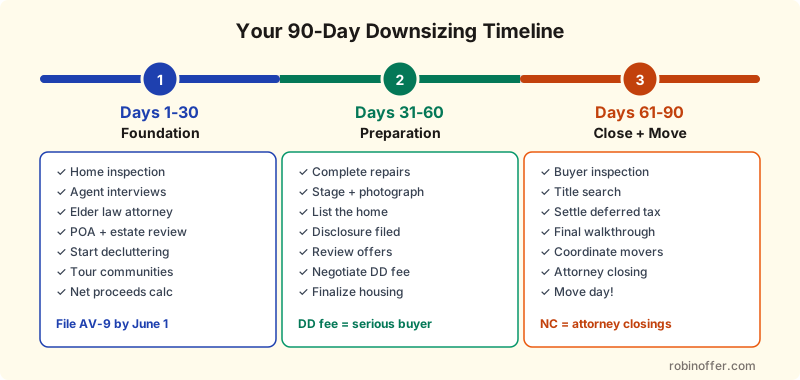
You've decided to move. Now what? Here's a week-by-week action plan that accounts for the NC-specific steps most generic guides miss.
Days 1-30: Foundation
| Week | Action Items | NC-Specific Notes |
|---|---|---|
| Week 1 | Get a home inspection on your current home; call 2-3 agents for a market analysis | Look for a Senior Real Estate Specialist (SRES), they're trained for exactly this type of transaction |
| Week 2 | Meet with an elder law attorney (POA, will, trust review); check Homestead Exclusion status with county | File Form AV-9 by June 1 if you haven't already; your POA must be in place before listing |
| Week 3 | Start decluttering one room per day; get estate sale quotes; photograph sentimental items | NC has strong estate sale companies, check references; typical commission is 30-40% |
| Week 4 | Run net proceeds calculation with your agent; tour 3-5 potential new homes or communities | Ask about NC excise tax ($1 per $500 of sale price), attorney fees, and prorated property taxes |
Days 31-60: Preparation
| Week | Action Items | NC-Specific Notes |
|---|---|---|
| Week 5 | Complete repairs identified in inspection; address cosmetic issues (paint, carpet, landscaping) | NC's seller disclosure form requires you to disclose known defects, fix what you can, disclose what you can't |
| Week 6 | Stage the home (or at minimum, declutter aggressively); get professional photos taken | Staging costs $1,000-$3,000 in NC markets; vacant homes sell 15-20% slower |
| Week 7 | List the home; schedule open house; finalize your new housing plan | NC's due diligence period gives buyers an inspection window, your agent should price this into the timeline |
| Week 8 | Review offers; negotiate due diligence fee and closing date | In NC, the due diligence fee is non-refundable to the buyer, a higher fee signals a stronger offer |
Days 61-90: Closing and Transition
| Week | Action Items | NC-Specific Notes |
|---|---|---|
| Week 9 | Buyer's home inspection; negotiate any repair requests or credits | You can offer a credit instead of making repairs, often easier for sellers who are packing up |
| Week 10 | Title search ordered; confirm clear title; resolve any outstanding lien issues | If you've been on the Circuit Breaker, deferred taxes are settled at closing from your proceeds |
| Week 11 | Final walkthrough by buyer; pack remaining items; coordinate movers | Senior move managers handle everything from packing to unpacking, typical cost $2,000-$5,000 |
| Week 12 | Close on sale; close on purchase (or sign lease); move day | NC closings happen through attorneys, not title companies. Your attorney reviews all documents before you sign. |
After the Move: The First 30 Days
The logistics don't end at closing. In the first month after your move:
- Update your address with Social Security, Medicare, your bank, insurance companies, and the USPS. Set up mail forwarding.
- Transfer utilities, cancel at the old address and confirm start dates at the new one. If moving to a condo or 55+ community, confirm what's included in the HOA.
- Update your estate plan. Your new home needs to be reflected in your will, trust, or transfer-on-death deed. Your attorney can update this quickly.
- Check in with yourself. The first two weeks in a new place can feel disorienting, especially if you've lived in one home for decades. Join a community activity, introduce yourself to neighbors, and maintain your existing routines as much as possible. The adjustment period is real, give it 60-90 days before you decide whether you love it or hate it.
12. Start With One Number
If you've read this far, you're seriously considering downsizing as a senior in NC, and you're weighing a real decision about the next chapter of your life. So here's my suggestion: start with one number.
Get a no-obligation market analysis on your current home. Not a Zillow estimate, a real analysis from someone who knows your neighborhood, your street, and what buyers are paying right now. That number tells you what you're working with. It tells you whether the condo, the 55+ community, the CCRC, or the stay-and-modify path is financially realistic for your situation.
Every path in this guide, the five options, the tax breaks, the reverse mortgage math, the transaction costs, the 90-day timeline, starts with knowing what your home is worth today. Once you have that number, the rest of the decisions fall into place. You'll know if you can buy outright with cash. You'll know if the freed-up equity covers a CCRC entrance fee. You'll know whether staying put and modifying is the smarter financial play.
If you want us to run those numbers for your home, net proceeds after all costs, tax implications including the Homestead Exclusion and capital gains, and a side-by-side comparison of your options, we'll do it for free. No sales pitch. No obligation. Just the math you need to make a decision that fits your life right now, not the life you had 20 years ago.
And don't go it alone. Build your team before you need them: a SRES-designated real estate agent who understands senior transactions, an elder law attorney for POA and estate updates, a CPA for tax planning, and a senior move manager if the logistics feel overwhelming. The best downsizing decisions come from having the right people in your corner, people who have guided hundreds of seniors through this exact transition and know where the pitfalls are before you step in them.
If you're also exploring what a cash offer looks like, no repairs, no staging, close on your timeline, our cash offer guide for NC and SC homeowners explains how the process works, what to expect, and how to tell a fair offer from a lowball one. For seniors who want speed and certainty over maximum price, a cash sale can eliminate weeks of showings, staging, and repair negotiations. We break down the trade-offs so you can decide what fits your priorities.
You've spent decades taking care of your home. It's time to figure out if your home still takes care of you.
Ready to see what your home is worth?
Get a free home value estimate from ListRobin to anchor your downsizing decision — no cost, no obligation.
13. Frequently Asked Questions About Downsizing in NC
What property tax breaks are available for seniors in North Carolina?
NC offers two programs: the Elderly/Disabled Homestead Exclusion (excludes the greater of $25,000 or 50% of assessed value for seniors 65+ with income at or below $38,800) and the Circuit Breaker Tax Deferment (caps taxes at 4-5% of income, but deferred taxes become a lien on the property). Apply with Form AV-9 by June 1.
How much does it cost to downsize your home in NC?
Total transaction costs for downsizing typically range from $37,000 to $49,000 on a $375,000 home sale. This includes real estate commissions (4.5-6%), seller and buyer closing costs, moving expenses ($2,000-$5,000), decluttering and estate sale services ($500-$3,000), and new furniture ($2,000-$8,000). Monthly savings of $700 from lower carrying costs take about 5 years to recoup the upfront costs.
Do I have to pay capital gains tax when downsizing my home in NC?
Most NC homeowners who lived in their home for at least two years owe nothing in capital gains tax. The Section 121 exclusion lets you exclude up to $250,000 of gain (single) or $500,000 (married filing jointly). NC follows this exclusion automatically. Only gain exceeding the exclusion is taxed at federal rates plus NC's flat 3.99%.
What are the best 55+ communities in the Charlotte NC area?
Popular Charlotte metro 55+ communities include Cresswind Charlotte ($400K-$600K), Regency at Palisades ($450K-$700K), and Trilogy Lake Norman ($400K-$650K). Sun City Carolina Lakes in Indian Land, SC offers Del Webb homes from $300K-$500K with SC tax advantages. More affordable options exist in the Gaston County corridor ($225K-$350K) and Matthews/Waxhaw resale market ($275K-$425K).
Should I get a reverse mortgage instead of selling my NC home?
A HECM reverse mortgage makes sense if you want to stay in your home, have at least 50% equity, and need supplemental income. The 2026 maximum claim amount is $1,249,125. However, upfront costs total $10,000-$20,000, interest accrues on the balance, and the loan reduces your heirs' inheritance. If you plan to sell within 5 years, the upfront costs make it an expensive short-term solution.
This guide is for informational purposes only and does not constitute legal, tax, or financial advice. Consult a licensed NC attorney, CPA, or financial advisor for advice specific to your situation. Market data sourced from NC REALTORS, Redfin, NAR, and county records as of June 2026. Written by CC Evans.