
Stanley, NC: Selling Smart in a Small-Town Market with Big-City Pressure
A practical homeowner guide for growth-transition pricing, builder competition, and certainty-first net decisions in Stanley.
1. Stanley’s Growth Shock: Why a 4,000-Person Town Feels Like Two Markets at Once
Stanley has always been the kind of place where people could name a road by memory faster than a GPS could load it. That is still true. What is different in 2026 is that the buyer pool is no longer mostly local and no longer moving at one speed. You now have longtime Gaston County buyers, Charlotte-area move-out buyers, first-time buyers stretching budget limits, and new-construction shoppers comparing incentive sheets all fighting over similar price bands. If you are selling in Stanley, you are not entering a sleepy one-note market. You are entering an overlap market, and overlap markets reward precision.
The short version: Stanley is small, but the decision stakes are not. In a town this size, one over-ambitious comp, one weak listing photo set, or one vague disclosure can change your trajectory by tens of thousands of dollars. Because available inventory is thinner than bigger neighboring cities, each listing can have an outsized effect on buyer expectations. Buyers overreact to what they can see, and sellers overreact to what sold three streets away under very different terms. This guide is built to stop that cycle.
You are probably reading this for one of three reasons in Stanley right now, with real financial stakes attached. Either you want to cash out after appreciation and move up or out, you are feeling pressure from repairs/timeline/life events, or you are trying to decide whether this is a better year to sell than hold. All three are valid. None should be answered by generic internet valuation tools alone. Stanley’s current environment is too dependent on micro-location, property condition, builder competition, and timeline risk.
What makes Stanley specifically hard is that “small town” and “growth corridor” are both true at the same time. You can still sell a property in a relationship-driven way where local reputation matters, and you can also lose a contract because a buyer got a rate buydown and appliance package from a new-build community 12 minutes away. Those are not theoretical risks. They are daily market mechanics right now.
In this guide, we will walk through the local market shape, where demand is strongest, how new construction changes resale math, what your three primary sale paths look like, what you are likely to pay in closing costs, and how to model your net instead of guessing in Stanley’s evolving 2026 environment. We will also cover practical NC legal checkpoints, support resources, and decision frameworks for homeowners with complex timelines. The goal is clarity, not hype.
If you want regional context while reading this, you can compare Stanley against nearby larger-market dynamics in our Gastonia selling guide and cross-check offer strategy in our Carolinas cash-offer guide. Sellers just across the county line can start with our Lincolnton seller guide instead.
2. Stanley by the Numbers: Price, Time-on-Market, and Buyer Behavior Signals
Because Stanley’s transaction volume is lower than larger cities, month-to-month numbers can swing hard. That does not make data useless; it means you read it differently. Instead of anchoring to a single monthly median and acting like it is truth, sellers should use a rolling range and map that range to property type, condition, and location tier. A renovated ranch on a usable lot is not competing in the same micro-pool as a newer two-story in an HOA subdivision, even if square footage is similar.
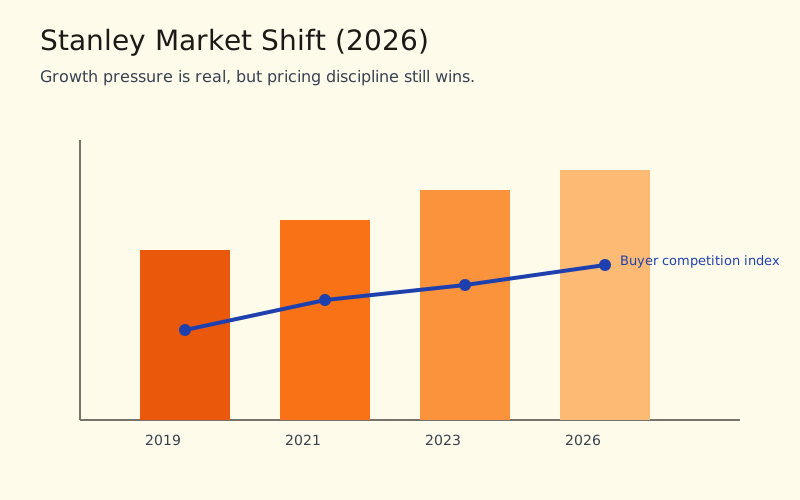
Recent public market snapshots from Redfin and zip-level views for 28164 indicate a slower, negotiation-heavy environment than the peak frenzy years. Median prices can still post strong year-over-year changes in select windows, but days-on-market and buyer caution have increased enough that pricing mistakes are punished faster. The first pricing decision now matters more than ever because buyers compare your listing against both resales and builder inventory with incentives.
| Stanley Market Signal | Recent Public Indicator | What It Means for Sellers |
|---|---|---|
| Median sale price trend | Volatile but generally elevated vs pre-2020 baseline | Avoid single-point pricing assumptions; use comp bands |
| Days on market | Longer than peak-frenzy years in many recent snapshots | Carrying-cost planning matters again |
| Buyer competitiveness | Somewhat competitive, not automatic over-ask | Condition + pricing + terms determine outcome |
| Zip-level spread (28164) | Large differences by product type and lot profile | Micro-location comp selection is critical |
| New-build influence | Persistent due to active surrounding communities | Resales must justify value vs incentives |
One practical takeaway for Stanley homeowners: your launch window should be treated like a campaign, not an event. Day one through day fourteen is when the strongest buyers benchmark your home against their shortlist. If you launch with incomplete prep, unclear disclosures, thin photography, or a price built on outdated optimism, you often miss the best buyer cohort and spend the next month negotiating from a weaker position.
Another reality: sale-to-list dynamics now favor disciplined pricing over “test-high then reduce.” In a lower-volume town, repeated price reductions can stigmatize a listing quickly, especially when buyers assume hidden condition issues. You are usually better off pricing within a realistic comp corridor, then letting good presentation and clean terms push competitive behavior.
For seasonal context across both Carolinas, compare this section with our best-time-to-sell guide. Seasonality still matters, but in Stanley it is often secondary to condition and competition from builder incentives in nearby communities.
3. Growth Without Losing the Small-Town Core: What Buyers Are Actually Purchasing
Buyers do not purchase “Stanley” as a slogan. They purchase an exact lifestyle package: payment level, lot usability, school options, commute tolerance, and confidence that the house will not become a repair pit in year one. In Stanley, those factors are filtered through a small-town identity that many buyers genuinely value. That identity is an asset, but only if your listing translates it into practical value.
The town’s planning and zoning framework shows active development management and permitting processes, while Gaston County handles key building code reviews and inspections. That split matters for sellers because buyers care whether growth is orderly, how quickly nearby areas are changing, and whether roads and services can absorb additional housing activity. You do not need to become a planning expert, but you do need to answer the buyer’s “what is changing around me?” question honestly.
| Buyer Question | Why It Matters in Stanley | Seller Prep Move |
|---|---|---|
| Is this still a quiet small-town area? | Lifestyle expectation drives willingness to pay | Describe neighborhood rhythm and traffic reality plainly |
| How much new construction is nearby? | Future supply affects perceived resale risk | Acknowledge nearby communities and explain your home’s advantages |
| Are schools and services accessible? | Family buyers prioritize stability and convenience | Provide route context and objective local resource references |
| Will commute time break my routine? | Payment value collapses if commute is painful | Use realistic timing ranges, not best-case claims |
| What hidden costs should I expect? | Buyers fear post-close surprises in older housing stock | Offer systems history and maintenance documentation |
When homeowners ask, “How do I make my Stanley house stand out?” the answer is usually not expensive staging gimmicks. It is confidence architecture: documented repairs, clear disclosures, useful photos, and precise pricing. Buyers in this market will forgive older finishes sooner than they forgive uncertainty.
You should also frame your listing around decision clarity. Buyers juggling Stanley versus nearby markets are sorting tradeoffs quickly. Help them compare with confidence: lot size, outdoor usability, parking, storage, and recent system updates. If you do this well, you reduce price-only comparison behavior and preserve leverage.
4. The New-Construction Problem (and Opportunity): Resale Homes vs Builder Incentives
This is the section most Stanley sellers underestimate. You are not just competing with other resales. You are competing with builder marketing machines offering rate buydowns, closing-cost credits, appliance packages, and fast-close promises. In nearby communities and the broader corridor, that incentive stack can materially change a buyer’s monthly payment and therefore their willingness to pay for your resale.
The mistake sellers make is assuming builder inventory only hurts higher price points. In reality, incentives compress multiple segments because buyers compare total payment, not just sticker price. A resale listed at what seems like a fair comp number can still lose attention if the effective monthly on a nearby new build is lower after incentives.
| Comparison Factor | Typical New Build Strength | Typical Resale Strength | How Stanley Sellers Should Respond |
|---|---|---|---|
| Monthly payment leverage | Rate buydowns and builder credits | None unless seller offers concessions | Model concession strategy before listing |
| Move-in condition | Brand-new systems and finishes | Mature but varied condition | Fix high-visibility deferred items pre-listing |
| Lot character | Often smaller / less mature landscape | Bigger lots, established trees, usable yards | Lead with outdoor and location utility |
| Timeline certainty | Can be very fast on spec homes | Depends on buyer financing and repairs | Pre-inspection + clean docs improve certainty |
| Neighborhood maturity | Still evolving amenities/traffic patterns | Known rhythm and neighbor composition | Show stability benefits without attacking builders |
The good news is that resale homes have real advantages in Stanley: larger or more usable lots, mature landscaping, established neighborhoods, and less uncertainty about what the area feels like after buildout. Buyers who value those features will pay for them, but only if your listing package makes the comparison obvious.
When possible, run a side-by-side payment worksheet before launch. Compare your likely sold price plus concession options against current builder offers buyers are likely seeing. This lets you decide in advance whether to hold firm on price, offer selective credits, or preemptively position your home as the better total-value choice.
If you skip this work, you risk becoming the listing that gets “liked but not chosen.” That pattern is common in incentive-heavy markets: lots of showing feedback, few offers, then a late reduction. Better to plan against builder pressure from day one.
5. Neighborhood Positioning in Stanley: Pricing by Micro-Market, Not Town Average
In a smaller municipality, it is tempting to think all locations are close enough that pricing differences should be minimal. In practice, Stanley behaves like several micro-markets. Buyer willingness to pay changes based on street appeal, lot size, proximity to through-traffic, subdivision maturity, and how directly the property competes with new-build alternatives.
Your pricing strategy should start with “comp integrity.” That means only comparing your house to genuinely similar homes sold recently under similar financing and condition assumptions. Pulling a high comp from a different pocket because it supports your target number is one of the fastest ways to sit stale and lose leverage.
| Micro-Market Type | Common Buyer Lens | Pricing Risk if Mispositioned |
|---|---|---|
| Established subdivision with mature lots | Space and neighborhood stability | Overpricing by comparing to upgraded new builds |
| Newer HOA cluster near active development | Turnkey feel and payment sensitivity | Underestimating incentive competition |
| Older in-town housing stock | Character + repair budget balancing | Ignoring condition-adjustment needs |
| Peripheral semi-rural pockets | Lot utility, access, maintenance burden | Using comps with very different utility/commute profile |
For semi-rural or edge properties, utility details matter more than in denser markets. Septic history, well service, outbuilding condition, driveway access, drainage, and internet service quality can all influence offer strength. Document what you can, disclose what you should, and preempt uncertainty discounts.
For subdivision properties, your main competition is often inventory that looks clean online. This means your photo set and repair posture must be better than average. Buyers comparing ten similar listings will select the home that feels lowest risk and easiest to live in, even if all options are within a narrow price band.
The broader point: Stanley does not reward lazy pricing. It rewards credible positioning that matches the exact buyer pool for your property type. Do this right and you can attract serious buyers quickly. Do it wrong and your listing becomes a cautionary comp for the next seller.
6. The Three Real Selling Paths: Traditional MLS, Hybrid, and Direct Cash
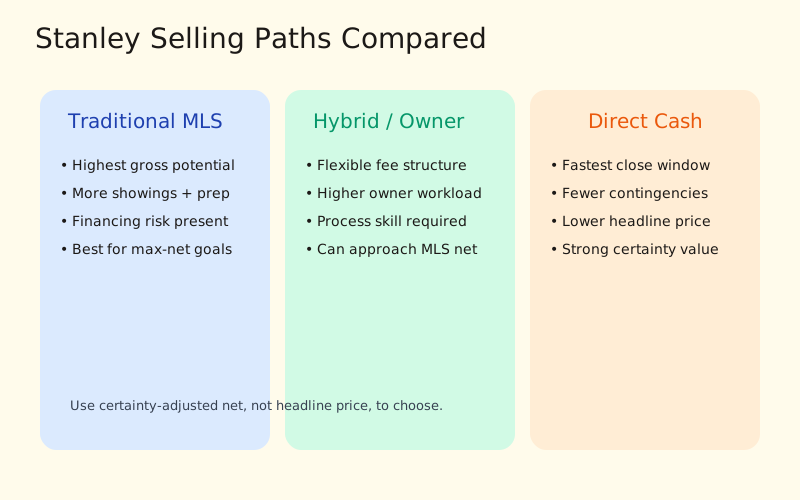
Most Stanley homeowners should evaluate three paths before committing: (1) traditional MLS listing with full representation, (2) hybrid/owner-assisted listing with selective support, and (3) direct cash sale. There is no universally correct path. The right choice depends on your timeline, property condition, stress tolerance, and need for certainty.
Traditional MLS: Usually best for maximizing gross price on homes in finance-friendly condition, where seller timelines can absorb showings, negotiation rounds, and a 30-45 day financed closing after contract. This route can produce the strongest net, but only if the house is priced and presented correctly from the start.
Hybrid or owner-assisted: Viable for experienced sellers who can manage communication, scheduling, and negotiation detail. Potential fee savings can be real, but process errors can erase those savings quickly. This path is hardest for sellers with full schedules or complex property issues.
Direct cash sale: Best for certainty-sensitive scenarios: inherited homes, heavy repairs, pre-foreclosure stress, relocation deadlines, tenant complications, or situations where avoiding repair/inspection volatility is worth a lower headline offer. A disciplined seller treats cash as one benchmark in a side-by-side net comparison, not as a default shortcut.
| Decision Factor | Traditional MLS | Hybrid / Owner-Assisted | Direct Cash |
|---|---|---|---|
| Gross price potential | Highest when execution is strong | Moderate to high, execution-dependent | Lower headline, sometimes higher certainty-adjusted value |
| Workload on seller | Moderate (agent-led process) | High | Low |
| Timeline predictability | Moderate | Moderate | High |
| Repair negotiation pressure | Moderate to high | Moderate to high | Low to moderate |
| Financing fallout risk | Present | Present | Minimal |
Do not choose the path emotionally. Run a net scenario for all three using the same assumptions: expected price, concession risk, days carrying cost, taxes, and closing fees. Then add a timeline stress test. If your life situation cannot absorb a delayed financed close, certainty may be economically superior even with a lower top-line number.
For a deeper look at how institutional and local cash buyers structure offers, review the cash-offer guide. For deadline pressure situations, pair this section with foreclosure options in NC.
See what your Stanley home is worth
Get a real, data-driven estimate based on your specific neighborhood and recent comps.
7. Net Proceeds Math for Stanley Sellers: What You Actually Keep at Closing
This is where clarity beats optimism. Sellers often anchor to the projected sold price and mentally spend money that does not exist yet. Your real number is net proceeds after commissions, credits, transfer taxes, attorney fees, prorations, payoff, and sometimes repair obligations. In Stanley, where timelines may be longer than peak years, carrying costs can also materially reduce net if your house sits.
North Carolina also includes transaction details sellers should plan for early: attorney-managed closings, excise tax at recording, and local prorations. None of these costs are unusual, but they matter when you are comparing sale paths or deciding whether to accept an early offer.
| Cost Line Item | Typical Range / Method | Planning Note |
|---|---|---|
| Listing + buyer-side compensation | Varies by agreement and market strategy | Model multiple compensation scenarios |
| Seller concessions / credits | Case-by-case negotiation | Set a max credit threshold in advance |
| NC excise tax | $1 per $500 of consideration (0.2%) | Often overlooked in quick net estimates |
| Closing attorney + title services | Varies by file complexity | Complex title issues increase cost/timeline |
| Prorated taxes / HOA | Based on close date and dues status | Late close dates can shift net expectations |
| Mortgage payoff and per-diem interest | Lender payoff statement controls final amount | Request updated payoff before final negotiations |
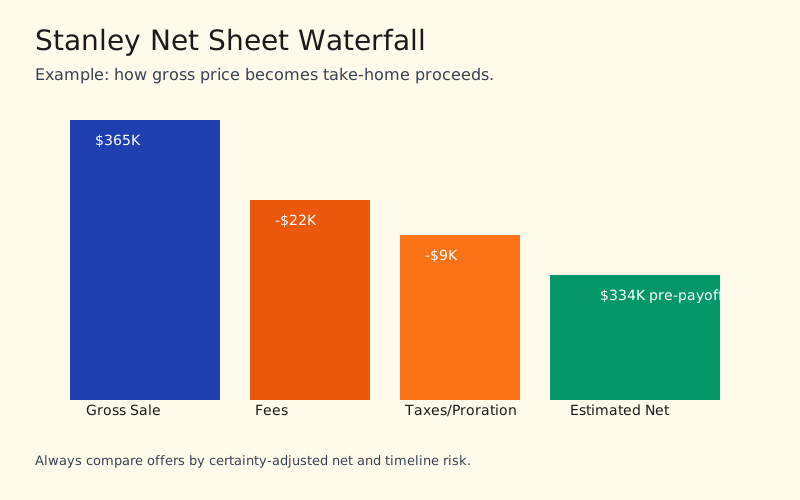
Example framework (illustrative): if your home sells at $365,000, and total transaction friction lands around 8-10% including compensation and customary closing adjustments, your pre-payoff net could vary by more than $20,000 depending on concessions and timing. That is why “close enough” math is not enough.
Now add carrying costs. If your all-in monthly carrying burden (principal/interest, taxes, insurance, utilities, maintenance reserve) is $2,500 and your listing runs two extra months, that is $5,000 gone before you account for possible additional credits after inspection. Timeline and pricing discipline are financial tools, not just process preferences.
Use one simple rule: every offer gets converted into a net sheet, and every net sheet gets stress-tested for timeline extension. If the buyer is financed, run the model with one delay scenario. If the buyer is cash, run at least one scenario where closing happens exactly on schedule. Decisions become much easier when the math is visible.
8. Taxes, Fees, and Municipal Reality: Stanley + Gaston County Cost Context
Property-tax context matters when positioning your listing and when helping buyers compare Stanley to nearby alternatives. Public-facing tax-rate compilations indicate Stanley’s combined county-and-municipal rate has recently been around 1.10% in certain tax years, though rates should always be verified against current county/town publications before citing exact figures in negotiations.
Why this matters: buyers moving from higher-tax jurisdictions may find Stanley relatively manageable, while buyers comparing to other local municipalities may treat small tax-rate differences as meaningful when monthly budgets are tight. Sellers should understand this dynamic and discuss it accurately without overpromising.
| Tax / Fee Topic | Stanley Seller Relevance | Action Before Listing |
|---|---|---|
| County + town property-tax rate | Influences affordability comparisons | Verify current-year rate with official sources |
| Potential district add-ons | Can change total bill by location | Confirm district status from tax records |
| Proration mechanics | Affects close-day net | Estimate with your projected closing month |
| HOA transfer costs (if applicable) | Impacts buyer/seller negotiations | Get resale packet + transfer schedule early |
| Excise tax | Standard seller-side closing cost line | Include in all net estimates |
Beyond annual property tax, some homeowners face localized utility or service costs that buyers ask about during due diligence. Be ready with actual bills or documented averages where possible. Transparency helps avoid late renegotiation and signals that your property is well managed.
If tax burden is a concern in your transition plan (for example, moving from a larger Stanley property to a smaller home or to a rental), calculate post-sale monthly obligations before accepting your final offer. A “strong” sale price that puts you into a difficult monthly budget after relocation is not a win.
9. Schools, Commute, and Daily-Life Utility: The Non-Obvious Price Drivers
In Stanley, schools and commute are not side topics. They are primary value drivers for many buyers. Even buyers without school-age children care because school reputation affects future resale liquidity. At the same time, commute practicality determines whether a payment that looks affordable on paper feels worth it in real life.
Gaston County Schools resources and East Gaston High School information show active programming and performance indicators that many relocating households evaluate early. You do not need to market schools aggressively, but you should avoid vague claims. Provide factual route context and encourage buyers to verify assignments directly.
| Utility Driver | How Buyers Use It | Seller Advantage Move |
|---|---|---|
| School access | Filters viable home options quickly | Include neutral routing and verification reminders |
| Commute to major work nodes | Sets tolerance for price and house size tradeoffs | Offer realistic timing windows, not optimistic claims |
| Nearby services and shopping | Determines day-to-day convenience | Map practical errands and drive times |
| Parks/recreation | Lifestyle and family-time quality signal | Highlight usable nearby amenities honestly |
| Traffic pattern stability | Affects perceived long-term livability | Disclose known peak-time impacts |
When preparing for showings, think beyond cosmetic staging. Stage for daily life utility. Show where backpacks go, where home-office zones can function, where parking solves real household patterns, and where storage actually works. Buyers in this segment are often practical first and aspirational second.
If your location has a known tradeoff, address it directly. For example: “Yes, afternoon traffic can back up near X intersection; here is the route owners use that stays more consistent.” Credible honesty reduces buyer skepticism and can preserve pricing confidence better than generic positivity.
For a broader family-decision framework, compare this section with nearby-market guides such as Belmont and Mount Holly. Buyers often compare these areas side-by-side before committing.
10. Complex Situations: Inherited Homes, Foreclosure Pressure, Divorce, and Tax Stress
Not every Stanley sale is a “we are upgrading” story. Many are complicated by legal timelines, title complexity, family dynamics, or financial pressure. In these cases, the right process can matter more than squeezing out the very last dollar from headline price. The objective shifts from pure optimization to risk-controlled resolution.
Inherited property: Confirm title status, probate authority, occupancy status, and repair condition before selecting a sale path. Delaying title cleanup until under contract is a common reason inherited deals fail or close late.
Foreclosure pressure: Time becomes the primary variable. Waiting for perfect market conditions is usually a losing strategy once deadlines are active. You need a path that protects optionality quickly, whether through reinstatement, workout support, listing strategy, or certainty-focused sale.
Divorce-related sale: Align legal and sale timelines early. Ambiguity around possession, repair decisions, and proceeds distribution creates avoidable conflict and can push buyers away during due diligence.
Tax delinquency stress: Understand exact arrears, penalties, and timeline exposure, then decide whether to resolve through payment plan, refinance, or expedited sale. Guessing here is expensive.
| Situation | Primary Risk | Best First Step | Helpful Guide |
|---|---|---|---|
| Inherited home | Title/probate delay | Confirm legal authority to sell | Inherited property NC |
| Foreclosure timeline | Losing timeline control | Get legal/counseling support immediately | NC foreclosure timeline |
| Divorce sale | Decision conflict + delay | Align legal terms with listing plan | Selling during divorce |
| Property-tax arrears | Escalating penalties | Verify exact payoff and deadlines | Property tax arrears guide |
These situations are emotionally heavy, and that emotional load often leads to rushed decisions. If this is your scenario, prioritize a clear 30-day action plan. Identify legal documents needed, property-prep minimums, support contacts, and a single decision date for choosing your sale path. Structure reduces panic.
11. Local Support Directory: Government, Legal, and Housing-Counseling Resources
Sellers in Stanley should keep a working resource list before listing day. Most transactions are smooth, but when a hiccup appears, speed matters. Having verified contacts in one place can save days and avoid unnecessary escalation.
| Resource Type | Organization | Use Case | Contact / URL |
|---|---|---|---|
| Town administration / zoning | Town of Stanley | Zoning, permits, planning context | https://www.townofstanley.org/ |
| County tax office | Gaston County Tax Office | Property tax verification and billing questions | https://www.gastongov.com/583/Tax-Office |
| Deeds and records | Gaston County Register of Deeds | Record retrieval, deed questions | https://www.gastongov.com/730/Register-of-Deeds |
| Property/deed search portal | Gaston County Property & Deed Search | Pre-listing record checks | https://www.gastongov.com/1124/Property-and-Deed-Search |
| HUD counseling finder | HUD | Find approved counselors by need | https://www.hud.gov/findacounselor |
| Local counseling entry point | City of Gastonia Housing Counseling | Budget/pre-purchase counseling resources | https://www.gastonianc.gov/community-development/hud-approved-housing-counseling-ql.html |
| Civil legal support | Legal Aid of North Carolina | Foreclosure and housing legal guidance | https://legalaidnc.org/topic/housing/foreclosures/ |
| Legal aid intake directory | LawHelpNC | Find local legal aid pathways | https://www.lawhelpnc.org/ |
For attorney closings and property-specific legal issues, homeowners often compare local real estate law firms by responsiveness, fee clarity, and ability to resolve title complexity quickly. If your sale includes estate issues, liens, boundary disputes, or unresolved permit history, selecting counsel early can protect both timeline and net.
Housing counseling is underused by homeowners who are not yet in formal distress. That is a mistake. Even a short counseling conversation can improve your budget assumptions, clarify options, and reduce panic-driven decisions. If your timeline is uncertain, use these resources before your first offer arrives.
12. The Stanley Selling Timeline: A 90-Day and 30-Day Version
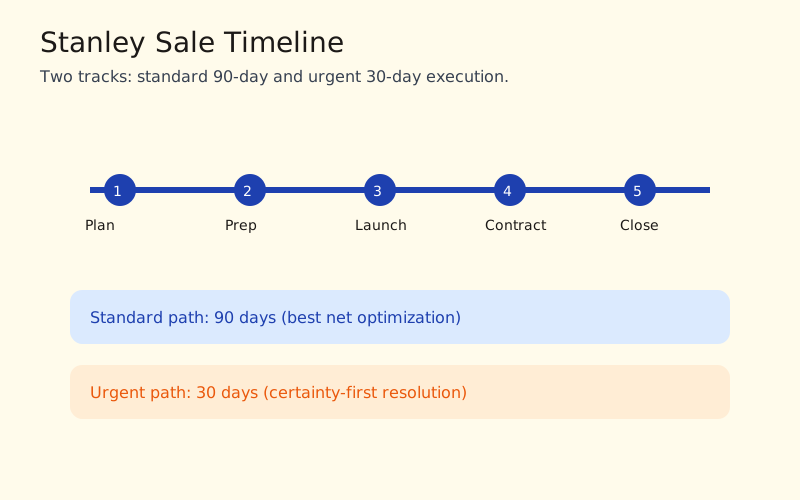
Most homeowners need a timeline that matches reality, not an idealized checklist. Below are two working models: a standard 90-day planning model and a compressed 30-day model for urgency scenarios. The right model depends on condition, legal complexity, and your tolerance for process risk.
| Phase | 90-Day Plan | 30-Day Urgent Plan |
|---|---|---|
| Week 1 | Comp analysis, path selection, resource setup | Triage decision: list vs certainty sale |
| Week 2-3 | Repairs, cleanup, documentation package | Minimum safety/cleanliness prep + disclosures |
| Week 4 | Photo/video, pricing finalization, launch prep | Immediate launch with conservative pricing |
| Week 5-8 | Showings, feedback-based adjustments | Offer comparison with certainty weighting |
| Week 9-12 | Contract to close, inspection/appraisal management | Fast close execution and transition logistics |
In the 90-day model, your edge is preparation depth. You can make selective repairs, optimize listing quality, and manage negotiation from strength. In the 30-day model, your edge is decision speed and clarity. Trying to run a perfection strategy under urgency usually backfires.
Regardless of timeline, use the same process controls: pre-set concession thresholds, document package readiness, and one net-sheet template for all offers. When pressure rises, sellers who already chose their rules make better decisions than sellers who improvise.
If your sale intersects financial distress deadlines, read foreclosure support options and the timeline guide in parallel with this section so you know exactly which dates matter most.
13. Decision Framework: Should You Sell in Stanley Now, Hold, or Run a Dual-Track Strategy?
By this point, most homeowners are choosing between three strategic directions: sell now, hold and reassess, or run a dual-track plan (market listing while evaluating certainty options in parallel). The right choice is less about broad market headlines and more about your specific financial position, property condition, and life timeline.
| Question | If “Yes” | If “No” |
|---|---|---|
| Can I absorb 2-4 extra months of carrying costs? | You can prioritize max-net strategy | Certainty-weighted strategy may be safer |
| Is the property in financing-friendly condition? | Traditional listing has stronger upside | Budget repairs or price for condition honestly |
| Do I have unresolved legal/title issues? | Start legal cleanup before launch | Proceed with standard prep |
| Am I comparing all offers by net, not headline? | Decision quality increases | Risk of expensive misread rises |
| Would a delayed close create serious personal risk? | Prioritize close certainty | You can tolerate broader buyer pool risk |
Sell-now case: best when your property is market-ready, your equity objective is clear, and your timeline supports a standard contract cycle. This case usually benefits from proactive prep and disciplined launch pricing.
Hold case: best when monthly ownership costs are stable, major repairs are manageable, and your household benefits from waiting. This case should include a defined re-evaluation date and measurable trigger points, not open-ended delay.
Dual-track case: best when you need optionality. You market for potential max net while also maintaining a certainty path if timeline risk increases. Dual-track works only when your numbers are organized and you are willing to decide quickly once data is in.
The final test is simple: which option gives you the best combined outcome across net, certainty, and stress? If one path wins on all three, the decision is easy. If tradeoffs remain, choose the path that protects downside first, then optimize upside within that boundary.
14. Build Your Stanley Decision File: Net Sheet First, Emotion Second
Before you choose MLS, hybrid, or cash, build one Stanley-specific net sheet with three scenarios and one delay stress test per scenario. That single exercise will remove most uncertainty and keep you from making a high-stakes decision based on instinct alone.
Your worksheet should include: projected sold/offer price, compensation assumptions, estimated concessions, NC excise tax, attorney/closing fees, payoff amount, prorations, and monthly carrying costs. Then add timeline assumptions: expected contract-to-close and one delay case. The winner is not the prettiest headline number; it is the most resilient outcome.
If you are still unsure after running the model, gather a second opinion focused on net outcomes rather than listing promises. Ask every advisor the same question: “What do I keep at the end under normal and delayed-close cases?” Anyone who cannot answer that clearly is not helping your decision.
For deeper context on related seller decisions, continue with: cash-offer mechanics, seasonality timing, and property-tax pressure options.
The Stanley market can reward sellers who prepare with precision. It can also punish vague strategy. You do not need to predict every market move. You just need a clear process, realistic numbers, and the discipline to choose the path that fits your real constraints. Process quality, not market guessing, is the durable edge for Stanley homeowners.
See what your Stanley home is worth
Get a real, data-driven estimate based on your specific neighborhood and recent comps.
15. Pricing a Stanley Home in 2026: A Practical Comp Workflow You Can Actually Use
Most pricing advice sounds simple until you try to apply it to a real house in Stanley. “Use recent comps” is correct but incomplete. The question is which comps, what adjustments, and how to handle low-volume months where there are not enough clean comparables in your exact micro-pocket. The wrong answer is to grab whichever sold properties support your preferred number. The right answer is to build a comp ladder that reflects buyer reality.
Start with the three strongest sold comparables from the last 90 to 180 days that match your property type, condition tier, and location profile. Then add two active listings and one pending listing that buyers are currently using as alternatives. This gives you both backward-looking evidence (what closed) and forward-looking pressure (what your buyer sees now). In Stanley, this dual view is essential because active new construction and nearby-listing incentives can shift buyer behavior faster than closed data alone suggests.
Next, force yourself to make line-item adjustments instead of hand-waving. Adjust for square footage, lot usability, age/quality of major systems, garage utility, and renovation depth. Then make one explicit location adjustment if traffic pattern or neighborhood desirability is materially different. Write the adjustment logic down. If you cannot explain it clearly in writing, it probably is not a defensible adjustment.
| Comp Workflow Step | What to Do | Common Stanley Mistake | Better Alternative |
|---|---|---|---|
| Comp selection | Use closest true peers first | Using nearby but different product types | Prioritize buyer-substitutable homes only |
| Time window | 90-180 days, with active/pending overlay | Using stale peak comps as anchors | Weight recent trend and current alternatives |
| Condition adjustment | Quantify systems + finish differences | Assuming “updated” means same value everywhere | Use specific project-level adjustments |
| Location adjustment | Apply one clear neighborhood factor | Ignoring traffic/lot/context differences | State practical location utility deltas |
| Price range conclusion | Create list floor, target, and stretch number | Choosing one emotional number | Set rules before launch and stick to them |
After you create your range, test the top end against buyer-payment reality. If a nearby builder is advertising meaningful rate incentives, your resale must either outperform on utility (lot, location, maturity, upgrades) or acknowledge payment sensitivity through price and concession strategy. Sellers in Stanley who ignore payment math often get showing traffic but weak offers.
One useful tactic is to prepare two launch plans before day one. Plan A is your primary list price and concession posture. Plan B is your predefined adjustment after two weekends if showing-to-offer conversion underperforms. This removes panic from the process and helps you avoid reactive, credibility-damaging cuts.
Also, do not confuse “price per square foot” with value. Price-per-foot is a directional tool, not a verdict. A smaller home with superior lot utility, better system updates, and cleaner functional layout can outperform a larger home with deferred maintenance. Stanley buyers are practical. They pay for ease and confidence.
Finally, use your pricing workflow to support negotiation strategy, not just launch day. If a buyer submits a lower-than-expected offer, your documented comp logic helps you respond with precision instead of emotion. A counteroffer grounded in credible local evidence is more likely to hold the deal together than a defensive “this is what we need” number.
Pricing in Stanley is not about being the cheapest or the most ambitious. It is about being the most believable listing in your competitive set. Believability creates urgency. Urgency protects net.
16. Pre-Listing Repairs in Stanley: What Pays Back, What Rarely Does, and How to Decide Fast
Pre-listing repair decisions derail many homeowners because the advice is too broad. “Fix everything” can waste money. “Sell as-is” can cost even more in buyer discounts. The better approach is triage by buyer psychology and lender risk. In Stanley’s current market, repairs that remove uncertainty usually outperform cosmetic overhauls that buyers view as taste-specific.
Think in three buckets. Bucket one: safety and financeability items that can kill deals (roof leaks, active plumbing issues, electrical hazards, HVAC failure, moisture intrusion signals). Bucket two: confidence items that improve offer quality (fresh paint in neutral tones, obvious deferred-maintenance fixes, clean exterior presentation, clear documentation of systems). Bucket three: optional upgrades that are often low-return in this segment (high-end custom finishes with narrow buyer appeal).
| Repair Category | Typical ROI Pattern in Stanley | Why It Matters | Decision Rule |
|---|---|---|---|
| Safety/financeability defects | High protected value | Can collapse financing and inspections | Fix before listing whenever feasible |
| Minor visible neglect | High perceived value | Buyers over-penalize visible deferred care | Address quick wins early |
| Major system transparency | High negotiation leverage | Documentation reduces buyer fear premium | Provide invoices and service history |
| Luxury custom upgrades | Low to uncertain ROI | Taste mismatch risk | Avoid unless comp-supported |
| Exterior usability fixes | Moderate to high ROI | Stanley buyers value practical outdoor function | Prioritize drainage, access, and curb clarity |
If your property has older systems, do not hide that reality. Buyers are surprisingly flexible when sellers are transparent. Share age ranges, maintenance records, and known performance status. Silence creates fear; documentation creates trust. In Stanley where many homes span varied build eras, trust can preserve price more than cosmetic polish.
One common misstep is spending heavily on kitchen or bath upgrades right before listing without confirming comp support. In many Stanley price bands, that money does not return dollar-for-dollar because buyers prioritize payment stability and low-risk condition more than premium aesthetics. A cleaner strategy is functional updates plus a concession reserve, letting the eventual buyer apply funds to personal preferences.
For older homes, moisture narrative matters. If you have had prior drainage work, crawlspace improvements, or foundation monitoring, organize those records in a seller packet. Buyers evaluating older stock often assume worst-case risk. Proof of proactive maintenance can materially improve both offer count and negotiation tone.
For subdivision homes competing with newer inventory, focus on move-in confidence: fresh neutral paint, lighting consistency, hardware alignment, and pre-list deep clean. These are not glamorous projects, but they consistently reduce buyer “mental repair budgets,” which can increase initial offer strength.
If timeline is tight and you cannot complete all preferred repairs, decide now which defects you will fix and which you will price for. Write that plan down. Sellers who improvise under inspection pressure often grant larger credits than they would have offered with a predefined repair policy.
Another practical tactic: obtain one or two contractor bids before listing for known issues, even if you do not plan to complete the work. During due diligence, those bids give you negotiation options and signal you are not guessing on cost. Guessing makes buyers defensive. Specifics keep negotiations productive.
In Stanley, the pre-listing goal is not “make this house perfect.” The goal is “make this house easy to trust.” Trust reduces discounting. Reduced discounting is where your net is protected.
17. Offer Negotiation in Stanley: How to Compare Terms, Not Just Numbers
When offers arrive, many homeowners look at price first and terms second. That is understandable and often expensive. In Stanley’s mixed market, term quality can change your real outcome as much as price. Two offers that appear close on paper can be thousands apart once you account for financing risk, concession likelihood, repair exposure, and time-to-close.
A strong comparison process starts with one standardized scorecard. For each offer, evaluate: price, financing type, proof of funds or lender quality, earnest money strength, due diligence fee posture, inspection terms, appraisal exposure, requested concessions, proposed timeline, and fallback rights if delays occur. The highest score is usually the best economic deal, even when it is not the highest headline number.
| Offer Term | Why It Changes Seller Outcome | High-Confidence Signal | Caution Signal |
|---|---|---|---|
| Financing structure | Determines fallout and appraisal risk | Strong pre-approval and lender reputation | Thin qualification or vague financing details |
| Earnest money posture | Signals commitment strength | Meaningful earnest + clear deadlines | Minimal earnest with broad escape options |
| Due diligence period | Affects timeline certainty and renegotiation leverage | Reasonable window with specific scope | Long open-ended diligence |
| Concession request | Directly reduces net | Limited or clearly justified credits | Large vague concession demands |
| Close timeline | Impacts carrying costs and move logistics | Realistic and documented readiness | Aggressive timeline with weak preparation |
In Stanley, inspection-phase renegotiation is where many deals lose value. You can reduce this risk by presenting a stronger upfront condition narrative, setting credit limits before negotiations begin, and requiring specificity from buyer requests. “General concern” should not automatically become a blanket credit. Ask for exact issue, supporting evidence, and estimated remedy logic.
Appraisal risk deserves special attention when comp depth is thin. If your accepted offer is at the upper end of the range, discuss appraisal strategy in advance. Understand who absorbs shortfall risk, whether there is appraisal-gap flexibility, and how quickly both sides must decide if value comes in low. Undefined appraisal terms are delay magnets.
For sellers balancing certainty against price, one useful method is “certainty-adjusted net.” Start with projected net proceeds, then subtract a risk reserve based on financing and timeline fragility. A cash offer may have lower gross but minimal risk reserve. A financed high offer may require a larger reserve. This puts uncertain outcomes on equal footing for comparison.
Communication discipline also matters. Keep all counteroffers structured and deadline-driven. In lower-volume markets like Stanley, lingering negotiation cycles can cause buyers to disengage and pursue alternatives quickly. Fast, clear, professional negotiation improves close probability and often preserves price better than prolonged standoffs.
If multiple offers are close, choose the one that aligns with your non-negotiables before final round. Common non-negotiables include close date alignment, post-occupancy needs, repair threshold limits, or minimum certainty. Deciding these upfront prevents emotionally inconsistent choices under pressure.
Remember: the purpose of negotiation is not to “win” every line item. It is to reach the highest-confidence path to your target net on your required timeline. Sellers who focus on that objective make cleaner decisions and experience fewer closing-table surprises.
18. After the Sale: How Stanley Homeowners Should Plan the Next 12 Months
The sale is not the end of the financial decision. It is the transition point. Stanley homeowners who plan the 12 months after closing usually protect more wealth and reduce stress compared with those who treat closing proceeds as “done.” The way you deploy proceeds, manage taxes, and structure your next housing decision can be as important as the sale itself.
Start by separating proceeds into three buckets on paper before funds arrive: transition costs, reserve capital, and next-goal capital. Transition costs include moving, temporary overlap expenses, repairs on your next property, and utility setup. Reserve capital is emergency liquidity. Next-goal capital supports your strategic objective, whether that is debt reduction, down payment, business funding, or relocation flexibility.
| Post-Sale Bucket | Purpose | Suggested Discipline |
|---|---|---|
| Transition bucket | Covers known move and setup costs | Fund first so logistics never become panic decisions |
| Reserve bucket | Protects against short-term surprises | Define minimum months of expenses and lock it in |
| Opportunity bucket | Funds next strategic move | Deploy only after timeline and risk review |
| Tax-planning bucket | Addresses potential obligations | Review with qualified advisor before major transfers |
If you are buying again in the same broader corridor, use the same discipline you used as a seller: payment reality, maintenance outlook, and location utility. Many former Stanley sellers move quickly into another property and accidentally inherit higher maintenance burden or commute stress than they intended. A measured 30-day buying filter can prevent that.
If you are moving to rental housing temporarily, decide in advance what conditions would trigger a re-entry purchase. Examples: target rates, savings milestone, neighborhood shortlist confidence, or school timing. Without these triggers, temporary plans can become expensive drift.
For owners who sold under stress (foreclosure risk, divorce, tax pressure), the first post-sale priority is stabilization, not immediate reinvestment. Eliminate urgent liabilities, restore predictable monthly cash flow, and protect credit profile before making higher-volatility moves.
Emotionally, post-sale regret is common when homeowners compare their result to hypothetical “what if I waited” scenarios. The antidote is process integrity. If you used a clear Stanley-specific model, compared certainty-adjusted outcomes, and executed according to your real constraints, then your decision was sound even if markets move later.
If you plan to stay in the region and eventually buy again, keep a lightweight housing journal for 6-12 months: neighborhoods visited, commute impressions, utility costs, and deal-breakers discovered. This turns your next purchase from reaction to strategy and helps ensure your sale proceeds create long-term benefit.
A good sale is not just one that closes at a strong number. A good sale is one that improves your next chapter. For Stanley homeowners, that usually means combining practical net discipline with practical life design: payment comfort, lower stress, and flexibility to make future moves from strength.
19. Stanley Seller Scenarios: Five Real-World Playbooks for Common 2026 Decisions
Sometimes strategy clicks faster when you can see it in real-world form. Below are five common Stanley homeowner profiles and the playbooks that tend to work best. These are illustrative frameworks, not one-size-fits-all answers, but they show how pricing, timeline, and certainty choices actually interact once life gets involved.
Scenario A: The Move-Up Family in an Established Stanley Subdivision. This household has a well-maintained three-bedroom home, moderate equity, and a target to move before the next school cycle. Their risk is overpricing based on one outlier sale and getting stuck in a reduction cycle. Their winning playbook is a disciplined launch with selective cosmetic prep, tight comp set, and concession flexibility capped in advance. Because timeline matters more than squeezing the last incremental dollar, they accept a strong financed offer with clean terms over a slightly higher offer with broad contingencies.
Scenario B: The Inherited House with Deferred Maintenance. The property has good lot value but aged systems and some unresolved estate paperwork. Family members disagree on whether to renovate or sell as-is. Their risk is delay while carrying costs and stress rise. Their winning playbook is early legal authority confirmation, minimal safety-focused repairs, and dual-track valuation: one as-is certainty offer benchmark plus one realistic MLS rehab-adjusted projection. They choose the path that produces higher certainty-adjusted net within the family’s emotional and logistical bandwidth.
Scenario C: The Owner Facing Budget Pressure. This seller is current today but worries about keeping up if one additional disruption hits. Their risk is waiting too long and losing optionality. Their winning playbook is immediate net-sheet modeling, housing-counselor consultation, and a decision deadline. If MLS path can close within the safety window, they proceed with strict milestone checks; if milestone drift appears, they pivot to a certainty-first path before pressure escalates.
Scenario D: The Remote Worker Leaving the Area. This homeowner has flexibility on move timing but wants a clean exit and minimal post-contract friction. Their risk is underestimating the work required for inspection negotiations while managing relocation tasks. Their winning playbook is pre-inspection transparency package, contractor bid backup for likely buyer concerns, and a negotiation matrix that prioritizes clean close terms over extended back-and-forth for small line items.
Scenario E: The Hold-or-Sell Investor-Style Owner Occupant. This owner has a favorable mortgage and is tempted to convert to rental. Their risk is optimistic rent assumptions and ignored maintenance reserves. Their winning playbook is conservative rental underwriting, vacancy stress testing, and direct comparison against today’s net-sale proceeds reinvestment options. If projected hold returns are weak after realistic reserves, selling now may be the stronger long-run move.
| Scenario | Primary Goal | Biggest Risk | Best-Fit Strategy |
|---|---|---|---|
| Move-up family | Reliable timeline + strong net | Overpricing and stale listing | Comp-disciplined launch + capped concessions |
| Inherited property | Family resolution + certainty | Delay from legal/title ambiguity | Early legal cleanup + dual-track option test |
| Budget-pressure seller | Protect downside quickly | Waiting past safe timeline | Immediate triage + certainty-weighted decision rules |
| Relocation seller | Low-friction close | Inspection renegotiation drag | Pre-doc package + term-focused offer selection |
| Hold-or-sell owner | Best 24-month financial outcome | Unrealistic rent/expense assumptions | Conservative hold model vs sale net model |
What ties these scenarios together is not property type. It is process quality. Each successful outcome starts with the same core steps: define constraints, build scenario math, compare certainty-adjusted outcomes, and decide with a pre-committed rule set. Sellers who skip these steps tend to make emotional pivots after each showing, each comment, and each market headline. That behavior is expensive.
You can also use these scenarios as a communication tool with family or co-owners. Instead of arguing abstractly about “best possible price,” align on which scenario most closely matches your real constraints and then agree on objective success metrics. For example: minimum acceptable net, latest acceptable close date, and maximum tolerated repair credit. Written alignment reduces conflict during negotiation stress.
If you are an analytical seller, create a one-page “decision dashboard” with four boxes: net range, close-probability range, timeline range, and stress cost estimate. Update it weekly during active listing. This simple dashboard prevents you from overreacting to anecdotal noise and keeps decisions tied to data that matters.
For sellers who feel overwhelmed, start smaller: one page with three numbers: target net, walk-away net, and must-close-by date. Those three numbers can anchor almost every major negotiation choice in Stanley’s 2026 market.
The final insight from these playbooks is this: the best strategy is almost never “maximize price at all costs.” The best strategy is “maximize the outcome that still closes reliably within my real-life constraints.” In a mixed-speed market like Stanley, reliability has economic value. Treat it that way.
If you want a practical closing checklist for Stanley specifically, build one folder with these sections: deed and tax records, repair invoices, utility history, HOA details (if applicable), insurance information, and your running net sheet. Having this folder ready before the first serious offer can shorten due diligence friction and keep negotiations objective. Buyers and attorneys move faster when the document trail is clean.
Another Stanley-specific tip: keep a quick-reference page for local contacts you may need during contract period: town offices, county records, attorney closing contacts, and preferred contractors for small post-inspection fixes. In smaller markets, responsiveness can meaningfully influence whether a buyer stays confident through closing. Fast, organized communication is an underrated advantage.
Also plan your move logistics in parallel with negotiation, not after. Many sellers wait until contract acceptance to think about packing, storage, transfer services, and utility overlap. That creates avoidable stress right when inspection and appraisal questions appear. In Stanley transactions, a smooth seller-side transition often makes buyer-side cooperation easier because the process feels controlled and predictable.
Finally, define what “success” means for your household beyond the closing statement. Is success a higher net, lower stress, quicker certainty, better school timing, reduced debt, or all of the above in a specific order? Put that priority list in writing. Stanley homeowners who do this usually look back at their sale as a strategic move, not a reactive one.
One more practical habit for Stanley sellers: run a 15-minute weekly review during active listing with the same five questions every time. Are we priced correctly for this week’s competitive set? Are showings converting to serious follow-up? Are buyer objections mostly condition-based, payment-based, or location-based? Have we updated our certainty-adjusted net model with current facts? Do we need a controlled change now instead of a larger reactive change later? This short routine keeps your decision process consistent when emotions run high and new feedback arrives quickly.
Even if you only do one thing after reading this guide, do this: write down your target net, minimum acceptable net, and must-close-by date for your Stanley property. Those three numbers will clarify almost every choice from pricing to final counteroffer. Revisit them before each major decision so your process stays grounded in the same objective from listing day through closing day.
Editorial note: This guide is educational and not legal, tax, or financial advice. Policies, rates, and market conditions change. Verify current figures with official county/town sources and licensed professionals before making final decisions.
Need another small-market benchmark in Gaston County? Use the Lowell homeowner selling options guide to compare commute-led pricing and certainty-first decision frameworks.
Want a cash offer on your Stanley home?
Tell us your address and timeline and we will get you a no-obligation cash offer.