
Monroe, NC: Two Markets Split by One Toll Road
A local guide for Monroe homeowners navigating a $395K median market with 6 sub-markets, $300 million in industrial growth, and 45 builder projects competing for your buyers.
Selling a house in Monroe, NC in 2026 means choosing which Monroe you are selling — a $395,000 median market split by the Expressway, with 45 builder projects competing for your buyers and a $150,000 price gap between the west side and the east. This guide breaks down every selling path with Monroe-specific numbers and Union County net proceeds math.
Monroe is Union County's seat and its most misunderstood market. Charlotte commuters drove past it for years, heading to Waxhaw and Wesley Chapel where the school zones felt safer and the subdivisions felt newer. But those towns now have $680,000 medians and HOA fees that eat mortgage budgets alive. Monroe sits 25 miles southeast of Uptown Charlotte with a toll road that cuts commute time to 33 minutes, a $300 million industrial expansion that is bringing real jobs, and a downtown that is being reinvented from courthouse town to walkable district. The gap between what Monroe costs and what Monroe offers has never been wider. If you own here and you are thinking about selling, the question is not whether buyers exist. The question is which buyer your home attracts and how to price for the one who will actually close.
1. The Toll Road That Split Monroe Into Two Markets
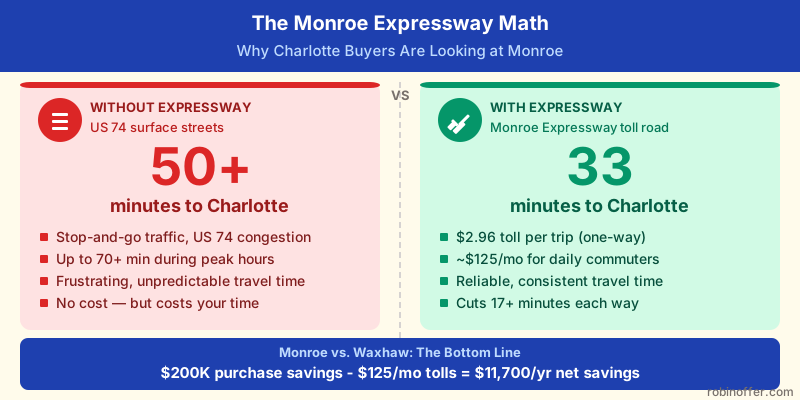
The Monroe Expressway changed this city more than any zoning vote or school bond ever did. The 18.68-mile toll road opened in 2018 and turned a 50-minute slog on US 74 into a 33-minute drive to Charlotte. That single infrastructure investment created two Monroes: the western corridor that feels like a Charlotte suburb, and the eastern half that still feels like a rural county seat. Your home's value depends on which Monroe it sits in.
Western Monroe and the Weddington corridor — from the Indian Trail border to the Expressway on-ramps — prices between $300,000 and $500,000. These neighborhoods have newer housing stock, proximity to I-485, and buyers who work in SouthPark or Ballantyne. The Expressway on-ramp at Rocky River Road put these homes 28 minutes from Southpark Mall. That changed everything about who was willing to live here.
Eastern Monroe and beyond US 74 prices between $180,000 and $350,000. The lots are bigger, the houses are older, and the buyer pool is different. These are local buyers — people who work at ATI, at Tyson Foods, at Atrium Health Union. They are not paying a Charlotte-commuter premium because they do not commute to Charlotte. The result is a city where two homes the same size, same year built, and same condition can differ by $150,000 based purely on which side of the highway they sit on.
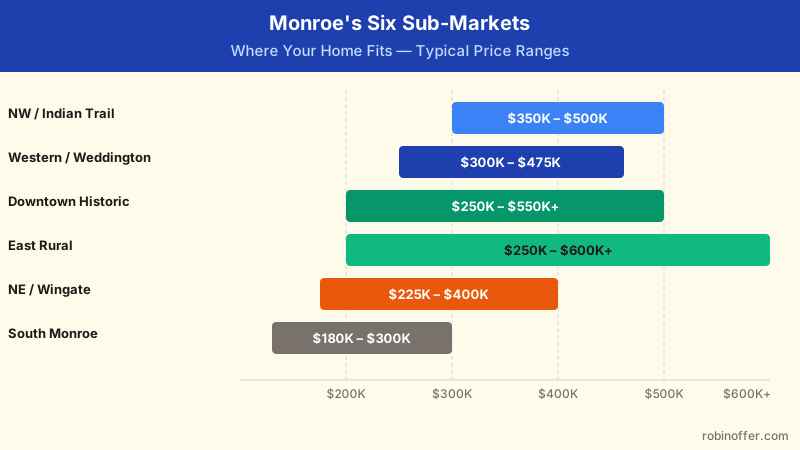
| Monroe Sub-Market | Typical Price Range | Primary Buyer | Avg. Days on Market |
|---|---|---|---|
| Western / Weddington Corridor | $300K–$500K | Charlotte commuters, young families | 45–65 days |
| Downtown Historic District | $250K–$550K | Investors, downtown workers, renovators | 60–90 days |
| South Monroe (US 74 corridor) | $180K–$300K | Local workforce, first-time buyers | 75–120 days |
| Northeast / Wingate Corridor | $225K–$400K | College employees, rural lifestyle seekers | 60–90 days |
| Northwest / Indian Trail-Adjacent | $350K–$500K | Charlotte commuters priced out of Indian Trail | 40–60 days |
| East Monroe / Rural Transition | $250K–$600K+ | Acreage buyers, hobby farmers, investors | 90–180 days |
2. What $395K Buys in Monroe — and Why the Median Lies
Monroe sits at the intersection of two forces that do not show up in a single median number: aggressive builder competition from the west and a deep affordable inventory from the south and east. The city has grown from 34,551 residents in the 2020 census to roughly 43,000 in 2025, and Union County overall has pushed past 267,000 people — up 12.3% since 2020. That growth is concentrated almost entirely in the western corridor, which pulls the citywide median higher than most of the actual housing stock.
The Monroe housing market in mid-2026 shows a median sale price of approximately $395,000, up a modest 0.3% year-over-year. The median price per square foot is $205, which is up 10.2% since last year. On the surface, those numbers suggest a stable market with mild appreciation. Below the surface, they mask a story that matters more for your specific home.
Monroe has two zip codes that tell different stories. Zip 28110, covering western and northern Monroe, shows an average sale price of $461,000 over the last 12 months. Zip 28112, covering central and southern Monroe, shows a median of $410,000, down 1.2% year-over-year. The gap is growing, not shrinking. Western Monroe prices are being pulled up by new construction. Eastern and southern Monroe prices are softening as older inventory competes against builder incentives.
The days-on-market average runs 60 to 84 days depending on the source and season. That is up from roughly 45 to 69 days last year. Homes are sitting longer across the board, but the range is enormous. A move-in-ready home in the western corridor with good curb appeal and a price under $400,000 can sell in 30 to 45 days. An older ranch on the south side with a dated kitchen and deferred roof can sit 120 to 180 days without a serious offer.
New construction starts as low as the $320,000s — below the county median resale price. That fact alone tells you everything about the pressure on existing homeowners. Builders like Pulte (Riverstone), KB Home, Century Communities, Smith Douglas, D.R. Horton, Ryan Homes, M/I Homes, and Meritage are all active in Monroe right now. A buyer looking in the $350,000 to $450,000 range can walk into a model home with a warranty, pick their finishes, and often get rate buy-down incentives. Your resale home needs to offer something a builder cannot — location, lot size, mature trees, or a price point that undercuts new construction after carrying-cost math.
| Market Metric | Monroe (Mid-2026) | YoY Change | What It Signals |
|---|---|---|---|
| Median sale price | ~$395,000 | +0.3% | Essentially flat; no runaway appreciation or steep decline |
| Median price per sq ft | $205 | +10.2% | Per-foot prices rising faster than medians — buyers paying more for less space |
| Avg. days on market | 60–84 days | Up from 45–69 | Homes sitting longer; preparation and pricing matter more |
| Zip 28110 avg. sale | $461,000 | Growing | Western Monroe pulling away from the rest of the city |
| Zip 28112 median | $410,000 | -1.2% | Central/south Monroe softening under builder competition |
| New construction starts | Low $320Ks | Stable | Builders undercut resale median — your competition has a warranty |
| Active builders | 8+ national builders | Growing | Supply is increasing; urgency for buyers is low |
3. $300 Million in New Steel: ATI, Union Logistics, and Monroe's Industrial Pivot
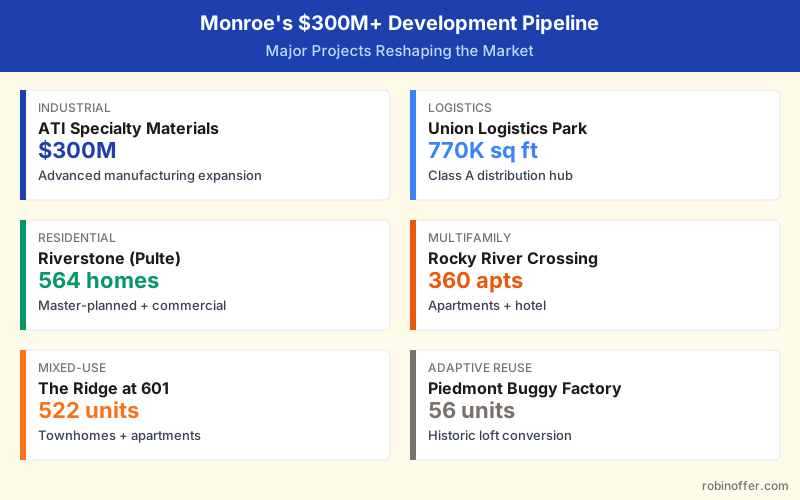
Monroe is in the middle of an industrial transformation that most Charlotte-metro residents have not noticed. On April 28, 2026, the Monroe City Council approved the annexation of additional ATI Specialty Materials facilities and secured two economic development incentive grants tied to approximately $300 million in new investment. ATI produces specialty alloys and advanced materials used in aerospace, defense, and energy applications. This is not a warehouse operation. These are advanced manufacturing jobs with salaries that support mortgage payments.
Separately, Edgewater Ventures selected Monroe as the site for Union Logistics Park — a 769,880-square-foot Class A industrial development planned for North Sutherland Avenue. The Charlotte Regional Business Alliance reports that Union County now has over 185 manufacturing companies employing approximately 15,000 people. Agriculture remains a $482 million industry in the county, producing the second-most grain crops and third-most poultry and eggs in North Carolina.
The practical impact for homeowners is this: Monroe is adding jobs that do not require a Charlotte commute. Every local job created is a potential buyer who does not care about Expressway access but does care about a 10-minute drive to a plant off Highway 601. These buyers want south and east Monroe — the affordable sub-markets that Charlotte commuters ignore. If your home is in that zone, the growing local employer base is working in your favor even as the Charlotte-commuter market softens.
| Employer / Project | Investment | Impact |
|---|---|---|
| ATI Specialty Materials expansion | ~$300 million | Advanced manufacturing; multi-phase construction underway |
| Union Logistics Park (Edgewater) | 769,880 sq ft Class A | Industrial distribution hub on N. Sutherland Ave. |
| Tyson Foods | Established employer | Production, maintenance, logistics; median wage ~$24/hr |
| Atrium Health Union | Hospital + clinics | Healthcare anchor; 24/7 staffing supports rental demand |
| Glenmark Pharmaceuticals | Manufacturing facility | Pharma manufacturing + apprenticeship programs |
The unemployment rate in Monroe sits at 3.6%, which is effectively full employment. The city's Office of Economic Development actively recruits aerospace and advanced manufacturing companies, and the Monroe Corporate Center provides shovel-ready sites. Greiner Bio-One, a medical device manufacturer, has partnered with South Piedmont Community College to create apprenticeship pipelines that train Monroe residents for jobs that start above $20 an hour. This is not a trickle-down theory — it is a direct pipeline from community college classroom to manufacturing floor to homebuyer.
4. Downtown's Reinvention: The Master Plan and the Buggy Factory
Monroe launched a full-scale update to its Downtown Master Plan in fall 2025, running through late summer 2026. The plan covers street design, streetscape improvements, and a vision for what downtown Monroe could become over the next decade. This is not the first attempt at downtown revitalization, but it may be the most credible. The city is simultaneously investing $2.5 million in grants for the Winchester area redevelopment, including the repurposing of the Winchester Ceramics Building (approximately $735,000 in renovations), community center improvements, and pedestrian walkway and greenway extensions.
The signature project is the Piedmont Buggy Factory — 56 residential units being developed inside a historic building that once manufactured horse-drawn carriages. The conversion of a 19th-century industrial building into modern housing is the kind of project that signals a downtown capable of supporting urban-style living in a small city. It joins a handful of downtown breweries, a community theatre, and a farmers market that is already drawing foot traffic on weekends.
Downtown Monroe has something its rivals in Waxhaw and Indian Trail do not: real architectural bones and genuine walkability. The Union County Courthouse, built in 1886, anchors a historic district with buildings from the late 1800s through the 1940s. The downtown district has free parking — a feature that seems trivial until you try to park in downtown Waxhaw on a Saturday afternoon. Homes in and around downtown range from $250,000 for unrenovated bungalows to $550,000 or more for well-preserved historic properties.
The Winchester area redevelopment is worth watching separately. Winchester sits between downtown and the south Monroe residential corridors, and the $2.5 million in grant-funded improvements — building repurposing, community center upgrades, and greenway extensions — are designed to bridge the gap between the historic core and the surrounding neighborhoods. If your home is in or near Winchester, these improvements are a direct value driver. The walkway and greenway connections will physically link properties that currently feel disconnected from downtown's energy.
For sellers with downtown or near-downtown properties, the Master Plan is a pricing tailwind. It signals municipal commitment and future investment that makes buyers feel confident they are buying into an appreciating area rather than a stagnant one. You cannot price that in today, but you can mention it in your listing description and let the buyer's imagination do the work.
5. Six Monroe Neighborhoods: From $180K Ranch to $600K Farmette
Monroe is not one market. It is at least six, and each one has its own buyer profile, pricing logic, and competition. Here is what each area offers and who is buying there.
Downtown Historic District
Homes from the late 1800s through the 1940s, many with original architectural details — heart pine floors, 10-foot ceilings, wraparound porches, and carriage houses that could become ADUs. The Union County Courthouse, built in 1886, and the historic Main Street corridor anchor this area. Price range: $250,000 to $550,000+. The high end goes to well-preserved or fully renovated historic homes. Mid-$500,000s is realistic for a properly restored pre-1920 home on a corner lot.
Buyers here are a mix of renovators who see potential, downtown workers who want a 5-minute commute to the courthouse, and investors who see the Master Plan as a signal. Walkability is higher here than anywhere else in Monroe — free parking, farmers market, and a growing brewery and restaurant scene. The Monroe Community Theatre on Crowell Street draws evening crowds, and a handful of restaurants along Main Street have turned downtown into a real dining destination. Compare downtown Monroe parking (free, always available) to downtown Waxhaw parking on a Saturday (circling for 20 minutes), and the lifestyle value gap starts to close even if the price gap does not.
Western Monroe and the Weddington Corridor
This is Monroe's growth engine. Master-planned communities like Braemar Village, Weddington Pointe, and Riverstone sit in the western tier with new-construction pricing from the $320,000s to $475,000. These neighborhoods draw Charlotte commuters who use the Monroe Expressway. Top-rated Wesley Chapel Elementary is nearby, and the commercial infrastructure along the Indian Trail corridor means families do not need to drive to Charlotte for daily errands. Harris Teeter, Target, urgent care, and youth sports leagues are all within a 10-minute drive.
This area has the shortest days on market in Monroe — often 40 to 60 days for properly priced homes. But the competition is fierce. Pulte alone has Riverstone with 564 planned homes and commercial space. KB Home, Century Communities, Smith Douglas, and D.R. Horton are all building within 5 miles of each other. Resale sellers in these subdivisions need to understand that their buyer walked through a model home yesterday and knows exactly what $375,000 buys brand new. Your listing needs to answer the question: why buy your home instead of the one with a warranty?
South Monroe and the US 74 Corridor
The most affordable sub-market in Monroe, and the one most affected by the interest-rate environment. Ranch-style homes from the 1960s through the 1980s on larger lots, many with carports instead of garages and original windows that need replacing. Price range: $180,000 to $300,000. Proximity to Atrium Health Union hospital gives healthcare workers a 5-minute commute, and the US 74 commercial corridor provides everyday services without driving to Charlotte.
Buyers are local workforce, first-time purchasers using FHA and VA loans, and investors targeting the rental market. This area has the longest days on market — 75 to 120 days — and the most price sensitivity. At a 7% mortgage rate, the monthly payment on a $250,000 home with 3.5% down is roughly $1,750 including taxes and insurance. That is uncomfortably close to what the same home rents for ($1,500 to $1,600), so buyers in this sub-market are doing the rent-vs-buy calculation on every listing and walking away quickly if the numbers do not work.
Northeast Monroe and the Wingate Corridor
A college-town dynamic anchored by Wingate University and South Piedmont Community College. Larger lots with a semi-rural feel and agricultural transition feel. Price range: $225,000 to $400,000. Lower rental pricing attracts student and faculty tenants. Access to Cane Creek Park adds a recreational amenity. Buyers here want space, quiet, and a reasonable commute to campus more than Charlotte access. Cane Creek Park offers 1,050 acres of lake, trails, and camping that adds recreational value no western Monroe subdivision can match.
Northwest Monroe — Indian Trail Adjacent
The hottest sub-market in Monroe. Newer housing stock built since 2010, community pools, sidewalks, and playground amenities drive pricing from $350,000 to $500,000. The Sun Valley commercial district and I-485 access put this area in direct competition with Indian Trail itself — except at a $50,000 to $100,000 discount. A family that cannot find a four-bedroom in Indian Trail under $450,000 discovers they can get the same square footage in northwest Monroe for $375,000 with a 5-minute longer commute. This area has the highest rental rates in Monroe ($1,500 to $1,900 for a 2-bedroom) and attracts the most interest from Charlotte-commuter buyers who start their search in Indian Trail and drift east on the map when the budget gets tight.
East Monroe and the Rural Transition
Genuine country living — working farms, open pastureland, and properties with acreage that can run 5 to 50 acres. Price range: $250,000 to $600,000+ depending on land size and improvements. Union County's agricultural roots are deepest here. The county produces nearly $482 million in agricultural goods annually, including the second-most grain crops and third-most poultry and eggs in North Carolina. Many of these operations are generational, and the homes that come to market are often estate sales or retirement transitions.
Limited inventory means these homes sit longer (90 to 180 days) but often sell with minimal negotiation when the right buyer appears. The right buyer is typically someone who specifically wants acreage, a workshop, horse pasture, or agricultural use — they are not comparison-shopping with subdivisions. Marketing an east Monroe rural property requires a different channel: equestrian sites, farmland listing services, and local agricultural networks produce better results than MLS alone. If your property has a working well, septic system, and outbuildings in good condition, lead with those features — they are the selling points, not the kitchen countertops.
| Neighborhood | Price Range | Best For | Days on Market | Builder Competition |
|---|---|---|---|---|
| Downtown Historic | $250K–$550K+ | Renovators, investors | 60–90 | Low (infill only) |
| Western / Weddington | $300K–$475K | Charlotte commuters | 40–60 | High (8+ builders) |
| South Monroe | $180K–$300K | Local workforce | 75–120 | Moderate |
| Northeast / Wingate | $225K–$400K | College, rural lifestyle | 60–90 | Low |
| NW / Indian Trail-Adjacent | $350K–$500K | Priced-out commuters | 40–60 | High |
| East Rural | $250K–$600K+ | Acreage, farms | 90–180 | None |
See what your Monroe home is worth
Get a data-driven estimate based on your specific neighborhood and sub-market — not the citywide median.
6. The Monroe Expressway Changed Everything (Except the Tax Bill)
The Monroe Expressway is the single most important thing that has happened to Monroe real estate in a generation. The 18.68-mile controlled-access toll road with a 65 mph speed limit connects the Charlotte metro beltway (I-485) to US 74 east of Monroe. The toll costs $2.96 with an NC Quick Pass for the full length. That $3 each way — roughly $125 a month for a daily commuter — buys a 33-minute commute to Charlotte instead of the 50-plus minutes on the old US 74 route through stop lights and school zones.
The Expressway unlocked western Monroe for Charlotte buyers. Before it opened in 2018, Monroe was "too far" for anyone working in SouthPark, Ballantyne, or Uptown. After it opened, Monroe became the answer to a simple math problem: a family priced out of $600,000 Indian Trail or $680,000 Waxhaw could buy a comparable home in western Monroe for $400,000, pay $125 a month in tolls, and still save $1,000 a month on their mortgage. That math has not changed, and it explains why western Monroe keeps growing.
NCDOT also has a 3.9-mile widening of US 74 on the books, expanding it from four lanes to six between Dickerson Boulevard and Rocky River Road, with preliminary construction targeted around 2030. Roosevelt Boulevard intersection work may start as early as 2026. When the widening is complete, the non-toll route will improve too — which could open up east Monroe to some of the same commuter demand that currently concentrates in the west.
For sellers, the commute math is your biggest marketing asset if you are in western Monroe. Run the numbers for your buyer: a family that buys a $400,000 home in Monroe instead of a $600,000 home in Waxhaw saves $200,000 on the purchase price. Their mortgage payment is roughly $1,100 lower per month. Even with $125 monthly in tolls, they net $975 a month in savings — $11,700 a year. That is a new car payment, a private school tuition, or a college savings fund. If your listing does not make this math explicit, your agent is leaving the most powerful selling point in Monroe on the table.
The tax bill is the part that did not change. Monroe's combined city and county property tax rate is 87.42 cents per $100 of assessed value — Union County at 43.42 cents plus the City of Monroe at 44 cents. NC assesses at 100% of market value. On a $395,000 home, that is roughly $3,453 in annual property taxes. Properties in the downtown district pay an additional 16 cents per $100. If you live in unincorporated Union County outside the city limits, you skip the city portion entirely and pay only the county rate plus any applicable fire district fee. That difference — roughly $1,700 a year on a $395,000 home — pushes some buyers to unincorporated areas and is a real factor in buyer decision-making that you should address in your listing.
| Tax Component | Rate per $100 | Annual on $395K Home |
|---|---|---|
| Union County | $0.4342 | $1,715 |
| City of Monroe | $0.4400 | $1,738 |
| Combined (inside city) | $0.8742 | $3,453 |
| Downtown district surcharge | +$0.1600 | +$632 |
| County only (outside city) | $0.4342 | $1,715 |
7. Sell Your House in Monroe NC With an Agent: The $395K Net Sheet
Selling through an agent in Monroe in 2026 means pricing into a 60-to-84-day market against active builder competition. Here is what that looks like on paper.
First, the agent choice matters more in Monroe than in most Charlotte-metro cities. An agent who works primarily in Weddington or Wesley Chapel may not understand the south Monroe buyer pool or the east Monroe rural market. They will price your home based on western Union County comps and wonder why it sits for four months. Find an agent who has closed at least 5 transactions in your specific Monroe sub-market in the last 12 months. Ask for the list. If they cannot produce it, they are learning your market on your dime.
The standard commission structure in the Charlotte metro is 5% to 6% of the sale price, typically split between the listing agent and the buyer's agent. On a $395,000 sale, that is $19,750 to $23,700. Your listing agreement will specify the exact split. Some Monroe agents offer reduced listing-side commissions in exchange for a longer exclusive period or a higher price point, so ask about the options before you sign.
NC closing costs for sellers include excise tax ($1 per $500 of sale price = $790), title insurance (if the seller provides it), attorney fees ($600 to $1,200), prorated property taxes, any outstanding liens or mortgage payoff, and transfer-related fees. Total seller closing costs in Union County typically run 1.5% to 2.5% of the sale price — roughly $5,925 to $9,875 on a $395,000 sale.
The biggest variable in Monroe is not the commission or the closing costs. It is the repair negotiation. In a market where buyers can walk down the street to a model home with a 10-year warranty, they have leverage to ask for inspection-related repairs or credits. The median inspection credit in the Charlotte metro runs $3,000 to $8,000. Plan for it.
| Cost Category | Estimated Amount | Notes |
|---|---|---|
| Agent commission (5–6%) | $19,750–$23,700 | Negotiable; ask about structures |
| NC excise tax | $790 | $1 per $500 of sale price |
| Attorney fees | $600–$1,200 | Seller's attorney at closing |
| Prorated property taxes | Varies | Depends on closing date |
| Title / recording fees | $200–$500 | Title search, recording, etc. |
| Inspection repair credits | $3,000–$8,000 | Common in a buyer-friendly market |
| Total seller costs (est.) | $24,340–$34,090 | 6.2%–8.6% of sale price |
Net proceeds on a $395,000 agent-assisted sale at 5.5% commission: approximately $358,185 before mortgage payoff. If you owe $250,000 on your mortgage, your cash-in-hand is roughly $108,185. These are estimates — your actual costs depend on your listing agreement, the buyer's repair requests, and your specific closing situation.
8. FSBO in Monroe: The Commission Math Against the 84-Day Average
Selling For Sale By Owner in Monroe saves you the listing-side commission — typically 2.5% to 3% of the sale price, or $9,875 to $11,850 on a $395,000 home. That is real money. The question is whether you capture it or lose it to a longer time on market, a lower sale price, or both.
The FSBO reality in Monroe differs by sub-market. In west Monroe and the Indian Trail-adjacent corridor, buyers typically have agents. If you offer zero buyer-agent compensation, you eliminate a large share of your buyer pool at a time when homes already sit 40 to 60 days. In south Monroe and the rural east, more buyers shop without agents and are accustomed to direct-sale transactions. FSBO is more viable there.
NC law requires FSBO sellers to comply with the same disclosure obligations as agent-represented sellers. The NC Residential Property Disclosure Statement is mandatory for most residential transactions. You must also understand the NC due diligence fee structure — a non-refundable payment that gives the buyer an investigation period. Mispricing the due diligence fee (too low invites tire-kickers, too high scares off buyers) is one of the most common FSBO errors in this market. In west Monroe, due diligence fees on $350,000 to $450,000 homes typically run $3,000 to $6,000 — higher than you might expect, because buyers competing against new construction want certainty that the resale home will appraise and inspect cleanly.
If you pursue FSBO, budget for professional photography ($200 to $400), a flat-fee MLS listing ($200 to $500), a real estate attorney ($600 to $1,200 for closing), and your own marketing time. The total cost of a well-executed FSBO in Monroe runs $1,200 to $2,100 plus your time. Compare that to the $9,875 to $11,850 you save on the listing-side commission and make your own decision.
One FSBO advantage specific to Monroe: the city's development map at monroencgis.maps.arcgis.com lets you show buyers exactly what is planned or under construction near your property. If your home is outside the construction zone, that is a selling point — quiet street, established neighborhood, no construction dust. If your home is near a new project, you can frame the proximity to future retail and amenities as a positive. Either way, having that information ready signals preparation and earns buyer confidence. Agents do this automatically; FSBO sellers need to do it deliberately.
9. Cash Offers in Monroe: Who's Buying and What They Pay
Monroe has an active cash-buyer market. Nationally, cash sales accounted for 41.7% of all home purchases in Q1 2026. In the Charlotte metro, 36.5% of single-family sales went to corporate or LLC buyers in April 2026, and 73.4% of those paid cash. Monroe sees its share of that activity, concentrated in the south and east sub-markets where price points attract investors.
Cash buyers in Monroe typically offer 80% to 90% of market value. On a $395,000 home, that means offers in the $316,000 to $355,500 range. The trade-off is speed (7 to 21 day close), no commissions, no repairs, no staging, and no risk of buyer financing falling through. On a $250,000 south Monroe home, the cash offer range is $200,000 to $225,000.
Several companies actively buy in Monroe. The market includes local and regional operators:
- Cardinal House Buyers — Charlotte-area cash buyer covering Monroe and Union County
- NC Cash Home Buyers — statewide operator with Monroe coverage
- Turner Home Team — local cash buyer focused on the Charlotte metro
- Carolinas House Buyers — regional buyer covering both Carolinas
- M1 Property Group — Charlotte-based investor with a Monroe landing page
- Cinch Home Buyers — national platform with Monroe coverage
For a deeper comparison of iBuyer platforms versus local cash buyers and what each type actually pays, see our cash offer guide for NC and SC homeowners.
Cash offers make the most sense when you need speed (relocation, divorce, probate), when repair costs would eat your equity (the $40,000 roof and HVAC quote on a $220,000 home), or when carrying costs (mortgage, taxes, insurance, utilities) are burning cash every month you wait for a buyer. They make less sense when your home is move-in ready, in a desirable sub-market, and you have time to market it properly.
One Monroe-specific dynamic worth understanding: cash buyers in south and east Monroe are often buying to rent. Atrium Health Union operates 24/7, and healthcare workers create steady rental demand within a short drive of the hospital. An investor buying your $230,000 ranch for $195,000 cash plans to rent it at $1,500 per month and hold for 10 years. They can afford to pay more than a flip-focused buyer because their return model is different. Ask the buyer what they plan to do with the property. A hold-and-rent buyer has more room in their offer than a fix-and-flip buyer who needs a $50,000 margin.
10. Rent It Out: What $1,995 a Month Means for Monroe Landlords
The median rent in Monroe as of September 2026 is approximately $1,995 per month across all property types. Rents have risen modestly — one-bedroom units up 5.66% year-over-year to a $1,100 median, two-bedrooms up 5.27% to $1,500, and three-bedrooms essentially flat at $1,995. Four-bedroom rentals average $2,198.
The keep-or-sell decision in Monroe comes down to math, not feelings. And the math depends heavily on which sub-market you own in, whether you still carry a mortgage, and how much new rental supply is flooding your area.
On a $300,000 south Monroe home with a $1,600 mortgage payment, $3,453 in annual taxes (inside city), $1,800 in insurance, and $2,400 in maintenance reserve, your total annual cost is roughly $25,889. At $1,600 monthly rent (realistic for a 3-bed ranch in south Monroe), your gross annual income is $19,200. That is a $6,689 annual cash flow deficit — you are paying to be a landlord.
The math improves on homes owned free and clear or with low mortgage balances. A $250,000 home with no mortgage, renting at $1,500 per month, generates $18,000 in annual gross income against roughly $6,600 in taxes, insurance, and maintenance. That is $11,400 in positive cash flow, or a 4.6% return on the asset value. Whether that return justifies the management headaches, tenant risk, and illiquidity of holding the property is a personal decision.
| Bedroom Count | Median Rent (Sept 2026) | YoY Change |
|---|---|---|
| 1-Bedroom | $1,100 | +5.66% |
| 2-Bedroom | $1,500 | +5.27% |
| 3-Bedroom | $1,995 | +0.29% |
| 4-Bedroom | $2,198 | +0.37% |
For a deeper look at NC landlord-tenant obligations and the realities of renting with existing tenants in place, see our guide to selling rental property with tenants in NC.
11. The Builder Problem: How 45 Active Projects Compete With Your Home
Monroe has 45 active development projects tracked by the city's Planning and Development department. That number is not typical for a city of 43,000 people, and it has direct implications for every homeowner trying to sell a resale home.
The largest residential projects currently underway or approved:
| Project | Units | Type | Impact on Resale Sellers |
|---|---|---|---|
| Riverstone (Pulte Homes) | 564 homes + commercial | Master-planned community | Direct competitor for $350K–$450K buyers |
| Villages at Rocky River – West | 295 units + 98K sq ft commercial | Mixed-use | Adds inventory in the western growth corridor |
| The Ridge at 601 | 215 townhomes + 307 apartments | Mixed residential | Townhomes compete with entry-level resale homes |
| Rocky River Crossing | 360 apartments + hotel | Mixed-use | Adds rental supply; eases rent pressure on landlords |
| Sycamore Apartments | 275 units | Multifamily | Rental competition for landlord-sellers |
| Piedmont Buggy Factory | 56 units | Historic conversion | Unique downtown product; minimal resale competition |
The combined new-construction pipeline is adding more than 2,000 housing units to a city that has approximately 15,000 existing homes. That is a 13% increase in housing stock. Not all of it is built yet, and not all of it competes directly with every resale home. But if your home is in the $320,000 to $450,000 range — the sweet spot for new construction pricing — you are competing against builders with model homes, design centers, 10-year warranties, and rate buy-down incentives.
The practical advice: if you are selling a resale home in builder-heavy western Monroe, price 5% to 10% below the nearest comparable new-construction closing. Your home's advantages are a mature lot, an established neighborhood, and no 12-month construction wait. Those advantages are real, but they need to be priced into the gap, not on top of it.
One counter-intuitive advantage resale sellers have: timeline. A new-construction buyer waits 8 to 14 months from contract to move-in. A buyer who just sold their Charlotte home and needs to close in 45 days cannot wait for a builder. Your home, standing and ready, wins that buyer purely on availability. If you can close quickly and flexibly — offering a rent-back period, a fast closing timeline, or a move-in date that matches the buyer's lease expiration — you are selling something no builder can offer. Market that flexibility explicitly. It is your best weapon against the model home down the street.
12. Net Proceeds on a $395K Monroe NC Home: What You Keep After Selling
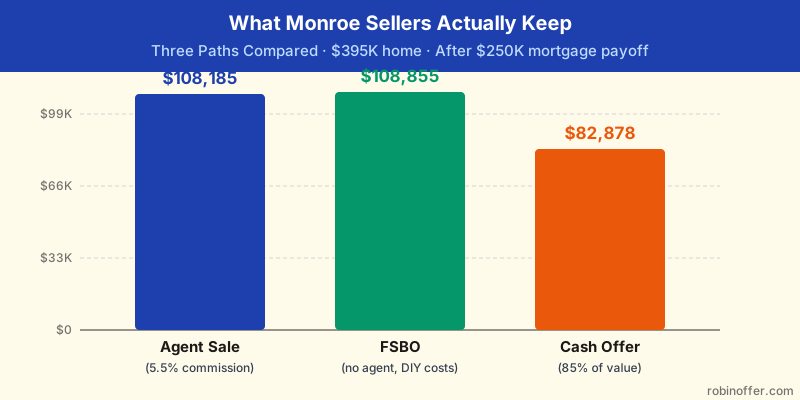
Here is the net proceeds comparison for a $395,000 Monroe home across three selling paths. These numbers assume a $250,000 remaining mortgage balance. Your numbers will differ based on your mortgage, your sub-market, and the specific terms of your sale.
| Category | Agent (5.5%) | FSBO | Cash Offer (85%) |
|---|---|---|---|
| Sale price | $395,000 | $385,000 | $335,750 |
| Commission | -$21,725 | -$9,625 (buyer agent 2.5%) | $0 |
| NC excise tax ($1/$500) | -$790 | -$770 | -$672 |
| Attorney + title fees | -$900 | -$1,000 | -$500 |
| Inspection credits | -$5,000 | -$5,000 | $0 |
| Prorated taxes | -$1,700 | -$1,700 | -$1,700 |
| Staging / prep | -$2,500 | -$1,500 | $0 |
| Holding costs (2 mo.) | -$4,200 | -$6,300 (3 mo.) | $0 |
| Gross proceeds | $358,185 | $359,105 | $332,878 |
| Mortgage payoff | -$250,000 | -$250,000 | -$250,000 |
| Cash in hand | $108,185 | $109,105 | $82,878 |
The FSBO path and the agent path produce nearly identical net proceeds in this scenario — $109,105 vs $108,185 — because the FSBO home sells for $10,000 less but saves on listing commission. The cash offer path nets roughly $25,000 less at $82,878 — that is the price of speed and certainty. Whether it is worth it depends on your specific situation.
This math changes significantly at different price points. On a $220,000 south Monroe home, the agent commission drops to $12,100 but still represents 5.5% of a smaller pie. The cash offer discount (15% to 20%) means you are leaving $33,000 to $44,000 on the table, which may be all of your equity. At this price point, the FSBO path becomes more attractive because saving even a 2.5% listing commission ($5,500) represents a larger share of your take-home.
On a $500,000 western Monroe home, the cash discount is $75,000 to $100,000 — a number that only makes sense if your carrying costs are severe or you literally cannot wait. At this price point, the agent path almost always wins because the buyer pool is deep, the days on market are short, and the commission is a smaller share of the value created by professional marketing and staging.
Want the net proceeds for your specific home?
We build a net proceeds comparison across agent listing, FSBO, and cash offer paths using your Monroe address and neighborhood comps.
13. When Selling Gets Complicated: Inheritance, Divorce, and Foreclosure in Union County
Not every sale is a lifestyle choice. Some Monroe homeowners are selling because life forced their hand. Here is what you need to know about the three most common forced-sale situations in Union County.
Inherited Property
If you inherited a house in Monroe, your first step is probate through the Union County Clerk of Court at 400 North Main Street (704-698-3100, Clerk Wendy Maynard). NC probate filing costs $120 plus 40 cents per $100 of personal property and proceeds of realty sold by the estate (capped at $6,000). Note: the $120 flat filing fee only applies if the house is NOT sold through the estate. The NC creditor window is approximately 3 months.
NC partition law matters when co-heirs disagree about selling. The current statute is Chapter 46A (not Chapter 46 — it was recodified by S.L. 2020-23, effective October 1, 2020). Under §46A-21, any cotenant may petition for partition. However, actual division is the default and sale is the exception. A court may order a sale only by finding that division "cannot be made without substantial injury to any of the parties," and the burden is on the party seeking the sale. The court must also consider whether owelty — a cash adjustment — would cure the injury. Heirs' property receives additional protections including a right of first refusal.
For a complete walkthrough of the NC inherited property process, see our guide to selling inherited property in North Carolina.
Divorce
NC is an equitable distribution state, which means marital property is divided fairly (not necessarily equally). The family home is typically the largest marital asset. Common options include: one spouse buys out the other, both agree to sell and split proceeds, or one retains the home until children reach a certain age. On a $395,000 Monroe home with $250,000 owed, there is roughly $145,000 in equity to divide. Buyout financing requires the retaining spouse to qualify for a new mortgage on their income alone. If neither spouse can refinance alone, selling may be the only practical option.
See our guide to selling during divorce in the Carolinas for the full legal and financial framework.
Foreclosure and Financial Distress
Union County had 261 foreclosure listings as of mid-2026, with Monroe accounting for approximately 121 of them — including 42 active foreclosures, 144 pre-foreclosures, and 23 sheriff sales. NC uses a power-of-sale foreclosure process that is faster than judicial foreclosure. From first missed payment to sale can be as short as 120 days, though the typical timeline is 4 to 6 months.
If you are behind on payments, you have options before the process runs out. Loan modification restructures your payment to something you can afford. Forbearance pauses or reduces payments temporarily while you recover from a short-term hardship. A short sale — selling for less than you owe with lender approval — lets you exit without a foreclosure on your record. Selling to a cash buyer before the foreclosure process completes lets you capture whatever equity remains and close on your timeline rather than the court's.
The key is timing. In month two of missed payments, you have every option on the table. By month five, you may be limited to a cash buyer who can close before the sale date. The difference in outcomes between acting early and acting late can be $30,000 or more in preserved equity.
NCHFA (NC Housing Finance Agency) operates housing counseling programs for NC homeowners in distress. The HUD counselor locator at hud.gov/findacounselor can connect you with free foreclosure prevention assistance. If you are behind on property taxes specifically, see our NC property tax lien timeline guide. For homeowners who want to sell a home that needs significant repairs — the $40,000 roof and HVAC quote on a $220,000 home — see our guide to selling a house as-is in North Carolina.
14. Five Paths Side by Side: What Each Option Nets a Monroe Seller
Here is every major selling path available to a Monroe homeowner, compared on the metrics that actually matter: time, cost, risk, and net proceeds.
| Factor | Agent Listing | FSBO | Cash Buyer | Rent It Out | Stay and Renovate |
|---|---|---|---|---|---|
| Timeline | 60–120 days | 90–180 days | 7–21 days | Ongoing | 6–12+ months |
| Sale price (% of value) | 97–100% | 92–98% | 80–90% | N/A | 100–110% after reno |
| Commission | 5–6% | 0–3% | $0 | N/A | 5–6% when you sell |
| Repairs needed | Varies | Varies | None | Tenant-ready | $15K–$80K+ |
| Carrying cost risk | Moderate | High | None | Monthly cash flow | High |
| Best for | Move-in ready, time | Market-savvy seller | Speed, distress, as-is | Equity play, no urgency | Long-term holder |
| Net on $395K (est.) | $108K | $109K | $83K | $11K/yr cash flow | Varies |
The right path depends on three variables: your timeline, your home's condition, and your financial situation. If you have a move-in ready home in western Monroe and 90 days, list with an agent — the buyer pool is deep enough to support full-price expectations. If you have a south Monroe home that needs $25,000 in repairs and you cannot or do not want to invest that capital, a cash buyer eliminates the repair risk and closes in weeks. If you owe more than you can sell for, explore short sales with your lender before the foreclosure clock runs out. If you have equity, no mortgage, and no urgency, renting may produce better long-term returns — but run the math against the new apartment supply before committing to a 12-month lease with a tenant.
There is no universally right answer — only the answer that fits your situation. The worst decision is no decision: sitting on a vacant property while carrying costs accumulate at $2,100 a month is the most expensive option of all, and it is the one most Monroe homeowners default to when they feel overwhelmed by choices.
For a detailed analysis of the best timing to list in the Charlotte metro based on seasonal data and carrying costs, see our guide to the best time to sell a house in the Carolinas.
15. Monroe and Union County Contacts for Home Sellers
These are the Union County and Monroe government offices you may need during a home sale. All URLs and phone numbers were verified at the time of publication.
| Resource | Contact / URL |
|---|---|
| Union County Tax Office | 704-283-3848 · unioncountync.gov/taxes-property |
| Union County Register of Deeds | 500 N Main St, Monroe, NC 28112 · 704-283-3843 · Crystal D. Gilliard |
| Union County Clerk of Court | 400 N Main St, Monroe, NC 28112 · 704-698-3100 · Wendy Maynard |
| City of Monroe Tax Office | 201 E Windsor St, Monroe, NC 28111 · 704-282-4517 · monroenc.org/Tax-Information |
| Monroe Planning & Development | monroenc.org/New-Projects · kmendler@monroenc.org |
| Union County Property Tax Rates | unioncountync.gov/tax-rates-and-fire-fees |
| NC Housing Finance Agency | Foreclosure prevention counseling · nchfa.com |
| HUD Counselor Locator | hud.gov/findacounselor |
If you want to see the numbers for your specific Monroe home — what an agent listing would net, what a cash offer looks like, and how the holding-cost math works for your situation — we will run it for free. No obligation. No pressure. Just the math.
You can also explore what your home is worth using our home value estimator, or browse all of our homeowner guides for more city-specific selling advice across the Charlotte metro.
If your home is in nearby Concord, Charlotte, or Indian Land, we have dedicated guides for those markets too.
This guide is for informational purposes only and does not constitute legal, financial, or real estate advice. Market data is current as of September 2026 and is subject to change. Consult with a licensed professional for advice specific to your situation. Guide written by CC Evans, Founder at RobinOffer.
Want a cash offer on your Monroe home?
Share your address and timeline and we will get you a no-obligation cash offer — free, no pressure, just the math.